Recognizing her daughter’s intelligence, Keller’s mother sought help from experts including inventor Alexander Graham Bell, who had become involved with deaf children. Ultimately, she was referred to Anne Sullivan, a graduate of the Perkins School for the Blind, who became Keller’s lifelong teacher and mentor. Although Helen initially resisted her, Sullivan persevered. She used touch to teach Keller the alphabet and to make words by spelling them with her finger on Keller’s palm. Within a few weeks, Keller caught on. A year later, Sullivan brought Keller to the Perkins School in Boston, where she learned to read Braille and write with a specially made typewriter. Newspapers chronicled her progress. At fourteen, she went to New York for two years where she improved her speaking ability, and then returned to Massachusetts to attend the Cambridge School for Young Ladies. With Sullivan’s tutoring, Keller was admitted to Radcliffe College, graduating cum laude in 1904. Sullivan went with her, helping Keller with her studies. (Impressed by Keller, Mark Twain urged his wealthy friend Henry Rogers to finance her education.)
Even before she graduated, Keller published two books, The Story of My Life (1902) and Optimism (1903), which launched her career as a writer and lecturer. She authored a dozen books and articles in major magazines, advocating for prevention of blindness in children and for other causes.
Imagine that, no, and she was written off by a majority of society — a woman, deaf and blind.
And now, 2023? Where would Keller stand? Syria, Vietnam, Libya, Yemen, USA, the constant build up military might, the proxy wars, the 20 years in Iraq? Imagine that, even now, we write off people even after all the Americans with Disabilities activism, the Eunice Shriver’s of the world and Special Olympics, inclusion in schools, all the special education. But socialst, radical, anti-war? Death to Helen, 2023?
In 1909 Keller became a member of the Socialist Party; she actively campaigned and wrote in support of the working class from 1909 to 1921. Many of her speeches and writings were about women’s right to vote and the effects of war; in addition, she supported causes that opposed military intervention.
And yet, and yet, there are other sides to Keller:
Many hearing people, Marxists included, are familiar with Helen Keller in one of two ways. Either we see her as the wild child rescued from the prison of deafness and blindness through the heroic efforts of her “miracle worker” teacher, Anne Sullivan; or as the butt of cruel “Helen Keller” jokes. Neither image bears any relation to the actual, politically active Deaf/Blind woman whom that nearly mythical child became.
In these texts, she explains how she came to Revolutionary Socialism after her graduation from college. Despite her reliance on intermediaries to communicate with the outside world, Comrade Helen Keller is fully her own person.
Helen Keller became a member of the Socialist Pary in 1909 and by 1912, she had become a national voice for socialism and working class solidarity. Her articles and speeches take on a harder edge as the war machine gears up and the reformist tendency in the Socialist Party forced a split with its revolutionary wing. We can see her calling for party unity in 1913, and then breaking publically with reformism and siding wholeheartedly with the IWW in 1916 and taking up the struggle against President Wilson’s hypocritical war machine .
Helen Keller’s work for the cause of socialist revolution continued through the years of the First World War up until 1921. She had been long active in efforts to reduce the causes of blindess and provide relief for the Blind. With the collapse of the Socialist Party’s commitment to revolution and the on-going persecution of the IWW, Keller lost her connections to the workers movement and became increasingly isolated among reformers and government bureaucrats who did not share her political perspectives.
Her own self image was that of a Blind woman who also could not hear. Helen Keller never learned the sign language of the North American Deaf community. Instead she had English sentences manually spelled into her hand and then vocalized her responses. This effectively cut her off from the largely working class Deaf population whose native sign language has a grammar all its own. Blindness at that time often meant unemployment, whereas Deaf workers were integrated into the largely non-English speaking ranks of manual laborers. One can only wonder what might have been if Comrade Keller had found a place in the ranks of politically unorganised Deaf workers in the heady years of the late ’20s and ’30s.
Sadly, her legacy among Deaf and Deaf/Blind people today is one of opposition to their native language rights. Her name stands for the dominance of spoken English over American Sign Language. This is due to her family’s early contact with Alexander Graham Bell and his campaign to wipe out manual communication in favor of the oral education of the Deaf. Her legacy in the larger hearing world today is one of the saccharine sweet triumph of the individual over personal adversity (with the help of a determined educator-hero). Gone is her call for international working-class solidarity and her clear revolutionary vision. Hopefully, this small archive will go some way to recapturing her socialist legacy for the Deaf, Deaf/Blind and hearing workers of the world. (source)
Yeah, there is an FBI file on her. What a world, what a world.
Now, I am thinking about mortality, for sure. I have been around a lot of interesting folk, people who are considered disenfranchised by the beautiful people, but alas, really, in my work in developmental disabilities, I have seen, as an employment specialist, many situations where I did not have to harp on the fact that people living with intellectual-developmental disabilities have the same aspirations of wanting independence and a job and some worthy place in society. Because: well, many of the store and business owners and managers and hiring honchos they themselves have a family member living with a developmental disability.
So, yes, one thirty-eight year old woman, paralyzed from the neck down, and non verbally communicative, got a job after fitted with a specialized chair and machine that she could use with her tongue, to take tickets at a movie theater, and the tongue-mouth computer allowed her to give the movie goers salutations and even recommendations of the movies playing in the 16-theaterplex.
And yet, and yet, so many people I have run into who think drug abusers and highly impacted individuals who are physically, mentally and psychologically damaged from a bad beating or from alcohol in the womb, that those people do not deserve all these government programs and services. Many have said they would love to put a drug-addict into his boat, with a chunk of cement chained to the waist, and let him go and be useful: crab pickings.
I kid you not!! And, we know, that at least drug users are many times drug dealers, and this is the crap and misanthropy we have to absorb daily from the likes of them all, including Trump:
Donald Trump’s White House plans to stop deaths from opioid abuse by putting more drug dealers to death.
The Trump administration is rolling out its plan to solve the opioid crisis Monday, when Trump is expected to visit Safe Station, a drop-in facility for opioid users seeking help and treatment, in Manchester, New Hampshire.
And according to administration officials, part of the plan will be to tell prosecutors to “seek the death penalty against drug dealers when it’s appropriate under current law.”
You know, all those freaks in American politics looking up at Singapore for lashings and harsh prison sentences. Utah lawmakers are pushing for the firing squad to come back. Oh, 2023! This is the way of the misanthrope:
Singapore resumed executions in March 2022, after a two-year hiatus. According to local activists, there are an estimated 60 inmates on death row, most of whom are for drug-related offences. The 64-year old Nazeri bin Lajim has been scheduled for execution by hanging on July 22, 2022. This is the 9th execution scheduled this year, just shortly after the State carried out a double execution on July 7, 2022. VICE World News followed his family in May 2022 to find out how the capital punishment inflicts the condemned individual and those closest to them.
And so that’s one way to deal with sickness:
October 10 is the World Day Against the Death Penalty, a day when people around the world speak out together to condemn this punishment for what it is – a brutal sanction that violates the right to life. More than half the world’s countries agree with them. But a minority of countries do not, going to great lengths to justify their continued use of it. Among the many justifications they use is that the death penalty deters drug trafficking.
But is the death penalty really the answer to drug crime – or any crime, in fact?
Drug offences can still get you the death penalty in over 30 countries.
If you’re convicted of a drug-related offence, you face the death penalty in more than 30 countries around the world. A drug offence can include anything from trafficking heroin to being caught carrying a small amount of marijuana. So far in 2015, China, Indonesia, Iran, Kuwait, Malaysia, Saudi Arabia, Sri Lanka, the United Arab Emirates and Viet Nam have all sentenced people to death for drug-related crimes. (source)
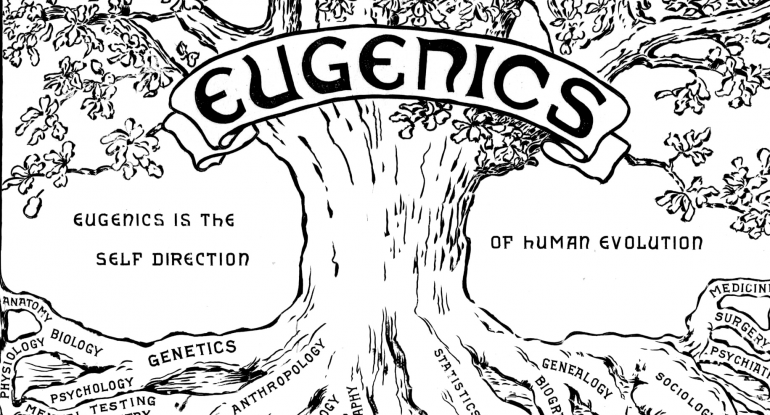
But again, eugenics for people born with DD-PD-ID or severe physical disabilities: Sterilization is one of the most frequently chosen forms of contraception in the world; many persons who do not want to have children select this simple, safe, and effective means of avoiding unwanted pregnancy. For individuals who are mentally disabled, however, sterilization has more ominous associations. Until recently, involuntary sterilization was used as a weapon of the state in the war against mental deficiency. Under eugenic sterilization laws in effect in many states, retarded persons were routinely sterilized without their consent or knowledge. (old source)
Thirty three states had forced sterilization laws on the books.
Gov. John Kitzhaber formally apologized Monday for Oregon’s past eugenics law that led to the forced sterilization of hundreds of people.
Girls in reform school, people in mental institutions and poor women selected by welfare workers were among the more than 2,500 Oregonians subjected to sterilizations under a law that stood from 1917 to 1983.
“To those who suffered, I say the people of Oregon are sorry,” Kitzhaber said during a ceremony in the governor’s office. “Our hearts are heavy for the pain you endured.”
He is the second governor to atone for state eugenics laws after Virginia Gov. Mark Warner, who also erected a memorial in May to the first woman sterilized under the policy.
Among the dozens of people who crowded into Kitzhaber’s office for Monday’s ceremony was Velma Hayes, 68, who was sterilized at age 15 while living at the Fairview Training Center, a state-run institution for the mentally ill and retarded.
Hayes called the state’s acknowledgment of wrongdoing “long overdue,” but praised Kitzhaber’s effort to make things right. (source)
“I want to thank you for taking the time to apologize,” Hayes told the governor. “Your apology is appreciated and accepted.”
Not everyone was satisfied. Ken Newman, 61, who said he was given a vasectomy without his consent when he was a teen living at Fairview, said the governor’s remarks don’t erase what happened.
“I want more than an apology. I want to be compensated,” Newman said. The law was based on the pseudoscientific movement that sought to prevent people considered “unfit” or “defective” from having children. After 1967, the Oregon law was chiefly used to sterilize those with mental illness or mental disability.
But I started this short diatribe around visiting the Oregon Health Sciences University in Portland. Visiting my wife’s mom’s husband, her step-father. He’s 78, and he was diagnosed July 2022 with Glioblastoma Multiforme. It is a death sentence: Glioblastoma (GBM), also referred to as a grade IV astrocytoma, is a fast-growing and aggressive brain tumor. It invades the nearby brain tissue, but generally does not spread to distant organs. GBMs can arise in the brain de novo or evolve from lower-grade astrocytoma. (source)
Now, the fellow opted for brain surgery in July, but unfortunately, after radiation and chemotherapy, he couldn’t get off the toilet last week, and so they went in and gut into the brain. He has advance medical directives stating he wants all measures to deal with a fatal disease. He wants to be resusitated in the event of a heart stoppage.
Now, these are personal choices, and the intervention the second time only allowed the surgeons to get 70 percent of the cancer, as any futher in the 6 hours under the knife might get to that part of the brain that would leave him, well, in a coma or worse, virtually locked in a body that couldn’t do anything, including talk and move arms, what have you.
Until we have reached this level, in 1990: Remember those Death Panels?
Saying they can no longer afford the costly miracles of modern medicine, Oregon officials today announced the centerpiece of a plan to begin limiting medical services for people whose health care is paid for by the government.
After months of public debate over life-and-death questions, the Oregon Health Services Commission made public the main tool for their program: a list of 1,600 medical procedures, ranked by computer according to a formula that balances their costs against how many people would benefit.
Proponents describe the plan as a pioneering effort to balance limited government money against the potential for extensive high-cost, high-technology medical care. But critics say the state is entering the realm of judgments that are best left to patients and their doctors.
Oregon is poised to become the first state to make decisions on health care in a way that gives priority to preventive care. Such policies are already the practice in some countries, such as Britain, whose National Health Service sets up strict limits on patients’ access to specialists and sophisticated medical treatments.
Later this year, Oregon’s Legislature will decide where to draw a line across the computer list. Those ailments and injuries below the line will not be covered by the Medicaid program, which is jointly financed by the state and Federal governments. Conditions above the line will be fully covered.
The Oregon plan would not reduce coverage for the aged, disabled and the blind. All Medicaid coverage to those groups, no matter the procedure, would continue as before.
By eliminating a handful of expensive operations, Oregon officials say they may be able to nearly double the number of people receiving some coverage under Medicaid. About 130,000 Oregonians now receive some Medicaid care.
Oregon Draws Praise
”The miracle of medicine has outstripped our ability to pay for it,” said Richard Lamm, former Governor of Colorado and a longtime critic of current national medical payment practices. ”Somebody has to have the guts to say what policy brings the most good to the most people. Oregon is the first state to face up to it.”
About $600 bilion was spent from all sources on American health care last year.
Ranking near the top Oregon’s new list of ailments and injuries are such things as bacterial meningitis, bone cancer, multiple sclerosis and acute headaches.
But the list does not necessarily reflect the suffering that a particular disease can inflict on a human being. Thus, several other ailments – thumb sucking, for instance – are high on the list, not because they are the most painful or serious but because they are easily treated at a relatively low cost and affect a large number of people.
Among the diseases ranked near the middle are agoraphobia, cystic fibrosis and certain kinds of arthritis.
Near the bottom of the list, and likely to be dropped from Medicaid coverage, are treatments for chronic ulcers, sleep disorders, viral herpes, varicose veins impacted teeth and sex-change operations.
Detection and prevention of AIDS are high on the list, but treatment for advanced acquired immune deficiency syndrome, when a patient is close to death, is near the bottom.
How It Was Done
The list, which may still be changed later this year by a legislative committee, was drawn up computer. It is based on a ranking produced by a computer under a formula involving the cost of care based on the current Federal standard for the treatment in the Medicaid program, the length of time before the ailment would recur and the health of a patient’s after-treament – what Oregon officials called ”the quality of well-being.”
The list was put together by a panel of doctors, consumer advocates, health care administrators and medical-ethics experts. They were faced with such choices as whether a $100,000 organ transplant may be less valuable than regular tests for breast cancer.
Before Oregon can proceed with changes in its Medicaid coverage, the state must get a waiver from the Federal Government. Skepticism about the endeavor has already been expressed by one key member of Congress, Representative Henry Waxman, a California Democrat who is chairman of the House subcommittee that governs Medicaid.
”If they can cover more people, I’m all for it,” said Mr. Waxman. ”But I don’t think we ought to fool ourselves into thinking there’s a lot of fat to cut from coverage of the most vulnerable people.”
Debate Dates to 1987
The Oregon Legislature’s health committee was ordered by the full Legislature to draw up the list after the state cut off Medicaid funds for organ transplants in 1987. At the time, state officials decided to concentrate their medical funds on such things as prenatal care.
The decision spurred a debate over where the state’s portion of Medicaid could best be spent.
”We think this will have a devastating impact on the poor in this state,” said Craig Irwin of Portland, whose mother, Kay Irwin, was denied Medicaid funds for a liver transplant two years ago. The operation was eventually done and paid for by a hospital in San Francisco.
”I don’t consider transplants wasteful,” said Mr. Irwin. ”They’re expensive, but they save lives.”
Public Sentiment Heard
The Oregon list reflects sentiment from more than 50 community meetings in the last year. In the hearings, prevention of illness and early detection were ranked much higher than operations that may prolong the lives of the gravely ill, according to a state study of the meetings.
”We picked up a very strong feeling from the general public that the American system pays too little attention to illness prevention,” said Dr. Michael Garland, a bio-ethicist who is president of a group that sampled opinion in the last year. ”The cost of health care is increasing at a rate that is unsustainable, and people want to put the brakes on somewhere.”
Some consumer groups, which were initially skeptical of the Oregon plan, have hailed the Oregon list.
”Nearly 60 percent of all medical procedures are unnecessary and inappropriate,” said Ellen Pinney, head of the Oregon Health Action Campaign, a consumer coalition. ”If this list draws us closer to identifying what those operations are, it’s a big boost.”
Proponents of the plan say the list, which ranks health care by priority, may eventually be used in all Medicaid programs.
”This is a strong dramatic step toward universal access of health care,” said Representative Ron Wyden, Democrat of Oregon. ”I think this is going to be copied everywhere.” (NYT — May 3, 1990)
So, the priorities then are to feed the war machine, to feed the tax abatements and tax giveaways and outright subsidies for all the banks-chemical companies, you know, the MIC, military-chemical-pharma-ag-mining-oil-gas-education-media-prison-transportation-building-Chamber of Commerce COMPLEX.
That was thirty-three years ago, and I was a journalist, newspaperman, and we talked about that in Texas. And, we are no where close to any sanity now, any humanity now, anything of a cultured, smart and giving society, for-by-with-because-in the name of WE the people.
One disaster after another. One paycheck away from eviction and foreclosure and sacking. This is what has occurred on steroids, supercharged, since 1990: the eviceration of agency and humanity, until we have the dog-eat-dog world of rabid canines going after we the people. Fines, tolls, tickets, repossessions, fees, add-ons, taxes, excise, VAT, until we are truly paying just to breathe.
So, one man’s decision to live another month or two, well, it is selfish from many people’s points of view. Having a child or fostering many with develomental disabilities is selfish to many. The system that looks at homelessness, chronic addiction, all the crime, big and small, the offenders in the criminal injustice system, yep, many fascists want them taken out the Singapore way.
This mass psychosis and mass Stockholmd Syndrome and massive general anxiety disorder, and this collective amnesia and then now, actually hating 1.3 billion in China and hundreds of millions in Russia, Mexico, Iran, wherever, this is the script being played out . . . after centuries in this shit hole of land theft and seeding blankets with disease and hangings and forced internment and, well, you get the picture of a totally karmic dead culture.
Oh, priorities. Train derailments. Palestine, Ohio, and Dioxin poising. Love Canal, fenceline communities, cancer alleys, persistent organic compounds, volitle organic compounds, factory farms, feedlots from hell, poisons in our food, soil, air, water. All of the attacks on the fetus, the child, the sick and the weak.
This is the standard for a fascist society, where both red and blue, mean on the outside and mean on the inside, this duopoly, this sick schizophrenia — hating Russians and wanting to invade Mexico, all of it, this is a decayed and cancerous system, capitalism but also nuclear submarine/gunboat un-diplomacy.
This is the thuggery of Americanos, and forced sterilization, and forced pollution thrust onto poor communites, these sacrifice zones here and throughout the world, all part of the Dirty Capitalism of Fascism and Inverted Totalitarianism:
This research focused on the health status of fence-line communities defined as those adjacent to industrial facilities. Previous research has shown that the longer a population is exposed to high levels of pollution, the more deleterious its effect on the health of fence-line communities. The populations in fence-line communities also typically consist of low-income minorities and present health disparities. Study findings were that fence-line communities demonstrated high rates of premature death, greater number of unhealthy mental days, and COVID-19 death rates. The differences in death rates for Blacks and Whites were staggering. The risk of COVID-19 death for Blacks in the 11-parish study area ranged from 1.5 times to 11.4% higher than Whites. Fence-line communities are an example of environmental injustice and the effects of slow violence from air pollution. (source)
So many countries are America’s fenceline sacrifice zones. (source)
This is just in one state, so multiple it for all states, and then countries:
There are 10 million people in North Carolina, and 9 million hogs. Judging by the smell, the hogs are winning. Or, rather, the giant corporate factory hog farms are. Hogs are the largest agricultural product of the Tarheel State, adding at least $2 billion to the economy there. How the hogs are raised and slaughtered, and how the waste is handled, is making life miserable for many North Carolinians. Billions of gallons of pig feces and urine are collected in lagoons, mixed with blood and rotting pig body parts. To keep these fetid ponds from overflowing, the toxic liquid is pumped skyward with enormous spray devices, aerosolizing the waste, which is carried away by the wind. Neighbors suffer indescribably bad odor and an array of illnesses. The notoriously regressive Republican majority in the North Carolina statehouse has passed a bill—H.B. 467, Agriculture and Forestry Nuisance Remedies—to protect the factory hog farming industry from liability, which the state’s recently elected Democratic governor has yet to sign—or veto. In the meantime, impacted communities, mostly African-American, are fighting back.
Choices? This is the reality of Capitalism — no parent wants plastic in their child’s feces or pig feces in atomized form in their lungs. There are no choices in this economic and commercial fascism.
How much more medical intervention can a 78-year-old afford? And this father in law is religious, so I am not sure why he’s not opting out for a decent cocktail of drugs and pain killers to ease him into the passing?
High level thinking means we have to look at the causes and the effects, the origins of decisions and medical therapies, and the psychology of individuals and the collective. We have to understand what was the option before these medical interventions. The toll on families, loved ones, society. We do not have these higher level thinkers in K12, and we discourage that higher order of thinking, and that solutions gathering discourse, and open dialogue and deep learning and advanced critical thinking and critical feeling: pushing our brains to other higher order levels of thinking—helping us move beyond remembering and recalling information and move deeper into application, analysis, synthesis, evaluation, and creation.
I can put myself into this father-in-law’s shoes, but I do not think he has even after 78 years on the planet, the ability to do that deep dialogue with us, his surgeons and with himself.
I taught for more than 40 years variations on the theme: Higher order thinking, or “HOT” for short, takes thinking to higher levels than restating the facts. HOT requires that we do something with the facts. We must understand them, infer from them, connect them to other facts and concepts, categorize them, manipulate them, put them together in new or novel ways, and apply them as we seek new solutions to new problems. Following are some ways to access higher order thinking.
Yet, oh yet, here we are, and the society is in decay, and a few beautiful people and elites rule the 80 percenters, us, even those of us with a higher level of thinking about now, context, competing and contradictory concepts, about history, about systems, and systems thinking and about baselines and shifting baselines.
Are we sort of in this consumerist and retail and consumption-based society in a classic vegetative state? Emotionally arrested? Stunted? Raw and fight-flight-freeze cultivated?
Oh, goddamn, you know my answer if you have read my “stuff” over time, over the years. And where is the best place for lawyers and billionaires and hedge funders and Wall Streeters and Lords of War, and how many circles of hell are there now for today’s new breed of Machiavelli and Eichmann and Edward Bernays and Ayn Rand?
A good start, indeed!!
Inflammed, man: Raj Patel and Rupa Marya, the authors of ‘Inflamed: Deep Medicine and the Anatomy of Injustice’, on building an economy focused on care
Rupa: The colonial project was really enacted through the missionaries, the medics and the militaries – medicine played a role in asserting the dominance of colonial forces in other people’s territories.
It was not interested in keeping all the native people healthy and optimizing their wellness. It was interested in keeping the colonizers healthy, so that they could continue to extract the wealth and dominate those people in their lands. When you really understand that, you’re not surprised when you see that Black women have a 12 times mortality rate than white women in the postpartum period in New York City. You understand that, okay these are remnants of thoughts and understandings that have really shaped the structures of modern medicine today – part of the violences are embedded into the frameworks and the institutions and the way that the culture recreates itself.
When we think about words, like the ‘non compliant patient’, doctors interrupt their patients within 11 seconds on average of encountering them. We don’t tend to think: is our patient the expert in their body through their lived experience in their own body with their disease? Doctors who focus on narrative medicine in history taking, can most of the time find out what’s wrong with somebody within 95% of the time by just really listening and asking the right questions and listening to how a person reveals the story of their illness. And then asking some more questions about what’s going on around the body. What are the sum of the exposures from that person? What are their histories, their ancestries? What kind of traumas are they carrying through generations? How is that impacting the cellular function of the immune system?
So all these things are much more intricately tied to the web of life around them. As a practicing doctor, we were used to thinking of the immune system as something that fights off invaders – again, like a very colonial us versus them dichotomy, this Cartesian Dualism that is really a part of our understanding whether it’s in medicine, or how we address ecology right now. These enlightenment era fallacies continue to pervert the way we’re able to understand what we’re seeing in front of us. So those ways of seeing were how I learned about the immune system. But as we studied and read for our book, I started to understand that the immune system is actually our harmonizer with the world around us. So if the world around us is toxic and damaging, the immune system responds with damage, and trying to remediate that damage, sets off its own cycles of more damage inside the body which is registered as chronic sterile inflammation.
But if the world around us is in balance – ecologically, socially, politically – then the immune system harmonizes with balance. So to just focus on each individual and say, Oh, you just need juice and this probiotic pill and get some more exercise and sleep better – misses the whole point, because you can’t actually get better health outcomes until you start working on the level of restructuring the world around our bodies. And that is not something any individual can do. That is something we must do collectively, and is happening right now collectively, and those are the stories that we have lifted in the book.
–Egalntyne Jebb, founder Save the Children a century ago.
We can celebrate and ruminate on any day of any month, and April is one of those months that have milestones and remembrances vital to me, and important to tens of millions.
I’ve written about National Poetry Month before for the New Times. This celebration of poetry was introduced in 1996 and organized by the Academy of American Poets as a way to increase awareness and appreciation of poetry in the United States.
For me, way before this recognition, I was deeply steeped into poetry – creative writing, too. A poet is a creative, a writer, and that person is more than someone like Pablo Neruda, Chile’s famous poet. For my own tutelage, poetry also means advocating revolution.
I was in Nicaragua in the 1980s, and I certainly embraced this revolution against the thug dictator. Some call this Sandinista rebellion as a revolution of poets: Ernesto Cardenal, Mejía Godoy, Sergio Ramírez, Gioconda Belli, and Rosario Murillo, currently the Vice President and First Lady of the country.
Someone who is almost my contemporary, Omar Cabezas Lacayo (born 1950 in León, Nicaragua), is a Nicaraguan author, revolutionary and politician. He was a commander in the guerrilla war against Anastasio Somoza and prominent Sandinista party member. His personal account of his time as a guerrilla fighting the dictatorship, published in Nicaragua, is entitled, “Fire From the Mountain.” I heard him read in Managua almost 40 years ago.
However, my introduction to poetry came from one side of my family, Scots, a grandmother, aunts and uncles living Ayr, the home of Robert Burns (1759-1796), Scotland’s national poet. I was 18 months of age with my family in Ayr absorbing recitations of Burns.
Burns came from a working family, unlike most of Britain’s men of letters. “Tam O’ Shanter” is Burns’ poetic masterpiece. The climax is a witches’ Sabbath, attended by all kinds of gruesome sights. And pride of place in this hellish scene is given to lawyers and priests:
“Three Lawyers’ tongues, turned inside out,
Wi’ lies seamed like a beggar’s clout;
Three Priests’ hearts, rotten, black as muck,
Lay stinking, vile, in every neuk.”
Many wonder how Burns’ poetry ever succeeded since he had no formal training; he managed to produce the finest lyrical poetry that ever emerged from these Isles. Burns’ lyricism is written, not in English, but in his own tongue, the dialect of the Scottish Lowlands. His song is as natural as the woodlark’s.
So many great writers have entered my mind, heart and imagination. I was a freshman at the University of Arizona (1975) in poet Richard Shelton’s class whereupon he recruited some of us to head up to the Arizona State Penitentiary for writer’s workshops he facilitated, with convicts behind bars. His book, “Crossing the Yard: Thirty Years as a Prison Volunteer” (2007), is more about Shelton’s professional fulfillment and a testament to the transformative power of writing for him, as well as the prisoners.
I hearken back to Walt Whitman (1819-1892), our own American poet (essayist and journalist, too). He was a humanist, and he worked as a stretcher bearer in the American Civil War. He embraced the power of transition — between transcendentalism and realism, incorporating both views in his works. For many, he is the father of free verse. Whitman on being a poet:
This is what you should do: love the earth and sun and the animals, despise riches, give alms to everyone that asks, stand up for the stupid and crazy, devote your income and labor to others, hate tyrants, argue not concerning God, have patience and indulgence toward the people, take off your hat to nothing known or unknown or to any man or number of men … re-examine all you have been told at school or church or in any book, dismiss what insults your own soul, and your very flesh shall be a great poem.
April 22 is traditionally tied to Earth Day, which I have been a large part of as organizer in several locales, including Spokane. This celebration of our web of life started in 1970 with the amazing book by Rachel Carson, “Silent Spring,” as the bible of environmentalism.
But then, April 30 also is another date, the starting date of the Fall of Saigon (1975) with the defeat of American forces in Vietnam. I was there in 1994 and 1996, and in 1995 I organized a 20th Anniversary look back on “Vietnam” where I put literary, visual, cinematic and theater arts front and center for this month-long event sponsored by dozens of groups, including my two schools – UT-El Paso and El Paso Community College.
The poets looking at war, the Vietnamese, the trauma and the country stirred me to action.
While I never met Carson or Whitman, I did spend time with Denis Levertov, who was an ardent supporter of poetry of protest. With Muriel Rukeyser and several other poets, Levertov founded the Writers and Artists Protest against the War in Vietnam. She took part in several anti-war demonstrations in Berkeley, California. In the ensuing decades she spoke out against nuclear weaponry, American aid to El Salvador, and the Persian Gulf War.
I go to a Vietnamese poet, Thanh Thao, from his poem, “A Soldier Speaks of His Generation” (1973) as a capstone of this opinion piece with my drumbeat concussing why poetry is so important:
They are so very young
as they flicker along on the stream
into a faraway meadow
on an endless evening.
They’re the people who came first
twenty years ago as one generation
and also the ones who will come later,
twenty years from today.
That evening
on the small canal
artillery attacks and flowing water.
How clearly you can see
the faces of
our generation!
+–+
Existential Crisis
I’ve been closely tied to poets — the term also hits close to home, as in writers in general — and the potential for change through language. Today, so-called poets wrie insipid junk about Zelensky, about a new Churchill or David! Here, one piece on Bly:
Each of his poems puts a chink in the armor of the war makers. Robert Bly’s Friday night appearance at SFCC will be part touchstone for peace and part riling-up of the audience to bear witness and take action.
Bly, a preeminent American poet whose 80-year-old voice and intellect have helped to sculpt an important vision of literary art and cultural reclamation, will speak as part of Spokane Falls Community College’s “Lit Live!”
While Bly is a sought-after voice of reason and lyrical charm, his poetic pulse has been stimulated by a life alone, working far from the rarified atmosphere of college or university settings. His roots are in Mansfield, Minn., and in the furrows of hard-working immigrants where his reverence for land and people germinated.
Translator of such great poets as South America’s Pablo Neruda, Cesar Vallejo and Antonio Machado, India’s Ghalib, Spain’s Lorca and Jim & eacute;nez, and Norway’s Rolf Jacobsen and Olav H. Hauge, Bly’s output of articles, essays and criticism is matched by his more than 40 books of poetry.
Enwrapped in solitude, Bly spins ruminations shaped by other cultures, other poets — as in “Meeting the Man Who Warns Me”:
I dream that I cannot see half of my life. “I look back, it is like the blind spot in a car./ So much just beyond the reach of our eyes, what tramples the grasses while the horses are asleep, the hoof marks all around the cave mouth…/ what slips in under the door at night, and lies exhausted on the floor in the morning.
Also slated for the Music Auditorium stage on Friday night are four male drummers, pounding animal skins as a tribute to “the wild man” in Bly’s Iron John. His 1991 book examines the dichotomy between Savage Man, who is both wounded and inflicts wounds on earth and humankind, and Wild Man, the shaman-healer, Zen priest or woodsman. In Iron John, we have a book about men and the lost energy of visions, fairy tales and the male drumbeat of power and depth. It’s a book of healing and reaffirmation of soul.
Bly also helped redirect the creative surge of Modernism’s influence on poetry by unraveling his words and lines into what Victoria Frenkel Harris has called “incorporative consciousness.” Bly believes that the poet or creative thinker must go “much deeper than the ego … at the same time [becoming] aware of many other beings.” In a sense, he believes that “leaping out” of the intellectual world and into what we intuitively hold as our own realities best explores the paradoxes of two worlds: the world of our psychic pain, and the world in which we must adjust to observing the rules.
Bly came to prominence during the Vietnam War era — a time that tore at the psychic integration of American culture. He recalls how controversial his work was then: “Most of the English teachers in the universities hated our doing ‘political poems,’ as they were called. That still happens,” he recently said about those heady days of the ’60s. “When I’m at a reception at a university these days, an English professor may come up to me and ask: ‘How do you feel now about those poems you wrote during the war?’ They want me to disown the poems. I say, ‘I’m sorry I didn’t write more of them.'”
Bly, along with David Ray, created the group American Writers Against the Vietnam War. The first important protest volume was A Poetry Reading Against the Vietnam War (1966), edited by Bly and Ray.
In one of his poetry collections, The Light Around the Body, Bly cast a beacon of hazy light upon the symbiotic relationship of poverty and racism and the country’s involvement in the Vietnam War.
But now, in 2006, with the stink of Abu Ghraib and Falluja still enveloping Mr. Bush’s war, Bly speaks with singular impetus in his recent work, The Insanity of Empire: A Book of Poems Against the Iraq War. “The invasion of Iraq is the biggest mistake any American administration has ever made,” he says. “The most dangerous and greatest confrontation is between twentieth-century capitalist fundamentalism and eleventh-century Muslim fundamentalism,” he writes.
For aficionados of the poetic form, The Insanity of Empire embodies both Bly’s disdain for immoral governments and Bly as an the artful practitioner of the ghazal, an Arab poetic form:
I don’t want to frighten you, but not a stitch can be taken/ On your quilt unless you study. The geese will tell you/ A lot of crying goes on before the dawn comes.
SFCC’s literary publication, Wire Harp, and the endowment for Lit Live! will not be the only beneficiaries of Bly’s incantations on Friday night (50 percent of the gate goes to the endowment). Conscious Living — a local business that creates events including the annual Celebrating Body, Mind and Spirit Expo and A Psychic Affair — is partnering with SFCC.
As a reminder of Bly’s continuing relevance, consider that he’s an anti-war activist of long standing. In the Dec. 9, 2002 issue of The Nation, Bly was one of the first to beat the earth drum against the impending war, in his poem, “Call and Answer”:
Tell me why it is we don’t lift our voices these days/ And cry over what is happening. Have you noticed & r & The plans are made for Iraq and the ice cap is melting?/ I say to myself: “Go on, cry. What’s the sense/ Of being an adult and having no voice? Cry out! See who will answer!”
+–+
But in 2023, the rot has flooded almost all people in the Western world. Censorship, the New Blue McCarthyism, and unimagineable crimes supported. This existential crisis for me is around cohorts who call themselves “poets” but who are navel gazers, looking at their folds of skin over time and waxing about getting old. Fine, that perspective, for sure, but in the past 40 years, and now, breakneck speed since the Planned Pandemic, and now, the Proxy War, and the Trump Years, and the Russia Ain’t at the Gate madness, my so-called fellow writers have fallen flat.
They do not look at the depth of how messed up the world is — poverty, land theft, murder incorporated in all parts of the world, those 800-plus US military bases, the ungodly hundreds of trillion$ dollars thrown at war lords, war dogs — but instead go into themselves, look at the raven in the sky and the time ticking off around their sagging eyes.
Political poetry? Great dervishes of pain calling out the entire cabal of capitalist killers.
Two dozen of Paul Haeder´s Vietnam photos are on display at the Community Building.
Paul Haeder traveled to Vietnam in 1994, taking about 6,000 photographs.
This week has been a time for reflection and discussion of our country’s involvement in Vietnam. The collective event called Vietnam War Remembered consisted of literary readings, films, panel discussions and a photography display.
“It’s a tribute to the people that fought and the fact that our country seems even today to be healing,” said Paul Haeder of the Gonzaga English Department, organizer of the event. “I think it strikes some raw nerves in people.”
Haeder was 18 years old by the end of the Vietnam War in 1975, but he felt the impact in many ways. “I was an Army brat,” he said of his experience during his father’s 32 years of service in the military.
During the 15-year war he even saw some of his older friends drafted.
“A lot of my friends have been messed up by that war,” Haeder said. “They’ve never been able to climb out of that foxhole.”
After the war, many soldiers fell into substance abuse, found themselves homeless, or developed post-traumatic stress disorder.
The country as a whole was troubled. Often soldiers did not receive a warm welcome home. Opposition to the war was strong. As the first televised war, the ravages of Vietnam were brought straight into American homes.
Rusty Nelson, president of Spokane Veterans for Peace, thinks the war was wrong. “I am amazed that people still try to glorify what the United States did in Vietnam or that they would honor me because I fought there,” he wrote in an e-mail. “My perspective is that I was given medals and recognition for the ugliest things I ever did.”
It was because of some of the ugliness they saw in Vietnam that some Americans were apprehensive about the recent war in Iraq. Many protesters adopted the slogan, “We don’t want another Vietnam.”
“[The Vietnam War] was an extravagant investment of money and human life to make Southeast Asia safe for United States corporations to exploit natural and human resources,” says Nelson.
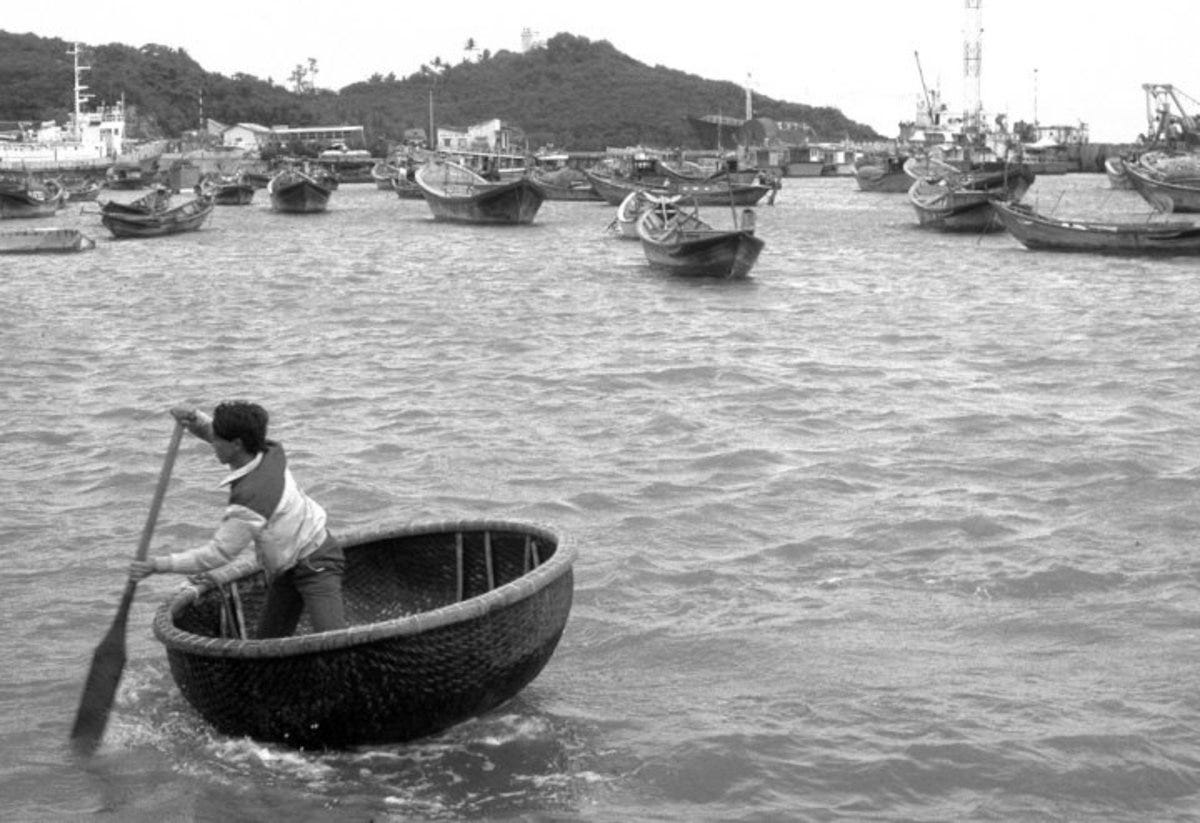
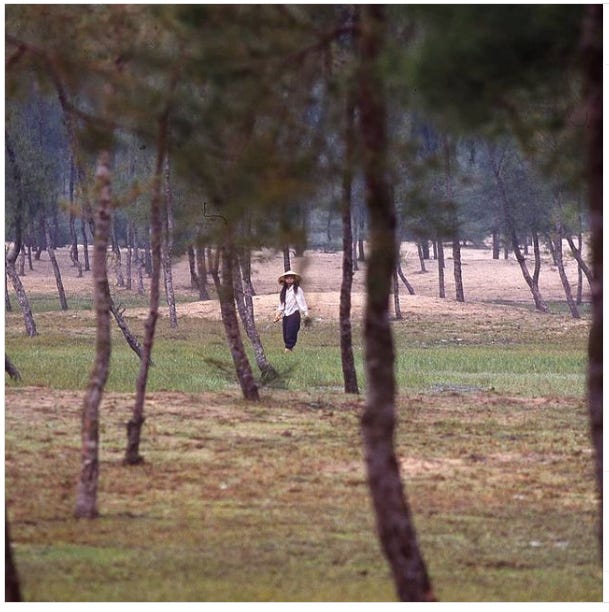
The war brought into question the issues of chemical and biological warfare and the rapidly evolving technology. In 1994 Haeder traveled to Vietnam to perform biodiversity studies with the World Wildlife Fund. When the studies were complete, Haeder traveled the country from border to border, taking about 6,000 photographs, two dozen of which were displayed for this week’s event. The photos will remain on display at the Community Building, 35 W. Main, for three weeks.
His color photographs capture the spirit of villagers old and young.
“They had so much respect for America and for me,” expressed Haeder. They wanted to know what America thinks, he said. In other photos street scenes, rice fields and forested landscapes put a person in the heart of Vietnam.
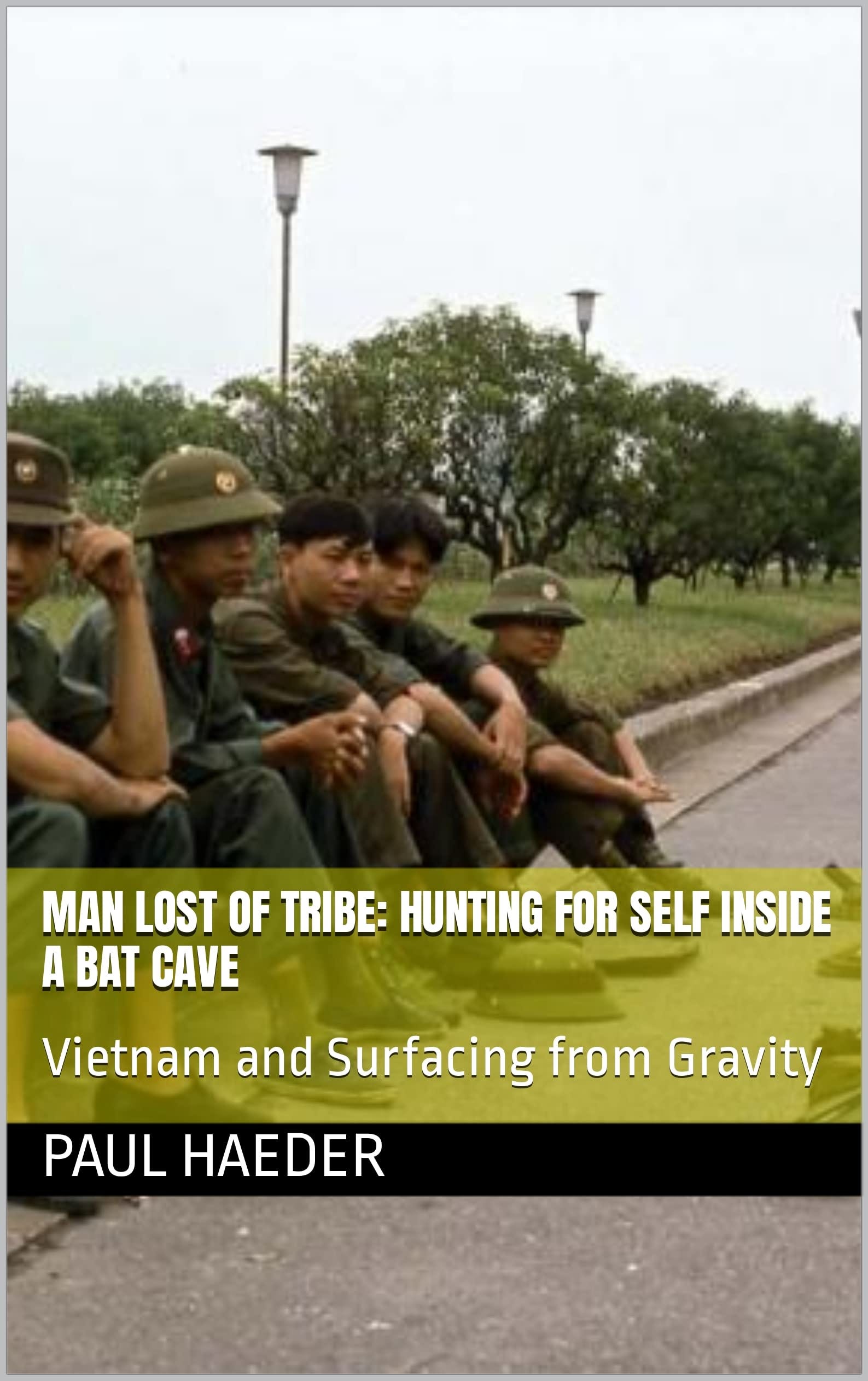
Shots such as those of a bright orange butterfly or a vibrant green snake show some of the country’s wildlife while a photo of Vietnamese soldiers resting before a monument to Ho Chi Minh is a more direct response to the war.
Upon returning to El Paso in 1995, where Haeder taught at a university, he organized a similar event reflecting on Vietnam. The larger-scale event was even commended by The New York Times.
This first-time event in Spokane started Oct. 20 with a showing of the Oliver Stone film “Heaven and Earth,” which follows a Vietnamese woman as she grows up in Vietnam, experiences war as a teenager and marries an American soldier.
Tuesday, a literary reading featured veterans Dan Webster of The Spokesman-Review and Michael Holmes and poetry reading by English professors Tod Marshall from Gonzaga, and Connie Wasem, from Spokane Falls Community College, as well as Haeder.
Vietnam like a leech inside my guts, slowly growing, waiting to expurgate right before truth hits my amydgala like a hollow-point uranium-tipped US of A projectile.
Di di Mao I & Ra khỏi đây II
Di di Mao – young guy named Hal with M-16
Di di mao Get out of here, boy, emaciated like a walking zither, legs shanked by B-52 metal chopsticks for arms Di di mao now, boy, so I get some madam boom-boom
Di di mao Go on, get out of here, leave me in my bivouac tethered to M-16 and howling Credence Clearwater Budweiser and Castle Rock cheeseburgers
Di di mao Black-toothed auntie your sack of bones weighted by bamboo shoots eyes rimmed by leeches you hiss when I drive by you twist up like roots — red exclamation point for tongue
Di di mao frozen refrain each zip from my bloated cheeks zip-zip-zip from Mattel’s automatic carbine white horizon courtesy of DuPont dioxin defoliant orange noon thanks to DOW napalm, white phosphorus, caldrons percolating into my bone
Di di mao get out of here now, Charlie, bequest your sisters and wives, we are masters of the flesh sweaty carcasses lurching for our all-American pursuit of happiness
Di di moi swollen delta where water buffalo undulate in their gases, heat from F-4 Phantoms — with jaws of a great white shark — rattle elephant tusks.
*–* *–*
Ra khỏi đây – Boy with Dog in Rice Basket
my rainforest is purity horn bills sail through mists where my elders follow our joss stick incense trails vines like tendrils to heaven, the slog and muck and verdant forest sings songs of genuflections to dead brothers and mothers
ra khỏi đây, get out of here now pulpy-flesh mastodons go back to your refrigerators T-bones and French fries find your leaders placate your lip-less gray kings who are mean with their green wads go, find them and ask why you are running into our shadows
ra khỏi đây recede into your choppers smoky trails lead back to your land of garish light your churning chugging citizens purge from your jet planes like sunburned bovine — leave me to my lotus blossom, my empty stomach my sister who is like an apostrophe agile, sudden fragile, but with a bomb
ra khỏi đây get out of my Hue, where my monks self-immolate on the banks of the Perfume River, butterflies flutter into memory — watch my grandmothers throw your C-rations into the river your photographs of lip-cinched sallow men fleshy children balloon pin-up girls float in a river of fire
ra khỏi đây we are pleasant in our stone age — our mosquitoes like black lace wet-skinned tigers lurch after barking deer vine snakes like liquid titanium civets watch kingfishers who spear frogs like my Viet Cong sending pongee stakes wet into your hearts . . . .
ra khỏi đây . . . di di mao.
Pretty simple stuff, even for a 66-year-old, 2/6/57, struggling, for fucking sure, in this punishment society, a culture pushing as many of its elderly and youth into the proverbial debtor’s gutter. It doesn’t matter to the controllers – teen, happy-go-lucky newly wed couple, 50-something, pensioner, kicked to the street, to the endless line of scraps, prayers to the money god, to the devils who evict, shut off gas-water-electric, to the white smocks and their big pharma and med industrial seven chambers of hell complex. Maybe the tipping point sliding beyond the beyond happened the moment we blew away any sanity and began playing the domino game about Vietnam. One tile falls, and the rest go, what, socialist, communist, antithetical to the corruption of capitalism, each tile falling, going, gone?
Resistance in the Womb – Vietnam Is in My DNA—Paul Haeder
Vietnam like a leech inside my guts, slowly growing, waiting to expurgate right before truth hits my amydgala like a hollow-point uranium-tipped US of A projectile.
Emiliano Zapata, more than some cut-out historical lie created by the controllers, the historians, the directors and producers.
I quote:
I want to die a slave to principles. Not to men. If there is not justice for the people, let there be no peace for the government. It’s better to die on your feet than to live on your knees.
Vietnam like a leech inside my guts, slowly growing, waiting to expurgate right before truth hits my amydgala like a hollow-point uranium-tipped US of A projectile.
There is no calm in America, this bloody July 4th, the gusto of a flagging, intellectually flaccid nation of killers, toned and full of IT hipster cool, those engineers and technocrats surfing in the California dream as they build the silicon master parts and the electronic nets that are the killing instruments of capitalism.
They await another bit of hubris and flatulence from the Spielberg and Bruckheimer types to the 10th power, blockbuster pathos a la propaganda, maybe coming soon from one of those chosen few studios to screen in one of the chosen few’s theaters: Lies about Vietnam, about Panama, Malvinas, Fallujah. The drama of our times is death and lies and unfathonable cunning. I remember all the hype about the foolish film, Saving Private Ryan, while one of my favorite directors, Terrence Malick, came out with his great anti-war film, The Thin Red Line – almost 20 years ago.
It’s the Vietnam of Full Metal Jacket, Platoon, Born on the Fourth of July, Apocalypse Now, Deer Hunter, Heaven and Earth. Imagine the books, Paradise of the Blind, The Sorrow of War, Scent of Green Papaya. Gut, really, this country is perverted, war and poisons, in the air and over the air, a pandemic of the consumer lie, infecting ever corner of the world. War criminals Bush-Clinton-Mrs. Clinton-Obama-All-Those-Israel Firsters. Think about Blair, pestilence that is allowed to breathe the same air as human beings.
Vietnam, the plague of the white Christian-Hebrew race, machinations, psy-ops, billions traded for gluttony and pleasure with arms and armaments.
Not another Vietnam . . . Not Another Vietnam on this Empire’s watch. Words uttered by Ford, Carter, Reagan, Bush A & B, Clinton, Obama, the rest of the universal replaceable parts to their controllers’ wars, skirmishes, dirty wars, battles, civil actions, coup d’etats, invasions, shock and awe’s.
Military glory–that attractive rainbow, that rises in showers of blood–that serpent’s eye, that charms to destroy…
~Abraham Lincoln
The welfare of the people in particular has always been the alibi of tyrants.
~Albert Camus
There are war criminals in colleges, as CEOs, in judicial positions, floating in their ether as media moguls; the entire system of capitalism is hinged on death and subjugation. There are criminals with more blood on their hands than the paid killers they sometimes call “warriors” they send to commit murder, and they look like Obama, like Kissinger, like Mrs. Clinton, like Bill Clinton, faces interchangeable, white/black/brown, Albright/ Rice/Gonzales, all of them, even the limp heads of Trump University or U of Phoenix. War criminals heading up the IT departments at any number of armament death companies. PhDs, engineers, software designers, all of them, holding onto the power of their wages, the vacations and bonuses, their children going to summer cello camp and soccer training retreats. Skiing and boating and slum tours and snorkeling with manatees and zip-lining in the Amazon. War criminals who never laced up a boot or hump a rucksack or touched an M-60 or grenade launcher. MBAs, JDs, software architects, doctorates in engineering . . . . War criminals, genuflecting at Easter, fasting at Lent and Rosh HaShanah . . . .
A thousand subsidiaries of the tooling companies – Lockheed, Boeing, Raytheon, General Dynamics, Northrop Grumman, Honeywell, HP, United Technologies, Bechtel, and on and on and on. The deliverers of death, of PTSD, permanent homelessness, continual war-war, depleted uranium, festering water systems, hospitals that have no air conditioning, lights, and life saving medicines, dumped into oceans. The DNA of America goes back to killing indigenous, killing with fire, muskets, smallpox, barbed wire, booze and shaved heads.
Imagine, the triple chins on Kissinger, Mrs. Clinton, Trump, their bad seed children giving birth to future bad seeds, all swaddled in the investor-renter-casino capitalism class that is responsible for more death and mayhem and global warming, global pestilence, global extinction than any and all the despots and warlords and sociopaths that have ruled their gold, their people, the people’s land, combined.
I am talking about PTSD with these rockets blaring, neighborhoods like war zones, friends who end up in corners, in closets, outside, shaking the death ghosts of Indochina like spiders in their heads, that delerium tremens of all wars, perpetrated by the Ivy League, Finishing School, MBA, Lobby Classless, leaches and ticks all of them, the black plague of debt like pandemics of dengue eating at the souls and future souls of the majority, us.
This war, Vietnam, or what the people of that country call, America’s War with Vietnam, defined me, since day one, really, 1957 the year of the rooster, my birth, or before, 1954, Battle of Dien Bien Phu, Ho Chi Minh ready for elections, Emperor Boa Dai assassinated by Ngo Dinh Diem who refused elections.
My old man was already working the intelligence sector of the first phase of the Vietnam War, 1959-’63. His boss, Dwight D. Eisenhower, stated, in 1954, “Nobody is more opposed to intervention than I am.” The white men are the liars, the false flag designers, plagues upon the war booty, victims, families on all sides, infinite and inter-generational PTSD. They are glib, get to triple-dip, retire with golf carts and skin cancers removed and quadruple by-passes after the Seven-and-Sevens are splashed on the ice of their veins.
We of course supplied bombs, munitions, bombers and pilots flying sorties over Vietnam for the French, advisers, bankers, funny-looking economic hit men, and my old man, before I screeched into the world, was working first with the Air Force on the cryptographic clandestine stuff for the US, and then later when he became an office in the US Army.
I remember as a three- and four-year-old kid listening to war stories from my family’s friends, special operations forces in both the Air Force and Army talking about the things they were doing in Vietnam . . . Thailand . . . Cambodia.
Bombs bursting in air, those Gatling guns, immense firepower, tsunamis of napalm, the entire shit show that is American and Western warfare. Of course, years later, as a journalism student, the first causality of war (now all warfare – cultural, racial, economic, environmental, educational, judicial) was and will always be Truth, as US Senator Hiram Johnson said in 1917 – “The first Casualty when war comes, is truth.” Taken to its journalistic elegance, Philip Knightley 60 years later published a book, “The First Casualty from the Crimea to Vietnam: The War Correspondent as Hero, Propagandist and Myth Maker. All expropriated from greater minds, someone like Aeschylus (In war, the first casualty is truth!)
So Ali is dead, the history, the revolt, the raw revolutionary force of Muhammad, the fabric of civil rights, Malcolm X, King, Black Panthers, dead; some semblance of anti-authoritarianism, something way beyond the here and now of US Patriot Act, Total Surveillance, the Zuckerberg-Google-Giving-It-All-To-The-Corporate-Man, gone.
Indochina, the lies, the cover-ups of Kennedy, Johnson, Nixon, Ford. The colonels and majors turned generals and thieves – Powell, Haig, Westmoreland, so many jumping, those interchangeable parts – wars in Central America, South America, Chile, entire continents, Africa. The gluttony of feeding frenzies for more and more money stuffed into all their orifices. . . . Then, five decades later, this pathetic thing called Obama. The scrubbing of history by the controllers. The project to disinfect America’s war with Vietnam, the eco-cide, the biological warfare, the assassinations, the napalm mornings, the entire shit storm that represents US of Armaments, the entire industries of death created by the Controllers, Financiers, in Iraq, overkill in Panama, anywhere that is not moved by USA shit culture or economic structural suicide, mowed down labor organizers, priests, students, nuns, teachers, clerics, environmentalists, grandparents search for the ghosts of children.
Mowed down by money. America’s claim to fame. A Trump of mafia casino fame, the Boss, fire for fun, or Clinton, secreted away to Goldman Sach’s alimentary canal for a million buck for the shit coming from her mouth. War Criminals, The Mrs. and the Donald Toupee . . . .
KATM . . . KATR . . . The alphabet soup of Murder, Inc. Kill Anything That Moves . . . Kill All That Resist . . . .
Any activist or resister or revolutionary could live and die by the boxer’s words, Ali:
Why should they ask me to put on a uniform and go ten thousand miles from home and drop bombs and bullets on brown people in Vietnam while so-called Negro people in Louisville are treated like dogs and denied simple human rights?
No, I am not going ten thousand miles from home to help murder and burn another poor nation simply to continue the domination of white slave masters of the darker people the world over. This is the day when such evils must come to an end. I have been warned that to take such a stand would put my prestige in jeopardy and could cause me to lose millions of dollars which should accrue to me as the champion.
But I have said it once and I will say it again. The real enemy of my people is right here. I will not disgrace my religion, my people or myself by becoming a tool to enslave those who are fighting for their own justice, freedom and equality…
If I thought the war was going to bring freedom and equality to 22 million of my people they wouldn’t have to draft me, I’d join tomorrow. But I either have to obey the laws of the land or the laws of Allah. I have nothing to lose by standing up for my beliefs. So I’ll go to jail. We’ve been in jail for four hundred years.”
But that is not how America flies now, as the scrubbing of all truth about the illegal invasions and the mass murdering of Vietnamese by America come to light. A celebration to last 13 years, this “thank you” to the veterans of the war on Vietnam by Americans is preposterous and asinine and Orwellian, all in one heavy lying breath to mark 50 Fucking Years of Illegal and Wonton Murder in Indochina. More than 10,000 companies (corporations, mostly) have put money into this project approved by Congress in 2012. It’s a pack of lies, a scrubbing of the real events and history of that criminal enterprise called America – from the “Celebration’s” Propaganda website: “to pay tribute to the contributions made on the home front” and “to highlight the advances in technology, science, and medicine related to military research conducted during the Vietnam War.” Wow, sick Little Eichmann’s and Josef Mengele’s, America is with all it’s Zio-Con and Puritan engines of profit firing on all 12 cylinders. You will not see a word on that Pentagon and Congressional tribute site any mention of the millions upon millions of peace activists and radical patriots fighting the scourge of the entire mess that was the corporate war we launched against Vietnam.

Sanitizing Malcom, MLK, Jr., Anything that attempts to move the people away from the lie factories that are part and parcel Occupation Corporate America. Billions made from that “war,” from the splat of children, the cancers of uterine hells, plowed-over towns, sprayed-upon vast millions of acres of land, the B-52s dropping bombs in veronicas of hate and precision onto orphanages, farmers, cities. The old starved of humanity from the invaders, and the families that lost loved ones. While Yankee Go Home drank, smoked, fornicated, murdered, shot-up with heroin, filled bellies with the calories of home airlifted to the jungle, and they laughed at the wounded, tortured, dredged the sky of heaven and torched Buddha and shrines and elephants, just for fucking fun, a Senator McCain said a thousand times as he belched on top of his prostitutes, young women sold into the covenant of capitalism USA style.
You are not supposed to write like this about this stuff, now, in 2016, words pressed so no blood is left, but just an empty string of marketing buzz words . . . . American killing Tuesdays and full of glee about all that collateral damage, a thing of necessity, but, heck, sorry, but what were those kids doing at that wedding party anyways?
The touchstone for me, 59 years and counting down, is a war, youth, that fanciful time, the moment when realization peaks, and the boy is not longer charmed by stories of great feats, stories of bombs bursting in air. The DNA code in me was to resist, revolt, oppose, and if I was now living today as a 10 year old, the diagnosis would be pure and swift delivered by the Mengele’s of Psychiatry and Perverted Medicine, those elites doling out prescriptions on how to cull defiance, strip discord, and all of it meted out by the compliant teachers and lovers of social engineering, mostly women now – in the education class, the social work class, those politically correct punishers who shop at Costco and paste on pastel highlights onto their ever-bloating faces.
The education class, now toeing the line and marching to the orders of the elite, a very small minority stuck in tribal and religious politics entwined with Capitalism with a big C. I understand the bending fabric of this country, my own brethren when I started teaching in 1983. This is not a country of Oaxacan resisters, Mexican teachers, who take it upon themselves to be the true voices of social justice not only for their children and students, but communities.
As I filed this installment of my anti-memoir, struggle, resistance, murder and resolve are taking place, the stage being rampant, rapacious capitalism USA style. Here, read where my heart is always:
Members of Coördinadora Nacional de Trajabadores de Educación (National Coördination of Education Workers, or CNTE), the largest teacher’s union in the country, went on strike to protest education reform passed by the current administration. Those reforms would — among other things — require teachers to take standardized tests to evaluate their qualifications.
Reforms would also end “normal” schools, government-funded teacher training schools that serve in rural and impoverished (and heavily indigenous) parts of Mexico, and which provide alternate paths to those who might otherwise grow up working in the fields. Normales have been around for a century, and historically are places people go to learn not just how to be teachers, but how to protest and challenge the government.
(The case of Ayotzinapa— the 43 teacher trainees who went missing in September 2014— involved “normalistas,”or students from a normal school in Mexico’s Guerrero state.)
The Mexican government has responded to the protests by first taking professors into custody, and then, on 19 June 2016, firing bullets and tear gas into a crowd in the Oaxacan town of Nochixtlán: “They were shooting at us as if we were animals”, William Velázquez, a 34-year old teacher, told FNL. He picked up a large stick. “These are the only weapons we have. We don’t carry guns. They were firing on unarmed civilians.”
There is no other way to put this – our country is a wasteland, vast and empty, a bubbling up Coke can in the hands of every man, woman and child, holding the stuffy toys of Disney and Speilberg, all the lies set up early on with the infantilization of adults as they trip along with children watching the most insipid stuff the masters and controllers spew out.
One world, one Disney-20th Century Fox-Netflix-Facebook package of lies, from cradle to grave. Imagine teachers in this country with any backbone stiffer than a squid’s fighting reforms of standardization, washing away teacher agency, generating one giant superficial triangulating set of lies produced by Pearson Publishing, LLC and the other one or two conduits of pacification and agnotology.
I found the same sort of resistance to my own resistance to the official narrative or history of this country, of the Vietnam war, to Ali, to anything remarkable about revolution and radical left thought in all the schools I was taught.
Today, the world is one compliant factory, a big tattletale world, mostly directed by women at lower echelons, driving the fight and resistance out of young people, young boys of color, anybody that might cross their narrative of following the rules and coloring in the lines.
My defining moment as a kid, since my old man was a professional soldier, as he called himself – 10 years in the Air Force and another 22 in the Army, coming out as a CW4, wounded twice in Vietnam, his own crytpography career tied to his intelligence, seeking a bachelor’s and accomplishing it when I was 10, in Heidelberg, and then a couple of masters degrees in many locales throughout his career, culminating at the University of Arizona. He was a history buff, and I fought him on the Vietnam War, fought the entire project of militarism and what it was like to be a military dependent living on posts and bases.
It’s a fifty-none year struggle, but there was an awakening, 22 and 20 years ago, when I floated into the gossamer of Vietnam, right when that first Clinton “normalized” relations with the USA, after 20 years after the Fall of Saigon. Here’s that story, a chink in the armor that is the plague of propaganda!

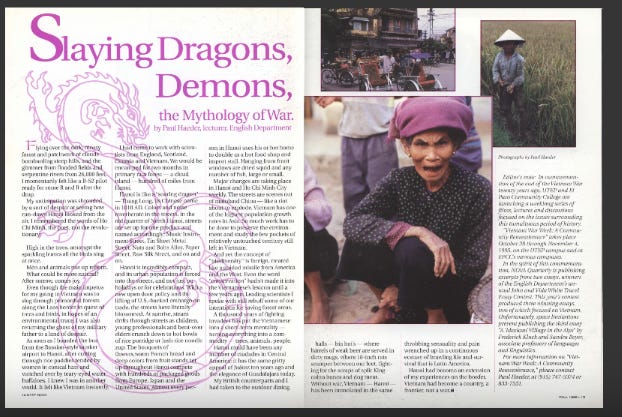
WAR AND PEACE IN VIETNAM
Flying into Vietnam 10 years ago brought back the phone call my family received that my father had been shot by the Viet Cong. That was 1969, and I was a 13-year-old fighting schoolmates because I didn’t support the war in Indochina.
Even before the cold announcement that my father had been severely wounded carrying cryptographic equipment in a Huey, I knew the United States was wrong to be in Vietnam. Something about the mythology of war, invisible dominoes, never repeating history.
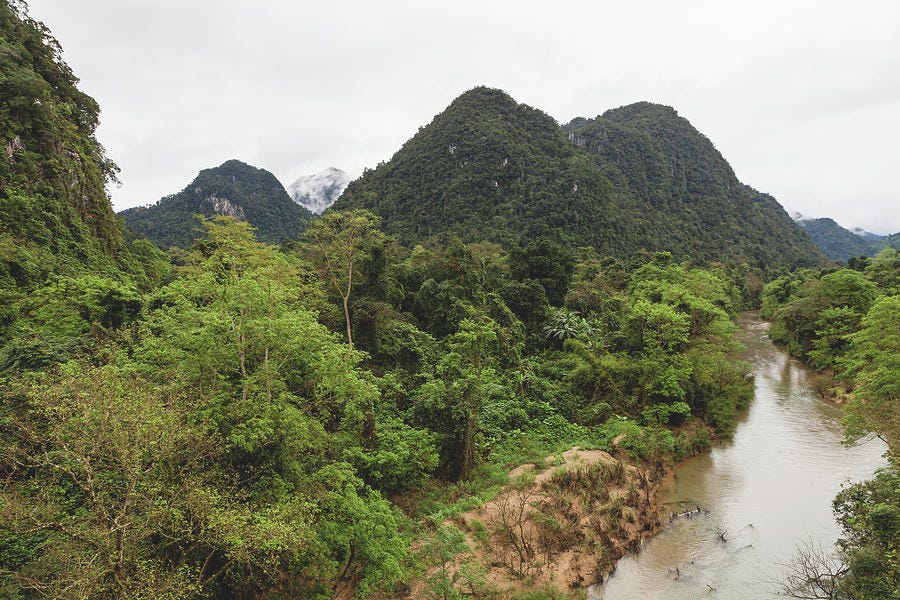
Now, flying over the mossy forest, a patchwork of clouds, and the glimmer from hundreds of flooded fields and winding rivers, I felt like I was about to drop into a dream.
The stiff green uniforms and yellow star on red background of the Democratic Republic of Vietnam suited the hard-faced immigration soldiers at Hanoi’s airport. There was panic in the air from mostly Vietnamese workers and businessmen deplaning from Moscow. Our group was scatterbrained from the long flights from London to Moscow to Pakistan to Hanoi. We were researchers being treated like tourists, our gear dragged by young blokes looking for hotel commissions.
Most of the Vietnamese on the streets hustling us for cyclo rides (three-wheeled pedaled push carts) and hawking imitation Swiss army knives, Rolex watches, Zippo lighters and U.S. dog tags were young men. This was a testament to one of the world’s highest population growth rates (2.5 percent) and to burgeoning under- and unemployment rates (40 and 20 percent). As soon as we boarded the bus, cutting through rice paddies tended by women in conical hats, surrounded by teary-eyed water buffaloes and frenetic ducks, I knew I was in another world.
It felt like Vietnam instantly. I could almost taste the explosives in the air.
Scientific expeditions into Third World locales evolve into a weird mix of wanting to be open to a culture and attacking it with these disassociations. With Vietnam, there was emotional baggage and the statistics of war:
2 million civilians killed in the north, 2 million in the south;
1.1 million military casualties; 600,000 wounded;
58,183 Americans (eight of them women) killed;
3,869 fixed-wing aircraft and 4,857 helicopters lost;
15 million tons of ammunition expended;
2,000 Americans and 300,000 Vietnamese missing in action.
So many millions of acres of rain forest and mangroves were destroyed. More than 6 million lives were lost from 1954 to 1975. America introduced the concept of “ecocide” — warfare on the ecology — that still affects each new generation with carcinogenic and mutagenic dioxin from herbicides in human breast milk.
But I hadn’t come to Vietnam to unload a war catharsis.
“The war against America has little relevance in the minds of the people today, as opposed to how people in the U.S. feel about it,” Gene Reddic, a copy editor in Hanoi with the Vietnam Investment Review, told me.
“They don’t live it everyday … the Vietnam war does not conjure up B-52’s bombing Hanoi, and they don’t see Americans as evil people,” he added.
I felt alone for much of the time I worked in Vietnam, and not only because I was the only American in a group of 23 British, Canadian and Vietnamese scientists.
It wasn’t separation from familiar surroundings that stirred the feeling, or the fact that we were bivouacking for three months in primary rain forest — a cloud island, really, and hundreds of miles from Hanoi, just a few clicks from Laos. The raw primal rain forest we had come to study as a part of an international biodiversity project wouldn’t account for the strange separateness I would be feeling. My isolation came from being an American in a sea of Vietnamese — more than 83 million of them in an S-shaped country the size of Italy but with a per capita annual income of just $270.
It has one of the world’s highest population densities for any agricultural country. And then there is the “onslaught.” The 1986 economic reform program, known as Doi Moi, or “open door,” has brought an incredible Westernization — not only of Hanoi’s storefronts, but in the mindset of the people who find themselves actually desiring Western capitalism.
There is almost a lust for the new life, with disregard for tradition, spirituality and the environment.
I felt like an intruder — big, burly, full of extra calories, my dollars gold. I was an American returning with my father’s ghost haunting me.
Many of us have the “secondary Vietnam aftershock”: episodes with friends who had been to Vietnam now self-medicating with drugs, booze, violence. I have taught Vietnam draftees at community colleges — students with faraway gazes who couldn’t cope with festering emotions. All the land mines at home.
“I have buddies who did the tunnel-rat thing, the deep jungle sapping,” said Brian O’Connor, a 42-year-old Ohioan who was swapping stories at the Apocalypse Now bar in Hanoi. “But you have to remember, most of the servicemen were not in combat zones. I had two tours, and I fell in love with Saigon — no bullets. Just the occasional knifing or bottle bomb.”
Almost 3.2 million Americans, including more than 7,000 service women, served in Vietnam during America’s one and a half decades here. Around 80 percent were rear echelon or support; less than 20 percent ever saw combat.
“It’s still something talked about in our schools in Germany,” said Petra Buchbinder, a 24-year-old German traveler and backpacker who has been working as an English teacher in Ho Chi Minh City (Saigon) and Hanoi. “Almost nothing about Hitler and the Third Reich, but much on the fire bombing and My Lai massacre. When I see Americans over here, I wonder if that one or this one fought here … and what they must have seen, or what dark horrors they carry with them.”
Buchbinder said after 18 months living in Saigon and Hanoi, she’s developed a “sixth sense” about foreigners. “I am 90 percent correct when I try to guess if he is American, if he has seen combat here.” It’s the look in their eyes, she insisted.
I had to press hard to get older folk — 40 or older — to talk about the war. In Hanoi, Hue and Vinh, people didn’t want to broach topics of combat duty or flights from carpet-bombing.
However, south of the Ben Hai River, the zone area along the 17th parallel that demarcated the war (DMZ), many spoke of killing Viet Cong. Others lamented how they had lost and been shuttled to reeducation camps set up by the communists after “the victory.”
Quang Tri, Cam Lo, Rockpile, Lang Vay and Hamburger Hill are just a few of the places these South Vietnamese fought at, places that saw bloody battles and ended up on television in America’s living rooms.
They had done hard labor in camps, and now they’re working the streets for big tourists to pay 50 cents for long rides on their cyclos. Others are street sweepers or sledging boulders.
I saw older women working on road gangs, hauling boulders and hot tar and baskets of sand. “The pro-Americans, the elite, or sympathizers were stripped of jobs, impoverished, received no education,” Reddic said. “Those that held land were basically evicted and singled out for reeducation.”
Because the north didn’t suffer as much from the Americans, compared to the south, a lot of tension exists between the north and south.
“The north fears the south breaking away. The south was more enterprising,” Reddic said. Of course, during the war, the U.S. government pumped in billions that built up infrastructure and provided capital for private and public works projects.
The war with America may have pitted the south against the north, but Vietnam has been at war with invaders for more than a thousand years. “The Vietnamese have a history of always protecting themselves, always throwing out the big guy. Like China, Japan, the U.S.,” said Tim Carr, a New York journalist who worked in Hanoi for two years.
An owner of three cafes — including the Memory Cafe, a hot spot for expatriates and foreign travelers looking for rental bicycles, motorcycles and tours around Hanoi — 37-year-old Tam Hang recalls B-52 bombing raids against Hanoi in the early part of 1970 and then three years later.
“I saw my aunt and uncle and friends laid out on the street when we were finally let out of the bomb shelter at school. There were thousands lined up and covered with sheets during just one attack. I still remember the sound of the bombs. I don’t forget the war, the smell of rotting flesh, but I am not against Americans,” Tam said.
Vietnam wants Americans back. This is true of the north, which saw some physical damage from American warplanes, as well as the south, which received the bulk of 13 million tons of bombs and tons of napalm and white phosphorus, as well as most of the 20 million gallons of Agent Orange sprayed on millions of acres of forest, cropland and mangroves.
When I was singled out of our group as an American, dozens of people, young and old, anywhere — in Hanoi’s old quarter at cobra and dog meat stalls, or at Buddha pagodas along the banks of the jade-tinged Perfume river in Hue, or in Con Cuong, an outback town full of loggers — would seek me out for handshakes and embraces.
They bowed and shoved to get a closer look. They measured my wrists and ankles. They stroked blond forearms hairs, bowed as if I held some prominence, and always laughed.
The younger ones wanted to know how much money I made; how much my diver’s wristwatch cost; why I was in Vietnam; what kind of car I owned. Others, older with war-weary eyes, tried in broken English or French to tell me their exploits. They secreted envelopes addressed to relatives living in the States and stuffed them into my pockets.
North Vietnam was victorious in the 15-year war with America, although “Uncle” Ho Chi Minh wasn’t alive to witness it.
Victory shows in crumbling buildings and ox-carts towing dung and human waste (night earth) for subsistence farms, and smoky Russian buses ferrying dozens of passengers crammed among blocks of tea leaves and live pigs and duck along Vietnam’s potholed roads built by the French and the United States.
Those first two weeks in and around Hanoi, we prepared to make the plunge into a bio-dome where rare Asiatic elephants, Javan rhinoceroses and a newly discovered species, a bovine called the pseudoryx, roam.
It was here where I was rushed with images of a rural country permanently sunk by “victory.” A country now overhauling itself daily, overloading itself with Japanese electronics and American clothing trends.
I was taken aside by expatriates who told me about yet-unexplored Buddhist temples. Surfers right out of the “summer of love” traced my maps showing me where the best waves where hitting China Beach. Vietnamese businessmen bought me syrupy, sweet coffee, pitching ventures for exporting jade or importing computers. Scientists making $50 a month asked me to send them Western books on entomology and taxonomy.
So many changes are taking place in Hanoi and Ho Chi Minh City weekly. The streets are a riot of bicycles, motorcycles and trucks. And time is running out to preserve the environment and study the few pockets of relatively untouched territory left.
And yet the concept of “biodiversity” is foreign, treated like a guided missile from the West. Even the word “conservation” barely made it into Vietnam’s lexicon a few years ago.
“You’d be in the same position if you exchanged shoes with us,” said Cao Vang Sung, deputy director of zoology and ecology for Vietnam’s Institute of Ecology and Biological Resources. “People need to cut wood for food and medicine. Biodiversity from your Western point of view forgets to look at the overall effects of a country’s living standard.”
I kept asking myself what I was doing here trying to collect data on this country’s mammals, plants, insects, ethnic minorities. It’s so poor, so backward, so unreceptive to outside help, so paranoid about foreigners.
A poet friend from Cleveland who had been a Vietnam vet put it best: “We spent so much time and money and lives to topple that country, and now Americans are going back 25 years later to help restore a country it helped destroy. It’s crazy, weird.” Schizophrenic.
“All these wars have put the Vietnamese into a short-term mentality … turning everything into a commodity — trees, animals, women and children,” says Reddic with a sigh.
I’m back at the Hatfield Marine Science Center in Newport Oregon, part of the Oregon State University campus harboring marine mammal-fisheries-benthic-ocean researchers and students.
The topic: How humans decimated whale populations through hundreds of years of industrial whaling, leaving some species and populations on the brink of extinction. But despite these impacts, many whale populations have made remarkable recoveries, demonstrating the ability of threatened and endangered species to bounce back from intense human pressure.
The presenter: Joshua Stewart, a new faculty member at OSU’s Marine Mammal Institute, PhD from Scripps Institute of Oceanography.
The running joke with Stewart last night was he WAS not Bradley Cooper, and so he let people know not to be too disappointed that instead of that overpaid undertalented Holly-Dirt guy (my phrasing) we were in for a presentation by a nerd, a passionate whale guy, and young at that!
He’s been focusing on the Southern Right whale and the Antarctic minke, but his interest is also around the many species of whales/cetaceans not recovering despite whaling and hunting of those species having been stopped decades ago.
The history of whaling as a commercial endevour goes back to the Basques, a thousand years ago, gooing after the Right Whale, so called southern Right whale. Then after a few centuries with simple boats, things got going, and in fact the Basques went for Northern Right whales with larger ships. They had a 500 year monopoly on commercial whaling.
The big push in whaling occurred in the 1700s, Nantucket, and that included the big ships of Moby Dick fame. Then, into the 1800s and 1900s the ships had steam engines, and alas the range for these whalers extended far and wide. Processing ships were introduced, with diesel engines and factories on board, and with the adevent of massive industrialization for the two “great” wars, the whalers got explosive harpoons and fast engines.
So, whereas for more than 700 years the blue and fin whales were too fast for the simple whalers, hence they were not being decimated by the whalers of that age. In the 1950s, however, as Stewart stated, more than three million whales were killed, which he calls the largest cull of wild mammales in the world. Many species became “commercially extinct,” i.e. the few numbers left in these species were not profitable enough for the big commercial operations.That included blues, sperms and fin whales.
I cut my teeth in the early 1970s on fighting whaling, that is, the commercial whaling tyranny. That effort globally — stopping whaling — super-charged the first Earth Day:
We are now 53 years later, and guys like Stweart, 35, is looking at declining whale populations, including the Southern Resident Orcas:
There are 73 (total) of these distinct salmon eaters left, and the issues around climate change, habitat degradation and their prey availablity play into any researcher’s tool chest. Many of these iconic animals generations ago were part of the live capture “industry” to supply killer whales to theme parks.
The issue around sea traffic, the noise from that traffic, the pollutants in that Salish Sea (Vancouver and Seattle area), the food stock (Chinook salmon) and climate change play into the degradation of the Southern Residents, as their offspring are coming out smaller, stressed, and a skinny whale triples the probability of dying in the first year of life.
There were around fifty of us there, March 23, and the auditorium allowed for the first time the beer and wine drinkers to bring in their libations. There were fellow researchers in attendence, as well as students, both graduate and undergraduate. As far as the public, it seems that most people going to these talks are associated with academia or marine research. As I point out time and time again — where are the K12 kids? This was a 6 pm event. Stewart’s slide show/Power Point was good, and he is young (he kept alluding to the fact he is doing research on the backs of oldtimers still working as researchers). This is an existential crisis in my mind. Having like minded, fellow marine wonks at an event is NOT enough in 2023. It’s barely anything, really. There are no outreach programs for K12 and families and fisher folk, and since this is after school hours, there seems to be no way in hell of getting high schools students who are interested in science and math and engineering in general to come out to these events. America is a cultural waste land, and one with dream hoarders ruling over the rest of us.
This is the echo chamber that is science, in my estimation. I can’t fault the students there from OSU, or the retired faculty or the active faculty, but this sort of event I have attended in the hundreds over the course of 50 years as a diver, then student of marine sciences, journalist, writer, educator and sustainability “wonk.”
There are no avenues now in 2023 built-in to go above and beyond, and surely, the happy hours/social hour from 5 to 6 pm could have been an hour where students got a little tour of the Hatfield which does have a public access educational center:
Yes, we have the Oregon Aquarium, a commercial marine park of sorts. And the Hatfield Visitor Center does get public attendance, but the K12 schools here in Lincoln county need to do outreach. We also need crab and fisher folk here to to have an open discussion with these wonky folk like Joshua Stewart who may or man not agree with the mitigation ideas, including limiting catches, closing seasons, biodigradable lines, and more.
Back to Stewart, AKA “not” Bradley Cooper: His work looks at the last two decades of declines with spring chinook salmon, through the San Juan Islands up to Vancouver Island. That’s an 85 percent decline in those salmon. As the orcas’ food stock, that means their lives are now in peril because of all those other factors, including food availability.
Here on the Coast we have the iconic gray whales, coming from breeding grounds in Mexico and Central America, making their way to the Arctic. We have whale watching as one tourist attraction, as the gray whales hang out here and push volumes of water into the sand to eat the anthropods that make small tubes as their feeding ritual. The only whale — a baleen whale, filter feeder, that is — which does this sort of feeding is “our” gray whale.
So, those gray whales, while in a state of recovery and delisted from the Environmental Species Act list, are still experiencing massive die offs, and the food they get in the Arctic is losing its own biomass, that is, the body weight has declined by one-third in the last fifty years.
So, like orca, gray whales are being studied now with drone photography, and the body shapes can be tracked over entire lifetimes. The lower the weight, the tougher it is on the individual and species in general.
Line entanglements are a big issue, as fishers use lobster and crab “pots” in the tens of thousands on our coast and east coast, with a buoy at the surface. Whales get entangled, and some live days, months and even a year with the gear in tow.
And, ship strikes are becoming a bigger and bigger issue not just on the USA’s coast, but worldwide.
Obviously, if there are more Fraser River spring chinook salmon, then there will be a healthier Southern Resident Killer Whale population. But fish stocks are decling, and so many other factors play into the marine mammals’ overall health worldwide.
Is it not curious, that so vast a being as the whale should see the world through so small an eye, and hear the thunder through an ear which is smaller than a hare’s? But if his eyes were broad as the lens of Herschel’s great telescope; and his ears capacious as the porches of cathedrals; would that make him any longer of sight, or sharper of hearing? Not at all. Why then do you try to ‘enlarge’ your mind? Subtilize it.
While gray whales were almost hunted to extinction, with 1,000 left, they have been delisted from the ESA — now estimated to be around 20,000 total population. However, researchers like Joshua are looking at these UME’s, Unusual Mortality Events.
There are so many issues that marine mammals face in this industrialized, highly toxic and waste heavy modern society. Lobster/crab gear entanglements are possibly a small problem when compared to the microplastic now found in the zooplanton’s, anthropods’ and the whale’s bodies. Add to that mercury and PCBs, and we have a triple toxic soup for the mammals.
We can imagine what the carrying capacity is for one whale species, and these researchers have “cool” jobs when they get to go out to sea and chase whales and tag them and photograph them and collect their feces, for sure. Here, yet another piece from my work attending these Science on Tap Hatfield events: Whales and People: A Tragedy! (note: you will see two live links referenced here in this story, which are now no longer available; I have a sneaking suspicion that the university’s thugs, PR spinners, got to the publisher of Discover Our Coast, to knock out all articles tied to OSU that I wrote!)
At the end of the talk, I asked Joshua to look at the glass half EMPTY. A few in the crowd were not happy about “ending on a negative note” (Yikes, this is academic in a nutshell). His biggest fear is climate change, which is warming seas, that is, where certain areas of the ocean are heating up faster than others. Sea ice is melting earlier and capping over later (according to the past 80 years or more data), and food stocks for marine mammals are become less and less.
This is the continuing story of extinction, and the supreme right of homo sapiens consumopithecus to rule the world, rule all species, and rule even a majority of our own species in this criminal and corrupting and colluding Capitalism. And, well, green washing and green pornography have taken center stage, man, in the so called sustainability arena. I was head of many sustainability initiatives. Here, a long time ago: Sustained Discussion And, from a standing column I headed up, Metro Talk: Facing uncertainty, the Inland Empire needs more than a global warming bucket list
So much work put into research and documentary making. But is it all echo chamber, now that the world is run totally by banks, hedge funds, Blackrock, Vanguard, Pharma-Media-Military-Congressional-Mining-Oil-Gas-Prison-Insurance-Surveillance-IT-AR-Digital Complex? Empty Nets, Emptying Oceans, Farming the Sea, and Soylent Green is People?
On a happy note, the crowd at Hatfield drank locally produced IPA’s, Oregon wine and locally backed pasteries. There was not mention of Greta’s honory doctorate from Helsinki, and Putin was not blamed for the the UME’s.
All was well at OSU, as if the world outside was outside of the bubble that is academia. Your choice, Stewart or Cooper!
Robin Waples: University of Washington (NOAA Fisheries, retired)
Topic: On the shoulders of giants: Under-appreciated studies in salmon biology with lasting influence.
In 1675 Isaac Newton wrote, “If I have seen further, it is by standing on the shoulders of giants.”
This idea epitomizes the way that science progresses by incremental steps, punctuated occasionally by major breakthroughs. But often it is the case that neither these ‘giants’ nor their research are well-known or even routinely recognized.
I discuss four such studies conducted in Oregon that have had a profound influence on scientific developments in salmon biology in subsequent decades:
1) a 1960s study of southern Oregon Chinook salmon that was the first documentation of what has come to be known as the Portfolio Effect;
2) a 1970s study of Deschutes River steelhead that was the first attempt to empirically evaluate genetic differences between hatchery and wild fish;
3) a 1980s study of family size variation in Oregon coho salmon that helped pave the way for entirely new lines of research; and
4) a 1980s report on age structure and relative fecundity for Oregon Coast Chinook salmon that provided crucial empirical data to help parameterize models of the rates of genetic drift and loss of genetic variability in Pacific salmon.
I attended the talk just to be in situ at this Hatfield Marine Sciences Center and see what this 76-year-old fellow had to say = Robert Snowden Waples, Jr., was born 18 January 1947 in Berkeley, California. He attended Palo Alto High School, where he excelled in swimming; he went on to Yale to major in American Studies and to swim, competing with the likes of future Olympians Don Schollander, John Nelson, and Mark Spitz.
He has been at the forefront of wild salmon (and now hatchery salmon) research. He has been cited more than 25,000 times, and he has plethora of articles, and he is credited with helping put ne teeth in the endangered species act for salmon wild species. That is, he and others worked on the varous genetic lines within species so they might get special categorization.
The ESA was set forth to bring a species to a status where it doesn’t need that endangered status. There are more than 50 percent of salmon species listed under the ESA.
The Bristol Bay sockeye salmon fisheries has been and up and down situation. There are 20 to 30 different stocks of Coho salmo, and with sockeye, resilency, representation, and redundancy are key to keeping this ecological area sustainable, Robin states.
While the talk was dry, and there were no photos or videos, graphics from Madison Avenue, he did his talk hoping the audience there was keyed into learning what his top four articles influencing him and the science of salmon research. first article he cited — “Biocomplexity and Fisheries Sustainability” concerning fal lchinook salmon on the Sixes River, OR.
Crazy science, including the slow work looking at adult returns using interesting criteria — fast to the ocean once hatched in home stream; a little time in the estuary after hatching; a lot of time in the estuary; a lot of time in home tributaries; yearlings staying in fresh water for a year.
What helps with survivability. While the 2, 3 , 4 and 5 year returns included mostly those in the third group = a lot of time in the estuary before maturing and heading to sea. This was done in 1965, without Google, the internet and so many other tools.
THe next article on Robin’s top four list includes looking atshutes summer steelhead and the genetic differences in growth and survival of Juvenile Hatchery and Wild Steehead Trout, salmo gairdneri.
The question posed in the 1970s research includes: What if there were no hatchery fish? That is, what would that effect be on wild fish? They call that hatchery supplementation since so many wild stocks (more than 50 percet) are endangered, in peril.
The research Robin goes over gets even more deep in terms of genetics and determining the status of coho salmo from WA, OR, and CA. That one was published in 1995.
Lots of work on wild populations and reproductive isolation and life history traied — they can be adapted to local areas.
He cited Valley Creek, near the Sawtooth mountains, where the salmon move from the ocean 900 miles away up to around 6500 feet in elevation.
Of course, the questions from the audience include what about the effects of climate change on salmon community. Robin says there are tons of studies on how salmon sustainability will be changed by warming land and ocean areas. The southern range will have a more difficult time. The northern area will see salmon expansion as the ice receeds and the water gets warmer.
The big questions around what sort of evolutionary changes can help them keep up. These are called evolutionary rescues, but he says warming seas might be too quick for that rescuing to occur.
Reduction in forests and those stream imperilment really affects salmon. Non-point source pollution is huge. More people are changing the land, through urbanization and agriculture. Rainfall and impervious surfaces add pollution loads. Robin states that there is great support for salmon, and most recent polls show 70 to 80 percent people want to work with salmon mitigation and are willing to pay more for salmon and be taxed, as oppopsed to the spotted owl, with only gets 10 percent backing for massive tax increases to save them.
While Robin is not a fan of techno fixes, he is for more streamside tree planting for shading the homes of salmon to lower water temperatures. And making sure water from rainfall gets back into the system clean.
He notes that trout have been put everywhere around the world (trout being a cousin of salmon), and he notes that steelhead and chinook have been put into Patagonia rivers starting a hundred years ago. New Zealand has also introduced Pacific salmon there.
Here’s the talk,
I got to talk with Robin for a few minutes. We talked about his American Studies degree, and how he taught English at the University of Hawaii. And what got him into the sciences. We also mulled over why there is such a disconnect from his and his fellow scientists’ research and the average person including the fisher people who live here in our rural community fishing for rock fish, shrimp, crab, halibut, and other species.
And the issue tied to K12 students NEVER being at these events. And, alas, the problem of higher education pushing MBA programs and programs around coding and software application creation.
I introduced him to some of my work, with David James Duncan, with David Suzuki, and Tim Flannery and dozens of other groups, including Save Our Wild Salmon.
PKH: Talk about writing, and young people trying to take a stab at writing as a career in a world of Flash videos and Internet messaging. We’ve got so much conglomeration of media – a majority of publishing houses in the USA owned by less than 10 corporations. And, the ungodly fact that the kids today in K-12 are averaging 10 minutes of outside reading a day. What can you say to aspiring young writers to stick it out?
DJD: To writers at the moment I would say, yes, it’s a struggle to keep our frail art form together, but hey, it’s a damned interesting time! Humanity is in the midst of a massive transition, so human communication is undergoing a transition. A tough-minded response to your question might be something like Robinson Jeffers’ line: “There is no reason for amazement: surely one always knew that cultures decay, and that life’s end is death.”
All human endeavor — including even our literature — is transitory. I’ve spent my life immersed in the myths, scriptures and bardic songs of the world — the best records of the best things human beings have said, sung and done for thousands of years. A little familiarity with this body of knowledge takes a lot of the stress out of living in a time of transition. The decline of literacy causes a lot of hand-wringing. But literacy is itself a recent human development — and a lamented development by the bards and singers of the oral cultures that preceded our literate one.
To learn to live with the earth on the earth’s own terms is more important to me than literacy. I lived on the Oregon Coast at a time when the most ancient Sitka spruce groves in the world were being converted daily into the L.A. Sunday Times. There was, in my view, nothing in the Times’ stories of that era that compared in beauty or import to the trees that were slaughtered to create the newspapers. The news those trees were emitting was something invisible, called oxygen. The news those trees published constantly was keeping the planet alive. We killed them in the name of literacy.
Paul: “A boat is more than an investigative tool,” Robert Kennedy said recently while on the Colorado, the threatened American icon. “It’s a reminder to the public that you own this waterway.” It’s pretty universal throughout civilization that there are laws of waterways stating that they belong to the people. Code of Justinian, Magna Carta, and constitution. Why have we allowed polluters, developers, and politicians to virtually destroy our connection to rivers and streams?
DJD: First off, I haven’t allowed any such thing, at least not directly. I’ve spent my life resisting polluters, developers and politicians who destroy waterways. And my connection to rivers and streams is a vivid part of my daily contemplative and recreational and economic life.
My downfall is as a consumer. The mistake the American people have made, from the very beginning, is to place faith and trust in an inhuman financial entity generally known as “the corporation.” Jefferson saw it coming. “I hope we shall crush in its birth the aristocracy of our moneyed corporations, which dare already to challenge our government to a trial of strength.” We did not crush the moneyed corporations. We enthroned them. And corporations are not human. They don’t eat, drink, or breathe, hence have no particular allegiance to clean food, water or air. They possess no beating heart or soul, hence fear no God, and no punishment for misdeeds in any kind of Hereafter. Corporations contain humans the way a cult, a sedative, or a TV contain humans. They dominate, “monoculturize,” dehumanize, mesmerize and misinform us, and make us pay and thank them for it.
Corporate transformation, corporate disempowerment, corporate accountability, corporate humanization, corporate spiritualization, is the crucial (in)human topic of our time.
Paul: The essay you wrote on Washington State’s salmon rehabilitation projects was read by Congress. You wondered, tongue in cheek , whether Congress “still reads.” Talk about that specific essay’s effect on politicians – do they read?
DJD: My salmon essay to Congress was extremely friendly, actually. I was trying to create a little love for the most magnificent fishes that swim. The line you cite was an attempt to irritate the deadbeats into reading me long enough to realize that financial support of salmon recovery is a very good thing for the United States of America. I had a small, definite job to do: try to get salmon recovery funded. And it was funded. Insufficiently. But it’s a start!
Paul: “Censoring Science” is a new book out on the Bush Administration’s fascist attack on Dr. James Hansen’s work with NASA on climate change. Did you ever predict when you were a struggling young writer cutting lawns and looking for the perfect stretch of water from which to cast that you’d see this sort of crap happening in the 21st Century? Why, if so? Why not, if not?
DJD: I’ve been surprised from time to time by the American people’s eagerness to vote for ways to increase their own suffering and their children’s destitution and Mother Earth’s degradation. But I refuse to despair. Salmon are my totem creature and salmon don’t despair. They keep trying to return home to their mountain birthhouses and create a beautiful new generation no matter what kind of hellhole industrial man has made of their rivers. Mother Teresa spoke with the heart of a wild salmon when she said, “God doesn’t ask us to win. He only asks us to try.” I’m in the business of trying. I leave the scorecard to the Scorekeeper.
Paul: “The ‘environmental movement’ is a caterpillar in the process of being transformed into a much more beautiful butterfly. It’s time to let the e-word go and find a butterfly of a word.” You said this in an interview. We are now at the time when the climate is changing dramatically, because of all sorts of tipping points, including all the green house gas emissions humans are spewing; because snow packs are going, going, gone; glaciers are receding; the oceans are acidifying; the list goes on and on. If this isn’t the moment for the globe – unfortunately, the USA has to be part of the charge – to get its act together, what will it take?
DJD: The desire to save the world is too big for any of us. I’m less than three feet in circumference. The Earth is 25,000 miles in circumference! I can’t wrap my arms or head around my sweet Mama. So I don’t try.
Instead, I try to live the advice of Mother Teresa. “We can do no great things — only small things with great love.” When small things are done with great love, it is not a flawed you or me who does them: it’s just love. I have no faith in any kind of political party, left right or centrist. I have boundless faith in love. The only spiritually responsible way I know to be a citizen, artist or activist in times like ours is by doing a daily and nightly, faith-driven skein of small things, each of them done with all the love I can muster.
Paul: What is the role of the media – not just TV and movies – but the entire mess of media tools in bringing this ignorance and conspicuous consumption mentality into focus in 2008? We seem collectively stupid to not realize the value of retrofitting our country for rail travel; for mandatory carbon taxes on polluters; on developing a land ethic; re-energizing local economies; and bringing back wilderness; the salmon. Discuss your relationship with the media, with publishing, with the repetition of talks you give to various groups.
DJD: The key to ongoing hope, strength, and effectiveness, for me, is to think small. Not big! Small. Look at your hands. Right now. They’re not large. They can’t do much. But they can do something. Right now.
I trust my hands more than my mind. My hands are enlivened by my lungs and heartbeat and by the Earth and by Spirit directly. Only indirectly are they guided by the mind. My aging hands have done so much cool stuff it staggers my mind.
There is a fabulous story by Raymond Carver called “A Small Good Thing.” It’s like a scripture to me. In it, a baker who has been an asshole to some customers who failed to collect a birthday cake, finds out that the reason the couple didn’t pick up the cake was that their child had been killed. At the climax, the couple goes to see the baker, wanting to kill him in return. Instead, he serves them fresh cinnamon rolls and hot coffee with his two small hands, and he joins them, and they talk. He admits he’s a fool. He admits he’s made many mistakes in his life, but none bigger than harassing them in their time of loss. Yet he’s certain that the cinnamon rolls and the coffee, in this time of grief, are what he calls “a small good thing.” This story makes me bawl like a baby. It’s so simple and beautiful and true. It also makes me crave cinnamon rolls every time somebody I love dies.
The daily doing of “small good things” — with one’s own two hands — transforms the doer. Transforms consciousness. Opens the heart. Sharpens the mind and senses. Too much media does the opposite. Too much “news” especially. I feel a vibrant energy and keen focus in solitude and silence. This beautiful energy gets lost when I tune in the smoke and mirrors being manufactured all day by centers of media and political power. When those glorious Sitka Spruce groves died to create L.A. Times “news stories” and ads and info-crap, it taught me something. No one on earth remembered any of that printed crap a month later. But the stumps of those glorious trees, and the voices of the kids who played in them, are still there, and they still haunt me.
When I’m haunted I try to put it to use. Instead of gathering media information by the ton, I spend a lot of time shedding such information, tuning in a mysterious internal spark instead. This spark may or may not “change the world.” But I’ve seen it galvanize mere information and pierce the world, again and again. When light shines out in darkness, the matter of this world is pierced so deftly and completely that I’m left with an almost physical certainty that matter is just spirit in a denser form. This moves me deeply. And so energizes me, giving me new life and courage, again and again. The conversion of matter into spirit, of ignorance into awareness, or hate into love, is the grand purpose of human life, according to my bibles. So I don’t try to “make news in the world” or “save the world.” I try, all day every day, to be true to a mysterious light that pierces the world.
Paul: Salmon embody such a huge cultural, spiritual, and historical significance to this part of the world. What is it going to take to remove those four lower Snake River dams?
DJD: The conversion of matter into spirit, ignorance into awareness, and hate into love, will remove the dams. I don’t know when, but I feel it will happen. Five thousand five hundred miles of fertile salmon streams are being given a hysterectomy. The removal of those four dams is the largest workable ocean-fish restoration project possible on the planet — in a time when we’ve lost 90% of the ocean’s fisheries.
My wheat farming friends who now oppose the dams are living examples of the conversion of ignorance into awareness and matter into spirit. My desire that their wheat-barging and irrigation systems be cost-effectively replaced by railroads and pumps is an example of the same. Farmers and fishers are brothers and sisters now. That’s as it should be. As it once was. It’s right out of the gospels, actually. And tthe outcry of the nation’s chefs also heartens us. “Loaves and Fishes” should be served to the world by our region forever.
We’ve bridged a rhetorical abyss created by cynics like Slade Gorton and Larry Craig and the BPA that greases their palms. We’ve jettisoned a lot of hate and ignorance. We just breached a dam in Missoula, Montana, and it’s been a cause for huge celebration by every kind of cowboy and Indian and realtor and Rotary Club member you can imagine. The upper Clark Fork River fishes and farms better by the day. Five-thousand five-hundred miles of streams await the same treatment near here.
Paul: You love rivers, writing, the fabric of cultures, the language of clouds and shadows and your own sense of humanity in nature. What message will you give people coming to your two appearances in Spokane? What sense of hope? In these times of destroying cropland for growing corn and wheat for ethanol? A time when destroying ecosystems like rainforests in Indonesia to fuel the Danes’ and other Nordics’ desire to get off OPEC and fossil fuel by investing in energy from palm trees makes sense to people? Help center some positive message for us, David, from all of this.
DJD: The whole time I’ve been answering your questions a spring snow has been falling out my window and a billion aspen and cottonwood leaves are budding, and bluebirds are arriving from Central America, and the hummingbirds and ospreys aren’t far behind, and wild turkeys and killdeer and meadowlarks and Canada geese are calling and mating, and rainbow and cutthroat trout are running up the creeks for the spawn, and opportunistic brown trout are following to eat the eggs that don’t settle in the redds, and the first buttercups are blooming, and the elk and Black Angus and sheep are all calving, and our horse Bonnie is growing a foal. And the ten heroic elementary school teachers who helped my daughters transform from illiterate five-year-olds into beautiful intelligent young women are helping other kids do the same down the road at Lolo School. And in your town and mine amid all the business and ruckus and “news,” people are smiling at each other even when they’re not paid to smile, and going out of their way to help each other when there’s no money in that either. The other day I watched a skinny white-haired trucker block an entire freeway with his semi to protect a woman who’d fallen asleep at the wheel and crossed a meridian and smashed into a guardrail right in front of him. He risked his life, though her stunt had threatened his life, to safeguard her. He leapt from his cab and ran, his shock of white hair brighter than the falling snow, to help this perfect stranger. Did he make the news? No. Yet people are constantly living and loving and serving in ways that make no “news.” So I tend to defy that corporate product. “If it bleeds it leads?” How cynical can you get?
If it evinces love and kindness, let it lead your story-telling and thanksgiving. If it’s a gift from Earth to you, let it lead you like headlights on a dark night. Bluebirds and kindergarten teachers and heroic truck drivers are news. There are no smoke and mirrors in the soul’s realm. Your hands can serve the soul’s realm. Look at your two hands and figure out some simple way to serve. Offer help on a highway. Play somebody a good tune. Teach a kid to play a tune. Knit somebody a scarf. Make it bluebird blue.
Paul: Today (March 31) is Cesar Chavez Day. You consider him one of dozens of heroes. What is it about him — or any man or woman that you deem a hero — that strikes you as most important about them?
DJD: I’ve had a Trappist monk friend for forty years, Brother Martin (a Chicano monk, recruited to contemplative life from a baseball field!) who tells me every time I see him, “Cesar Chavez was the most Christ-like man I’ve ever met.” Why? You’d have to be in the presence to see “Christlikeness,” I reckon, and I never met Chavez. But I know from those who knew him that h practiced small-scale compassion activism. And that he lived for and served others for the simplest and best of reasons: he sincerely loved those others. I know he knew those he served intimately. Knew their pain and suffering and shared it intimately. Yet he didn’t demonize those who caused this suffering. His life of love and service is the opposite of a World Bank project or a papal decree or a government program. It was grass roots love. Love from the ground up, not the top down. Love with the mud of the fields all over it.
The “most important thing” about such heroes? Chavez’s respect for other migrant laborers and for himself was grounded in his sense that Christ Himself lived within each of them — that the kingdom of heaven truly was within them. Not up in the sky. Not in Rome. The kingdom and God and angels were right there in the fields of California. Why does this belief strike me as crucial? Because when you live and breathe in the daily understanding that the people working your fields each have the kingdom of heaven within them, and that God and the angels are out there working with them, you don’t spray those people with insecticides and pesticides and cheat them out of a livable wage. On the contrary, you revere them. Like Cesar Chavez did.
David James Duncan will be in Spokane April 15 and 16. Noon at the Spokane Club, April 15. Contact Sam Mace with Save Our Wild Salmon for information on this luncheon – sam@wildsalmon.org. April 16 at Spokane Community College, Lair Auditorium. 7:30 as part of Get Lit. Free and open to the public.
Contact Sam Mace here in Spokane with Save Our Wild Salmon for a high resolution copy of a really great image that might help illustrate my story on DJD.
“[T]hese Falls, which have fallen further, which sit dry and quiet as a graveyard now? These Falls are that place where ghosts of salmon jump, where ghosts of women mourn their children who will never find their way back home…”
— Sherman Alexie, from “The Place Where Ghosts of Salmon Jump”
One of the greatest contrasts for area residents is how the river Spokane is so powerfully sculpted by nature yet so disembodied from its recent past. The Children of the Sun tribe less than 70 years ago made great snatches of Chinook and Coho near where the Maple Street Bridge funnels SUVs and trucks in an endless stream of belching metal.
Sherman Alexie, best known for Smoke Signals and The Lone Ranger and Tonto Fistfight in Heaven, and a member of the Spokane tribe, does more than lament the loss of the salmon runs. He is confrontational and “in the face” of corporate and political forces that deem salmon as “a fish of diminishing value.”
For Alexie and Spokane tribal elder Pauline Flett, and for groups like Salmon for All and Save Our Wild Salmon, it’s a no-brainer to bring back the clear waters and an abundance of native fish to a river like the Spokane and a river system like the Columbia/Snake.
For some Northwest salmon people, such as Grey Owl, a Southern Cheyenne artist and cultural guide living on the Nez Perce reservation, river and subsequent fish contamination means early, hard deaths.
“Even supposing that we exclude some nefarious government plot to study them,” Grey Owl said, “it is certainly not beyond the realm of possibility that the government was not as careful in the ‘60s about what Hanford released, including radioactive water used to cool the reaction, into the Columbia. Just in our small little Native community here, all salmon people, there is a high incidence of cancers, tumors, and unexplained cysts.”
For salmon and salmon people — including various Inland West and Pacific Coast tribes and non-tribal commercial and recreational fishermen — they recognize three pivotal river systems that incubate and release salmon into the Pacific for the world to enjoy. The Sacramento, Yukon and Columbia/Snake systems are the genetic conveyor belts of wild salmon. For many, these river systems must be unleashed, free of mining and agricultural bleed-offs, and set in riparian and forest cover where clear-cutting is a long-vanished 1900s technology.
More than 45 local, regional and state organizations make up a coalition supporting breaching four dams on the lower Snake River: Ice Harbor, Lower Monumental, Little Goose, and Lower Granite.
Groups like Friends of the Earth, Trout Unlimited, Northwest Sportfishing Industries Association, American Rivers, NW Energy Coalition, Sierra Club, Earthjustice, Washington Trollers Association make up a cadre of lobbying, informational and advocacy groups poised to support bringing down the four dams.
Save Our Wild Salmon (SOS), as part of the coalition’s main group pushing dam removal, focuses specifically on restoring salmon in the Snake River. Kell McAboy, three years in the trenches as Eastern Washington organizer for SOS in Spokane, has been a vocal public protector of the Snake River and its salmon.
“When thinking about removing the four dams in the lower Snake River, not only is it the best bet for the salmon, it’s the best bet for people. There are more than 200 dams in the Columbia Basin, making it the most constipated watershed on earth.”
The main issues McAboy and others in the coalition see as their stumbling blocks are transportation, farmers and the mythology of having an inland seaport at Lewiston, 900 miles upstream from the Pacific Ocean.
“The issue comes down to transportation,” McAboy says. She noted that rail and eighteen-wheeler transportation links can be revitalized in order to move the wheat and other goods the current barges on the dammed Snake provide.
As part of her duties with SOS, McAboy has organized tours of the Snake River, the four dams and free-flowing rivers like the Clearwater and Salmon. Her organization and the coalition at large are connected to a non-profit group, LightHawk, which has planes and pilots at the ready to take people into the air so they might see the environmental impact of dammed rivers from aloft.
“From the air, the people get a unique perspective of how a free-flowing river and the impounded river look like,” McAboy said.
It’s clear when one starts looking at this “to breach or not to breach” debate that there is a definite dichotomy between east and west Washington. Most people for breaching have zip codes set west of the Cascades, while those opposed are from the Inland Northwest.
One strategy Jill Wasberg from SOS in Seattle sees as a way to put flesh and bone on those everyday people who have lost livelihoods and cultural connections because of the death of the natural, large salmon runs, is to foster a sense of story — a narrative lynchpin so the pro-dam breaching stakeholders in this “Save Our Dams” versus “Save Our Salmon” gain voice.
She and others in SOS — with offices in Portland, Seattle, Washington D.C. and Spokane — are interviewing people for a video and publication venture called “The Stories Project.” Wasberg hopes to capture the history, cultural identity and economic value.
Bill Kelley, professor in Eastern Washington University’s Urban and Regional Planning Program, promotes an on-going dialogue “about what constitutes community.” Kelley stresses that a definition of ecology — including river and salmon recovery — should include a “place for humans [and] their needs and desires in balance with ecological capacities.”
“I worry that when our passionate advocacy is too shrill and when our science and comprehensive planning, with all of its complexity, can’t be illustrated in simple and compelling and human terms,” Kelley said, “that we turn off our citizens when we most need to be turning them on.”
As EWU professor, Kelley coordinates undergraduate and graduate students in projects with various communities and constituencies to help them decide how their rural and undeveloped land and their urban space can give them a sense of stewardship and self-determination.
More than 85 rapids and falls will reappear on the Snake River if the dams are removed, McAboy notes. This will result in thrusting volumes of water and no more fattened impounded pools where salmon face nigh nitrogen loads, bacteria and viruses, longer journeys back to the Pacific estuaries, and unnaturally warm waters. Cold, fast-flowing water will push salmon smolt out to sea as nature designed.
Many biologists see breaching and habitat recovery as the only credible salvation to regenerating wild salmon stocks to numbers where sustainability occurs. If breaching is finally approved as the best, most prudent and eventually the most economically sane solution, the four main barriers will be gone, allowing 140 miles of the main stem of the Snake to open up.
This in turn will free hundreds of miles of tributaries in Eastern Washington, Idaho, Oregon and Wyoming for salmon to return full of sperm and roe to breed hundreds of millions of fry that will live and die, leaving millions to transmogrify into river-loving fry and estuary-seeking smolt. Most salmon return to and live in oceans, either close to shore or thousands of miles out to sea, for two to seven years before the evolutionary switch clicks on to return to their gravel beds.
Dave Johnson is a passionate fisheries scientist with the Nez Perce tribe who works to refine and harmonize a dozen tribal hatcheries as a way of supplementing the wild salmon that have been cut off since the Snake River dams came on line in the 1960s and ‘70s. For Johnson, his tribe and others have “a right to fish in all those streams.”
There seems to be a card up the sleeve of various Northwest tribes, including the Nez Perce. “The Nez Perce are not just some historical artifact,” said David Cummings, Nez Perce legal counsel. Cummings notes that the courts system is just one of several tools; yet treaties signed 1855 and 1856 with tribes of the Washington Coast, Puget Sound and Columbia River stated that while tribes ceded most of their land (1.34 million acres compared to the current 750,000 for just the Nez Perce tribe, as an example), those treaties gave exclusive rights to fish within their reservations and rights to fish at “all usual and accustomed places . . . in common with citizens.”
For Cummings, the 1974 “Boldt Decision” reaffirming tribal rights to 50 percent of the harvestable fish “destined for tribal usual and accustomed fishing grounds” is sort of a cultural and environmental ace in the hole.
Cummings notes that the treaty carries with it a right to restoration of wildlife, including the riverine ecosystem and water quality.
There is a genetic, dietary, and cultural connection to salmon and sustainable harvests. Johnson is one of more than 200 scientists who advocate breaching the four lower Snake dams.
Pacific Northwest salmon for a million years have struggled to recreate their genes by leaving salt water to go upstream. By the millions, wild Coho, Chinook, sockeye, pink, chum, King and others had returned in their respective fall, summer and spring runs. The wild salmon of the Columbia drove their fasting bodies through scablands, falls, and heat to return to their birthing riffles more than 900 miles inland from the Pacific to Eastern Washington and Oregon and deep into Idaho and Wyoming.
That was before the eight federal dams that are the gauntlet stopping the Inland West’s salmon from spawning.
The parallel struggle of overcoming obstacles — now dams — that anadromous fish and the tribes of the Northwest share is telling.
For 10,000 years, Indian tribes rendezvoused at the lower Columbia River’s Celilo Falls. Traders from as far away as Central America gathered with thousands of others from dozens of tribes.
Fast-forward a few thousand years to the Lewis and Clark Expedition as Clark comments on the hundreds of thousands of salmon they came across: “The multitude of this fish. The water is so clear that they can readily be seen at a depth of 115 or 120 feet. But at this season they float in such quantities down the stream the Indians have only to collect, split and dry them on the scaffolds.”
The Dalles dam in 1956 impounded the river, mucked up the cascades and free-flowing nature of things, and inundated the sacred Celilo Falls.
The four lower Columbia dams have been technologically manipulated to allow for safer passage of salmon running to the spawning beds and to allow the smolts to be flushed more safely to sea. The process for the lower Snake River dams, however, is more daunting and less technologically successful.
Most of this country’s 75,000 dams were pounded, cemented and erected into the paths of ancient free-flowing rivers before humans, especially at the political level, saw the big picture of negative biological, cultural and economic impacts of this river-jamming technology, notes Lizzie Grossman, author of the book, Watershed: The Undamming of America.
Grossman read from her just published book at Auntie’s Bookstore in Spokane on July 29, emphasizing how “in the past ten years people all over the country have been looking at waterways — how their local creek or river was ignored and abused.” There is a strong sense of wanting the rivers back, including breaching dams.
“America has spent most of its first two centuries turning its rivers into highways, ditches and power plants,” Grossman states. “Now, slowly, we are relearning what a river is and how to live with one. . . . Reconsidering the use of our rivers means examining our priorities as a nation. It forces us to rethink our patterns of consumption and growth and may well be the key to reclaiming a vital part of America’s future.”
“A dam can disrupt a river’s entire ecosystem, affecting everything from headwaters to delta,” Grossman puts into her book’s Forward. “So removing a dam, large or small, is not an easy process. . . . Dam removal alters the visual contours of a community. It is a very public enterprise and is almost always controversial, involving political decisions and civic debate.”
A hodgepodge of liberal environmental and politically conservative groups is pushing to gain political support for the Salmon Planning Act, which states that dam breaching is an option if all other routes to wild salmon species and habitat recovery fail to generate sustainable, healthy levels.
The executive director of Northwest Sportfishing Industry Association, Liz Hamilton, sees dam breaching from a died-in-the-wool capitalist point of view. Her own Republican Party roots and her membership’s conservative bent belie a dynamic most people do not associate with endangered species causes.
“Our industry lost 10,000 jobs in the northwest,” she noted as a consequence of the construction of the eight dams. “Fear mongers have led this issue: ‘If we don’t breach, every single salmon will die.’ On the other side, we’ve heard, ‘If we do breach, we will lose our jobs and way of life.’”
Hamilton sees her group and the coalition’s biggest challenge to convince people of the economic and cultural benefits of breaching dams as psychological. “People fear change. People have to see a future. If they don’t see themselves in it, your average citizen will not respond.”
Hamilton knows salmon restoration is costly. But she sees the Snake River system as a thousand miles of nearly pristine spawning habitat. Hamilton and her coalition lobby people to see a future many resist: removal of the four Snake River dams. “Without the dams we can still transport wheat. We can still generate electricity. We can still irrigate crops. The pressures that people put on the land will still be there when the dams are removed. . . . The cheapest thing to do is unblock a blocked culvert.”
The General Accounting Office reported that more than $3.3 billion in taxpayers’ money was spent by more than a dozen agencies the past 20 years to try and mitigate declines in Columbia River basin salmon runs. On top of that, tens-of-millions have also been spent by state and local governments.
This waste of money has paid for ill-conceived measures and technologies to try and help the fish survive the dams — 34 years of barging fish around dams. Snake River sockeye, Chinook salmon and steelhead were granted “protection” in 1991, ’92, and ’97 respectively through the Endangered Species Act.
Hatcheries have produced more than 90 percent of 2001 salmon and steelhead. Hatchery salmon are not the goal for the diverse environmental and scientific communities because of various issues, including disease, weak genetic lines, and stifling of biodiversity in its natural state. If wild salmon are not rejuvenated, many predict that by 2017 several indigenous populations will become extinct.
Additionally, RAND, a conservative “think tank,” completed a report in September 2002 that posits dam removal on the lower Snake will not bring with it economic turmoil. In fact, the RAND report shows how 10,000 long-term jobs might very well be created and centered right in the economically hard-hit communities that make up the Inland Empire.
Remove dams and help create livable wage jobs and revive a weak Inland Empire economy while preserving sustainable and abundant salmon? The answer seems obvious to most, but for those who resist, there is the 1855 treaty and Boldt decision which cost U.S. taxpayers upwards of $10 to $60 billion paid to the tribes for destroying their salmon and habitat.
“The salmon are our relatives,” Grey Owl said. “The salmon are of this land just as we are. We both share a connection to this land that is hardwired into our DNA. They teach us many spiritual lessons such as the circle of life, giving of yourself to help others, and that our life’s purpose should be to help someone else live.”
Note: Paul K. Haeder teaches college at Spokane Falls Community College and other places. He is a former daily newspaper journalist in Arizona and Texas, whose independent work has appeared in many publications. As a book reviewer for the El Paso Times, many of his reviews appeared in other Gannett newspapers.
+–+
Finally:
A Tribe Once Called “Power from the Brain” by Paul K. Haeder, Dissedent Voice, June 17, 2014
A Tribe Once Called “Power from the Brain”
How’d you end up in the Inbred Northwest. . . What act of fate dragged your Texas butt up here. . . You exchanged West Texas, Cormac McCarthy, real Tex-Mex food and sun for this? Or some variation on that theme greeted me when I first bivouacked in Spokane after heading to El Norte from “I fought the law but the law won” Bobby Fuller El Paso, Texas.
It was a hell of a Salmonidae journey, hitching my adult body and soul to the Pacific Northwest in the form of the Inland Empire, Spokane — “largest city between Seattle and Minneapolis,” they kept telling me. My olfactory memory burst with narrative skills by traveling the region as reporter, educator and environmental activist. Man, the work I did on writing about removing those four lower Snake River dams. Pieces on sustainable agriculture in Washington. Stories on the power of storytelling in this region of Earth.
This place is full of river-teeth; the place of Ice Age Floods’ erratic boulders dropped 12,000 years ago from ice rafts in the middle of the Willamette Valley; the ramming tectonics and ring of fire. Luckily for me, writers like Rick Bass, Lizzie Grossman, David James Duncan and so many others kept me busy as a desert salmon looking for some home stream back to the Pacific.
I left Sonora and then Chihuahua for Inland Salish land, where 24 distinct languages once ruled.
NpoqÃniscn, or Spokane. For thousands of years the Inland Salish people here built permanent villages along these powerful rivers in order to connect to their lifeblood and make benedictions to brother-sister salmon. Over three million acres made up their distinct territory, and later other Indians introduced them to horses and plank houses.
It’s a place that encompasses a kind of hope trapped in the way the sun hits water through a stand of cedars and towering Douglas firs. “Sun People” Spokane is translated as, though I’ve talked to a few Spokane scholars who say it’s more closely, “the color of the sun reflecting through the water on a salmon’s back.”
That story dredging is what makes a place, place. The legend about my new home is even more poetic: “There was once a hollow tree. When an Indian beat upon it, a serpent living inside made a noise which sounded like spukcane, a phonetic sound without meaning in the tribe’s language. So, one day, as the tribe’s chief thought about those sounds, these vibrations reverberated from his head. Spukcane then blossomed to mean, ‘Power from the brain.'”
Even a thousand years ago marketing rued the day — Spukanee is what they ended up calling themselves. Children of the Sun.
One of my trips deeper into the spiritual and intellectual fabric of this place (new to me starting May, 2001) was with a contemporary Caucasian writer — David James Duncan. We were talking about dam breeching, slack water rivers, President Bush, war, salmon recovery, and writing. That was April 2008:
I’ve been surprised from time to time by the American people’s eagerness to vote for ways to increase their own suffering and their children’s destitution and Mother Earth’s degradation. But I refuse to despair. Salmon are my totem creature and salmon don’t despair. They keep trying to return home to their mountain birth houses and create a beautiful new generation no matter what kind of hellhole industrial man has made of their rivers. Mother Teresa spoke with the heart of a wild salmon when she said, ‘God doesn’t ask us to win. He only asks us to try.’ I’m in the business of trying. I leave the scorecard to the Scorekeeper.
That journey for me, those tallies by the proverbial Scorekeeper as Duncan frames it, is tied to salmon, as the corpuscles of that species have been in my bloodline for centuries. The blood of Celts and of Scots. Why not? The word “salmon” is from Old French: salmonem, salmo, maybe even from salire.
Salire — to leap.
My mother was born and raised in British Columbia, Powell River. The stench of the largest pulp mill in the world at that time was rotting the alveoli of her lungs and hundreds of others’ respiratory tracks, eventually resulting in emphysema, or what is referred to as COPD.
I remember from one stay there how I noticed a line of cars at the town’s free car washes when the day shift switched to night shift. Acid releases, ash snows, rotten egg winds, and automobile paint flaking.
Both her parents were from Ireland and Scotland ending up on the Sunshine Coast. Some call it Sechelt (shishalh) First Nation land, again, Salish (coastal).
I remember pulling in Coho and King salmon, huge ones in the 1960s. In fact, one that I hooked was close to my eight-year-old’s size, at seventy-five pounds. My Uncle Ted (not by blood, but my grandparents’ friend and boarder) had to take over for me, pulling on the rod with his tobacco-stained hands. His own tired lungs wheezed and rattled while he wrestled the magnificent muscular Chinook close to the gunnels while directing me to gaff it.
Here I was, on this boat along this dark-dark forested coast, with Uncle Ted, friend of my Irish-Scottish grandparents. Son of a chief, from the Sliammon Reserve, 20 miles north of Powell River.
That deep red heart and liver were still connected after Ted gutted it quickly — after some word in his native language he exhorted while proceeding to smash the salmon’s head. He put the heart and liver into an old bucket, the one we used to piss in. As I watched the rhythm of that seven-year-old fish’s power train still pulsating with life in salt water, after being eviscerated, dog fish sharks surfaced near us and gulls dive-bombed our foredeck. Just along the beach a mother and her two cubs paraded around that brown bear way, scenting our kill.
That was almost five decades ago.
Strawberries, spuds and these Douglas firs that stayed with me as shapes long after any J. R.R. Tolkien dreams.
Olfactory memory. I recall those smells on a dive boat off Honduras. I remember the taste of Sockeye blood when I was snorkeling off the Baja peninsula into the thrashing sailfish that was in the grips of a 12-foot hammerhead’s jaw.
Once in Vietnam, along the Laos border, in a bat cave with British and Vietnamese scientists, I tasted that Sechelt cedar fire when Uncle Ted took me and my sister to the “reservation” for a potlatch. Dried smoked salmon was on my deja vu mind in 2006 when I was with Nez Perce friends digging camas in a field near Lolo Pass, Idaho.
It’s cliche but apropos to think some of us are shaped by anadromous destinies, like the salmon, biologically programmed millions of years ago by small but mostly large geologic transformations, and the ice barriers, leaking rivers and creeks caused by melting ice. What got salmon going was the changing nature of the oceans cooling some 30 million years ago.
Theories abound, but the prevailing science says they started out as freshwater fish. Moved to the cold Pacific where nutrient rich waters attracted their ancestors.
That destiny to move, to follow some ancient walkabout song or subsonic calling, it’s been an arousing part of my life. I was born on the ocean — San Pedro, California — and then moved as an infant to the Sunshine Coast in British Columbia.
We moved like migrating salmon, hitching our lives to the tether of my old man’s military profession. I ended up teething on the island of Terceira, part of the Azores, Portugal, about 1,600 km west from Lisbon and 3,680 km east from New York City.
Fish, bread, saints and milagros. Miracles. And stories of fishermen hitting the open waters with poveiro boats launched from the Port of Póvoa de Varzim. Thirty oarsmen making it all the way to Newfoundland. Cod, sardine, ray, mackerel, whiskered sole, snook, whiting, alfonsino and salmon.
Also, tuna, migratory and strong. They’ve been recorded by modern biology traveling some 5,000 miles in 50 days. Albacora these fishermen call them.
Piano wires, hooks and barracuda brought up from the depths. I ate their flesh around beach fires, using colorful upturned boats as barriers from the whipping winds. These fishers talked of sperm whale hunts and monsters from the depths west in the Puerto Rico trench.
A uma profundidade de cinco milha, oito quilometros. More than 26,400 feet down.
Later in college, while working as a dive master in the Sea of Cortez, I was boning up for the History of Hispania course I was taking at the University of Arizona. I read about a 1755 earthquake in an undersea “fracture zone-subduction zone” off Portugal — near the Azores. It generated a giant tsunami that went both directions, as far as Caribbean islands. It killed more than 100,000 people and destroyed the city of Lisbon. It sapped Portugal as a going concern — European power — impacting in grand scale not only the religious thinking of the time but philosophical constructs.
Salmyo, Portuguese for salmon. Some of those old salty dogs talked about fishing a river along the Spanish border — Rio Mino — for salmon.
Atlantic salmon.
For me, Pacific salmon, a calling in Salish. Words whispered by the prince and his salmon people, lured me away from that walkabout. We ended up as a family moving to Paris, France, and then Munich and Edinburgh. We harbored in Arizona, where I became, of all things, a dive master. Then, Mexico, Central America, Belize. West Texas, New Mexico.
That home stream, that electromagnetic pull, got me to Spokane. I ended up working on a study guide for six through eight graders for Claire Rudolph Murphy’s Tsimshian tale, The Prince and the Salmon People.
I am here, in Vancouver, having traveled from Seattle via Spokane. I just finished work on two magazine pieces around the 70th Anniversary of Hanford, the Manhattan Project, also couched as the A-bomb. That was 2013. My pieces were on downwinders — those people throughout Washington, Idaho, Montana, California and Oregon hit with bursts or radioactive iodine 131. Secret government experiments during the cold war. Millions of gallons of radioactive waste in tanks buried along the Columbia.
The iodine 131 came with the winds and settled into feed, hay. The milk runs to Spokane from Pasco carried the radionuclide with them.
Stories of three-eyed salmon. Sheep born with two heads. My Nez Perce and Yakima Indian friends speak about young girls with cancers. Diseased thyroids for people in their twenties. Aches, pains, stomach ailments, early deaths. Stories of the Pacific Northwest, really, as those waters around Hanford leech into the mighty Columbia as it makes it way to the Pacific.
Salmon made me a storyteller. I have a sockeye tattooed on my right calf muscle. I listen to those sidebar stories. I listen to writers born in the Pacific Northwest. Born to tell the story of their own returned journey.
It’s a story etched in fossils a hundred million years old. Over and over, the stories, yet what is literacy unless we embrace the knowledge that rivers and streams have to be clean, unimpeded, free-flowing, and cold in order to harbor life, to make the salmon. To make warm-blooded storytellers.
David James Duncan:
To learn to live with the earth on the earth’s own terms is more important to me than literacy. I lived on the Oregon Coast at a time when the most ancient Sitka spruce groves in the world were being converted daily into the LA Sunday Times. There was, in my view, nothing in the Times’ stories of that era that compared in beauty or import to the trees that were slaughtered to create the newspapers. The news those trees were emitting was something invisible, called oxygen. The news those trees published constantly was keeping the planet alive. We killed them in the name of literacy.
Note: I was not on Facebook, Telegram, Gmail, the dumb phone for 24 hours! Whew, less stress in one day equaling thirty days of stress with all that crap I check out since I am a writer, journalist, educator and non-consumer of mainstream or stupid stream media!
+–+
The Covid Insnaity stopped face-to-face fun of Special Olympics fun, i.e. sports, until this year, so I was asked to be the basketball coach. For Lincoln County, we had more than 20 athletes show up, and we did the practices and mentoring.
We decided to turn those 20 athletes into three teams — two five-on-five teams, full court, and then skills athletes, who can shot the ball and dribble, but are not up to the task of full court running back and forth.
Here is the Tiger Sharks, one of the teams, coached by Eric and Donna =
Look, it was not about the medals — gold, silver, bronze and fourth place. But, my team, the Mighty Penguins, well we got a bronze, but more importantly we got the sportsmanship award:
My specific team, Mighty Penguins, are young, for sure, and at the state competion there were many teams from bigger cities and counties, and to my surprise, there were some teams of adults in their 30s and even fifties. Tall and aggressive players.
Our team did well against two of these teams with six foot four folk they played against. We were fouled a lot. But we had fun, and I attempted to make things fun.
Yeah, some of the coaches — there were like five or six for the teams we went against — were loud, demanding, taking this way too seriously. And the fouls, and the body checks, all of that, my team had not experienced because during our drills and practices we learned how to move, get into offensive formations and defensive formations. No heavy NBA basketball crap.
Our players actually stopped a lot of shots, dribbled well, tied up some of the start players, did get to shoot a lot of foul shots, and just stayed in and had fun.
Bronze is fine, but outstanding sportsmanship winner was icing on the cake. They all seemed to know that was the diamond in the rough award.
The irony for me is when doing these public events, I see the number of folk in the stands cheering on and those coaches and volunteers having their own stressors, their own battle with disease and quality of life issues. And, yes, there are dozens of disabilities, as in intellectual and developmental, learning, too, that are not just the luck of the draw and throw of the dice. Not just some hereditary i.e. genetic family line of this or that birth developmental disability.
So much is tied to environmental factors, and, yes, that includes food, air, water and the chemicals switling around food, air, playing fields, in the water, and, yes, just how many vaccinations should people get or should babies receive and then call it enough?
On top of the cards the babies and youth are dealt, we have more and more people so out of shape, so overweight, so hobbled by chronic diseases tied to the food, water, and air they take in. All the dirty food, all the dirty chemicals in candy, drinks, and what about that high fructose corn syrup and soy and GMOs in EVERYTHING?
This equation of synergistic effects, and what about the brain-gut connection, and the swarm of anxiety and fear and PTSD, and the reality of Capitalism as Immune Suppressing Disease, or inflammatory diseases?
We have a society that is broken on a thousand levels, truly, and alas, even those born with fewer neurological and physiological challenges, we have so many immune suppressors and immune inhancers and so many unstudied chemicals that are bombarding the fetus, the mother, the sperm, the babies, us all?
Chronic disease affects health and quality of life. Still, it also is a significant driver of healthcare costs and has a related impact on business, such as absenteeism and presenteeism. Nearly 60% of adult Americans have at least one chronic disease. Chronic conditions like diabetes, cancer, and cardiovascular disease are the leading causes of death in the United States. More than two-thirds of all deaths are caused by one or more of five chronic diseases: heart disease, cancer, stroke, chronic obstructive pulmonary disease, and diabetes.
Kennedy is ON this: But try to put RFK Jr.’s name in a Google Gulag search. It is more than just algorithms. It’s slander, it’s memory hole, it’s Orwell on Steroids.
“The greatest crisis that America faces today is the chronic disease epidemic in America’s children.” – Robert F. Kennedy, Jr. (source)
Who Are the Not So Superstars?
One of my athletes, we’ll call Donnie, has quite the life story. Again, we are working with people who were diagnosed with some form of disability tied to developmental developing in the fetus and then outside. Many times the disability is diagnosed in schools. Many disabilities tied to learning, and alas, I have been trained to work with adults with disabilities, in their actual foster home, where they pay some rent, have their own rooms, have kitchen responsibilities, and people live there 24-7 to assist them with medications, getting to work, and just supporting their lives.
Then, trained with United Cerebral Palsy organization, again, supporting adults with everything, but specifically to get into the job market.
Lots of places I got “courses” on the entire suite of how to work well with people with PD, ID, DD. Many clients were homeless, many were stuck in bad biological homes, and some in foster home after foster home.
So, many amazing people I have worked with, met, broke bread with, and laughed and cried with. Too many to count, and alas, since I am an outsider everythwhere I go, I am not in the mainstream, in terms of accepting authorities, old and tried paradigms, and those attached to top down thinking and organizing. Radical left, I guess, or communist.
I come to places with way too many hats worned, I guess, and that is intimidating, speaks to some secret bias or prejudice foisted upon me, and a set of lenses that allow me to look in while I am also inside.
Plenty of stories I have written about those places, and plenty of stories written about the poor treatment of my clients, and then, me, being sacked, or me having to move on.
But Donnie, man, atypical, and typical in an odd combination. He’s 55, and I found out he was from Davis, California, but he is Serbian, that is, his biological mother came to Pennsylvannia with parents, from Bosnia. Donnie speaks a little Serbian (he says while on the court, when he misses a shot, he talks to himself in Serbian). He has five other siblings, and he tells me that they all came from other fathers but the same mother.
He has amazing memories of California, Special Olympics, all sorts of competitions, and he is only 5 foot 1. He smokes, and he turns 56 in May. He came up to Oregon a few years ago, and many people I have talked to said he was living in a tent on a beach near the new Beer Joint, Pelican. He said they were fine with him kipping there. He says he’s now with a sister in a trailer, but he braved the hard winds and rain for six months.
Amazing life, navigating the life of a kid who left his family, his foster family, too, to live with friends, and friends’ families. He has been to football games in Pennsylvania and really went on and on about live concerts (rock) he has attended. He survives, and he has been a rough sleeper, and here he is, 55, heavy smoker, running up and down the court with his fellow teammates. The oldest guy out there, besides me, his coach!
His story needs telling, and I need to get deeper into his life, maybe talk to his siblings, and others who know him. I have to believe his belief system, what he’s seen, what he has experienced. Again, in USA, it’s all about celebrity, or classless people Thinking about this freak show: “In an extreme social experiment, six singles yearning for a lifelong partnership agree to a provocative proposal: getting married the moment they meet.”
These people, both the show creators and the idiots agreeing for their 15 episodes of fame, quite the commentary on the chosen elites putting this crap together and the poor fools who want to be filmed and followed around in their stupidity: Note the “social experiment” terminology of this blurb. MK Ultra, Milgram Experiment, Covid Lockdowns, 9/11, the entire mess of these “eggheads” messing around with human nature, all for a container ship of shekels.
This is the behavioral experiment of Madison Avenue, Edward Bernays, CIA, Milton Friedman, all the other rabbi-mentored elites running neocon central, finance and FIRE central, that is, Finance Insurance Real Estate, and really pulling the wool over the heads of us, the herd, the plebs, the prols, the misbegotten victims of their experiments on colonizing minds, money and municipalities.
Oh, there are disabilities porn out there, lots of junk on watching youth and adults with DD looking for a date, and then lots of weird stuff on homeless camps. Hell, you get Nomadland, too, that ball of crappy wax.
(Editor’s note: This is part one of a two part series on Lincoln County’s homeless population)
Part One:
LINCOLN COUNTY — The tip of the proverbial iceberg when it comes to homelessness is what the average person sees on Newport’s streets — mostly men, some women, seeking a public or private building’s overhang to get out of the rain.
Many on the streets are disheveled, struggling with mental health issues and addiction. Others are not so easily identified as homeless people.
Creating a permanent warming shelter is one stop-gap measure the Newport Working Group on Homelessness has been grappling with for more than a year.
On Feb. 5, more than 20 people filled the cramped space in the Avery Building, where Department of Human Services offices are co-located with other agencies, to move this group into achievable goals.
Outside the DHS office, fighting against the gale force rain, many of these house-less people were on the covered concrete pad that leads up to the offices housing SNAP and TANF DHS workers.
They were seeking a dry space and companionship.
I asked one fellow — he said he goes by Fred, age 47 — what he wants immediately as a homeless citizen.
“Look, I see families out there with kids in tents. That’s just not right. I am OK living in the woods, but even a dude like me wants something, some place, to get out or the rain and cold. Even some simple open carport like structure, man. Nothing fancy. They should be all over the place.”
We talked about portable toilets, even cold-water taps and sanitary soaps.
“Look, with this virus over in China, coming here … you think the powers to be would think about sanitation,” he said. “I guess the solution is to let us die off in the woods … or ship us off to come sort of camp.”
Task force with teeth?
Inside the Avery Building, a city council woman, the Lincoln County Sheriff, a plethora of social services leaders, private citizens and others coalesced to try to come up with a plan and priorities. The agenda to create safe transitional housing, welcoming and effective car camping regulations, policies for tent camping areas and siting a warming shelter is daunting. Also on the agenda was the big slice of the pie — addressing health and health-related issues.
Community Service Officer Jovita Ballentine, with the Newport Police Department, and Lincoln County Sheriff Curtis Landers were among the group wondering how all this money spent on services for these so-called “frequent users” of the ER really helps people with mental health issues who spend their days hanging out at such places as the Newport Rec Center.
For Landers, mental illness and addiction are the root causes of the homeless that police agencies run into on a daily basis.
For Samaritan House director Lola Jones, helping homeless get out of the elements and into programs to assist them into permanent housing are part of a bigger picture. She reiterated that the task force is not a panacea for all the underlying issues why people end up homeless.
Amanda Cherryholmes, Lincoln City manager for Communities Helping Addicts Negotiate Change Effectively (C.H.A.N.C.E.), was quick to push back on the myth that more homeless services in an area will bring more homeless into the community. Cherryholmes cited counterarguments to that belief. She also pointed out that car camping allowances and even some concerted effort to have designated spaces with portable toilets and storage facilities don’t address the fact “most people can’t afford to keep their car running when temperatures hit the low 30s or below.”
Also at the meeting was a board member of Grace Wins Haven. Betty Kamikawa, board president, made the point that many in Newport and Lincoln County say, “Hotels are struggling because of Airbnbs. The vacation rentals have caused so many people to become homeless.”
I met people at Grace Wins after the task force adjourned. For Kamikawa and the Haven director, Traci Flowers, the crisis of unhoused individuals in Lincoln County is growing out of proportion to the solutions.
Shelter us from the storm
“We need more shelters first,” Flowers said. “Too many people think the homeless are one type of individual. They are not.” That belief creates huge conflicts within social services agencies, nonprofits, religious organizations and for the homeless themselves.
Cherryholmes wants a more robust assessment of people coming into shelters and transitional housing. “We need to figure out what services the individual needs. Each one has different needs,” she said.
She militated against the idea just any individual should end up in a warming shelter or in car camping arrangements. “There are two distinct groups — families and young people needing shelter, and then single men.” She pointed out that having a sexual offender among a group of homeless in a communal setting is not a good idea. There are some brighter horizons in the mix. Some churches are stepping up to the plate.
Tiny homes, relaxing zoning
Pastor of the First Presbyterian Church, Kelsey Ingalls, on her Feb. 2 church blog, discussed one small effort to avail the housing shortage: six cottages on church property.
“We formed the exploration team that is undertaking a feasibility study to form a partnership with Habitat for Humanity of Lincoln County and other local service agencies to help meet the housing needs of homeless, single-parentfamilies,” wrote Ingalls. “The exploration team is looking into the idea of building six, two-bedroom/one-bath cottages on the southeast corner of the church campus. We are proposing a circular village layout with front porches and a central common area. Supportive services would be provided by our local service agency partners.”
Before the task force convened, Blair Bobier, regional director of Legal Aid Services, sent out an email framing the impetus behind the Newport Working Group on Homeless.
“There are many service providers who agree that some form of a ‘coalition’ model is an important next step towards addressing homelessness in our community,” said Bobier. “In other places, one form of this model included a regular meeting of elected officials and law enforcement, along with service providers, to ensure that there was sufficient coordination among involved parties. As has been pointed out, here in Newport, the Lincoln County Affordable Housing Partners is a great example of service providers coming together on a regular basis — along with developers, government officials and members of the faith community — to exchange information and work towards common goals.”
With this large brain trust in one room, and the compassion and passionate solutions-driven people commenting on what needs to be prioritized, it’s clear Newport and Lincoln County at large have many hurdles to overcome as homelessness, and housing precarious situations are growing.
Relaxing zoning laws and rolling up sleeves will help develop coordinated efforts to get people out of the cold, screen people through various social services resources and begin to help coastal communities look at the long-range health of affordable housing in this coastal area.
“Over the two years operating, Grace Wins has had over 2,000 clients coming through. Some stay a while. The fact is by this September there will be no winter shelter, as the commons will be torn down. Nothing for the homeless and the farmers market,” Kamikawa said.
Since Housing and Urban Development no longer funds states for shelters, the onus is on states, counties and municipalities to grapple with the steadily growing problem.
(Part two in this series will appear in a future edition of the News-Times)
+–+
Part Two:
(Editor’s note: This is part two of a two-part series on Lincoln County’s homeless population)
What’s inside (their character) when people find themselves outside?
I run these information sessions for a social capital pilot project here in Lincoln County. I had an op-ed on the program in the News-Times last year (“It Takes a Mini-Village,” Sept. 10, 2019).
For all my work attempting to get people — households, individuals on their own, etc. — to sign up for a stipend of $800, I am finding a large case of paranoia, reluctance to share and an atomized population.
A rural county like Lincoln has the appeal of being out in nature or on your own acre, but in reality, everything a city needs, a rural county needs.
The automatization of society is probably the most difficult challenge to educators, social service workers, even employers. It creates fear, isolation and self-effacement.
“To be uprooted means to have no place in the world recognized and guaranteed by others; to be superfluous means not to belong to the world at all.” said Hannah Arendt, political scientist and philosopher (1906-1975).
Isolated individuals do not make up a healthy democratic society. Part of the reason any city the size of Newport is grappling with more direct services for homeless people is to stem that survival-of-the-fittest mentality in order to help people form some sort of communal bonds and deep connections to their communities.
Part of the Task Force on Homelessness is to grapple with what many might see as low-hanging fruit — getting a warming shelter up and running in Newport so there is a permanent place to not only help the homeless during the cold, but also a place where more resources and possible case management might occur.
Unfortunately, many people see the homeless as completely dysfunctional and/or hooked on substances creating a person unable to function as a contributing member of society.
I’ve had many conversations with many people in Lincoln County who are precarious — some living in fifth wheels and their cars. Others are doubling and tripling up housing situations not conducive to raising school-aged children.
In addition, I talk to people in my own community, Waldport, who are both visible to the community and talkative about their homeless situations. There are Terry, Brooks and John (a pseudonym), who I end up conversing with about their own state of homelessness.
All three men are on the streets, but the three of them present themselves as very different humans in their houseless circumstances.
John has lived on the streets for seven years. He tells me he wanted to be a novelist when young. He is outside the Waldport library drinking coffee from the patron appreciation cookies and coffee event the library is hosting.
“Look, most of the services come with a big bunch of terrible things,” he said. “The warming shelter has some bad people there. It’s not a place for families. And women! They have it worse as homeless.”
He’s thoughtful, careful and willing to talk. In some ways, John is jaded by his experiences on the street.
Terry is from Oklahoma, and he jokes about “having a few daily” just to stay warm. He looks and presents himself differently than John. I talk to Terry outside the post office, where he is there looking for some changes.
“I have family down in Oklahoma,” he said. “I choose to be out here, don’t get me wrong.”
Terry is funny, mercurial and presents himself as eccentric, but he has grimy clothes and the stench of alcohol on his breath.
All three men tell me they’d be open to a longer conversation, more in depth, and they even say they’d have a few things to tell any task force or politician around homelessness.
John and Brooks reiterate they are known in the community and assisted with food and a few odd jobs. One businesswoman tells me she gets a “How are you today, miss?” from Brooks regularly. People in Waldport tolerate the three in their community, on the surface.
Many I meet attribute homelessness to laziness, boozing and just downright mental illness. But a true picture of individuals facing homelessness is so much more complicated than that simplistic connotation.
What comes first, homelessness or mental illness? This question pervades conversations in many iterations, but in the end, falling on hard times — loss of a job, physical illness, divorce, eviction, bankruptcy and/or a combination of these — can put a so-called contributing member of society, the workforce, into a quick spiral of unpaid bills, shredded safety nets, a loss of family or social capital.
Mental illness is a result of many varying factors, but ending up in your car with a dog and spouse and a child can be a tsunami of fear, self-loathing, impenetrable lack of confidence and anger. If you have a chronic illness that demands medical attention, the crisis is compounded exponentially.
Running a permanent shelter costs money
Without financial support and volunteers, a shelter is a pipe dream.
“We have to have financial support,” said Samaritan House director Lola Jones at a recent meeting of the Task Force on Homelessness.
Cynthia Jacobi, Newport City Council member, said recently she is hopeful that HB–4001 will spur serious discourse on what to do about the homeless population in relationship to cities having the tools to allow for shelters. House Speaker Tina Kotek (D-Portland), has introduced a $120 million proposal to allow cities to more easily site homeless shelters. Kotek also wants a statewide emergency declaration on the homeless problem.
Jacobi, too, sees the need for immediate mitigation and a shelter for this emergency-sized problem here in Newport.
Kelsey Ingalls, pastor of the First Presbyterian Church in Newport, on her blog tells her congregation a chilling fact most social services agencies in Lincoln County also shudder to contemplate — there’s a 17 percent homeless rate in our local schools. How a community frames the idea that nearly one of every five students doesn’t have stable housing while the county is home to many second-home residents will be important.
Several compelling stories about people who are homeless and dying due to exposure to the elements were discussed at the meeting: according to Betty Kamikawa, an 87-year-old Lincoln County resident was found dead in her car. She had been in an apartment living with her disabled son. Electrical wires were eaten through by rats. She had no electricity. She was evicted. She had a stroke while living in her car with her son.
Putting a face on, and a story behind each homeless person might get the average person to think about how he or she can support a shelter and permanent housing solution as well as volunteering some hours each month to stem the tide of tragedies like this one.
Grilling Newport City Councilor
I decided to ask a Newport City Councilor, Cynthia Jacobi, some questions on homelessness and next steps.
Paul Haeder: What role do you see citizens joining the Homeless Task Force?
Cynthia Jacobi: I’m the city liaison to the Homeless Work Group/coalition.
PH: What role do you see citizens joining the Homeless Task Force?
CJ: I see the role of citizens in the new homeless coalition work group (as yet without an official name or title) as coming forth with the best ideas tailored for our community. Social services, government entities, law-enforcement, interfaith community and concerned citizens can all have a voice in shaping these policies.
PH: Why are you involved?
CJ: I have always felt a strong sense of social justice. I see families with more than one parent working who still cannot afford safe and decent shelter. Sometimes the cost of an illness, a car repair or other unexpected costs forces the choice between buying groceries or paying rent or utility bills. Children in unstable situations are especially vulnerable. As a wealthy society, in good conscience we cannot say there is no room at the inn. We have the means to house all of our population. With strong leadership and compassion, I know we can do this.
PH: Will the task force cover larger issues?
CJ: There are so many overlapping issues: the new Oregon State House Bill 4001, which may be a game changer in zoning, and funding. All coastal communities have been addressing the short-term rentals impact on housing inventory for working folks. It is a valid suggestion to have a study on the actual impact economically and socially of STRs. For example, does the room tax cover expenses of police and fire departments, wear on roads, etc.? Who would finance this study? The City of Newport has been instrumental in building Surfview, the 110-apartment complex for lower-income citizens. This will open by summer. This was accomplished with a complex partnership of public and private funds, and the leadership in local city and county government. Need to do more of this.
PH: What role do you see mental health services playing in this move to have both temporary homeless facilities (a night facility) and also a warming shelter?
CJ: My understanding is that the county mental health providers have formed outreach teams that will go directly to unsheltered people, assess their needs and provide services and contacts for assistance.
PH: Car camping at churches and nonprofits and governmental parking areas with some sort of case management and oversight seems like a good first step in getting the housing insecure into a system of evaluation and moving ahead with housing options. Is this the biggest and easiest priority now?
CJ: I think the quickest way to make an impact is to allow safe, supervised car camping in Newport. Newport Planning Commission is in the process of examining our ordinances to allow car camping in certain defined areas. Along with oversight, outreach teams and case management, this is the easiest first step to create safe shelter areas. Women, children and seniors living in their cars are especially vulnerable. At the very least, they need a safe place to stay at night. We can do this. I heard anecdotally that much of the seasonal help lives in their cars and rents small storage lockers for belongings.
PH: Do you know anyone personally or within a family circle who have been or are housing insecure, or homeless?
CJ: Personally, I have a few family members who have experienced bad luck, poor choices and mental illness causing them to live in unstable conditions. My husband, Gary, and I have volunteered at the overnight shelter. We have met people displaced from their previous long-term housing, people who can’t afford rent, people who are disabled. A common problem is affordability when working folks have to pay the first month, the last month, a damage deposit and utility hook ups. Before any of this can happen, there is background check costing $50 per adult for each application, even to be placed on a waiting list. While realizing that landlords must be protected, this situation seems unfair. How many working families can afford $2,500 and more up front?
PH: What role do businesses and the chambers have in helping get some sort of affordable housing for the very people who clean the fish, serve the food, chop the veggies, clean the hotels, etc.? Can we get a roundtable together, where we bring a large brain trust together to attack the housing insecurity and the street homeless issues as a multi-pronged problem to solve?
CJ: As far as the responsibilities of businesses and chambers of commerce, some businesses have stepped up to help their workers. In particular, one of the fish plants has purchased motels and converted them to longer-term living quarters. In the last few years, Newport has lost three large economy motels: one deteriorated and was bulldozed, one burned and the fish plant bought another one. These motels were often used as emergency shelters with vouchers by government agencies.
Note: Paul Haeder works in Lincoln County for an anti-poverty nonprofit, Family Independence Initiative, through State of Oregon County DHS funding. His new short story collection, “Wide Open Eyes — Surfacing from Vietnam” was just published by Cirque Press. He’s worked as a case manager for veterans, foster youth and others facing homelessness, substance abuse and employment hurdles.
Finally, a guy I still break coffee with: living off the grid, in a forest, working for the homeless!
Against the grain, this coastal man searches for universal human rights
“A country should be defended not by arms, but by ethical behavior.”
— Vinoba Bhave
Out of the blue, an email: “Paul, I’ve been reading your stuff on the homeless situation, and I wanted to get a hold of you. Here’s my phone number. I have been involved with the homeless community for many years in Lincoln County. I’d like to talk.”
David Peltier, 65, hails from Milwaukee, Wis. Anyone living and traveling from Yachats to Depoe Bay might recognize him peddling his bike along Highway 101.
In a nutshell: He’s still in command of his faculties, he can marvelously recall a collection of experiences and stories on a path less well worn, and he is the steward of 30 acres just north of Waldport.
A periodic column profiling unconventional Oregonians who push the boundaries of social order.
He’s been on the Oregon Coast for almost two decades, living in a 1984 Pace Arrow, 23-feet of “luxury” with no electricity or running water.
Last year, the Lincoln County sheriff ordered him to evict five individuals barely making it from his property.
A couple, with the wife going through cancer treatments, started off in a tent on his land but then moved up to a motor home. Other narratives like the couple’s are rooted to Peltier’s land.
However, the code enforcers and Lincoln County Planning Department stepped in.
Peltier, like hundreds of others in Lincoln County, has seen our county fall into one crisis after another crisis before the coronavirus lockdown. The collateral damage includes low-paid service workers, single parents, aging people unable to afford rent and few who could afford buying a home somewhere not as expensive as those in our neck of the woods.
Sheltering hearts know it takes a village (or a county)
Homeless, underemployed, disabled, medically fragile, psychologically vulnerable and veterans all pay the price of an economic system that not only leaves them behind, but puts impediments in their survival, Peltier said.
He called it punitive functionality. Then there are those who cook our food, change the bedding in hotels, devein shrimp and hammer nails who are one paycheck away from living in their vehicles.
Emergency shelters are critical components of an effective crisis response system that moves them to transitional housing and in many cases away from home precarity. Peltier has been advocating for a permanent transitional living system to support his brethren for more than four decades.
We talk about what social scientists call “rough sleepers” who occupy public space and how so many dictates of social control over their lives — and their destinies — are Orwellian.
“Dancing to the beat of a different drummer” is a lightweight way of defining Peltier’s life. He’s traveled across the U.S., Ireland and parts of Europe. We swapped perspectives on the relationship between distinct forms of social control including “regulation” and “criminalization” of street populations, as well as those who just fall into homelessness because of some crisis, trauma or significant emotional event.
Hearts, minds and hearths
I worked in Portland with many agencies to assist people living on the street. The high number of prohibitions on homeless folks using public spaces to lie down, to perform personal hygiene like washing and showering, and store personal belongings is chilling. The built environment in many cities is designed to be less conductive to these “undesirable” (yet human) activities.
Add to that the surveillance and policing of targeted areas, and we have a situation where people who need all these safety nets get nothing but harassment, fines and jail.
I met Peltier at his forestland during this insane time of lockdown that the SARS-CoV-2 pandemic has brought to Oregon. He gave me a tour of his 25,000 trees, and he pointed to a few stands of cedar. Peltier knows this property like the back of his hand. He’s been on it for 18 years.
Labeling Peltier with terms like “quite a character” and “eccentric” wouldn’t be an insult.
My dedication to this column is to find people who set down roots (or spread out roots); have unusual narratives (pasts); and who have incredible journeys (continuous) through this cacophony we call life on spaceship Earth.
Judging a book by its cover might propel the average person observing Peltier entering Ray’s grocery store in Waldport for a few items to label him “homeless” and “oddball.”
“I’m a people person, and I like to see people happy,” he said.
David Peltier was been ordered to evacuate the people he allowed to live on his land in Lincoln County.Photo by Paul Haeder
We were looking at three abandoned camper trailers on his land. It’s zoned for forest conservation, but Peltier would like to see that designation fall away to allow him to circle a few trailers and build some microhomes to give homeless people a chance at a roof over their heads, a dry bed and some respite from street life.
Collector
In some ways, Peltier and I are alike; we’ve run into many interesting, and in some cases “famous,” people in our lives. Time and again, during my interview, David explained intersections with interesting, mindful and intellectual minds.
He took me on his travels to Harvard University, where he audited a class from Professor Gene Sharp — who was inspired by Gandhi and founded the Albert Einstein Institution to advance the study and use of strategic nonviolent action as an alternative to violent conflict.
Sharp’s first book, “Gandhi Wields the Weapon of Moral Power: Three Case Histories,” inspired Peltier to dig deeper into the land movement in India.
I touched a few photos of the young Peltier, in places like Greenwich Village, on his motorcycle, and he showed me a few old posters confirming his travels and travails. A book by Sharp was signed: “To David, a pacifist and humanist warrior in arms.”
Four decades later, Peltier is right on point: “I believe in cooperative communities. Intentional communities with tiny houses and intergenerational connectivity. Young people want to farm.”
We both articulated this new-old paradigm of getting off the destructive path of consumerism and casino capitalism. He sees 3,000-acre communities that are biodynamic, with learning and healing centers tied to community-based ethos, one that includes all the biotic and geological community.
One of three abandoned RVs scattered across 30 acres of property in Lincoln County owned by David Peltier.Photo by Paul Haeder
One way to solve the precarious housing and food security issues raging like wildfire across the land would be thousands of these agrarian communities where serious, deep Native American and global Indigenous learning could be coupled with many forms of the digital realm.
He ventured into another influence — Vinayak Narahari “Vinoba” Bhave — who was a spiritual leader, considered the first nonviolent resister to the Britishers in his country. He was a reformer of Independent India who initiated, Peltier explicates, what became the Bhoodan movement.
Peltier was jazzed about the idea of this Indian persuading wealthy landowners to willingly loan small shares of their land to people. He traveled across India convincing landowners and landholders to give small parcels to the downtrodden. Over a span of 20 years, more than 4 million acres of land was shared across the country through this movement.
Too many rich, too many heartless rich
“I’ve been homeless. More and more, poverty is becoming prevalent in the country. The wealthy need to step up to the plate and help. People need land and a way to live closer to food, nature,” Peltier said.
Breaking the cycle of poverty and ending isolation are components of Peltier’s ethos. He also understands that simple things like warm healthy food and a clean bed can do wonders to turn people around. “It’s not rocket science.”
We both agree that turning this country around is the only way forward, to not only protect the growing number of vulnerable people, but to strengthen the nation.
“There are almost a thousand billionaires in the U.S.,” Peltier said. (The U.S. remains the country with the most billionaires, with 614, followed by greater China, including Hong Kong and Macao, with 456, according to Forbes’ 2020 count.)
“We are at a critical point, not only in Lincoln County, but in the country. Poverty and homelessness are symptoms of sick political and economic systems,” he said.
“Being is a spiritual proposition. Gaining is a material act. Traditionally, American Indians have always attempted to be the best people they could. Part of that spiritual process was and is to give away wealth, to discard wealth in order not to gain.”
– Russell Means
Peltier talked about a young woman and her 3-year-old who lived in a small trailer on his property. “She lost housing in Seal Rock. She had suffered a stroke and sepsis. A lot of single parents like her are in similar situations.”
He illustrated how the homeless are hidden people:
“If you were driving up to Newport and saw a little girl on the side of the road crying, most anyone would stop and offer assistance. However, those same people don’t stop, don’t see those homeless people.”
One of three abandoned RVs on David Peltier’s land in Lincoln County, Ore.Photo by Paul Haeder
I checked out a letter Peltier wrote to the editor, published Dec. 5, 2019, in the biweekly newspaper, Newport News Times. He wears his heart on his sleeve:
“Our community enjoys great wealth, and yet many people struggle and suffer. Our community must have a warming shelter so that we can save lives. We have many people who have medical needs, housing needs and employment needs, and we still have no warming shelter in south Lincoln County.
“Our cold weather is here. January is our tough month. I am asking for a donated house so that we can assist a family, or a veteran, or a disabled person or even an elder.
“I will work for donations and I will staff this shelter. A donated house can allow us to actually help people. We can obtain a tax-deduction for the donor. We finally have a nonprofit that is willing to advance our cause.
“I attended recently the Lincoln City Planning Commission meeting in city hall. This is for a conditional use permit for the Lincoln City Warming Shelter/Chance Inc., which is run by some very dedicated people — Sharon Padilla and Amanda Cherryholmes.”
Unfortunately, the warming shelter was closed with 18 days still left on the agreement during the cold wet weather. Additionally, Lincoln County has no plans for a shelter opening up in the fall of 2020.
I am part of the Working Group on Homelessness Taskforce working with more than three dozen stakeholders on the very real issue of lack of housing, lack of leadership for allowances for car camping, and the big elephant in the room: no homeless shelter for the entire county. Many attending these meetings (before the lockdown) expressed both exasperation and passion about our county’s homeless.
Peltier ventured back into his life during the interview: He was a kid growing up in Milwaukee. His father was a lawyer for Miller Brewing Co., and he called his mother “an Irish beauty who was bipolar.”
He told me he rode the rails short distances starting at age 7. He’s hitchhiked to California. He was part of the June 12, 1982, Mobilization for Survival — a 1 million-plus gathering in New York City against nuclear proliferation.
Here’s 27-year-old Peltier hanging with Pete Seeger; Peter, Paul and Mary; Jackson Browne; James Taylor. He stayed at the Maryhouse (part of the Catholic Worker Movement to support the homeless). He talks of hearing Dorothy Day speak. He’s met Dolores Huerta who worked with the United Farm Movement and Cesar Chavez.
On David’s pretty threadbare Facebook page, he lists on his “about me” the following:
I’m a frumpy middle aged over educated curmudgeon … lol
University of Wisconsin at Sundara Ecology
Former Grunt at CONTRUCTION
Studied Ecology at University of Wisconsin-Madison
Studied Biology and Cooperative Development at University of Wisconsin
Studied Peaceful social change methods at Harvard University
Went to Whitefish Bay High School
Lives in Waldport, Oregon
From Whitefish Bay, Wisconsin
Those formative years logged at the University of Wisconsin, a hotbed of intellectualism and political activism, including protests against the Vietnam War, cemented in him his liberal politics.
He told me he could recall several campus demonstrations headed up by Karleton Armstrong, who, with three others, blew up the ROTC armory at the University of Wisconsin-Madison on Aug. 24, 1970. It was a protest against the university’s research connections with the U.S. military during the Vietnam War. The four perpetrators went underground, and three eventually resurfaced, tried and convicted for the death of a university physics researcher and injuries to three others.
Open hand — antidote against hard-fisted policies
For Peltier, his life is embedded in nonviolent protest and helping vulnerable people through outreach and direct support. He’s embedded in nonviolent social change, and he considers himself a catalyst of sorts in getting nonprofits going. He helped with the funding drives for Arcata House (established in 1991) in Humboldt County, Calif. Its mission is tied to the foundation of housing as a human right.
This dovetails with Peltier’s life philosophy, and he knows he is in a place of precarity himself. He has no political power in the community and holds no great wealth. He owns no vehicle and depends on the Waldport Library to access the internet.
Who he is and how he lives are counterintuitive to almost everything this country espouses as successful and deems legitimate under capitalism.
“We humans can be magical. We can do great things,” he said. “I’m out in the world all the time. I think like the aboriginal people of Australia who say they are never lost in their walkabouts.”
“The Irishman,” as Peltier calls himself, gravitates toward so many world cultures, but still he returns to Native American wisdom and history. He met Russell Means in South Dakota, one of the big actors in the American Indian Movement. He also met Phillip Deer, a Muscogee Creek, who was the spiritual leader for the movement.
During my life, I have had the opportunity to meet great people and bring them to my community college classrooms. Winona LaDuke was just one of many I befriended.
Having done substitute teaching in K-12 districts in three states, I know people like Peltier and others are needed agents of change and catalysts of learning in the public school system.
Unfortunately, our teach-to-the-test and Google Chromebook-dominated public schools would never have the intestinal or intellectual fortitude to have speakers like Peltier come to campus.
Even on a public community college campus in Spokane, where I taught in 2008, when LaDuke opened a talk with her tribe’s benediction — “Aaniin Ninda-waymuganitoog” (hello my relatives) — her presence ruffled some feathers.
Shortly after LaDuke spoke, stating, “In the end, there is no absence of irony: The integrity of what is sacred to Native Americans will be determined by the government that has been responsible for doing everything in its power to destroy Native American cultures,” two white faculty members stood up, mumbled, “We don’t need to hear more white male bashing,” and bolted out of the room.
No electricity, running water, but memories galore
Peltier takes all this sort of chaos and patriarchal meanness in stride and realizes he has more hope than most fighting for the homeless. He has worked for 54 years of his life, much of that doing construction and cement work. He realizes that few people would see him as successful under the constraints of how Americans define accomplishments.
That’s OK with him.
“Look,” he said, “I know if you stick me in any town in the U.S. without a dime and nothing but the clothes on my back, in a week’s time, I will have money and housing.”
Those are lessons all K-12 students should learn and hear. But no public school principal or superintendent would allow such a character on their campus. The irony is not lost on Peltier.
“Instead of a punitive approach, we have to be proactive. It’s a human right to have housing. What better lesson to engage young people in that belief,” he said.
Food, shelter and caring for your neighbor, imagine that in the school system, beginning in kindergarten all the way through to graduation.
“I’m already a rich man: I have land. I have a great family. I have a great education. I am a white male of privilege,” Peltier said. “I know we have to turn around our country.”
Paul Haeder has been a journalist since he was 17. He crisscrossed Latin America, Europe and Vietnam. He eventually landed in the Pacific Northwest, now residing on Oregon’s Central Coast. He is a social worker for veterans, foster youths, adults with developmental disabilities and those in homeless circumstances, and others battling addiction and recently released from prison. Haeder is a prolific writer of poetry, short fiction, memoir and environmental polemics. He is also the site director in Lincoln and Jefferson counties for an anti-poverty initiative through Family Independence Initiative. His latest book, “Wide Open Eyes: Surfacing from Vietnam,” is a collection of intertwined short fiction based on his own work in Vietnam 25 years ago.
you look into dreams those chambers of memory warped bent images on broken mirrors
these you say are an umbilical to another layer of spirit maybe matter in the quantum sense consciousness that flies like a giant moth looking for stellar light
now you follow roads back understanding origins, faded photographs songs long forgotten still emanating from those souls, beings
where you find voice and decide there are second births maybe more, an infinity in the expansion of universe and time, other lives reincarnations, reverberating as we age, as we count years
a countdown, from vigorous youth to the haggard essence of living, weathering a mother, daughter, sister wife for the ages, alone in that task these hard times rolled up like wet masa
as you push and pull tamale dough, hold husks, roll each fold and turnover a woman going back
to another place, history recalled these birthdays rattle a forward glance, as we – you – unfold new memories, stories of old histories stored so your next birth is one of abundance
**Note: **Gabor Mate and so many others talk about the trauma in our society, including that which can be leveled at our capitalist system. Alas, families are part of that trauma/trauma bond. This woman for which this poem is written is a tribute to her own rising above the death of a younger brother on her birthday one year ago. And, alas, (I’ve written about it here at Dissident Voice, daughters deciding [sic] to estrange from mothers.), she too passes her birthday now without her 25-year-old daughter sending sweet nothings to her and keeping mom up to date on her life just 100 miles away in Portland. This is a growing phenomenon.)
I’m attempting to concentrate on the Consortium News “feature” covering Sy Hersh. The Committee for the Republic was hosting investigative reporter Seymour Hersh at the National Press Club in Washington Tuesday evening at 7 pm EDT to speak about his Nord Stream reporting. “Watch it live exclusively on Consortium News.”
This is a dog and pony show, and this fellow, Sy, is on a repetitive roll (I’ve heard him on six or seven shows, hoping for something new, but he isn’t that sort of guy — very repetitive, and the interviewers are somewhat fearful of just interrupting him to get him back on task, whew). And while he thinks he’s snarky and cool about it, the amount of shit coming out of his mouth sometimes around this or that autobiographical musing is amazing. You can’t interview Hersh, and you can’t have a conversation with him. He will go on for 15 minutes, or more, before a questioner can get a question in.
He puts down people’s questions. He is arrogant. He is not funny in any Jewish Lenny Bruce way. He’s old, behind the times, and a type of dinosaur. The Nordstream story is nothing grand, for sure. We all knew what happened BEFORE the Sy Substack, and there were plenty of speculative ideas of who did the pipeline bombing. Sy Hersh is an exceptionalist, and he loves this country, and he thinks it has the best and brightest people on earth. I’m not sure I believe his diver down story. But the bottom line is that it was USA that did it, benefitted from it, and all the gloating, man, that too speaks volumes of all those trashy countiries in Europe. Celebrating this sabotage.
He doesn’t go deep into other sources in his life, and the people at this event, this talk or rehash — seeminly all gray hairs, all white, and mostly male — just go on and on how this fellow is the best investigative journalis ever, whatever that means. This sort of pedestal hoisting is bizarre. Think of all the stories, like Gary Webb’s, and a million others, from other countries, but Hersh is the winner among none others.
These people are asking Hersh him what he thinks about this and that, and it’s just a drunken brawl where Sy is the all-knowing reportrer beyond all reporters, and, now he tells us the right movement — Right Wing, that is — is a problem in Russia, and all reporters are missing it. It’s going to be the next big thing hurting Russia and Putin.
I get so bored with these sorts of people who really don’t ask questions, but have this confirmation bias and really are asking dead end queries, and this Sy can’t listen, can’t talk in a back and forth way, can’t talk with humans who are as smart or smater than he is. It’s as if he’s been stuck in a cave when it comes to a lot of things..
From World War Two, onward, that’s Hersh, and he laughs at his own rants, and his continuing with his type of conversation as Soliloquy is sometimes pointless.
He goes on and on about working for the New Yorker and NYT. Being from a working class family. Being a copy boy. He’s so American, so out there, and he just flows on and on with this or that piece of history, and he’s in a hurry to talk about what he knows about history, and he is allowed to just go on and on, with tangents, all over the place.
An hour and twenty-four minutes. His biggest observation is how the press has to protect the people who end up as undisclosed sources.
In a report to the United Nations, both Denmark and Sweden said that the damage done to the Nord Stream pipelines was caused by blasts equivalent to the power of “several hundred kilograms of explosive.”
It should be noted that underwater pipelines like those used in Nord Stream are designed to withstand proximal explosions from devices up to several hundred kilograms in size. Indeed, in locations such as the Baltic Sea, where unexploded military ordnance from multiple world wars abounds, the threat of a drifting device striking a pipeline and detonating is quite real.
Computer modeling shows that a 600-kilogram high explosive charge detonated approximately 5 meters from a 34mm-thick steel pipeline filled with gas would not compromise the structural integrity of the pipeline.
Imagine that, this guy, Sy, has a spedcial SEAL Team source, or someone, and he got the low down on two divers from Panama, Florida, and a large Norwegian ship, and a recompression chamber. In some ways, Hersh is a bit confused about diving, tri-mix, depth, etc.
That is the duh we knew months ago, and then there are stories about underwater drones, tested in that area, big drones, torpedo drones,with explosives, and with telemetry and the ability to set an explosive, or series of explosives. Directed explosives. Duh.
Divers? Well, maybe, maybe not. But we have this story, and there is no interest in the pipeline, theft of Russia’s gold and assets, and the fact that Sy’s America now has always been this America, and worse.
Doug Valentine:
CIA, man, no SEAL Team:
So, Hersh is limited, and these events are sort of aberations. Here’s a fun fact:
“A growing body of evidence suggests that the US would blow up the global economy to prevent China from laying claim to Taiwan’s semiconductor factories. Former White House National Security Advisor Robert C. O’Brien has hinted at a sinister US contingency plan in the event of a Chinese invasion of Taiwan. Rather than see Taiwan’s semiconductor factories fall into the hands of the Communist Party of China, the US and its allies would simply pull a Nordstream.” (Source)
This is the history of the Anglo Saxons, UK or USA, and the Five Eyes controlling the world, and now Japan wants to join. And nuclear submarines for Australia, and Sy is breaking a pipeline story? Oh, it’s so much more worse than that.
Obstruction of Justice: How the British Government Protected 8,000 Soldiers of the Waffen-SS Galitsia Division
Amid the continued support given to the fascist politicians and military of Ukraine by western governments, many people are asking how such a betrayal of the sacrifices of the Allies in World War Two could take place. However, what most people are unaware of, in large part due to an ever-more corrupted media, is that these governments have a shocking history of protecting the perpetrators of some of the most terrible crimes of that war. One of the most egregious examples of this practice of shielding war-criminals from justice was confirmed in 2005 with the declassification of British Home Office papers showing that the British government protected at least 8,000 members of the Waffen-SS Galitsia Division from the justice that awaited them in the Soviet Union. (source)
Yeah, a trite saying, for sure, but what does it mean when it comes to green, sustainable design, permaculture, all sorts of building and planned community magic?
Capitalism: The Elephant in the Room (another person I worked with, i.e. Democracy School, riverkeeper, Center for Justice, Rights of Nature — Thomas Linzey)
I definitely do not want to question the deep drive for the people I met recently working on these things called land-art generator concepts. One book, Land Art as Climate Action, was on the Maritime Museum theater piano.
We were there, and it was just a handful of folk (I always wonder how difficult and why it is that there are no young people at these events, i.e. we have OSU Hatfield Marine Sciences and a Community College and 11 K12 campuses), to listen to three presenters tied to a local community experiment on land regeneraton on a former diary, 18 acres, with two creeks and ponds, near an amazing larger creek, Beaver. Well, that who the host was, and two out of town guests, Bob and Dave, came in to bring their specific messages to the audience.
This bio-centric, new ideas hub is near Eddyville, on the Oregon Coast, but inland. I was mulling around the museum after viewing an opening of photography, drone photography, here on the coastline.
This was New Ledo Hub‘s public coming out event, and the coordinators of this place have interesting backgrounds
Melissa Cliver is the curator of the Newledo Inventor Spotlight. She is excited to help community organizations and regenerative creators develop their own events, happenings and inventions.
Nicole Cousino is an entrepreneur, regenerative planner and creative strategist. Her background includes mission based startups, documentary film, industrial design, permaculture, and sustainable sanitation.
One of the guests was Robert Ferry, co-director of Land Art Generator, which is an experimental design organization, looking at renewable energy which can be beautiful.
The third presentation was with David Stone, inventor, with degrees from Purdue and doctorate from University of Arizona.
His claim to fame is ferrock, created from a mixture of steel dust waste and silica, both of which are byproducts. When mixed with ferrous rock and water and exposed to carbon dioxide, this mixture hardens as a result of a chemical reaction between the steel dust waste’s iron and carbon dioxide from the air. As the iron in the steel dust waste absorbs carbon dioxide, iron carbonate is formed and the material continues to harden. The resulting product is strong, durable, quick to set, and carbon neutral.
Stone created this building material in 2002 as an experiment-gone-wrong. According to some news sources, Stone was researching how to prevent iron from rusting and hardening, ferrock was initially abandoned by Stone. After figuring out how to manufacture ferrock with the help of Tohono O’odham Nation Reservation and $200,000 in Environmental Protection Agency (EPA) grants, the University of Arizona was issued a patent for ferrock in 2013.
The Eddyville hub is about bringing idea makers and inventors to the land for a community conversation, learning, sharing. The farm has a vision of biointensive farming and on site living. It’s in its infancy, and the impetus for these two women is about “practitioners and farmers working on early stage innovations in our four focus areas: farming, energy, shelter and waste.”
Regenerative is the keyword, the overarching concept, operating system, and a philosophy.
Of course, I’ve worked on these issues educational wise, as a sustainable coordinator, as a sustainability editorialists, columnists, radio show producer and activist.
Green building, and the LEED certification, and then net zero architecture:
Many cool places I have gone to as a journalist include no-till farming operations, new ways to deal with that deadly crop, wheat, small farming organic and CSA operations. Dozens of amazing authors on my radio show — David Suzuki, Tim Flannery, author of Against the Grain:
James Howard Kunslter, Novella Carpenter, Richard Heinberg, David Helverg, and so many others. Air, water, ocean, fresh water systems, urban design, and of course, localized economy, or slow money.
All this stuff stuffed in my noggin, and nowhere to go, except these screeds.
There’s the Food Forest, too, in Seattle.
“A forest of food planned for Jefferson Park” by Paul K. Haeder | September 14, 2011
Water chestnuts, breadfruit, dragon fruit and medicinal palms: In just two years, all this could be harvested two and a half miles from downtown Seattle.
Organizers of the Beacon Hill Food Forest want to turn a city-owned seven-acre site west of Jefferson Park into a community garden where residents can grow their own food.
Beacon Hill resident Glenn Herlihy, a garden designer, got the idea from a design class he took in 2009.
“We picked Jefferson Park and came up with a design to pass the class,” he said.
To make the plan a reality, Herlihy and his neighbors have launched Friends of Beacon Hill Food Forest.
Group members tout the area’s ample sun exposure as an ideal location for growing food and envision an array of crops that reflects the area’s ethnic and cultural diversity.
The group has backing from the City of Seattle. In March, the Department of Neighborhoods awarded Beacon Food Forest a $22,000 grant to hire a consultant and pay for outreach and conceptual designs.
Project organizers held two meetings, in June and July, to gather support and input from the community. To publicize the first one, organizers mailed notices printed in five languages to more than 7,000 households, Olson said.
About 70 people attended the group’s most recent community meeting.
Concepts for the garden include zones, with space for fruit and nut trees, wild areas and more manicured landscapes.
“There are a lot of hungry and out-of-work folk on Beacon Hill. Think of this as low-cost organic gardening.”
. . . and I was a board member of Washington Food and Farming Network: … and one project, Farm to School Program, strengthens local and regional food communities across the State by increasing opportunities for schools to purchase Washington-grown food, helping our farmers get access to school markets, and helping our kids get access to fresh, local food.
I’ve written magazine pieces on the variety of food and sustainability and localizing projects in Washington and thereabouts.
Francene Watson, one of the Quillisascut brethren, and WSU doctoral student and teacher, is developing place-based education tied to gardens. She’s been working with second graders, making sure that each school has a greenhouse, composting program, and garden.
WSU College of Education Instructor Justin Hougham helped establish for the 2010-2011 school year a program entitled Palouse Pollinators: School garden Series for Teachers and Learners.
“This project is based on the simply query: What if everyone could learn the wonders of sowing seeds, nurturing plants, and learning how to cook produce fresh from the garden?” Hougham stated.
The Quillisascut attendees learned how to talk to bees, lift food from soil, draw shadow from the apricot trees needing strong harvest hands. They learned the thermal dance of a bread and pizza oven that always reminds me of my days growing up on Portugal’s Azores islands.
They were there to inculcate change in their instruction. I’ve been to the farm years ago, before a book was written about it, before a video was made.
Scroll down to this image and listen to Rick talk about his farm: My Podcasts/Radio shows!
I am not digressing, just enhancing. This is what all those ideas are about, but they’ve been in place for decades, and alas, the Lockdown, the death of tens of thousands of small restaurants, things have changed. Here, a slice of the story from a long time ago:
Eating Close to Home
We all know how eating out at a local restaurant can affect our temperaments, our wallets, even our waistlines. But how many see the act of dining out as a step toward sustaining the livelihood of some local cheese maker or grain producer? Or as a political statement that determines sustainability for the environment?
“The most important relationship I have in my restaurant is with the farmer,” says Tamara Murphy, well-versed chef, co-owner of Seattle’s Brasa Restaurant, and keynote speaker on Dec. 5 at the Spokane Athletic Club as part of the Farmer-Chef Connection, a gathering of 100 local chefs, ranchers, farmers and retailers galvanized to strengthen the fabric of local and seasonal food networks.
Murphy has spent 16 years in Seattle at two restaurants building these relationships with food producers. Her stated principle is to “go out of my way to learn about the farmers.” She believes knowing the people who catch the fish, make the cheese, raise the livestock, craft the wine and grow the produce helps her to concoct food creations that taste better.
Sustainability, food security, and protecting the small farm/ranch way of life were issues undergirding the event.
“I’d love to see a day when local food producers and chefs come together and understand each other’s craft,” says Pete Tobin, instructor at the Culinary Academy of Spokane Community College.
“Sustainability means bringing the farmer to the chef,” says fourth-generation farmer Fred Fleming of Shepherd’s Grain. Growing Eastern Washington wheat means bringing the chef to the farm and onto the combine, but Shepherd’s Grain’s second mandate is to bring the farmer into the kitchen to see how hard chefs work.
The Farmer-Chef Connection was sponsored by Chefs Collaborative, Ecotrust, WSU-Spokane County Cooperative Extension, American Culinary Federation and the Washington State Department of Agriculture.
I’ll continue mixing it up with Friday night’s talks (3/10/2023). First a caveat: I’ve done so many thousands of hours of doing, of organizing for, of participating in, of writing about, of educating and mentoring with students, of interviewing for that big tent show called “sustainability.” Water footprint, ecological footprint, wild salmon recovery, beaver restoration, cradle to cradle manufacturing, green building, net zero architecture, and dozens of other projects far and wide.
Whew, do I have multiple perspectives, and it still comes down: where do cultures come into the picture?
Like I said, I was just going to a photo show here in Newport, and alas I went to this event by accident. I talked with David Stone before the presentations, and we swapped ideas around ecosocialism, education, Tucson, and how he and his spouse are considering Silver City as a move.
I’ve cut my teeth on education, and how the classroom has always been the bad place, the place of deadening ideas, and that the K12 experience is like a prison or locker room fight and mutual admiration and intense bullying experience. All tied to 30 fixed desks and chairs pointed toward the Drill Sgt, err, teacher.
K12, the place where consumerism, lock-step capitalism, throw-away mentality get cemented. There are not simple tweaks. The entire system has to be scrapped, and turned into community and societal and environmental and music and arts and hands-on biology and place making. That takes money, shifts in the capitalist mentality of divide and conquer, and of course, it’s revolutionary . . . really deep learning and participation.
Having a David Stone get grants and obtaining these higher education degrees is great, but it’s top down in its own way, and while he is doing good things, the scale is small-small-small.
He went to Purdue for two degrees, and he told me he studied philosophy, buthe ended up in Tucson working on an environmental sciences doctorate.
Now, the big thing is for me THE PEOPLE who are rarely put front and center in this equation of sustainability, you know, billions on planet earth getting short shrift while a smaller and smaller swatch of overlords determine banking, investing, consumerism, goods and services, food, water, air, that is, what happens to those vital components of life on earth.
We are talking about a massive scaling up of all these supposedly sustainable systems. And, having them, using local materials and local knowledge and native wisdom and tribal and cultural philosophy, drive communities into resilience, robust rootedness, and a sense of working and acting and doing local while also connecting to other localities, in this sense, a global outlook, without the deadly concept of globalization.
It has to be multigenerational, many levels of thinking, and of course, god forbid, a more levelling of who gets what, and who doesn’t. Haves and those haves not.
We also must not forget that we are made of oil, man — food, clothes, cars, trains, planes, consumer goods, locomation, more. So we are the folk with oil in our veins, and 10,000 chemicals swirling around solo killers and synergistic death by 1,000 chemical cuts.
Hormone disruptors, immune discombobulation, and so many brain-gut issues, wherein we have societies polluted from fetus to old person. Chronic illnesses, low spern count, metobolic and psychiatric issues, all tied to that elephant in the room.
Yes, that room had mellow people, for sure, and my presence probably puts a downer on the hippie thing. I have had this debate since I started teaching at the college level starting in 1983. We needed a Russel Brand in the midst, and I was that before Russell Brand, as a teacher and events MC/organizer.
So many of the greenies I worked with were meanies, not funny or fun, and way too fascistic in their hatred of the Population Bomb (sic) and all those ecosystems dying off because of those other deplorables. Before Hillary’s moniker for 49 percent of the folk in the USA.
The issue here is how do we get young people in on this? Stone wondered how it was that when enviornmental sciences and ecology classes were hot in the Sixties and early ’70s, how it is now we have more and more people — young people — not interested in these holistic fields. It’s not to say there aren’t young women going into marine biology and vet science. But the bottom line is that academic is colonized, and almost every inche forward, in almost all departments and fields, there is a legion of Capitalist “interests” bastardizing and corrupting all fields.
John Steppling writes about this waning of ethics, philosophy and so-called classical liberal education. Here, his latest:
And since the enclosure of the commons the human psyche has been undergoing a gradual but inexorable reshaping. The contemporary mind is one is now bereft of experiential understanding. Desire itself is commodified and somehow obscured. Today fertility statistics suggest a waning of erotic desire, and birth rates have plummeted. The irrationality of capitalism has resulted in the manufacturing of useless technologies while simultaneously destroying traditional farming, traditional education and the erasing of knowledge and of history itself. Technology has contributed to the loss of literacy and to a culture of acute depression and anxiety. (“Rebuilding Jerusalem“)
[…]
Today, technology, meaning primarily digital technology, is playing a prominent role in what I have called (and Johan Eddebo has called) the shrinking of experience. But certainly there are others. Universities report nobody is signing up for post graduate degrees in English literature or philosophy, but there is a waiting list for business departments.
We have a society flipping over like live minnows in a hot frying pan. We have science as religion, i.e. so called climate change, and then we have contradictions en mass. Anti-intellectualism, and then stiff arm salutes to the industrialists, the AI-VR-AR gurus, and then, we are here, at an ecological and sustainability presentation and no young people were in attendence, and no one from the general public, it seems, showed up.
Stone is a smart guy, and he is perplexed at the same time, why the environmental movement and majors have not taken off. THe first organized Earth Day was 1970, and what we have is a complete mess, with the industrialists, the chemical-oil-mining-lobbing-smelting-priming-big ag corporations taking over those famous COP conferences (COP 2 just happened in Eygpt).
There are more than 600 fossil fuel lobbyists at the Cop27 climate conference, a rise of more than 25% from last year and outnumbering any one frontline community affected by the climate crisis.
There are 636 lobbyists from the oil and gas industries registered to attend the UN event in Sharm el-Sheikh, Egypt. At Glasgow, the figure was 503, which outnumbered the delegation of any single country. This year the only country with a larger delegation is the United Arab Emirates, hosts of Cop28 next year, which has 1,070 registered delegates, up from 176 last year.
At Cop27, “the influence of fossil fuel lobbyists is greater than frontline countries and communities. Delegations from African countries and Indigenous communities are dwarfed by representatives of corporate interests”, said the group Kick Big Polluters out, which campaigns against the influence of fossil fuel lobbyists at the climate negotiations.
Capitalism is at war with nature, humanity, air, space, bodies, minds, hearts. And that is always the elephant in the room, and we are in a world of hurt with 9 billion people, many billions needing clean water, toilets, fridges, fans.
While the great white hopes of USA, Canada, Europe are colonizing the earth with techno fixes, which are not fixes at all, but fixed and stacked card decks, all for the Faustian Bargains, the Eichmann Effect, for the dog and pony show of Edward Bernays, and we then end up here, with 18 acres and no mule, and these kind and wanting people attempting to find meaning in their lives and hoping to generate a new way of thinking, even though it is not new at all, and we have all been caught up in Western Civilization as the answer, when we are the problem.
Most colleges produce either arrogant or self-important folk who are ready and armed to lecture to the rest of the world.
That elephant and gorilla in the auditorium include the two-headed monster of Capitalism & War, and while David Stone said we might be called Homo fluescere/ignis/flamma (fire) since we evolved as a species to burn things, cook things, to run heat and flame onto everything, from internal combustion engines to jets to campfires to every thing we touch in our waking and sleeping lives, we are actually the war makers. If it’s metal, or wood, or plastic, or even cotton or corn, the amount of flame — fossil fuel — is what runs the world. Cutting off the commons, that’s war, and war against hunters and gatherers and simple pastorialists.
His invention is this harding rock, and it’s made up of say iron dust and ground up glass and water, mixed in, to create these slabs of tough material, tougher than concrete, i.e. Portland cement. Imagine that, I’ve writen about the fact that everything is concrete, and more concrete worldwide is pured than all other materials combined.
This ferrock Dave has been messing with in Tucson.
This stuff needs CO2 to harden, cure, so the idea is this sequesters carbon dioxide, which for the people at this event is a deadly gas, all pumped up in the climate change-global warming game. There are so many alternative theories around climate chaos, and a world without ice, but CO2 is a market, man, carbon credits, and alas, what about the people, the ones in India who need an ice box, sewer treatment, basic “things” to lift up the masses of people who live in highly air polluted cities with out of the root wet bulb kiler temperatures?
The goal is seven-fold: recycling, carbon capture, green materials, sustainable building, renewable energy, resilient communities, climate change adaptation all leading to Clinton’s blurb — “It’s the economy, stupid — jobs.”
Years ago, yes, I talked with Mike Renolds, “Garbage Warrior”, about his earth ships.
Amazing, stuff, but again, small-time, baby.
These are innovators, dreamers, solutionaries in one sense, and sincere. But that Homo flamma, well, let’s call us Homo bellum. War war war. Imagine that, at an event, no mention of STOP the arms to Ukraine, and no chants, Push Your Legislator for Peace Talks NOW.
Because we are the Empire of Lies, Chaos, Terror, War, and with those four deadly sins, add to it, Empire of Amnesia, Infantalizing, Disneyfication, Mass Formation, Collective McDonaldization and Amazonification. Image that, perception is reality, and then we are here, the other elephant in the room = US military multiple complexes.
These people NEVER take into account the growing number of humans living with chronic disease, and they never see the reality of the loss of land, home, agency, culture, and then, they see the world from a capitalist point of view, even believing that we fight better more efficient wars (combat) with fewer soldiers and all this high tech wonder.
That hopey dopey thing.
Like I said, these people I met on Friday are not evil or mean and are certainly well meaning. But it’s baby steps, botique stuff, small-scale projects that are amazing, but the big picture is a very big picture indeed, and that control of wealth, education, health outcomes, spirit, science, economies, languages, thought, philosophies, oh, what a terrible place we have come to where each waking and sleeping nanosecond is being tracked, pulled and pushed into soon-to-be-released data mining, digital dashboards, compliance on EVERY level, man. Touch that spark plug in the new auto, and the car police will shut you down. Any and everything will be on the CCTV to the 10th level.
Any discussion about 5 G or the EMF’s curculating throughout the land and space, any discussion about theories and other ways of seeing how the overlords are killing us softly, all of that will be on the data dashboards and we shall pay the price — the ultimate price: sanctions, lost bank accounts, poverty, in the streets, and full of anger and hate to the point of the thought and physical and medical police taking us down, one at a time, en mass.
It makes sense that thoughtful and hopeful people would dive deep into these 18-acre projects, and more power to them.
Additionally, I love these competitions. The Land Art Generator Initiative (LAGI) helps design renewable energy infrastructures that are also beautiful places for people. The goal of the Land Art Generator is to accelerate the transition to post-carbon economies by providing models of renewable energy infrastructure that add value to public space, inspire, and educate—while providing equitable power to homes around the world. Cities are invited to commission Land Art Generator Initiative projects.
But solar and wind will not run the world as the world is being run, and gas and oil — all those vast pockets and fields and enormous sources — are being found daily and shall be consumed. African nations, and now, the Alaskan fields, and, yep, there are so many bad things from this oil extraction, refining, combustion, and the armies of haters working for the billionaires and multimillionaires are not going away, but that trip to the coral reef sanctuary off Belize, it’s all powered by oil, mining, smelting, fabrication, all the moving and finishing, the transporation, all of that, with the power of THE FLAME.
Aspirational, but not realistic:
As we prepare for the emergence of the truly post-carbon city, renewable energy technology is having (or should be having) a profound influence on the way that developers, architects, landscape architects, engineers, planners, designers, and artists are approaching every new project opportunity. The city of the very near future will be defined by the ever-present energy harvesting and generation infrastructures of a decentralized and resilient grid, changing the visual landscape in ways not seen since the advent of the automobile.
In his 1986 film, True Stories, David Byrne remarks that major highway interchanges are the cathedrals of the 20th century. The reference is meant to be interpreted as an ironic reflection on their brutal ugliness and disregard for human scale. Will renewable energy infrastructures be the cathedrals of the 21st century? And if so, will they be an inspiring reflection of the highest aspirations of human culture, or will they be the butt of jokes in future films that lament their contribution to aesthetic and cultural discord? (Special editorial by LAGI co-founders Elizabeth Monoian and Robert Ferry)
Oh, the competing theories and perspectives are never in the same room, siloed, and bastardized as some tinfoil conspiracy thing:
Geoengineering Watch?
From flash freezes to flash floods, climate intervention operations are nothing less than weather warfare. The climate engineers are chemically cooling the continental US wherever and whenever they have enough atmospheric moisture available. Endothermic reacting elements are seeded into cloud canopies to initiate manufactured winter weather operations, flash surface cool-downs are the result. Patented processes of chemical ice nucleation cloud seeding are creating “snowstorms” of frozen material at lower elevations that would otherwise have received only rain. The frozen material that falls often has very different characteristics as compared to naturally nucleated snow. At their discretion the climate engineers can then manipulate warmer moisture flows of atmospheric moisture into regions buried under chemical snow, flooding is the result. What will it take to awaken the masses to the climate intervention operations? The latest installment of Global Alert News is below.
Oh, that elephant in the room: The United States of America and its vassals messing with climate earth. War against not just the planet per se, but war against weather:
Much of what the Turks have now said corresponds to this. Turkish officials have said there was a light effect just before the earthquake. They also said that Americans with portable radar systems were in the area and are to be blamed for it.
So – yes: it is theoretically possible that the Turkish earthquake, terrible as it is, was triggered artificially. But you can’t prove it.
It now seems possible to “manage” the jet stream that defines the boundary between warm and cool air in geographic regions, or to manipulate the large vapor flows that carry rain from the tropics to temperate zones, causing droughts or floods. Natural events or instabilities such as monsoons, hurricanes, tornadoes, etc. in the atmosphere can be amplified by “energizing”. Injecting oil into tectonic faults or creating artificial earth vibrations with electromagnetic pulses can trigger earthquakes. (Rosalie Bertell)
Zeitpunkt: Could the weather weapons be responsible for climate change?
CVW: Yes, of couse. Climate is the wrong word anyway. Climate is a worldwide system dependent on the sun and the position in the solar system. Climate cannot be changed. You can change the weather. With existing technology, you can change the weather continuously. Due to the northward shift of the jet stream, it becomes hot in the northern hemisphere and, with the southward shift, ice cold there even in summer. Then there is the dying of the ozone layer: this is the layer that envelops the earth and intercepts the electromagnetic waves coming from the sun. Despite the agreement to ban CFC gases, the ozone layer is still severely depleted. New holes have been added, also over the North Pole and the entire northern hemisphere. As a result, the radiation hits the ground pure and directly, it changes the DNA of the plants, destroys plankton and the harvest. This is a result of radioactive contamination, most recently from Fukushima, and weather technologies and space travel. But this is not discussed publicly.
‘These are the people we are dealing with, man. And, RIP, Rosalie Bertell, the so-called environmental nun, was an American environmental scientist and winner of the Right Livelihood Award – a renowned personality. More than 23 years ago she wrote the book “Planet Earth. The Latest Weapon of War”, in which she denounces, among other things, exactly this possibility and practice:
The military use of technologies that can control and trigger the weather, volcanic eruptions and earthquakes. Rosalie Bertell died in 2012. But she has a successor: Claudia von Werlhof, professor emeritus for political science and women’s studies in Innsbruck, critic of patriarchy and author of numerous books, became Bertell’s “deputy in the German-speaking world.”’
Man we have so many battles to fight against those elephants and gorrilas in the room!
There is fear, man, and that is what rules the West.
Fear makes thinking harder, yet there is an urgent need to think and to question every aspect of our current situation. The philosopher, which Agamben truly embodies, is a figure that must be heeded.
— Nina Power, Roehampton University
Agamben’s book title emphasizes a vital but all too often unappreciated question. By way of answer, he worries that we are collectively and individually in a very dangerous place that, contrary to popular opinion, has little to do with a virus or pandemic.
— T. Allan Hillman, University of South Alabama
We have been betrayed!
Paul Haeder’s been a teacher, social worker, newspaperman, environmental activist, and marginalized muckraker, union organizer. Paul’s book, Reimagining Sanity: Voices Beyond the Echo Chamber (2016), looks at 10 years (now going on 17 years) of his writing at Dissident Voice. Read his musings at LA Progressive. Read (purchase) his short story collection, Wide Open Eyes: Surfacing from Vietnam now out, published by Cirque Journal. Here’s his Amazon page with more published work Amazon. Read other articles by Paul, or visit Paul’s website.
Tax time is coming around for the year, 2022 = The Year of Water Tiger, and that Zoidiac went completey 180 degrees the other way:
The 2022 year of the water tiger promises a year of positive changes. Your business will be stable, and finances will flow smoothly throughout the year. This year is favorable for new love and relationships. However, you are advised to make savings that might be needed in the future.
You might know where I am going with this. My spouse and I will pay through the nose taxes. The complete rip-off of our household. Recall, we pay taxes on other things daily, and alas, we get double and triple taxed so Warren Buffet can say this shit:
Buffett’s secretary since 1993, Debbie Bosanek, sat next to her boss just hours after being invited by the president to the State of the Union address, where the president made her the face of tax inequality in America. Bosanek pays a tax rate of 35.8 percent of income, while Buffett pays a rate at 17.4 percent.
“I’ll be a fair amount higher, 8 or 9 points higher,” Buffett said of his own tax rate in an appearance on CNBC Monday. “But the differential between me and the rest of the office, not just my secretary but the rest of the office, was greater than that. It’ll be closer, but I’ll probably be the lowest paying taxpayer in the office.” (source)
Nah, most people reading this will say he earned his money, right? And, well, Capitalism means we listen to the hoarders, the economists, the bankers, the pie in the sky billionaires: Jaime Dimon, Larry Summers, Michael Bloomberg, Bezos, Soros, Larry Fink, and, well, that list is short but in the multiple trillions of dollars of thievery. If you do not have a dart board or bullseye, then get one to take out some of that anger.
You know what Europe is mired in now — a war economy (sic) which is no economy at all. Building drones to kill kindergarteners? Buttons for those flak jackets? Diodes for those missile payloads?
You don’t need me to link all the stories on how the UK and Europe in general is suffering 40, 60 and 100 percent increase in food bills, let alone the tripling of energy costs. Go do you Google Gulag search yourself.
So, now, the European plan is to bring back conscription, killing fields, armed services service, you know, since these Macron’s and Scholtz’s and the others are such self-sacrificing millionaires. This is what they want?
So, sure, this is an undercount = Roughly 20 percent of the federal budget is dedicated to defense and security, which can be understood as the percent of tax dollars spent on the military. Look, the VA is a behemoth, and this is an undercount, too = There’s $161.3 billion (an increase of $8.6 billion or 5.7 percent) in mandatory funding in 2022 for benefit programs inclusive of Compensation and Pensions, Readjustment Benefits, Housing and Insurance.
Oh, so all that untreated C-PTSD, all the chaos in veterans and their families’ lives. All the overpolicing, the courts, all of that, tied to MILITARY.
Strike up the band:
A parable, to begin: in 2016, the 136 military bands maintained by the Department of Defense, employing more than 6,500 full-time professional musicians at an annual cost of about $500 million, caught the attention of budget-cutters worried about surging federal deficits. Immediately memos flew and lobbyists descended. The Government Accountability Office, laying the groundwork for another study or three, opined, “The military services have not developed objectives and measures to assess how their bands are addressing the bands’ missions, such as inspiring patriotism.” Supporters of the 369th Infantry Regiment band noted that it had introduced jazz to Europe during World War I. How could such a history be left behind? A blues band connected effectively with Russian soldiers in Bosnia in 1996, another proponent argued, proving that bands are, “if anything, an incredibly cost-effective supplement” to the Pentagon’s then $4.5 billion public affairs budget.
When the dust cleared, funding for the bands was not cut, because the political cost entailed in reducing the number of them by, say, half would have been enormous. The resulting $250 million in annual savings, on the other hand, while a significant sum for most government agencies, would have produced the almost unnoticeable difference of three one-hundredths of one percent in the Pentagon budget. (source)
Every bead of sweat in the USA goes into the military, spying — from DoD, NSA, CIA, FBI, all those police units from Seattle to Selma, all the universities with contracts with DoD, et al, all the crap, the junk on computers, all those software applications, pharma to viruses to ecological studies, all of it, beyond freeways and highways and waterwags and airwaves, all of it is tied to the military, so screw that 20 percent of your tax dollar going to military offense. It’s more like 60 percent.
And, you can’t separate this onion, man. All the billetting, building, burgers, buttons, bombs, all of it, the USA taxpayer foots that bill.
We have thrown tens of billions at Israel, in direct taxpayer money, and then these black budgets, and then, alas, it all comes down to Israel selling back what we GAVE them: Again, these figures are undercounts, so we need to multiple by 10: To date, the United States has provided Israel $158 billion (current, or non-inflation- adjusted, dollars) in bilateral assistance and missile defense and . . . ..
As Israel has become a global leader in certain niche defense technologies, Israeli defense exports to the U.S. market have grown substantially.17 According to one report, the U.S. military purchased $1.5 billion worth of Israeli equipment in 2019, representing a five-fold increase from two decades before.18 In addition to the U.S. purchase of Iron Dome (see below), the United States has purchased, among other items, the following Israeli defense articles: Trophy active protection systems for M1 Abrams tanks, enhanced night-vision goggles, laser range finders for the U.S. Marines, helmets for F-35 fighter pilots, wings for the F-35, and a system of towers, electronic sensors, radars, and cameras for use along the U.S.-Mexican border. The U.S. Army is currently evaluating whether to purchase Rafael’s SPIKE Non-Line of Sight missile to be mounted on AH-64E Apache Helicopters. (limited source)
Even excluding all of these extra costs, America’s $84.8 billion in aid to Israel from fiscal years 1949 through 1998, and the interest the U.S. paid to borrow this money, has cost U.S. taxpayers $134.8 billion, not adjusted for inflation. Or, put another way, the nearly $14,630 every one of 5.8 million Israelis received from the U.S. government by Oct. 31, 1997 has cost American taxpayers $23,240 per Israeli.
It would be interesting to know how many of those American taxpayers believe they and their families have received as much from the U.S. Treasury as has everyone who has chosen to become a citizen of Israel. But it’s a question that will never occur to the American public because, so long as America’s mainstream media, Congress and president maintain their pact of silence, few Americans will ever know the true cost of Israel to U.S. taxpayers. (source)
Again, lies, since aid to Israel in the form of, well, cultural, education, scientific, is in fact MILITARY aid since that country is full-fledged military society, bombing Syria as I write this, bulldozing Palestinians into the ground.
Then, the Ukraine project? How much has the USA and its vassals thrown into Ukraine since 2000?
Oh, yes, tax time, and I have a tax preparer in Arizona, and she’s okay in terms of some knowledge about the world, but she watches Maddow and CNN and CNBC, and she is Jewish as is her husband, so she has told me she is not up on Ukraine and Russia but that propaganda and fake education that is in the air, 24/7, all of that has created colonized minds, even smart ladies like this tax lady. And, while she goes through our measley tax forms and measley losses in our retirement accounts, I am seething mad, man, seething. Our county is depressed economically, as are hundreds and hundreds of counties throughout the land, but we foot that thief’s bills — Zelensky:
Economic support to the Ukrainian government, which goes directly to the Ukrainian government to allow continuing operations since the war has disrupted its own mechanisms for raising revenue; and
U.S. government operations and domestic costs related to Ukraine, which covers the increased expenses to government agencies for operations like moving embassy personnel and prosecuting war criminals. It also includes $2 billion for support to energy companies, particularly the nuclear industry, to offset higher supplier costs. Some observers might exclude the energy subsidy as only tangentially related to the war in Ukraine. This tabulation includes the item since the administration categorized it as Ukraine related. (again, a propaganda and cover-up operation, pro-pro war, pro-pro-pro Ukraine — CSIS)
This YouTube on the infection of war and military in Hollywood is superficial, not deep, not the whole ugly taxdollar picture:
There is so much lying about what is happening in Ukraine, that those lies — PSYOPS of the highest level, and those presstitutes, the stenographers for the military and neoliberal cabal of Nuland-Blinken-Kagan Family-Sherman-Yellen-Garland-Biden-Power et al, they have colonized the American mind, man. And Europe.
Imagine, the largest industrial terrorism in a while, against Nordstream, and Sy Hersh covering it with plenty of others before him covering it, as an operation done by USA Inc., and now, we get these USA and German newspapers saying the pipeline was blown up by Oceans 6. With a billionaire’s yacht. Amazing how much money we the taxpayer pay in taxes and then feeding the dirty machines of Amazon Studios, Showtime, Hulu, Netflix, HBO, the lot of them with their sick and propagandistic and pro=pro=pro War and CIA crap, that now, we have Ocean’s Six.
Here’s a good but wordy look at that lie: Russia Captures East Bakhmut, Zelensky Admits Importance: Intel: Nord Stream Attack 6 Guys (actually, the story says, one woman) & A Boat
All of this crap is paid for by you and me, my spouse and my daughter. On and on and on.
While neighboring Lithuania decided to reinstate conscription in 2015, and Estonia never abolished it, Latvia chose no change. Classes on national defense were introduced in schools, along with summer camps for practical skills.
My goddamned tax dollars, with my measley social security checks, $3.60 a gallon for gas, $4 for a dozen eggs, and, well, taxes taxes and taxes for our house since the money is going to, well, Vanguard and Blackrock and pipsqueaks like ZioLensky and Bibi.
Because the assistance is drawn from a variety of sources — and because it’s not always easy to distinguish between aid that’s been authorized, pledged, or delivered — some analysts estimate the true figure of the U.S. commitment to Ukraine is much higher: up to $40 billion in security assistance, or $110 million a day over the last year. This assistance is believed to be playing an important role in the advances Ukraine is making in an ongoing offensive to retake territory seized by Russia earlier this year; the cities of Kupiansk and Izium are reported to have just been liberated. What is clear is that the volume and speed of the assistance headed to Ukraine is unprecedented, and that legislators and observers are struggling to keep up.
I have seen where my tax lady is PSYOP-ed into delusional thinking: I saw two “reports” putting Ukrainian soldier losses at 100,000 and Russian losses at 180,000. Amazing this crap still flies around. Ukraine lost the war in April 2022. The mercenary forces of NATO and USA and other demented countries have thrown junk and killer junk at Ukraine. USA is spending money on AWACs and satellite time and so so much on this war.
Taxes, taxes, taxes. And we thrown money at Europe, and gut Europe at the same time. Here, more of the insanity: “Max Blumenthal interviews Heinrich Bücker, founder of Berlin’s COOP Antiwar Cafe, about his prosecution at the hands of the German state for publicly denouncing Germany’s military aid to a Ukrainian government that reveres World War II-era Nazi collaborators and incorporates neo-Nazi battalions into its military. Bücker also discusses that state of the German antiwar movement as it gathers momentum following mass protests after the February 24 first anniversary of the Ukraine proxy war.”
These are our allies, though we bugged German politicians’ and military personnel’s phones, and then the Nordstream, man. This is what my taxes pay for:
“U.S. journalist Seymour Hersh says, “they can’t be that stupid” in reaction to NYT’s article claiming a “pro-Ukrainian group” carried out the Nord Stream attacks.”
UPDATE – U.S. journalist Seymour Hersh says, "they can't be that stupid" in reaction to NYT's article claiming a "pro-Ukrainian group" carried out the Nord Stream attacks. pic.twitter.com/SB2RK9Xekk
And so, am I mad as hell and can’t take it anymore?
And under Biden Incorporated, how many more agents hired for the IRS? “Do you make $75,000 or less?” tweeted House Minority Leader Kevin McCarthy. “Democrats’ new army of 87,000 IRS agents will be coming for you—with 710,000 new audits for Americans who earn less than $75k.”
The Inflation Reduction Act, a landmark climate, health care and tax package that passed the Senate on Sunday and is expected to head to Biden’s desk after the House approves it on Friday, includes roughly $78 billion for the IRS to be phased in over 10 years. A Treasury Department report from May 2021 estimated that such an investment would enable the agency to hire roughly 87,000 employees by 2031. But most of those hires would not be Internal Revenue agents, and wouldn’t be new positions.
In the incendiary words of Radical Women founder Clara Fraser, whose 100th birthday would have been this month:
“It is time for swift-striking gender insurgency. Time for women guerrillas, [21st] century Amazons, mad shrieks of protest, and careful mobilization of political battalions. Goddammit, sisters: Let’s get revolutionary. Let’s understand that the private profit system is at the bottom of all this horror, and let’s catapult ourselves on to the mainstage of history.”
— from “Revolution, She Wrote”
International WOmen’s Day — Russian pilots!
удачи — udachi — good luck!
The National Guard congratulated women in the Lugansk region on March 8, Women’s Day!
#8M23: “By rebelling, we sow popular peasant feminism, build food sovereignty, and organize against crises and violence!”
To mark International Women’s Day, The Black Agenda Review is pleased to reprint “Dedicated to Women in Struggle,” an editorial from a 1974 special issue of the newsletter African Agenda: A Voice of Afro-American Opinion . African Agenda was published from 1972 to 1977 by the African-American Solidarity Committee, a Chicago-based coalition of Black radicals committed to the anti-imperialist struggles in Africa, the Caribbean and Latin America, the Middle East, and Asia, and to the fight for Black rights within the United States.
On many holidays recognizing people’s struggles and their leaders — for example, the civil rights movement and Dr. Martin Luther King Jr. — the present-day celebrations are both sweet and sour.
The only reason for formal recognition is that protests and struggle made it so — and this is a victory. But the other, “give it the side-eye” part is that the actual history of how they originated is covered up in pink ribbons.
The blood, sweat and tears that were shed have been washed away.
If you can’t HATE Israel for the Nakba, then look deep inside your cold heart.
If you can’t HATE Israel for their Apartheid State, then you need to go back into some history books.
If you can’t hate Zionist Jewish provactuers in the Israel-First USA camp, then you are the problem,, not the solution.
These are evil people with their law degrees, MD degrees, PhD’s, MBA’s, PharmD’s, EduPhD’s . . . . You want a complete list?
A major attack on the First Amendment: No credible advocate of free expression can remain silent about this “free speech exception for Israel.”
In mobilization throughout the country, the National Day of Struggle of Landless Women has already mobilized 22 states and the Federal District, with marches, occupations of land and public bodies and a series of pedagogical camps. In at least three states, Rio Grande do Sul, Pará and Piauí, there were cases of repression by the police apparatus and private security against mobilizations.
The most emblematic case occurred in Belém, when the Landless Women were harshly repressed by the Military Police, when they approached the Legislative Assembly of Pará to negotiate their agendas. The PM, under the order of President ALEPA, used pepper spray and physical force against the demonstrators. At least one of the participants in the act had to be hospitalized.
Mulheres Sem Terra denounce the various forms of patriarchal and racial violence, which have affected people in vulnerable conditions and made victims, such as the cases of femicide, LGBTIphobic murders and suicides that have been experienced in recent years. In this way, they also announce the willingness to build emancipated human relationships, free from all forms of violence.
“We need to maintain and expand popular organization, because this is a Government in which rights will have to be defended and conquered on a daily basis, both in dialogue and in struggle. We demand the repeal of EC 95, the New Secondary School, the Labor Reform and many other agendas, which will only be possible to be implemented with a lot of struggle and grassroots organization”, explains Lucinéia.
God, I was watching Jimmy Dore and his minion going after some creep of a journalist (sic) who created some Google open source document for women to place the names of men who they accuse of all sorts of “crimes” or “assaults,” both verbal and physical.
Dore goes off on this woman, and he does that a lot, against women in particular, and while he has free speech and the poetic license of half-assed comedy and pretty shallow knowledge about the world, there just seems a tinge or two of misogyn. It’s being 66 and haven been on dozens of teams and in many more dozens of workshops and conferences where guys like Dore have hit the metal ceiling of depth, of understanding the reality of hateful men, violence and what happens on the ground, and certainly in other countries.
If the goofballs celebrity females and goofball journalists and communications handlers in the USA and Europe now are doing goofy stuff, but the reality is the entire culture tied to the blue-red political line and the dumbdowning and the infantalization and the Disneyrfication of the Collective West is rotting.
Here’s a female hero beyond heroes:
She said “Don’t side with Skynet, Terminator!”, a message that was repeated by the Russian Ministry of Foreign Affairs (MFA), which posted the footage on Twitter.
Maryana Naumova, in a video message addressed to Schwarzenegger that was posted on Twitter by the Russian MFA on Monday morning (21st March), said in Russian, with English subtitles, that he should not “side with Skynet” and mentioned the deaths of children in eastern Ukraine, which she attributed to the Ukrainian army.
Her message to Schwarzenegger, in the nearly seven-minute video, says in full: “Dear Mr Schwarzenegger, I’m sure you remember me.
“In 2015, at the Arnold Classic competition in the USA, I, a 15-year-old girl from Russia, set a world record by lifting a barbell weighing 150 kilograms.”
“You were congratulating me, asking about Russia, and I was crying with joy. You seemed so thoughtful, kind and smart to me. You left me an autograph on the sleeve of your branded jacket, and it remained with me, as a good memory of our meeting. To set this record, to lift a barbell at that time, was a matter of honour and a huge responsibility for me.
“I carried for you, Mr Schwarzenegger, letters and photos from the children of the warring Donbass, which by March 2015, I had already visited twice. Yes, I could not stay at home, in Moscow, when Ukraine declared war on Donbass, when for my peers from Donbass, the school bell meant not only a school break, but also the beginning of shelling and bombing. In every school where I performed and talked with the children, I talked first of all about you, about my idol both in sports and in life.
“An ordinary boy from a poor Austrian family became a famous athlete, then a movie actor, then a politician – and all this thanks to sports and dedication.
“Of course, those Donbass children knew and watched your films. I told them that in the spring of 2015 I will be going to the USA again for competitions, and maybe I’ll see you.
“And those children, ordinary schoolchildren from the Lugansk and Donetsk Republics, started to write letters and send photos with a request to give them to you. They were telling the Terminator how they live in the war, asking for help, asking for the simplest advice – how to play sports in such difficult conditions, how to develop, how to become a successful person.
“The Donetsk children saw you as a strong hero who they hoped would be able to protect them. I printed out the photos, translated the letters, handed you an envelope and said, ‘Arnold, I was recently in Donbass with a humanitarian sports mission, there is a war going on there, and children, schoolchildren, asked me to hand over these letters for you.’
“You said then, ‘Ukraine, yes, yes, I know. I’ll take a look, I’ll work on it’, and handed the envelope to your assistant.’
“Mr Schwarzenegger, I watched your message to my fellow Russians. Obviously, you didn’t ‘work’ on the letters I gave you, even though you promised.
“You are a wonderful motivator, athlete and actor, you are really loved in Russia, but your message is based on some other invented reality. It often happens in the movies.
“But the truth about what happened, Arnold, is in the letters that have been kept by your assistants since 2015. The true reality, Arnold, is on the ‘Alley of Angels’ memorial, in Donetsk, where everyone can read the names of children who were killed by bullets and bombs of the Ukrainian army.
“And the reality is, Arnold, that your Terminator not only did not protect, did not help, did not save the children of Donbass, but did not even read their letters and did not try to understand the situation.
“Mr Schwarzenegger, I have visited Donbass more than 20 times since 2014, I have visited the most dangerous combat zones there. I have visited more than 120 schools, talked to thousands of children, held more than a hundred children’s sports events, even though I am an ordinary Russian girl, not an iron fearless Terminator warrior.
“In your message you tell about your father, who did not like Russians and who, along with the Nazis, came with weapons to my Russian, then Soviet, land.
“You say that there is no Nazism in Ukraine, you tell about the Jewish president of Ukraine, and that Russian bombs are allegedly destroying Ukraine now.
“Arnold, sometimes it is very difficult to understand, being thousands and thousands of kilometres away from us, but you still have those letters and photos from 2015, don’t you? In fact, you could just come and see everything in person, you are a brave man.
We can remind ourselves of the despicable folk of the female persuasion in CEO position, MIC leaders, etc. More chilling than a M. Night Shyamalan flick, these two in a room with booze, pizza, children, and a Doomsday Clock! The room is being lit with lanterns fueled with the suet of children. And, Soylent Green is FOOD! Henry and Hillary!
Hero:
“The greatest challenge of the day is how to bring about a revolution of the heart, a revolution which has to start with each one of us.”
–Dorothy Day
Enemy:
This says so much about the Jewish Project in Ukraine. Amazing, no, that Bandera Land, that Nazi Land, and here two Jewish “freaks” shake hands while the USA coffers empty out. Yellen and Company are NOT interested in the American Goyim and his/her/their problems.
Her father’s daughter, not a hero, but the enemy.
Her father Ernst Albrecht, President of the German state of Lower Saxony from 1978 to 1990, brought unrehabilitated Nazis into his administration and carried out a black-flag terrorist operation designed to discredit the left-wing Red Army Faction.
In the wake of the Russo-Ukrainian war, terms like “European values” have come back into the mainstream. One of the people who has been most responsible for this is Ursula von der Leyen, the president of the European Commission who is now a nearly omnipresent figure in the media.
Hero in Nicaragua:
Viva Nicaragua. If you missed this, then watch and listen: One Year Ago,
Max Blumenthal interviews Sonia Castro, lead advisor to the President of Nicaragua, Daniel Ortega, on the Sandinista government’s response to the Covid-19 pandemic. Castro explains why, despite heavy criticism, her government did not follow World Health Organization guidance to lock down the population and instead kept schools and businesses open. She also discusses her government’s guidance to prescribe off-patent early treatments against Covid and its ongoing, Cuban and Russian-assisted national vaccination campaign. This interview was conducted in Managua in February 2022.
As opposed to this shit show of a woman: Many pose this stupid question: Why don’t we make Politicians take tests like lawyers, doctors, and a majority of other careers?
Yeah, we are doing great with those Ivy League grads from MBA programs, law schools, medical schools, et al.
So this fake PhD English teacher, nah, never gave an exam or test or final essay assignment in her life. RIGHT.
Now, again, Haley wouldn’t pass a general knowledge and ethics and cultural literacy and basic environmental and world perspectives test, nor would ANY of them, including school marm Jill.
Biden is broke, but so was Clinton, and what about Bush on Coke? What about Ford on Trippy Dippy Land? Nixon? Oh, JFK did what to Marilyn? They are ALL sick puppies because they do not have the licks and the ticks and the deep philosophies of what it means to be human and humane.
+–+
More media drivel: First lady Jill Biden pushed back on concerns about President Joe Biden’s age and dismissed a proposal by Republican presidential candidate Nikki Haley for politicians over age 75 to take a mental competency test.
“Ridiculous,” the first lady said, responding to Haley’s proposal during an interview with CNN, which will air as part of “CNN Primetime: Jill Biden Abroad” at 9 p.m. ET on Monday.
Asked if her husband, who would be 82 at his inauguration if he’s reelected, would consider taking such a test, Jill Biden said, “We would never even discuss something like that.”
More of the monsters:
USAID’s Samantha Power joined EU and US officials rallied at the Lincoln Memorial at a pro-war demonstration organized by a clique of Ukrainian activists that have described themselves as “true Banderites” and “Right Sektor’s Washington DC branch.”
[Power married to Jewish journalist, Cass Robert Sunstein, also an American legal scholar known for his studies of constitutional law, administrative law, environmental law, and behavioral economics. He is also The New York Times best-selling author of The World According to Star Wars and Nudge.]
Compared to these amazing heroes:
[Photos:The women from Caracas’ Antímano Parish have trained themselves to build homes for their families as part of Venezuela’s Great Housing Mission, created by Hugo Chávez in 2011. (Andreína Chávez Alava / Venezuelanalysis)]
In Caracas, an army of self-trained women are working to build their own homes while they transform the reality around them.
But the unforgettable turning point that sealed the deal was when the women of Russia touched off a revolution.
On March 8, 1917, striking women textile workers joined other women attacking bakeries over high bread prices in Petrograd, Russia. They implored soldiers to put down their rifles.
Some 90,000 protesters took to the streets demanding “peace, land and bread.”
This was the opening salvo that toppled Russia’s hated czar and in less than a year, the workers, peasants and the poor led by the Bolshevik Party took power in November 1917.
While encircled and under attack by the imperialist powers, they formed the first socialist workers’ state. One of the very first things the new Soviet revolution did was codify women’s equality. (Source)