

Yep: I don’t speak Yiddish, and Jew go home, and your home is Ukraine!
Aug 13, 2026

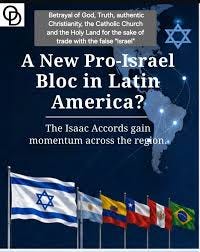
Becoming more of an international pariah, Israel has been quietly but rapidly expanding its influence across South America, hoping to use it as its new base of international influence and diplomatic protection.
The Israeli newspaper Ynet late last year quoted Israeli foreign minister Gideon Saar saying that “2026 will be ‘the year of Latin America’” for Israel.
The article quoted Amir Ofek, deputy director general for Latin America and the Caribbean at the Foreign Ministry of Israel, saying, “We hope and believe that 2026 will be the year of Latin America, a year that will look different diplomatically, one in which we see a positive change in the relations of the continent’s countries with Israel”.
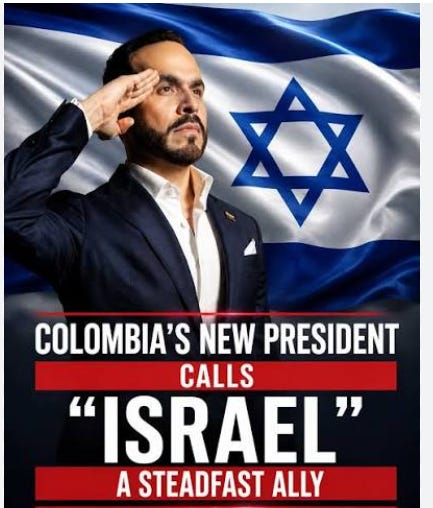
This was in reference to Israel normalizing ties with the new U.S. backed Bolivian President Rodrigo Paz, a country which under the MAS-led government cut ties with Israel in 2009 over its bombardment of Gaza .
Under the new U.S. backed president Rodrigo Paz, Ynet noted, “ Bolivia announced it was canceling its visa requirement for Israelis, a move expected to put the country back on the map for Israeli travelers in the region. After intensive talks … the two foreign ministries agreed on the text of an accord and a joint statement.”
This is just a part of a far larger U.S. backed Israeli plan to turn every South American government into Israeli puppet states.
A win, and calling a Jew a Jew is, well, NOT antisemitic:
WATCH NOW: The story of my victory against the Zionist movement
Jews Inspired:
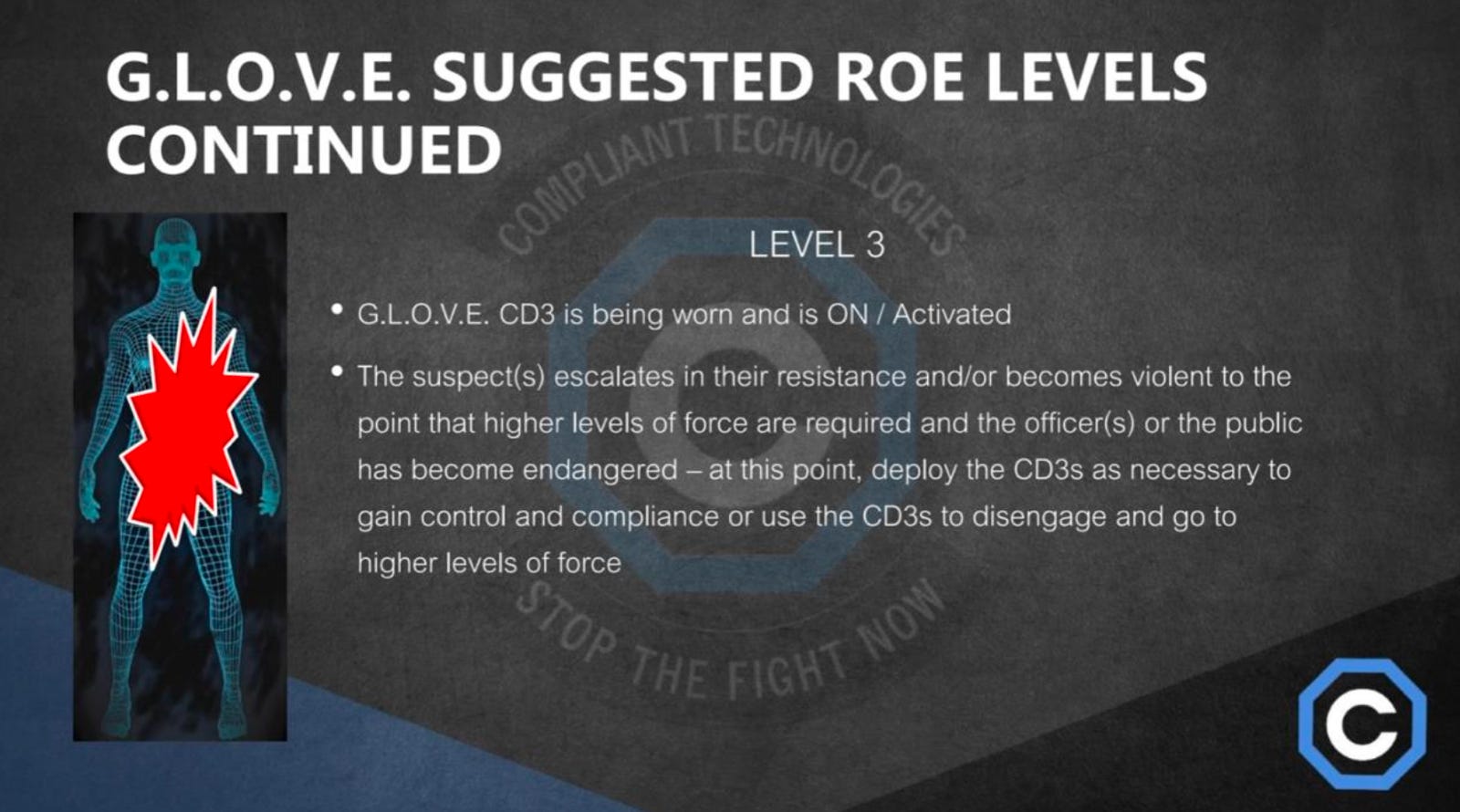
Immigration and Customs Enforcement (ICE) plans to spend tens of millions of dollars on buying specialized gloves that pulse with electrical energy, which make it easier for agents to subdue people, the Associated Press reported on Tuesday.
A user manual for G.L.O.V.E, or Generated Low Output Voltage Emitter, sold by a company called Compliant Technologies, provides more specifics on how the gloves are supposed to work and allegedly be used.
Do you know anything else about this device? I would love to hear from you. Using a non-work device, you can message me securely on Signal at joseph.404 or send me an email at joseph@404media.co.
“No more than two (one pair or equivalent) of G.L.O.V.E. devices should be applied at one time to a single Subject,” the manual reads. 404 Media found multiple copies of the manual online and archived a version here.






Look at this fucking sadist:
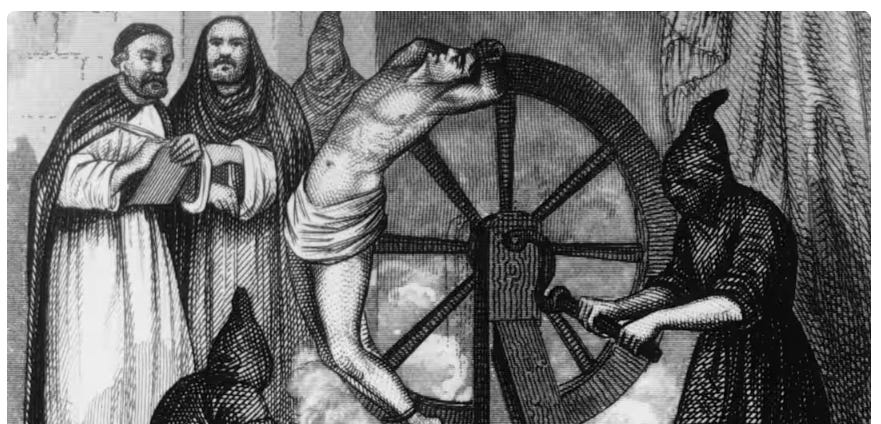
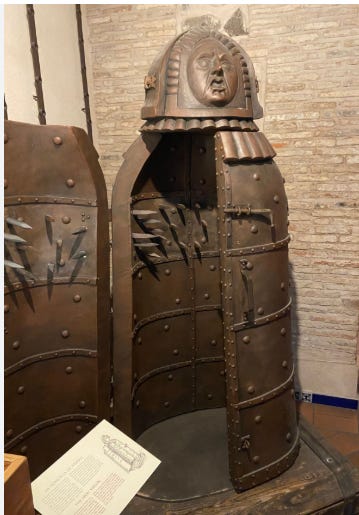
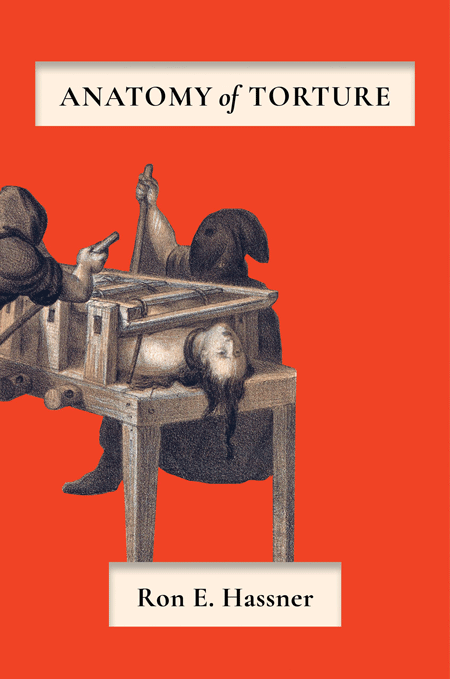
Hassner is a realist, and the reality is that torture is always an option. He’s not saying that it’s just, or justified. Rather, he’s saying that the argument that torture does not work is weak — too weak to prevent its use.
“There is a moral hazard in studying any form of political violence,” he said in the interview, “but there is an even greater danger in making bad policy based on wishful thinking. As political scientists, we’re obligated to study nuclear weapons, assassination or genocide carefully and dispassionately. We don’t claim that these things are immoral because they don’t work. We know they are immoral regardless of how well they work.”
This, he says, is the argument torture opponents should be making: Torture is so cruel, it is so dehumanizing to both the tortured and the torturer, that it is always wrong, unconditionally.
“If torture is evil,” he writes, “its efficacy is irrelevant. Those who know it to be evil should reject torture outright, regardless of how efficacious it may or may not be.”
Even in a world shaped by brutal power competition and extreme conflict, this argument is forceful because it speaks to our common humanity and our shared moral values. Similar arguments have almost always been sufficient to prevent ethnic cleansing, genocide and nuclear war.
In our imperfect world, Hassner says, that is the strongest argument against torture. But it leaves us to live on a knife’s edge, hoping the argument holds in times of challenge.

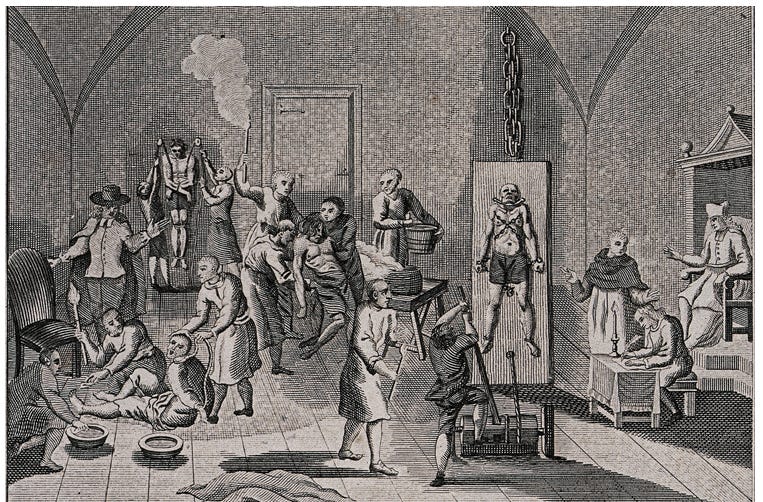
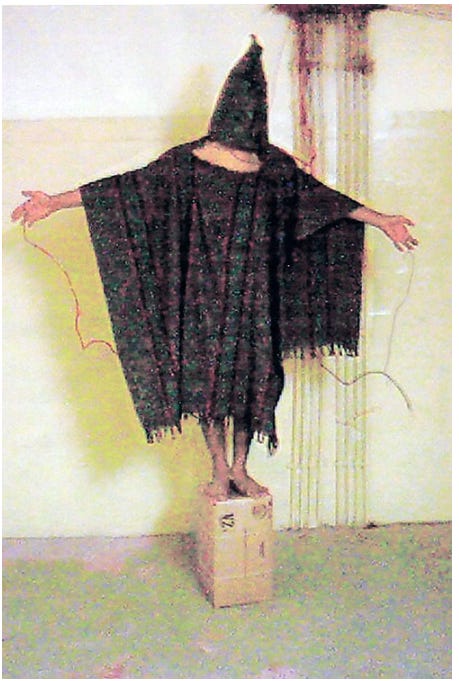
Ahh, torture by another name, the Jews: They will hound you into bankruptcy, termination, and eventual heart attack, if not just messing with the brake lines.
THE MARTYRDOM OF TONY GREENSTEIN
Aug 13, 2026
The persecution of the British anti-fascist, anti-Zionist campaigner, Tony Greenstein, is more than a personal trial for him and his supporters. It is a lesson in how Israel works to defeat the Palestinians at every turn.
Greenstein has a long history of outspoken, fearless opposition to Zionism and the State of Israel. His support for the Palestine cause has been equally bold and vehement. Given that position, it was only a matter of time before the Zionists got to him. He will stand trial at Kingston Crown Court in London for the second time in eight months, charged under the Terrorism Act. Anything more absurd and unjust can hardly be imagined.
He was born in Liverpool, the son of an orthodox Jewish family, who grew up to be an atheist and activist for left-wing causes. A founder member of the Palestine Solidarity Campaign in the 1980s, he has long viewed Zionism as a racist, Jewish supremacist ideology which he has fought against most of his life.
As an activist for the Palestine cause, he soon attracted the attention of the Zionists in Britain and their backers in government. They consistently accused him of ‘antisemitism’ – which is the same as anti-Zionism in their lexicon. In 2018, he was driven to sue the Campaign Against Antisemitism, a British pro-Israel charity, for libel along these lines. The same charge of antisemitism got him expelled from the British Labour Party, and most recently from the Green Party.
But the most devastating accusation he has faced is the charge of terrorism. It started after October 7, 2023, when anti-Hamas hysteria was at its height in Israel and the western world. Police broke into Greenstein’s home in Brighton in late December 2023 and arrested him for supporting Hamas. This was on the basis of a tweet he previously posted saying he backed the Palestinian group’s resistance against the Israeli army.
At a time when Hamas has been demonised beyond reason in Israel and all over the West, Greenstein had committed an unforgivable crime. Hamas’s military wing was first proscribed in Britain in 2001 under the Terrorism Act of 2000. Its political wing was proscribed in 2021, after which it became prohibited to show even the slightest support for the organisation. In 2025, I myself was interrogated under caution by the police after I gave a talk at a literary festival in Lewes, a town in the south of England. I had tried to explain what Hamas was in simple factual terms to clarify matters for the audience. It didn’t help me, but at least I was spared the charge of terrorism.
Not so for Tony Greenstein, who is being prosecuted under section 12 of the Terrorism Act, 2000. If convicted, he faces up to 14 years in prison. Meanwhile, his life has been difficult, de-banked without explanation by five banks since 2024. No bank will take him on, and he has been forced into the cash economy. He now lives under the shadow of possible prosecution at the forthcoming four-day trial at Kingston Crown Court.
That this decent, principled man will be in the dock for expressing his verbal support for the Palestinian right to resist genocide is a travesty of justice. But, at its basis, it represents the success of a pernicious Israeli policy of presenting Palestinian resistance against oppression as a form of terrorism.
This conflation began in the 1970s when terrorism changed its definition from being a method of using violence to attain political ends to an identity. You were a terrorist if you were Muslim, or Arab, but especially Palestinian. The idea inexorably grew that ‘Islamic terrorism’ was a threat to Western civilisation and its values. You were a threat by virtue of simply existing as a Muslim.
Israel played a key role in transferring these ideas to the Palestinian struggle against Israeli oppression, in which Palestinian fighters were presented as mindless ‘terrorists’, intent on destroying Israel for unknown, psychotic reasons of their own. The plane hijackings in the early 1970s were another example of mysterious evil. The Palestinian Liberation Organisation (PLO), established in 1967 and recognised by the world community, was dubbed a terrorist organisation by Israel. The twinning of terrorism with the Palestine struggle reached its apex on 7 October 2023 and has increased exponentially ever since. Thus, according to this conflation, Gaza’s population, including small children, are all terrorists and it justifies their murder.
Criminalising Palestinian solidarity as supporting terrorism is a triumph of Israeli framing. Israel has made terrorism the central issue in its dealings with the Palestinians. As terrorists, they have no right of resistance, no right to protection against attack, and do not deserve the right to self-determination. Who would support the creation of a terrorist state inside their borders? The extensive ramifications of this framing would form the subject of a separate article.
An eager Western world has accepted Israel’s framing, and hence the punitive acts against all forms of Palestinians solidarity in Europe and the US. In this context, the trial of Tony Greenstein is not only about one man and his fight for justice. More importantly, it is about ensuring the defeat of a pernicious Israeli campaign to discredit the right of Palestinians to resist their Zionist occupier, and the unhindered right of decent people everywhere to support them in that righteous struggle.
The court in Tone Greenstein’s trial must put an end to his ordeal, set aside Israel’s chicanery, and act with justice and honour.

Fucking rats these settlers, who are Jewish Rats:
What’s happening in Qusra right now is exactly the kind of shit Western media loves to ignore: settler thieves terrorizing Palestinian families, the Israeli terrorist army pretending to “intervene” while doing jack‑shit, and an American Palestinian family trapped in their own home while the thieves cut their water, electricity, food, and medical access. And yes — there’s a two‑year‑old who needed medical attention while these parasites physically blocked the ambulance.
Let me spell out the fucking insanity.
Terrorist thieves have besieged multiple Palestinian homes since August 10.
They set up tents in the families’ front yards, blocked every entrance, cut water and electricity, threw stones, vandalized property, screamed obscenities all night, and prevented anyone from entering or leaving. It’s a coordinated “settler” terror campaign.
 Manufacturing Dissent
Settler-terrorists Starving A Village in the West Bank
What’s happening in Qusra right now is exactly the kind of shit Western media loves to ignore: settler thieves terrorizing Palestinian families, the Israeli terrorist army pretending to “intervene” while doing jack‑shit, and an American Palestinian family trapped in their own home while the thieves cut their water, electricity, food, and medical access…
It is now official: Israeli Prime Minister Benjamin Netanyahu has flatly rejected the core conditions of the Board of Peace framework, explicitly stating that Israel will neither adhere to a ceasefire nor withdraw its forces from Gaza.
During a cabinet meeting on Sunday, Netanyahu stated with unambiguous language: “Israel rejects the 15-point document published by the Board of Peace for Gaza”.
In a previous conversation with lead envoy Nickolay Mladenov, Netanyahu set conditions—such as demanding unilateral operational freedom for the Israeli military to strike inside Gaza at will—that render a genuine peace agreement structurally impossible.
The Israeli army leadership, under Chief of Staff Eyal Zamir, reinforced this posture by outlining three uncompromising “red lines” to the political establishment: complete operational freedom to eliminate perceived threats anywhere in the Strip, strict control over all weapons entering or exiting Gaza, and zero military withdrawal unless Hamas is completely disarmed.
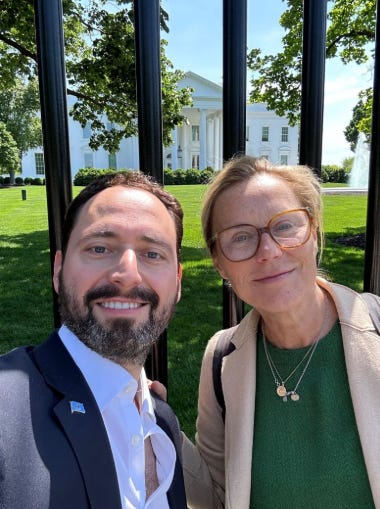
It’s fucking disgusting. UNICEF — the agency that’s supposed to protect children, especially the ones being blown apart in Gaza — has handed one of its most sensitive posts to someone who was already investigated for allegedly feeding UN intel to Israeli diplomats. Yahav Lichner, accused of acting like an Israeli mole inside UNFPA, is now running UNICEF’s Washington office. And the UN has said jackshit about this.
The UN has a long, filthy habit of burying internal investigations, shielding insiders, and promoting people who should be nowhere near positions of trust. Lichner was accused — by his own colleagues — of leaking confidential UN documents, internal strategies, and diplomatic communications to Israeli officials. According to reporting from The Intercept, staff said he openly aligned herself with Israeli government interests while holding a UN badge. Instead of getting fired and ostracized, they gave her a promotion.
Now he’s in Washington, the center of UNICEF’s relationship with the U.S. government, Congress, and the agencies that control billions in global child‑protection funding. This isn’t some local office. This is where all the lobbying happens, where narratives are shaped, where the UN bends or stands. And they put her there. Take a gander at who owns the UN huh?
It’s disgusting because UNICEF works in Gaza. UNICEF counts dead children. UNICEF documents starvation, trauma, amputations, bombed schools, shattered families. And while Gaza’s children are being killed by Israeli airstrikes, UNICEF hands a top job to a zionist accused of funneling UN intel to the same government responsible for those deaths. How do they expect anyone to trust them after this?
UN staff are furious — but only off the record, because speaking publicly gets you punished. They say the appointment feels like a slap in the face, a reminder that the UN’s internal justice system is a joke. Whistleblowers get crushed. Insiders get protected. Investigations disappear. Promotions happen quietly. And the public never hears a word.
UNICEF hasn’t explained anything. No statement. No reassurance. No acknowledgment of the investigation. Just silence — another institution that is above any international scrutiny, obviously.
UNICEF’s credibility depends on neutrality, on trust, on the belief that its leaders aren’t serving any government’s agenda. Putting a zionist with these allegations in charge of the Washington office tells the world exactly how little the UN thinks of its own standards.
It’s disgusting. It’s reckless. It’s deplorable. It’s maddening. Just more proof international law is a damn farce.
Israeli Operative Running UNICEF’s Washington Office
It’s fucking disgusting. UNICEF — the agency that’s supposed to protect children, especially the ones being blown apart in Gaza — has handed one of its most sensitive posts to someone who was already investigated for allegedly feeding UN intel to Israeli diplomats. Yahav Lichner, accused of acting like an Israeli mole inside UNFPA, is now running UNICEF…
Dude, man, goddamn DUDE.
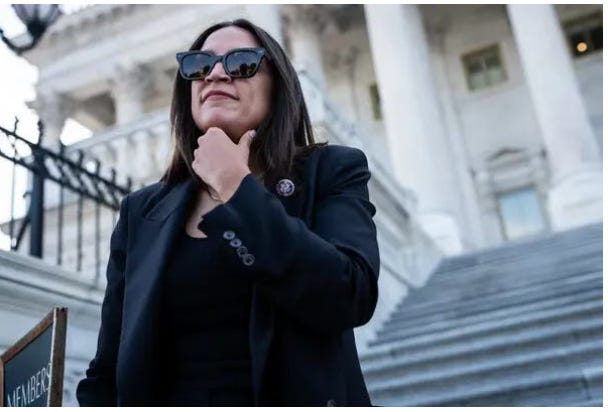
It looks more and more likely that Alexandria Ocasio-Cortez (AOC), the Democratic New York representative, will run for president in 2028.
She recently stated that she “hasn’t ruled out the possibility” of running for president in 2028.
If AOC runs for president, the most important question to ask is what will an AOC presidency’s foreign policy look like? It is the most important focus of a United States president.
All indications show that Alexandria Ocasio-Cortez would govern as a liberal imperialist, supporting liberal Zionism, propping up the CIA’s meddling machines such as USAID and NED, supporting militaristic alliances like NATO, and supporting imperialist wars in the name of Democracy and humanitarianism…
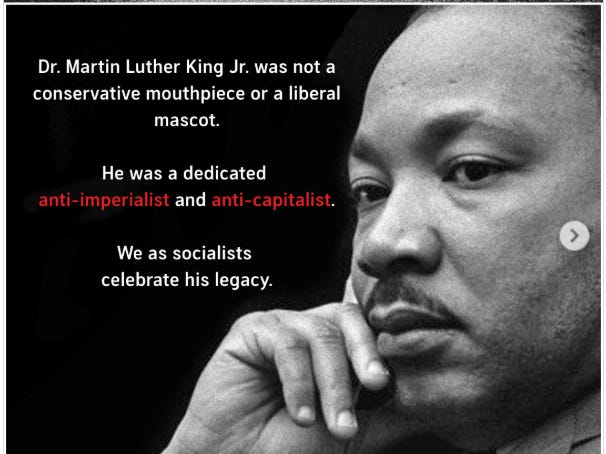
A civil rights icon, he was also a dedicated anti-imperialist and anti-capitalist. He openly spoke about the combined evils of capitalism, racism, and American imperialism. We still feel these today, from Palestine to Minneapolis, and in our own city of Cleveland.
We as socialists celebrate and help reclaim his message of hope and revolutionary change to the nation. A better world is possible.
Solidarity forever!
V. I. Lenin’s pamphlet, Imperialism, remains the leading elaboration of the concept of imperialism for Marxists. It is the starting point for any discussion of the global dynamics of capitalism from the late nineteenth century until today.
While capitalism has taken twists, turns, and even detours since Lenin’s time, the destination remains the same– the exploitation of labor for profit, wherever workers and resources can be found. Capitalism’s evolution, concentration, growth, and uneven development are the necessary conditions for imperialism. Imperialism respects no social or political borders.
The pamphlet, Imperialism, captures the features of modern– monopoly– capitalism. Yet, many seemingly fail to read Lenin’s subtitle: The Highest Stage of Capitalism (International Publishers, 2004). They fail to grasp that Lenin is writing about, elaborating on, explaining a particular stage of capitalism, not characteristics of individual states. He is describing an historically bound period, a period in which capital in its mature, financially organized, monopoly form comes to dominate the entire world through the conquests of the “great powers.” In Lenin’s words:
…we must say that the characteristic feature of this period [imperialism] is the final partition of the globe – not in the sense that a new partition is impossible – on the contrary, new partitions are possible and inevitable – but in the sense that the colonial policy of the capitalist countries has completed the seizure of the unoccupied territories on our planet… in the future only redivision is possible… (p. 76)
As Marx’s method demands, Lenin is addressing processes, tendencies – in this case, a tendency for capital to not merely dominate nation–states, even regions, but the entire world. It is the completing or redividing that defines imperialism as an historical era, a process that – through competition – creates ever-changing alliances and blocs. In the final analysis, it is intense competition carried beyond national borders that may ultimately be settled with arms, by wars.
These processes that Lenin associates with imperialism occur unevenly and in different forms. After the Bolshevik revolution, monopoly capitalism’s domination of the entire world was interrupted by the existence of the Soviet Union. An anti-Communist crusade on the part of the great capitalist powers ensued, but the underlying process remained the same: delivering every worker and peasant into the arms of monopoly and finance capital.
Again, after World War II, the growing power and influence of a socialist community proved decisive in the liberation of nearly all of what were once colonies of the great powers. New “independent” countries sprang up in Asia and Africa. But the underlying tendency identified by Lenin expressed itself again through a new expression of imperialism: neo-colonialism.
Neo-colonialism maintained the old economic advantages for the dominating great powers, but without the burden of occupation and administration. “Spheres of influence,” a more benign term coined in the nineteenth century, captured the tendency for capital to penetrate every nook and cranny of the world, while masking the raw subjugation implied by “colonies.” Thus, a dependent “independence” was born, cemented more by economic necessity than naked coercion.
With the fall of the Soviet Union, the most viable economic scaffold for independent development outside of the imperialist system was eliminated. Western commentators vigorously celebrated the prospect of unimpeded capitalist penetration to all countries without exception. Huge labor markets entered the capitalist system from Eastern Europe and from Asia, dramatically lowering the costs of goods, services, and most importantly, labor.
Capitalism got a second wind, enjoying higher, more stable growth and profit rates.
Capitalists scurried to pry open new markets, remove impediments to trade, accelerate foreign investments, secure mutuality in a manner unseen since the early decades of modern imperialism. Indeed, the later decades of the twentieth century resembled that earlier period of classical imperialism to many Marxists.
Ironically, capitalist triumphalism served to underscore the timelessness of Lenin’s theory of imperialism. Once again, the global economy was dominated by the mobilization of great powers, seeking economic advantage (exploitation) and spheres of influence.
With the US, like Great Britain in its nineteenth-century glory, claiming the right to determine the terms of economic activity and trade for the world, a period of cooperation and peace was foreseen. On this view, the capitalist economic links and mutual dependency would serve to cement social and political relations and ensure stability in international relations. A new world order would be welcomed by all and guaranteed by the US.
Those few in the West familiar with early-twentieth-century Marxist revisionism noted that this fiction was remarkably similar to Karl Kautsky’s theory of “ultra-imperialism,” a theory that the big powers would divide the world and settle the matter between themselves without friction or conflict.
Lenin, much earlier, mocked this idea. When he wrote Imperialism in 1916, he saw the catastrophe of World War I as the decisive refutation of the idea of stable imperialism or imperialist equilibrium.
Most of the Western, non-Communist left, alienated from Leninism and blind to historical parallels, scrambled to make sense of the “new” post-Soviet era, failing to connect it with the classical imperialism described by Lenin and his adherents. At a loss for a theory, they cryptically coined the vacuous term “globalization” to describe monopoly capital’s celebratory lap.
Post-Marxist, post-Fordist, Postmodernist theories abounded. Some academic “Marxists” thought the late twentieth century ushered in an era of the withering of the nation-state. Others thought we were seeing the rise of a supra-state, Empire, a totalizing entity sprung on the world like an alien invader.
The celebration of capitalist triumphalism came soon to an abrupt end with the return of constant, near-endless wars and frequent political and economic crises. Along with the exit of “benign” imperialism, leftist theoretical fantasies faded.
Global trade shrank in the aftermath of the 2007-2009 crisis and tensions between capitalist countries grew over who would gain and who would bear the burden of a sluggish or stagnant global economy. Centrifugal forces in the EU split the EU from north to south.
Germany dominates EU policies, imposing one-size-fits-all austerity on diverse, unevenly developed states.
The People’s Republic of China’s (PRC) impressive entry into the global capitalist economy and subsequent remarkable growth threatens US hegemony, creating intensified competition and tensions.
The US has sought to quell independent development outside of the global hierarchies, using surrogates, war-by-other-means: sanctions, boycotts, and tariffs. And with exceedingly obstinate resistance, the US engages its coup-fomenting apparatus or unleashes its military to shepherd those who dare to escape from the US constructed imperialist corral.
“New” great powers replaced or changed places with the line-up active in Lenin’s time. The EU, despite its member differences, scraped together an imperialist agenda under the US stewardship of NATO, as witnessed by its participation in the dismantling of Yugoslavia and its wars in Afghanistan, Iraq, Libya, and Syria.
Saudi Arabia, infused with petro-dollars, seeks to enforce its influence over its neighbors, demonstrated most recently by its bloody war in Yemen.
Even tiny Israel participates in the imperialist scramble by annexing territory from its neighbors and from the Palestinian people.
Where there is capitalism, there is a drive for territory, resources, labor, or influence.
As in Lenin’s time, countries fit into this chaotic, unstable cauldron in different ways – sometimes as greater powers, sometimes as lesser powers or victims. Competition – promotion or protection of economic interests – stirs this cauldron.
In Imperialism, Lenin does not identify countries as “imperialist,” without qualification. It would violate his steadfast recognition of uneven development to do so. In Chapter VI, The Division of the World Among the Great Powers, he simply identifies those countries (the big six!) that have been most active between 1876 and 1914 in acquiring colonies.
He can be viewed as establishing an imperialist hierarchy, but this too can be misleading. Lenin, always attentive to historical contingency and shifting social forces, goes to some length to describe the variety within the “great powers”:
… great differences still remain; and among the six powers, we see, firstly, young capitalist powers (America, Germany, Japan) which progressed very rapidly; secondly, countries with an old capitalist development (France and Great Britain) … and, thirdly, a country (Russia) which is economically most backward, in which modern capitalist imperialism is enmeshed, so to speak, in a particularly close network of pre-capitalist relations. (p.81) [my emphasis]
Lenin leaves no doubt that a country (czarist Russia) can be a big player in the imperialist scramble for colonies (or spheres of influence) while remaining a less-than-robust capitalist country with remnants or foretells of other (non-capitalist) economic formations or features. In other words, their place in the imperialist system is not strictly determined by their place in the capitalist hierarchy – they can be a bright young capitalist star or a decadent, old star clinging to a brilliant past, while still playing a decisive role in the empire games.
It would be wrong, as some have argued, to mechanically take Lenin’s “five essential features” found in Chapter VII as giving a criterion for admission into some kind of imperialist club. It could not be clearer that Imperialism as a Special Stage of Capitalism is not about the status of individual countries in the imperialist system, but about imperialism as a whole.
Capital concentration, the merging of financial capital with industrial capital, the export of capital, international monopolies, and the territorial division of the world (spheres of interest) are features of the imperialist stage of capitalism, and not necessarily any individual country in the imperial project.
Countries – small or large, developed or backward, endowed or impoverished -play different roles at different times in the march of imperialism.
Whether it is czarist Russia (a mix of emerging capitalist relations in urban areas and only weakly existent feudal relations in rural areas) or Putin’s Russia (a stunted industrial capitalist economy, but with enormous essential resources), the capacity to participate in great power activity, to enlarge or protect spheres of interest, to confront other great powers is an unquestionable reality. To hide this reality – this active participation in the conflict with other capitalist countries – behind the facade that Russia does not meet the “five essential features” characterizing the imperialist era is sheer sophistry.
Lenin is clear. Apart from the “great powers” are a host of countries whose “participation” in the imperialist system is complex. The dialectics of uneven development produces no ideal types.
Lenin speaks of smaller players in the imperialist system that have diverse relations with imperialism. Some have their own colonies but “retain their colonies only because of the conflicting interests, frictions etc., among the big powers…” They risk losing their colonies to a new colonial “share-out” to the big powers (page 81).
He also recognizes “semi-colonies” like Persia, China, and Turkey which were, in his time, nominally independent, but exploited profoundly by the big powers. He refers to them as “examples of transitional forms which are to be found in all spheres of nature and society”; they are in “a middle stage” (page 81). Today, all three have transitioned into bigger players in the capitalist firmament.
In his discussion of Argentina and Portugal, Lenin anticipates the mid-twentieth-century Marxist concept of neo-colonialism, discussing how independent countries can be tied into the imperialist nexus as financially dependent or as a protectorate (page 85-86).
Thus, Lenin shows, with great nuance, that imperialism is a dynamic global system, constantly in motion, and that countries participate in the system in many ways. The imperatives of monopoly capital enjoin all capitalist countries to seek advantage in the competition for resources, markets, and labor. In this struggle, there are those that become the biggest powers and dominate others through the exercise of their power. Lesser powers lose to the most powerful, but may aspire to challenge, nonetheless, or exercise their power over the less powerful. The system tends to engage all economies in relations of dominance and dependence. Competition breeds aggression and war.
Lenin derisively notes the petty-bourgeois reformist tendency to separate imperialism from capitalism, to deny “the indissoluble bond between imperialism and the trusts, and, therefore, between imperialism and the very foundations of capitalism…” Without recognizing capitalism as the source of imperialism and war, anti-imperialism remains “a ‘pious wish’”. (page 111).
It might be useful to summarize this discussion by showing how a closer read of Imperialism might shed light on twenty-first-century imperialism.
- Twenty-first-century imperialism shares more features with the imperialism of Lenin’s time than differences.
- Imperialism constitutes a system of global competition for resources, markets, and labor-power that pits capitalist countries against one another to establish spheres of interest and a better field of operation for its monopolies. The struggle instigated by the US for dominance of Ukraine involves monopolies in the energy sector and the weapons industry, as well as an attempt to secure and expand existing spheres of interest. While the US is the more powerful great power and the instigator, Russia is an aspiring great power drawn into invading a “transitional” country – Ukraine. With successive corrupt governments, Ukraine has, since its independence, longed to be a protectorate of a great power, whoever offers the best bargain. At stake are the interests of the various ruling classes.
- The argument popular among Western leftists over whether Russia is an imperialist country or an anti-imperialist country opposing US and EU imperialism is a sterile, scholastic debate. From a Leninist perspective, today’s Russia, like czarist Russia, is a nascent capitalist country vying for a position as a leading force in the scramble for markets and spheres of interest. Russia’s engagements in defiance of US imperialism – in Syria, Cuba, Venezuela, etc. – is just that: defiance of a rival. That powerful rivals are aggressively threatening Russia’s ambitions is notable, but of little bearing on the interests of the Russian, Ukrainian, US, or EU working class.
- In fact, the Ukraine war’s “progress” has– as a Leninist perspective would predict– dramatically and negatively affected the fate of workers globally. Millions of lives have been disrupted, harmed, or ended.
- The demise of the Soviet Union has freed the hand of imperialism, producing a world substantially congruent with early-twentieth-century imperialism. Some of the players have changed or assumed different roles, but the logic of great-power imperialism is intact. Those of us who defend the historical role of the Soviet Union must dispel any remaining romantic attachment to today’s Russia. It participates in the global system of imperialism as a great power.
- As Lenin warns, the attempt to separate imperialism from its capitalist roots destines anti-imperialism to ineffectuality – “petty-bourgeois reformism.” Moralistic anti-imperialism, what Lenin calls “the last of the Mohicans of bourgeois democracy,” collapses into pacifism – a posture good for the soul, but impotent against the schemes of the great powers. Today’s leftist celebration of a projected “multipolar” capitalist world is a further attempt to separate great-power rivalries from their roots in capitalist – specifically, monopoly – interests. Multipolarity was a feature of imperialism in the prelude to World War I. In fact, the attempt to impose multipolarity upon a world saddled with the domination of the British Empire was a critical factor leading to World War I.
- The retreat from Leninism is essentially a retreat from socialism. Desperate, unfounded faith in (a) the efficacy of multipolarity, in (b) the hope of finding a principled anti-imperialist rallying point around an eviscerated, ravaged former socialist state now owned by mega-billionaires, in (c) the miraculous transformation of the existing money-driven, elite-led Western bourgeois parties, and in (d) the belief that the splintered, self-absorbed, multi-interest, multi-identity left can magically coalesce into a force for radical change are all products of a loss of confidence in the socialist project.
The lessons of history and history’s most brilliant teachers are the best guides for the future we want. Plus ça change, plus c’est la même chose.
Greg Godels
zzsblogml@gmail.com
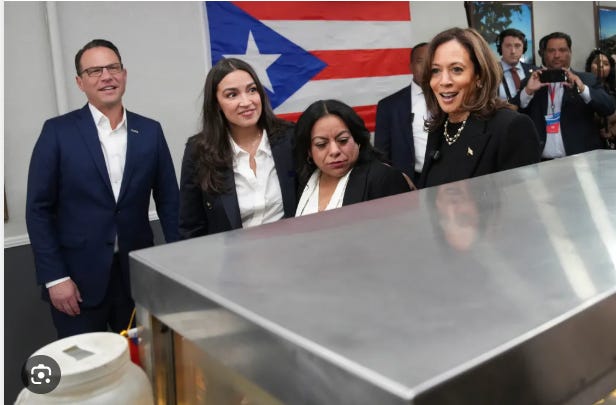
[Democratic presidential nominee Vice President Kamala Harris, from right, looks at food at Old San Juan Cafe with restaurant owner Diana de La Rosa, Rep. Alexandria Ocasio-Cortez, D-N.Y., and Pennsylvania Gov. Josh Shapiro during a campaign stop in Reading, Pa.]
The big field in the race for the 2028 presidential sweepstakes is already off and running. Two of the top Democrats vying for the job are former Vice President Kamala Harris and Rep. Alexandria Ocasio-Cortez (D-N.Y.). The election of either one would address the urgency of putting a woman in the White House for the first time.
Harris’s decision not to run for governor in her home state of California indicates she will make another White House run. But that’s not the only sign that the Democratic stampede towards 1600 Pennsylvania Avenue has started. Democratic presidential wannabes have already made treks to early primary states like South Carolina and New Hampshire. Former Transportation Secretary Pete Buttigieg has already raised $1.6 million dollars for his leadership PAC.
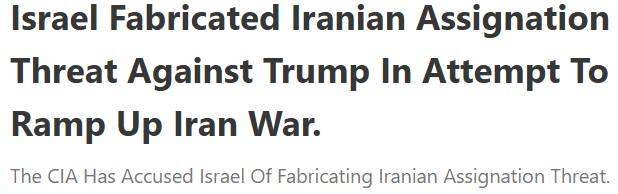
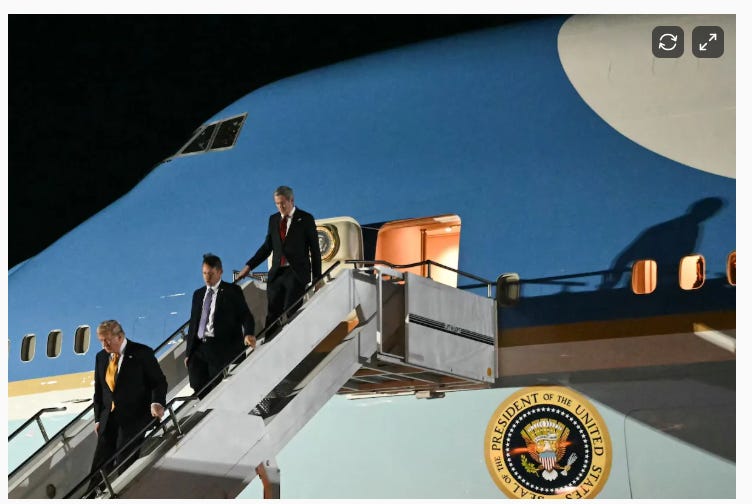
Were the great Jewish directors helping the Jewish State of Rape and Murder and Thieving?
Hollywood Legends & Masters
- Steven Spielberg: Directed massive cultural touchstones like Schindler’s List, Jaws, and Raiders of the Lost Ark.
- Stanley Kubrick: Visionary director of 2001: A Space Odyssey, The Shining, and Dr. Strangelove.
- Billy Wilder: Master of classic Hollywood comedy and drama, directing The Apartment and Sunset Boulevard.
- Sidney Lumet: Renowned for intense, grounded dramas like 12 Angry Men and Dog Day Afternoon
- Joel and Ethan Coen: Distinctive sibling duo behind unique cinematic masterpieces like Fargo and No Country for Old Men.
- Woody Allen: Prolific creator of neurotic urban comedies and dramas like Annie Hall and Midnight in Paris.
- Darren Aronofsky: Known for psychological and visceral features like Black Swan and The Whale.
- Greta Gerwig: Acclaimed modern director of Barbie and Little Women.
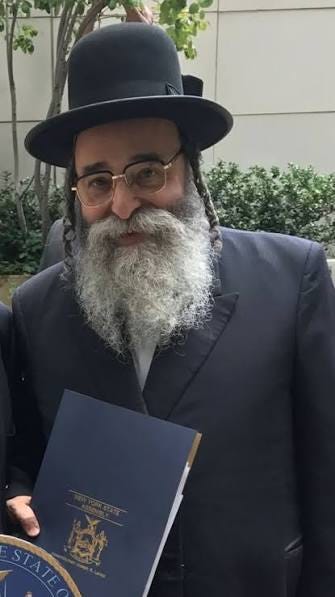
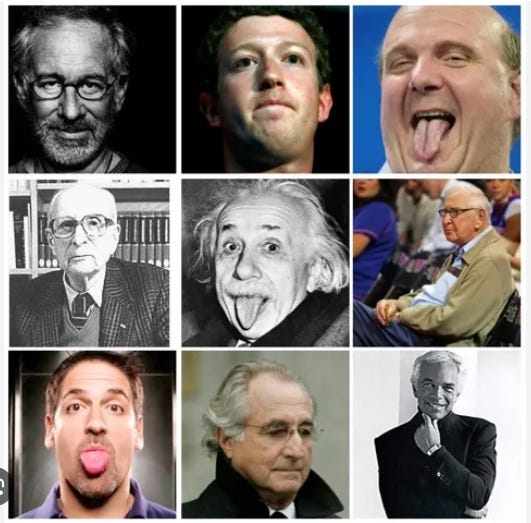
They celebrate their circumcisions and bar and bat mitzvahs and dirty Books of Genocide. [Don’t look at these faces below — just placeholders for the rats.]
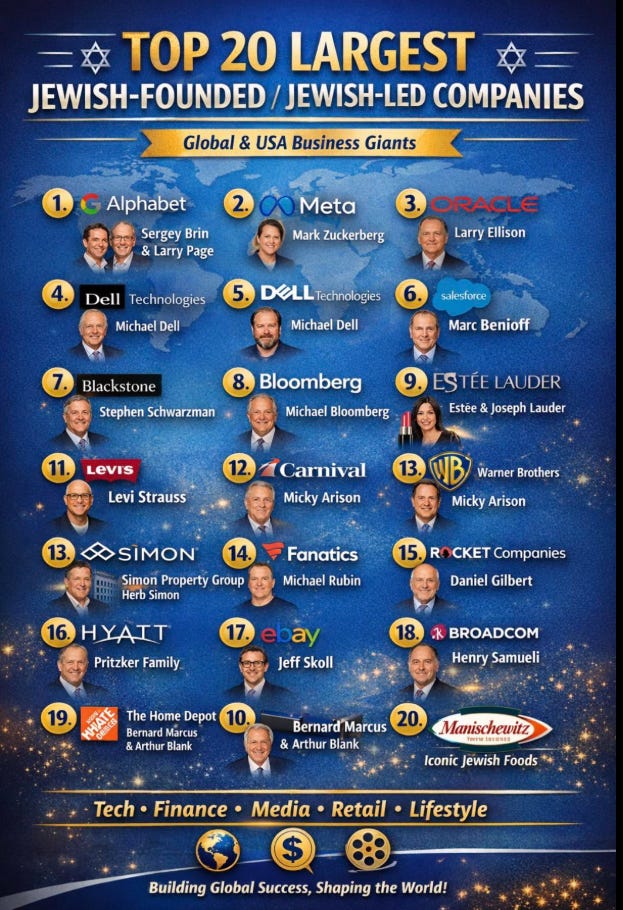
The tongues of pedophilia?
Deport. Meet the Rabbi Leading Iran’s Thousands of Jews – WSJ
Written By: Justin K.P.
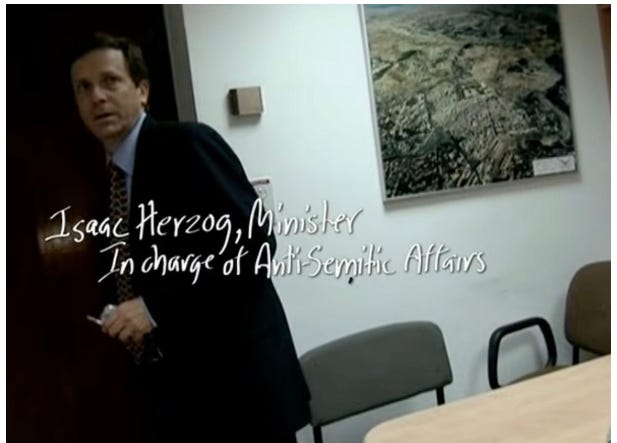
A clip from the documentary film “Defamation,” released in 2009, about the ADL’s strong ties to the Israel lobby, contains a clip that seems deeply relevant to current developments in Venezuela.
In the film Isaac Herzog, the current Israeli president, who was then the Israeli “Minister in Charge of Anti-Semitic Affairs,” is filmed meeting with Abraham Foxman, then National Director of the Israel lobby group ADL (Anti-Defamation League).
The conversation goes as follows:
Isaac Herzog: I wanted to ask, since we met last about the issue of Venezuela, because I heard voices kind of saying it’s not so bad and Latin America is not so bad, but I’m not convinced.
Abraham Foxman: You have good reason not to be convinced. It is getting, and little by little, as long as oil money …
Isaac Herzog: I’m told that by our experts it’s the only- except for Iran- it’s the only government propagating anti-Semitism today around the world … so are you pressing in any way?
Abraham Foxman: We’ve talked to Jesse Jackson, who has a relationship, but it’s not for camera, but there are other plans we’ll talk about it in a minute.
This discussion was likely in the context of then Venezuelan president Hugo Chavez breaking off ties with Israel in solidarity with Palestinians in Gaza after Israel slaughtered hundreds of Palestinians civilians during “Operation Cast Lead”.
The oil giants Chevron and Exxon Mobil had pushed for regime change in Venezuela since 2001, after Hugo Chavez “passed a law called the Organic Hydrocarbons Law, which asserted state ownership over all oil and gas reserves, held upstream activities of exploration and extraction for the state-controlled companies, but allowed private firms – including foreign firms – to participate in downstream activities (such as refining and sale)” which “deeply angered the US-owned oil companies – particularly ExxonMobil and Chevron – which put pressure on the government of US President George W. Bush to act against Chávez.”
This resulted in extensive CIA interference in Venezuela, including a short-lived U.S. backed coup against him in 2002.
But the clip shown in “Defamation” shows that since 2009, the Israel lobby, including the ADL, joined the oil lobby in pushing the U.S. towards regime change in Venezuela.
Years later, Israel made connections to María Corina Machado, a U.S. puppet in the Venezuelan opposition, to further the regime change goal in Venezuela.
This included her signing an “Inter-Party Agreement” with the ruling Israeli Likud party in 2020, which promised to“forge an alliance between our two parties to cooperate on political, ideological, and social matters, as well as advancing cooperation on issues related to strategy, geopolitics and security, among others, in order to create an operational partnership”.
The Israeli newspaper Ynet reported that Machado has “close ties with the state and the Likud party”.
“We rely on Israel’s support in dismantling Maduro’s crime regime and in the transition to democracy”, Maria Corina Machado admitted to Israel Hayom, implying Israeli involvement in the regime change operations.
While the Trump administration ended up deciding that interim Venezuelan president Delcy Rodriguez would be an acceptable puppet leader rather than Maria Corina Machado, she seems to have made the same deal with Israel that Machado did.
Reversing years of solidarity shown by Venezuela with Palestine, the Delcy Rodriguez administration recently announced:
The Governments of the Bolivarian Republic of Venezuela and the State of Israel announce that, following the visit of the Israeli humanitarian delegation to Venezuela in response to the double earthquake that occurred on June 24, and in follow-up to discussions held between high-ranking officials of both countries, the two nations have agreed to allow the continuation of bilateral technical cooperation stemming from the emergency and recovery efforts following the double earthquake. Furthermore, the two nations agree to establish a coordination mechanism to facilitate the provision of consular services to their respective citizens residing in the other country, as needed. Both governments recognize the importance of the bond between the State of Israel and the Jewish community residing in Venezuela, which constitutes a significant historical bridge of friendship between the two countries.
The apparent involvement from the Israel lobby in pushing for regime change in Venezuela seems to have paid off and reversed the country’s support for Palestine.
Fucking CUNTS, InBred UnUnited Queer-Dumb.

