Paul Haeder, Author

writing, interviews, editing, blogging

COVID-19 through a literary lens

COMMENTARY | My conversations with librarians have been the bright line in a ‘world of words’

 Paul K. Haeder | 31 Mar 2020

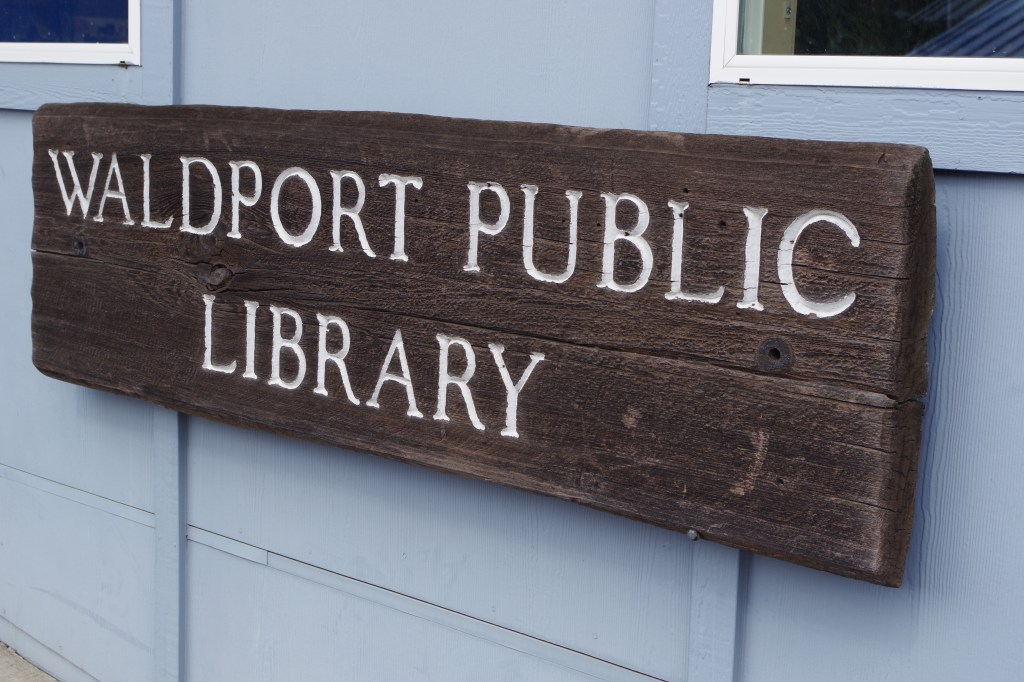
“Look, we have been on the front lines of all sorts of diseases. New strains of TB. Hep C. Even bedbugs are blamed on us. This virus doesn’t scare me. The people out there — the citizens — that’s what scares me, man, all that toilet paper hoarding and shit.” 
— Brooks, as we talked in front of the Waldport library
“I’m preparing for National Poetry Month, not for death.
“See, there I was time I thought I was going to die. I was really scared. And in that moment, no one was scared with me. Doctors didn’t take me seriously; my family even questioned if my illness was real.
“It was then that I was scared of all of you, your germs, your coughs, and your unwashed hands. It was then that I really didn’t want y’all to touch me.
“Doctors told me I needed a nap and that I was just stressed. But I, in fact, had a serious case of Babesia, a neurologically based tick-borne illness that impacted by brain, my speech, my cognition — and my life.”  
— Whit Easton, L.A. writer, from the piece  “I’m Making Art (and Love) This Go-Around of a Global Health Pandemic — One poet’s response to COVID-19”

I’m talking with John (he prefers this pseudonym) about his own desire that incubated more than three decades ago about becoming a novelist.

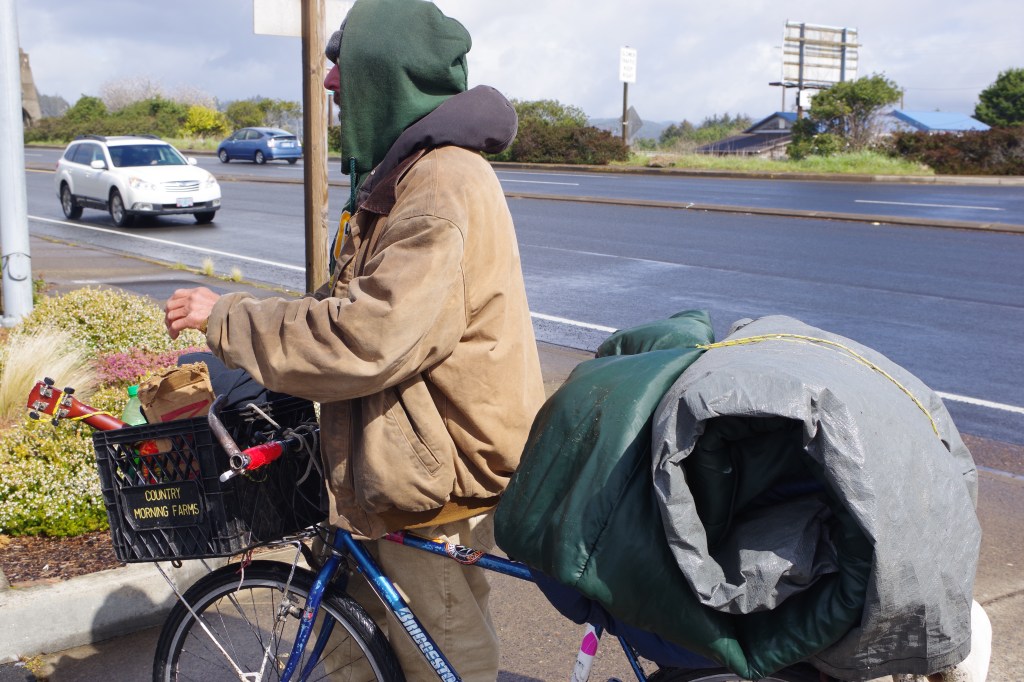
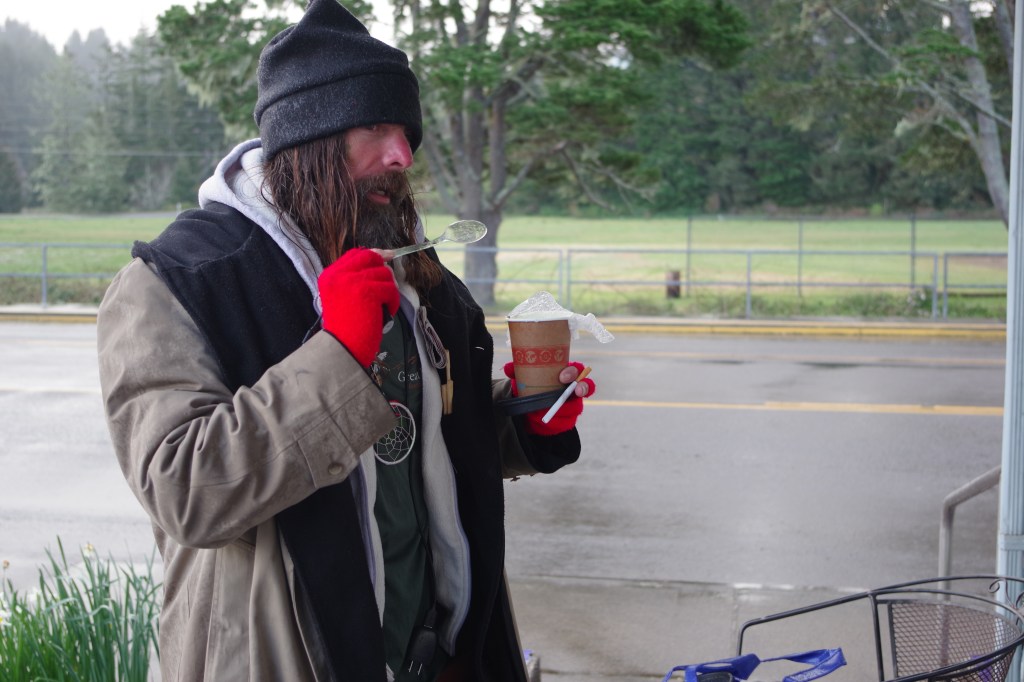
“I always thought about that as a career, even in high school.” He is not a 48-year-old “victim of circumstances,” though the average person might see him crossing the Alsea bridge at night with his backpack and bedroll as such.

He prefers to be called a vagabond. We’ve talked about intelligent design, quantum physics, zoning laws, solutions to housing precarity. 

He reads a lot. He spends a lot of time inside libraries reading. This pattern has been in his blood way before the seven years he’s been on the road. His own life philosophy is complicated, but in one sense it can be whittled down to, “Here today and gone tomorrow.”

“I am not a loner, don’t get me wrong,” he tells me while we share coffee. “I’ll associate with anyone who’s kind regardless of their station in life.”

Like many on the road, John doesn’t want specifics revealed. But he still is open about some things in his narrative.


He grew up in Los Angeles. He said he was a foster child. He has no siblings. He has no connection to his parents (he has negative things to say about both of them). The effects of a bullet to the lung and one to the hip at age 22 (both removed) are taking a toll on his ability to work long and grueling jobs.  

“Yeah, I think when you and I were talking a few months ago about the Influenza A, I figured anything like this new virus would put a kink in everything. Am I right?”

Social distancing is easy for John — he stays in his own tent — and difficult: He shares a bench with Brooks, and they swap tobacco and rolling papers for their cigarettes.

We talk about the concept of story. John and Brooks have a lot of them — stories. John, though, is steeped in the writerly way of framing narrative through his life and a universal lens. Brooks has tales about many dramatic brushes with the law, criminals, courtrooms.

“I still think about it — writing a book. You never know what I might be doing when I turn 50 … or 60.” This is John looking at me pensively but with no regret etched on his face.

We continue talking about surviving and how people on the streets, on the road, have survival skills the average person in the U.S. society doesn’t have. Not just the ways these people can find shelter, tap into resources and be blessed with other windfalls. They have a certain outlook on life that is “not filled with unrealistic pots of gold at the end of the rainbow.” 

John’s thrown in as a line chef, as a carpenter, cabinet-maker, and demolishing structures. He was once paid a penny a word for research through an online university. He worked in Arizona picking melons with mostly immigrant laborers. 
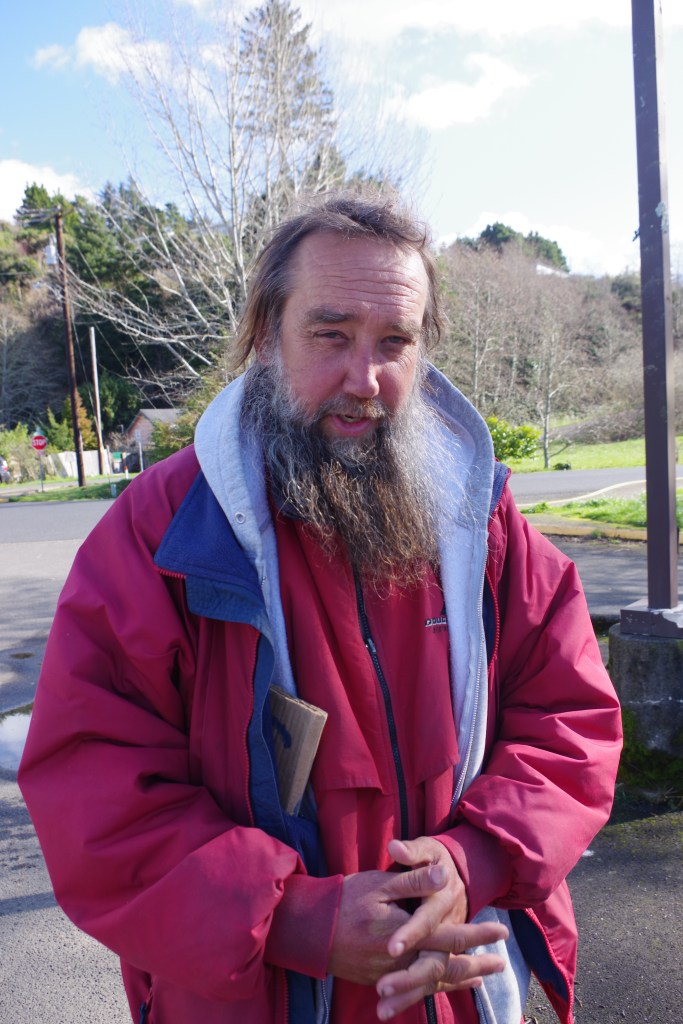
“Yeah, right out of ‘Grapes of Wrath,’” he said. “We got paid two hundred a week, but the manager kept our first week’s wages. And, we had to pay for food and this crappy shed to sleep in. We paid every time we took a shit.”

He thinks labeling anyone with “mental illness” is incorrect — “we can have mental issues and problems, but it is not a disease” — and a quick way to control people and taking away their rights.

John is skeptical of government services for homeless, saying, “The secular institutions aren’t capable of helping the homeless. When people help me, it’s members of the community. Religious institutions should be helping out much more.” 

John said, “It seems like the powers that be want us to freeze to death. Sometimes it’s just a place to get out of the cold that can make the difference.” 

Librarians in a time of plague 

So many homeless people I interact with see our local public libraries as both nirvana — a place to get out of the cold — and a gold mine of information and killing time with words.

Toledo, Ore., is a small mill town (Georgia Pacific), and the library there is run by the city. It’s pretty large compared to the size of the community. Deborah Trusty has managed it for over a decade. We talk about COVID-19; all the author readings and story-time events for kids were canceled. 

Other libraries in Lincoln County had already closed altogether, including Newport. She says more people from Newport were coming in for library cards. The staff saw more people than ever using the Wi-Fi services. 

“I’m concerned about people with issues. The elderly. The immunosuppressed. And I know that my patrons who are homeless count on the library. Here in Toledo, we just closed the pool. I am concerned now because that’s where people without homes showered.”


Cornel West praises Occupy Seattle movement at Green River Community College: By Yours Truly


We talk about having online author readings, Skyping and using Zoom for interactive literary events. We discuss other ways the library system can step it up in a time of COVID-19.

“I’ve done those tabletop exercises. You know, disaster preparedness for the big earthquake. There is no way to prepare for something like that. Other than laying in more food. But most likely what will happen is what all those movies have been showing us.”

But Deborah sees COVID-19 as an opportunity to do things differently and to ask, What can we do to change? She’s thinking of slowing down, stopping to smell the proverbial coffee and listening. Part of that denouement is reading more. 

I ask former Stockton, Calif., resident and now Portland resident (since 1975) Leanne Grabel what she thinks of these lockdowns, public cancellations, and quarantining due to a virus.

“Let’s face it. There is a thrill in crises, and I feel it. It’s an abandonment of routine, which has an excitement to it. Is there fear? Yes. We are over 60, and my husband has lung issues. But staying home, watching movies, working on projects, and now having a snowstorm, it has its sweetness. 

“Now, if we get sick, it won’t be so fun. And of course, there is huge concern and disgust over the current administration’s handling of it all since their first priority is not people but money. It just piles up the disgust that was already up to the sky. But local communities — schools, restaurants, stores — are being generous and people-focused.”

Her pedigree is long and varied, but most interesting to me is she’s worked in the Portland Public Schools focusing on language arts and special education. Much of her time concentrated on teenage girls in a lockdown residential treatment center: Rosemont.

 “As a writer, and a victim of trauma myself, I knew the act of writing one’s ugly story — could help — just help.” From that work, she published “badgirls,” a chapbook based on her experiences with the girls.

Poetry and music

I was on my way back from Spokane last week, plugging my new literary work, a short story collection, “Wide Open Eyes: Surfacing from Vietnam,” when I heard an interview featuring Peter Sears’ poetry. Sears served as Oregon’s poet laureate from 2014 to 2016 and was active in the state’s literary community for more than 40 years. The story produced by Oregon Public Broadcasting was about fusing Sears’ poetry with classical music.

Teddy Abrams is one of classical music’s “biggest proponents of collaboration and breaking artistic barriers.” He is the music director of the Britt Music and Arts Festival in Jacksonville, Ore. In 2014, Aoife O’Donovan, a well-known songwriter, was asked to help him write a suite of music based on the work of this now deceased Oregon poet.

“Of all the human values we hear about that are wonderful — drive, resolve, insight, charm, empathy, whatever — we don’t hear much about imagination and it’s really, really critical. We live there a lot more than we know. Whether there are any results, that’s another matter. But if a person has an opportunity to engage that imagination, as they do in writing, things can happen that they never saw coming.”
– Peter Sears

Writing in a time of crisis

As the old adage states, a rolling stone collects no moss. Now that the stones of society and gearworks have come to a halt, and all public gatherings in many states across the U.S. have been “banned,” we have a crisis of more atomization in our society, more social dislocation, and more isolation.

My conversations with dozens of librarians, from big universities where I’ve taught to small towns where I’ve lived, have been the bright line in a “world of words.” These professionals support writers and books. Community libraries function as computer-based assistance, warming places for the houseless, and clearing houses for local information and bulletins.

As a bookend here, I want to chisel in the words of one of our Central Oregon writers, Wallace Kaufman. His bio is varied and diverse, the fuel of myriad of written forms. He has been a wrestling coach, museum curator, high school biology teacher, college professor, land developer, property appraiser, licensed construction contractor, conflict mediator, journalist, land-use consultant, adviser on housing and land reform to the government of Kazakhstan, Spanish translator, president of three statewide environmental groups, and economics researcher for World Bank and USAID projects. 

He lives in Newport and is the author of seven books: science fiction, nonfiction, memoir and poetry.

For him, the power of the word and why he writes are intertwined:

 “As a shy kid who could not sing or play an instrument and wondered what life was worth, I was seduced by the music of words that could also bring into focus the wonders of the world and engrave in memory important facts and enduring mysteries.”

I ask librarians and people like John and Brooks many questions tied to the “new normal” of COVID-19 and fear.

Brooks tells me he sees “more people on the streets coming together, talking, sharing things.” John believes under the virus hysteria, things will get more draconian. “And people like me will be targeted more than we already are. Treating us more and more like lepers.”

The published author Kaufman sees the virus as emblematic of a modern world gone crazy:

“Humankind has mastered most of the powers of the natural world. This new pandemic makes clear that bio-engineered weapons can create more economic and social havoc and death than any other weapon, and that created viruses can be spread faster and farther with less effort than other weapons. Our powers are now god-like for both creation and destruction. We have met the Titans and they are us.” 

While John is pragmatic and road-toughened (and weary), he said he enjoys this part of the world for its amazing forests meeting the sea. Kaufman echoed the same: “Now is the time we should be celebrating the wonders of the natural world and the genius of humankind.” 

For 32-year-old Whit Easton, this crisis of the pandemic is a blossoming cherry tree: “This week, in the wake of a society inundated by fear, an impending sense of doom, and a full-blown global pandemic, I find myself pensive — cautious yet calm — as I reflect on the journey I am about to undertake as a young entrepreneur. I’m on a mission to launch a digital platform in psychology and wellness that will be revolutionary for the diverse audience I aim to reach.”

Leaving behind baggage is Whit’s lesson now during this isolation:

“In 2019, I walked out of just about every damn closet that you can possibly walk out of in life. I came out as a transgender non-binary lesbian in nine months’ time. Once I knew I was gay, I figured why not get all the coming-out over with? I launched my freelance writing career and said goodbye to the 9 to 5 office life, published my first work of creative prose, and began to build a writing business.”

Paul Haeder is a seasoned print journalist, has been a college English faculty for a dozen colleges and universities, and now works on a statewide anti-poverty project, Family Independence Initiative, in Lincoln County. He just published a new book of short fiction, “Wide Open Eyes: Surfacing from Vietnam” (Cirque Press, 2020). His Portland roots connect with Central City Concern, Lifeworks NW, United Cerebral Palsy, and the Salvation Army as a case manager for people who were homeless, developmental disabled, in foster teen programs, veterans and newly released from incarceration. 

Reading and writing in a time of crisis

 (Photo by Paul Haeder)

By: Paul Haeder – Updated: 1 day ago

Posted Apr 2, 2020  

Editor’s note: this is the second and final installment of a two-part series on how stories aid Waldport’s homeless during difficult times. The first article was published in the March 27 edition of the News-Times.

I asked librarians and homeless people like John and Brooks many questions tied to the “new normal” of COVID-19, with all the fear connected to it.

Brooks told me he sees “more people on the streets coming together, talking, sharing things.” John believes with the virus hysteria things will get more draconian, “and people like me will be targeted more than we already are, treating us more and more like lepers.”

While John is pragmatic and road-toughened — and weary — he said he enjoys this part of the world for its amazing forests meeting the sea. Wallace Kaufman, a Newport published author, reiterates: “Now is the time we should be celebrating the wonders of the natural world and the genius of humankind.”

My own journalistic work is tied to getting under the skin of a story, to peel back layers of the people I interview. I use my bicycle in Waldport and Newport to meet so-called street people. I am seeing more in my neighborhood, walking the street in groups of two or three, always tossing my way a “how’s it going?” or “howdy.”

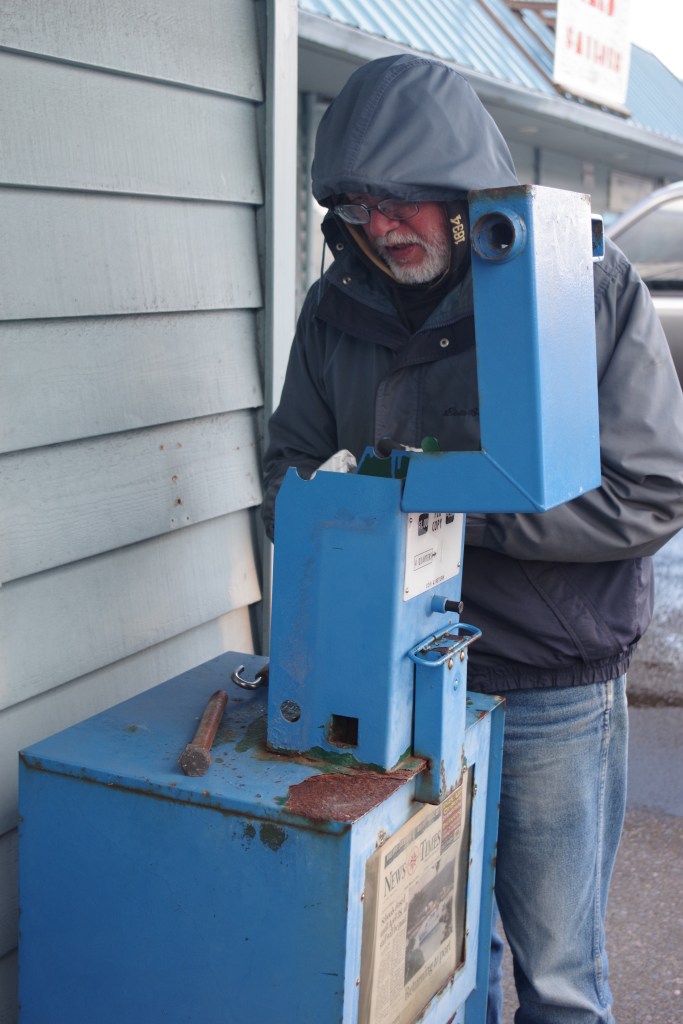
I just discovered my other gig, with the Portland award-winning street paper, Street Roots, is on hold in some ways. At a dollar each, the homeless vendors get to keep 75 cents of the dollar each weekly sales for, but for the first time in two decades, the street vendors are without actual newspapers to sell.

My work in Seattle years ago with another street paper, Real Change News (RCN), spurred me to hang out with many street newspaper vendors. I wrote stories about two of them. Sometimes, I would stand way back and blend into the crowd in front of places like Whole Foods or Trader Joe’s.

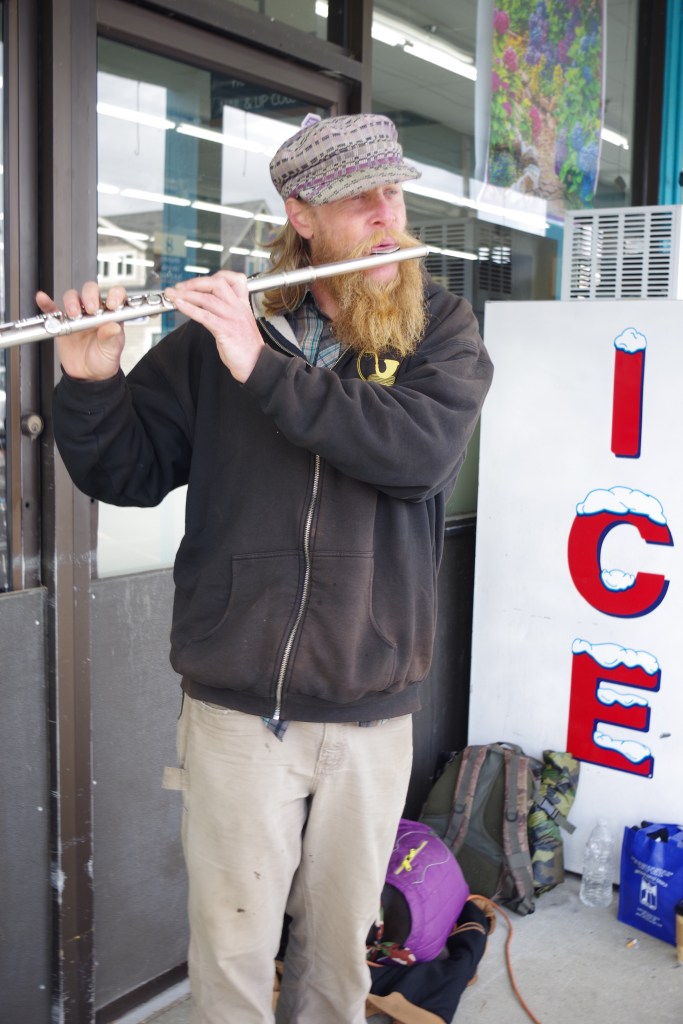
Newspaper vendors in Seattle were virtual street magicians, and buskers — some performed tricks, recited poetry, sang songs. Every so often, a tambourine and even a keyboard accompanied their newspaper pitch.

The outfall was many RCN newspaper vendors would get way more than a dollar for the newspaper. A few made $70 or more a day. Now that’s all gone for the time being — RCN is down, too.

Talking with Deborah Trusty, Toledo’s head librarian for the past seven years, I understand the challenges she was having before the lockdown and now with the shuttering of all Lincoln County libraries. She wants Wi-Fi still available, but for homeless people that could mean people driving to the parking lot or hoofing it to access that. 

Congregating even in small numbers is not a good idea with COVID-19 orders around social distancing.

Trusty and other librarians are working for story time to be delivered online. She is open to videos and podcasts coming from writers of every stripe. She’s even just challenged me to do a presentation, record it and then send it her way. My new short story collection, “Wide Open Eyes – Surfacing from Vietnam,” might be packaged soon and sent to the libraries.

“I took this job because I love being exposed to, sharing, and hearing others share great reads,” said Trusty. “I know that a library is much more than that and libraries are evolving every day, but that was my original motivation. Libraries are perhaps our most valuable public space left in America.”

For readers who can access online resources, libraries in Lincoln County are offering their collective work collating online resources for families that offer activities and learning opportunities on their Facebook pages.

My last outing at a local library was in Siletz. It’s an amazing library, headed up by Carol Rasmussen Schramm. She told me that it’s been tough the past years to get people interested in book readings like my own gig. This was before the lock-down.

Yet folks like Rasmussen Schramm and Trusty see themselves as members of a larger community. When things get back to “normal,” our local libraries will be places for community gatherings, discussions and more. The Newport Library’s conference room has hosted many important speakers and events.

We are counting the weeks for those days to return.  For writers and others, the best way to get the written word out is, many times, through the spoken word.

Support my writing and work by going to Wide Open Eyes, from Cirque Press: This literary arts journal has compelling art, photography, poetry, fiction, drama, interviews, and non-fiction. The newest one is the 10th Anniversary issue, about to come out. Yours truly is in that one, and many others. Support us, please. Us, being truth teller (AKA, soothsayers), journalists, poets, hard-nosed investigative writers, essayists, biographers, memoirists, and the like!

When the world gets crazy, the spoken and written word counts


Posted Mar 19, 2020  

This started off a few weeks ago as an article on an upcoming — now canceled, thanks to Covid-19 — fundraiser for our own community radio station, KYAQ.

It was a fairly simple assignment – get under the surface of some of the participants’ lives as writers.

Weeks ago, I asked those participants some simple questions, and I received a few responses back and a few persnickety and curmudgeon-like retorts. My first set of questions, I thought, were pretty straightforward:

In one word, associative, the power of literature.

One sentence: what was the impetus that propelled you to become a writer?

Is literature being threatened by all those colluding forces — from no common canon, to the internet, to a distracted society?

Here is a pugnacious and straightforward set of responses from Carol Van Strum, who is pretty well known in the area for her fight against aerial spraying of clear cuts. I featured her in a column for Oregon Coast Today, “A Real-Life Toxic Avenger.”

She believes literature conjures up the word, “hunger.” Her own life is a series of reading opportunities, “learning to read everything from cereal boxes to Chaucer at age two and never stopping to this day.”

Van Strum — who wrote the work of fiction “The Oreo File,” and her real-life fight against herbicides, “A Bitter Fog: Herbicides and Human Rights” — like several other authors, believes literature, or the word, is not threatened by our modern digital distracted world.

Toxic Avenger

The same goes for Marianne Klekacz, author of “When Words Fail.”

“Literature is not being threatened by outside forces, other than those that conspire to produce an illiterate, easily manipulated society,” Klekacz said. “As long as people can read and write and apply human brains to ideas, literature will remain a driving force in the evolution of human society.”

Andrea Scharf, who published “Saving Big Creek” with Dancing Moon Press in 2018, sees positive forces at work in our 21st century, online world.

“People still read, some even read literature via new media, new forms of literature attract new audiences,” she said. “There’s never been a time when everyone read what we’d call literature—in fact, it’s possible that more people read now . . . have the leisure to do so.”

In the end, though, Van Strum sums up her response in a universally relevant way: “Storytelling and songs and poetry are what make us human.”

Beach and Forest Blitz

Peter Sears, who served as Oregon’s Poet Laureate from 2014 to 2016, said in an interview with OPB that,

“Of all the human values we hear about that are wonderful — drive, resolve, insight, charm, empathy, whatever — we don’t hear much about imagination, and it’s really, really critical. We live there a lot more than we know. Whether there are any results, that’s another matter. But if a person has an opportunity to engage that imagination, as they do in writing, things can happen that they never saw coming.”

I was on my way back from Spokane, plugging my new literary work, a short story collection, “Wide Open Eyes: Surfacing from Vietnam,” when I heard an interview with Sears’s poetry featured. In fact, the story produced by OPB was about fusing Sears’s poetry with classical music.

Teddy Abrams is one of classical music’s “biggest proponents of collaboration and breaking artistic barriers.” He is the music director of the Britt Music and Arts Festival in Jacksonville. In 2014, Aoife O’Donovan, a well-known songwriter, was asked to help him write a suite of music based on the work of this now-deceased Oregon poet.

My gigs, as an author of a new work of fiction, have also been cancelled due to edicts around public gatherings. While I do not agree with this stunting of small gatherings based on a viral outbreak, the bottom line is that my four library appearances in Toledo, Waldport, Siletz and Newport are on the back burner. Most notably is the cancellation of Get Lit! — one of the biggest literary festivals in the West held each April in Spokane, Wash., my old stomping grounds. I was to read/perform there April 16-18.

My bookstore gigs in Portland have been canceled, as well as those in Seattle.

There is life outside of public readings. I also work on anti-poverty programs; I was both a community college and university writing teacher in several states. Most recently, I have been a social worker for homeless veterans in one program, for at risk foster teens in another, and for recovering addicts in yet another.

With this pedigree, I am now being tasked to work with “Street Roots,” an award-winning, Portland, free weekly distributed by homeless adults who gain part of the sales to survive. The newspaper’s big push, called “The Next Generation,” focuses on youth born in 2000 who are coming of age and face housing insecurity.

Writing in a Time of Plague

As the old adage states, a rolling stone collects no moss. Now that the stones of society and gear work have come to a halt, and all public gatherings in many states across the U.S. have been “banned,” we have a crisis of more atomization in our society, more social dislocation and more isolation.

Therefore, I came up with a new set of questions I posed to the participants of the now-cancelled KYAQ-FM Live Scribe benefit:

What are your thoughts in this time of chaos, plague, crisis?

The word is powerful in times of upheaval and collective angst. Discuss what you will be doing reading and writing wise during this “lock-down.”

Define “community” from your perspective — could be any sort of “community,” not just a writing community.

One KYAQ-invited writer — former Stockton, Calif., resident and a current Portland native since 1975 — Leanne Grabel sees these lock-downs and cancellations, due to a virus, as more than just an inconvenience:

“Let’s face it; there is a thrill in crises, and I feel it,” Grabel said. “It’s an abandonment of routine, which has an excitement to it. Is there fear? Yes. We are over 60, and my husband has lung issues. But staying home, watching movies, working on projects, and now having a snowstorm, it has its sweetness. Now, if we get sick, it won’t be so fun. And, of course, there is huge concern and disgust over the current administration’s handling of it all since their first priority is not people but money. It just piles up the disgust that was already up to the sky. But local communities — schools, restaurants, stores — are being generous and people-focused.”

Her pedigree is long and varied, but most interesting to me is that she’s worked in the Portland public schools focusing on language arts and special education. Much of her time concentrated on teenage girls in a lockdown residential treatment center: Rosemont.

“As a writer and a victim of trauma myself,” she said, “I knew the act of writing one’s ugly story could help — just help.”

From that work, she published “badgirls,” a chapbook based on her experiences with the girls.

“badgirls” was transformed into a multimedia performance directed by Susan Banyas. Grabel has been working on a collection of flash memoirs called “Husband,” collaborating with dancer Gregg Bielemeier.

Deborah Trusty is the librarian in Toledo. I just finished her book on Newport’s first city manager, Don Davis, “The Kid From Valsetz.” She, too, was on the South Beach venue. However, Trusty and I have talked about the role of libraries in a community outside the purview of a radio benefit. She has seen, over time, a lowering of interest in reading.

She was an English teacher in California for two decades, and here in Toledo, she pointed out how the library’s DVD section gets bigger and attracts most of the interest of many patrons.

My conversations with dozens of librarians, from big universities where I taught, to small towns where I lived, have been the bright line in a “world of words.” These professionals support writers and books. Community libraries function as computer-based assistance, warming places for the houseless and clearing houses for local information and bulletins.

As a bookend here, I want to chisel in the words of one of the invited participants, Wallace Kaufman. His bio is varied and diverse, the fuel of a myriad of written forms. He has been a wrestling coach, museum curator, high school biology teacher, college professor, land developer, property appraiser, licensed construction contractor, conflict mediator, journalist, land use consultant, adviser on housing and land reform to the government of Kazakhstan, Spanish translator, president of three statewide environmental groups and economics researcher for World Bank and USAID projects.

He lives in Newport and is the author of seven books, which span science fiction, nonfiction, memoir and poetry. For him, the power of the word and why he writes are intertwined.

“One word? Surprise! As a shy kid who could not sing or play an instrument and wondered what life was worth, I was seduced by the music of words that could also bring into focus the wonders of the world and engrave in memory important facts and enduring mysteries,” he said.

my account closed by Linked In — doth protest too much!

Real quick — Something like 2,900 connections on that pathetic Linked In are now gone, since that Microsoft propaganda engine “de-platformed” me from the bloody “social” media product. I didn’t save the names and contacts of some really fine people I was sharing information with and for whom I exposing the real journalistic reports covering this corona-predatory-parasitic-casino-vulture Capitalism.

In the end, though, I find the engineers, trades people, many blue collar types, tech people, cops, military, clergy and white retired men are, generally speaking, some of the most rabid MAGA-Over-Anything retrogrades. Many many interesting backs and forths with them, but who knows why I was de-platformed. My entire profile, hasta la vista, baby..

I’m working hard now, as always, so the Linked In pro-Forbes-Fortune 100-Goldman Sachs-Billionaire Overlords site is no loss to me, and I never got anything from it — except for the exchanges of information from progressive and sometimes revolutionary folk. The people outside of the USA who I corresponded with I will also miss.

This surveillance punishment Capitalism has always been fascist, but exponentially it is increasing daily with its criminality, usury and felonious secretive project to fleece us, the 80 Percenters!

Support us: Purchase AND read my new book, Wide Open Eyes. More time, alas, to concentrate on long form writing. Read the two below, starting with Part One, and a third and final part to this Viet Nam memoir will soon appear.

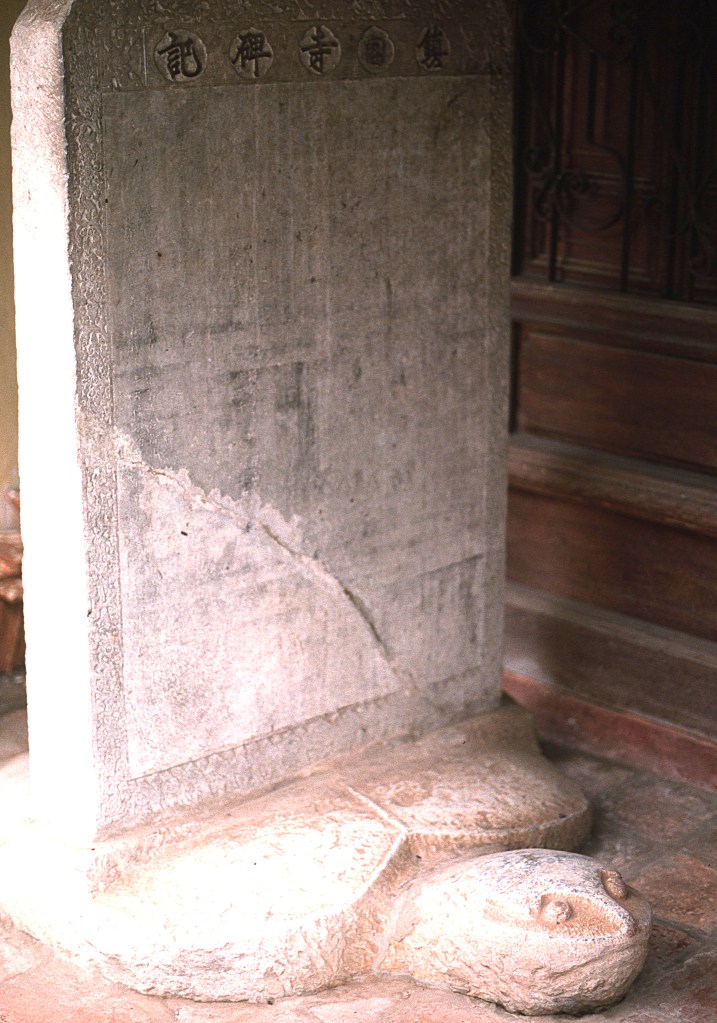
Wisdom, the great turtle with the tablet of knowledge! Viet Nam!

part-two of three parts — re-conning Viet Nam for April 30th Anniversary of the Fall of Saigon

Fall of Saigon – 20 years later.

It’s 1995 and I have Dan Yen, former vice mayor of Saigon (now Ho Chi Minh City), Le Ly Hayslip, author of When Heaven and Earth Changed Places and John McAfee, author of A Slow Walk in a Sad Rain, in our living room.

El Paso, Texas. I am in the midst of coordinating a huge several month-long look at Viet Nam and the Viet Nam war (Anerica’s war on the Vietnamese) and all those attendant issues tied to USA invading and killing, from 1960 to 1975 (disregarding the killing through secret bombings and proxies and CIA maleficence), several million Vietnamese.

It’s been a year since I was in Viet Nam essentially running like a demon through several BioBLitzes and my own search for truth (my own internal truth) as well as photographing the country.

For all intents and purposes, the defeat of the USA was pronounced April 30, 1975, with the Fall of Saigon, also known as the Liberation of Saigon. The capital of South Vietnam, Saigon, was captured by the People’s Army of Vietnam (PAVN) and the Viet Cong.

Le Ly was portrayed by Hiep Thi Le,  a Vietnamese refugee, who starred in the Oliver Stone 1993 movie of Le Ly’s life, Heaven and Earth,  the last of his Viet Nam War trilogy films (Platoon  & Born on the Fourth of July).

In El Paso,  the three are my guests for the Viet Nam War retroactive I helped spearhead and organize in El Paso, then a city with a super large number of retired military, former military and then of course the Fort Bliss and the Biggs Field Sergeants Major Academy bringing in many military, as well as the White Sands Missile range and Holloman Air Force base in Alamogordo.

I teach at several places, including UT-El Paso and the community college system. I write for the two dailies, the El Paso Times and the Herald Post. My photography of my work in Viet Nam the year before and now have been in several shows.

Le Ly and Dan both live in California, and John is a teacher in Ashville, NC. All three want to know how I liked Viet Nam, what it was like, and of course I had some crazy wild lie narratives to tell them.

Nothing as harrowing as Le Ly’s life as a village girl by day and recruited by Viet Cong at night. Dan had taken John Steinbeck through parts of Vietnam  December 1966 through May 1967 when he was working for Newsday. A book, Vietnam: Dispatches from the War came out after he died.

Steinbeck was supportive of the war, and Dan Yen was a lieutenant colonel in the South Vietnamese Army.

Le Ly was obviously the more controversial figure in this interesting confab in our El Paso house. My wife then was six months pregnant with our daughter, and both Le Ly and Dan blessed the baby with their respective prayers.

It is an amazing moment – John, a Green Beret soldier in Vietnam, Dan, a LTC, and Le Ly, a woman who was decried by all actors in the Viet Nam war and struggle. She ended up getting hitched to a US contractor (in the movie, he was depicted as a Marine played by Tommy Lee Jones) and immigrated to the United States.

Her book is highly compelling and much different than Stone’s movie narrative. Accused as a spy by the South, imprisoned, set for execution, raped by two Viet Cong soldiers. She was a drug courier and sex worker and supported her mother and a son.

For obvious reasons, I have McAfee (former West Texan) and Le Ly  in several readings and panel discussions. Dan Yen also is here to talk about his experiences.

All three admire my large photographs of places they all recognized and then others shot deep in primary rain forest and way far out of the main spots near Laos.

I have my old man’s bronze star and two purple hearts and the slug the military hospital dug out of his chest on a mantel place next to a dozen kachinas. My grandfather the World War One German pilot was framed in a collage of his childhood, Navy days and as a bread truck driver in Iowa, along with his Maltese cross and other medals for that meat grinder war.

Even though the year before most of my time is deep into ecology and animal and plant life, I still have strong connections to the American War against the Vietnamese: in village after village, when the local farmers and shopkeepers find out I am the only American in our team, time and time again Dr. Viet helps me communicate with amazing men my dad’s age and older who tell me of their long-long conscription in the military before, during and after the US was defeated.

Strong levels of respect these men have for me. It is many times Dr. Viet and me and two dozen villagers drinking wine, the sun setting, and a brilliant patchwork of two dozen greens as a backdrop.

I have no idea one year later, in 1995, I will be heading up a very large and comprehensive Viet Nam War retrospective. Unborn daughter blessed by Le Ly, and Dan Yen and John McAfee singing songs from Vietnam.

John, of course, was not pro-war, but he had been a captain in the special forces. His novel, Slow Walk in a Sad Rain demonstrates both the ugly reality of special forces virtually murdering civilians (the ends justify the means in war, also known as collateral damage) and the sheer trauma of being part of the US forces in a country not their own and in a culture way out of their range of understanding.

John and I talk a lot about the life of a writer, about his own journey as a playwright and high school drama teacher in North Carolina. He really admires my writing, and even writes a jacket blurb for a book that never made it past a couple of editorial board meetings at St. Martin’s Press. He is sure I am going to be the next great American novelist.

How the world turns in very opposite orbits. Maybe I sabotaged my life as a novelist, as some have accused me of doing. I still don’t know about self-sabotaging, but alas, I have gone from wild and crazy journalist, college teacher who supplemented income by smuggling Valium and other prescriptions over the Juarez-El Paso border, to union organizer for part-time faculty, Occupy Seattle activist, social worker for adults living with developmental disabilities and memory issues, to case manager for just released prisoners, foster youth and homeless veterans.

Le Ly tells me I am an old good soul, and that I will do good for people. We all toast on some 400 Rabbits Mescal and crank up the fireplace and dance and laugh. I know something is in the wind for me, but definitely not an Oprah moment or even third rate literary creative writing teacher with tenure. My life course never put into place those stepping stones to get anywhere, really, not in this capitalist and co-opted world of Brave New World silliness and surrealness.

I still write things down as all three of my guests say a lot and I write about them, about this experience with them in now, 1995, about all the things that happened before and after the Twentieth Anniversary of the Fall of Saigon. Even a few people in the large crowd that show up for Hayslip’s presentation stand up and turn their backs on her. Many stand up and turn their backs on me, too, when I moderate a few panel discussions while also self-describing myself as against the war, even when my old many was in the jungle getting plugged through with a slug from a Chinese carbine.

For you see, the face of destiny or luck or god that gives us war also gives us other kinds of pain: the loss of health and youth; the loss of loved ones or of love; the fear that we will end our days alone. Some people suffer in peace the way others suffer in war. The special gift of that suffering, I have learned, is how to be strong while we are weak, how to be brave when we are afraid, how to be wise in the midst of confusion, and how to let go of that which we can no longer hold. In this way, anger can teach us forgiveness, hate can teach us love, and war can teach us peace.

— Le Ly Hayslip, talk, University of Texas- El Paso, Nov. 4 1995.

In Vietnam

One full year before . . .  I am here with Meg, Rod, Mike, Dr. Viet, Jon, and a few others in the middle of primary rain forest at base-camp, along a river bend. I had just spent the night studying civets and these incredible bats that scoop fish out of the water.

Rattan harvesters are just arriving in our camp – some of the few people coming into these mountains are rattan men and hunters looking for pseudo oryx, barking deer, tigers, gibbons, hornbills.

We ask them about caves, about guano, about places we might venture to with backpacks, bird nets and gear. They draw maps on the wet ground, share green tea, eat bowls of rice and Raman and stir-fried duck eggs.

Mike the science leader pulls out a map, and we start putting down grease pencil marks on areas where the rattan men say are up thrusts of limestone where bats roost.   They wonder if we are in the game to collect bats to eat.

We show these four hardy fellows our equipment and some photos we’ve got uploaded on the computer. Dr. Viet helps us with our rudimentary language skills. They inspect our camp, which is scattershot with my tent and then a main living and sleeping area made out of bamboo, a mess area, another large lean-to, and our three Minsk motorcycles and extra gasoline. The latrine is hand-dug and enclosed with tarps.

That’s where I find and capture a green vine snake which is diurnal and mildly venomous. This arboreal snake is a constant in and around our camp, feeding on frogs and lizards. It has binocular vision to hunt.

I show the timid Brits (our Canadian, Josh, is not so timid) this snake, and since it is not happy being held by me, it expands its body when revealing black and white scale marking. A sign of even a more venomous species in the jungle.

An hour later, two of the fellows bring us a gallon glass jug of rice whiskey. Inside the container are herbs and roots and, alas, one of those vine snakes.

We sip, we talk, we laugh, and the guys show us how they cut through rattan-canes quickly. We decide to follow them the next day into the forest where they gather the rattan, which is used in basket making, furniture and flooring.

One day to the next, and we make hikes into the forest, set up rudimentary transect, and start recording what we see – insects, fungi, plants, reptiles, anything. We end up doing a lot of bird watching and recording, and the number of butterflies up here is surprisingly high. We do what the British and Americans have done for centuries – we capture-kill one species of each we see.

We are not any sort of Charles Darwin team, though at times the Brits tend to have that attitude.

Before our trip into forest, we are in Hanoi talking to scientists and researchers from the institutes of biology and forestry. One small museum has all these birds in drawers. A few rare species taxidermized into lifeless pathetic poses.

The rare barking deer is here, in a bizarre standing pose. That rare creature had been captured and taken to the institute. The biologists didn’t know what to feed it. They gave it shoots and other things they found from the Hanoi market. Eventually, the rare deer perished. Not leaving anything to go to waste, the scientists stripped the animal of its flesh and had a barbecue. Then some fellow took the carcass and hide and bones, and reconstructed it based on photos and his own instinct.

Flash forward to London, after the months and months of work in the jungle and then debriefing back in beautiful Hanoi. I am here with my wife who flew over from El Paso for Winter Holiday in London to rendezvous on my way back from Viet Nam and my debriefing in London.

Plenty of snow at Hampton Court and all the other tourist sites. We end up getting into the play, Miss Saigon, in the nosebleed seats.

Then and there, I begin writing and taking notes. I end up four month later back in El Paso with a three-act full play called Tiger Cages.

I review the American movies on Viet Nam – the three from Stone, Full Metal Jacket, Apocalypse Now, Deer Hunter.  The Scent of Green Papaya is one way outside the strictures of Hollywood. “Miss Saigon” is reviewed.

We have films shown as part of the Vietnam retrospective in 1995. My play, Tiger Cages, is performed as a read and stand play.

All of this Viet Nam – Fall of Saigon – retrospective steels me, motivates me. My former student (in basic composition) Thomas Daniel (he goes by Vu now) and I collaborate and he uses 13 of my Viet Nam images, blows them up, and imbeds them into his large canvases called “Napalm Mornings.”

Vu was a child during the America’s war War on Viet Nam. His father was in the military. His father was killed. He became a refugee with his mother and three sisters. He ended up in New York, then Los Angeles and then El Paso.

He is now in his late fifties teaching at Binghamton University. He is an incredible print maker, designs and makes clothes, and he has embraced his Vietnamese self, re-appropriating his father’s name after having a stepfather with the name of Daniel.

Here is an amazing story about the woman who plays Le Ly in Stone’s Heaven and Earth. The LA Times piece was written in 1993, right after Stone even thinking about the movie. In fact, he looked at around 16,000 Vietnamese Americans before ending up with Hiep Thi Le as the lead and staring role.

Hiep Thi Le says that even though she was only 9 years old, she can still see the look on her sister’s face that night in 1979 when a fishing boat captain grabbed her screaming 7-year-old sister and put a knife to her throat.

“Tears rolled down her face, but there was no more crying,” says the now 23-year-old Le. “I thought her eyes were going to fall out of their sockets.”

Le and her sister were hidden in a secret compartment behind a galley pantry on a fishing boat carrying them and about 60 other refugees–boat people–toward China and Hong Kong. Their father had made the trip the year before, and the girls thought their mother was sleeping with them. She wasn’t–she had stayed behind with her three other children.

“Sometime during the night, just as we arrived at a Vietnamese checkpoint, my sister woke up and started screaming for our momma,” Le says. “Everyone thought we were going to die.”

Sometime during the night, just as we arrived at a Vietnamese checkpoint, my sister woke up and started screaming for our momma … Everyone thought we were going to die”, she says. That night, a fishing boat captain grabbed her screaming 7-year-old sister and put a knife to her throat. Le witnessed it and it scarred her for life. “Tears rolled down her face, but there was no more crying … I thought her eyes were going to fall out of their sockets”, she says. Her sister survived, and when they both reached port, they stayed in a Hong Kong refugee camp. They eventually reunited with her father in Hong Kong. Le’s entire family — her parents and five children — were eventually reunited in Northern California. – Jack Matthews, LA Times

That same year, 1979, Thomas Vu came to the US as a refugee, with his family. He was 12 years old.

Those BioBlitzes still stick with me, sometimes ending up in my short fiction, other characters in novels I am writing.

The  tropical lowland rainforest trees of the genus Dipterocarpus are still in my dreams, over 150 feet above me while gibbons launch through hand over hand like running track stars.

Then the bats – as my friends, true chiropterologists — have studied all over Viet Nam, north and south, are now counting   several taxa new to science, two of which were described as new species. The bat faunal list of Viet Nam is up to 120.

The demons of Vietnam – and ironically the demons all those veterans I would end up working with later almost 23 years after these trips into Viet Nam, as a social worker  – are the monsters of my country, of the wicked war lords, of all those pigs in high office with their Military Industrial Complex brownshirts leading more and more acts of terror against brown and black people.

Every load of stench in Central America, in Iraq, in Afghanistan, in Panama, wherever, is the stench of the Viet Nam War’s legacy. This “not another Vietnam” bullshit from the soldiers of fortune and mercenaries that define the US military, I have heard it all on military compounds where I taught college English, to the highlands of Guatemala where mercenaries and ex-military were doing their dirty wars School of the Americas shame to more brown farmers.

Each step into the primary forest with hornbills above me or pangolins below is dream time, a whole other part of my brain and heart separate from my old man’s war. Separate from my older friends who have missing legs and burned faces. All those people I know who committed suicide because of Viet Nam. Viet Nam for me is people and the faltering landscape which has undergone massive bombing and napalming and razing, and even after the wars, so many starving people going into the dark jungle for food. Anything they could their hands on.

Yes, the same bats we were studying while sleeping and eating in bat caves are the same species big and small cities sell as deep fried delicacies.

In that reality is the dichotomy and the ever-flagging spirit of what it means to be an American in this land we invaded. To be a judgmental American working with scientists who are judgmental. Beauty and poverty, nature and unnatural acts, landscapes made for Van Gogh and inner cities in a layer of sadness.

But people in huts and along the Mekong near Hanoi, in Hue, in Nha Trang, those are my people in a sense – the people I want to talk to. Thanks to Dr. Viet, I am able to have more than a basic restaurant conversations.

The story continues, of course, with specific encounters, specific moments, time frozen in 35 mm film strips, enlarged and mounted on walls.

You know Paul, it takes someone like you to bring this all together. You are kind of a dramaturge pulling all these artists together, seeing this vision. It can only happen via someone like you who sees my world through different eyes. You were there but not there as Le Ly was or Dan or me. I can’t thank you enough for pulling this together. I hope there is healing as well as learning. — John McAfee tells me over some tequila

Bat Caves and Viet Nam – More than Just a War Log

I want you to guard against those who demand that you die just to prove something. It is not that I advise you to respect your life more than anything else, but not to die uselessly for the need of others… for you still have many years ahead of you. Many years of joy and happiness to experience. Who else but you can experience your life?
― Bao Ninh, author of Sorrow of War

We toast with Huda and Su Tu Trang (White Lion) beer. I am with Brits, a Canadian and two Vietnamese biologists. We are in Central Vietnam near the Laos border, in a park now called Pu Mat.

This image has an empty alt attribute; its file name is haeder-001.jpg
Personal Space not a challenge.

There are nine of us in this camp. We are on a transect to record biological wonder and caches for this part of Vietnamese. I am also here on a bat transect biodiversity blitz.

I ended up getting hired on (no pay, but that’s part and parcel the earth sciences and ecology world – MS and PhD students paying their own way to research, living on the cheap) because of skills sets.

This image has an empty alt attribute; its file name is haeder-002b.jpg
Mekong and the sea meet.

Not that I am special, but I have the scuba diving, survival school, journalist, and motorcycle mechanical attributes that make for a good team member. Photographer, and a big knapsack of proverbial ecology and environmental activism in my background. Rough travel pedigree. And more.

At age 36, I am the oldest one in the camp. Twenty-three is the youngest. I am digging up much to help build our latrine.

Oh, and my amateur reptile and herpetology fun as a youth and into adulthood puts me to the top of the list of blokes who will look at, measure, catalogue all the cool snakes we run into.

At the latrine I get to study one great specimen, with my jury-rigged bamboo snake hook.

The mythological Malayan pit viper was referred to as a 3-step snake. The veterans from the Viet Nam War talked about supposedly dying only 3 steps after being bitten. Not true, but our base camp is nowhere within days of a hospital or medical care, other than our own first responder training.

The bites from this snake can be extremely unpleasant (severe pain, swelling & tissue necrosis), the chance of death is minimal if treated. We are in no man’s land, so to speak. Everything is jungle primed, and we use iodine to disinfect our drinking water. We all got various gut aliments out here, including giardia.

A panga or machete cut while working here is a dangerous thing. We use pangas

We hike through village after village – some just a few homes (on stilts, bamboo, thatched and others dirt floors, all open to mother nature’s breezes, and many barely illuminated at night with homemade soda pop can lanterns).


We encounter some of the amazing people who are considered members of the country’s ethnic tribes. Many of the local ethnic groups residing in mountain areas are known collectively in the West Montagnard or Degar. The largest ethnic groups are Kinh (85.7%), Tay (1.9%), Tai Ethnic (1.8%), Mường (1.5%), Khmer Krom (1.5%), Hmong (1.2%), Nùng (1.1%), Hoa (1%_, with all others comprising the remaining 4.3%.

For me, although the bats, reptiles, birds, trees, mammals are amazing, it’s the people I gravitate to, as always. I’ve spent time in the Copper Canyon with Tarahumara, and times in other parts of Mexico, Guatemala and Nicaragua with other indigenous ethnic groups. My own early teen days included friends with the White River Apache band and Navajo brothers and sisters.

This image has an empty alt attribute; its file name is haeder-014.jpg
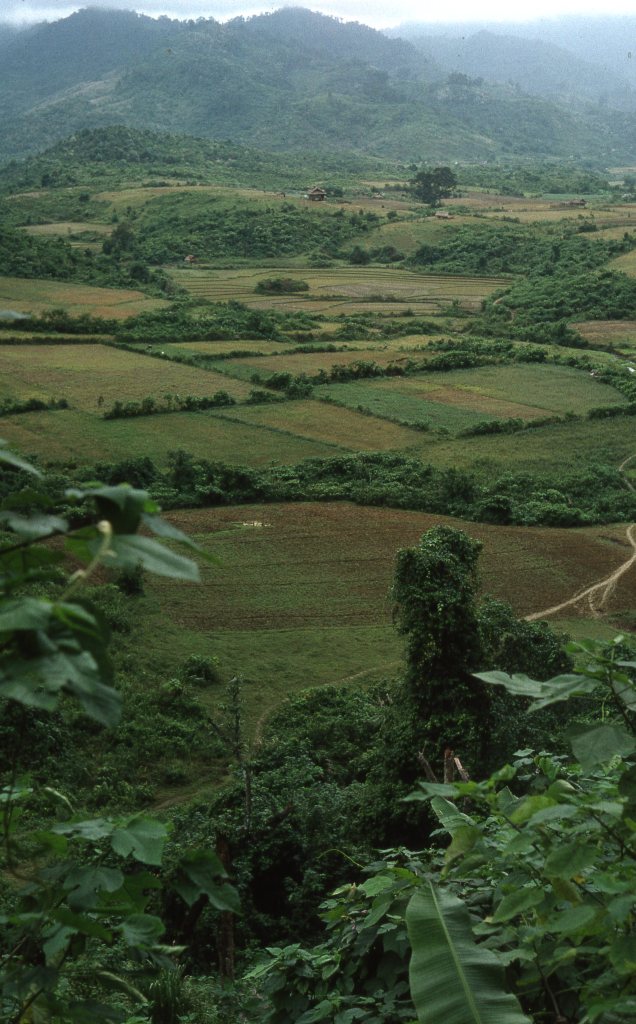
View from out climb to a small bat cave.

This is the Frontier — Society for Environmental Exploration, with marching orders from the Vietnamese government, Bird Life International, Audubon Society, and World Wildlife Federation. This group is out of England – London – and it is a non-profit that helps science projects by finding support teams to help real science get done.

As I said, I’m 36, the exact same age my professional US Army soldier father was in 1969 when he was mucking about under orders with his crypto high-level clearance and signal corps encampments.

Bronze star, purple hearts and then a total of 31 years in the US military – the exact opposite of everything I stood for. In Vietnam, he was shot in the shoulder about two inches from his heart.

The slug sliced through the Huey (UH-1) aluminum shrouding and the helicopter pilot lost half his skull from another slug.

I have an old beat-up Chinese carbine at home in Oregon that is the same weapon that pierced the Huey and my old man’s chest cavity. I have his two purple hearts and the actual slug that was removed from his body in Japan after he was air-lifted from where he had been shot.

They sent him back after recuperation. He was 100 percent medical disabled (meaning he got more on his retirement package) because of the wound, arthritis and lack of strength in the arm and shoulder.

(The irony is some 25 years later I was asocial worker for a non-profit in Portland working with mostly disabled veterans in a homeless center for vets and their families. Most of my clients were disabled in boot camp or in training. Those in the Middle East Wars were hit with PTSD and again, training exercise injuries. My job was to help them write and attend disability claims, many times rejected not once but twice before a third board hearing got these homeless vets something).

My old man’s helicopter went down, and then, the reinforcements with Air Calvary came in and set up a new LZ and got the surviving army guys out of harm’s way. He was the CW4 who carried the communication codes and a thermite grenade to use in case of enemy capture.
Fast forward 25 years.

I am here in Viet Nam working with science teams, and it’s 1994 and Clinton just normalized relations with Vietnam.

This image has an empty alt attribute; its file name is haeder-064b.jpg
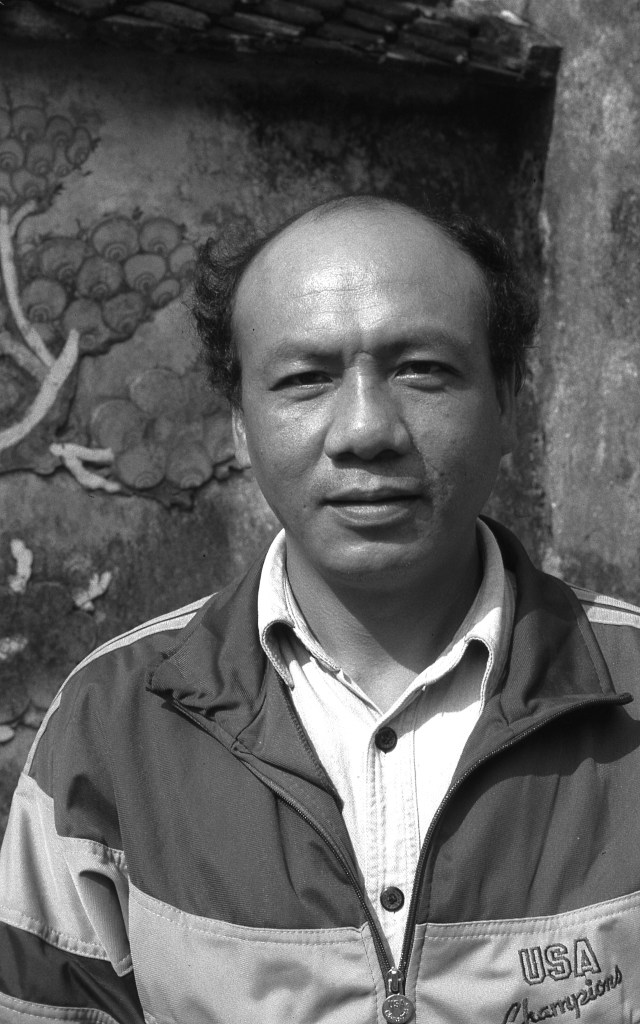
Dr. Viet my friend and colleague.

I am the lone American, or Yank in the parlance of the Brits. We are men and women, and many of my compatriots are constantly asking me questions right and left about America’s war with Viet Nam, the pulse of this society in 1994, approaching the 20th anniversary of the Fall of Saigon. Scientists like their beer and rice wine whiskey, so there are a lot of loud and passionate talks after a hard day’s hiking.

Even inside these bat caves, while waiting for the rush hour of returning bats, we drink and argue. I find the Brits more defensive of the war effort by US and its allies than most of my colleagues back home. I am a Marxist and anti-imperialist, so I am like some new species to these Brits.

I love many things about my Irish and Scots roots, and spent time in the UK, but in the end, most Brits are arrogant, patriarchy, patronizing, and, well, rather shallow when it comes to the things I have learned in deserts, on reefs, and in myriad of Latin American countries.

They can’t fathom a Che Guevara supporter like myself having a few weapons back home. I won’t go on about my spin on the Anglo Saxon here, but I have written about that side of the pond a lot.

I’m a deep socialist and ecosocialist, so I easily notice how the Brits come at things much differently than a socialist and wobbly as I consider myself. Even though they are cool, existing somewhat on the edge, living in mud and doing biodiversity studies, they have colonized minds from a half a millennia being an empire. They are naturally arrogant, patronizing, and they believe the hubris of their nation as a land of good. They are also quick to quip about how the Vietnamese we work with being backward or too disconnected to the Western concept of ecology.

In fact, repeatedly they talk about how the word ecology is not in the language of the Vietnamese. Which is of course not true on so many levels, but when it comes to the natural and jungle world, yes, the Vietnamese go into areas to trap, kill and butcher things to eat. This is not a Marks and Spencer and Safeway land.

This image has an empty alt attribute; its file name is haeder-008b.jpg
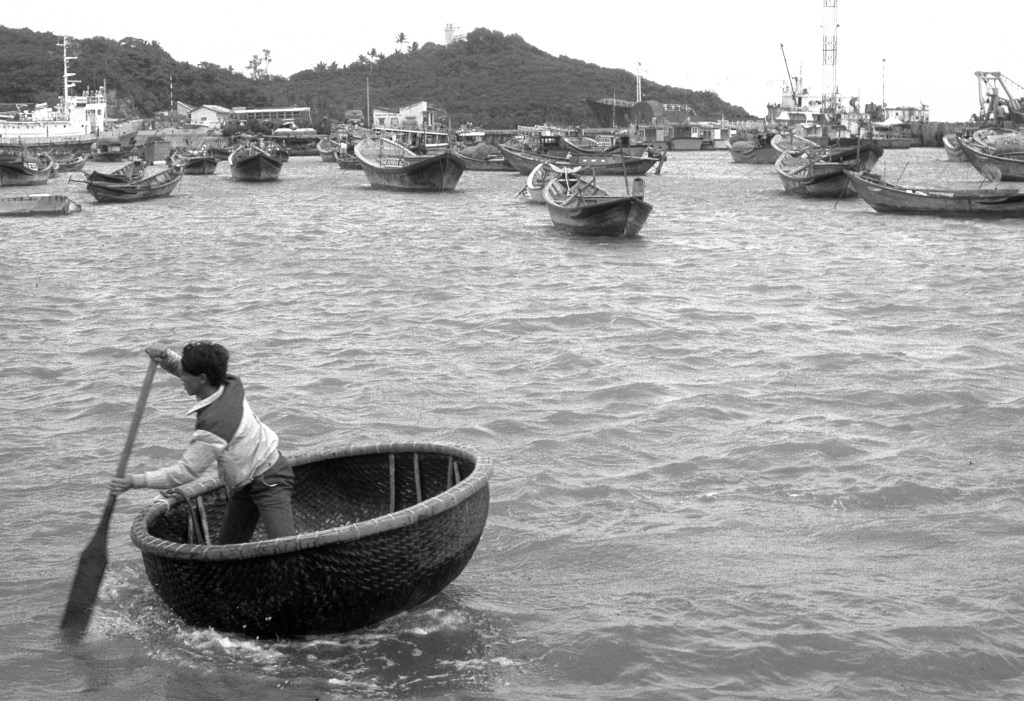
Waiting for fishers to come back.

Vietnamese starved under so many invasions, so many wars, so much austerity and broken economic systems. Anything to stay alive. Including eating deep fried bats. Which I have tasted in Hanoi.

The Brits have leveled their island and Ireland’s as well, I remind them. There are no original natural ecosystems in England. The fox hunt is big. The fact that England imports everything including their own vaunted tea and coffee, well, we are sometimes hiking through villages that have had jungle cleared so tea can be grown. I run into coffee plantations.

So, for every high tea and coffee klatch in the UK, there are real world consequences thousands of miles away. Wood for homes, cement for foundations, and on and on, the British Empire does not stand on its own.
It’s not that the Brits are daft, because I am with well-traveled blokes, and many are working on post master’s science degrees. However, I have always been in a world of night and day around academics, albeit some ecologists who are living it rough and tumble with me in the middle of jungle.

Our base camp is all self-made, and there are no tents (I am the only one who has a small alpine tent) and we dig our latrine and make our lean to’s and we cut word for our fires where we boil water to soften up our rice while we throw in tins of tuna and bamboo shoots gathered in the forest.

I know US and multinational military bivouacs and encampments since I was in the Army and around it many years as a teacher and with friends in “the service.” We have no phone service, no gas-flame cookers, no nothing. This is roughing it. Even hippies I once hung out with in Guatemala and Mexico had a shit load more amenities in their Jesus and God encampments than we do.

We have two laptops for which to type up reports and a small generator that gives us that capability and runs two 60 watt light bulbs, though we mostly use Chinese made kerosene hurricane lamps.

I know how my dad lived in Viet Nam. They had Army-Navy football games flown in on reels of tape. Castle Rock burgers. Blue bunny ice cream. Stereos and cameras and all sorts of generators and a load of mess halls and they even hired local workers to do their laundry, cooking and latrine cleaning.

Only deep long-range sappers and special ops went into the fold of jungle and mountains, and even they had communication equipment for home base logistics.

Briefings
Hanoi is amazing, and we are here for orientation, language classes, getting a look at the general lay of the land, and working on finding supplies and learning the tools and parameters we are going to use for the biological survey.

We get briefed by WWF Audubon, Bird Life International and a few other international outfits. Some agencies want us to look for pygmy rhino scat and others want to see if we find any Indochinese tiger scat. However, our basic job is to get into primary rainforest and conduct basic transect stuff, and get as much of the BioBlitz done in a few months.

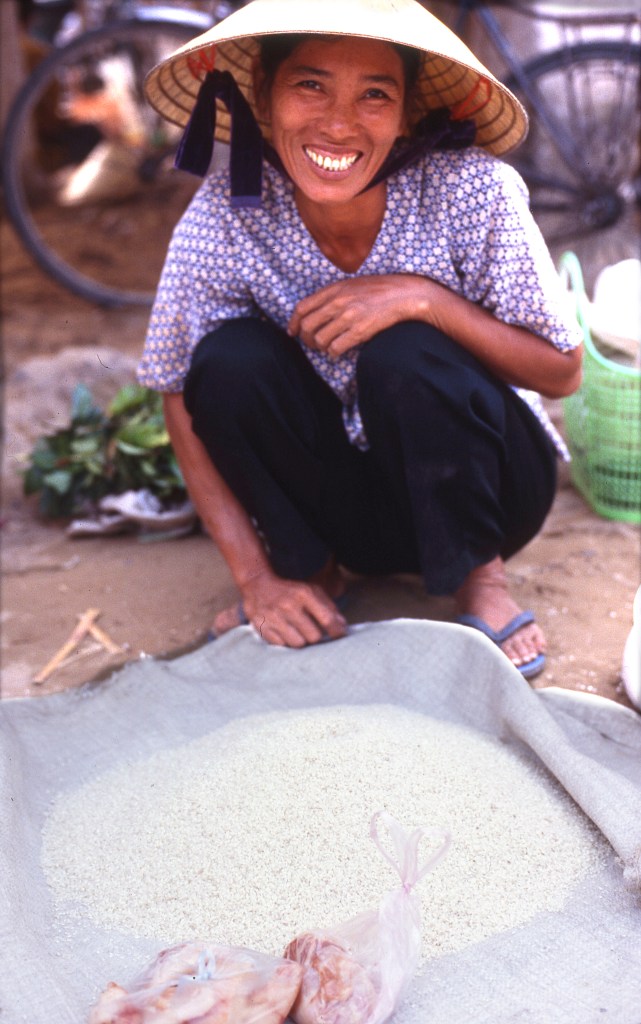
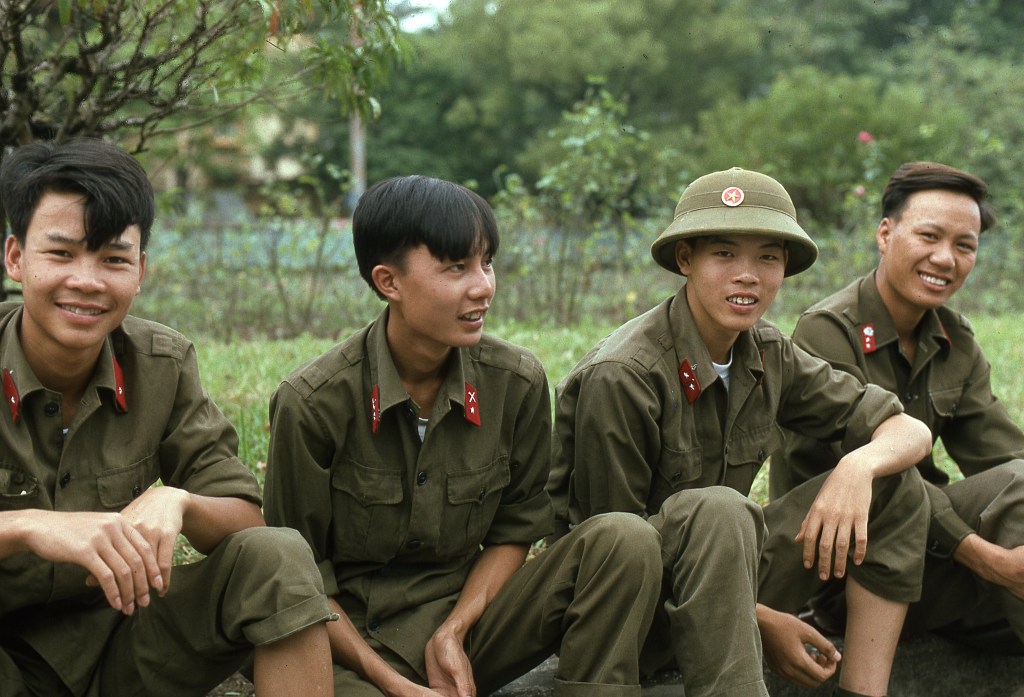
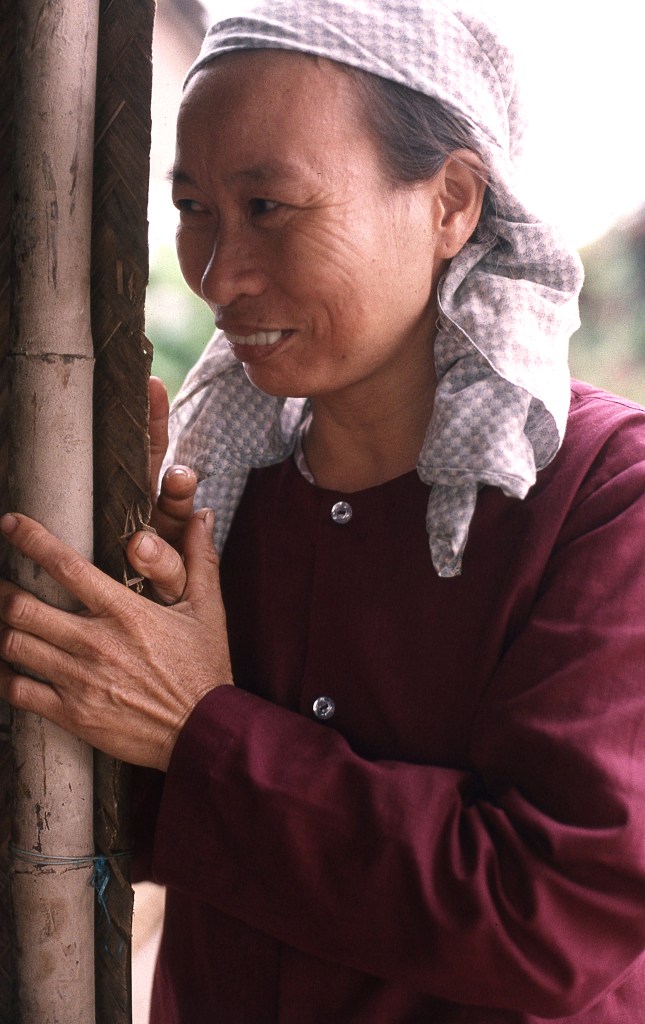
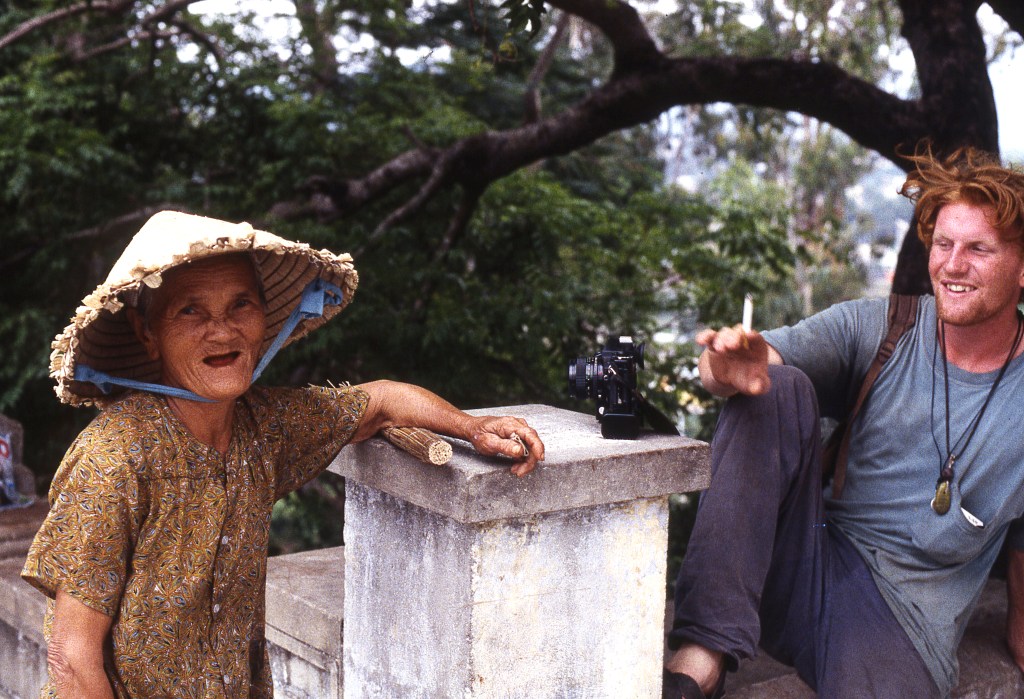
There is time to explore the city, and I end up hanging out with Viet, who is actually, a PhD in biology who lives in Hanoi and speaks some English. He is amazing and kind, helping me get shots – I have my Nikons with me and plenty of 35mm film. He is amazed at how intrusive I am, but notices my aplomb and sleuth manner of getting photos. The things I want shot – in marketplaces, close-ups of hands, odd angles, and the like – he assist me in finding.

I am not doing a travel log postcard thing, and eventually, Viet gets my artistic and photojournalistic bent quickly.

I have a motorcycle I rent, and I drive it with Viet on the back as he directs me to Buddhist monasteries, farms, food production plants, rice fields, and any number of places he thinks I would get some decent shots of.

We drink strong green tea, get up early, get on a bicycle, drive through Hanoi and find a place to eat croissants, drink strong coffee. Sometimes we eat pho for breakfast. Viet knows I am a vegetarian, and he knows I will not refuse home-cooked food from family or anyone. He also knows I am not afraid to sip anyone’s rice wine or whisky — sometimes home-brewed concoctions with added delicacies like green sniper heads, centipedes and any number of botanical fauna put in each family’s batch.

A year later, when I returned to El Paso as an English teacher and journalist, I’ve hosted photo shows of my trips to Viet Nam, through the jungle and into the cities wherein I spent time. I have helped to host big conferences to bring the Viet Nam War into perspective in relationship to the people and the country the US and dozens of other countries invaded.

Sure, I helped spearhead Viet Nam War themes film series, landing historians on campuses to talk about the war from a geopolitical point of view. I’ve helped spearhead playwrights, Vietnamese artists (including friend and former student Thomas Vu), other artists and my own photographic art in group shows. I have organized nurses who were in Viet Nam and others, like soldiers and officers, to give symposia.

This image has an empty alt attribute; its file name is haeder-076.jpg
Some people who fed us on our way to bat caves.

Still, over the years it’s difficult to really engage Americans around the lies of this country, the murdering in that country, the entire rotten episodes of US invading and deploying bioweapons, napalm and all manner of bombs and machine-gun fire into that country.

Even my own adventures in the jungle and primary rainforest and elfin forest, well, most Americans then (in the 1990’s) and now, 2020, have little bandwidth for this sort of stuff. You know, this isn’t Steve Irwin kinda gimmicks, but I certainly have been in some pretty interesting and challenging ecologies.

Just going from base-camp high into primary forest to resupply with rice, food, beer, cigarettes and the like, it was 26 river crossings, on Russian motorcycles, Minsks. Breakdowns, mud slews, raging waters and leeches sticking to unmentionable parts of the bodies and on our eyes.

Cobras and vipers. Fifteen-mile hikes into the forest to conduct surveys. Gibbons tossing their feces at us from high above the canopy. Butterflies by the dozens of species. Birds and civets.

I remember one time looking at the heavens and the setting sky light, leaning on a tree. I thought it was a breadfruit tree or something of the sort. Darker and darker the air got and I jerked, coughing a couple of times on hot green tea.

Then what I thought were fruit pods exploded above me with unfurled wings.

More than 20 flying foxes,, AKA fruit bats, took off in the dusk after my pulmonary spasms.

Shit like that happened daily. In Vie Nam.

Trekking into small villages looking for limestone mountain tops. Asking families if they had any idea about where caves were. Hikes where the people offer food and rice whiskey, and we exchange cigarettes and tins of tuna.

We end up on some bat cave hike looped from all the sit downs and toasts the villagers demanded. With their home brew. Their moonshine.

They want to know what this scraggly band of white men and women with a few Vietnamese scientists from Hanoi are doing way out in the middle of nowhere near the Laos border.

“We are here to study your country’s wildlife. We are here to help your government understand what you already know – this is an important part of Viet Nam to know and to preserve.”

Variations on a theme. Dr. Viet is there and he helps with the translation. He helps to explain what ecology is not only as a scientific field but as a concept.

I am in a place – spiritual, emotional, intellectual – my old man could only dream of.

He is already dead and buried. Age 58, from sudden coronary death.
I know what he would say to me upon my return from Viet Nam. I know how he would react to all the activism I undertake for years all tied to the history of his war with the country, our war with Viet Nam, and my own travel to the place where our own people wanted to bomb back to the Stone Age.

“Holy moly, Paul, you are doing things I could only dream of. I know you didn’t agree with what I was doing in the army, but, no matter what, the sins of the father at least are being washed away by his son. Up there with the bats. There in the rice paddies. On China Beach. It is like a dream I could never have.”

This image has an empty alt attribute; its file name is haeder-024b.jpg
Welcome home, Vietnam vet.

Upcoming: Part Two – “Deep Country, Bats, the Riot of Life in Viet Nam’s Cities”

Here is Part Two — DEEP COUNTRY, BATS, THE RIOT OF LIFE IN VIET NAM’S CITIES

NOTE: This is non-fiction, but if you purchase and read my short story collection, you might be able to see germination and the genesis of how some writers create fiction. There are 17 stories and a hell of a big preface. Here: Wide Open Eyes — Surfacing from Vietnam

Support writers during a time of lock-down and no public appearances and book signings and talks allowed. Thanks, Paul Kirk Haeder!

A real micro-manager

“At 550 percent of daily value cumulative nutrients, broccoli [microgreens are] the king of nutrients. It has the most complete nutrient package of any vegetable on this list. It is packed with Vitamin A, B, C and K. Plus, it has a significant amount of as iron, magnesium and phosphorus.”

— Jason Lee, Grow Your Microgreens

Microgreens 2
Biointensive growing!

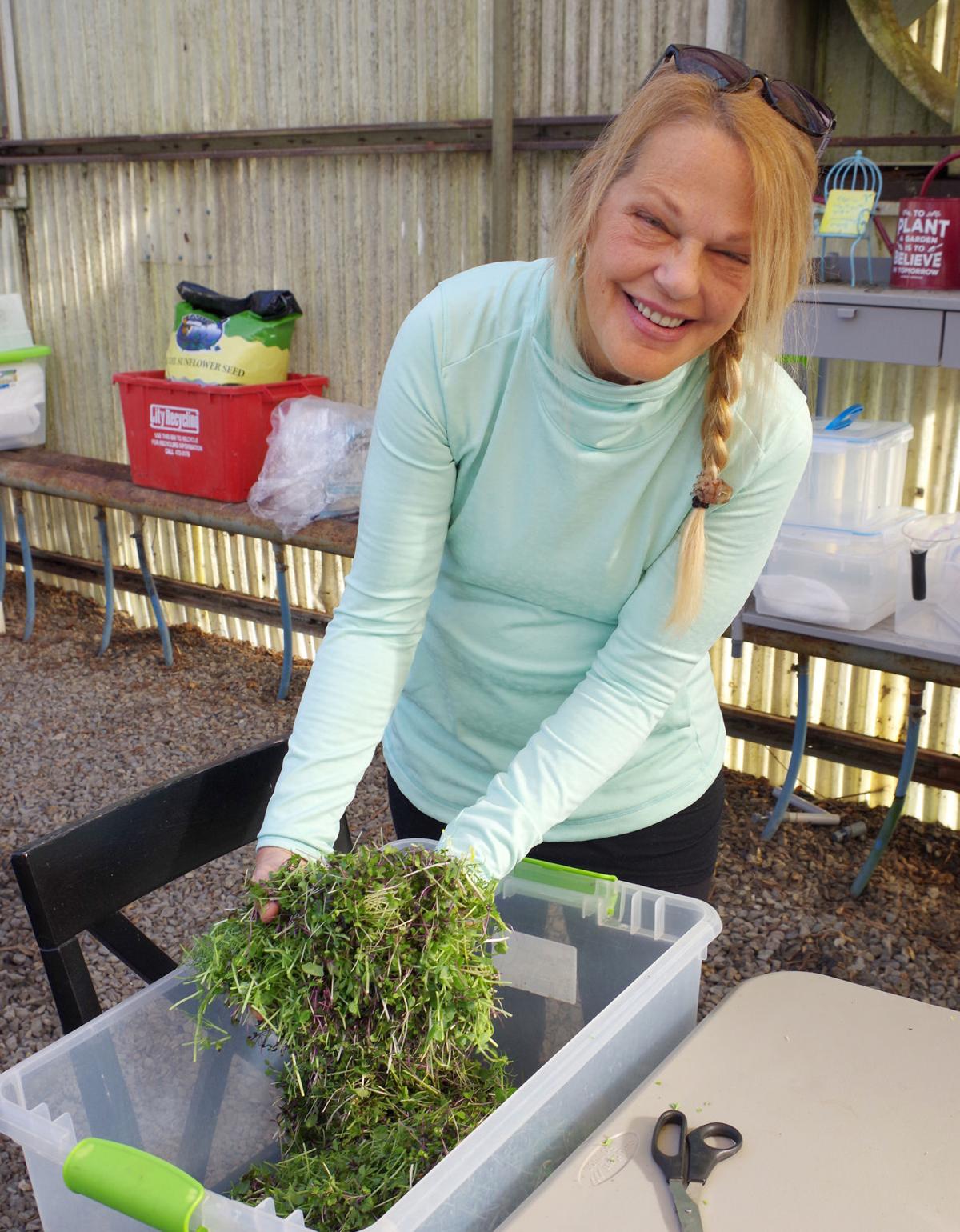
I met Helen Denton at a Newport restaurant while interviewing for a feature story. She had just brought in clear plastic containers of some of her delights — called “plant confetti” for some, microgreens for others. Also, in her cache were edible flower blossoms.

Her operation is in Waldport, called Lil Swiss Farms. She invites me over since I thrive on the stories of people on the coast whether newcomers or sixth generation deep, it doesn’t matter to me.

The story of microgreens eclipses any hippie and vegan roots — if you hate your broccoli like George H W Bush stated as president, there is still the option of broccoli shoots. All that energy to push the seed up into gravity-fed air, all those resources to get the stalk to lift up leaves and flowers through all that cellulose magic actually saps the plant of nutrients. Big time.

“I’ve heard up to 40 times the nutritional value broccoli microgreens have over the vegetable broccoli.”

She’s showing me around her greenhouse operation in Waldport, as part of the seven acres where Tiny Tranquility Park is sited.

This is a one-woman show, and Helen’s 62 years on planet earth belie a 180-degree turn from her more than 40 years in the time-share resort business.

Microgreens 1

Early roots, early gardens

Interestingly, Helen’s background goes back to her grandparents from Bavaria, who ended up in the US after World War One. Family history is a big story for most of my column’s people. Some, like Helen, decide to not get too deep into immediate family dynamics.

She did say, however, that one day her New Jersey-raised father in one fell swoop lost his wife. Helen was six months old at the time when her mother died of a cerebral aneurism. “And if it had happened today, she’d be operated on and be fine.”

He was left raising Helen and sister. She counts Painesville, Ohio, and New Jersey as stopping points in her early life. She ended up in Houston, Texas, from 4th grade to her high school graduation.

Not surprisingly, she wanted to build a family, but she ended up with three children who she raised herself. “I have great kids. It’s the best work I have ever done.”

Her current two-plus year microgreens venture contrasts greatly with her father’s work as a chemist. As a scientist with Bayer, he was part of the manufacturing team for dinitrotoluene (DNT), a mixture of toluene and nitric acid. It’s what ends up in bedding, furniture and car dashboards as a flexible polyurethane foam. Its closes cousin is the more infamous TNT (dynamite).

She is quick to explain while microgreens are a new iteration of Helen Denton, she has always been around gardens and was always gardening. In fact, when she moved back to Texas (there while helping a family member battle cancer), Helen built and tended 27 raised garden beds.

“It must be a leftover from my grandfather. He had half an acre on his New Jersey property. Half of that was a garden. My sister’s been the same. It must be in my blood.”

Demand for the product

She counts many local and regional restaurants as part of her customer base. Green Salmon, Yachats Brewery, Restaurant Beck (a James Beard mention) and Coast & Vine are just a few that put in orders.

The Lil Swiss Farms list of microgreens is extensive, including collards, kohlrabi, pea, mustard, radish, broccoli, borage and sorrel. Also, in the mix are herbs like rosemary, mint, sage and basil. Then there are the edible flowers: nasturtium, marigold, calendula, snapdragon, chive blossom.

“Lil Swiss Farms’ microgreens not only make food more appealing to the eye, but the flavor can take a dish from good to great,” according to Chef Sam Bretz with Restaurant Beck at the Whale Cove Inn.

The greenhouse at Tiny Tranquility Park is huge and full of light. Helen said she has put in sweat equity to clear it out of all the junk as things piled up during its disuse. The space comes from Josh Palmer, the New York native who owns the tiny home/trailer park.

Part of her responsibilities are maintaining the garden dedicated to the Tiny Tranquility residents who have access to homegrown vegetables from a garden which takes up part of the greenhouse. The residents harvest it, in a pay-as-you-will honor system.

She’s aware of microgreen growers who set up grow lights, irrigation systems and hundreds of trays to produce 800 pounds of microgreens a week.

“There’s something really fulfilling, healthy and satisfying to grow in this natural light. To put your hands in the soil.” She says she’d have it no other way working this small business vis-à-vis the value of fresh air, sunlight and ground and gravel under her feet.

The Tiny Tranquility Park garden is her reminder that people who live intentionally have a desire to eat healthy food from a pesticide-and-herbicide-free garden.

While surfing the internet, I came across this accolade for Helen and her microgreens, from a resident of Tiny Tranquility Park:

“Pinch me, as it is a tiny houser’s dream come true. To be in a community with its own greenhouse garden and, with Helen’s expertise in helping us raise our own vegetable gardens. Plus, we have a place to store our own plants in the wintertime. The best perk is having the closest opportunity to purchase the freshest microgreens just a few steps from our tiny houses. Wow, how cool and healthy is that. Thus, the title of my blog, Tiny B is in ‘Microgreen Heaven.’” — Brenda Schwerin, Just B Tiny blog.

Growing the Micro-green biz

“With just the right partner, we could easily quadruple this business,” Helen says while showing me those exotic-looking microgreens like red garnet mustard and red-veined sorrel.

She may be hoping for a 50-50 partner in 2020 — “I worked seven days a week straight for six months, and I haven’t had a vacation in two years.” But she knows daily watering, prepping and washing down containers, packaging, marketing and expanding markets will require a special sort of co-owner.

She laughs about how in all her years in resort timeshare marketing, she got used to four weeks off a year for vacation fun.

Now’s she’s 62 and working long and hard to maintain the business — one where you can’t just lock the doors and take off for a week at a time. Someone has to water the crops. With an average growth cycle of seven to 10 days, they have to be clipped, watered and delivered.

The road here has been long traveled, a far cry from her nascent years.

Think “and ah-one, and ah-two . . . “

She ended up working for a timeshare development company tied to the North Waterwood National Country Club. She was in college majoring in languages and commercial art when a careless “drag racing” accident pushed her out of school and into the corporate world to pay off the resulting bills.

She moved up from secretary and receptionist to director of special projects for the timeshare entity run by the grandson of that famous champagne music guy, Lawrence Welk during her more than 45 years working in resort marketing.

Helen emphasizes that she knows many timeshare schemes have “earned a bad name with their marketing practices in the early days.”

Her role was working on research projects to delve into the corporation’s internal needs such as new computer systems or call center technologies.

At the end of the day — while she relishes her new simpler life — this Microgreens Lady tells me she feels she helped a lot of families have rewarding family vacations.

That world taught her laudable lessons — independence, self-agency, single parenting tools, love of her family.

This family includes son Justin, 35, who is in an RV traveling across the country with his girlfriend. Kathryn, 34, is working for the Westin Hotels & Resorts timeshare office. Her youngest, Kalynn, 33, is a photographer for the Mayo Clinic in Scottsdale.

She is jazzed about a two-year-old grandchild living in Arizona.

As she shows me incredibly vibrant microgreens, we talk about how she fought hard in the “good old boys club” while in the timeshare business, and how she felt like a token female.

“I’m a pretty opinionated, strong-willed person who wasn’t a stay-at-home kind of woman.” She points out she wanted to be married and have children, but that she also wanted independence.

He life now is tied to these shoots, microgreens that on average take nine days to grow in the summer and up to 16 days to get big enough for harvesting in the winter.

“These guys are pretty particular and need every day watering and tending.”

Marketing Push 2020

I meet Helen at the greenhouse in January as she preps and packages her microgreens for a run to Yachats, to one of her regular customers, Green Salmon Coffee Company.

I take photos of flowers some chefs incorporate as garnish in their recipes — sugar peas, fuchsia, snapdragons, nasturtium. She quickly updates me on her 2019 gains — her accountant said she did much better than even Helen thought. It was an 85-percent increase in her gross sales from the year before.

Her goal for 2020 is gross at least 20 percent more in sales. She’s also redesigning her brochure and is ready to go north to pitch her product line to restaurants in Lincoln City.

Her one-person show is all about becoming more efficient and hiring reliable part-time help to carry out jobs like basic washing and sterilizing the trays.

She repeats to me several times, “Compared to the women you have written about, I am pretty bland.”

Her story is one where more than 45 years in the corporate world — “where everybody wants more and more out of people” — has morphed into “allowing life to slow down without all these self-imposed pressures.”

“I love my life. It’s taken me one and a half years to say it’s okay if I leave at 1 or 2. The world’s not going to fall apart.”

Her micro-greens are delivered within 36 hours of harvesting. Many last easily seven days under refrigeration. Some of her clients are twice-a-week users, others once-a-week or bi-monthly.

Her greenhouse has a community lounging and a yoga practice area onsite. Inside during winter, the place is warm. In the summer, all the windows are opened and fans cranked up.

Her greens and flowers are digging it, so to speak.

She reminds me that both the basil and chard micro-greens have been a real bear for her to grow. Luckily, she has a good friend and fellow micro-greens and vegetable grower, Becky Sue Graves in Siletz, covering those two products.

Her business has doubled from year one. For now, she is looking forward to her son and his girlfriend coming to Waldport for a few weeks to help out during the peak time, summer.

From the end of May through to the end of December (her peak months), the reader shouldn’t be surprised to see this spry woman delivering compact containers with her dozens of micro-green products to one of your favorite eateries.

In her own words on the quick

She’s a busy person, getting orders for her current list of buyers and planning for new markets for these tasty and nutritious plants. She answered these questions with aplomb.

PH: In a sentence or two define community as you have found it here in Waldport?

HD: I have found a generosity of spirit, thought, acceptance and openness in the Waldport Community; both from people I have gotten to know well and those who are merely acquaintances.

PH: Toughest things you face as a business woman — solo — with your microgreens business.

HD: I don’t necessarily feel any gender-related challenges in this business; however, I do wish I could schedule a vacation so I would say my biggest challenge is that it is a solo operation that requires daily attention.

PH: What philosophy have you garnered over the years — personal philosophy?

HD: Do your best to take care of your corner of the world as much as you are able. If you can do more; do more.

PH: What advice would you give a 17-year-old facing dropping out of college?

HD: I wouldn’t.

PH: When you think of a better world, here in our county or anywhere, what does that look like?

HD: The elimination of greed and jealousy. Imagine how awesome the world would be if we didn’t have those two things.

PH: Define success for me in your words.

HD: Being genuinely happy

PH: Define justice for me in your own words.

HD: The illusion that something you didn’t want is an ok replacement for something you did want

PH: If you weren’t in this line of work, now, here and now, what would you see yourself doing and why?

HD: No clue (other than falling back on old employment patterns) so glad I don’t have to think about that.

PH: What do you do for fun around here?

HD: Crab, hike, mushroom hunt, kayak, read.

First appeared in Oregon Coast Today, my paid (minimum) writing gig.

Support writers, man, in this lock-down and death of social groups. I had dozens of book readings planned for local and regional libraries and bookstores and a literary conference. Interviews in newspapers and on the radio. All cancelled. Here is my book, folks. Short story collection that will knock your socks off. I will be writing a piece on my bat cave studies in Vietnam, a non-fiction piece, to appear here on the blog and elsewhere. Order the book, and/or hit that GoFund Me campaign.

Go Fund Me for the story collection, Wide Open Eyes — Surfacing from Vietnam.

The books is ordered through me or the dreaded Fascist Amazon. Here, Wide Open Eyes (Amazon)

Great review of the book, here: Linda Ford at Dissident Voice.

Al M. donated $25 ·10 hrs ago “Love the writing”; Christine L. donated $75 ·15 days ago. A big thanks!

Trapped by the White Man’s Devils

by Paul Haeder / March 21st, 2020

A certain amount of despair is, well, healthy. But that fine line between using it as a motivator and that other type of the neutering kind, or the type of despair that pushes one over the edge into depression, it’s a matter of degree. And perspective.

Denial certainly staves off despair. The huge swath of Americans who are either MAGA crazed or believers in the democratic party line of war, neoliberalism, austerity, and the facilitators of the dog eat dog mentality that is capitalism under any level of American self-declared red-white-and-blue. Bloomberg or Gates, or Bezos or Buffett, they all are the power brokers of despair.

Their riches and their self-importance and their overlord power, all of it, the cause of so much despair in thinking and feeling people.

For me, a few weeks away from Dissident Voice and these polemics is more of a symptom of business that is the new normal for Americans, young and old. I turned  63,  and here I am, with three jobs, and a fourth avocation attempting to hawk my books in a climate of controlled opposition mega-obscene celebrity publishing.

All bets are off since all books readings have been canceled in Washington and Oregon, thanks to CV-19.

But it begs the question . . .

No one buys books of fiction anymore, and few read novels and short story collections, two of my forms of creative expression. My writing is not happy-go-lucky, and the concept of narrative and the great American novel/short story form I have little tolerance for.

I’ve done the college degrees – Journalism, English, Rhetoric, Writing – and have had my time with smug MFA types and worse, belittling professors of writing, AKA Literary Little Eichmann’s.

The despair I have within the context of my own struggle and creative avocations, conjoined with my disregard for this society, or the Western culture of rapacious theft and degradation of other peoples, other cultures, other lands can set forth a type of nihilism or cynicism that proves unworthy of my own desire to continue chopping at the windmills in a ritual of helping as many people as I can.

It is struggle, talking to commercial novelists, or those that have tenure outposts at colleges who are a safe bet, or who wrangle their words from a highly structured environment of  strictures that kill any outlier or outrageous way for writing.

There are not just rules for their form of creative fiction, but rules of the game.

Devil’s Churn

The oddity of the US Forest Service having a little outpost near Yachats, Oregon, called Devil’s Churn is remarkably absurd. Think about it – the number of things in western societies named “devil this, devil that” in a land ripped from the true caretakers of these places is both pathetic and demeaning.

All original names from first nations people’s have been ham-fisted into suffering Anglo Saxon or Germanic or Greek oddities. Spanish, too.

I take the path almost daily to this little cataract of waves surging in and out and pounding the volcanic rocks of this cool place along the Oregon Coast. I leap around slick rocks, look for a sign of any sea star clinging to the rocks, even though I know seastar wasting disease has decimated most of the species of sea stars in Oregon waters.

Along a rocky portion of the geographic stop I see a placard, put out by the Forest Service, in some sort of historical remembrance of the native people’s who used this part of the world for centuries as clamming sites, and well holy places.

It’s been scratched to death, this plaque, with most of the wording obscured by gouges in the Plexiglas. Amazing, this plaque is off the beaten path, under salal and pine boughs. I feel that despair – how the white tourists, the miscreant species, probably with their collective balled up hate for the Indians, just decided to say to the world that the history of these indigenous people are meaningless.

So they scratch off a culture, at least in their square small minds.

Probably dangerous to the illiterate masses this wasteful country keeps churning out yearly in our PK12 “schools” and those bastions of “higher” education called colleges and universities. Knowledge and history are the bane of Americans’ thinking, whether it’s the current accused pedophile in high office who daily bombards us with lies,  or masses more that have the power positions: business heads, politicians, the financial class, CEOs, the rich and famous.

In this time of hysteria, bad planning, no health care safety nets, no leadership, no human governance, we are all stuck in the place of plague!

Thatcher is more relevant now than every. Her words are tattooed on the asses of Fortune 1000 sociopahts and on Trump LLC’s neck, on Pelosi’s and Schumer’s and Dianne Feinstein’s dirty rotten backs.

Margaret Thatcher said it plainly, remember? The clipped syllables yet issue from that throat of near-mechanical inelasticity:

“ … there’s no such thing as society. There are individual men and women and there are families.”

Therein lies the dog-eat-dog, survival of the fittest, the fired Apprentice shit Americans consume and bow to.

So simultaneously looking at this amazing place of crashing Pacific (Devil’s Churn or Devil’s Punchbowl) waves and realizing how my fellow citizen and I are world’s apart lends a certain despair in my bones.

THE DIFFERENCE between despair
And fear, is like the one
Between the instant of a wreck,
And when the wreck has been.

The mind is smooth,—no motion— 5
Contented as the eye
Upon the forehead of a Bust,
That knows it cannot see.

–Emily Dickinson (1830–86), Complete Poems, 1924, Part Five: The Single Hound

Worldviews, Not Enough Local Views

This is meandering and it should be. I have gone many miles inside my brain since I started writing this. Man, the world has topsy-turved, but it was expected. My next piece is on bats — all those bats I lived with in caves in western Vietnam working with teams of researchers on biodiversity studies. Bats, man, some 1,300 species, and then, the corona!

I can leap around back to the bailouts for airlines, for a putz like Richard Branson, for so so many millionaires and billionaires. My daughter in Spokane, however, is out of work. The aesthetician school she was about to attend is on hold. Her photography is on hold since she does cool shots of businesses and people.  Her significant other just opened up a New York style pizza place, and that too is closed down. Things will close more and more.

The closing of the American mind slammed shut decades ago. My new book — short stories, Wide Open Eyes: Surfacing from Vietnam —  has my preface in it discussing the “no more Vietnam War mistakes” syndrome. That is the neocon syndrome, the neoliberal syndrome, of making sure to go into someone else’s land and bomb them back to the stone age, both literally and with financial nukes.

Vietnam was all about the ramped up bioweapons (that started back thousands of years ago, but for USA, well, read on, and weap: A Short History of Bio-Chemical Weapons.

Damn, this well-done Counterpunch article doesn’t even have listed the Swine Flu USA/taxpayers/CIA unleashed upon Fidel’s Cuba — San Francisco Chronicle first reported this, and alas, it’s not even discussed in a time of bat corona, AKA SARS. That was 1971.

Rumsfeld, Cheney, Swine, Turkey Feather and CIA deja vu in Cuba

With at least the tacit backing of U. S. Central Intelligence Agency officials, operatives linked to anti-Castro terrorists introduced African swine fever virus into Cuba in 1971.

Six weeks later an outbreak of the disease forced the slaughter of 500,000 pigs to prevent a nationwide animal epidemic.

A U. S. intelligence source told Newsday last week he was given the virus in a sealed, unmarked container at a U. S. Army base and CIA training ground in Panama with instructions to turn it over to the anti-Castro group.

Why oh why have the chickens come home to roost?

“…it was the evil of slavery that caused the downfall and destruction of ancient Egypt and Babylon, and of ancient Greece, as well as ancient Rome,” Malcolm told his audience. In similar fashion, colonialism contributed to “the collapse of the white nations in present-day Europe as world powers.” The exploitation of African Americans will, in turn, “bring white America to her hour of judgment, to her downfall as a respected nation.”

Malcolm’s core argument was that America, like the ancient civilizations of Greece and Rome, was in moral decline. The greatest example of its moral bankruptcy, Malcolm argued, was its hypocrisy.

“White America pretends to ask herself, ‘What do these Negroes want?’ White America knows that four hundred years of cruel bondage has made these twenty-two million ex-slaves too (mentally) blind to see what they really want.”

All those Wall Street, Military Industrial Complex, Economic Hits, CIA-launched Businesses, Structural Adjustment, Bioweapon-producing, Fat Boy and Little Boy Nuke hugging leaders of the free world need these pandemics, these September 11, 2001’s, all of it, to keep the engines of money and surveillance capitalism  going.

And it all comes down to my friend Joe from California. It’s a long letter to me, but so many layers of truth and emblematic connections to the DV readers’ everyday lives and struggles in so many ways. The layers of how messed up USA under capitalism are deftly stratified here.

Paul

My oldest brother was born with cerebral palsy as a result of a nurse binding my mother’s legs together because the doctor was still at the golf course and not present for the delivery. As a result of that stupidity, my oldest brother, who was already engaged in the birth canal, starved for air. It fucked him up pretty good.

My father never really handled my oldest brother very well. I think he felt my brother’s handicap was somehow a reflection on him. People and society back then had some pretty weird ideas about what being a man was. Coming off the war, a man was supposed to be tough, and having a child like my brother I don’t think fit in real well to my fathers image of himself.

Growing up in that household was one Hell of a life experience never knowing what was going to set things into pandemonium. The best and worst thing or maybe the worst and best thing that ever happened to my brother was that some medical quack recommended my brother have shock therapy, which turned out to be like pouring gas on a raging fire. The best thing that ever happened to him was that he was institutionalized and assigned a councilor that did more to help my brother than probably anything else in his life. This man was truly a Godsend for my brother. And then came Ronald Reagan. I’ve often pondered who was crazier Ronald Reagan who closed the mental health hospital where my brother was being treated, or my brother. Fortunately the councilor that was helping my brother, before getting the ax, got my brother on aide to the totally dependent.

ATD and with the help of the family, my brother was able to live independently in his own small apartment in Merced. He was crazy as a shithouse rat, but he wasn’t stupid. In some ways I think my oldest brother was the smartest of the bunch. When Nixon went off the gold standard because Charles de Gaulle demanded gold as exchange rather than paper dollars, my brother would take cash from his check and exchange it for rolls of coins. He would take the silver coins out and replace them with the copper coins and do it over and over until he ran out of money and had to wait for his next check.

He did this until he had about fifteen hundred dollars in face value of silver coins. When the Bass brothers in Texas decided they were going to skin a fat hog and try to capture the silver market, my brother got my mother to come in and take him to get the silver coins he had amassed exchanged for dollars. He made a sizable wad of cash out of the deal, and, fortunately, my Mother who didn’t know my brother had been doing this, took possession of his wad and doled it out to him to help with his food, clothing and rent; otherwise, he would have just pissed it away.

I would take vegetables to him after Market on Saturdays; he would never let me inside his apartment which I’m sure was a fucking mess. What finally ended up happening to him was he contracted a disease called Guillain Barre Syndrome. It’s the most horrible fucking disease you can imagine. It started as numbness in his feet and slowly moved up his bod,y until he was completely paralyzed. The only way anyone could communicate with him was to formulate questions in a yes or no sequence and have him blink once for yes and twice for no. He was sent from hospital facility to hospital facility like yesterdays trash with every move ending him up further away from his family.

Somehow I got designated as the contact person for his affairs. I was contacted one morning at about 3:00 AM by a hospital down by the San Fernando Valley that my brother was having a series of mild heart attacks and wanted to know if they should continue treating him or just let him go? During the telephone call, he had a massive heart attack and died. His death certificate listed his cause of death as a heart attack. I later found out that in fact it was a heart attack, but it was caused by gas gangrene because of bedsores because the facility he was in didn’t have a bed that moved his muscles like the previous facility had and no one was checking him for bedsores.

I, along, with my sister got the job of cleaning my brother’s apartment out before his death. It was the most unbelievable mess you could ever imagine. No animal would ever live that way. It made a hog wallow look sanitary. I would suspect it had a lot to do with his chronic health problems regarding his breathing and maybe even helped bring on his Gullain Barre disease. The filth he lived in was a danger to himself and others in the building he rented.

I don’t know why I’m telling you any of this, Paul, other than as I read this essay on homelessness  [ A Crash Course on How to Handle Homelessness ]  all this started coming back to me about my brother. This fellow that wrote this piece brought up a lot of things my own family experienced with my brother; he also left a lot out. Dealing with mental illness is a tough row to hoe. As a social worker, I’m sure you well know that. But what little help there was for my brother was always under assault, and if it wasn’t for my parents, my siblings and myself it would have gone a lot harder on my brother.

Maybe that’s why I get so incensed by a cocksucker like Jamie Dimon who never worked a fucking day in his life and who gets all butt hurt when someone questions his success. His wealth came at the expense of my brother that couldn’t help himself due to circumstances beyond his control by a cocksucker doctor and his Nurse Ratched who totally fucked him up because of the same arrogance Dimon displays. And I do hope the Devil has his arrow- tipped tail up Ronald Reagan’s ass in an eternal effort to never let Reagan forget the Hell he brought on to a lot of those unable to defend themselves.

Book Review of Paul Haeder’s Wide Open Eyes:  Surfacing from Vietnam

by Linda Ford

I can’t pretend to be a literary critic, but as an historian and one who’s plenty old enough to know something about the effects of the Viet Nam war, Paul Haeder’s stories about the lasting, inevitable impact of the Viet Nam experience, in his new book Wide Open Eyes:  Surfacing from Vietnam, are just riveting.  The problem is, of course, that people did (and do) not want to open their eyes wide enough to see all the horrors and lasting pain and enduring legacies of that era and that experience.  When I was a junior at SUNY Albany (1970), the editors of the college yearbook, “The Torch,” decided to insert a photo of a severed head of a Vietnamese child hanging from a pike between each senior’s photo.  This was a time of in-your-face political protest and the editors’ statement caused a huge uproar and a lot of discomfort.  I think that’s what Haeder’s stories are doing — opening eyes and creating discomfort by showing how the horror of that severed head appears in the apparent normalcy of people’s lives.  So in many and varied stories, with their many and varied characters, he is involved in a disturbing but very valuable enterprise.

Haeder’s time in Viet Nam in the 90s, working on a biological survey, solidified a connection with a people who “had no stake in America’s way of life.”  They were just being invaded by “another colonialist.”  Just more victims of American Empire.   Haeder sees their experience as a “linchpin” for other American “adventures” in places like Iraq.  I also see it as the beginning of the inflating of the Big Lie as government policy, that Philip Slater wrote about in Pursuit of Loneliness, a book which had a tremendous influence on accelerating my continuing disillusion with America and its so-called superiority and greatness.  And as Haeder says, this awful war came into everyone’s living room — with the media’s attempted sanitation of it — and with those of us who began to know it was a lie, creating huge rifts between generations, friends, families, and huge rifts within the culture.

Each of these stories is an opportunity to go into a deep pool — sometimes of pain, and sometimes of triumph.  One of my favorites is “Conversation in a Second Story Studio Apartment.”  As a bookseller myself, I sympathized with Jacob Weiss, the widower “Bookman,” in his efforts to keep bugs, etc. away from his books (mothballs are a bad idea, however).  Weiss has unsuccessfully tried to instill anti-war sentiments in his Viet Nam vet Air Force Lt. Colonel son, who “exterminated people thirty thousand feet down”; and he has not been entirely successful trying to start a relationship with Ramona Vinkovska, ballet instructor.  These characters are not romantic leads — they are flawed people — and that makes them interesting.  Jacob complains that there in Albuquerque, he can’t sell Yiddish poetry — people want books on horses, and war.  Ramona lost her husband and baby daughter when she lived in New York, a place where she had lost her chance at being a ballerina.  But they both have their dreams, separately and together.  They make do, do the best they can, and put off decisions.  They deal with their tragedies and they survive, helping each other through painful remembrances.

In “Sister of Glaciers,” protagonist Tony’s sister was married to a war dissenter, and Tony is himself about to go to war in Viet Nam.  His sister died in a motorcycle accident and his mother has “acid eating her thoughts” about that loss, and about Tony going off to war.  Tony’s thoughts revolve around the blame that “old men in Washington and corporate America” hold for the war.  Guilt is key here:  Tony is for going to war and for not being able to heed his sister’s pleas against the war, but instead giving in to his father’s desire for Tony to be a soldier.  His father excommunicated his daughter for being with an AWOL soldier.  Haeder says the war killed Tony’s dissenter sister, Her (AWOL) husband’s will to live, and “his mother’s spunk”, along with Tony’s spirit.  Tony finally finds peace after spreading his sister’s ashes into the ocean.  Keeping some of Kathleen’s ashes with him in a leather pouch, he says he wants to take her “whole” into war.  This account is incredibly sad, but Haeder is able to also present people — again — who survive and still have hope.

Sacrifice and sadness and never-ending pain under the surface are also the themes of “Scordato’s Famous Pasta and Shrimp and Peanut Sauce” (which sounds really good to me).  Martino Scordato is lauded for his food and also for his purple hearts, but Viet Cong were among the villagers he saved in 1968, so he is not entirely a hero to Viet Nam vets.  It’s particularly interesting to me as a women’s historian, that Haeder’s character “Di-Di,” Trung Giang McEvoy — the Viet Cong leader that Scordato saved — was named for one of the sisters who were warriors and then martyrs for their people in 40 A.D.  “Di-Di” fought the American invasion, but also eventually married one of those invaders and left Viet Nam, becoming an author who was a “darling” on the talk show circuit.  The convoluted, secret plot of an American attack to kill Major Wat (Di-Di) and her unit, ran into and attacked Scordato’s unit and his mission to save civilians.  This incident was something everyone wanted to stay hidden — another perfect illustration of America’s Big Lies and its constant collateral damage that Haeder displays so well.

When Scordato and his friend Flip talk about what happened that day, Scordato reveals his still painful scars, and when they talk about Trung, Flip says good for her: “Fuck the war. And bravo to her.”  Sums it up nicely.  Flip also talks about the “corporate world” being behind the wars, and how “CIA types” get away with this sort of operation all over South America, but ”nobody cares now.”  All so true.  I like the way Haeder meshes his politics with his fiction — it all fits — not always smoothly, but it fits.  During the reunion of Di-Di, Scordato and Flip, they acknowledge their truths:  the former hate, the attempts to sanitize what happened to them.  And they find common ground — again — in food and the sharing of that truth.  The vets who were there protesting Di-Di’s presence, accepted the food that Di-Di (who, like Scordato also had a restaurant) and Scordato had cooked together — some of them.  When asked by an NPR reporter if he would have saved Trung’s life if he had known who she was and that she would continue her fight against the Americans, Scordato told the reporter he should not ask that question unless he had been there that day.  He asked him which side would he have been on?  With those who shoot to kill with no questions asked, or with those who questioned who should be killed?  We know which side NPR would be on now.

All of the “mainstream” media hype war now — just as they hype the corporate/capitalist world agenda.  Haeder’s characters have a knowledge:  they know too well what such agendas bring.  The “higher-ups” plan and scheme and the people who have to carry out the schemes suffer and pay and try to forget.  My taste in fiction tends to run to romance and happy endings, but sometimes you just have to read something real — something gritty, with warts and all — Paul Haeder-

Linda Ford is a women’s historian and antiquarian bookseller in central NY. Her recent book is Women Politicals: Jailed Dissidents from Mother Jones to Lynne Stewart.

Image result for scorpion art

many times the Virgin
of Guadalupe has resonance
you touch heart of Dolores
as universal pain, women
tending more than
hearth, flowers
of a dreamy field, tiger
lilies ears to heaven
interstellar places
where hermaphrodite
snail in our aquarium
bursts after two years
egg pouches
you are engaged
laugh

you see cracks in walls
as art, terra cotta
a glimmer of Taxco
pottery earth
of mother country
a dream, sometimes
fancy, you take shots
of Don Julio not
to stave asthma
but to galvanize
agave and soil
to sun and scorpion

a thousand maladies cured
you trace shapes
your eyes see under
surfaces, look to art
intuitively… you were born
with global style
Japanese lacquer here
dabble of aquamarine
there, walls near Cuernavaca
foisted hot air
rumble of buses
you still wish stars
in Oregon move
to Morelos
take you closer
to equator

did we say
you teach us
how to trowel
the earthly trauma
loneliness, despair
reshaped, saddened
you have many lessons
a future sharing
how to celebrate
even inside a war
of emotions
you are like scorpion
beautiful, a temptation
the tail sprung
ready for your
story, plunged
deep, floating
proteins, congealed
pain, but dreams
as technicolor as anything

imagined, your beauty is
held at night
florescent
even in death
bottled up
the alcohol
or formaldehyde
glows blue-green
a reminder Lisa is here
will always be a light at night
under the special glow
of anyone willing
to search

….for Lisa….