Paul Haeder, Author

writing, interviews, editing, blogging

Pitch perfect

“I keep going to a lot of places and ending up somewhere I’ve already been.”

— Don Draper, lead character in TV series, “Mad Men”

“It’s hard enough to write a good drama, it’s much harder to write a good comedy, and it’s hardest of all to write a drama with comedy. Which is what life is.”

— Jack Lemmon, actor

Oh, how to characterize this Lincoln City pitchman? A mixture of Jack Lemmon, Peter Sellers and PT Barnum?

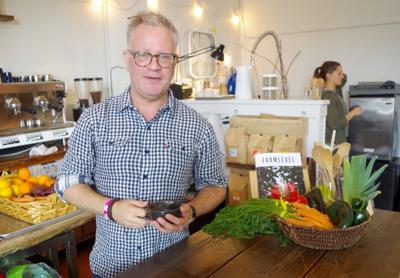
Ed Dreistadt is in his office, just above the Lincoln City Council Chambers. He sits me down at a small table, and we both roll up our sleeves for several hours of riffing with this 65-year-old’s adventure as a “wild and crazy guy” (in the words of Steven Martin).

“I’ve admittedly had a strange life. Not sure how you are going to cram it into an article.”

He may be the lead cheerleader for the City’s new iteration of the Lincoln City Visitor & Convention Bureau — Explore Lincoln City (ELC) — but his pathway to our neck of the woods (four and a half years as director of ELC) reads like a script from a Monty Python and David Mamet collision of ideas.

This unofficial member of the Mad Men Club, Ed Dreistadt (he laughs that his wife opted to NOT change her last name upon marriage) has a heck of a resume, typical of someone who has been in marketing and advertising for more than two-thirds of his life.

He’s pretty confident of his positive role in society: “The concept of advertising is to identify the consumer’s needs and present the product as the solution. The game is to identify the Unique Selling Proposition: the point of difference between your competitor’s product and use it to move a product.”

The career of this “ad man” has been a minefield of ups and downs, deals for fat contracts and plenty of lost accounts, and a career tied to the “boom or bust” magic of selling products.

Steel town, college radio, AM rock

His early roots spread back to a typical Pittsburgh working-class: his mother’s family came from Northern Ireland, and his father’s side came over in the 1860s from Southern Germany.

Right out the gate we talk about his infamous birthplace — Homestead Hospital, 1954. And the fact that his grandfather Dreistadt came from coal miner DNA.

The Homestead Strike was a labor/union dispute between the Carnegie Steel Company and workers. That was July 6, 1892, in Homestead, Pennsylvania. The strike went against the company’s management — industrialists Andrew Carnegie and Henry Clay Frick — who hired scabs (strikebreakers) and the Pinkerton National Detective Agency. A gun battle ensued in which a number of strikers and Pinkerton agents were killed and many more were injured.

The young Ed worked with scrap metal and learned how to weld and take apart/put back together a lot of construction equipment.

He was a cartoonist for the high school paper, and he ended up in New Wilmington at Westminster College taking a potpourri of classes — chemistry, psychology and history. His highlight there was working on the college radio station — WKPS. He even did DJ gigs with a country station, WWIZ; easy listening, WEDO; and late-night rock ‘n roll on WKST.

Graduate school was in Athens, Ohio, at Ohio University, where he turned a speech and psychology BA from Westminster to a Masters in radio-TV management from OU.

Then he got into 13Q, a rock AM radio station, as a salesperson. “You want to get a picture of my PTSD associated with FM eating up AM? Watch that show, ‘WKRP Cincinnati.’ Every new rating book was a disaster. I was, I guess, too ethical to sell something like that and didn’t do all that well.”

That hardcore sales experience — banging on doors to pitch AM radio spots on a dying station — taught him a valuable lesson that resonates today: “I have had so many doors slammed on me. I have a very thick skin.”

Advertising agent par excellence

It takes some cramming to get from his days on the advertising account for Coca-Cola’s Mello Yello, to reluctantly pitching Doral cigarettes, then to promoting the new $40 million-dollar Apollo’s Chariot roller coaster at Busch Gardens, the one where the goose smacked romance novel icon Fabio in the face on its first run, and finally to our Central Oregon Coast.

He’s all in for promoting Lincoln City and its seven miles of beaches and 9,500 residents. He sees all that 101 traffic as among one of the unique opportunities — here are nine million vehicles driving through each year “with those 22 million sets of eyeballs looking at all the things we have to offer our guests.”

“When I first started here, the city had 13 different logos. One of my first jobs was to help come up with a single city brand, graphics standards and an official typeface.”

A consistent message is what Ed is after.

He says the needle is moving — the city promises people that “we have a small beach town feel but we’re also seven miles long and full of fun surprises.”

His life is about imagining the potential in things. “As a product, Lincoln City is nothing to sneeze at. We have these beautiful places like Cascade Head and Drift Creek Falls. Seven miles of beautiful beaches.”

He counts on the Chinook Winds Casino Resort as an anchor for major headline entertainment. He sees the outlet mall as a great attraction, as well as all the “treasure trove of quirky, one-of-a-kind businesses and eateries.”

With his background in theme parks such as Busch Gardens in Williamsburg, Virginia; and Stone Mountain Park near Atlanta, Ed’s seen recession hit the tourism industry hard. He is of the belief that “nothing goes in a straight line forever” and after more than nine years of economic growth, he expects another recession sometime soon.

However, Ed Dreistadt believes places like Lincoln City are positioned to weather a national economic downturn.

Looking at the Transient Room Tax (TRT) revenue reports, he says he’s pleased to see that while growth halted during the Great Recession, revenue collected by lodging properties didn’t decrease. “It held steady during the bad times.”

When money gets tight, families still want to travel, but they look for places to vacation closer in. “People are willing to trade down, say, from a trip to Hawaii or Paris, to something nearby.”

His big impetus now as director of Explore Lincoln City, which has a budget of $2.1 million coming from the TRT hotel bed tax, six full-time workers and one part-time employee is “to begin to shift Lincoln City from weekend getaway to week-long family vacation destination.”

One tool he is looking at to build this concept is expanding his department’s PR capabilities.

Getting stories and editorial copy about “this gem of a city” he is tasked to promote — especially into such markets as Boise, Seattle and beyond — takes money.

He knows markets and, interestingly, his children from a previous marriage are spread around, and some have taken their father’s lead in their own careers.

Carol Ann, 32, is in DC with a wealth-management company. Becky, 34, is in LA as a character designer whose work readers can see on the Disney Channel’s “Star vs. the Forces of Evil,” Cartoon Network’s “Steven Universe: The Movie” and soon with HBO’s “Adventure Time.” Son Kyle, 36, is into network security with military bases out of Virginia Beach.

However, the very reason Lincoln City has Ed in its tourism toolbox falls to Puyallup, Washington.

His wife Shellie Stuart wanted out of the Southeast to be closer to her family in Puyallup from where she was raised.

200228_oct_DSC_0002.jpg

“Many a small thing has been made large by the right kind of advertising.”— Mark Twain

Ed Dreistadt has a litany of stories from his more than four decades acting as a marketing and PR spin wizard. He sees himself as part PT Barnum (he had an account with the circus group, Ringling Brothers) and part Edward Bernays, father of modern marketing (he was Sigmund Freud’s nephew).

One of Ed’s assignments as an advertising account guy in Atlanta was as a researcher for Anheuser-Busch, which was developing a new brand to go against the Schlitz Malt Liquor Bull — a mainstay for African American drinkers.

“it was an opportunity to be immersed in the black community,” he said, adding that he was treated like family and as a friend everywhere he went.

He was part-diplomat for the brand he was working for, and part tabula rasa to learn all he could by being invited into a part of an America he might never otherwise have entered. The new brand eventually became King Cobra Malt Liquor through a different shop.

However, what he learned parlayed into events like the Stone Mountain Park Gospel Celebration in partnership with Antioch Baptist Church North and other members of the Southern Baptist Convention.

As a volunteer for the Georgia Council for International Visitors, Ed also took delegations hosted by the U.S. State Department to meetings with Civil Rights leaders like Joe Beasley, who worked with Jesse Jackson on Project Push and the Rainbow Coalition.

Next, Ed dove into marketing the sweetest and highest-caffeine soft drink in the business — Coke’s Mello Yello.

First there was a Dotty West song that supposedly was going to roll out the drink — “Country Sunshine” — but the temperamental singer had a falling out with Coca-Cola.

Ed says got onto the Mello Yello account after ad men attempted to market the drink to the west, to LA. Unfortunately, the three-year drought back then derailed Mello Yello making a foothold in California.

“These signs and public service announcements were all over the place in LA: ‘If it’s brown, flush it. If it’s yellow, let it mellow.’ That pretty much did us in.”

Ed’s work came later, revitalizing the soft drink as a regional brand. “My job was to re-position Mello Yello in a way that made it more relevant to the youth market.”

A pitchman can only do so much with the material he has. For the beverage dubbed the world’s fastest soft drink (lowest carbonation) with the most sugar and caffeine of any other drink (“makes you feel good so fast”), Ed enlisted Lee Abrams, radio consultant, father of the Album Rock format and general radio station fixer.

“This thing called MTV was just starting.” Then there was the Greg Kihn band. Ed and his team convinced the band to re-lyric their song, “Jeopardy” to “Mello Yello.”

“We leased out the old Fox Theater in Atlanta — this beautiful old 1930s art deco venue. We got radio commercials promoting a free rock concert with the Greg Kihn group.”

There were eight roving camera operators with 16-mm equipment. All the kids showed up looking like real kids in their real outfits. “We broke the bank,” Ed says with relish, saying the TV advertisements were new of a kind.

With tongue in cheek, Ed says he’s partly responsible for Michael Jackson’s hair catching on fire. It turned out Pepsi and Jackson copied that Mello Yello campaign, and during the filming of “Billie Jean” for Pepsi, the pyrotechnics set his locks ablaze.

The case of the rogue goose

He’s got that dry and wry sense of humor, for sure, as we figuratively screen “Ed’s Very Unique & Excellent Adventure” scenes.

One minor blip in his career, Ed says, is his brief connection to hawking cigarettes — Dorel and Magna brands with R. J Reynolds. “There’s a special room in Hell for me.” He says that he had a wife and kids, a car payment and a mortgage to keep up when he needed to jump from a failing ad agency.

With all the advertising agencies he has worked for, and Ed’s iterations running a few of his own, he ended up spending many years in the theme park biz.

The movie, “Honeymoon in Vegas,” has these 10 Flying Elvises jumping out of a plane. For Busch Gardens, Ed arranged a fleet of 1957 Chevy convertibles for a parade around the park celebrating 15 years of the Loch Ness roller coaster. The Elvis impersonators dropped out of the plane, which resulted in a combined “Loch Ness and Elvis sighting” that garnered worldwide coverage.

Unexpectedly, that airplane also captured the attention of Camp Perry, AKA, “The Farm” (CIA training base near Busch Gardens). “Park security was informed that the plane was close to CIA airspace and the parachutists would be detained if they landed on base property. And shot if they resisted.”

They made a safe landing in Busch Gardens. That was 1993.

Then, he was tasked with creating the brand for a new roller coaster, the result of a commitment of $40 million by Busch Entertainment Corporation.

After finding a place for its construction in the existing Williamsburg, Virginia (it ended up in the Italian section with a big ravine) and naming it (he got the idea for Apollo’s Chariots after reading a book on Greek and Roman mythology), Ed enlisted his brain trust to come up with a logo and a celebrity to pitch the coaster’s grand opening.

They got this model-actor Fabio to play the part of Apollo for the launch of the spectacular ride that rises up 805 feet and reaches speeds of 73 mph and pushes people to 4 Gs.

That big inaugural run with all these actresses playing vestal virgins behind Fabio had loads of TV newsfeeds ready to uplink the fluff stories around the country and world.

The red carpet was rolled out, the music played, and the rollercoaster peeled out — with cameras attached to the ride, on cranes and elsewhere filming.

The news teams were awaiting the three-minute ride to bring back the celebrity.

“They returned from the ride and here the passengers were all aghast as the vestal virgins’ togas had red splotches all over them. Fabio had blood on his face.”

It turns out a rogue goose got in the way, flew across the lead car and hit Fabio on the nose with its neck. The star was left with a nick on the nose and a small bruise on his cheek.

200228_oct_fabio_enq.jpg

Lucky, Ed said, because those geese can weigh a dozen pounds, and if the bird’s body had slammed into Fabio, the celebrity’s head would have been crushed.

Damage control went into full gear, but the media cat had been let out of the bag. First aid station, news teams wanting to uplink any footage of the ornithological show, and Fabio whining about the dangers of the ride.

National Enquirer was calling. “Good Morning America,” “Entertainment Tonight,” Jay Leno, David Letterman and on and on covered the story.

Fabio had a lawyer who was threatening to have Fabio say there are these dangerous geese right next to the rollercoaster and that children will die.

This taught Ed that the absurdity of that act of nature could instantaneously go global and have staying power as the butt end joke for the late-night scene for months.

Less is always better? In the ad man’s own words

Ed was kind enough to break out of his busy schedule to answer some questions I posed him. What he did premise these questions with is insightful to me as a chronicler of people’s narratives: sometimes I jar awake old things, past lives. “Haven’t thought about a lot of this stuff in years.”

Paul Haeder: Give us your concept of “community” as you see your role here in Lincoln City?

Ed Dreistadt: I just looked up “community” in the dictionary and found this: A feeling of fellowship with others, as a result of sharing common attitudes, interests and goals.

I think that sums up how I understand the term and, also, what it means to live in a small town like Lincoln City. You have a bigger stake in a small town. You have a feeling of belonging here as well as a responsibility to help make the community better. I think I actually have two roles, personal and professional. On a personal level, Kiwanis is where I can make the most difference. I was a Kiwanian back when I lived in Williamsburg where I helped raise money with events like their annual shrimp feast (we did wonderfully absurd things to promote the event). Here, I was honored to serve as president of the club for a year. I helped them organize Pixiefest and assist where I can on other fundraising events. Kiwanis is dedicated to improving the world one child and one community at a time. It is where I think I can make a difference.

Professionally, what I do is constrained to promoting Lincoln City as a tourism destination. My role is to convince people to visit and stay overnight. Heads in beds is my defining metric. I find this to be an important and challenging job because tourism is the biggest industry in Lincoln City. However, our tourism efforts go well beyond just getting guests to visit. When my department promotes Lincoln City, the lasting impression is that this is a great place to visit…and work…and live. We demonstrate to the world that Lincoln City is surrounded by natural beauty, populated by fascinating people and home to endless one-of-a-kind businesses and attractions. When we get people to visit our city, they fall in love with it. Some of them can’t get enough and want to be part of it. This is why Explore Lincoln City is working hand in glove with Lincoln City Urban Renewal and Economic Development. What makes our city a great place to visit is the same as what makes it a great place to live and work.

PH: What’s the most difficult decision you have made in your life that changed your life?

ED: Leaving family and friends in the town where I grew up was a tough choice. Not long after graduating college, I headed off to Atlanta to work at an ad agency. That move put me into a boom-or-bust industry that took me to Tennessee, North Carolina, Florida, Virginia, back to Georgia and eventually here. When you work for an ad agency, you learn at least two or three industries a year. Each town I lived in also challenged what I thought I knew. I didn’t realize it at the time, but I had committed to a lifetime of learning, which continues today. I came to Lincoln City knowing next to nothing about the Oregon Coast. Fortunately, Anne Hall at the North Lincoln County Historical Museum and Kip Ward, owner of the Eventuary and the Historic Anchor Inn, each took me under their wing and taught me the history of the area. I couldn’t have done my job without them and everyone else in town who took the time to share with me.

PH: What does Lincoln City really need as an economic driver?

ED: I have to answer this as a personal opinion, not as a City employee or an expression of a City policy, so please note it as such. I was lucky enough to work on BellSouth advertising immediately after the breakup of AT&T. That gave me a window to the birth of the internet. I was taught by the network engineers who were taking the world from analog to digital. I still tend to see things through that transformative lens. When I look at the Lincoln City area, I see a town that was close to inaccessible prior to the Roosevelt Oregon Coast Military Highway in the 1920s. From then on, we have been a tourism destination. However, Lincoln City still doesn’t have an interstate highway or a seaport or a railway or an airport. We’re not the ideal city for warehouses or anything that needs to be shipped. However, we can move electrons as well as anyone else. The main fiber optic cable line for the coast goes right down Highway 101. This to me is key to attracting a class of people called Lifestyle Entrepreneurs. These are folks who can work via computer from anywhere in the world. They choose their location based on the lifestyle it affords. I think these are the people who can create high-paying jobs here. Convincing someone that they can do their job with an ocean view, walk along our seven and a half miles of beach when it’s time for a break, hike up to the breathtaking view at Cascade Head for fun when they want and then unwind at Black Squid after an art film at the Bijou, all while earning a high income and creating jobs here in town, feels very right for Lincoln City. Very few cities can offer anything comparable. The same things that are great assets for tourism are great in attracting knowledge-based businesses.

PH: Give us one of your most outside-the-box ideas you have or have heard of which might be a driver of people coming to a place like Lincoln City?

ED: Actually, this one was is actually very much in the box. A vacation is a very ethereal thing. It’s an experience and not something you can literally buy off a shelf. Years ago, I tried to take the vacation and make it a packaged good, same as a box of cereal or a tube of toothpaste. The result was Vacation In A Box. The idea was that you could go into a store, pick your vacation from a shelf, buy it and take it home. Inside the box would be souvenirs, vouchers for your lodging, attraction tickets, everything for you need to just go and enjoy your vacation. Almost all the hassles of planning would go away. I took it to focus groups and people loved it. The use occasion (I’m buying this for me and my family) actually shifted where the vacation could also be gift for others, sitting under the tree with a bow on top. People said that it made the vacation start even before they left home. However, this was pre-internet and we simply couldn’t get it to work because of the infinite number of variations we would have to produce to make it work. Family size being the biggest variable that stumped us. I’d like to revisit this one day, surrounded by internet-savvy folks who can help walk me though the daunting logistics of it all.

PH: If your budget was doubled for the next three years, what sort of things would you be doing differently?

ED: Our current paid advertising budget vaporizes when we hit Portland. I’d love to cast our net a little wider, but it’s difficult when your main market is as big and expensive as ours. One of my frustrations is that, for the most part, Lincoln City is a weekend getaway destination, not the place for that week-long family vacation. There are two ways to change that. One is to get people to visit from farther away. If you invest a lot of time and expense to get somewhere, you tend to stay longer to justify it. The other is to demonstrate that you simply can’t do everything there is to see and do in a weekend. For that we need more attractions, preferably indoor experiences for rainy days and off-season visits. We are going to propose setting up a budget item where Explore Lincoln City works with Lincoln City Economic Development to bring attractions to town. With more money available, I’d make that a much bigger program.

PH: Give us your elevator speech when someone might ask you — say some of those folk in the south you used to work with — “What the hell is in Lincoln City?”

ED: Lincoln City is the Unexpected. It’s a long, slender town that winds its way along the rugged Oregon Coast. It offers endless surprises with rivers and trails and bays and seven miles of beach, plus a full seven miles of beach town to explore that varies in amazing ways along its length. A farm-to-table dining experience that’s also a bowling alley? Lincoln City. Restored 1930s theater featuring avant-garde cinema? Lincoln City. A lantern tour of the cemetery where you meet the people buried there? Lincoln City. Casino gambling, dining and shows? Lincoln City. Glass art that mysteriously appears on the beach? Lincoln City. Haunted historic Bayfront? Lincoln City. Secret-recipe potato salad in a tavern with a view of the ocean? Lincoln City.

PH: If you couldn’t be doing this job, what might you be doing?

ED: A long time ago, I had a boss who wanted to talk to me about career planning. This guy had his life planned out all the way to his grave. I disagreed with everything he told me to do. As far as I’m concerned, life is a parade of opportunities that come by. You watch them go by, pick one and then jump in to join the parade. You have no control over of what will present itself next, so my answer is who knows? Something fun, I hope.

PH: Marketing in some circles — “Mad Men,” Edward Bernays, etc. — has some negative connotations. Which one negative one you regularly hear would you would like to dispel. How?

ED: I get to do luncheon presentations and radio appearances here now and again. I usually start with, “I’m from the government and I’m here to help.” It gets laughs, but it also hopefully dispels the negatives I see the most. It’s not marketing per se, but more a feeling that nothing good can ever come from a governmental entity. My hope is that I can demonstrate the fallacy of that mindset. My department, and the rest of the City of Lincoln City’s staff, work very hard for the common good.

PH: Which one of the myriad marketing campaigns in the world are you particularly intrigued by, or which you would have been happy to be a part of?

ED: I’m showing my age here, but I would have killed to be able to work with Stan Freeberg back in the day.

I started out in radio way back when and Stan was a genius when it came to painting pictures with words and sound. Radio is a medium where budget pretty much doesn’t matter. You can create anything up to the limits of your talent and imagination.

PH: What’s a typical week for you in your position.

ED: Typical? I honestly don’t think there is any such thing in my department. We rarely do the same thing twice. It’s constant challenges, innovation and creation. Just like an ad agency. It’s not the place for anyone who wants a routine.

PH: There seems like a lot of PR spin happening in some of those articles you have on the website — what sorts of things would you like writers coming out to Lincoln City to focus on?

ED: We want the stories to be where the brand promise of the advertising is proven to be true. Lincoln City is the Unexpected. One Place, Endless Adventures. I want to see stories that have a feeling of amazement, the discovery of things they never expected to see and do in a beach town.

PH: Last book you read:

ED: “Astoria: John Jacob Astor and Thomas Jefferson’s Lost Pacific Empire: A Story of Wealth, Ambition, and Survival” on the heels of “Undaunted Courage: Meriwether Lewis, Thomas Jefferson, and the Opening of the American West.” I think my fascination with the book, especially in contrast with the Lewis & Clark story, is how almost everything goes wrong. Also, much in the book is close to unbelievable except for the fact that it’s history. It’s a book about fallible humans, which actually gives me some comfort. Things happen. Mistakes can be made, even among people who are making history.

PH: Last film you saw:

ED: “Where’d You Go Bernadette” at the Bijou. Missed “The Story of Valsetz,” much to my regret. Too much going on sometimes.

PH: Favorite activity to do in Lincoln City:

ED: Bluegrass Jam Night at the Eagles Lodge. It’s the one thing I do for me, plus I get to be among a group of supportive musicians who help me try to get better on my banjo. I picked up music late in life and am so far behind everyone else there it isn’t funny. However, they are very supportive and encouraging. I’ve made more progress with their help than I ever could have made trying to learn how to play music by myself.

PH: If Lincoln City could have a theme song, what would it be?

ED: I think we have one. Bryan Nichols, our local surfer-singer-artist-writer-surf shop owner performs songs with his band ZuhG that are inspired by Lincoln City. “Imagine That” from his “Field Trip” album talks about the wonders of living here right next to the surf.

200228_oct_elvi_newspaper.jpg

First appeared here, in my lowly paying gig –– Oregon Coast Today.

Support writing — purchase my short story collection, Wide Open Eyes. It will make you feel good! Here, at Killer Amazon — Wide Open Eyes — Surfacing from Vietnam. Or contact me and send me a check and I will personalize the book, autograph it, and ship it to ! haederpaul@gmail.com

Note: Not all my writing sticks to my socialist principles. A feature on a person is also my MOS. Ed is a family man, an ad man, a real member of many parts of his community. Selling a location as a tourist and visitor destination? Well, you know where I stand on urban planning, resilience, sustainability, etc.

200228_oct_IMG_1600.jpg

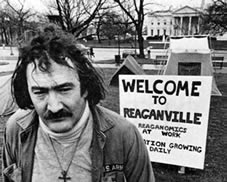
In 1981, Ronald Reagan was sworn in as President of the United States. For many the Reagan Administration is remembered for Reaganomics and ending the Cold War. Yet the poor and homeless of the time remember it rather for a dramatic reduction in housing and social services, Boss Tweed politics, and constant reminders that a mythical “welfare queen” in Chicago and exaggerated “welfare cheats” across America made their poverty their fault. “Mr. Reagan and Congress’s housing cutbacks are directly responsible for the homeless problem,” Mitch Snyder once said of the Administration.

On Thanksgiving Day 1981, tents appeared in Lafayette Park, across from the White House. A sign amidst the spread of tents read “Reaganville: Reagonomics at Work.” The tent city, an intentional throwback to the Hooverville encampments of the Great Depression, held 20-25 homeless persons and activists each night for the next four months. For many observers, a fine line had been drawn between what is real and what is theater. Such was precisely Snyder’s desire.

In addition to being an activist, Snyder was a self-proclaimed actor. A master of social pageantry and what now would be dubbed “street theater,” Mitch was famed for his insatiable motivation to cause a public scene. Among his exploits, he orchestrated a blood spattering of the Capitol steps, sloshed through the world’s biggest pie yelling “It’s all mine,” sat outside the White House in an old Irish tradition of waiting outside the home of someone who had wronged you without appropriate remorse, often jumped the White House fence, and, most infamously, fasted, nearly unto death three times. These actions gained significant attention to Mitch, the cause of homelessness, and helped to energize and unify many homeless persons and advocates.

Source — “I Don’t Mind Stealing Bread.”

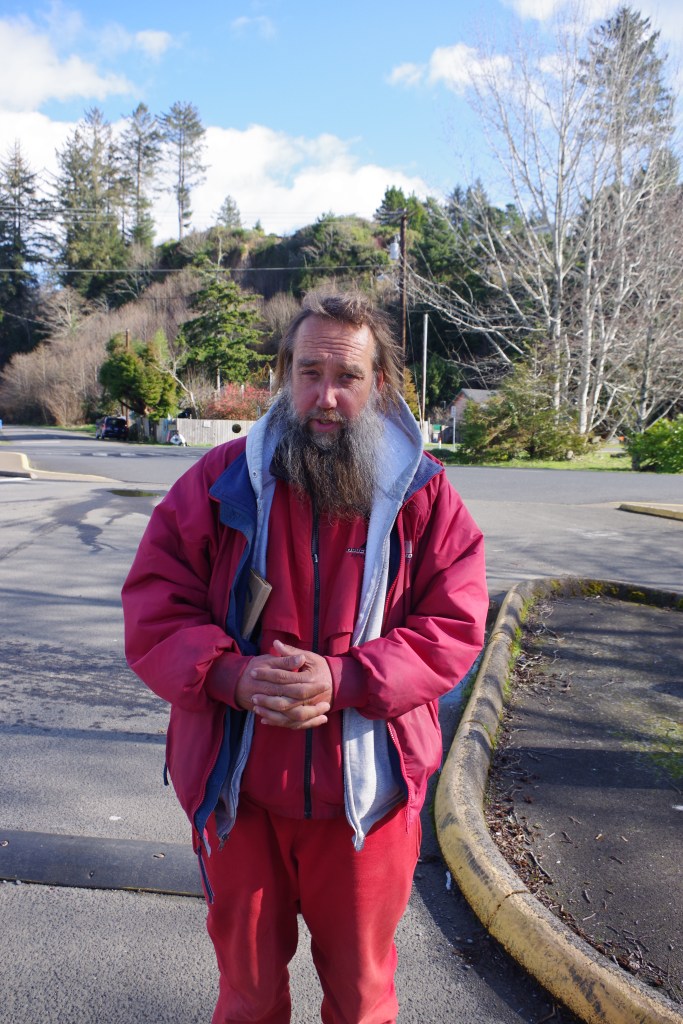
Talking with John (he prefers a pseudonym), I know tagging this 48-year-old as a “victim of circumstances” won’t stick. He prefers to be called a vagabond. We talk about intelligent design, quantum physics, zoning laws, solutions to housing precarity.

He’s been going state to state for seven years. His own life philosophy is complicated, but in one sense is can be whittled down to – “Here today and gone tomorrow.”

“I am not a loner, don’t get me wrong,” he tells me while we share coffee. “I’ll associate with anyone who’s kind regardless of their station in life.”

Like many on the road, John doesn’t want many specifics revealed. He grew up in Los Angeles. He said he was probably a foster child. No siblings. He has no connection to his parents. The effects of a bullet to the lung and one to the hip at age 22 (both removed) are taking a toll on his ability to work long and grueling jobs. 

Terry, 50, from Oklahoma, in Waldport, Oregon

He’s thrown in as a line chef, in carpentry, cabinet-making, demolishing structures and even was paid a penny a word for research through an on-line university.

He thinks labeling anyone with “mental illness” is both incorrect (“we can have mental issues and problems, but it is not a disease”) and a quick way to control people and taking away their rights.

John is skeptical of government services for homeless, saying, “The secular institutions aren’t capable of helping the homeless. When people help me, it’s members of the community. Religious institutions should be helping out much more.”

He’s not atypical in that he had his ID stolen in 2016, and has had major difficulty securing a copy of his birth certificate (from California) to get the process going for an ID. His California driver’s license, he said, was taken by police.

Working under the table isn’t always easy. He isn’t asking for any handouts, but when I pressed him about his immediate needs, he said:

  • somewhere to get out of the rain
  • a place with a source of heat
  • a place to cook food
  • a place to get out of the cold.

“It seems like the powers that be want us to freeze to death. Sometimes it’s just a place to get out of the cold that can make the difference,” John said.

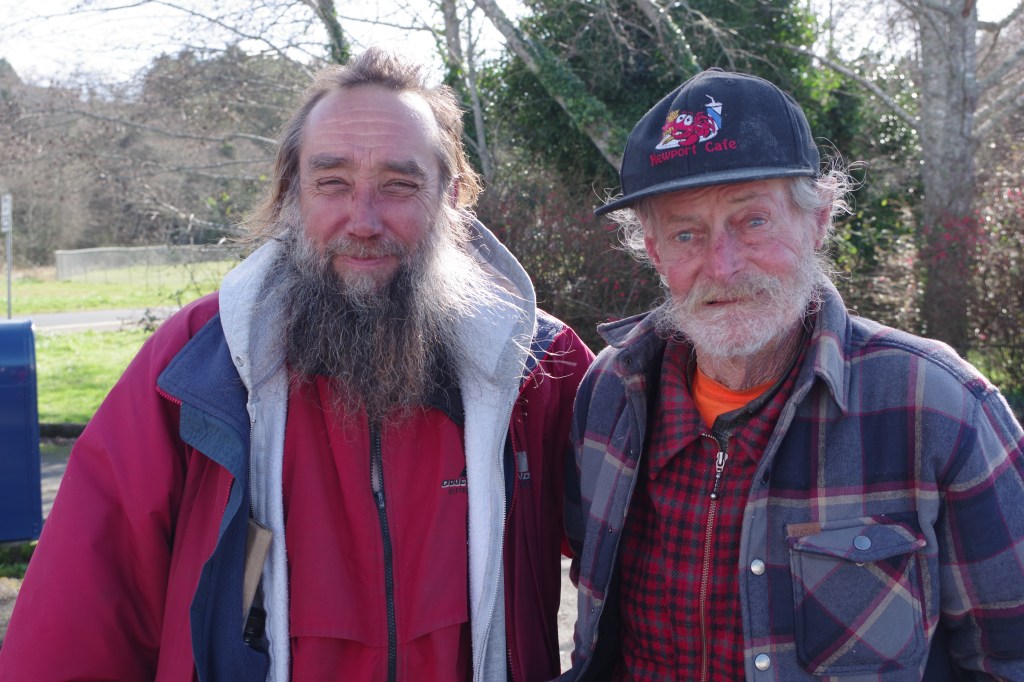
Larry, right, 74, from California, went to Humboldt State, and he’s been without a home for fifty years. Both Larry and Terry (left) are the tip of the iceberg, so to speak: they are on the streets, have signs — “Anything will help” — and talk with locals. Citizens. Homeowners. The issue with homelessness yawns its monster mouth when we take into account couch surfing, basement living, folks with families in garages, those living in fifth wheels and vans and cars.
Two-part series in the local rag — Behind the Faces of Lincoln County’s Homeless.

Part of my impetus doing this sidebar is to get the word out, but in so many cases, I feel as if I am a babe in the woods. There are not real forums where strong, focused arguments about the failures of capitalism can be voiced. You see, the fewer opportunities for social-people-environmental-cultural justice to be voiced and delineated, the quicker this retail/consumer society will tank.

From the bottom up, of course, since we have a system of corporate welfare that sucks the very blood from people. Imagine, no outrage about food stamps — a program if run right STIMULATES local economies, local food purveyors, local community building.

Instead, a million more people off the measly program, while those pigs of capital get cash hand over fist billions for military-surveillance-prison-banking complex.

Children already in bad schools — bad because they teach incompetence, small mindedness, compliance, stupidity, chaos, genuflection to lies about history and about the Empire — need real food, real veggies, real fruit, real nutrition. Instead, more children left behind.

And, then, who knows how many end up like these men in a decade, or two decades.

Imagine systems of oppression in schools, in communities, with police forces, with the broken and dictatorial social services, working to put more and more people through the ringer.

Yep, people come to Lincoln County (like hundreds of other counties) to find a place in the sun. To find work. To get away from the urban core of a Portland.

They find seasonal work, tourist industry low paying service jobs, no transportation system, no community gardens, no community centers, nothing, really, and alas, the worst part, they have no housing.

Think how hard communities of every size and shape give away trillions in tax abatements, free land, loopholes, entitlement program, federal dollars, the whole works. Yet, do we have cooperative housing so these businesses can keep people here with the low wages they shell out?

Insanity is believing the tip of the iceberg is the iceberg, so seeing these down and out men (and some women) on the streets and then calling it good when crappy hot chocolate is donated on a windy cold day, when a pile of toothbrushes is given out, when a Oregon Ducks used sweatshirt if thrown at them!

PhD’s on food-stamps! Adjunct faculty and graduate teaching assistants living in cars, tripling up, while football coaches and a million other superfluous employees at universities get big pay, big tenure rewards, big retirement benefits.

I have been around enough to have talked with plenty of faculty (I was a freeway flyer with a spouse, so we threw in together, with some help from my mother and her parents buying our only child “things” that would have cost us an arm and a leg) who are living in their vans. I have been around enough to have worked as a social worker with clients living in cars, in tents, in abandoned garages and shacks. These homeless people ARE workers, man — cutting Dole’s fruit, loading a million consumer goods onto pallets, answering phones at call centers. Tons and tons of people working the Amazon Fascist Smile Warehouse gig living in a beat-up 20 foot RV.

Tickets on their windows for parking in “illegal zones.” Tickets for expired plates. Tickets for garbage neatly boxed outside the RV. Tow truck operators making bucks, judges getting paid, cops getting retirement benefits.

Being poor, as John attests, costs a lot of money. “If I have no place to cook and heat up food, what does that leave me? Chips and bad food. I can’t go into a restaurant like this an pay $12 for an enchilada plate.”

Larry is so down and out he has cancerous growths on his face, on his back. His clothes are so bad that he gets shooed away from businesses just being outside. He is in need of massive intervention, and on the surface that intervention might look like mandatory “commitment” to a program or suite of programs. But he is in pain, dying on the streets, a constant reminder of the failure of so many systems in this wacko survival of the fittest/dog-eat-dog/Christ Let’s The Poor Inherit The Earth mumbo-jumbo.

Mumbo-jumbo that drive policy. I have met a hundred social workers (females) who have crucifixes around their necks, who believe in their own personal angels. I have met dozens of male social workers who believe in tough love, in turning off someone’s food stamps to get them to come into the office for their monthly face-to-face.

These are the evil people, the Little Eichmann’s, the banality of evil that is a country like USA. Or any country that values the rich and the material over the majority of people in their midst, over the land, over the ecosystems.

John believes the churches will step it up. He thinks the government is too strong, and that churches — the Xmas kind — should have power in this country. he’s a smart guy, deep thinker, been around but over the years it’s been those ministries that have given him a spare blanket, a dime, food.

That’s the odd thing about smart homeless people — they have undying faith in their personal protector, their big daddy in the sky. Many see their lives in this constant chaos and estrangement from “norms” as part of some big plan.

Some, that is, believe that.

But, just last night — a woman, forty, with two girls, on her own, getting disability security checks for the autistic child. She’s in subsidized housing. She has no money for car insurance. Getting a job means something right across the street from her subsidizing housing. An 11 year old at home with a daughter who just turned 18 receiving the $1300 a month for housing and disability compensation.

If this woman — the daughter — goes over $15 or more a month, she loses payments. Already the food stamp allotment has been cut by $85 a month. Imagine, a family of three, and that is a big cut big time.

The average person spends $75 a month on coffee at Starbucks. But the average person in the other category — really precarious, on the edge, without many employment options — they end up in a life and death situation. Less nutrition.

Now, some redneck type might ask where’st he father? Oh, where is that father who ended up in the US Army, got injured twice, with 300 pounds of antifreeze coming down on his head? Yep, ya think that man is cognitively okay? Divorced and left with the two children at a young age, this woman is not getting back child support.

The cogs of the machinery not only to not turn, they are frozen in place.

Recrimination abounds in the world I travel through — it’s her faulty for having kids; it’s her fault for having a bad spouse; it’s her fault for not going to college’ it’s her faulty she was born into a bad family with no father figure; it’s her fault she carries extra pounds on her frame; it’s her fault the kids have no extras, no activities to do outside of school, walks on the beach and TV; it’s her fault for being here on the coast.

A lot of faults, a lot of recriminations, a lot of what most people of “good upbringing” say among themselves or to themselves while passing this woman by as she walks with her daughters and the passerby is in her SUV.

As a writer-journalist-advocacy thinker-biased human being, I can say not enough gets said in meetings, not enough passion is passed around by the stakeholders and powerful. Not enough calling the kettle black, man.

This society where I enter — so many different demographics, activities, realms, professions, people types — is still deluded into believing the crap of American Exceptionalism. They really believe there was great time in USA, when it was a Great White City on the Hill.

IN the end, trauma-trauma-trauma. Many end up precarious because of the trauma. Misanthropes like a Trump or Bloomberg or Zuckerberg, well, there might have been trauma-trauma-trauma in their lives (all three have exacted millions of traumas to others) but these archetypes are able to “overcome” them and become the cruel and ruthless and demeaning hucksters they have become. That the average Joe and Jane like or respect any of these folk — cult of celebrity is a death sentence of intelligence — is amazing still to me.

But the daily survival of John — he has so many skills a Trump of Bloomberg do not have — is both elegant and real. He is getting close to fifty, and he may look like a regular guy on some walkabout, he still knows things could be much better for him.

He laments how women who are homeless have it worse than the men. “Look, I have seen women come into an area after an assault. The cops don’t care. There are missing women all the time. There’s a new poster out in Newport of a young woman missing. How many of them are murdered, left in the woods. The police don’t pursue these rape cases, these missing persons cases. It’s a tragedy, a crime.”

What We See Behind the Faces of a Homeless Family

On the Streets

The tip of the proverbial iceberg when it comes to homelessness is what the average person sees on Newport’s streets – mostly men, some women, seeking a public or private building’s overhang to get out of the rain.

Many on the streets are disheveled, struggling with mental health issues and addiction. Others are not so easily identified as homeless people.

Creating a permanent warming shelter is one stop-gap measure the Newport Working Group on Homelessness has been grappling with for more than a year.

On Feb. 5, more than 20 people filled the cramped space in the Avery building (where DHS offices are co-located with other agencies) to move this group into achievable goals.

Outside the DHS office, fighting against the gale force rain, many of these house-less people were on the covered concrete pad that lead up to the offices housing SNAP and TANF DHS workers.

They were seeking a dry space and companionship.

I asked one fellow – he said he goes by Fred, age 47 — what he wants immediately as a homeless citizen.

“Look, I see families out there with kids in tents. That’s just not right. I am okay living in the woods, but even a dude like me wants something, some place, to get out or the rain and cold. Even some simple open carport like structure, man. Nothing fancy. They should be all over the place.”

We talked about portable toilets, even cold-water taps and sanitary soaps. “Look, with this virus over in China, coming here. . . you think the powers to be would think about sanitation. I guess the solution is to let us die off in the woods . . . or ship us off to come sort of camp.”

Paul Looking for Camps —

Task Force with Teeth?

Inside, a city council woman, the Lincoln County Sheriff, plethora of social services leaders, private citizens and others coalesced to try to come up with a plan and priorities. The agenda to create safe transitional housing, welcoming and effective car camping regulations, policies for tent camping areas, and siting a warming shelter is daunting. Also, on the agenda was the big slice of the pie – addressing health and health-related issues.

Newport Policewoman Jovita Ballentine and Sheriff Curtis Launders were among the group wondering “how all this money spent on services” for these so-called “frequent users” (of the ER) really helps people with mental health issues who spend their days hanging out at such places as the Newport Rec Center.

For Launders, mental illness and addiction are the root causes of the homeless police agencies run into on a daily basis.

For Samaritan House director Lola Jones, helping homeless get out of the elements and into programs to assist them into permanent housing are part of a bigger picture. She reiterated that the Task Force is not a panacea for all the underlying issues why people end up homeless.

Amanda Cherryholmes, Lincoln City manager for Communities Helping Addicts Negotiate Change Effectively (C.H.A.N.C.E.), was quick to push back on the myth that more homeless services in an area will bring more homeless into the community. Cherryholmes cited counterarguments to that belief.

Image result for Paul Haeder homeless LA Progressive

She also pointed out that car camping allowances and even some concerted effort to have designated spaces with port-a-potty’s and storage facilities don’t address the fact “most people can’t afford to keep their car running when temperatures hit the low thirties or below.”

Also, at the meeting was a board member of Grace Wins Haven. Betty Kamikawa, president of the board of directors, ramified the point many in Newport and Lincoln County profess: “Hotels are struggling because of Air B & B. The vacation rentals have caused so many people to become homeless.”

I met people at Grace Wins after the taskforce adjourned. For Betty and the Haven director, Tracie Flowers, the crisis of unhoused individuals in Lincoln County is growing out of proportion to the solutions.

 Image result for Paul Haeder homeless LA Progressive
The US had a shortage of 7.8 million units of affordable housing for very low income (7.5 million) and homeless (400,000) households and individuals in 2017, according the National Low Income Housing Coalition using US Census data. The US Department of Housing and Urban Development’s count had number of homeless higher, at 550,000 on any given night. The US Department of Education reported that 1.5 million school children experienced a period of homelessness during 2017.

Shelter Us from the Storm

“We need more shelters first,” Tracie said. “Too many people think the homeless are one type of individual. They are not.” That belief creates huge conflicts within social services agencies, non-profits, religious organizations, and for the homeless themselves.

Amanda Cherryholmes wants a more robust assessment of people coming into shelters and transitional housing. “We need to figure out what services the individual needs. Each one has different needs.”

She militated against the idea just any individual should end up in a warming shelter or in car camping arrangements. “There are two distinct groups. Families and young people needing shelter. And then single men.”

She pointed out that having a sexual offender among a group of homeless in a communal setting is not a good idea.

There are some brighter horizons in the mix. Some churches are stepping up to the plate.

Image result for Paul Haeder homeless LA Progressive

Tiny Homes, Relaxing Zoning

Pastor of the First Presbyterian Church, Kelsey Ingalls, on her Feb. 2, 2020 church blog discusses one small effort to avail the housing shortage: six cottages at time on church property.

“We formed the Exploration Team which is undertaking a feasibility study to form a partnership with Habitat for Humanity of Lincoln County and other local service agencies to help meet the housing needs of homeless, single-parent families. The Exploration Team is looking into the idea of building six two-bedroom/one-bath cottages on the southeast corner of the Church campus.  We are proposing a circular village layout with front porches and a central common area. Supportive services would be provided by our local service agency partners.”

Before the task force convened, Blair Bobier, Regional Director of Legal Aid Services, sent out an email framing the impetus behind the Newport Working Group on Homeless:

“There are many service providers who agree that some form of a ‘coalition’ model is an important next step towards addressing homelessness in our community.  In other places, one form of this model included a regular meeting of elected officials and law enforcement, along with service providers, to ensure that there was sufficient coordination among involved parties.  As has been pointed out, here in Newport, the Lincoln County Affordable Housing Partners (AHP) is a great example of service providers coming together on a regular basis—along with developers, government officials and members of the faith community—to exchange information and work towards common goals.”

With this huge brain trust in one room, and the compassion and passionate solutions-driven people commenting on what needs to be prioritized, it’s clear Newport and Lincoln County at large have many hurdles to overcome as homelessness and housing precarious situations are growing.

Relaxing zoning laws, and rolling up of sleeves will help develop coordinated efforts to get people out of the cold, screen people through various social services resources, and begin to help coastal communities look at the long-range health of affordable housing in this coastal area.

“Over the two years’ operating, Grace Wins has had over 2,000 clients coming through. Some stay a while. The fact is by this September there will be no winter shelter as the Commons will be torn down. Nothing for the homeless and the farmer’s market,” Betty Kamikawa stated.

Since Housing and Urban Development (HUD) no longer funds states for shelters, the onus is on states, counties and municipalities to grapple with the steadily growing problem.

Image result for Paul Haeder homeless LA Progressive

Running a Permanent Shelter Costs Money

Without financial support, and without volunteers, a shelter is a pipe dream. “We have to have financial support,” Jones stated.

Cynthia Jacobi, Newport City Council, told me at a PFLAG event at OCCC Feb. 8 she is hopeful that HB – 4001 will spur serious discourse on what to do about the homeless population in relationship to cities having the tools to allow for shelters. House Speaker Tina Kotek, D-Portland, has introduced a $120 million proposal to allow cities to more easily site homeless shelters. Kotek also wants a statewide emergency declaration on the homeless problem.

Jacobi too sees the need for immediate mitigation and a shelter for this emergency-sized problem here in Newport.

Pastor Ingalls on her blog tells her congregation a chilling fact most social services agencies in Lincoln County also shudder to contemplate – There’s a 17% homeless rate in our local schools. How a community frames the idea that nearly 1 out of every 5 students don’t have stable housing while the county is home to many second home residents will be important.

Several compelling stories about people who are homeless dying exposed to the elements were discussed at the meeting: According to Kamikawa, an 87-year-old Lincoln County resident was found dead in her car. She had been in an apartment living with her disabled son. Electrical wires were eaten through by rats. She had no electricity. She was evicted. She had a stroke while living in her car with her son.

Putting a face on and a story behind each homeless person might get the average person to think about how he or she can support a shelter and permanent housing solution as well as volunteering some hours each month to stem the tide of tragedies like this one.

Image result for Paul Haeder homeless LA Progressive

Grilling Newport City Councilwoman

I decided to ask a Newport City Councilwoman some questions on homelessness and next steps.

Paul Haeder:  What role do you see citizens joining the Homeless Task Force?

Cynthia Jacobi: I’m the City Liaison to the Homeless Work Group/coalition.

PH:  What role do you see citizens joining the Homeless Task Force?

CJ: I see the role of citizens in the new homeless coalition work group (as yet without an official name or title) as coming forth with the best ideas tailored for our community. Social services, government entities, law-enforcement, interfaith community and concerned citizens can all have a Voice in shaping these policies.

PH:  Why are you involved?

CJ: I have always felt a strong sense of social justice.  I see Families with more than one parent working who still cannot afford safe and decent shelter. Sometimes the cost of an illness, a car repair, or other unexpected costs forces the choice between buying groceries or paying rent or utility bills. Children in unstable situations are especially vulnerable.

As a wealthy society, in good conscience we cannot say there is no room at the inn. We have the means to house all of our population.  With strong leadership and compassion, I know we can do this.

PH: Will the Task Force cover larger issues?

CJ: There are so many overlapping issues:

The new Oregon State House Bill 4001 which may be a game changer in zoning, and funding.

All coastal communities have been addressing the Short-Term Rentals impact on housing inventory for working folks.

It is a valid suggestion to have a study on the actual impact economically and socially of STRs. For example:   Does the room tax cover expenses of police and fire departments, wear on roads, etc.?  Who would finance this study?

The City of Newport has been instrumental in building Surfview, the 110-apartment complex for lower-income citizens. This will open by summer. This was accomplished with a complex partnership of public and private funds, and the leadership in local city and county government. Need to do more of this.

PH: What role do you see mental health services playing in this move to have both temporary homeless facilities (a night facility) and also a warming shelter?

CJ: My understanding is that the county mental health providers have formed out-reach teams Which will go directly to unsheltered people, assess their needs and provide services and contacts for assistance.

PH: Car camping at churches and non-profits and governmental parking areas WITH some sort of case management and oversight seems like a good first step in getting the housing insecure into a system of evaluation and moving ahead with housing options. Is this the biggest and easiest priority now?

CJ: I think the quickest way to make an impact is to allow safe, supervised car camping in Newport.  Newport Planning Commission is in the process of examining our ordinances to allow car camping in certain Defined areas.  Along with oversight, outreach teams, and case management, this is the easiest first step to create safe shelter areas. Women, children, and seniors living in their cars are especially vulnerable. At the very least, they need a safe place to stay at night. We can do this.

I heard anecdotally that much of the seasonal help lives in their cars and rents small storage lockers for belongings.

PH: Do you know anyone personally or within a family circle who have been or are housing insecure, or homeless?

CJ: Personally, I have a few family members who have experienced bad luck, poor choices, and mental illness causing them to live in unstable conditions.

My husband, Gary, and I have volunteered at the overnight shelter.  We have met people displaced from their previous long-term housing, people who can’t afford rent, people who are disabled.

A common problem is affordability when working folks have to pay the first month, the last month, a damage deposit and utility hook ups. Before any of this can happen, there is background check costing $50 per adult for each application, even to be placed on a waiting list. While realizing that landlords must be protected, this situation seems unfair. How many working families can afford $2500 and more up front?

PH: What role do businesses and the chambers have in helping get some sort of affordable housing for the very people who clean the fish, serve the food, chop the veggies, clean the hotels, etc.? Can we get a round-table together, a charrette, where we bring a large brain trust together to attack the housing insecurity and the street homeless issues as a multi-pronged problem to solve?

CJ: As far as the responsibilities of businesses and chambers of commerce: Some businesses have stepped up to help their workers.  In particular, one of the fish plants has purchased motels and converted them to longer-term living quarters.

In the last few years, Newport has lost three large economy motels: one deteriorated and was bulldozed, one burned, and the fish plant bought another one. (or two?). These motels were often used as emergency shelters with vouchers by government agencies.

– The availability of housing related to jobs is affected by public transport access.

– Walkability and bicycle access are also important.

Image result for Cynthia Jacobi Newport City Council
Image result for Cynthia Jacobi Newport

Teaching kids how to feed themselves and how to live in a community responsibly is the center of an education. — Alice Waters

Fun fact — Having been a journalist since I was 17, I’ve gotten to pen some amazing stories through first-person experiences.

• won a reporters’ pool to be “co-pilot” on one of the Blue Angels

• camped with volcanologists in Honduras at the rim of an active volcano

• helped a veterinarian near Pecos round up and vaccinate wild mustangs

• took some veterans down Highway One in Vietnam on our motorcycles

• made several 250-foot dives with SCUBA-clad scientists in the Sea of Cortez

• one round of boxing with one of George Foreman’s sparring partners

• spelunked with cavers in Southern Arizona at a just-publicly announced cavern system

Then there are the articles about chefs, farms, wineries and breweries.

Spending hours on three occasions with JT — chef/ owner of Coast & Vine in Nye Beach — I dig back to my roots in sustainable farming, farm to fork activism and working around people who build the culture of healing mind and body with healthy, clean food.

Jonathan James Trusty (JT) is a 47-year-old master of many culinary arts, as a chef, sommelier and coffee expert. When we kick around a rural county like Lincoln and smallish towns like Newport and Lincoln City, stumbling upon a sustainable, healthy and socially/ethically conscious restaurant is a find.

JT’s serious about supporting local farms, food producers, foragers, cider, wine and mead purveyors.

The relationship between restaurant and grower is one JT not only encourages, but he believes a tsunami-risk area like Lincoln County should be developing deep, long-lasting socially-dynamic communities in order to build resiliency to stave off some of the disastrous effects of an earthquake and ocean deluge.

When he first started in the food and drink business, in 1990 near Sacramento, JT conjured up secrets of coffee growing-roasting-brokering by going down to the Bay Area to get his hands into those coffee beans.

“My mom will tell you this story how when I was 11 or 12, I was cooking meals . . . nothing like what she was cooking in our kitchen. You know, 1960s Betty Crocker stuff. It was the late ’80s and we were eating McDonald’s for lunches at school and we thought that was just wonderful,” JT says with a laugh, emphasizing the words “poisoning us” in many of our conversations stories recanting our broken food system.

He recalls mother Deborah (Toledo librarian) and dad Robert (director of the Blue Water Task Force) taking the kid JT into wine country — the renowned Napa and Sonoma valleys.

“You know, all of that stuck from age five on. In fact, this restaurant is actually the product of that early exposure and education.”

From espresso café to getting deep into the wine industry, to working with amazing chefs like Alice Waters, JT gives benediction to his mentors and his young staff, who he calls “the kids.”

Moon, sun, air, water, fire

While pouring some incredible Scribe Winery chardonnay (Sonoma Valley) and Day Wines pinot noir (Dundee, Oregon), JT rises to the occasion as both proponent and practitioner of biodynamic wine and food.

He tells me that biodynamics actually occur in the vineyard before winemaking takes place. “It’s simple –rain, sun, soil, moon.”

The bottom line is “clean, organic, natural,” which is how JT runs his kitchen – a dream started when he was a child stomping around those farms, orchards and vineyards in California, now a place ravaged by drought, fire, deluges.

We toast the fourth-generation of farmers and vineyard tenders at Scribe, for this amazing organic wine, a gift of 120 acres that include perennial crops and nut trees.

Deep Dive continues as I explore JT’s years in France; his US Coast Guard days; and the new iteration of Coast & Vine — the quintessential oyster bar. His big push is being part of the Central Coast Food Trail and connecting a foraging-to-fork ethos to his purchasing of products, to cooking, then connecting many aspects of our Native American brethren on the Coast and in the region to the entire food web.

JT

“We are activists, engaging the revolution . . . who just happen to love food and imbibing . . . seeking to restore the basic connection between person and their food and drink.” — Jonathan (JT) Trusty, owner/chef, Coast & Vine, Nye Beach

You might catch JT mincing green apples and a variety of veggies for his house ferments, but you’ll never catch him mincing words.

I met JT almost a year ago as a journalist invited to attend a media conference put on by OSU at Hatfield Marine Science Center. He and his father, Robert, were the food caterers. The dining experience for the journalists and scientists alike was like a passage through time and cultures: Spanish, Mexican, Peruvian, Thai and Moroccan flavors and textures aroused our palates.

JT and I hit it off, trading our own sustainability and food stories and experiences. I knew at the time he was once in the US Coast Guard — he tells me now that he went in when he was in his mid-20s during the Gulf War. “The Coast Guard spoke to me. Helping my own country here on our shores. I didn’t want to see combat, fight a war for a business deal gone bad. I knew I’d be making a difference here at home in the Coast Guard.”

The truism throughout our conversation at Hatfield and then this most recent interview is everything tied to food, beverages, farming, cooking is political. Politics enters everything JT does because he is attempting to make food and serve wine that come from places of origin we can call clean, organic and with ethically-raised/farmed/harvested/processed practices.

Big Ag is part of Big Chem, Big Oil, Big Business and Big Pharma — all the things Coast & Vine is not about. That in itself, JT and I agree, makes food both a political decision and gourmet’s delight.

He was a political science/journalism major at a Sierra Community College, and wanted to attend Cal for an undergraduate degree. Food and wine, however, became his classroom, his avocation, sort of his post-doctorate work.

While he states joining the Coast Guard was an act of “putting away aprons and jumping off perfectly sound boats,” the mystique and allure of the wine business got to him.

His mother had different expectation for him, as a teacher, librarian and later published author of “The Kid from Valsetz.”

His father, Robert, was in the air force during the Vietnam War, and then became a hippie out in San Francisco. His mother was from Alabama and dad from Tennessee (where JT was born). They skedaddled to Marin County when JT was three.

Then they ended up moving to Newport in 2000, when JT made a go of it with two Nye Beach establishments — the Market Deli and the Wine Bar where he lived in an apartment upstairs. Live jazz, late nights and hard work paid off in terms of honing his chef-manager licks.

He says he is both lucky and inspired by the travels he made around the world. He ended up working in the Burgundy region of France and other places as a representative of Seguin Moreau cooperage, a barrel-maker that reaches all the way back to Charlemagne (Charles the Great, 768).

A test market

After a few more samples of wine like Petit Frog Bordeaux and Running Bare blend (25 percent Malbec, 25 percent Tannet, 50 percent Cabernet Fanc) while we drizzled Oli de Marges olive oil on some hearty bread, we get deeper into JT’s dream, vision, mission.

A typical question he confronts: “’Why did you pick one of the poorest counties in the state to open up an organic healthy café?’ I tell them you have to start somewhere.” He had at first eyed Corvallis for this eatery, but ended up out here where his parents live.

Coast & Vine has been open since April 2019, and JT, family and staff put the place together using reclaimed wood, repurposed items, sweat equity. The seating is communal on large plank tables he built. The food is presented on rustic plates. There are no deep fryers or open flames. It’s all through convection and induction.

This place (526 NW Coast Street) would make a killing in Portland, San Francisco, Sausalito or anywhere foodies and the health-conscious work, live and play.

However, for now, he’s found his niche here in Newport.

“Instead of getting onto all these boards and organizations, my goal is to bring the best tasty food to this place. This is what you can do — make it a bit of an education platform disguised as a wine oyster bar.”

He was quick to develop relationships, and act as a bridge between farmer, fisherman, rancher with chefs and the public. JT’s built ties with OSU staff and faculty, organizations like Surfrider, and people harvesting and growing the food that ends up in his restaurant.

“This is a marketing step for me,” he says of Coast & Vine. “It wasn’t built to be a standalone place.”

The five-year plan is ambitious — finding a building, sort of a warehouse, overlooking the Pacific. He wants to turn it into an incubator of education, cooking, baking and sustainability. His concept is “The Shed,” where there will be a bakery, restaurant, coffee house, fermentation station and a commercial kitchen.

He’s working with foster youth now, teaching them life skills, to include selecting clean food and learning how to prepare it. “This is something they can hold onto the rest of their lives.”

“The Shed,” JT envisions, will also be part of an ecotourism venture, where people can partake in heading out to the forests, estuaries, beaches and mountains to learn about how ecosystems work as “services” for humans in the food chain.

It’s a big impossible dream, the way JT rolls.

Eclectic interests

There are tunes always wafting at Coast & Vine, including ‘80s stuff, like Simple Minds and Depeche Mode. But also, classics like the Eagles, Dan Fogerty and others. The sound system also blasts new music to include psychedelic beach surf music like The Growlers, The Mermen, Crystal Stilts.

He has heroes, including John Muir, Wendell Barry, John Steinbeck, Henry David Thoreau and Cormac McCarthy. He says he has three mothers, to include his blood mother Deborah, and then Alice Waters the famous chef, and then mother sea.

Interestingly, his second wife (second ex-wife), Liz Rose who owns Salon Ethos, stopped by. Both JT and Liz said they are very good friends now.

I asked her what she thought of JT’s ethos: “His philosophy is about creating an environment that not only feeds the body in a holistic health sense, but he has also created a place where people can feel appreciated.”

Yes, JT and I talk about frozen fish versus fresh fish, as OSU’s food experimentation department is conducting food tastings of the two types of seafood. Frozen fish means fishermen can tackle the age-old problem of spoiling fresh fish and seafood. The perception, though, is fresh is tastier, but that is not what bears out with these OSU tastings.

JT and I talk about the antioxidants and cancer-fighting properties of the greens that Lil Swiss Farms brings to his kitchen. We talk about probiotics, gut health and such as JT is a proponent of fermented vegetables. Jacey is cutting up beets and packing them in mason jars with brine water for that process to happen.

At Coast & Vine, many delicacies are fermented on the spot, and as JT explains this simple process — lacto-fermentation — has nothing at all to do with lactose or dairy. It’s about lactic acid. Additionally, fruits and vegetables typically have the beneficial bacteria Lactobacillus on their surface.

Food as a gift

Growing up in that dynamic farm and vineyard country, JT thought all restaurants just went to their farmer’s markets or roadside stands to pick up the products to cook with. The cold reality of the industrialized, centralized and homogenized food system hit him hard when he went to work for restaurants that got their “foodstuffs” from big 18-wheeler Sysco deliveries.

He shows me how he raised the dishwasher so it would be more ergonomic. How counters are raised. He composts leftovers and gives it back to the farmers. Everything is used, and he throws very little food away. Small-batch cooking and on-the-spot preparing help him battle the proverbial restaurant industry bad rap — more than 50 percent of all cooked food and fresh ingredients is tossed away.

I asked him why he likes coming to work. “We built a place I would want to hang out in and where I’d want to drink coffee and drink wine. And I was tired of not finding options for vegans and vegetarians. I wanted a place with whole clean food.”

He tells me that he feels it is his duty to share his knowledge and skills to the community. “It would be very selfish of me to keep them to myself.”

While this is a business, the margins are leaner when making fresh organic “clean” food and serving biodynamic wines. “We do it because there’s a mission, a drive to bring this type of cooking to this county.”

There is that spiritual cohesion when JT and I hoist a rosé wine, and then he explains how food and wine are some of the most intimate things we share as Homo Sapiens. He reminds me how all the labor put into growing, harvesting and producing products has to be respected, honored and loved while cooking and preparing it.

“To me the definition of integrity is doing the right thing even if people aren’t looking.”

I end up taking the last bites of my Red Apple & Onion Melt (grilled onion, roasted apple, herbed vegan cheese, sorrel) before ordering a bottle of Cidre Fermier, a 5.5-percent alcohol apple cider from France.

JT hands me a book from his coffee roaster, Verve, titled, “Farm Level Digest/Panama.” He gives me a reading list:

“The Farm Shop Cookbook” by Christine McFadden; “Bouchon Cookbook” by Thomas Keller and Jeff Cerciello; “Coming to My Senses: The Making of a Counterculture Cook” by Alice Waters.

I read the statement at the bottom of the Coast & Vine menu: “We go the distance to source fresh, organic ingredients.” That says it all for a long day of food, wine and conversation!

Central Coast Food Trail

For a business, a restaurant in trendy and tourist-influenced Nye Beach, JT finds opening up an oyster bar is his best way to fill his restaurant and stay afloat. His first big event is a sustainable crab and wine event this Saturday, Feb. 15.

We talk about the value of a “food trail,” a big multi-pronged push by many groups, including Travel Oregon and the various local visitors associations along our coast.

For $55, Coast & Vine offers five flights of regional wines and all these plates tied to the fishers getting those crabs.

JT mentions how winter business has picked up, and a raw oyster bar will be the first in Newport. He wants those bivalves coming from places like Winchester Bay and Netarts.

No matter where our conversations end up, JT is consistent. He’s dedicated to supporting local foragers, fishermen and farmers. He’s dedicated to the regional and local food sources telling the story of place, people, cultures and our shared desire for healthy tasty food.

While his Coast & Vine has gone through evolutions — no more juice bar and complex coffee service offerings — JT says his catering gigs are growing with wineries booking his delicacies for big release weekends.

“I’m really getting a lot of catering gigs in The Valley,” he said, emphasizing he’s serving food for 600 walk-by wine consumers during some weekend winery events. “I’m open from 12 to 8 pm, Thursday through Sunday. I’m dedicated to seasonable cooking. I believe an oyster bar will really be popular here.”

Note: First appeared in Oregon Coast Today.

after many years, my short story collection is out!

Wide Open Eyes — Surfacing from Vietnam

B and White and Color Photos accompany the book of stories — Order Here.

What radiates from every page of Paul Haeder’s Wide Open Eyes – Surfacing from Vietnam is a journeyman’s gift for showing the ties that bind ordinary people to their own crystallized struggle with “their Vietnam War baggage.” These 17 stories confront estrangement war veterans and their families have dredged through lives which are heroic because they all are survivors. This a collection of stirring interlinked stories of reclamation from the perspective of the walking wounded. The characters are colorful inside Haeder’s cauldron of quirky visceral story-telling. Lost souls are deftly moved from plot to plot as this writer shows a wizard’s sense of life’s absurdity. There is sinew and heart sculpted into myriad of protagonists.

ORDER here:— Wide Open Eyes – Surfacing from Vietnam But scroll down and see another way to order, for your personalized copy!

No alt text provided for this image

— Ordinary people are scrawled into this atmospheric collection, yet Haeder seeks to explore the devastation of heartache by deploying black humor and leafy poignancy. From an old Army colonel lamenting rotting teeth getting yanked, to a hard-boiled street person humping it in the West flailing at his own demons from America’s War with Vietnam, this is funny, stirring stuff from a talented writer.

— Coupled with his imaginative story-telling and eye-watering vernacular, this collection comes with visuals – 18 arresting photographs anchoring each story. The writer was in Vietnam – after the war – as his preface sets the stage for the first casualties of war.

Praise for WOE — Short stories:

“From a lonely book seller in Albuquerque to a street vagabond in Tucson, these are people most readers pass over in their lives. As readers of this collection, if we keep our eyes open and ears tuned, Haeder shows us vibrancy in people struggling. The author pins a lot of these stories on the theme surfacing from Vietnam, but the reality is we as readers are forced to dive deep into the author’s realm of sometimes twisted characters and unforgiving plots.” — Rick DeMarinis (1995), Author of The Year of the Zinc PennyThe Mortician’s Apprentice, and other works.

No alt text provided for this image

I will be reading and talking and signing the book at Waldport Library, Newport Library, Toledo Library, Driftwood Library, Yachts Libray. In March. More info soo.

Dick Price at LA Progressive and Hollywood Progressive is in the process of writing a revew of the book! I write for them: Paul Haeder.

There will be coverage in the weekly I write for, Oregon Coast Today!

Help spread the word and spread the sales, please. If you want a personalized and autographed copy, please email me ASAP — haederpaul@gmail.com

Thanks, and any interest in the book — it’s a great book — is more than appreciated. !!!!!!!!!!!!!!!!!!!!!!!!!!!!!!!!!!!!!!!!!!!

NOTE: I take checks and money orders, sent to PO Box 2434 Waldport OREGON 97394. This parasitic capitalism, well, the right wingers at PayPal charge 2.9 percent plus more for any money coming in to an account — my wife’s since she set one up a long time ago — so I can give you the number for the account, 5035023651, but the money stays with PayPal until you use the money to buy something via PayPal.

GoFundMe, they take 5% out, of which includes, drum roll, 2.9 percent plus. Ahh, digital capitalism, like I have written about a million times, is death/urudry by a 1,000 transitions-fees-levies-fines-tolls-charges-surcharges-taxes-add-ons. Ya think that evil PayPal is part of GoFundMe? Sure.

So order the book(s) through me, send me the check, and I personalize it and ship it USPS. I’m that kind of guy. Use the Amazon purchase frame, and, well, I won’t get into how much Amazon steels from authors. You can read John Grisham and a load of authors who have written about Amazon killing publishing houses and forcing authors to sell at rock bottom and rejoinder prices.

Read about this evil dude and his evil Little Eicmanns.

HuffPost!

When you go to a product page on Amazon, the ADD TO CART button is the default offer. Other used options fall below the Buy Box. Where books are concerned, the default Buy Box option has always belonged to the publisher. When you buy a book, Amazon pays the publisher 45 percent of the list price, so authors are making a profit (albeit small) every time you buy. This contributes to authors’ royalties and also means that your purchase is supporting the entity that published the book, namely the publisher.

The suggestion in some of the articles I’ve read on this topic is that this new policy hurts small sellers, favoring bigger third-seller operations. But I’d like to break down how much this policy hurts authors and publishers.

I finally clued in to how problematic this policy is a couple weeks ago when one of my authors emailed me to inform me that her book was no longer being listed on Amazon—at all—as available from her publisher, in this case SparkPress, one of my company’s two imprints. When you typed in the title of her book, the only listings that came up were from third-party sellers.

Again, thanks thanks thanks to all those who supported the Go Fund Me. You are mentioned in the dedication. Cheers, Paul K. Haeder

Sugar Cane Heaven

Earth Day and Capitalism Like Vinegar and Oil?

Continuously, discussions focusing on degraded ecosystems and tipping points forcing climate change to ramp up to chaos many times center around the “C” word.

Not  “c” as in “cancer.”

“Capitalism is destroying the planet,” said Pat DeLaquil, an energy policy expert working with various governments, NGO’s and the private sector to “help achieve economic development and combating climate change.”

He was one speaker in a two-guest gig at the Newport Library. Jan 27 as part of the Citizens’ Climate Lobby and 350 Oregon Central Coast.

The other person presenting is director of a plastics to road recycling non-profit headquartered in Toledo.

Twenty people listened to DeLaquil as he zoomed through his data-filled Power Point. His SOP is working with the Oregon League of Conservation Voters and other groups to lobby for passage of a new version of climate change policy during this state’s short legislative session.

No matter how many details behind the framework of HB 2020 are aired, convincing Oregonians of all stripes to get behind this cap on statewide carbon emissions is a technical, legal, intellectual, PR, and emotional challenge.

Two Newport City Council members attended Monday, as gale force winds buffeted the library. Interestingly, kicking off the double header was a video clip from a January 13 Senate National Resources and Environment Committee.

 Arnold L. “Arnie” Roblan in a droll voice stated how he’s visited all parts of Oregon listening to youth. He emphasized it’s been 16 years since he was a school principal, but now he’s seeing  like never before a huge shift in how PK12 students are viewing the world.

“There’s been a big change,” Roblan stated in the video. “Kids are extremely anxious about the climate.”

Kicking off the 2-hour event was Bill Kucha, Otter Rock artist and head of 350 Oregon Central Coast. He strummed guitar and sang his song, “There’s Music All Around Me.” The message is one of hope in a world with thousands of ecosystems collapsing.

While Sen. Roblan stated the counties along the coast are at the “epicenter of ocean acidification and beach erosion caused by climate change,” one audience member, Michael Gaskill asked Pat DeLaquil if he gets frustrated with each year increasingly watered-down of environmental bills get passed.

Gaskill was in attendance to listen to the speakers and to sign up attendees interested in the Congressional campaign of Hillsboro Democrat Mark Gamba, who’s vying for the 5th district position November.

Another audience member wanted immediate response to her comment that “capitalism is the problem hurting the poor” was exasperated by the lack of social justice apparent in the discussions.

Scott

The C word was bandied about much in DeLaquil’s opening remarks:

“What drives capitalism to extremes? Two things: this hyper-individualism of the Ayn Rand economic school which purports everyone is unique and must fight for himself or herself to acquire as much as possible.  And, two, patriarchy which indoctrinates young children into believing this hierarchy of male control. This belief that males are not caring about social issues, the environment, and females are not supposed to speak their minds when confronted with this apparent destructive system.”

The dichotomy is common in discussions about male domination in business, industry, militarism, and monetizing seemingly every single human transaction. Women, on the other hand, are seen “only “as mothers, nurturers put on earth to support the family and keep the peace by not speaking out against environmental, cultural and community degradation and destruction.

DeLaquil carried that allusion further saying capitalism and socialism can be reformed to support a clean, safe, market-centered society with social safety nets like education, health care, other entitlement programs that are part and parcel of Social Democratic countries like Norway or Denmark.

Don Quixote Fighting the Plastics Monster

“The window is closing faster on plastics than climate change, I really believe,” Scott Rosin of Plastic Up-Cycling told the gathering.

Knowing Rosin from Surfrider beach clean ups, and for an upcoming Deep Dive column, I don’t see him as Chicken Little “the sky is falling” fellow.

He’s fought forest fires in the 1970s and ‘80s. He’s been high up in the trees as a forester, and he knows the value of hard work – taking down entire stands of forest in for many years as an area logger.

He and his co-lead, Katharine Valentino, are looking for partnerships and financial backing for their project to get most of Lincoln county’s plastic waste stream into our roads in the form of new thoroughfares, repaved ones, potholes, driveways and parking lots.

The stats on the ground and in the water are staggering: “Think about it. Predictions of a billion tons of plastic produced each year by 2025. Compare that to 1.5 million pounds produced in 1950.”

He went on to punctuate this staggering stat: “Predictions about current rates of plastic waste state by 2050 there will be more plastic in the ocean than fish.”

As a surfer and lover of the ocean, Scott reminded the audience every time they read about a whale beached and dead, guts filled with plastic, that mammal represents less than 10 percent of the actual death rate of whales since most die offshore and sink to the benthic zone.

Rosin and Valentino see innovators in Scotland and in California, as well as other places, coming to the rescue. TechniSoil out of Redding California is taking recycled plastic, bitumen, asphalt substrate and integrating it into a flexible and long-lasting paving mixture (up to 15 percent of the total volume for paving roads could be plastic).

Then there is MacRebur and Scottish CEO Toby McCartney who was working in Southern India helping people at landfills gather potentially reusable items and sell them. Scott Rosin tells us McCartney observed some of the plastics the pickers culled, putting it into potholes and setting it  on fire.

Instant melted plasticized pothole filler.

“Not the most environmentally friendly way to fill potholes,” Scott said. “However, those plastic filled potholes outlasted the actual roads.”  

Carbon, Global Heating, Resources Plummeting & Us v Them?

Some of the buzz words coming from the 2-hour talk include “decarbonizing the economy” and “carbon budget.”

Add to those – renewable energy; trade exposed; energy intensive.

Pat DeLaquil, with doctorate in nuclear engineering from MIT and who’s worked with USAID, the Asian Development Bank, and large companies like Bechtel (not a green company), wants people to related to what they are seeing in the news – flooding, wildfires,, degraded ecosystems, increased rain events, droughts – as applicable to their own communities and states.

“The artic is warming two to three times faster than the rest of the planet,” he said showing us maps of that ice world. He’s also warning us about methane clathrates releasing a greenhouse gas more than 30 times as potent as carbon dioxide; and the warming tundra with millions of tons of frozen greenhouse gasses – ancient carbon.  “The carbon that’s locked in the permafrost in the Arctic is thousands . . .  millions of years old.” 

He also brings to light the terms “runaway climate change” and the “albedo effect” – white snow and ice reflect back the sun’s rays. Less white, means more ocean warming.

DeLaquil and the Oregon League of Conservation Voters are pushing hard a Clean Energy Jobs bill. “[This] is one step in a continuing process of increasing climate change ambition in Oregon and by example the rest of the US. Just as the Renewable Portfolio Standard was followed by the Clean Fuel bill, then the Coal to Clean program, the Clean Energy Job (CEJ) bill will need to be followed next year with Agriculture and Forestry measures and elements of the Green New Deal. We are in this fight for the long haul and our strategy is to win one step at a time.”

He mentioned Time magazine’s 2019 person-of-the-year Greta Thurnberg who just attended the most recent Davos, Switzerland, gathering of the World Economic Forum. DeLaquil dovetails Senator Roblan’s comments about youth being panicked about the status of the world tied to global warming with this 17-year-old internationally-known Swede.

Politics play front and center in the climate debate at the state level with all the parsing of SB 1530 (regulating carbon emissions through commercial, industrial, agricultural use of fracked or natural gas) as well as how we tax and regulate transportation fuel.

Pat also discussed the concepts around clean fuels, carbon sequestration in our forests, natural resource protection (like wetlands), assessing the emissions coming from agricultural and the forestry industries, and the heady concept of a law to protect the rights of nature. Lincoln County Community Rights is one group heralding this rights of nature designation.

This is no bed of roses, as the people attending the talk and the two speakers know. There is much pushback on this bill and other decarbonizing legislation, and many in Oregon have contrary opinions on global warming. The lobbying group, Timber Unity, has expressed disagreement with SB 1530.

Ironically, globally the court of last resort – public opinion – is pitting scientists in the climate arena and superstars like Greta against those in the Donald Trump administration and Fox news. At Davos Jan. 21 Trump announced the U.S. would join an existing initiative to plant one trillion trees.

He also pitched the “economic importance of oil and gas” while throwing barbs at those like Greta Thurnberg, calling climate change activists “pessimistic” and the “heirs of yesterday’s foolish fortune tellers.”

Pat DeLaquil, interestingly, is not in this geopolitical arena, yet someone with his energy sector experience would paint a different picture for global warming deniers. He reemphasized the power of the youth movement. Thunberg responded to President Trump’s remarks by referring to them as “empty words and promises” by world leaders.

“You say children shouldn’t worry… don’t be so pessimistic and then, nothing, silence.”

Elephants, Billiards, Paradigm Shift

“The first man-made plastic was created by Alexander Parkes who publicly demonstrated it at the 1862 Great International Exhibition in London. The material, called Parkesine, was an organic material derived from cellulose that once heated could be molded and retained its shape when cooled.”

“Svante Arrhenius (1859-1927) was a Swedish scientist that was the first to claim in 1896 that fossil fuel combustion may eventually result in enhanced global warming. He proposed a relation between atmospheric carbon dioxide concentrations and temperature.”

Transitioning from DeLaquil’s 35,000 foot view of the climate change debate, then down to the micro view of the state’s efforts to go carbon free by 2050, to Scott Rosin’s Plastic Up Cycling non-profit spurred the audience into thinking about one “miracle of oil” – plastic – and the consequential negative consequences both locally and globally.

It’s obvious the tall white-haired Rosin has fun talking to groups – he’s a real yarn spinner.

“In 1867 an article came out saying elephants were going to be extinct in ten years. The billiards market used ivory for the balls.”

Necessity and environmental concerns turned into the mother of invention. “It was called cellulose. The invention of plastic billiards balls was the beginning of the consumer revolution. Anybody could have a pool table now since the plastic balls were affordable.”

Four or five quality billiard balls could be made from the average tusk of an Indian, Ceylonese, or Indo-Chinese elephant. This market for raw tusks centered in New York and Chicago where craftsmen would eat up blocks of ivory to create the gleaming spheres.

“Now we are experiencing 154 years of plastic, and it’s not a pretty picture,” Rosin told us.

He reminded the audience his work from Jan. to July 2019 for Surfrider heading up weekly Sunday beach plastic debris clean ups where on average 5 people from Lincoln County showed up was disheartening. Even after he had contacted dozens of volunteer organizations.

This past October Katharine Valentino and Rosin scrambled to set up a non-profit to deal with the plastics coming into our county’s dumpsters which invariably ends up trucked to Salem and dumped into a landfill.

TechniSoil is working with the Mayor of Los Angeles to put in a plastic road that leads to the Dorothy Chandler Pavilion.  MacRebur has a proprietary aggregate that binds the plastic to the bitumen so there is no leaching into the ground.

TechniSoil touts their roads containing 6.6 percent plastic last seven to 14 times longer than conventional roads. Rosin emphasizes how on-site machines repaving roads with plastic aggregate actually tear up the old road, grind up plastic, mix it with bitumen and old asphalt, eliminating  a  huge carbon footprint of dump trucks hauling off torn-up roadway pavement.

Plastic Up-Cycling is hawking its project to interested people, as well as looking for $100,000 to get the plastic road mixture tested by an OSU lab.

Plastic comes from an energy-intensive and polluting process of turning oil into polymers and then into various types of plastics to serve myriad of purposes for which we in our throwaway society consume it.

The fact is landfills are composed of 12 to 15 percent plastic. The road paving process pencils out this way: for every miles of roadway, 1.1 million plastic bottles or 3.2 million plastic bags churned into a road mix will cut down on the waste-stream big time.

Climate Action Plan 2.0

The event was topped off with Martin Desmond, with Central Coast Citizen’s Climate Lobby, giving us the table of contents to the 74- page Lincoln County Climate Action Plan. The goal for this initiative is to get Lincoln County carbon neutral by 2035.

For Pat DeLaquil, his biggest disappointment, he stated, “after working in this field for years” was the failure to pass the Waxman-Markey cap and trade bill.”

This congressional bill —  American Clean Energy and Security Act of 2009 —  was passed as major legislation to create a cap-and-trade system for heat-trapping greenhouse gas emissions, but was not taken up by the full Senate and never became law.

For Bill Kucha – artist, teacher, activist and musician – he puts much hope in young people in this county and throughout the world. He’s also a prolific letter-to-the-editor writer:

“The good news is that there is a growing movement toward a new type of corporation called B-Corporations. In B-Corporations, financial profit counts, but so too does consideration for the environment, neighboring communities, and the workers. Our state must actively encourage the proliferation of progressive alternatives like this, if we ever hope to heal what ails the Earth. You can play a role, too: you can insist that the 2020 Election, at all levels of government, must prominently feature serious conversations about the Climate Crisis.” (Sept. 1, 2019, News Lincoln County)

For me, it’s obvious conversations have to be more dynamic and robust, covering a larger swath of citizens. We have to organize half-day or three-day summits or charrettes to get policy makers, politicians, subject matter experts and citizens coming together to communicate more effectively and think both critically and holistically about issues around ocean rise, acidification, coastal inundation, weather and climate disruptions.

Lincoln County residents need to respect (and question) the work of activists and citizens on all sides of the issue while also coming together to listen to the passionate scientists and experts working on these issues.

For Scott Rosin, getting plastics out of the waste stream means cleaner water, cleaner soil, cleaner food and cleaner human and non-human bodies. “I would have never thought about the effects of plastic on the environment and us thirty or forty years ago,” Rosin said. “It’s unthinkable to have plastic in our drinking water, in all our food, and breathing it in.”

Pat

Getting into the Narrative of an Energy Guy

Pat DeLaquil was touted to me by several people at the Newport gathering as “he’s really been around” and “he really knows the deal with China since he’s been there” and “he has a lot of insight into energy.” So, Pat was kind enough to submit to some email questions. Pat lives in Gresham.

Paul: You said you have been doing this for more than 40 years. What got you started in energy analysis, and was it always EEE — energy, economy, environment?

Pat: Following grad school, I joined Sandia National Labs in Livermore, CA to work in their new systems analysis program.  My first assignment was working on safeguards for nuclear material used in the country’s nuclear weapons program, but in 1980, I joined their solar energy program and been a leader in the commercialization of clean and renewable energy technologies.  In 1984 I left Sandia and joined Bechtel Corporation to lead their Renewable Energy RD group.  There, I worked closely with the California utilities and EPRI to lead the development of consortiums to build key R&D projects such as PV-USA and the 10 MW Solar Two Power Tower.

Paul:  Your age, where did you grow up and schooling?

Pat: I’m 71 and grew up in western Pennsylvania in strip mining country and saw firsthand the destruction they caused.  I knew I wanted to be an engineer by age 13, and I have a B.Sc. in Marine Engineering from the US Merchant Marine and a Ph.D. in Nuclear Engineering from Massachusetts Institute of Technology.   I have authored or co-authored over 90 papers, reports, and articles on solar and renewable energy including chapters in two books on renewable energy technology.  I have a patent for a high temperature solar receiver.  

Paul: I work on the 5 e’s — started off as triple e’s for sustainability: Equity, environment, economy . . . education and energy. There are a lot of intersectionalities here, and of course, the environment overrides and undergirds everything. In capitalism, that is not true. What are your own intellectual challenges when you consider how rapacious, how extractive-oriented, how unjust capitalism is to the people, the 99 Percent, or the 80 percent. Discuss.

Pat: This requires a long answer, and I touched on this in my talk, but only briefly.  I am attaching for your information and use, both my presentation from Monday and a longer presentation on this subject I gave to the Multnomah Democratic Party Climate Action Forum back in November.  Slides 1 thru 9, including the notes, provide a pretty full answer.

Paul: There is a lot of policy stuff and political maneuvering and lobbying in your work. For the average reader, what are your holistic takeaways for this evening’s talk.

Pat: The most important things that the average reader can do is to get engaged politically by demanding that your legislators be climate champions and if they are not find one who can replace them.  While individual actions are important, they will never be enough.  We must have systemic change that will only come when progressives have control of our political systems.

Paul:  What gives you hope for the world, for Oregon’s future?

Pat: I have been in a very discouraging mood since HB2020 was stonewalled by the Republicans, and even more so given the ho-hum response that too many people have given to the wildfires in Australia, which also has a climate denying government.  The voices on youth are what currently gives me the most hope, but even that seems not to be enough.  I’m afraid that it’s going to take a major climate-derived calamity, with millions of people dying before the average person decides we must take action.

Paul: What lends you pause?

Pat: The tremendous amounts of money, imbedded organizations and media-led philosophies that the oligarchs and large corporations have used to gain strangle holds on governments around the world.  The four key conservative political frames are shown below, and we must replace these with progressive frames I the general public discourse.  In addition to people power and grassroots organizing, we must counter and replace the Reagan framing with more progressive framing if we are to win this battle.

Miseducation and the Trail of Tears Daily Exacted

beware of the child who is taught the ways of the brown shirts and Hitler Youth — lie, steal, snitch, plot against, unlearn Golden Rule

by Paul Haeder / January 16th, 2020

Writing a Book in the Trenches

I am marking this blog post with an unusual challenge to myself — writer it from beginning to finish, one sitting, with the objective to get under the skin of  why and how and what is so messed up in our PK12 system. Extrapolate to the messed up muck home schoolers in general get. Forget about those so-called charter schools. And, as we move into this polemic, we might as keep in check the mis-education of entire generations in the post secondary realm, AKA, college and university.

It’s 1411 PST, and I am of course licking my wounds: I have mentioned a hundred times that I am working on this book — not your typical book — on the good bad and ugly of PK12 education in the USA. Part of that research — mostly — is ground truthing: going into the schools and substitute teaching. I’ve done it in five states, and now, alas, after more than two dozen schools, I have a global view and typical view of what is, is not, will never work in the realm of US public education.

Think of this as prefatory material for the book — not a deeply footnoted thing, not super long, not scholarly (that’s a good thing), and not steeped in the billion books, papers, speeches and policies around pedagogy and curriculum; around organizing public education in the urban centers, suburbs and rural locals; and all the rules and regulations and outcomes and data fields collected and parsed by the so-called policy wonks, educational lobbies, the think tanks, the politico, and the like.

Listening to Band of Horses and other groups (light fare, man), while cranking this out in record time (not for me). Is this stream of consciousness, magic realism, diatribe, polemic, reactive, angry steeped, precipitated rant?

Yep.

Crazed Method to the Madness

And here is the precipitating event horizon that got me on my laptop here in Waldport in Lincoln County in Oregon in the Pacific Northwest west of the 100th meridian, and drawn by so many cultural, geographic, geologic, ecosystems influences that, hands down, no student in K12 or beyond really has any surface understanding why they are here in someone’s else’s territory, homeland, spirit land, creation place.

Substitute teacher, and today, halfway through third period as substitute for a high school language arts class, the burly, idiotic, uninitiated, reactionary, dense, illogical, broken, un-teacher of a vice principal stood out that door at Waldport High School and summarily told me to “grab your belonging and we want you to leave.”

Okay, Joe from Merced, I know you will and should retort soon and tell me,

Paul, you of all people know how rotten the capitalist society is, so why would warehousing and propagandizing and dumb-downing and spiritually drawing and quartering young people be so far from the goal of American education? Why would you believe that administrators and deans and provosts and principals and their vice petty officers have anything in mind tied to real educating? You of all people want the classroom walls torn down and want the ceilings smashed. You of all people want community gardens, want students outside in long-houses, and want students to learn crafts, micro-home building, ways to make organic cheese with their own goats on campus. You of all people want students to go into the communities and work their youth magic in foster homes, retirement homes, and the like. You of all people want to see young people do that drive-by-shoot — with digital cameras: 48 hours; shoot your community; come back and talk about what you shot; edit; research your community; write songs, poems and blurbs so this photo montage of the community through the eyes of, say 6th graders, or high schoolers, can be presented to the communities, to parents, grandparents, other students, city council. You of all people want elders in the community to come in around a fire circle and talk about life, about struggle, about success, about careers loved, lost and reviled. You want peace studies with people like Veterans for Peace to come to school and give the alternative to the lies of US MIC and US DoD and the red-white-and-blue lies of invented history. You of all people want youth to intermingle with other youth, from other countries, via Skype, and to have cross disciplines emerge as the leading edge. You of all people want professionals, both ex and current, to describe what went right and wrong with their own aspirations. You, again, Paul, are asking for revolutionary politics, sciences, social studies, arts, history, political sciences to be introduced at a young age. You of all people want outside the box teaching and learning opportunities. You of all people want alternative classes, alternative design, a reimagining of what oppression is. You of all people, man, you saw this writing on the wall.” — Make Believe Comment from Joe from Merced (the farmer)**

He’s right, for sure — I have been frog marched out of jobs, social work situations, other schools, protests, and community events. Is it that chip(s) on the shoulder? Is it that ODD — oppositional defiance disorder? Is it that disregard for authority? Is it the entire life cycle I have flowed through and created that has turned me into a defiant one, a Cool Hand Luke, a revolutionary thinker?

Language arts. This teacher had no lesson plans. Typical. He called on the school phone. He wondered who I was, and after I told him college English-writing-journalism-literature-poetry teacher, and that, yes, I know Of Mice and Men and Animal Farm and Ethan Frome  like the back of my liver-spotted hand, he took a big breath. He wanted me to leave my home phone. That was 8:15 am.

This gig was to be a 7-hour assignment. What, $23 an hour, so around $175 for the day? I had just taught the day before at Waldport High, in a math class, half a day, 8, 9, 10 graders. The teacher came back at noon and asked how they were.  That’s why I am doing this, besides making money I need in my coffers to survive this messed up predatory capitalism land. Living on the coast, EVERYTHING, costs more, yet pay is less. That’s capitalism 101.

So, yes, the half day reaffirmed much of what I have learned in five states: managed chaos; one or two really disruptive students killing learning; distracted students; off task students; students who do not respect teachers or the thought of school; students who don’t connect the dots why reading and writing and history and science and math and arts connect. This is not news to most DV readers, for sure. But when you ground truth in the places we are researching and writing about, the echo chamber is large, the complaints are looming, and the reality is the same old tune is being played by student and teacher alike.

The level of disrespect for teacher and themselves is certainly something folk like me predicted 40 decades ago when I first started teaching English at the University of Texas-El Paso. OF course, things were not as bad then as now. The book I am writing is going to be human-based, not research based. It will be about the bright lights that shine through the miasma of stupid public education delivery systems, and it will look at what is bad and ugly. The good is strained, and much much work must be done — the entire system must be dismantled. Maybe dismantling it would be one generation’s teachable moment. Maybe we need the schools designed as Joe the Farmer from Merced has reminded me (in my brain).  Design schools based on the circumstance, the prevailing future dynamics, based on what youth need, want, dream of.

I get how broken the administrators are, how harried the teachers are, how disconnected the support staff are, how unrealistic the city fathers and mothers and state politicos are in the entire mess that is public education.

Today, this morning, Of Mice and Men and Animal Farm, well, we talked about bullying, about the themes — man v man; man v god; man v society; man v self; man v nature. We talked about man v AI as the newest dynamic for story telling. We talked about man being replaced by man/woman. Talked about Lennie in Of Mice and Men having special ways of seeing the world, about his unique nature, developmental disabilities. We talked about bullying and how bullying is cyclical, and how bullying can be anything — groups of religious people not liking those un-Christians, et al. We talked about the bullying they themselves had gone through. We talked a lot, and the books were drawn into the conversation.

Second period, at the end, this burly dude in his fifties came in, sat down, while the student raised their brows. For me, that meant some teacher counselor,, but I suspected Vice Principal, even though we had never met.

Student leave, he asked third period to hold off coming in, and then he tells me several students came into the office crying and others said I was talking bad about religion (I wasn’t –that is stupid in a redneck community and redneck high school). This punk said there was talk about communism (as if that’s bad). I talked about how the world is not on lock step –capitalism and communism; Muslim or Christian or non-religious. We talked about what trigger warning meant, and we talked about the value of fiction and poetry to be transformational.

Yes, I said I was a diver, a traveler, journalism, photographer, novelist and social worker, and much much more. We talked about prison and homelessness. This all related to the literature they are supposedly exposed to (though these school districts take out tons of books from the library ont he whim of a parent or community member).

We talked about Sapphire the poet who wrote Push which ended up as a movie, Precious.

Yes, thin ice is the purview of every teacher who has a dynamic instructor. More so for a substitute coming into literally a battle zone without the tools of the head captain, the teacher.

I tried to tell this punk VP that, no, there wasn’t any anti-religion talked about, or pro-communism rant. I am sorry, but certain youth — 15, 16, 17, 18 — are not fully formed, are malformed, are misdirected by shitty parents, are wrapped in their world of, yes, snow flake-ville.

Several students went to the office crying? Oh my god. I had to get the third period going so trying to extract something smart out of the vice principal was impossible (he thinks disrupting a class and taking class time away is the appropriate thing to do).

Befuddled? Shaken? Not really, but pissed off. I can’t hate upon the poor sop children who are brought up this way to have no ability to see the light, to understand the holism of a teacher like me.

Third period, small class, mellow, and yes I stuck to the themes of fiction and getting the students to relate that to what they had learned in Of Mice and Men.

Then this piece of pablum outside the door before class was over, telling me to gather my stuff and leave.

He thought he was taking me to the office, but I quickly gave the idiot the badge and keys, and he intimated he was going to talk with me, but I said — “You speaking, mister. There is no dignity here. This is how you run your school.? This is how you expect visitors to be treated?” Before that, he said a child of an administrator came into his office  crying. That tells me that that parent demanded I be tossed.

Ironically, students from the day before recognized me in the hallway and gave me high fives. My final words — “This is not how you run a school. And, mister, you have just begun to hear from me.”

Nah, singling out Waldport High School, is too easy. The fact that we are in a monkey muck mentality, and this proven guilty on the word of one, two or several students, without a hearing or public airing, well, you get it. Kangaroo court mentality.

Why boys and girls are expelled for challenging teachers. Why SWAT teams come to school weekly. Why students have no respect for teachers and administrators. An idiot like this VP has no clue.

And, the way this broke public school system runs is that they have idiots in these fake levels of authority. And, they rely on substitute teachers, because, one, a lot of teachers I have talked to can only teach four out of five days. The level of chaos and mayhem and behavioral issues and acting out and youth with home-grown trauma, well, they are not wired as adults to last long. Two, they get sick and, three, they have in-service and continuing education to attend to.

And, a rural county has no big pool of substitute teachers. The drive to and from a school back home is expensive. Add to that winter weather.

You get the broken picture. 50 minutes in and I have only 2140 words. I expected twice as many.

Emoting, catharsis, dump, purge. Call this what you may.

The reality is I have been teaching writing almost my entire 62 years. I believe in stream of consciousness, in free writing, in free association, in purge, catharsis, fugue states.

Mixed media — drawing, poem, song, three-d image, and essay, as well as spoken word.

Invisible Mists Holding Children Like Ghosts

empty vessel
ready for words and worlds
to flow into their hands
children of a lesser god
the child inside
finger painting and murals
real syncopation with eagle
king tide

children captured in retail
space yet blocks away
crashing waves, Seal Rock
Devil’s Churn, black eye
of gray whale
eagle couple over football
field, children held in gulag
four walls like moat
tables chairs lined up
DMV driver’s license test

unholy is imprisonment
unworldly is bumbling
teacher as police officer
dead time half the day
bells and announcements
medium security
old men at 39
women heavy with bulging
hips, hunched over at 50

you are what you eat
what you read
what you say
what you do
what you watch
what you hope
what you dream
what you think
what you don’t do
don’t eat don’t read
don’t say don’t dream of
don’t hope for
don’t watch don’t believe

you are that

the truncheon evil
enforcers of codes
rules regulations grades
assignments deadlines
do’s and don’ts

will they rise above
riptide of stupid
adults stale concepts
misanthropic ideas
mean patriotism
lunatic nationalism
fanatical Christianity?

Is this survival of
fittest dog eat
dog small fish
big pond follow
the crowd don’t
make waves stay
in box?

School.

+–+

This is more than snowflake, more than entitled child, more than pedagogy of the oppressed. More than unintended consequences. This is more than a few hysterical children engaging in tattletale. We talked about frontal cortex, executive function, decisions not made from the bright light of recognition but through the lives of the the oppressed, the beaten and raped and discarded.

Maybe the administrator’s child didn’t get the connection to epigenetics I was talking about and explaining how decisions are made based on a whole lot of backstory, context, baggage and family and nature. George kills Lennie. Why? Those sad weak children of the parents that allow for snow flake behavior are products of that nature-nurture. Why did George kill Lennie?

In the novella, Of Mice and Men, by John Steinbeck , George killing Lennie is a merciful kill to save others from Lennie’s unintentional acts of aggression, to spare Lennie from suffering a cruel death, and instead ensuring a peaceful and quick departure one that will cause George the least regrets.

That’s one take, uh? Merciful killing? And there we go. A real high school class allows for those words to be parsed and diced and cogitated and facilitated into real conversations. Waldport High School, is not the place. Maybe almost all schools in the USA are not the places to talk about themes, hidden agendas, reading between the lines, and interpretations. Or bringing real life to the classroom.

I talked about teaching in prisons, teaching gang-influenced youth who were actively taking inhalants. I talked about former soldiers of our immoral wars coming home and attempting to navigate a “real world.” I attempted to discuss what is merciful to one is a sin to another.

This is it, though, I believe, for my teaching gig. I’ll see if I get a phone call, not from Lincoln County School District, but from the education service for-profit outfit that just took over hiring, paying out, managing, assigning and I guess canning substitute teachers.

Yep, in less than half a year of teaching I went from being an employee of the district to being an employee of some redneck for-profit staffing agency stated in Tennessee. They make their shekels  hiring all school staff, bus drivers, para-educators, even administrators, classified staff, janitorial, food servers, and, yes, vice principals and principals. Not full time teachers — yet (something about a union).

This is the system of oppression and inefficiency, the system of the Peter Principle in Full Force. This is the corrosive belief system, ideas based on opinion and a world of unbelief, of banning books, and, me, banning substitute teachers. This is the time of extrajudicial murder and now the world of fear and loathing.

I know I am Hunter S. Thomson-like,  and radical, and way outside the coloring book lines. But I have enough common sense to know where to draw the line teaching K12. Now, the line is moving, and the field of possibilities for everyone in Capitalism is shrinking. The dictates of the oppressors and middle managers, and thug vice principals, yes, are insane, coming from their colonized minds.

These middle managers are collecting time, doing time, collecting retirement points, and in that process, they are making sure the children do not get out of line or cross the line. They have the power of the police, of the suspension,of the expulsion. Yet, they are just paper tigers, held by the short hairs from community members who are lunatics of religion, Trumpism, foolish liberalism. These days are the end time days in the minds of many Americans. This country’s schools are on the chopping block, and the teachers are leaving, and the substitutes are in more demand, and the sick adults are pushing their diseases onto children. And, the snow flakes win, while common sense and realism and creative cohesion dies like the weeds the idiots spray with Round-Up.

Kill kill kill collectivism. Push push push individualism. Drain the heart with hyper-competitiveness and competition at all costs. Get a gold star for putting name and date at the top of the blank and undone assignment.

Children of a lesser god!

I remember working around Mark Medoff at NMSU in Las Cruces.

Yes, I’m a terrific teacher : Grow, Sarah, but not too much.
Understand yourself, but not better than I understand you. Be
brave, but not so brave you don’t need me any more. Your silence
frightens me. When I’m in that silence, I hear nothing, I feel like
nothing. I can never pull you into my world of sound any more
than you can open some magic door and bring me into your
silence. I can say that now.

― Mark Medoff, Children of a Lesser God

This is about a deaf student, Sarah, and her former teacher James Leeds. But oh so relevant to my teaching experiences — I am not so big to think I am a super super-terrific teacher or know it all or embodied in perfection incarnate. It’s about mentoring and about learning and adapting to each group. But also expecting the genius of youth to be regarded, and to celebrate and coax  out creativity.

This realm is now codified in my brain — the good and bad and ugly of public education.k The book will flow as easy as this short essay did.

You betcha the good will be highlighted in this screed — and so many others before me and contemporaries know how to get the best out of students, even the not so neuro-normal or behavior-compliant or mainstream-learning kind of student.

We have to hear when there is silence. We have to teach them to understand themselves better than anyone in their lives might think they understand them. We want them to grow very much, beyond our own limited growth. We want them to be braver than any of us are brave.

This punk VP and whatever prescripts in his demented toolbox he goes by, and whatever this pressure the board member’s and administrator’s children put on him, and whatever the asinine phone calls that transpired from redneck parent occurred,  this is not a dignified way to treat a fellow human being.

The punk VP, well, he was another washed out white guy, so I might not recognize him in the very very small community we both live in. He is what we call a meaningless bloke, but he has enough control over youth, and the power to quell their natural rebellion.

As many students in Lincoln County, Oregon, or in Seattle, or in El Paso or Spokane or Vancouver said to me, “We just can’t wait to be done with this school . . . we aren’t learning anything, nothing much that will do us any good in real life.”

They are of course are wrong, but the system of oppression and broken pedagogy and the powers that be are certainly happy to accommodate that belief system.

Fear and self-loathing and disconnection and lack of creativity rule the public school systems in many cases. The one bad apple, they think, can be removed to save the bushel. They are wrong, or so wrong, because that “bad apple” is in reality the only hope these youth have in self-discovery and meaningful learning and rebelliousness. Everything else is just going through the motions, and busy work, and disconnected information, and nothing deep, no deep deep meaning.

Bye — 1600 PST.

Quoting myself and Cornel West as a kicker!

Cornel West praises Occupy Seattle movement at Green River Community College

by Paul K. Haeder | November 23rd, 2011

Princeton professor, author and activist Cornel West urged the 300 people who gathered for his Nov. 16 talk at Green River Community College to go beyond getting credentialed and pursue a “deep education.”

It would not be easy, he warned his audience, about half of them students: “In the process of being educated you have to learn how to die in order to live.”

Drawing on Plato and Malcom X, West said the death process is part of real education — paideia — a concept developed by Socrates that means deep, critical thinking.

It is the antithesis of contemporary culture: “The problem in American society is we are a culture of death-denying, death-dodging… a joyless culture where pleasure-seeking replaces what it means to be human.”

Fresh from a trip to Occupy Seattle earlier in the day, West praised the movement, which he said represents “a deep democratic awakening where people are finding the courage to find their voice.”

Greed has corroded society, he said.

“Market moralities and mentalities — fueled by economic imperatives to make a profit at nearly any cost — yield unprecedented levels of loneliness, isolation and sadness. Our public life lies in shambles, shot through with icy cynicism and paralyzing pessimism. To put it bluntly, beneath the record-breaking stock markets on Wall Street and bipartisan budget-balancing deals in the White House, lurk ominous clouds of despair across this nation.”

West said that in this age of fear, economic instability and employment challenges, young people must learn “to have a love of wisdom, love of your neighbors and love of justice.”

Such love, embedded in our cultural and social justice traditions, is powerful, he said.

“That Coltrane love, that subversive love. It’s there in the Occupy Wall Street movement. … When it’s organized and mobilized, love is a threat.”

Note: I was also summarily dismissed from this college gig, Green River College, at the winter break, during their Christmastime joy to the world time, by the powers that be, for speaking out for students, for unionizing part-timers, for breaking the locks and unholy walls of the oppressors. Another dollar, another gig gone south!!

**

**I got this one from Joe the Farmer after submitting this: 

Paul– I can’t improve on what you wrote in your imaginary comment from me. I’m not going to try. I wish I had some wisdom to give regarding your circumstance but I’m wise enough to know I don’t have any. What you have penned is what Chris Hedges referred to as the wages of rebellion. I too have been paid those wages. Anyone who stands up and fights will sooner or later get paid in that currency.

For me it was a wife taking the kids and leaving, which in itself wasn’t that bad had she not turned my daughters against me. Most of who I thought were friends,(most of them teachers), turned against me in the same way. My crime! I challenged the placement of the University of California in Merced. I participated in five lawsuits to try to stop the UC and the environmental carnage that went along with it. Damned near everyone I started the fight with to stop the UC fled like rats from a sinking ship and most won’t even talk to me now. 

That is the price I paid and I don’t regret it what soever. We are living the collapse. I don’t know where it’s going to end up but apart of me is very excited about it. As I’ve told you before I was always drawn towards older people rather than the peers of my own age. The older people knew things I wanted. I respected their knowledge and creativity. I gave up on the people you describe as snowflakes and the vice principal long ago. I worked to stay away from them. It’s funny because I’m not even certain I have a high school diploma because of one of those assholes.

Yet when I was fighting the UC several times I was asked by University officials where I went to college. I never told them. I got jobs in professions where most had degrees in engineering or were MBA’s and found I’d be asked for my input to situations I guess because I ran a contracting business successfully for twelve years. I locked horns with attorney’s for an environmental non profit that was representing us in one lawsuit who wanted to settle for a ridiculous figure. I and the others demanded a meeting with the opposing lawyers in a settlement hearing. The environmental  lawyer representing us knew I was the one demanding the meeting. He chewed on my ass for an hour before the meeting with a high priced attorney the other side had hired and let me as well as the others with me know that we were on our own, that he wasn’t going to help us. Immediately after the meeting started I got into it  with the other sides attorney.

Their side called for a recess and went into another room to discuss the situation.At the end of the day we were well north of 15 million in a settlement agreement. Far from the paltry figure our environmental nonprofit lawyer wanted us to settle for. I really don’t know why life took me into those circumstances and even though damn near everything I’ve done and fought for in life would be considered a failure by societal measurements I don’t regret them. I took the shot for the things I valued. At this point of my life I find myself going back to my roots.

Reconnecting with earlier life. I find solace and comfort doing the things needed to be done to live a simple life. I listen better to the nature around me. I’m taking time to learn things that I passed by before. My only regret is I don’t have the body I had twenty years ago. I know you’re going to land on your feet Paul, You might not be facing the direction you thought your were going in when you land but I’m not sure that’s important. You have the gift of being able to write and have a hell of a background. I’m sure at some point some gangly kid is going to approach you because…well…you know stuff. Keep up the trudge.

 Joe

“Social capital provides the glue which facilitates co-operation, exchange and innovation.”

— The New Economy: Beyond the Hype

“The Chamber shall strengthen the identity and enhance the image of our business community.”

— Lincoln City Chamber of Commerce vision statement

It’s important for the reader to remember these numbers for later reference:

• 30.2 million

• 99.9%

• less than 500

Last October, Lori Arce-Torres, executive director of the Lincoln City Chamber of Commerce, and I met at Chinook Winds Casino Resort for a half-hour interview on her radio show.

It was her once-a-week venue to interview business owners, local movers and shakers, and blokes like me — talking about my work heading up an anti-poverty program in Lincoln County, Family Independence Initiative.

I’ve been “doing journalism” for a long time: since my late teens in Arizona. I’ve had my own radio show. I’ve won press awards for my newspaper and magazine writing.

Lori does a fine job laying down questions to get to the heart of the initiative I am helping the State of Oregon head up in order to determine the reality of working and struggling families in our county from their point of view. She gets into background questions, and looks for context not only for the project I am involved with, but also dives into my own narrative.

Social IQ

In one very elegant sense, Lori Arce-Torres is establishing yet another layer of her own social capital network — the very essence of how communities and individuals weather the storm of a tough economy and limited resources.

One might say Lori is all about social capital as the head of the Lincoln City Chamber of Commerce.

She has only been at the helm of the chamber for three years, but her life — starting out in Blackfoot, Idaho, 56 years ago, to today — is defined by real-world links between groups and individuals. Her networking acumen — with friends, family networks, networks of former colleagues and so on — must have been front and center of how she landed the job in November 2016.

If there’s anything easy to understand about a small-town chamber it is how its unstated goal is to foster a divergent business community, which in turn creates shared norms, values and understandings in order to support local businesses.

Lori and talk about the relationship of businesses to their workers and, of course, how consumers — who make up the third leg of the “enterprise stool” — are the engine driving a successful business.

Back to the numbers

Lori shows me the carving (Lovell’s Burlworks) of the chamber’s tree for the Angels Anonymous event held on Dec. 8. The artwork is amazingly intricate but solid — a wood carving depicting “angel’s wings growing out of a twisted trunk.”

“The idea is people will take selfies in front of it,” she said, “acting as the trunk to the wings. Our chamber tree is around the theme, be an earth angel: Reduce, Reuse, Rejoice.”

The event in question, The Angels’ Ball, is an $85-a-ticket black tie auction to serve the poor in Lincoln City.

The idea is to help people in our community in need by raising money from dozens of business participants with their own unique themes. Some of the gifts under the chamber’s carving will be live plants and ornaments designed and made by 4th grade students at Sam Case — all from recycled materials.

Okay, back to those numbers: In the US, there are more than 30.2 million small businesses with 500 or fewer employees comprising 99.9 percent of all businesses.

Don’t think Amazon, Walmart or McDonald’s — but rather imagine all those hotels, restaurants and standalone businesses, including those in strip malls, providing goods and services to the very people who make Lincoln City tick.

Supporting local businesses in turn strengthens the very fabric of a community through relationships with families dependent upon work. This in turn weaves a cultural, educational, recreational and spiritual web that we all hope envelopes our community in the form of public health, safety and well-being.

The idea behind a group of 300 business members with the chamber — all dues-paying participants — is to facilitate both networking opportunities and hands-on economic development. The very thread of how well these small businesses do is predicated on the well-being of their employees, Lori emphasizes.

Interestingly, when I ask her what she wanted to be when she was growing up, first she said, “a singer . . . Barbara Streisand was my mom’s favorite.” But then as she got older growing up on a farm near Idaho Falls, she decided, “I sort of like the idea of being an activities director for a nursing home.”

She ended up regularly visiting her father who was in a nursing home for Alzheimer’s patients for eight years before he died.

Now fast forward — we are talking about the three legs to the other stool challenging young and not-so-old workers and families in Lincoln City: lack of affordable housing, lack of day care and lack of things to do.

One of the initiatives Lori is undertaking is studying the idea of siting day care facilities inside nursing facilities and retirement homes: “It’s good for the residents to be around these young children, and it helps our struggling families continue to go to work and stay here.”

She’s quick to point out how the chamber is always evolving to support different businesses. She also professes how millennials are not big into going to meetings. So new tools are being developed to lure more members and to gauge their businesses’ needs and wants.

For now, though, her husband Joey (from Puerto Rico), their 19-year-old track athlete son Gabe (at Western Oregon University), their two daughters Kandis (34, in McKinleyville, California) and Kamile, 32 (in Cloverdale), and now two recent additions — grandchildren — will continue to grow Lori’s social capital we have in the form of family and friends.

The reader can tune into Lori interviewing her own social capital network: “Chamber Chat,” on Monday mornings from 8:30 to 9 am on KBCH-1400 AM.

Why local matters now more than ever

Lori talks about Idaho and her early LDS upbringing. Lori reiterates she has not been a practicing Mormon for her adult life.

There are, however, many in her family still wedded to the conservative groundings of the Latter-Day Saints.

Her formative years were pretty idyllic. “My job was to sing to the animals,” she says with a laugh. That was on a dairy cow farm, with all the Old McDonald’s livestock: calves to feed, horses, chickens, dogs, cats. They grew corn and wheat, and tilled one of those big quintessential gardens.

That was in Blackfoot, southeast of Idaho Falls. They were near the Blackfoot Indian Reservation.

Her mom came into the relationship with two children while marrying a man with two of his own from a previous marriage.

They had Lori and another child. Lori said that her mother, Melba, did not like the farm. At age 10, Lori saw that marriage end. It was the first case in Idaho where there was joint custody granted the mother and father.

She grew away from the Mormon faith and its attendant conservatism. She laughs and says her dad who was a practicing Mormon said, “The older I get, the nuttier the religion seems to get.”

She met her future husband Joey while both worked at the Bon Marche (later bought out by Macy’s) in Idaho Falls where he was the visual manager and she managed the kids and lingerie departments.

Lori sees her life in phases of the number “7”: she was with the Bon Marche 14 years; then, 14 more years with Maidenform; a solid 7 years with American Family Insurance; and, finally, 7 months with a mortgage company. For now, the three years she’ has been with the chamber is not near any iteration of that magic number.

It started with lingerie

Lori and Joey went on scouting trips to see where she might end up managing a Maidenform outlet. She asked him what he thought about Denver or Utah, and he told her both were too much like Idaho, geographically and weather wise. California was off the table.

“We’d never been out here, and it was Saint Patrick’s Day 1994 when we went west to visit Portland and then Lincoln City.” Two months later, they were living in a studio apartment at the Surftides with the girls — second and fourth graders.

“My older daughter Kandis told me I had ruined her entire life moving out here. I remember that huge storm, the one that blew off the roof of Izzy’s. I remember the rain was hitting us sideways.” Two months later, they found a house in Lincoln City. They have been there ever since.

It was that job and promotion as district manager that finally precipitated her change of careers. “I had been missing out of so much of the kids’ lives. My weekends were traveling and training for Maidenform.”

She recounts how one Friday she was driving south on I-5 coming from Seattle when she got a call from the Lincoln City day care saying her son Gabe had not been picked up. However, it was a family reunion in Joseph, Oregon, that convinced her it was time to leave retail — she had to get up at 3 am to drive from Joseph to staff the Troutdale store.

“The universe tells us you have to be happy,” she said. “Change was inevitable.”

Baseball and Field of Dreams

Lori was at her son’s baseball game when she was looking at the banners encircling the outfield. “I saw my banner on the field.”

American Family Insurance kept calling her, and eventually Lori went into the insurance field. She was on paid salary for four years. Three years later — for a total of seven — she quit and then tried her hand in the mortgage game. That lasted seven months.

Luckily for Lori, she had been a member of the chamber for five years prior and had served as the chamber board president.

“I thought I knew what a director did. Boy was I wrong. It’s a really diverse job not just focused on one thing. We are pulled in many directions.”

The challenge of the job — deciding what the priorities should be day to day, month to month — is also what puts spring in her step, so to speak.

We talk a bit about the local chamber versus the US Chamber of Commerce, a rather onerous conservative lobbying agency (my take on it). I mention my own background in urban and regional planning working with economic developers, land developers, community and neighborhood organizations and all the other stakeholders in a small town such as Spokane where I did this sort of work and research.

I have always believed in the local multiplier effect having worked with some of people at the Institute for Local Self-Reliance (LSR) and others who fight to keep local businesses local, as well as staving off the concentrated corporate power in order to strengthen local economies.

According to LSR, small businesses — which by definition are locally-owned — create two out of every three jobs in the US, employ half the private workforce, and generate half of private GDP.

Lori and I talk about keeping that Lincoln City business community robust, not only for stores to keep their doors open, but also because keeping money circulating locally — that’s called the local multiplier effect — becomes the foundation for a healthy and diversified local tax base.

More and more (and this might possibly be why millennials and younger folk are not engaged in Rotary clubs and local chambers) the local enterprises that used to give the places we call home their special character and identity — your favorite café, coffee shop, hobby shop, furniture store or bookstore — are succumbing to online powerhouses like Amazon, Walmart and even Target.

Ownership does matter. Lori’s very task as chamber director is to support locally-owned businesses as stakeholders in our community. If the owner lives here and raises a family here and sets down other roots here, there is a good chance he or she will have more at stake in Lincoln City than just the bottom line — profit.

Tourism is our industry

It’s obvious hotels and restaurants drive the tourism economy, and so everything radiates out from that center to all other businesses. Lori’s role is a bit different from that of the director of Newport City Chamber of Commerce, which gets financial support from the city.

Lori says the Lincoln City Chowder and Brewfest was a flashy event for three years running, but this year marked its first hiatus. These are costly events for any entity to put on. Most soirees like these leave the organizers in the red. The concept behind them is to attract people and future businesses to the area. That costs money her chamber doesn’t have.

More value for the buck, in a sense, is manifested in education and business conferences where breakout sessions and panels on marketing strategies, advertising, tourism and media outreach make much more sense. Those business conferences are called “Kick off the Season” and are held in May through the chamber.

Small towns traditionally have trouble keeping young people because there isn’t much for young single and family residents to do. Sure, visitors spend time eating out, beachcombing, lounging around, participating in certain seasonal events.

For young struggling families, however, these are not activities that keep the brood happy and engaged.

Lori also knows “small things” like city sign ordinances can take up a lot time from businesses and others in the form of meetings and hashing out old regulations and proposed changes. The feather banner is one such issue.

Technically, those wind-billowing flag signs are not legal in Lincoln City, but they haven’t been regulated. Some see them as unsightly, tacky, while businesses think they provide inexpensive and effective means of attracting the tourist’s eye.

Even the Oregon Department of Transportation gets into the conversation around sandwich and feather banner signs.

Another hot button issue for Lincoln City is the food truck debate — the city conducted a visioning study and the city discovered food trucks/food carts were on everybody’s list of wants and needs.

The current ordinance says that a restaurant truck with a motor (self-contained like an RV) is prohibited. Setting up food carts — trailer style food serving venues — are also somewhat contentious because brick-and-mortar food establishments feel they have an unfair advantage due to lower overheads.

Maybe an outdoor food truck area near the old Goodwill would be a win-win for both tourists and locals, as well as for the food truck vendors and the permanent restaurants. These are the issues Lori thinks about.

Travel takes off the blinders

Lori says she has not done a lot of overseas travel, with trips to Mexico pretty common. Just this past April, she ended up in England and Paris for 10 days with her two sisters. She was there when the “yellow vests” and others were protesting austerity measures by the French government. Huge protests and police responses that could be characterized as “riots.”

“What I learned on that trip was I wasn’t afraid to go anywhere,” she said. “And, we’re all basically the same. Their (Parisians’) lives are more condensed — smaller homes, cars and even food proportions. But they want what we want.”

In five years, the house will be paid off, she says, and Gabe will be on his way to some career tied to physical therapy or exercise science. She tells me she wants to travel more. Her husband Joey grew up in Puerto Rico, and she’d like to go there, too.

For now, though, she says she “is slowly being sucked in as my husband’s grease monkey.”

They ended up purchasing him a 1982 El Camino which he is putting his all into so the rig is “car show ready” by next summer. That was his Father’s Day gift. Lori said if she had her preference for her own classic car, it would be a 1969 Camaro or Mustang.

In the director’s own words

Paul Haeder: Your life philosophy in two sentences?

Lori Arce-Torres: Treat others how you want to treated…my kids heard this often growing up.

No News is Good News…meaning, don’t worry about something until you need to.

I also love Ellen Degeneres’ saying, “I pick my friends based on how they treat their waiters, and where they leave their shopping carts.

PH: What do you like about the coast?

LA-T: There are so many things that I love about the coast; of course the unprecedented beauty, but not only in our surroundings, also the people that call Lincoln City home

PH: If you weren’t doing what you are doing, what might you also want in your life?

LA-T: I’ve always wanted to work as an activities director in an assisted living facility.

PH: Who are big influences in your life — names and reasons why.

LA-T: My dad taught me to work hard and to be ok with whatever life throws at you, but never stop trying to make it better.

PH: Define “community” for me in your own words.

LA-T: A sense of belonging and acceptance.

PH: Give an example where you have helped someone in this line of business, in this role you have.

LA-T: My passion is to help businesses grow and get noticed. Sometimes just a simple reminder to look up and get outside of your businesses and meet new people. You never know who you’ll be sitting next to at a chamber luncheon, or who you’ve just met at a Business After Hours that are in need of your services. People do business with people they like and trust. Not everything is done over the internet.

PH: Who would you like to interview on your radio show, and why?

LA-T: My dad. He was wise in so many ways, but I’d love to hear his take on our current political state.

PH: Where will you be mentally, physically and career wise in five years?

LA-T: I hope to be able to travel more. I believe traveling is the best way to expand your horizons, understand different cultures, all while helping to appreciate what you have at home.

PH: Define “hope” as you see it.

LA-T: To me, hope is the belief that things will get better.

PH: Define the word “Success.”

LA-T: Success is when you get to the point of contentment. Being OK with where you are in life, whether it be with family, friends, or career.

•••

200117_oct_78861185_3256930801000514_7713761409644888064_o.jpg

Note: First Appeared in Oregon Coast Today.

reflections on the poverty of one’s life and the richness of one’s character

by Paul Haeder / January 11th, 2020

I’m watching the Pacific heave up a king tide in the tiny town of Waldport on the Oregon Coast. Houses right above the beach line are now soaked, their back and front yards littered with driftwood, logs and tree stumps.

And water. The power of that expanding ocean and the rising tides lend pause for any sane person realizing that this yearly cyclical event is a premonition: what I am seeing now is going to be the new normal. Everything shifts with one-three-nine feet of ocean rise in the next 20-30-50-100 years. The winds are pushing up more sea spray, and the entire scene is both amazingly beautiful and dangerous to the future of my town, a million towns across the globe.

That “normal” is no more beaches, or, that is, until the ocean takes out homes and front and back yards to sweep away more of the land to deposit beach materials to create beaches.

The idea of humanity is to deploy hard mitigation techniques to fight the tide of rising oceans — dikes, boulders, trillions of tons of earth, cement, sea wall, diversion conduits, stilts, bloated and expensive channeling and walling off wetlands.  You know, more and more busy bees, busy ants trying to push back on the forces of nature. Then there is retreat and abandonment. Obviously, we see how well retreat works when so many investments in capitalism are tied around the real estate and infrastructure of so many of their industries and businesses being so close to the impending ocean inundation. Forgot about abandonment for a long while, as we can see for obvious reasons beach community after beach community rebuilding after powerful hurricanes, that will look like rain storms under the impending new normal of heating ocean currents, etc.

There are other ways to plan for a world without ice, but we are an insane species who have let overlords control every blinking, swallowing, thinking, defecating, urinating, masticating, breathing, bleating, REM-ing moment of our lives. We have been so brainwashed and colluded and controlled that we can’t think even though we should and are capable of fixing the mitigation plans. Retrenchment is out of the question when it comes to capitalism, USA all the way, arrogance, and war making against people, planet, species. Ecosocialism!

Unless we change the conversation. Unless we get people to start thinking about and talking about and working for a viable alternative to the market-driven collapse of civilization. Our job, as ecosocialists is to put forward a practical plan to slam the brakes on emissions, an emergency response to the climate emergency. This plan has to begin with brutal honesty:

We can’t have an infinitely growing economy on a finite planet.

We can’t suppress emissions without closing down companies.

We need to socialize those companies, nationalize them, buy them out and take them into public hands so we can phase them out or retrench them.

If we close down/retrench industries then society must provide new low- or no-carbon jobs for all those displaced workers and at comparable wages and conditions.

We have to replace our anarchic market economy with a largely, though not entirely, planned economy, a bottom-up democratically planned economy.

The environmental, social and economic problems we face cannot be solved individual choices in the marketplace. They require collective democratic control over the economy to prioritize the needs of society and the environment. And they require national and international economic planning to reorganize and restructure our economies and redeploy labor and resources to those ends. In other words, if humanity is to save itself, we have to overthrow capitalism and replace it with some form of democratic eco-socialism.

Yeah, I know, we didn’t all sign up for the pollution, the massive surveillance, the penury, the ecosystems destruction, the addictions promoged and promulgated by consumerism, the predilections of greed, the gentrification, McDonaldization, Walmartization, Facebook-Google-IZATION of our worlds, for sure. But all of that didn’t just happen, since this country has a DNA-warp which allows for almost complete deification of the rich and the powerful and the controlling. Celebrity cultism doesn’t even scratch the surface of how colonized the Western mind has become.

Yep, we were sleeping when all the psy-ops, info-wars, algorithmic predictive shit came barreling into our lives. And complicit in the entire colonization of our minds, bodies, hearts, souls, futures and fates by a Brave New World corporate SOP and a big brother government.

Wet, Wild, Unpredictable

I’m talking to a few people who are here in Waldport photographing with phones the king tide phenomenon, and they dance back and forth out of the surge of high tide and the sneaker waves pummeling parking lots, cars and yards.

Some say, “Well, this is man’s doing. Or it will be more and more each decade. Amazing we think we are the highest forms of life in our universe.”

Yes. this is a direct quote from one of the bystanders who also told me she plants as many trees on her five acres, and she sees the little town of Waldport sort of vanishing in the coming decades because she knows there is no will of the people to work together to move it, or to put in hard barriers, which in the end won’t do that much.

Oh, those 7 R’s: retrench, retreat, regroup, reorganize, reassess, reinvent, revive.

In my slow (by many of my friends’ standards) life here, I am faced with a lot of time to write, a lot of people who are precarious, faced with poverty and with people who end up in my column for a little rag on the coast. Some of those pieces end up in Dissident Voice.

Not exactly tinged with revolution and Marxism and anarchy and ecosocialism and hard left zeal to at least give a decent run at this perverse society of exploitative and predatory capitalism, the columns are my emotional and intellectual Prozac, man, insulating me for a few nanoseconds from the madness of this world and the reimagining of my own sanity. I’ve got a friend out there who sees the scientists and others I feature in this rag of a column as sell outs, as reasons for the many precipitates  the communities and the cultures within those communities are failing.

Scientists and capitalism, an old pairing that has done wonderfully destructive things to people, planet, ecosystems big and small. And I get it, really, as I plod through slipstream after slipstream. Man, I am on the thin ice of aging (63 next month) and being made anachronistic daily by my idiotic dream of still getting something out there on some mainstream best sellers or notable list for my brand of literary fiction.

Reimagining Sanity - Voices Beyond the Echo Chamber (Paperback): Paul Haeder

I daily have fights on various channels and in person about how people like us, like me, give zero to society.

What great invention or engineering feat have you done? What contribution to the good of humanity have you done? I bet everything you do — including typing your idiocy on your computer — is the result of engineers and technologists and doers. Take your poor ass liberal teaching (indoctrination) and Podunk writing (who the hell reads your irrelevant stuff?) and crawl back to your tie-dyed, smoked out Oregon. Another libtard/turd . . . Living in Oregon? ‘Nuff said!

This is the hard-wired brain of many Americans — and the so-called left and the wavering liberals are part and parcel part of that mindset because so many in my lifetime have denigrated my brand of revolution, perspective and analysis as way too extreme or radical. Irrelevant. Utopian. Impossible. Foolish. Something along those lines, as tempered as the above quote really is since most people I run into who label me commie, socialist and libtard are threatening my life, want my expulsion from love-it-or-leave-it-in-a-coffin USA. It gets worse what these pigs of capitalism and red-white-blue Military Industrial Complex say to me on-line and sometimes in person.

They are here to wear us down . . . 

Nothing works, it seems. Each big, small, tiny, gargantuan community is flooded with takers, and the leavers of the world, the givers, are not only out-gunned, but the entire fabric of capitalism and consumer culture and this military-might-makes-right society is flooded with those Yankees.

Begging for a countywide warming shelter, no free clinics, not dentists, reckless law enforcement hobbling the poor with more violations and court dates and jail time. The RV-with-Jeep-in-tow-and-vacation-home America against the very people who do the oil changes, the plumbing fixes the burger flipping, the road . . . .

Have a beer and celebrate when the video of Saddam’s neck is snapped by a rope. Celebrate with tailgaters when Osama bin Laden’s supposed dead body is sealed upin body bags  by those magnificent SEALs.

Despair is easy in this country, with the wide gape of peering into the belly of the beast, which is really us, US, USA.

I work as a substitute teacher and also work for a national non-profit that has designed this anti-poverty program around social capital and unconditional cash transfers. I am daily struggling to see how my two books that are coming out will make a drop in any bucket, and I am plagued with the fear of lifelong bad decisions, with a general anxiety disorder, and my own form of collective Stockholm Syndrome just daily slogging along in this messed up culture, society and country.

Let me reframe here — Any creative artist who is revolutionary and communist in purpose is going to be wacked hard in this competitive, superficial, predatory, hard-boiled, violent, usury-drawn country. Every single monetary interchange and human exchange is filled with duality after duality. Contradictions. Counter-intuitive thinking. Equivocation. Rationalization.

Daily it’s as if I have to fight very hard to stave off the insanity from surfacing, or at least battening down all those mental duress points from congealing. Daily, I have to quell the anger. Daily, I have to resort to looking toward some spiritual  formula to stay sane, pacific, and within the constraints of the social contracts laid out to keep me from going ballistic.
And yet . . . . I also work with people in complete struggle against all aspects of capitalism — shitty jobs, low pay rates; shitty vehicles or vapid public transportation; shitty local culture for people with no money, or no places for children to gather without throwing in dollars for the ride; shitty schools for their kids; shitty housing situations; shitty social capital and community resources; shitty backgrounds; shitty family dynamics; shitty physical and mental health; shitty credit scores; shitty prospects; shitty people controlling their shitty lives; shitty air and water.

Then, it’s up against this backdrop of drive-in fast-food culture, in this homogenization of every mile of roadside attraction country. Little things like — Did you know that the 7-11 corporation is directly responsible for all those bodegas and cool little family holes in the wall in places like New York going belly up? Colonization, like cancer . . . page from the playbook of Starbucks, Walmart, Amazon, the lot of them. Flipping 7-11 “convenience” stores flooding neighborhoods using economies of scale and the power of billions to push out the mom and pop’s, the little guy or gal. Rents go out the roof, and that’s it, RIP small town/big town America.

Yet . . . but . . . however . . . hold on a minute! Many of these people living under shitty circumstances can muster some sense of positive daily outlook. Sure, many have false hope, and many believe that hype and propaganda of the American Dream, that anyone can be a millionaire — forgetting that there is-will be-was always a million suckers born every minute in this stolen land.

Given that, though, my whole life has been compelled to understand that survivable character in these people — how they can get a can of sardines and believe they have caviar. You know, the old lemons made into lemonade axiom.

That’s what the new short story collection coming out, Wide Open Eyes — Surfacing from Vietnam, galvanizes in the 17 short stories: the will to survive, and not always thrive. Like that coyote chewing leg out of trap to limp on three legs to still live another day and another. Three-legged Americans, these characters in this collection are all somehow tied to the Vietnam War, plagued by their own survival or someone close to them. It’s not thematic, and each story is a stand-alone. I didn’t even try and thread this or that juxtaposition to make the collection super cohesive or interlinked. Alas, though the book is a stand-alone in that all the stories have that atmospheric and gritty demarcation between failure and giving up and just going on, moving ahead . . . no matter the circumstances of past, present or future.

In that sense WOE is an American book, like the wide scope of American literature. That’s Wide Open Eyes from Cirque Press, available, gulp, on Amazon, my arch nemesis. There will be a review of the book here soon. Looking at maybe four sales from my DV crowd. Oh well.

That little detail is like death by a thousand cuts, and, coming around the bend to 63 years old, I am having a difficult time having my principles stick. Everything about Amazon, about Bezos, about the people who plan the company from coder to software and logistics engineer, who develop AI and flood the world with the non-competitive shit that is the company, I despise . . . and yet, here we are, Year of the Rat, 2020, and I have just given over my soul in a Faustian Bargain to Amazon hawking my book with their bloody cut of the deal.

Checking out isn’t an option, and the fight is now for the little guy and gal, the child, the wordless old man with Parkinson’s, the bent over old lady checking items at the Safeway. There may be MAGA in some of those struggling souls, and that’s a whole other deal. For now, though, what is this country, and what is the ordinary man-woman-child?

Country as an idea, country as something that doesn’t exist, country as something continually changing because of outside forces. Country as a word from the enemy, meaning the empire. — Roque Dalton, Salvadoran poet

Joseph Campbell (“The Power of Myth”) quote roiling around my busy mind:  I don’t think there is any such thing as an ordinary mortal. Everybody has his own possibility of rapture in the experience of life. All he has to do is recognize it and then cultivate it and get going with it. I always feel uncomfortable when people speak about ordinary mortals because I’ve never met an ordinary man, woman, or child.