

So, Jewish Supremacy is only the mark of the Israeli? The Zionist? Critics use the term Jewish supremacy to describe specific laws, political structures, or nationalist policies in Israel.
Sep 03, 2026
CEO Howard Lutnick survived because he was taking his 5-year-old son to his first day of kindergarten on the morning of September 11. Cantor Fitzgerald suffered the largest loss of life of any single organization during the September 11 attacks, with 658 employees killed.

The fucking French:
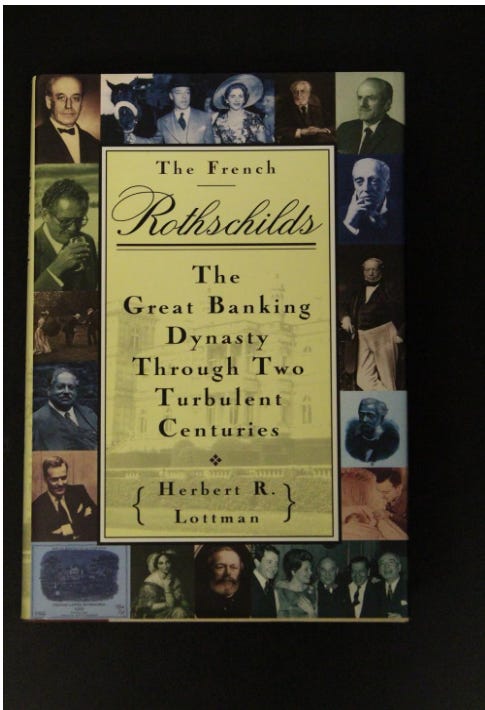
France’s Hijab War Reignites: Far-Right Vows to Fine Veiled Women in Public
With the 2027 presidential race looming, the National Rally’s plan to punish Muslim women for their hijab has triggered political fury, legal doubts, and fresh fears for religious freedom in France.

The psychosis of whiteness in living fucking Quasimodo color, on the right!
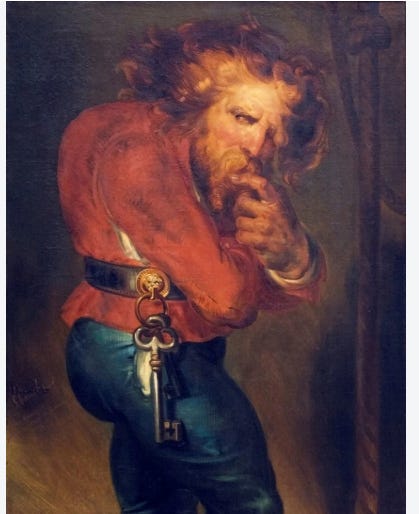
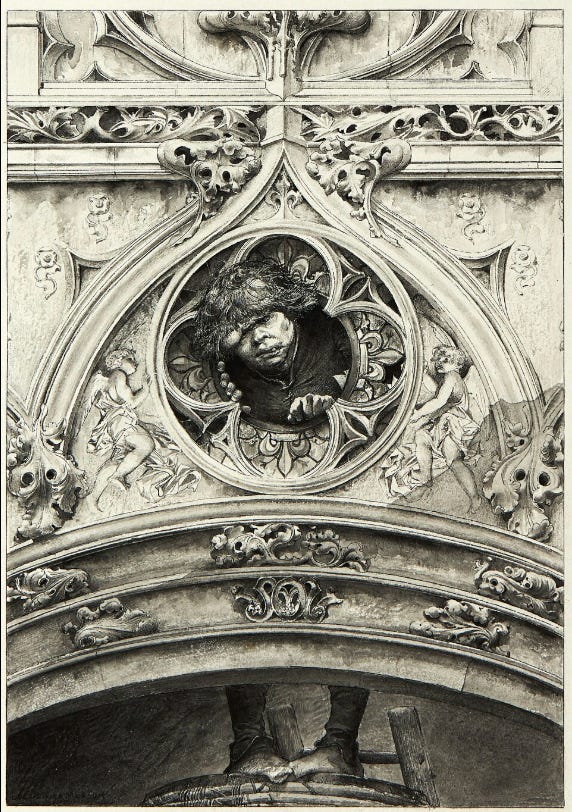
In the English-speaking world, we like to call the novel The Hunchback of Notre Dame, which is a marvelous title, given how marvelous is Quasimodo the Hunchback, born of a Jew and a sow (according to a nasty old lady in Book IV), who has got to be the most heartbreaking brokenhearted lover in the history of literature—Quasimodo, whose deformed and decayed skeleton turns up on the final page, entwined in posthumous and pathetic embrace around the skeleton of the hanged “Egyptian,” La Esmerelda, the “bohemian.
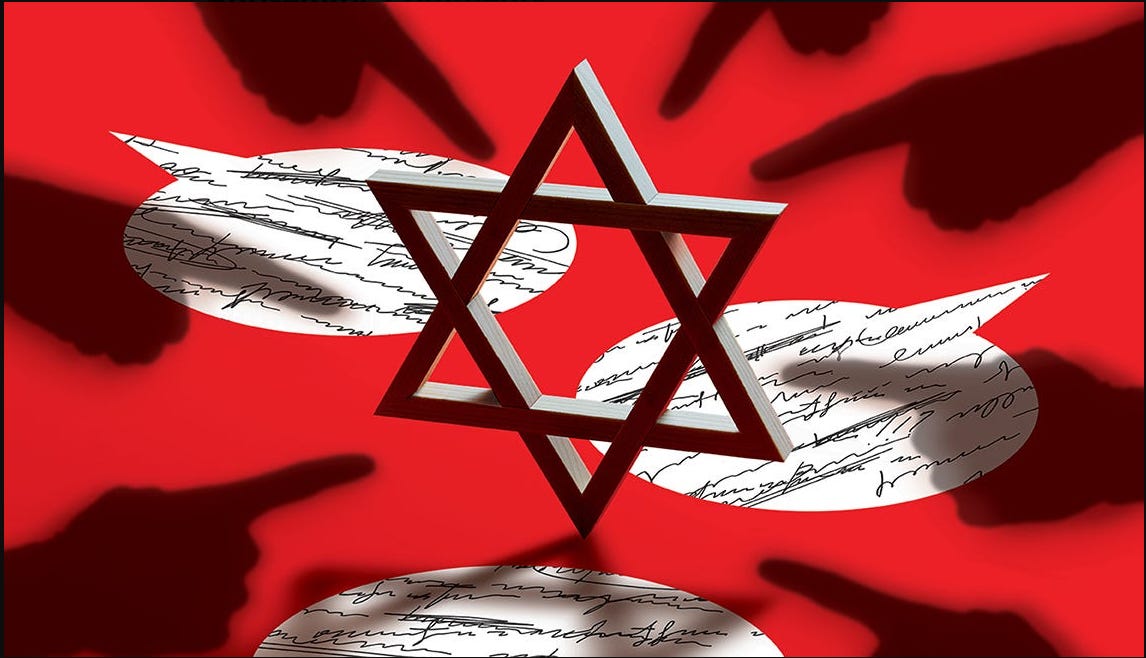
God, these fucking spineless Substack creeps are worried the Jew AI will penetrate their precious fucking prognostication tools: Antisemitic Comments/ Watford Indie\ Sep 03, 2026????

The IDF, the “settlers” in Occupied Palestine, Members of the Knesset, and Israeli society in general have all shocked the world with their brutality, their inhumanity, and lack of human empathy.
Palestinians have experienced the Zionist brutality, barbarism, and hate-filled sociopathy of Israelis for eight decades, and not just in the last 3 years. The lack of humanity; the lack of human empathy which sociopathic Zionist ideology has nurtured in Israeli society in particular, and the diaspora worldwide in general, is responsible for the madness the world looks upon with horrified disbelief.
One is tempted to look upon that inhumanity and dismiss the Israelis as devils and demons.
But they’re not demons – they’re human. Flawed beyond apparent redemption, possibly, but still human.
All the lies, the gas-lighting and the appalling inhumanity we have witnessed these last three years – not even that should tempt us to surrender our humanity in a fit of rage; we can’t allow the inhumanity of Zionism to squander our own humanity for the tempting bargain of vengeful, saccharine hate. Sweet at first, but it quickly turns into a bitterness we can’t shed.
There are comments on this Substack which are clearly antisemitic. It’s hard to say if they are coming from trolls; perhaps some are Zionists who need to encourage antisemitism, the oxygen that keeps Zionism flourishing; or real antisemites who have an irrational hatred of Jews.
I won’t block them, but I do disavow such comments.
There is a world of difference between anti-Zionism and antisemitism.
Anti-Zionism is anti-Nazism; it is anti-Fascism; it is anti-bigotry, anti-racism; it is the morally right position to take.
Antisemitism is racism; it’s an irrational bigotry; it will find another target of hate eventually; it is morally repugnant.
Norman Finklestein has described Zionism as “jewish supremacism”. I don’t believe Finklestein is being antisemitic here. He is merely being Finkelstein – pedantic to a fault. He recognises that Zionists are people with a jewish heritage, although they are largely secular, and irreligious, and deep-down antisemitic. Just read some of the statements from the founding fathers of Zionism – they could have been uttered by Hitler himself.
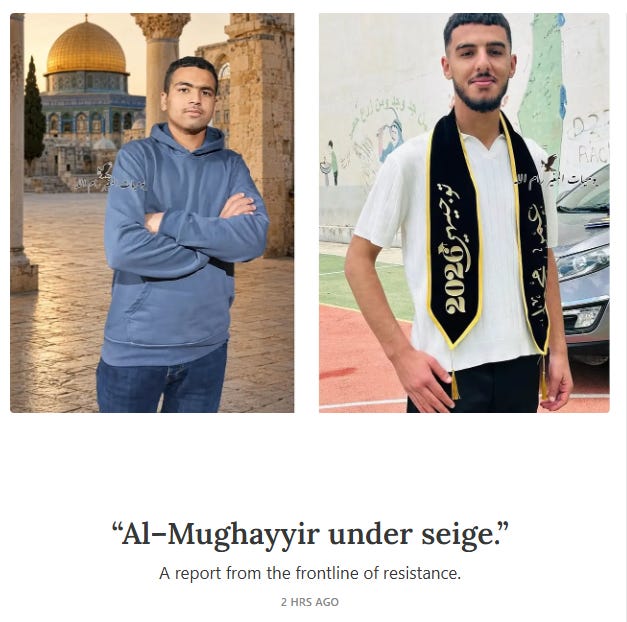
3 SEPTEMBER—Rabhi Abu Alia, age 17, and Omar Muhammad Naasan, age 18, were shot and killed by Zionist occupation forces during an attack on the village of Al–Mughayyir on Wednesday evening, 2 September. Naasan, who graduated from high school one month ago, is pictured above (right) on the day of his graduation. Abu Alia was photographed standing in front of the Dome of the Rock at Al–Haram Al–Sharif (the Noble Sanctuary) near Al–Aqsa Mosque.
In what follows, journalist Wisal Abu Alia—sharing the same family name and related to Rabhi Abu Alia through their grandfather—reports on the current state of siege of Al–Mughayyir.
Wisal Abu Alia’s report arrived by text this morning in the form of a letter. I publish it as it arrived.
—C. M.
By Wisal Abu Alia
Good morning,
To whom it may concern—and to those who do not know where Al–Mughayyir, northeast of Ramallah, is located: this is not merely a village on a map, nor is it a passing story in a news bulletin.
It is a village where nearly five thousand people live every day beneath a sky that always seems clouded—not because clouds never leave its skies, but because the fear and grief that have accumulated in the hearts of its people have left no room for yet another sorrow.
In Al–Mughayyir, even the calendar seems different.
Day and night are no longer separate periods of time. What happens during the day happens at night, and what begins at dawn does not end at sunset. For three years, people have forgotten what normal sleep feels like. But in recent months, the fear has become even more intense, making every moment capable of turning into a raid, a bullet, an arrest, or an assault. People live constantly on edge.
The army never truly leaves the village. It spreads through its streets, raids homes, breaks down their doors, and enters while carrying weapons and using violence. A home in Al–Mughayyir no longer means safety. A family may be gathered inside when suddenly a tear-gas grenade is thrown among them, turning the very place meant to protect them into a space of suffocation and terror. Between tear gas and bullets, people are left with nothing but their own bodies, using them to try to protect their children and themselves.
And every time a son leaves the house, his mother places her hand over her heart and waits for him to return. She does not know whether he will come back as he left—or whether he will return wounded, detained, or carried on the shoulders of others.
Then come the settlers.
They attack homes at any moment, under the protection of the occupying forces. The scene is no longer simply one in which settlers attack while soldiers stand at a distance. What is new is that the occupation forces have begun bringing settlers with them in military vehicles during raids on the village. And this makes the scene even more brutal than a mere assault.
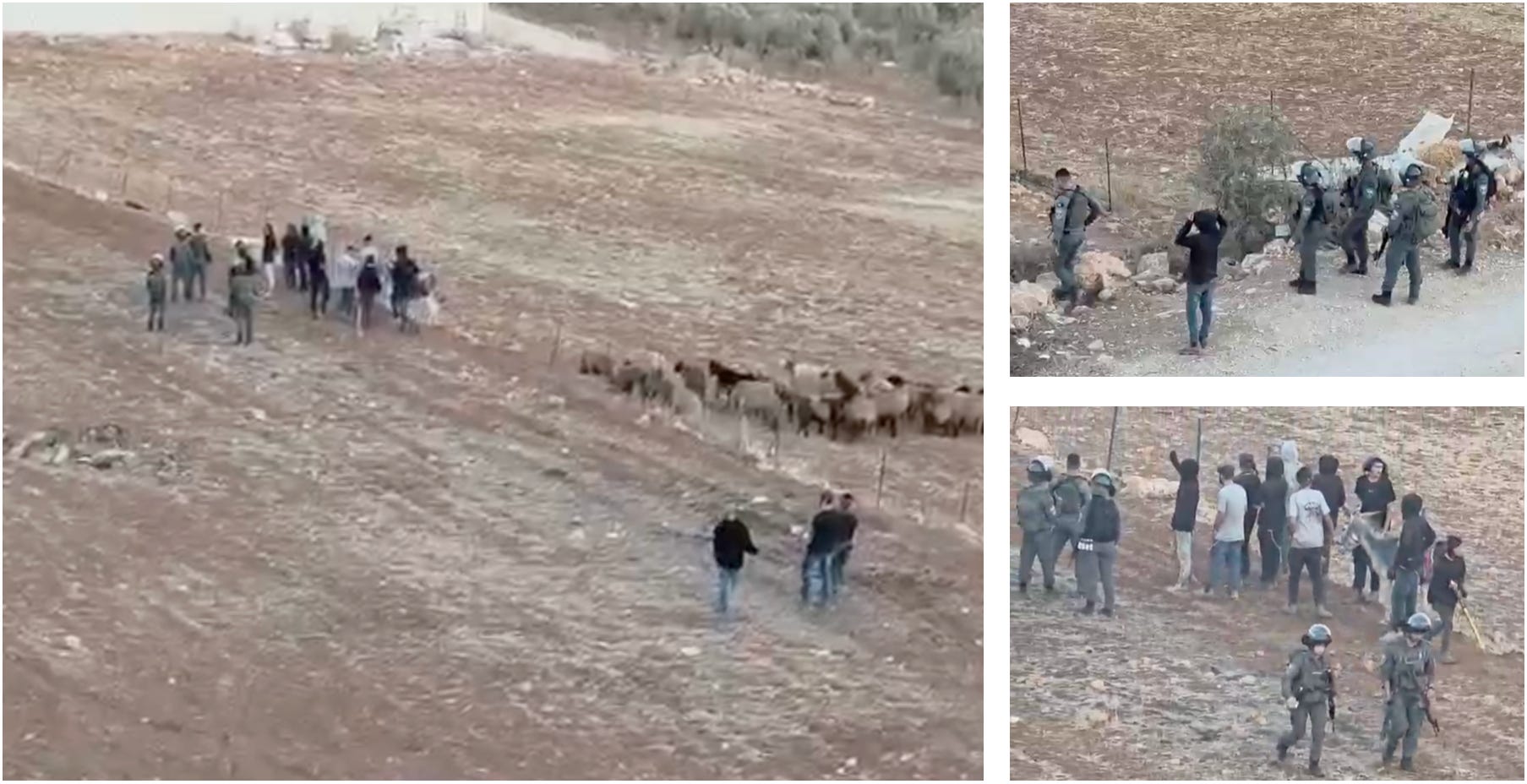
The army and the settlers operate as one force—occupying Al–Mughayyir, moving through it, and imposing their presence upon it day and night. It is as though the village is no longer merely being raided; it has become surrounded by a force that is present inside it at all times.
Even the trees have not been spared. Trees are uprooted just as homes are torn apart, because a tree on this land is not merely wood. It is memory, livelihood, an extension of a family, and a witness that someone was here—and intends to remain here.
In Al–Mughayyir, there are families who raise sheep and depend on what they produce for their livelihoods. It is a simple life built around the land, what it gives, and the hard work and patience of those who depend upon it. Yet the occupation protects settlers when they come to steal these sheep. And when residents try to defend their homes and their livelihoods, the result is often bloodshed.
Occupation snipers take positions on rooftops, waiting for the moment when residents attempt to defend their homes and their sheep—and people are killed. This is how defending your home becomes an accusation, protecting your livelihood becomes a risk to your life, and simply remaining where you are becomes an act for which you may pay with your blood. And the attacks are no longer confined to homes.
At the entrance to Al–Mughayyir, vehicles are smashed, with people inside them, by settler attacks. And there, at the permanent checkpoint, another story of humiliation begins. Workers and employees who spend an entire month working to bring their salaries home to their families may have those salaries stolen before they ever reach their homes. Soldiers from the occupation forces take them at the permanent checkpoint at the village entrance. And all of this happens only when they, the villagers, are allowed to leave or return in the first place.
The checkpoint may open for only a few minutes, and most of the time it remains closed. Reaching the village is like trying to cross a border that never ends, while returning home becomes a matter determined by the mood of the soldiers at the checkpoint rather than a person’s right to reach their own home. At this checkpoint, hundreds have been subjected to beatings, degrading treatment, and humiliation.
Al–Mughayyir is not merely living under siege. It is living within an entire system of daily pressure:
A checkpoint that closes the road.
An army that raids homes.
Settlers who attack residents.
Bullets that tear into bodies.
Sheep that are stolen.
Trees that are uprooted.
Salaries that are taken.
Arrests that continue.
And vehicles smashed over the heads of those inside them.
Today, during almost every raid on a home, hardly anyone is spared from violence.
Children. Men. Women.
Everyone stands equal before the butts of occupation rifles.
The question in Al–Mughayyir is no longer: Who is being targeted? The question has become: Who is left outside the circle of those being targeted? Hundreds of people in the village—men, women, and children—have been injured. Some injuries have left their victims facing a lifetime of pain, including cases of limb amputation caused by gunshot wounds.
At the same time, the space in which life itself can exist continues to shrink. Al–Mughayyir once had approximately 43,000 dunams of land (10625 acres). Today, only around 980 dunams (242 acres) remain. And even this remaining area changes from one day to the next, revealing that the struggle is not merely over a house, a street, or a tree. It is a struggle over the village’s right to continue existing on its own map.
Land that once had room for an entire village is now shrinking until its people can barely breathe. Even vendors have stopped entering Al–Mughayyir because they fear attacks by settlers. And so it is not only the road that is closed to people. The doors to the market, to work, to movement, and to life are closed as well.
This is how isolation is created, step by step:
The entrances are closed, so people become afraid to come.
Vendors are afraid to enter.
Workers and employees are trapped.
Salaries are stolen.
Vehicles are attacked.
Homes are raided.
Doors are broken down.
Tear-gas grenades are thrown inside homes.
Men, women, and children are beaten.
Trees are uprooted.
Sheep are stolen.
Arrests continue.
And snipers take positions on rooftops.
Then people say that the village lives in isolation. But this isolation is not a natural fate. It is deliberately created. Today, Al–Mughayyir is experiencing an unprecedented state of siege and isolation, to the point that reaching it has become a daily battle.
A battle to reach your home.
A battle to return to your family.
A battle to protect your sheep.
A battle to protect your tree.
A battle to bring your salary home to your children.
A battle to leave the village and return to it.
And an even greater battle simply to remain.
And here lies the harshest truth:
The aim is not only to make people afraid, but to make them exhausted. Not only to injure them, but to strip them of their ability to carry on. Not only to uproot a tree, but to push a person into uprooting themselves. Uprooting does not begin when a house is demolished. It begins when the road to that house becomes impossible.
And,
When going to work becomes dangerous.
When a livelihood becomes vulnerable to theft.
When a father fears for his son.
When a mother fears for her child.
When a shepherd fears for his sheep.
When a farmer fears for his trees.
And when night becomes nothing more than an extension of the day in fear.
And yet, Al–Mughayyir remains steadfast and deeply rooted. Nearly five thousand people still live there, despite everything. Mothers still wait for their sons. Shepherds still go out to tend their sheep. Farmers still look upon their trees. Homes, even with their doors torn from their hinges, still say that their owners are here. And the village, despite the siege, refuses to become a place without its people.
That is why the real struggle does not seem to be only about Al–Mughayyir. It is a struggle over what it means for a human being to have a place to which they can return.
When a place is besieged, the human being is put to the test.
When a tree is uprooted, memory is put to the test.
When a road is closed, the right to access is put to the test.
When a child is terrorized, the future is put to the test.
And when a village’s people are pushed to leave, the very meaning of homeland is put to the test.
And Al–Mughayyir, through everything happening there, says one thing: We are not defending a few dunams of land. We are defending our right to have a tomorrow here.
This is not the whole story of Al–Mughayyir. It is only a small part of what happens every day in a village besieged by the occupation and settlers, where its people live under fear, gunfire, assault, and isolation.
But perhaps this small part is enough to make us ask:
How much more land must be uprooted?
How many more people must be injured?
How many more homes must have their doors torn down?
How many more salaries must be stolen?
How many more trees must be uprooted?
How many more mothers must place their hands over their hearts every time their sons leave home?
How many more times must an entire village have its roads closed?
How much more must happen before those who have the power to listen understand that what is happening in Al–Mughayyir is not an isolated incident, but a daily attempt to uproot people from their land, their livelihoods, their memories, and their right to live?
Al–Mughayyir is not simply a village that cannot sleep. Al–Mughayyir is a village that is being forced not to sleep, so that it will become too exhausted to remain. But, for now, it is still here. And that alone, in an age of dispossession, is an act of resistance.
■
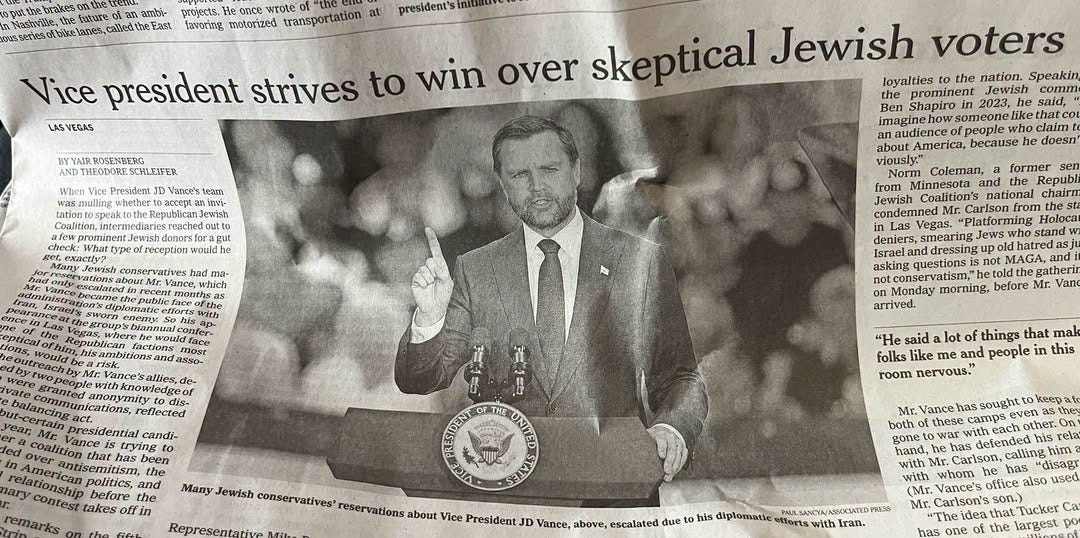
I wonder how the 98% take it…
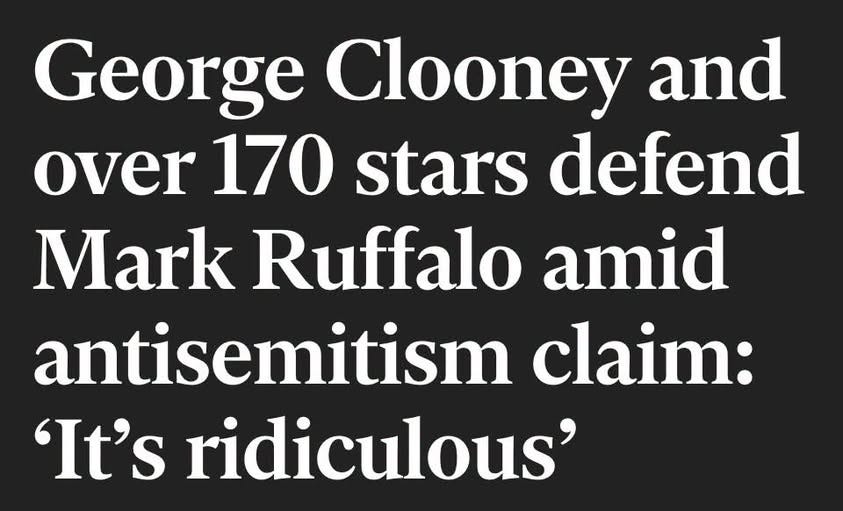
Last month, Ruffalo criticised the links between tech company Oracle – which is owned by Paramount Skydance boss David Ellison’s father, Larry – and the Israeli military, describing the Israeli military’s actions as a “genocide”…
Try to think of a situation in which every time a Jew refers to the Holocaust we would manage to silence him or her, accusing him or her of being anti-German…
Try to think of a situation in which every time a woman complains about a rape we would dismiss her as an ‘anti-male obsessive.’
This is exactly what we see here-an attempt to castigate the reference to the genocide as ‘antisemitism’. To make people fearful, pointing at the worst documented crime against humanity in human history.

Gilad:
This is precious. Dershowitz is probably the best living example of a Talmudic litigious mind – endless hypothetical delusional games furnished with a complete lack of ethics, let alone empathy or even something that resembles humanity.
I have been arguing for years that Dershowitz is on the low cognitive end. Not one argument by him ever presented a sound rationale. The fact that Dershowitz did so well in Harvard points at the systematic collapse of American academia. Jeffrey Epstein and others like him may have something to do with that collapse. It is reasonable to assume Epstein & Co. received something in return for the millions they poured on American academia. They basically made Harvard and other Ivy League institutes into Yeshivas…
David Smith, on the contrary, is the exact Jew whom I am so excited to see more of. He is always presenting a humanist ethical position; he doesn’t BS about his ‘Jewish Values’. He never pulls the ‘As A’ nonsense. He is always applying reason. He is a humanist who happens to be Jewish. Not many of those around..

To the comment “Zionism is an ideology and ideology cannot be defeated,” I answer: Zionism has been hijacked by Judaism; it was defeated a long time ago.
Judaism, on the other hand, is neither a religion nor an ideology. It is a tribal, litigious, racially driven, evolutionary, oppressive model. It is forceful, sophisticated, and dialectical to the extent that it encompasses its so-called “dissenters” (from the Hebrew Prophets all the way to JVP). Judaism and Jewishness cannot be eliminated. But they must be unveiled for what they are.
Jewish power, in that regard, is the power that is designed to prevent this disclosure.
This power is now in decline…
In the image: Rabbi Abraham Kook, who grasped very early on that integrating Zionism into Judaism, making Eretz Yisrael into a sacred Judaic pillar, is the way forward for the Jews. Rabbi Kook’s ideology dominates the Jewish State politically, spiritually, and culturally.

- Building 7: Silverstein received about $861 million in mid-2002 for the collapse of 7 World Trade Center.
- The Twin Towers: He fought a legal battle over whether the two plane crashes counted as one event or two separate attacks.
- Final Settlement: By 2007, the courts and insurers finalized a total payout of $4.55 billion for the entire complex,
And he was a JEW: EDDY.
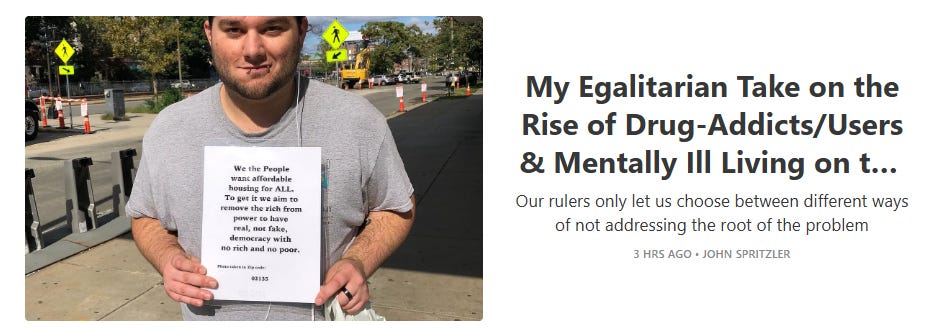
Spritzler / / / My comments:
Drugs? Hmm, like Freedom Bernays Torches? Most folk I know in their 70s, as former or current cancer stick imbiders, started at age 13.
Drugs? Sacrifice Zones? All those poor people along the fences of refineries or pig-shit ponds?
Hmm, how many nanoparticles in Johnny’s Cheerios? Oh, glyphosate in 90 percent of Jane’s food?
Oh, drugs, that’s right. EMF’s and adjuvants in those jabs, all those, what, 35 vaccines by age 18? Hmm.
Pesticides? Atrazine? Come on, brother, so many drugs and chemicals in the fucking somatic fluid.
Fuck, the black mirror, that fucking Zuckerberg et al attention distractor and attention deficit and attention manipulator fucking screen poison?
Well, so, is it not surprising that modern humans will be zapped, man, AMR? PFAS’s? Forever chemicals again approved by that other Talmudist freak, Zeldin?
Here, one rare Jewish person who dug deep into manipulation, almost a counter-valence to the Monster of the World, that Jewish Stain, Eddy Bernays.
And HE was a Jew, Meerloo.
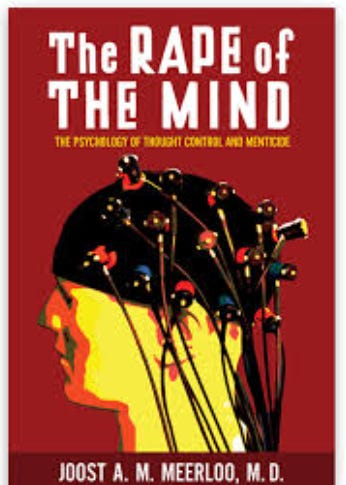
Rape of the Mind
The Rape of the Mind is a foundational 1956 book written by Dutch physician and psychoanalyst Dr. Joost Meerloo that explores the psychology of brainwashing, thought control, and mass submission. Meerloo, who escaped Nazi-occupied Europe during World War II, coined the term “menticide”—defined as the systematic killing of the human spirit and independent mind. The book analyzes how both totalitarian regimes and modern democratic institutions use psychological coercion to force conformity.
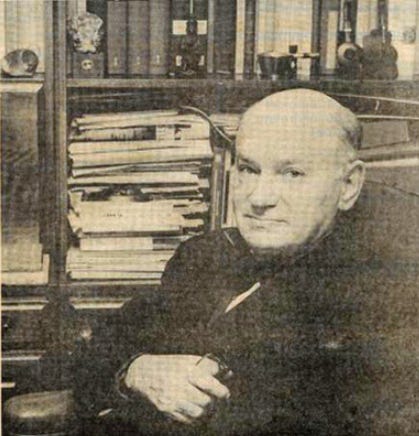
Core Concepts & Mechanisms: Meerloo outlines several specific tactics used by entities to strip individuals of their mental autonomy:
Menticide & Hypnosis: Operating on the premise that under continuous trauma, isolation, and pressure, virtually anyone can be forced to break. The conscious personality goes into a trance state, robotically repeating programmed ideas.
Pavlovian Conditioning: Treating human beings like animals in a laboratory by utilizing conditioned reflexes. By alternating rewards and punishments, totalitarians breed predictability and absolute submission. Semantic Fog & Verbocracy: Using confusing language, shifting definitions, and a flood of political jargon to intentionally clutter public discourse. This strips words of their true meanings, leaving citizens exhausted and unable to form coherent arguments.
Mass Delusion & Fear: Employing constant anxiety as a tool. A population kept in a permanent state of fear will voluntarily surrender their personal freedoms in exchange for a false sense of security.
Creeping Mind Control in Free Societies: A central warning in the book is that mind control is not exclusive to dictatorships. Meerloo highlights how citizens in democratic societies face subtle, creeping psychological pressures from everyday systems:
Technology & Media: Automated entertainment and constant media broadcasts can easily bypass critical thinking, fostering passive conformity.
Bureaucracy: Over-regulated institutions demand blind compliance and push individuals to stop thinking for themselves.Mental Contagion: Prejudices, moral panics, and mass hysterias can sweep through a population like a virus, clouding individual judgment
Dr. Joost A. M. Meerloo, a psychiatrist and a prolific writer best known during the Cold War years for his studies on the effects of “brainwashing,” died Nov. 17, 1976, in Amsterdam. He was 73 years old.
Imprisoned briefly by the Nazis during the 1940’s, Dr. Meerloo escaped and fled to England, where he became an expert on “mind‐killing,” the various means of torture for which he coined his own word, “mentacide.”
“The Rape of the Mind,” his best-known book, was published in 1956. It brought him wide attention beyond medical circles because of public concern over allegations of “Communist brainwashing” of American soldiers in Korea.
Dr. Merloo emphasized, though, that his overall concerns were focused on describing how modern technological societies exert stressful pressures on the human mind and were not limited to the political implications of brainwashing.
“Mentacide is an infectious disease that exists everywhere, including the United States, where there is a mass hysteria over Communism,” he told a friend before he returned to his birthplace in the Netherlands after 22 years of residence in New York City.
At the time of his death, Dr. Meerloo was working as a consultant in a geriatric medical center and writing books and reviews in subjects ranging from psychiatric studies to art.
Born at The Hague on March 14, 1903, he was the youngest of six children.
Three sisters and two brothers were later killed by the Germans.
Dr. Meerloo was educated at the University of Leyden, where he received his medical degree in 1927. After postgraduate work in psychiatry and psychoanalysis, he continued psychiatric studies in Paris.
Zurich, Berne and London. Between 1930 and 1934, he taught the People’s University in Rotterdam.
During that period, he received his at the University of Utrecht. After his imprisonment by the Nazis, in 1942, and his escape to England, became colonel and chief of the psychological department for the Netherlands army‐in‐exile, based in England.
Treated Nazi Victims
In two works published in 1945, “Homo Militans, the Psychology of War and Peace in Man,” and “The Psychology of Pain and Sorrow,” Dr. Meerloo detailed his experiences during the years in which he treated Nazi torture. Implicit in his studies was the notion that all individuals can break in the hands of their enemies. “Aftermath of Peace; Psychological Essays,” and several hundred other articles were written by Dr. Meerloo and published here where he taught psychiatry at Columbia University and social psychology at the New School for Social Research.
In modern psychological and political discourse regarding Israel and the broader Middle East, Meerloo’s theories on “mass delusion,” “mental contagion,” and “semantic fog” are frequently cited by scholars. Academic researchers and political psychologists leverage his work to analyze:
- The weaponization of fear and propaganda in the geopolitical theater.
- How populations under prolonged structural trauma can become susceptible to radicalization and ideological conditioning.
- The psychological impact of inherited, generational trauma among Jewish populations and Holocaust descendants.

