
And yep, my Snakes US Passport already has the Homeland Security red flags, so, what would I expect going to Scotland to see a cousin, or buddy in Spain, upon my return?
Jul 21, 2026

- Adely, Suzanne: The president of the National Lawyers Guild who participated in the Nuestra América Convoy and who, the report notes, praised Venezuela’s 2024 elections.
- Amazon Labor Union: A labor union founded by Christian Smalls that participated in the 2026 Nuestra América Convoy to Cuba.
- Antifa: A decentralized group of self-described “Anti-fascist” political activists
- Assata’s Daughters: A Chicago-based Black Lives Matter abolitionist offshoot that trains young activists in the radical spirit of Assata Shakur.
- Association for Investment in Popular Action Committees (AIPAC): A California-based umbrella nonprofit that funds left-wing media and delegations to Cuba and Venezuela.
- Bass, Karen: The current Mayor of Los Angeles and former Congresswoman who was a Venceremos Brigade organizer in the 1970s.
- Benjamin, Medea (Susan Benjamin): A co-founder of Code Pink and Global Exchange who organizes Cuba solidarity efforts.
- Black Alliance for Peace: An activist group that maps U.S. military bases and police training facilities as targets for radical agitation.
- Black Lives Matter (BLM) (including Global Network Foundation, Grassroots, and at School): A sprawling racial justice network whose leaders and offshoots, the report says, have expressed solidarity with Cuban regime and radical figures like Assata Shakur.
- Boudin, Chesa: The former District Attorney of San Francisco and son of Weather Underground member Kathy Boudin.
- changingFrequencies: A Black Queer Feminist-led abolitionist project aiming to disrupt waht it calls the “Medical Industrial Complex”.
- Claudia Jones School: A Washington, D.C.-based organizing collective that conducts popular education and, the report says, pro-Cuba lobbying.
- Code Pink: Women for Peace: A left-wing protest group that describes itself as anti-war and organizes solidarity delegations to Cuba.
- Cohen, Ben: The co-founder of Ben & Jerry’s who attended the wedding of Neville Roy Singham and Jodie Evans.
- de la Cruz, Claudia: The co-founder of the People’s Forum, IFCO executive director, and 2024 presidential candidate for the Party for Socialism and Liberation.
- De Los Santos, Manolo: The co-founder and head of the People’s Forum who the report says maintains deep relationships with Cuban regime elites.
- Democratic Socialists of America (DSA): A major socialist political organization that has organized official delegations to Cuba.
- Ensler, Eve (V): A prominent playwright who attended the wedding of Neville Roy Singham and Jodie Evans.
- Equality for Flatbush: A Brooklyn-based Black Lives Matter abolitionist group fighting gentrification, police, and ICE.
- Evans, Jodie: The co-founder of Code Pink who married Neville Roy Singham.
- Floyd, George: A Minneapolis man whose 2020 death sparked nationwide uprisings that the report notes were praised by Cuba.
- Garza, Alicia: The co-founder of Black Lives Matter who credited Assata Shakur as a key influence in her organizing work.
- Goodman, Amy: The host of Democracy Now! who the report notes attended the wedding of Neville Roy Singham and Jodie Evans.
- Haitian Women for Haitian Refugees: An activist group led by Black women that organizes to defend Black migrants and block deportations.
- Hirsi, Isra: A campus activist and daughter of Ilhan Omar who was suspended from Barnard College for organizing anti-Israel encampments before traveling to Cuba.
- IFCO / Pastors for Peace: An ecumenical foundation that organizes aid caravans to leftist regimes and serves as a fiscal sponsor for numerous radical U.S. groups.
- Larudee, Paul: A U.S. citizen based in San Francisco who serves as the North American coordinator for the pro-Iranian “Resistance Axis” coalition Al-Tajammu.
- Mamdani, Zohran: Mayor of New York
- National Lawyers Guild (NLG): An association of radical lawyers that provides legal defense and “legal observers” for various left-wing groups
- National Network on Cuba (NNOC): A coalition of over 60 American groups dedicated to lobbying for Cuba and coordinating nationwide direct actions.
- Omar, Ilhan: A Democratic Congresswoman and mother of campus activist Isra Hirsi.
- Party for Socialism and Liberation: A leftist political party that fielded a 2024 presidential candidate and conducts protests.
- People’s Forum, The: An activist hub for anti-ICE and pro-Cuban agitation.
- Piker, Hasan: A streamer and left-wing political commentator who, the report notes, traveled to Cuba to film a documentary and participated in the Nuestra América Convoy.
- Pressley, Ayanna: A Democratic Congresswoman who, the report notes, publicly praised convicted murderer Assata Shakur upon her death.
- Singham, Neville Roy: A Shanghai-based American technology magnate who funds various left-wing activist groups.
- Smalls, Christian: The founder of the Amazon Labor Union who participated in the 2026 Nuestra América Convoy to Cuba.
- Thousand Currents: A progressive nonprofit that served as the fiscal sponsor for the Black Lives Matter Global Network Foundation.
- Villaraigosa, Antonio: A former Mayor of Los Angeles and Speaker of the California Assembly who was a Venceremos Brigade alumnus.
- Viva Palestina US: The American branch of an international network that, the report says, previously provided convoys and funds to Hamas.
- Waters, Maxine: A Democratic Congresswoman who, the report notes, once wrote a letter urging Fidel Castro not to extradite fugitive Assata Shakur.
- Wilson, Diane: A co-founder of Code Pink.
- Witness for Peace Solidarity Collective: An organization that runs recurring solidarity delegations to Cuba.
Ahh, from another Jewish liberal:
Guilt by association at its finest. But what exactly are they guilty of?
What the report shows isn’t that any of these people are knowingly taking directions from a foreign power — only that they disagree with the U.S. government on Cuba policy (or at most, agree with Cuba).
Their views can be wrong — aggressively, offensively wrong even — but it’s their goddamn right as Americans to hold them.
U.S. and Iran trade strikes for 9th day. Israel has killed at least 1,158 Palestinians in Gaza since the so-called ceasefire deal was signed, according to Gaza’s Health Ministry. Middle East Eye reports Israeli minister “Smotrich says U.S. fighting Iran is ‘best for us’ and Israel will not join … Finance minister says the war serves Israeli interests while American troops and households bear its mounting costs.” AntiWar.com is reporting “Nearly 100 U.S. Troops Injured This Month”.

Words, man, this shit hole’s White Man’s House of the Minyans . . . .
Luna Amendment to #1394 The National Defense Authorization Act (NDAA)
Jul 21
Written By A New Policy Staff
Date last updated: Jul 21, 2026
Representative Anna Paulina Luna (R-FL-13) introduced Amendment 1394/320 to the H.R. 8800 (National Defense Authorization Act) on July 20, 2026.
Related legislation: H.R.8800; S.4784
Bill Summary: The Luna Amendment strikes 7 words, including four instances of the word “integration/integrate” from Sec. 219 of the NDAA, the section that creates the U.S.-Israel Defense Technology Cooperation Initiative.
Context: The changes made by this Amendment are entirely cosmetic. The Amendment is a cosmetic cynical ploy and bad faith politics on the part of REP Luna and the Republican Majority to muddy the waters around this section. Specifically, the Amendment:
- Does not strike the most important instance of the term ‘integration,’ which occurs in Section (a)(1), as follows:
identifying jointly developed or Israeli-origin technologies with operational utility for potential integration into United States systems and programs of record;
- Would not have any meaningful impact on the overall direction of the Initiative – it would not remove the directive for integration of Israeli tech into U.S. weapons systems; would not substantively change the 10 areas of emerging tech collaboration, would not impact the directive to expand coproduction, and would not remove the directive to appoint an Executive Agent in DOD to see the program forward.
A New Policy’s Recommendation: OPPOSE
A New Policy opposes the amendment as it is a cosmetic change to section 219 and bad faith politics, and A New Policy is urging Members to OPPOSE the Luna Amendment on that basis. Had the Majority wished to have a real debate on this issue, they could have advanced the Massie-Khanna Amendment to strike Sec. 219 entirely. The fact they did not tells you everything you need to know about this Amendment.

BENJAMIN FREEMAN, wrote the pieces “Congress quietly moves to integrate U.S. and Israeli militaries“ and “Congress blocks Massie-Khanna effort to kill U.S.-Israel integration“ for Responsible Statecraft. He is director of the Democratizing Foreign Policy Program at the Quincy Institute. He is also co-author of the The Trillion Dollar War Machine.
He said today:
“Congress has once again defied the will of the American people and moved us one step closer to fusing our military industrial complex with Israel’s. Even worse, they’re not even willing to have an honest, public debate about the issue. They just keep pushing this dangerous proposal forward behind closed doors. And, the reason they’re doing this is painfully obvious: they know the American people don’t want it, but they’re too scared to stand up to the Israel lobby. But, enough is enough, it’s well past time that Congress puts the interests of the American people above the interests of Benjamin Netanyahu.”
What the fuck? China Rejects U.S. Allegations of Foreign Military and Intelligence Facilities in Cuba.

On Monday, Chinese Foreign Ministry spokesperson Lin Jian rejected U.S. allegations about the presence of foreign military and intelligence facilities in Cuba.
FUCK AMERIKKA:

Yeah, Wolff and Sachs and other Jews yammering about the end of Imperial AmeriKKKa. I want some of that HOPEIUM they snort.
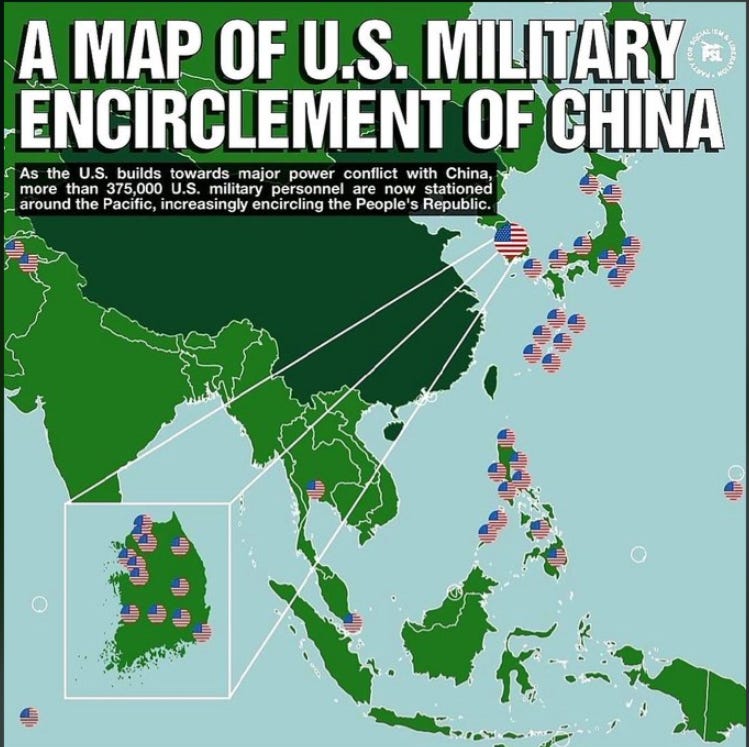
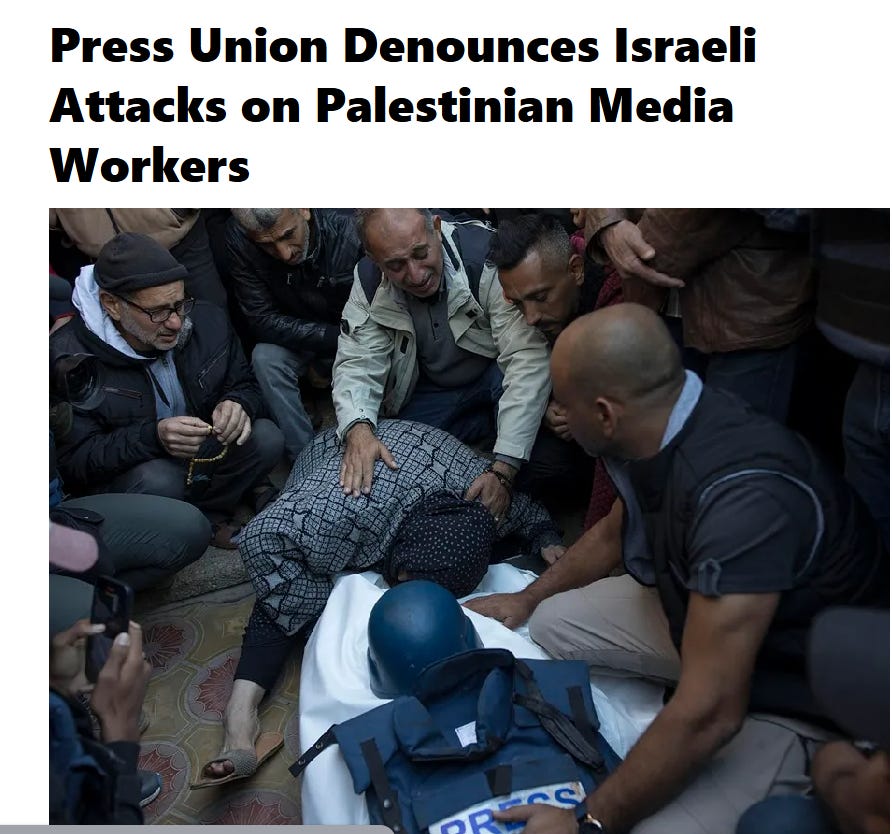
Denouncements? We need to start training folks how to pick up a gun, how to make gasoline and fertilizer bombs, and how to remote detonate them, motherfuckers:
A strange strange world indeed: DICTATORS!


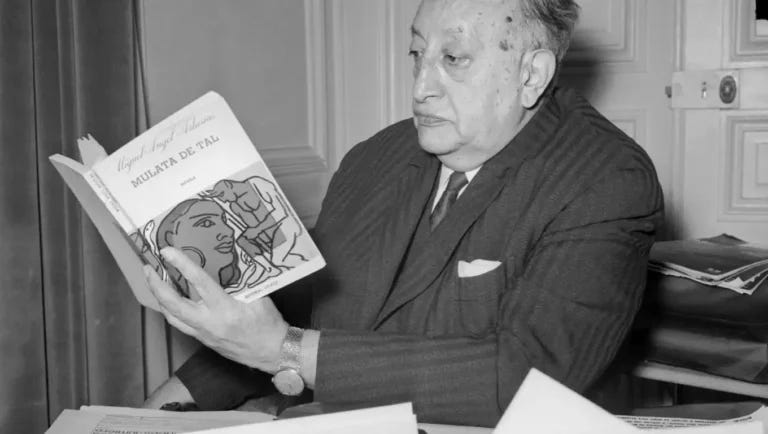
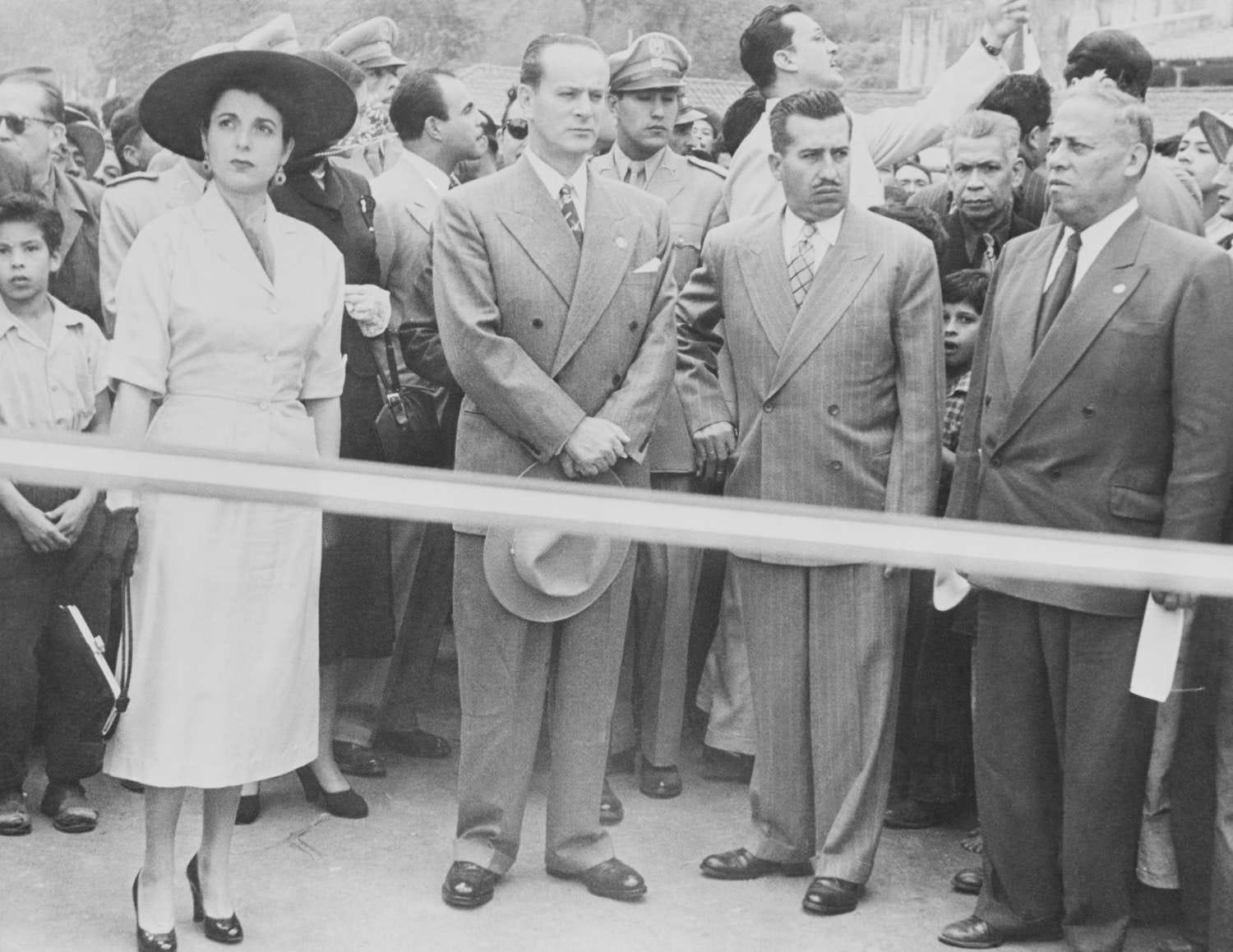
On Wednesday, the Guatemalan government unveiled the design for the funerary monument that will house the remains of writer Miguel Angel Asturias, winner of the 1967 Nobel Prize in Literature.
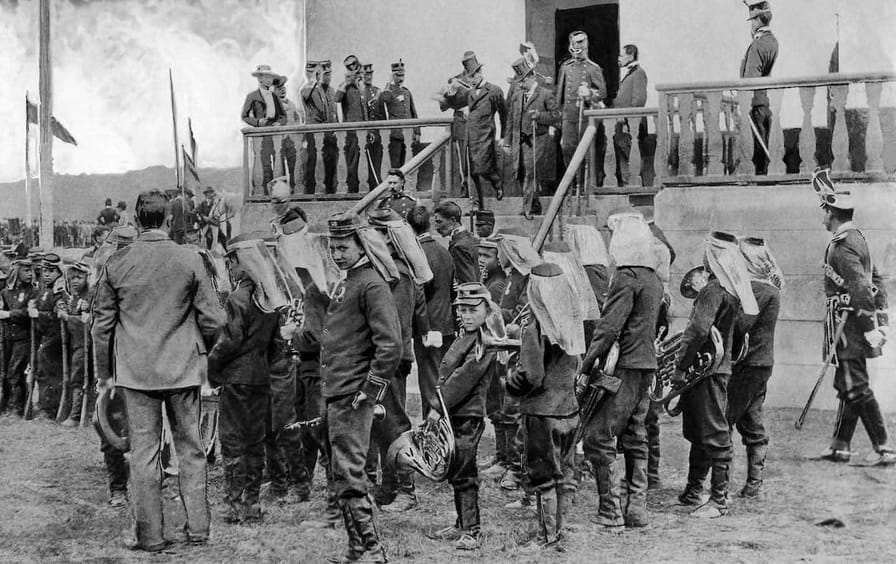
The repatriation of Asturias’ remains from France is scheduled for October, while Minister of Culture Luis Mendez explained that the memorial will be located in the gardens of the Miguel Angel Asturias Cultural Center in Guatemala City, as a permanent tribute to the writer.
The design, by Guatemalan architect Alejandro Paz, consists of a contemporary pavilion with twin reinforced concrete beams, a metal roof, and marble elements, respectfully integrated into the existing heritage site.
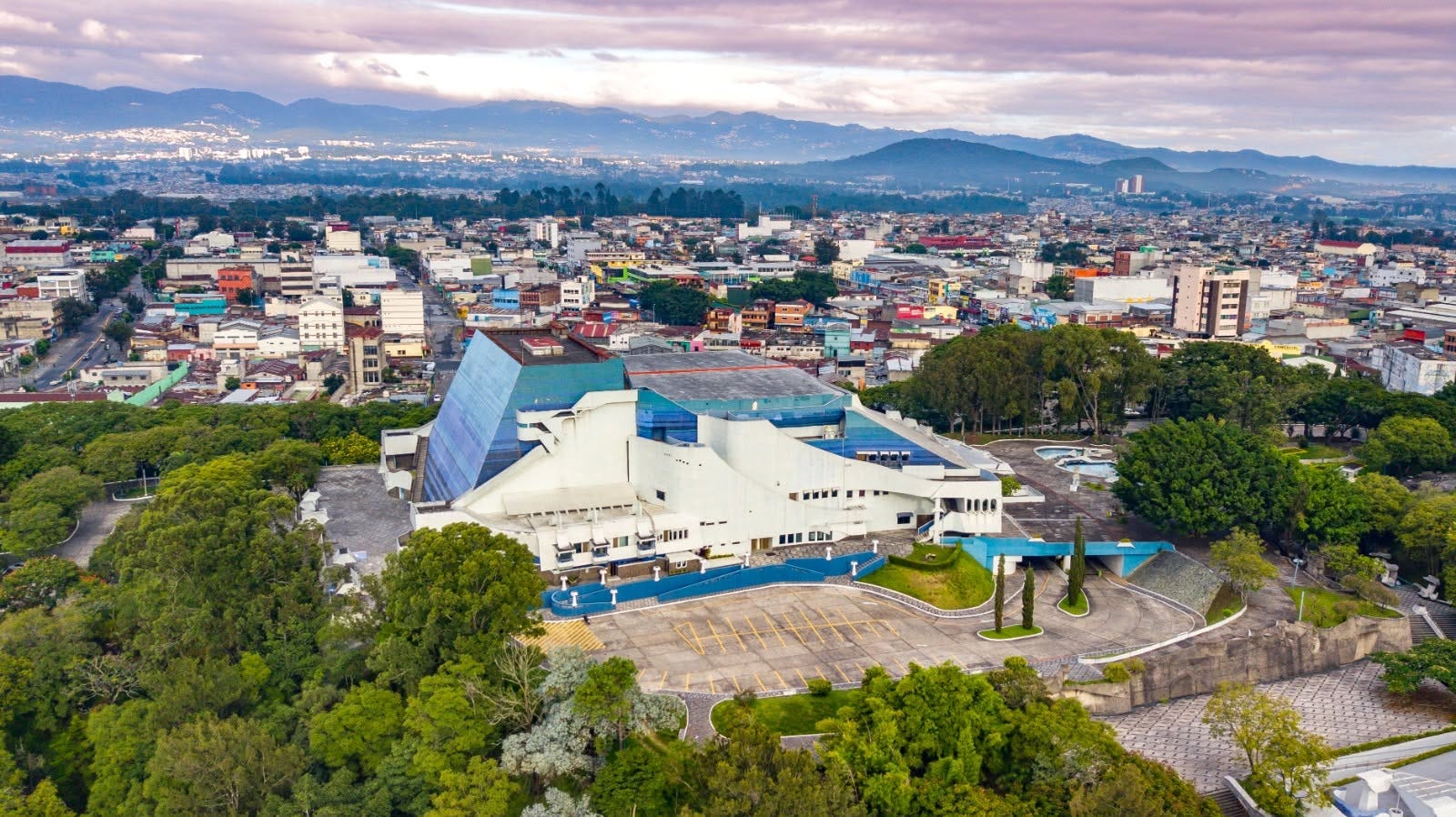
Meanwhile, the Miguel Angel Asturias Cultural Center is internationally recognized for its organic architecture, which blends structures with Guatemala’s topography and volcanic landscape.
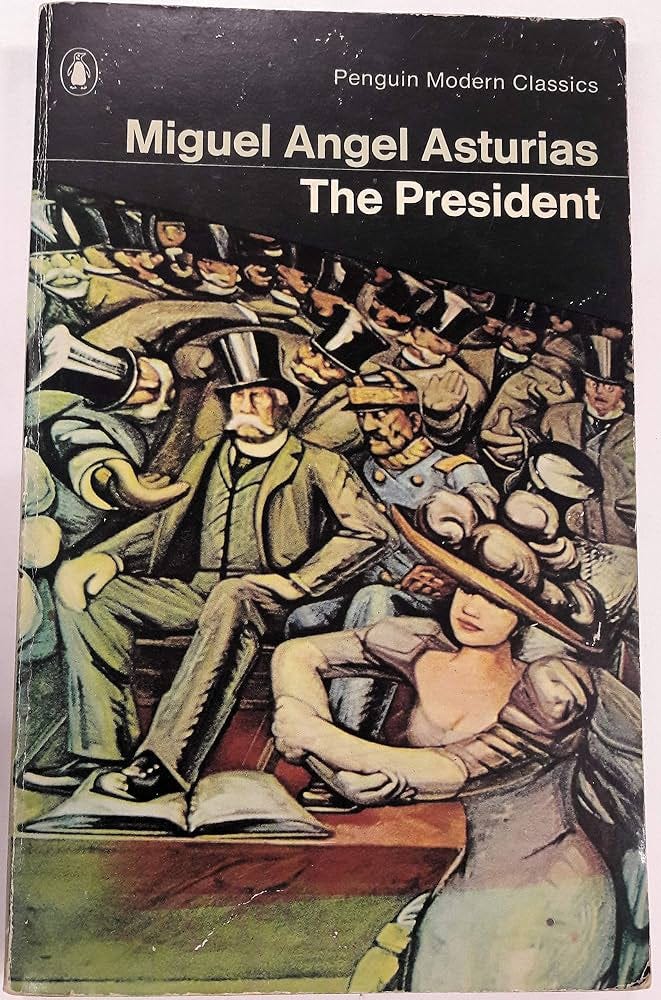
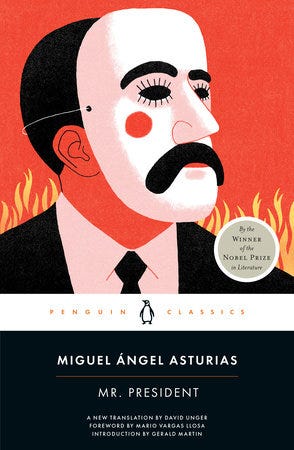
There’s a certain confusion about this novel, to which Asturias himself contributed. At the time, he championed social and protest fiction, the kind that revealed the horrors that Latin American dictators had committed. On many occasions, he claimed that his book belonged to the genre of politically engaged novels.
Undoubtedly, this is one important aspect of Mr. President. The novel deals with prototypical Latin American realist or local color themes, based on the dramatic historical circumstance that dictators ruled most Latin American countries.
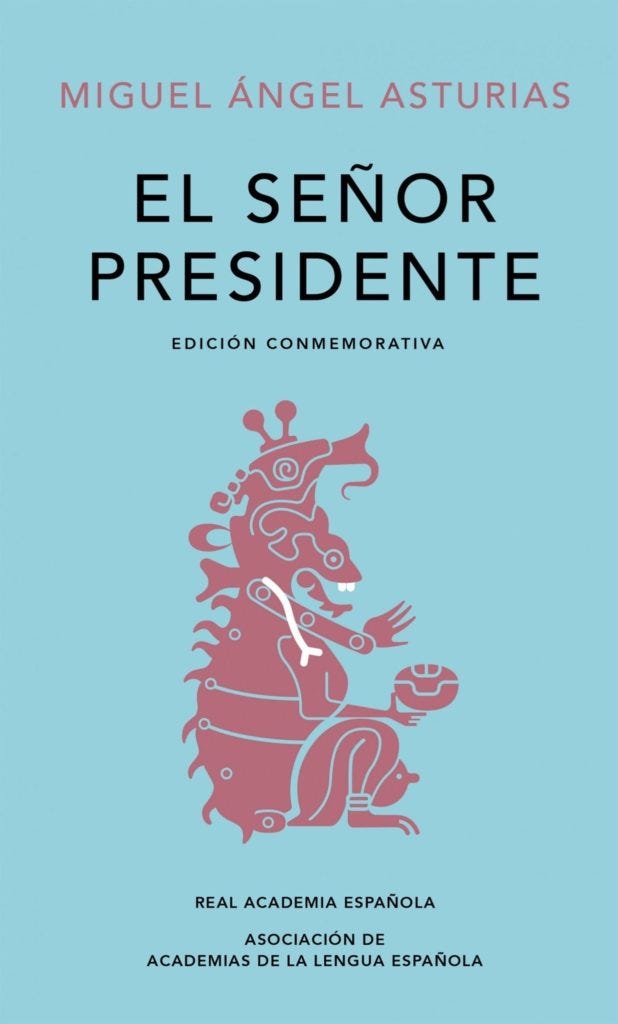
In an unnamed country, an egomaniacal dictator schemes to dispose of a political adversary and maintain his grip on power. As tyranny takes hold, everyone is forced to choose between compromise and death. Inspired by life under the regime of President Manuel Estrada Cabrera of Guatemala, where it was banned for many years, and infused with exuberant lyricism, Mayan symbolism, and Guatemalan vernacular, Nobel Prize winner Miguel Ángel Asturias’s magnum opus is at once a surrealist masterpiece, a blade-sharp satire of totalitarianism, and a gripping portrait of psychological terror.
Miguel Ángel Asturias’s Nobel Lecture, 12th December 1967
(Translation)
The Latin American Novel: Testimony of an Epoch
I would have preferred this meeting to have been called a colloquium instead of a lecture – a dialogue of doubts and assertions on the subject that concerns us. Let us start by analysing the antecedents of Latin American literature in general, focusing our attention on those aspects that have most connection with the novel. Let us follow the sources back to the millenarian origins of indigenous literature in its three great moments: Maya, Aztec and Inca.
The following question arises: Was there something resembling the novel among the indigenous peoples? I believe there was. The history of the original cultures of Latin America has more of what we in the Western world call the novel than of history. It is necessary to bear in mind that the books of their history – their novels we would now say – were painted by the Aztecs and Mayas and preserved in a figurative form which we still do not understand by the Incas. This assumes the use of pictograms in which the voice of the reader – the indigenous do not distinguish between reading and reciting since for them it is the same thing – recited the text to the listeners in song form.
The reader, reciting stories or ‘great language’, the only person who understood what the pictograms meant, carried out an interpretation, recreating them for the enlightenment of those who listened. Later, these painted stories become fixed in the memory of the listeners and pass in oral form from generation to generation until the alphabet brought by the Spanish fixes them in their native tongues with Latin characters or directly in Spanish. In this way, indigenous texts come to our knowledge with very little exposure to European corruption. The reading of these documents is what has allowed us to affirm that, among the native Americans, history has more of the characteristics of the novel than of history. They are accounts in which reality is dissolved in fable, legend, the trappings of beauty, and in which the imagination, by dint of describing all the reality that it contains, ends up re-creating a reality that we might call surrealist.
This characteristic of the annulment of reality through imagination and the re-creation of a more transcendental reality is combined with a constant annulment of time and space as well as something more significant: the use and abuse of parallel expressions, i.e., the parallel use of different words to designate the same object, to convey the same idea and express the same feelings. I wish to draw attention to this point – the parallelism in the indigenous texts allows an exercise of nuances that we find hard to appreciate but which undoubtedly permitted a poetic gradation destined to induce certain states of consciousness which were taken to be magic.
If we return to the theme of the origin of a literary genre, similar to the novel, among the pre-Colombian peoples it is necessary to link the birth of this novel form with the epic. The heroic legend, exceeding the possibilities of historical fiction, was sung by the rhapsodists – the great voices of the tribes or ‘cuicanimes’ who toured the cities reciting the texts in order that the beauty of their songs would be disseminated among the peoples like the golden blood of their gods.
These epic songs that are so abundant in pre-Columbian literature, and so little known, possess what we call ‘fictional plot’ and what the Spanish friars and missionaries termed ‘tricks’.
These fictional tales were originally the testimony of past epochs; the memory and fame of high deeds that others on hearing, would desire to emulate. This literature of reality and fable is broken in the instant of servitude and remains as one of the many broken vessels of those great civilisations. Other narratives will follow – in this same documentary form – recounting not the evidence of greatness but of misery, not the testimony of liberty but of slavery, no longer the statements of the masters but those of the subjects and a new, emerging American literature attempting to fill the empty silences of an epoch.
However, the literary genres that flourished in the Iberian peninsulas – the realistic novel and the theatre – were not to put down roots here. On the contrary, it is the indigenous effervescence, the sap and the blood, river, sea and mirage that affects the first Spaniard to write the first great American ‘novel’ for the ‘True Story of the Events of the Conquest of New Spain’ written by Bernal Diaz del Castillo deserves to be called no less. Is it not rather bold to describe as a ‘novel’ what that soldier called not history but ‘true history’? But are not novels frequently the true history? I repeat the question: is it really boldness to describe as a novel the work of this illustrious chronicler?
To those who might call me daring in my description, I would invite them to enter the cadenced and panting prose of this versatile foot soldier, and they will notice how – on entering into it – they gradually forget that what happened was reality and it will seem to them increasingly a work of pure imagination. Indeed, even Bernal himself says no less, next to the very walls of Tenochtitlan: “this seemed to be the work of enchantment that is recounted in the book of Amadis!” But this is the work of a Spaniard – it will be said – although the only thing Spanish about it is its having been written by a ‘peninsular’ resident in Santiago de los Caballeros de Guatemala – where that glorious manuscript is kept – and its having been composed in the old language of Castile although it partakes of that masquerade characteristic of indigenous literature. To Don Marcelino Menendez y Pelayo – this expert in classic Spanish literature – the taste of this prose is strange and the fact that it has been written by a soldier he finds surprising. It escapes this eminent writer that Bernal, at the age of eighty, had not only heard many texts of indigenous literature being recited, being influenced by it, but through osmosis had absorbed America and had already become American.
But there is another more impressive parenthesis. In their last sorrowful cantos, the indigenous peoples – now subjugated – call for justice and Bernal Diaz Castillo expresses his deepest feelings in a chronicle which is a howl of protest at the oblivion into which they fell after being “fought and conquered.”
As from this moment, all Latin American literature, in song and novel, not only becomes a testimony for each epoch but also, as stated by the Venezuelan writer Arturo Uslar Pietri, an “instrument of struggle”. All the great literature is one of testimony and vindication, but far from being a cold dossier, these are moving pages written by one conscious of his power to impress and convince.
Will the south give us a mestizo? The mestizo par excellence since – in order for nothing to be lacking – he was the first American exile: Inca Garcilaso. This Creole exile follows the indigenous voices already extinguished in his denunciation of the oppressors of Peru. The Inca offers us in his magnificent prose not only the native American – nor only the Spanish – but the mixture materialised in the fusion of the bloods, and in the same demand for life and justice.
To start with, nobody discerns the ‘message’ in the prose of Inca. This will be clarified during the struggle for independence. Inca will then appear with the dignity of the Indian who knew how to make fun of the empire of “the two knives” – that is to say, civil and ecclesiastical censorship. The Spanish authorities, slow to fathom the message containing so much spirit, imagination and melancholy, wisely order the confiscation of the story of Inca Garcilaso where the Indians have “learned so many dangerous things.”
Not only poetry and works of fiction bear witness. The least expected authors such as Francisco Javier Clavijero, Francisco Javier Alegre, Andrés Calvo, Manuel Fabri, Andres de Guevara gave birth to a literature of exiles which is – and will continue to be – a testimony of its epoch.
Even the Guatemalan poet Rafael Landívar has his form of rebellion. His protest is silence – he calls the Spanish ‘Hispani’ without qualifying the adjective. We refer to Landívar because, despite being the least known, he should be considered the standard-bearer of American literature as the authentic expression of our lands, our people and landscapes. According to Pedro Henriquez-Urena, “among the poets of the Spanish colonies he is the first master of landscape, the first to break definitively with the conventions of the Renaissance and discover the characteristic features of nature in the New World – its flora and fauna, its countryside and mountains, its lakes and waterfalls. In his descriptions of customs, of the crafts and the games there is an amusing vivacity and – throughout the poem – a deep sympathy and understanding of the survival of the original cultures.”
In 1781 in Modena, Italy, there appeared under the title of ‘Rusticatio Mexicana’ a poetic work of 3,425 Latin hexameters, in 10 cantos, written by Rafael Landívar. One year later in Bologna, the second edition appeared. The poet, called by Menendez y Pelayo ‘the Virgil of the modern age ’, proclaimed to the Europeans the excellence of the land, the life and the peoples of America. He was concerned for the people of the Old World to know that El Jorullo, a Mexican volcano, could rival Vesuvius and Etna, that the waterfalls and caves of San Pedro Martir in Guatemala were the equals of the famous fountains of Castalia and Aretusa and referring to the cenzontle – the bird whose song has 400 tones – he elevated it above the realm of the nightingale.
He sings the praises of the countryside, of the gold and silver that was filling the world with valuable coins and the sugar loaves offered at royal tables.
His poem is not short of statistics concerning the riches of America. He cites the droves of cattle, the flocks of sheep, the herds of goats and pigs, the sources of medicinal waters, the popular games – some unknown in Europe – and he does not hide the glory of the cocoa and chocolate of Guatemala. But there is something that we should be aware of in the song of Landivar; namely his love of the indigenous. The Indian, for Landivar, is the race that succeeds in everything; he describes the marvels of the floating gardens created by the Indians; he holds them up as examples of charm and skill without forgetting their great sufferings. In this way he imparts poetic substance – in naturalistic poetry far from symbolism – to a fact that has always been denied: the superiority of the American Indian as farmer, as craftsman and worker.
To the image of the bad Indian, lazy and immoral that was so widely propagated in Europe and accepted in America by those who exploit it, Landívar opposes the picture of the Indian on whose shoulders has weighed – and continues to weigh – the burden of labour in America. And he does not do it by simply stating it – in which case we would have the right or not of believing it. In his poem we see the Indian on board his charming canoe, transporting his goods or travelling and we admire him extracting the purple and scarlet, laying out the snowy worms that produce the silk, holding on stubbornly to the rocks in order to remove the beautiful shellfish, patiently and doggedly ploughing, cultivating the indigo plant, extracting the silver from his native mines, exhausting the golden veins… The Rusticatio of Landívar confirms what we have said of the great American literature – it cannot accept a passive role while on our soil a famished people live in these abundant lands. In its content it is a form of novel in verse.
Fifty years later, Andres Bello was to renovate the American adventure in his famous ‘Silva’, an immortal and perfect work in which the nature of the New World appears again with maize the leader – as haughty chief of the corn tribe – the cacao in ‘coral urns’, the coffee plants, the banana, the tropics in all their vegetable and animal power, contrasting the impoverished inhabitant with this grandiose vision ‘of the rich soil.’
Bello recalls Inca Garcilaso in his role as an exile; he is of the American lineage of Landívar, both represent the brilliant start of the great American odyssey in world literature. As from this moment the image of nature in the New World will awaken in Europe an interest but it will never attain the incandescent fidelity that is achieved in the work of Landívar and Bello. A distorted vision of the marvels is offered us by Chateaubriand in ‘Atala’ and ‘Les Natchez’.
For the Europeans, nature is a background without the gravitational force achieved by Creole romanticism. The romantics give nature a permanent presence in the creations of poets and novelists of the epoch. This is exemplified by José María de Heredia singing of the Niagara Falls and Esteban Echeverría describing the desert in ‘La Cautiva ’, to mention just two.
Latin American romanticism was not only a literary school but a patriotic flag. Poets, historians, and novelists divide their days and nights between political activities and dreaming their creations. Never has it been more beautiful to be a poet in America! Amongst the poets influenced by the Patria converted in Muse are José Mármol, author of one of the most widely read novels in Latin America – ‘Amalia’. The pages of this book have been turned by our febrile and sweaty fingers when we suffered in our very bones the dictatorships that have plagued Central America. The critics, when referring to the novel of Mármol, point out inconsistencies and carelessness without realising that a work of this type is written with a madly beating heart – pulsations that leave in the sentence, in the paragraph, on the page that abnormal heartbeat reflecting the distortion of the life force that troubled the entire country. We are in the presence of one of the most passionate examples of the American novel. Despite the years, ‘Amelia’ – the imprecations of José, Mármol – continues to move readers to such an extent as to represent an act of faith.
It is at this very moment that the voice of Sarmiento is heard posing his famous dilemma at the threshold of the century: ‘civilisation or barbarism’. Indeed, Sarmiento himself will be startled when he becomes aware that ‘Facundo’ turns his arms against him and against everyone, declaring himself to be the authentic representative of Creole America, of the America that refuses to die and attempts to break – with a breast already hardened – the antithetical scheme of civilisation and barbarism in order to find between these two extremes the point where the American peoples are able to find their authentic personality with their own essential values.
In the middle of the last century another romantic, no less passionate, appears in Guatemala: José Batres Montúfar. In the midst of tales of festive character, the reader feels that he should forget the fiesta to listen to the poetry. The immortal José Batres Montúfar, with abundant charm tinged with bitterness, was able to get to the core of issues that already – in the middle of the past century – were highly charged.
Another voice was to ring out from north to south, that of José Martí. His presence was felt, whether as an exile or in his beloved Cuba, the fre of his speech as poet or journalist being combined with the example of his sacrifice.
The 20th century is full of poets, poets who have nothing more to say, with very few exceptions. Among the latter stand out the immortal Rubén Darío and Juan Ramón Molina from Honduras. The poets flee from reality, maybe because this is one of the ways of being a poet. But there is nothing living in much of their work, which instead tend towards garrulity.
They are ignorant of the clear lesson of the native rhapsodists; they are forgetful of the colonial craftsmen of our great literature, satisfied with the bloodless imitation of the poetry of other latitudes and ridicule those who sang the bold gestures of the liberation struggle, considering them dazzled by a local patriotism.
It is only when the First World War is passed that a handful of men – men and artists – embark on the reconquest of their own tradition. In their encounter with the indigenous peoples, they drop anchor in their Spanish home port and return with the message that they have to deliver to the future.
Latin American literature will be reborn under other signs – no longer that of verse. Now the prose is tactile, plural and irreverent in its attitude to conventions – to serve the purpose of this new crusade whose first move was to plunge into reality not so as to objectify but rather to penetrate the facts in order to identify fully with the problems of humanity. Nothing human – nothing which is real – will be foreign to this literature inspired by contact with America. And this is the case of the Latin American novel. Nobody doubts that the Latin American novel is at the leading edge of its genre in the world. It is cultivated in all our countries, by writers of different tendencies, which means that in the novel everything is forged from American material – the human witness of our historic moment.
We, the Latin American novelists of today, working within the tradition of engagement with our peoples which has enabled our great literature to develop – our poetry of substance – also have to reclaim lands for our dispossessed, mines for our exploited workers, to raise demands in favour of the masses who perish in the plantations, who are scorched by the sun in the banana fields, who turn into human bagasse in the sugar refineries. It is for this reason that – for me – the authentic Latin American novel is the call for all these things; it is the cry that echoes down the centuries and is pronounced in thousands of pages. A novel that is genuinely ours; determined and loyal – in its pages – to the cause of the human spirit, to the fists of our workers, to the sweat of our rural peasants, to the pain for our undernourished children; calling for the blood and the sap of our vast lands to run once more towards the seas to enrich our burgeoning new cities.
This novel shares – consciously or unconsciously – the characteristics of the indigenous texts; their freshness and power, the numismatic anguish in the eyes of the Creoles who awaited the dawn in the colonial night, more luminous however than this night that threatens us now. Above all, it is the affirmation of the optimism of those writers that defied the Inquisition, opening a breach in the conscience of the people for the march of the Liberators.
The Latin American novel, our novel, cannot betray the great spirit that has shaped – and continues to shape – all our great literature. If you write novels merely to entertain – then burn them! This might be the message delivered with evangelical fervour, since if you do not burn them they will anyway be erased from the memory of the people where a poet or novelist should aspire to remain. Just consider how many writers there have been who – down the ages – have written novels to entertain! And who remembers them now? On the other hand, how easy it is to repeat the names of those amongst us who have written to bear witness.
To bear witness. The novelist bears witness like the apostle. Like Paul trying to escape, the writer is confronted with the pathetic reality of the world that surrounds him – the stark reality of our countries that overwhelms and blinds us and, throwing us to our knees, forces us to shout out: WHY DO YOU PERSECUTE ME? Yes, we are persecuted by this reality that we cannot deny, which is lived in the flesh by the people of the Mexican revolution, embodied in persons such as Mariano Azuela, Agustin Yanez and Juan Rulfo whose convictions are as sharp as a knife; those who share with Jorge Icaza, Ciro Alegría, Jesús Lara the shout of protest against the exploitation and abandonment of the Indian; those who with Romulo Gallegos in ‘Done Bábara’ create for us our Prometheus. Here is Horacio Quiroga who frees us from the nightmare of the tropics, a nightmare that is as peculiar to him as his style is American. ‘Los ros profundos’ of José María Arguedas, the ‘Rio oscuro’ of the Argentinian Alfredo Varela, ‘Hijo de hombre’ of the Paraguayan Roa Bastos and ‘La ciudad y los perros’ of the Peruvian Vargas Llosa make us see how the life-blood of the working people is drained in our lands.
Mancisidor takes us to the oil fields to which are drawn – leaving their homes – the inhabitants of ‘Cases muertas’ of Miguel Otero Silva… David Vinas confronts us with the tragic Patagonia, Enrique Wernicke sweeps us along with the waters that overwhelm whole communities while Verbitsky and María de Jesús lead us to the miserable shanty towns, the Dantesque and subhuman quarters of our great cities…
Teitelboim in ‘E1 hijo del salitre’ tells us of the gruelling work in the saltpetre mines while Nicomedes Guzman makes us share in the lives of the children in the Chilean working class districts. We feel the countryside of E1 Salvador in ‘Jaragua’ of Napoleón Rodríguez Ruiz and our small villages in ‘Cenizas del Izalco’ of Flakol and Clarivel Alegria. We cannot think of the pampas without speaking of ‘Don Segundo Sombra’ by Guiraldes nor speak of the jungle without ‘La voragine’ of Eustasio Rivera, nor of the Negroes: without Jorge Amado, nor of the Brazilian plains without the ‘Gran Sertao’ of Guimaraes Rosa, nor of the plains of Venezuela without Ramón Díaz Sánchez.
Our books do not search for a sensationalist or horrifying effect in order to secure a place for us in the republic of letters. We are human beings linked by blood, geography and life to those hundreds, thousands, millions of Latin Americans who suffer misery in our opulent and rich American continent. Our novels attempt to mobilise across the world the moral forces that have to help us defend those people. The mestizo process was already advanced in our literature and in rediscovering America it lent a human dimension to the grandiose nature of the continent. But this is a nature neither for the gods as in the texts of the Indians, nor a nature for heroes as in the writings of the romantics, but a nature for men and women in which the human problems will be addressed again with vigour and audacity.
As true Latin Americans, the beauty of expression excites us and – for this reason – each one of our novels is a verbal feat. Alchemy is at work. We know it. It is no easy task to understand in the executed work all the effort and determination invested in the materials used – the words.
Yes, I say words – but by what laws and rules they have been transformed! They have been set as the pulse of worlds in formation. They ring like wood, like metals. This is onomatopoeia. In the adventure of our language, the first aspect that demands attention is onomatopoeia. How many echoes – composed or disintegrated – of our landscape, our nature are to be found in our words, our sentences. The novelist embarks on a verbal adventure, an instinctive use of words. One is guided along by sounds. One listens, listens to the characters.
Our best novels do not seem to have been written but spoken. There is verbal dynamics in the poetry enclosed in the very word itself, and that is revealed first as sound and afterwards as concept.
This is why the great Spanish American novels are vibrantly musical in the convulsion of the birth of all the things that are born with them.
The adventure continues in the confluence of the languages. Amongst the languages spoken by the people, in which the Indian languages are represented, there is an admixture of the European and Oriental languages brought by the immigrants to America.
Another language is going to rain its sparkle over sounds and words. The language of images. Our novels seem to be written not only with words but with images. Quite a few people, when reading our novels, see them cinematically. And this is not because they pursue a dramatic statement of independence but because our novelists are engaged in universalising the voice of their peoples with a language rich in sounds, rich in fable and rich in images.
This is not a language artificially created to provide scope for the play of the imagination or so-called poetic prose; it is a vivid language that preserves in its popular speech all the lyricism, the imagination, the grace, the high-spiritedness that characterise the language of the Latin American novel.
The poetic language which nourishes our novelistic literature is more or less its breath of life. Novels with lungs of poetry, lungs of foliage, lungs of rich vegetation. I believe that what most attracts non-American readers is what our novels have achieved by means of a colourful, brilliant language without falling into the merely picturesque, the spell of onomatopoeia cast by representing the music of the countryside and sometimes the sounds of the indigenous languages, the ancestral smack of those languages that flourish unconsciously in the prose that is used. There is also the importance of the word as an absolute entity, as a symbol. Our prose is distinguished from Castilian syntax because the word – in our novels – has a value of its own, just as it had in the indigenous languages. Word, concept, sound; a rich, fascinating transposition. Nobody can understand our literature, our poetry if the power of enchantment is removed from the word.
Word and language enable the reader to participate in the life of our novelistic creations. Unsettling, disturbing, forcing the attention of the reader who – forgetting his daily life – will enter into the situations and personalities of a novel tradition that retains intact its humanistic values. Nothing is used to detract from mankind but rather to perfect it and this is perhaps what wins over and unsettles the reader, that which transforms our novel into a vehicle of ideas, an interpreter of peoples using as an instrument a language with a literary dimension, with imponderable magical value and profound human projection.
Translated by The Swedish Trade Council Language Services.
From Les Prix Nobel en 1967, Editor Ragnar Granit, [Nobel Foundation], Stockholm, 1968
Copyright © The Nobel Foundation 1967
The Old Song of the Blood
My mother’s milk fed me no Castilian
when I came into this world.
My language was born among trees,
it holds the taste of earth;
my ancestors’ tongue is my home.
And if I use this language that is not mine,
I do it as someone using a new key
to open another door and enter another world
where words have other voices,
a different way of feeling the earth.
This language holds the memory of pain,
and I speak it without fear or shame
because it was paid for
with the blood of my ancestors.
In this new language
I show the flowers of my song,
bring the taste of other sorrows,
the shades of different joys…
This tongue is just one more key
for singing the old song of my blood.
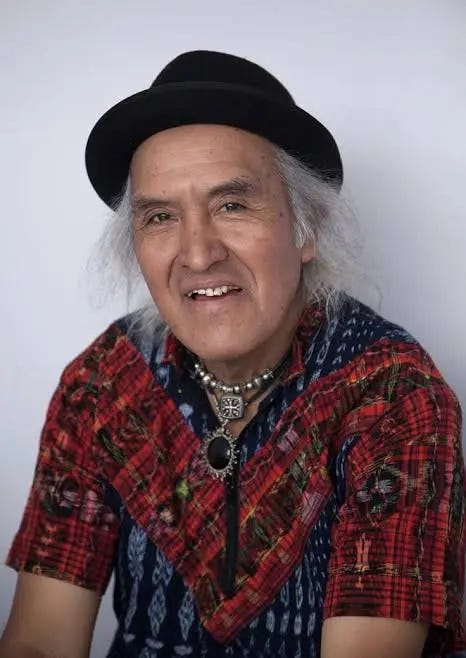
Humberto Ak’abal (1952–2019) was a K’iche’ Maya poet from Guatemala. His book Guardián de la caída de agua (Guardian of the Waterfall) was named book of the year by Association of Guatemalan Journalists and received their Golden Quetzal award in 1993. In 2004, he declined to receive the Guatemala National Prize in Literature because it is named for Miguel Ángel Asturias, whom Ak’abal accused of encouraging racism. Ak’abal, a recipient of a Guggenheim fellowship, passed away on January 28th, 2019.
ICE has been touting record-high arrest numbers this summer—and they are not wrong. The daily rate of ICE arrests in June was over 1,300, the highest month of the Trump administration, and in July that number increased again to a record 1,474 arrests per day for the first 11 days for which we have data. This reverses a trend we saw since the early fall where overall arrest numbers had actually remained fairly consistent or declined. The purported shift in ICE tactics—from the manic Kristi Noem months that cost the lives of two U.S. citizens to the less spectacular tactics under Markwayne Mullin—has effectively led to more arrests without as much popular backlash. The rising death toll of ICE detention, not to mention the deadly shooting of Joan Sebastián Durán Guerrero in Maine, hardly points to a more disciplined, less rogue agency.
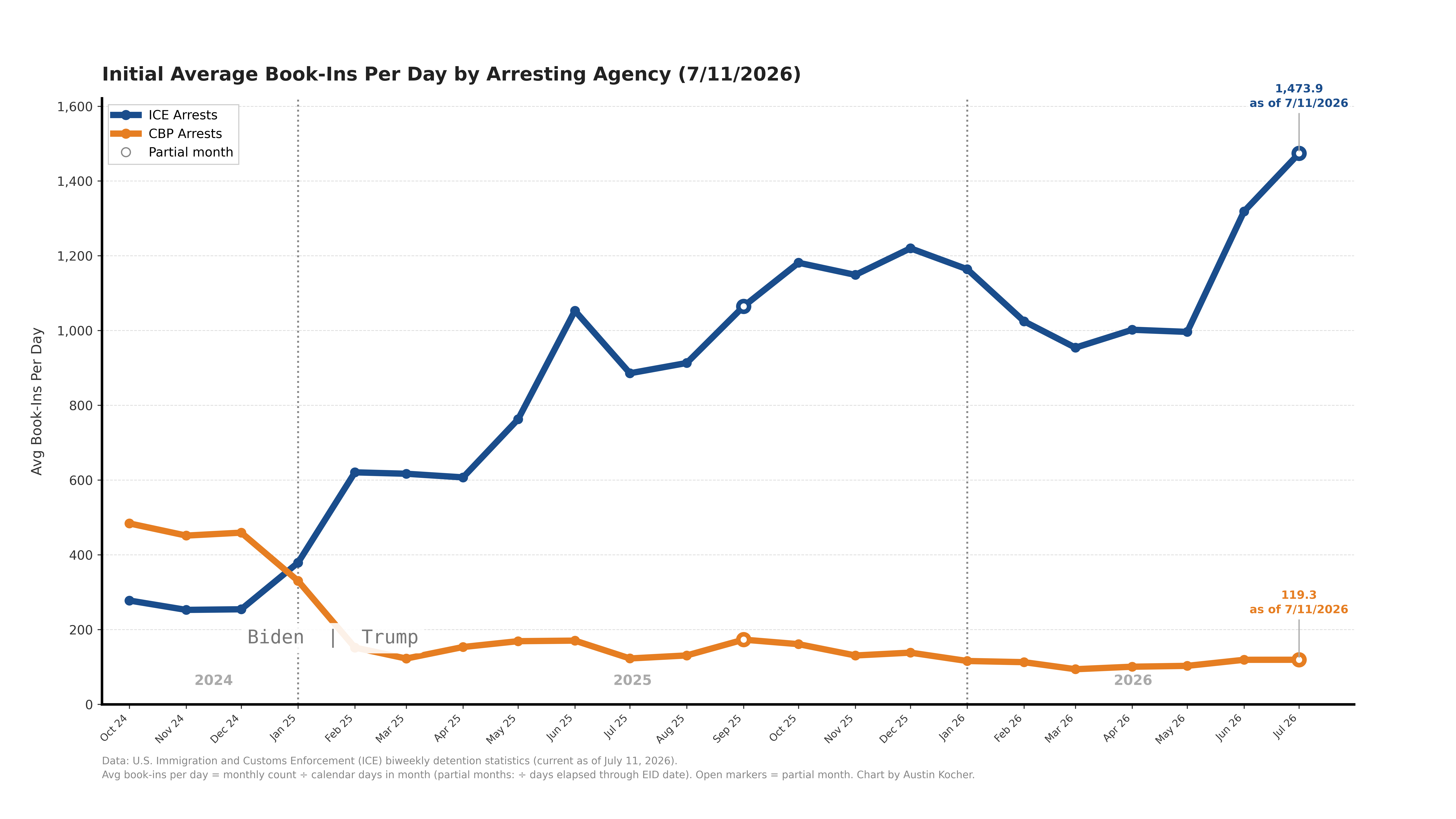
Of those people held in detention, the largest group continues to be immigrants with no criminal history whatsoever, reinforcing the now longstanding observation that the agency is not targeting the worst of the worst. In fact, the percentage of people in detention with nothing more than an actual or alleged immigration violation (with all of the utter meaninglessness that this administration has made of that category) continued to grow since April while the percentage of immigrants with charges or convictions declined as a percent of the total. These crude categories do not tell the whole story of the lives of people in detention, but I continue to present this as an important contextualizing data point.
+—+
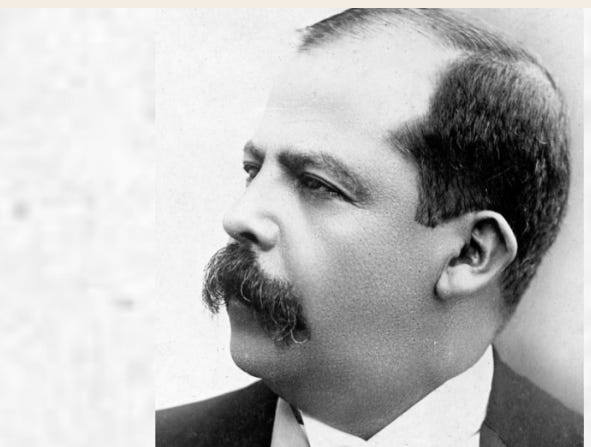
Drawing on his personal experiences under the reign of Estrada Cabrera, Asturias explored the nature of a totalitarian state and how it annihilated human dignity and spirit.
[CABRERA’S 22-year rule (1898–1920) is widely documented as a “reign of terror” responsible for thousands of casualties.]
My father was one of the victims of the man for whom all the torments of Hell are waiting—Colonel Parrales Sonriente— that hired assassin whose deeds will some day figure in history, if there is anyone prepared to dip his pen in snake-poison to write it.
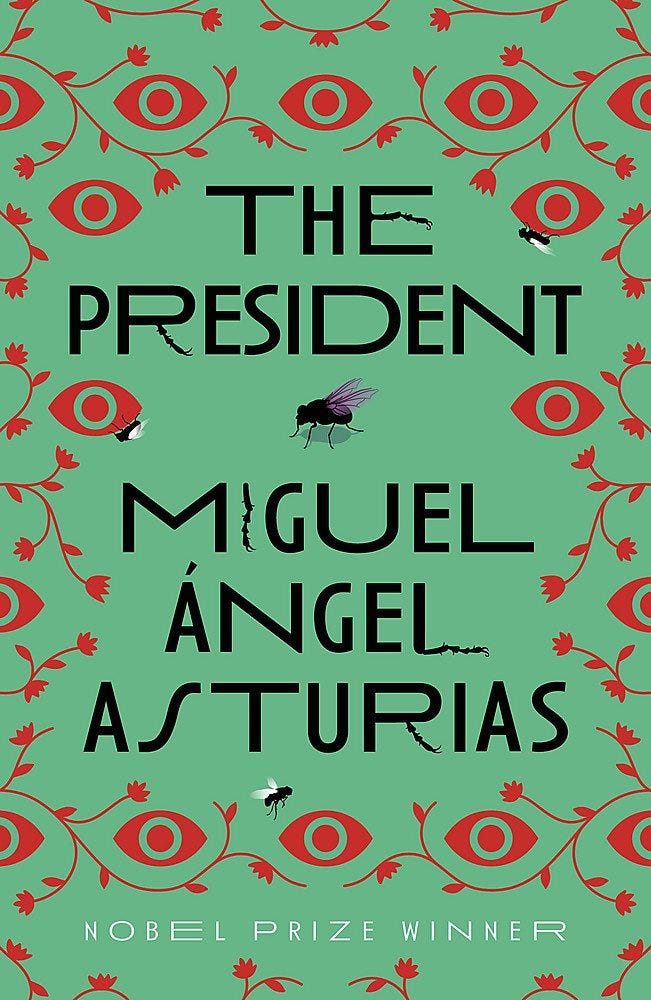
At the behest of the all-controlling dictator, the police and the judicial system work in tandem to frame two innocent public figures who can be a threat in the future for the President – ‘the indictment charging Canales and Carvajal with sedition, rebellion and treason, with all possible aggravating circumstances.’
The scene of Carvajal’s trial is a classic:
“The table round which the tribunal sat was covered by a flag, as prescribed by the regulations. The beggars were sitting in the witnesses’ seats. Carvajal turned and looked at the members of the tribunal, searching for signs of wisdom and judgement. The first one his eyes encountered was as drunk as it was possible to be. And the President (of the tribunal), who was giving the most finished performance of them all as an alcoholic, seemed on the point of passing out.”
Carvajal is neither given adequate time to read the ninety-one pages of the indictment nor allowed to defend himself against the charges. Since the tribunal knows that he is innocent, this is considered waste of time and an exercise in futility. The tribunal has been meticulous, however, to ensure that “the sentence had been drawn up and written out in advance” – and it is now served on him. Carvajal is executed the next morning.
In a totalitarian state corruption always seeps from top to bottom. Asturias amplifies it with the description of the judge advocate general, the highest judicial authority in the state who has swindled a brothel owner of ten thousand pesos, and is all too willing to prostitute his office to serve the tyrant. When Carvajal’s widow comes to his house to know where the body of her husband is buried the judge’s servant sympathises with her, only to be chastised by his master when he learns about it:
“When will you understand that you mustn’t encourage people to hope? In my house the first thing everyone, down to the cat, has to learn is that there are never grounds for hope of any description for anyone. It’s only possible to go on holding a position like mine if you obey orders; the President’s rule of conduct is never to give grounds for hope, and everyone must be kicked and beaten until they realise the fact.”


The Fortune
Miguel Ángel Asturias
To give is to love,
To give prodigiously:
For every drop of water
To return a torrent.
We were made that way,
Made to scatter
Seeds in the furrow
And stars in the ocean.
Woe to him, Lord,
who doesn’t exhaust his supply,
And, on returning, tells you:
“Like an empty satchel
Is my heart.”
Caudal
Dar es amar,
dar prodigiosamente
por cada gota de agua
devolver un torrente.
Fuimos hechos asi,
hechos para botar
semillas en el surco
y estrellas en el mar
Y ¿ay! del que no agote,
Señor, su provisión Y al regresar te diga:
¿Como alforja vacía
está mi corazón!
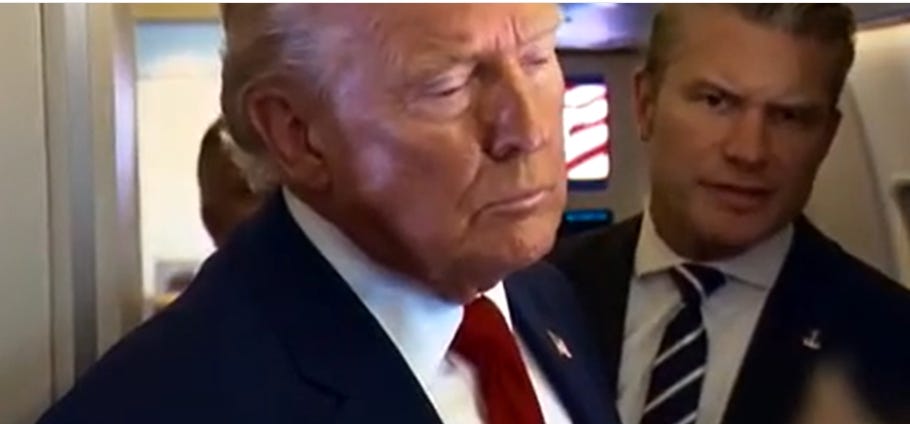
DICTATORS……
Uncovering the Killing of 168 Children in a U.S. Strike on an Iranian Primary School
Sky News spent four months pulling apart the bombing of the Shajareh Tayyebeh primary school in Minab — the strike that instantly became the most notorious moment of the U.S.-Israeli war on Iran. It happened on day one. The school was hit again and again, and 168 children were killed, along with teachers and staff whose identities were traced through painstaking open‑source work. Most of the dead were girls between seven and twelve. Their families have waited four months for the U.S. investigation that was promised, and nothing has been released.
With Iran’s internet shut down and travel into the country nearly impossible, Sky News’ Data and Forensics team turned to whatever evidence could be gathered remotely: satellite archives, CCTV, witness videos, old maps, school records, anything that could be verified. They worked with Forensic Architecture to rebuild the school in 3D and reconstruct the attack second by second.
What they found wasn’t a mystery. It was a failure that had been built into the system long before the missiles were launched.
The Pentagon had satellite imagery of the site going back to 1987. They had decades of overhead surveillance showing exactly what the compound was. They had images from December 2025 where you can literally see children’s shadows in the playground. The school had been walled off from the adjacent IRGC naval base since at least 2015, with its own perimeter, its own website, its own public footprint. Any analyst with basic tools could have confirmed it was a civilian school in minutes.
But on February 28, three Tomahawk missiles were fired from the USS Spruance, roughly 716 kilometers away in the Arabian Sea. CCTV shows the compound being hit nine times at 11:22 a.m. The school itself was struck about ten seconds after the first impact. Witnesses say the second missile landed exactly where a teacher had moved surviving students for shelter, killing nearly everyone who had taken cover there. A third strike followed on the same spot. The crater matches a Tomahawk. The pattern of impacts matches a Tomahawk. The launch platform matches a Tomahawk. There is no serious doubt left about what was used or who fired it.

This pathological psychopath is their president. This tells you everything you need to know…

Dictators of a many colored Feathered Yemukle
Israel Delays Release of Gaza War Crimes Investigations Again