

Nah, just Shazam Goyim prattling away, getting on the Judge’s and Danny’s show, and there you have it . . .
Jun 21, 2026
Cunts:
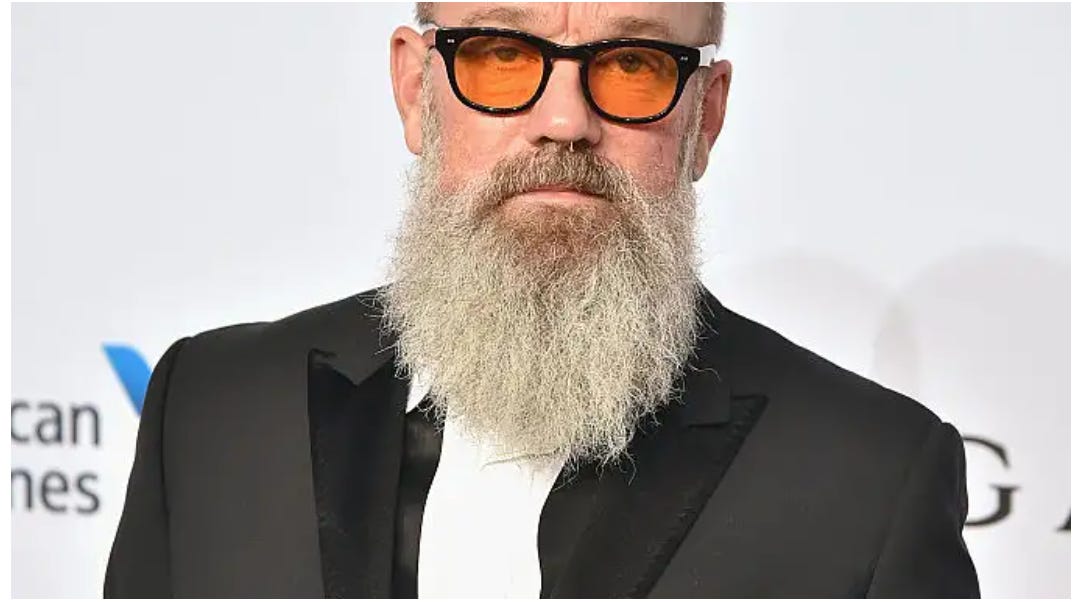
REM singer Michael Stipe has spoken out in support of British band Radiohead.
The Oxfordshire rock five-piece, whose guitarist Jonny Greenwood is married to an Israeli, have been subjected to criticism over their decision to play a concert in Tel Aviv.
Stipe, whose own band played in Israel in the 1990s with Radiohead as their support act, published an Instagram post which said:
‘I stand with Radiohead and their decision to perform. Let’s hope a dialogue continues, helping to bring the occupation to an end and lead to a peaceful solution. Sincerely, Michael Stipe’
R.E.M.‘s Michael Stipe has urged his social media followers to join him in a temporary boycott of Meta and its associated products to protest their part in “helping advance the far right in America”.
Stipe shared his intentions via a post on Instagram on Sunday (Jan. 19), outlining the “Lights Out Meta” campaign which would take place from Jan. 19 – 26, and asked users to log out of all Meta platforms for the week. As Stipe added, this includes the likes of Facebook, Instagram, Threads, Messenger, WhatsApp, Giphy, Meta Quest, and Ray-Ban Meta smart glasses.
Cunts:
“I believe that boycotting artists will not bring any solution. I believe that banning songs, movies, plays, books etc, is not going to fix the world’s problems.”

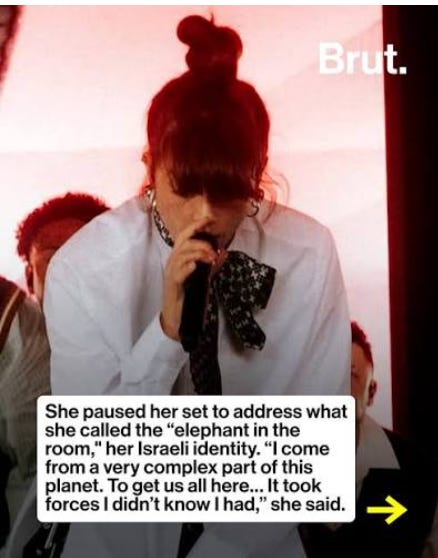
Erez has rejected ultimatums demanding she condemn Israel or publicly state her views. She has emphasized that boycotting artists based on their nationality will not solve world conflicts. While noting her own desire for peace in the region, she has expressed frustration over the atmosphere of intense polarization that forces artists to take sides.
+—+
Endless endless prattling . . . These fucking Zeteo Cunts are, well, soft-headed….
Could Trump Resign After His Iran Humiliation? Jim Acosta Weighs In
A botched reflecting pool renovation, a capitulation to Iran, and an embarrassing spectacle at the Kennedy Center… Will the U.S. president finally give up?
John Harwood, Jim Acosta, and Team Zeteo
President Donald Trump hasn’t had a great week. He essentially surrendered to Iran, his name was stripped from the Kennedy Center, his multimillion dollar reflecting pool remodel is already crumbling, plus his health appears to be declining and stars are backing out of his “America 250” celebration. It raises the question: will he finally quit?
“It is very much the latter days of a dictator who is on his way out,” says CNN host turned independent journalist Jim Acosta to Zeteo’s John Harwood. The two discussed Trump’s recent embarrassing endeavors in a Substack live conversation, in which they answered questions from an audience of subscribers.
So, will Trump call it quits? Will he throw JD Vance under the bus over Iran? How worried should we be about people like Stephen Miller and Peter Thiel? Watch the full video above to hear Acosta’s take on all that and more – and let us know what you think in the comments below.
You’ve probably heard of Russia’s “Dead Hand” system, also called Perimeter. It’s been around since the Cold War; it shows up in movies, and people reference it whenever nuclear tensions spike. The basic idea is that even if Russia gets completely obliterated in a nuclear strike and there’s nobody left alive to push the button, the missiles still launch automatically.
Scary, right? But here’s the thing, it actually makes a twisted kind of sense as a deterrent, and we’ll get to why in a second.
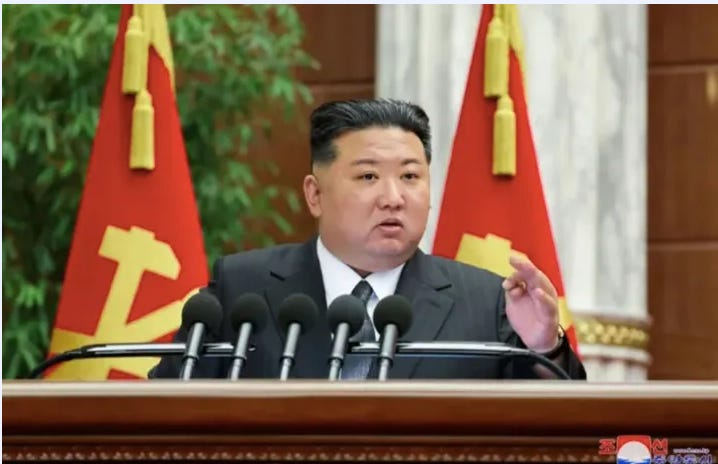
Now, North Korea just passed a constitutional amendment that sounds like the same thing, but it isn’t. And the difference between what Russia built and what Kim Jong Un just wrote into his constitution is one of the most dangerous gaps in nuclear policy on the planet right now.
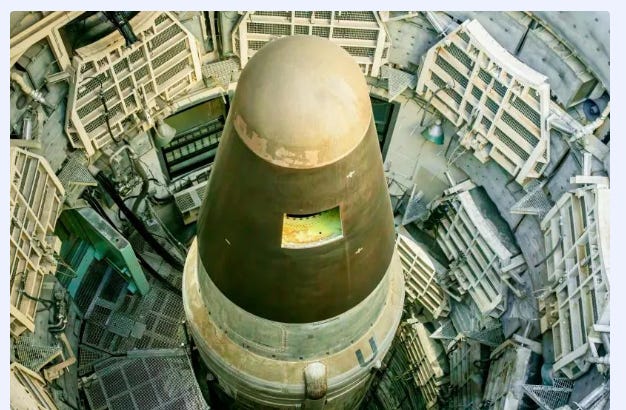
Perimeter was developed in the 1970s and placed on combat duty in January 1985, at the height of the arms race. Its core problem was a legitimate one: if the United States launched a first strike sophisticated enough to simultaneously destroy Russia’s entire leadership, its communications infrastructure, and its command nodes, how would the surviving missile forces know to retaliate? The answer was an automated fallback loop, a system that monitors for the electromagnetic, seismic, and radiological signatures of a mass nuclear strike; attempts to reach the General Staff, then the presidential command system (”Kazbek”), and only if both fail, autonomously launches command missiles that relay the strike order to nuclear forces across Russian territory.
Perimeter was engineered to respond to the signature of a civilization-ending nuclear exchange, not to a single event.
It requires multiple sensor confirmations across multiple spectra. It attempts human contact before going autonomous. The 1984 test that first tipped off US intelligence involved a command missile transmitting launch orders to a waiting ICBM at Baikonur, which then struck a target range in Kamchatka, a complete validation of the chain:
- command missile,
- combat missile,
- target.
What North Korea Just Built
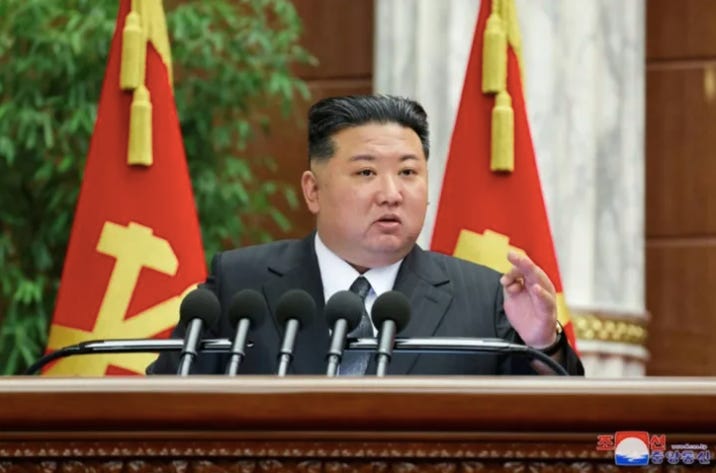
Kim Jung-Un’s constitutional amendment has no such architecture of restraint.

Jew-oogle: J. Robert Oppenheimer consistently defended the wartime development of the atomic bomb, arguing it was an inevitable scientific progression and a necessary military tool to end World War II. However, he deeply opposed an arms race and strongly advocated against the development of the vastly more destructive hydrogen bomb.
How can scholars and scientists balance moral and ethical dilemmas that can potentially arise in the application of their work?
When Oppenheimer refused to sign the letter that Leo Szilard, the physicist who created the nuclear chain reaction in 1933, and others wrote opposing dropping the bomb on Japan, Oppenheimer said that the scientists who invented the atomic bomb have no greater rights or responsibilities than others about how to use the weapon. I disagree with that. I think scientists and social scientists who have expertise in this area have grave responsibilities to express their opinions about nuclear strategy, and how we respond could be used in a war or used for deterrence. I think there can be worrisome tendencies for scholars to fall in line with what is the current rage or received wisdom about what the best national security policy should be. We’ve got to constantly challenge the status quo and think carefully about alternative policies.
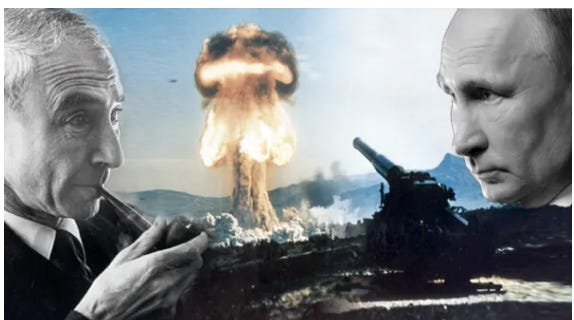
Oppenheimer envisioned the tactical use of nuclear weapons. Putin now threatens it. And the Jews of Israel have already used the weapon, so-called tactical nuke, and the depleted uranium shells? The gift that keeps on giving.
Jewified, man, this cunt of a monster, Oppen-Monster-Heimer:
Based on the Acheson-Lilienthal Report, largely drafted by Oppenheimer, Baruch’s plan eliminated the provision for international control of uranium deposits and emphasized instead the punishment of countries that sought to use atomic energy for military purposes. Baruch insisted that the United States maintain its monopoly on nuclear weapons until intrusive inspection procedures had assured that no other countries possessed them—clearly a nonstarter for the secretive Soviet Union.
Oppenheimer was disappointed at the failure of international negotiations to control the bomb but was still eager to maintain his privileged access to policy circles in Washington. He devoted his attention to accelerating US production of fissile material and developing bomb designs that would use it more efficiently. As chair of the General Advisory Committee of the Atomic Energy Commission (AEC), he oversaw three major expansions of atomic production facilities in 1949, 1950, and 1952. The Sandstone series of nuclear tests in April and May 1948—a follow up of the 1946 Operation Crossroads—had demonstrated the success of new designs of smaller, more efficient nuclear weapons than had previously been available. At this point, US strategy for a potential war with the Soviet Union—including a feared invasion of western Europe—focused entirely on attacking Soviet cities with atomic weapons. But Oppenheimer preferred that nuclear weapons play a more direct role in defense. He chaired a panel on “long-range objectives” for the Pentagon’s Research and Development Board that recommended in August 1948 that nuclear weapons be developed for use on a battlefield. Norris Bradbury, Oppenheimer’s chosen successor as director of the Los Alamos Laboratory, accordingly, submitted a request in October “that a complete small weapon be readied for test early in 1951.”[2] He relayed an order to the Sandia Laboratory, responsible for the weaponization of nuclear devices. Sandia was already at work on the “Mark 4” bomb, which consisted of an improved version of the Mark 3 “Fat Man” bomb dropped on Nagasaki. The Mark 4 was the first US atomic weapon to go into mass production and eventually came in a variety of yields, including one kiloton (1,000 tons of TNT equivalent), considered at the time small enough to use for tactical purposes.
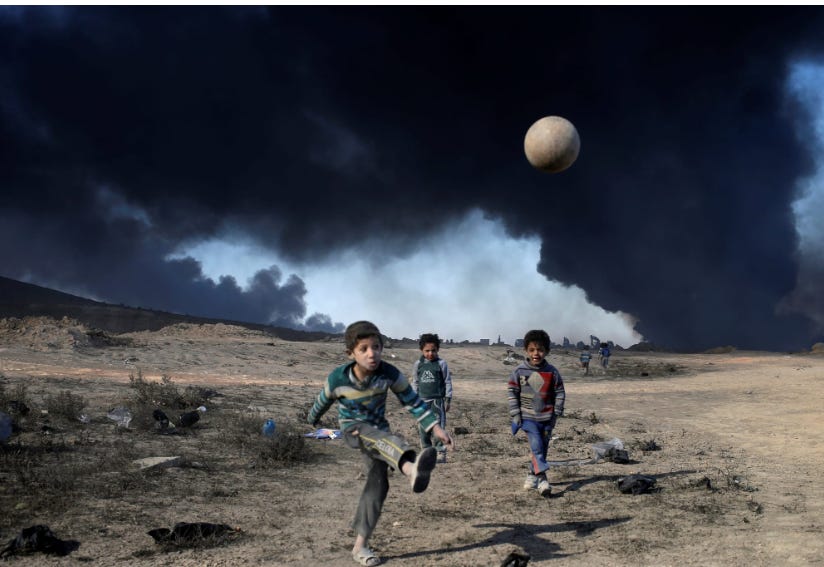
Birth defects in Iraq are part of an evidentiary ecology of war brought to political and moral attention through the practices of archiving and documenting.
When Iraqi scholars and doctors catalogue incidences of birth defects and note that their rates exceed that of Hiroshima, or when epidemiologists conduct studies to mark where, when and how a population experiences birth defects, they highlight the connections between militarism and public health, global inequalities and environmental racism.[4]Majid, a physician who treats children with heart defects in Falluja, said in an interview, “When people see birth defects, there is no avoiding the issue. Birth defects say, ‘Something is wrong here,’ in a way that other medical problems do not.”[5]
Applied to the Middle East, the term ecologies of war often refers to environments transformed by decades of intensive militarism. In Lebanon, Iraq, Afghanistan, Palestine and Syria, such ecologies are not always accidental side effects of military operations but are instead central components of military strategy.[6] For example, Iraqi president Saddam Hussein drained the marshes of southern Iraq as a direct counterinsurgency tactic to suppress the Marsh Arabs, whom he accused of disloyalty during the Iran-Iraq war (1980 –1988).[7] When the Iraqi marshes were reflooded in the name of ecological restoration after 2003, it was part of a broader restructuring of Iraq’s environment and economy, alongside other mechanisms of spatial control like the use of T-walls (portable concrete walls).[8]
Beyond deliberate spatial and social transformations, chemical pollution also shapes Iraq’s war ecologies. While living and working with internally displaced farming families from Anbar province in 2014 and 2015 I witnessed plant crops and livestock with malformed parts or tumorous growth. Many farmers kept photographs and told stories of destroyed irrigation systems, contaminated water and hypersalinized soil. Infertility, cancers and birth defects prevented them from having and raising healthy children. They described birth defects as just one consequence of the environmental damage they witnessed in all aspects of their lives.
Many Iraqis I spoke to described these enduring environmental maladies as intentional. Ahmed, the father of a child who died within a few hours of her birth from multiple birth defects, said, “The Americans wanted this. If they didn’t, they would have cleaned up from their wars. They starved us during the sanctions; now they are poisoning us.”[9] When Ahmed speaks of being poisoned, he refers to both the enduring life of toxic war materials embedded and abandoned in Iraq’s landscape and the destruction of the human resources needed to cope with public health crises.
US military intervention heavily damaged Iraqi infrastructure and ecologies that sustain human survival, especially during the initial invasion in 2003 but also later during the occupation (2004–2011). Adhering to a “shock and awe” strategy, the United States launched 800 cruise missiles within the first 48 hours of the invasion in March 2003 —more than double the number of missiles launched in the entire Gulf War.[10] Between 2002 and 2005 alone, the US armed forces expended 6 billion bullets—roughly 200,000-300,000 bullets per individual killed in Iraq.[11] This number of shells, full of lead and mercury, does not include larger ordinances or other metal remnants from after 2005, or from previous wars: the Iran-Iraq war (1980–1988), the First Gulf War (1990–1991), the sanctions era (1991-2003) and the 2003 occupation’s instigation of a further decade of militia warfare. The most recent military intervention in Iraq was accompanied by unprecedented waste abandonment and waste burning: discarded vehicles, excess weapons, discarded clothing and much more were all left in Iraq’s land, water or air.
Given the onslaught of military toxic dumping in Iraq, from spent bombs and bullets to base-making, burn pits and junkyards, it is no surprise that widespread cancers and congenital anomalies, along with other major health issues in the civilian population, abound.
Birth Defects and the Toxic Legacy of War in Iraq
Edward Bernays, the “father of public relations,” leveraged Cold War paranoia to manipulate American public and political opinion. His most famous operation during this era was orchestrating a massive propaganda campaign for the United Fruit Company (UFCO), painting the democratically elected Guatemalan President Jacobo Árbenz as a communist puppet.

A Palestinian baby losing their legs at two months old does not shatter the world into action. Our genocide is sustained by weapons deals, colonial land theft, Zionist ideology, and a bottomless apathy. Even those who offer solidarity give only a fragile grief, one TikTok cat video away from being forgotten. We chew on glass while they scroll past.
Yet this wall of indifference is finally cracking. The Zionist state is hemorrhaging support in the United States. Americans want accountability, not branding. In a panic, the Israeli government has poured resources into American PR campaigns to launder its image. But the effort is not stopping the shift. The boycott is working. Campus occupations, BDS campaigns, and grassroots defiance have pierced the armor of the settlers. They do this not because pressure magically stops bombs, but because it makes denial harder to sustain.
This shift matters. The US and Israel remain entangled, but their alignment is strained by competing priorities. It does not signal restraint, but it exposes the friction between two colonial projects. As a direct result of global boycotts and BDS campaigns, economic costs are rippling outward. The Zionist entity has lost over fifty-seven billion dollars. Tech giants are laying off thousands, shutting down research centers, and fleeing the apartheid state. The empire and its outpost bicker, but the violence rolls on without pause.
Watching them now feels like witnessing a toxic marriage unraveling. It is not a clean ending, just mutual accusations as shared interests fracture. They are two settler projects built on stolen land and sustained by elimination, turning on each other in public while our bodies pile up. The empire is starting to see its mirror image as a liability, and that fracture offers a rare opening.

I love this fellow’s writing, BUT . . . . He’s Palestinian in Ireland. He is not seeing the forest for the fucking Judaic World Sucking Chlamydia TREE.
Are the US and Israel Breaking Up?
Inside the Toxic Collapse of a Colonial Marriage
A Palestinian baby losing their legs at two months old does not shatter the world into action. Our genocide is sustained by weapons deals, colonial land theft, Zionist ideology, and a bottomless apathy. Even those who offer solidarity give only a fragile grief, one TikTok cat video away from being forgotten. We chew on glass while they scroll past.
Yet this wall of indifference is finally cracking. The Zionist state is hemorrhaging support in the United States. Americans want accountability, not branding. In a panic, the Israeli government has poured resources into American PR campaigns to launder its image. But the effort is not stopping the shift. The boycott is working. Campus occupations, BDS campaigns, and grassroots defiance have pierced the armor of the settlers. They do this not because pressure magically stops bombs, but because it makes denial harder to sustain.
This shift matters. The US and Israel remain entangled, but their alignment is strained by competing priorities. It does not signal restraint, but it exposes the friction between two colonial projects. As a direct result of global boycotts and BDS campaigns, economic costs are rippling outward. The Zionist entity has lost over fifty-seven billion dollars. Tech giants are laying off thousands, shutting down research centers, and fleeing the apartheid state. The empire and its outpost bicker, but the violence rolls on without pause.
Watching them now feels like witnessing a toxic marriage unraveling. It is not a clean ending, just mutual accusations as shared interests fracture. They are two settler projects built on stolen land and sustained by elimination, turning on each other in public while our bodies pile up. The empire is starting to see its mirror image as a liability, and that fracture offers a rare opening.
How Israel Improves the World: Technology Edition
I liked the title “How Israel Improves the World” so I wanted to create another like it.
First let me present the core metric that explains almost everything else: Israel spends more on R&D as a percentage of GDP than any country in the world. Not the US. Not South Korea. Not Germany. Israel. About 6% of our GDP goes straight into research and development.
What’s even more unusual is where that R&D happens. Israel has the highest share of R&D done by the private sector in the OECD. It’s in companies, startups, spin-outs, and small teams solving problems because someone needs a solution now, not in ten years.
Further Israel leads the world in Foreign Direct Investment (FDI) per capita. More than half of private-sector R&D in Israel is funded by foreign companies. The rest of the world is literally wiring money into Israel so Israelis can solve their hardest technical problems for them.
Israel also ranks #1 in the world for scientists and engineers per capita in the workforce. Number one. Which explains why so much of the world’s core technology quietly originates here.
Take cybersecurity. Despite being a tiny fraction of the world, Israel consistently captures around 20% of global private cybersecurity investment. That’s absurd when you remember our country’s population. A huge chunk of the world’s encryption, network defense, endpoint security, fraud detection, and cyber-resilience tooling has Israeli DNA in it. Look at Wiz, the hugest M&A in history. An Israeli company.. Banks, hospitals, power grids, and governments all over the planet are running on systems designed by Israelis.
Then there’s medical technology. Israeli companies pioneered capsule endoscopy (a literal camera you swallow), advanced imaging systems, remote patient monitoring, robotic surgery components, and AI-assisted diagnostics. Hospitals worldwide use Israeli-designed devices every day without ever seeing Hebrew.
Water and climate tech is another massive contribution. Israel essentially industrialized desalination and made it cheap, reliable, and scalable. Countries facing water scarcity depend on Israeli desal tech, leak-detection systems, and smart irrigation. Drip irrigation is now a global standard and it was invented in Israel. That one innovation alone reshaped agriculture on multiple continents.
In semiconductors and deep tech, Israel punches way above its weight too. Israel designs most of the world’s most advanced chips, and Taiwan builds them. Critical CPU and GPU architectures, chip validation tools, hardware security modules, and low-level systems software are designed here. If your laptop, phone, or cloud server feels faster or safer than it did ten years ago, odds are good an Israeli engineer is why.
And then there’s AI. Computer vision for industrial inspection, AI for drug discovery, optimization engines, anomaly detection, edge AI, and infrastructure and tooling. Israel is consistently one of the top countries in the world for deep-tech outside the US, especially in areas where the problems are ugly and the data is messy. Which is where real value usually lives. Let me not forget to mention the former Chief Scientist of OpenAI is Israeli and the reason why ChatGPT “thinks”. He is now running a multi billion dollar AI company out of Israel. To add, if not Israeli, all major AI companies in the USA are founded and ran by Jews.
Israel builds foundational tech underpinning much of modern civilization. Stuff that becomes invisible once it works. Stuff other countries rely on without thinking about where it came from.
The metrics tell the story: #1 in R&D, #1 in scientific talent, #1 in private-sector investment, and dominant position in multiple strategic tech verticals.
So, Israeli spends an awful lot of time improving the underlying machinery of the modern world. The code, the chips, the water systems, the medical devices, the security layers, the AI. Many things you take for granted. In fact, why Israel is even a rich country is due to our technology exports. Like the Arab countries export oil, our industry is science and technology. All powered by the immense talent of our people.
+—+
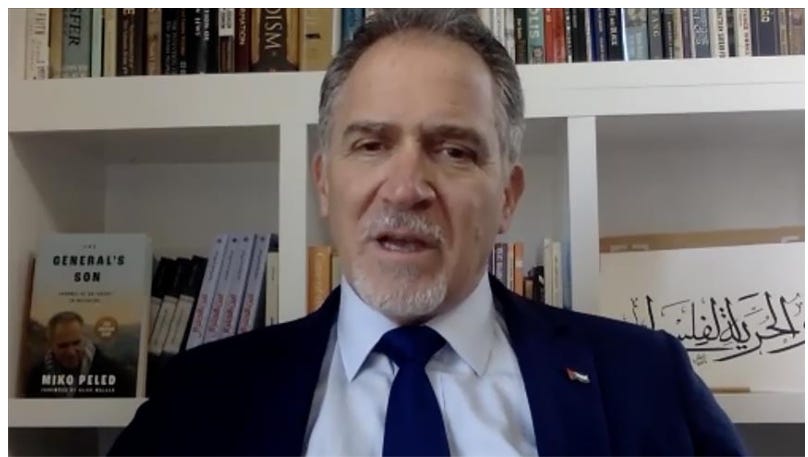
– Israel was humiliated on Oct. 7, is taking revenge from innocent people and civilians, Miko Peled tells Anadolu
ISTANBUL
Israeli activist and writer Miko Peled, the grandson of a signatory to the Jewish state’s 1948 Declaration of Independence, has criticized Israel’s policies towards Palestine, asserting that “they cannot defeat the Palestinians.”
The author, whose father served as a general in the Six-Day War of 1967, spoke to Anadolu about his journey as an activist advocating for the rights of Palestinians, and evaluated the current conflict that started on Oct. 7.
“I come from a very prominent Zionist patriotic family … I grew up as a patriot, a strong supporter of my country, my state, and of course, Zionism,” said Peled, who was born in Jerusalem in 1961.
He was greatly influenced by his father’s ideas in the early years of his life, and served in the military for a while but later regretted it and left.
“My father, while still in uniform right after the war, said: ‘Look … we are here forever, our existence is no longer uncertain or in danger. We must allow the Palestinians to have their small state in a small part of Palestine.’ … As soon as the war ended, they started building massive cities in East Jerusalem and the West Bank.”
‘According to Zionism, there is no such place as Palestine’
Emphasizing that there is no place called Palestine in the fundamental philosophy of Zionism, Peled said: “According to Zionism, that is Israeli land, and those lands belong not to the Palestinians living there, but to all Jews in the world. If you have a supremacist ideology, that is, if you argue that one group has more rights than another, then you must use violence. You must have an apartheid regime for this racist ideology to be realized. That is the Israeli state,” he said.
Peled, pointing out that the Israel-Palestine issue did not start last month, but 75 years ago with the establishment of Israel, said: “As a movement, Zionists and then the state born from this movement declared war on the Palestinian people. In this war, we saw ethnic cleansing, genocide policies, and a racist apartheid regime.”
Describing Israel as a “terrorist state,” Peled drew attention to the oppression that Palestinians have been experiencing for years.
“Palestinians are exposed to terrorism every day. You don’t know whether you will be beaten or killed while walking on the street, whether your children will be safe going to school, whether your house will be demolished, whether your brothers will be taken or abducted and disappeared by the Israeli army or Israeli intelligence,” he said.
‘I realized I lived in a kind of colony, a superficial, artificial reality’
The Israeli-American said he started questioning the existence of Israel after the death of a family member more than two decades ago.
“In 1997, my sister’s little daughter was killed in a suicide attack in Jerusalem. She was 13 years old. This was a tragedy that fundamentally shook a person; you know, after such an event, you cannot look at the world with the same eyes. This led me to examine the reality of what was taught to me, the existence of Israel.” he said.
He then embarked on a journey to Palestine to find answers.
“When I started the journey, I realized that the country I thought was mine was someone else’s country. I was living in a kind of colony, a superficial, artificial reality that was not real. It did not rely on reality. It was based on an apartheid state built on lies, and these lies legitimized the existence of the Israeli state,” Pelod said.
‘Condemning a nation under oppression for resisting is the height of hypocrisy’
On Israel’s ongoing attacks in Gaza, which started after a cross border attack by Palestinian group Hamas, Peled said: “Palestinians who have nothing to do with this event are paying a heavy price. Israel was humiliated, and now it extracts all its revenge and anger from innocent people and civilians who have nothing to do with the attack.”
Israel’s air and ground attacks on the besieged enclave has since killed more than 14,000 people, most of them women and children.
Pointing out that in Western media there is a tendency to condemn Hamas in every comment on the conflict, Peled said: “It is absurd to condemn those who emerged to resist, people who have been under pressure for so long. This was expected. If we want to eliminate resistance, then we must eliminate pressure. Resistance is always a reaction against oppression. The Palestinians’ response to greater violence that has been going on for more than 75 years has mostly been non-violent.”
“If there is something to condemn, it is to condemn the apartheid regime. It is necessary to condemn the violence, brutality that Palestinians face every day, the thousands of Palestinians being arrested and killed in the West Bank while we speak, the racism practiced by Israel against Palestinian citizens. It is necessary to condemn the Israeli doctors who signed the petition approving the bombing of hospitals in Gaza, the students who demand the expulsion of Palestinian Israeli citizens from university dormitories, and many more. But condemning a nation under oppression for resisting is the height of hypocrisy and meaningless.”
Which countries buy the most from Israel?
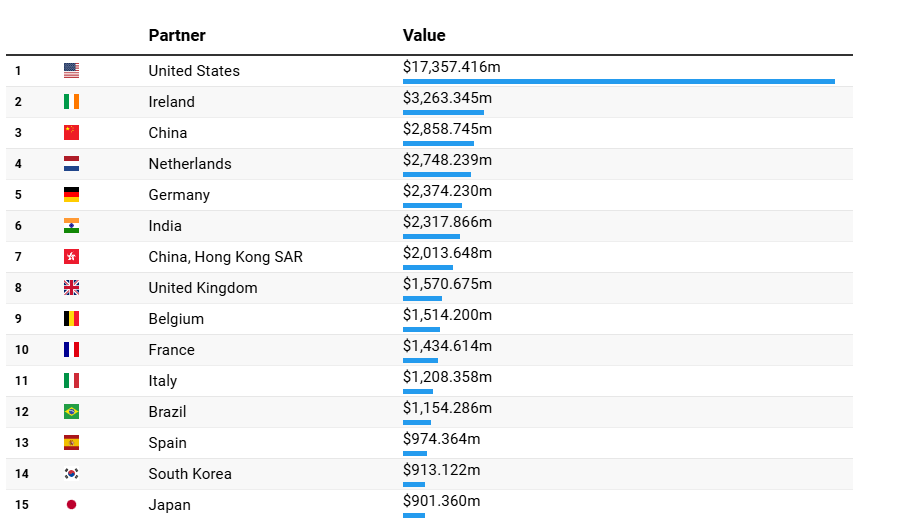
Israel sold $61.7bn worth of goods in 2024. The biggest importers of Israeli products were the United States with $17.3bn, Ireland with $3.2bn and China with $2.8bn. Hong Kong, a semiautonomous region of China that trade databases treat as a separate entity, imported an additional $2bn in products from Israel. Add that to China’s tally, and the country becomes the second-largest importer of Israeli products.
- The United States primarily imported diamonds, high-tech electronics, including integrated circuits and telecommunications equipment, as well as chemical products.
- Ireland was the largest buyer of Israeli integrated circuits in 2024, importing some $3bn billion worth of electronic integrated circuits and microassemblies. These components are widely used in Ireland’s pharmaceutical, medical device and tech manufacturing sectors.
- China imported a range of Israeli products including optical equipment, electronic components and chemical products.
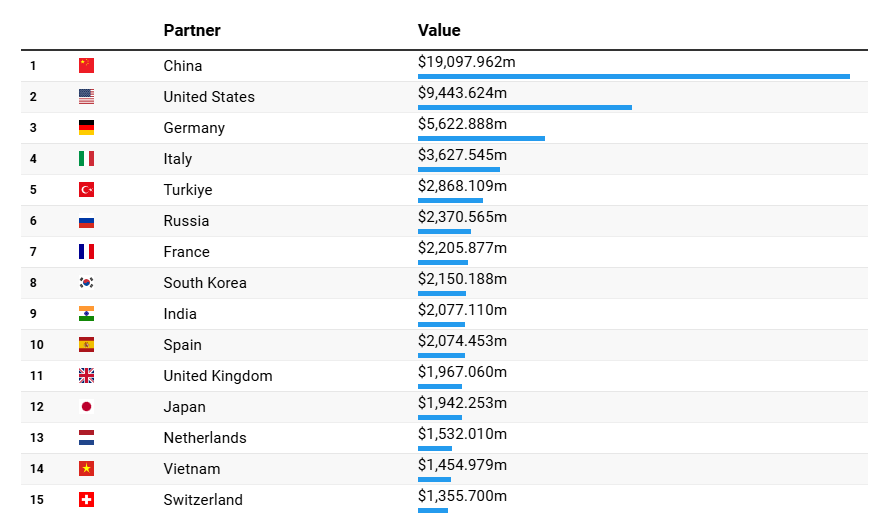
Which countries sell the most to Israel?

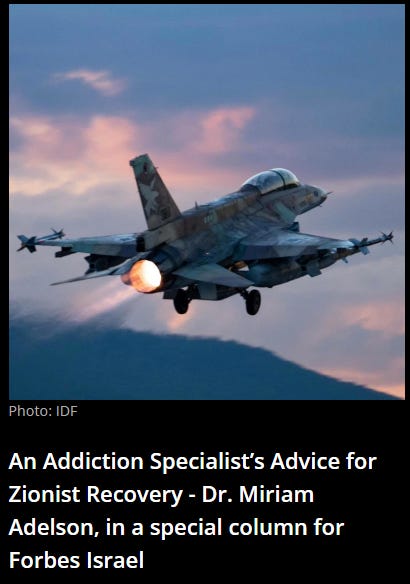
Forbes Israel presents the definitive ranking of the world’s wealthiest individuals of Jewish heritage- an exclusive annual project documenting extraordinary achievement, innovation, and wealth creation at the highest levels of global capitalism.
This year’s list features 319 billionaires with a combined net worth exceeding $2 trillion, including six individuals who rank among the 15 richest people on Earth. From Silicon Valley’s technological titans to Wall Street’s financial masterminds, from shipping magnates to media moguls, these entrepreneurs and business leaders have fundamentally reshaped industries, built iconic companies, and accumulated unprecedented fortunes through vision, ambition, and relentless execution.
The 2026 edition reveals remarkable shifts at the very top: Larry Page reclaims the crown as the wealthiest Jewish billionaire following Google’s AI-driven resurgence, while fellow founders Sergey Brin and Larry Ellison battle for position amid dramatic market swings. Meanwhile, Israeli billionaires achieve record representation, with 52 citizens appearing on the list – their combined wealth surging 50% over two years to $308 billion.
This is more than a wealth ranking. It’s a chronicle of transformative impact.



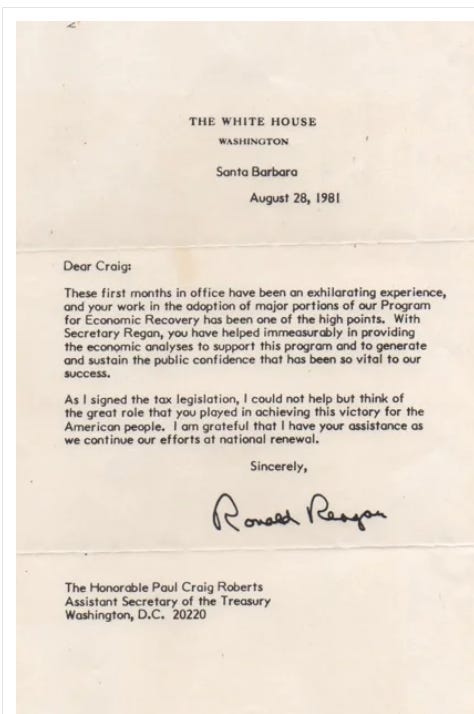
Then this piece of shit, Paul Craig Roberts, trickle down cunt of RayGun years:
The Anti-white Starmer Government Completes the Erasure of the Ethnic British People By Paul Craig Roberts
From another cunt using his mercenary rank to sell crap: Capt. Roy Harkness

Captain Jack Harkness our beloved Jack Russell has gone. He waited until i came home and he died peacefully in his dada’s arms within an hour of my return with @scottmale Dixie and Tito around him. He was a good boy, a loyal friend and our Jackamo for 18 years. We are very sad but grateful he died of old age and did not suffer.
Jun 21


Paul Craig Roberts
(This website depends on readers’ support. At least, buy me a coffee.)
Thanks for reading Capt. Roy Harkness’ Substack! Subscribe for free to receive new posts and support my work.
It turns out that a number of British governments not only turned a blind eye to immigrant-invader gang rapes of ethnic British children for 30 years–and the gang rapes and other horrors are still ongoing– but also enabled and financed the gangs with the raped girls’ parents’ taxes.
The anti-white British governments and the anti-white British presstitutes dismissed the legitimate complaints of white parents and raped kids as “far-right racist agitation.” The British governments were determined to protect the open borders policy at the expense of the ethnic British population, proving themselves more insidiously evil than open borders US Democrats. As Janice Gassam Asare said, “The most insidious form of oppression is that which comes at the hands of your own.”

The New Color Line: How Quotas and Privilege Destroy Democracy, by Paul Craig Roberts and Lawrence M. Stratton, Washington, D.C.: Regnery, 247 pages, $24.95
The New Color Line: How Quotas and Privileges Destroy Democracy is a provocative but frustrating book. The heart of the book is a well-researched history of how civil rights litigation and legislation ultimately led to today’s ubiquitous racial quotas and preferences. No boring academic tome, The New Color Line is well-written and concise. It is likely to be the leading conservative study of affirmative action for some time.

Paul Craig Roberts, who played a crucial role in enacting the tax cuts of the 1980s and in forging the political emergence of supply-side economics, reflects on his experience in Washington. He emphasizes that intra-party power struggles, not economics, are the main influence on policy.

