

Until YOU KIND READER, discover the term “Israeli” is the same as JEW, and Zionist? Another forked tongue mumbo jumbo to get Goyim Gooey with Mitzvah Fluids!!
Jun 20, 2026
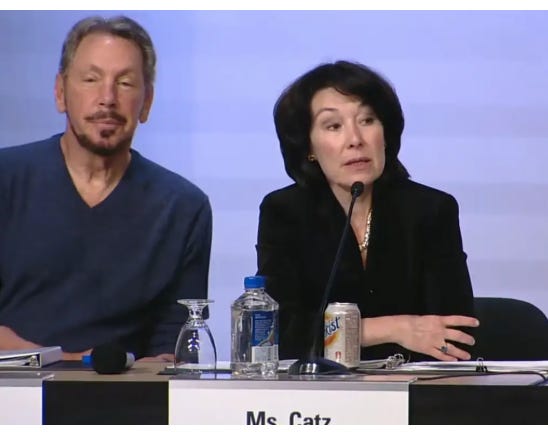
“We have really scary technology at Oracle . . . “ Jew Katz, Oracle. “Extremely cool stuff, man.” These are the enemies.
Now, how is it that Iran WON?
‘Life has become nothing but queues’: Gaza faces renewed famine threat amid Israeli siege
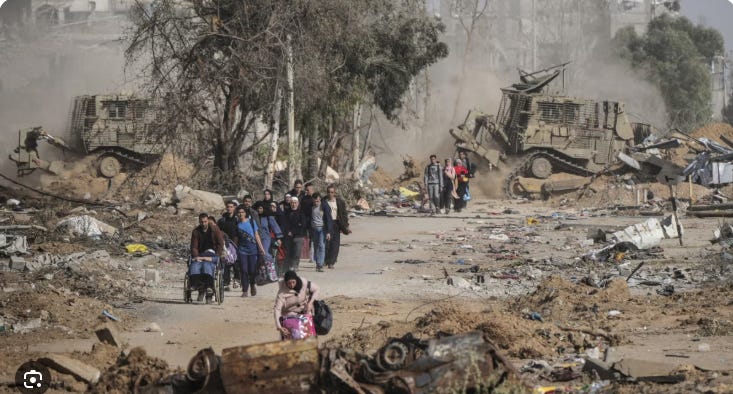
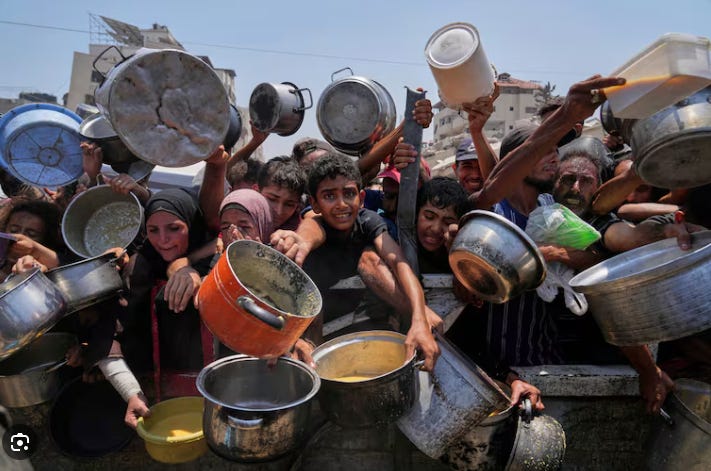
Pretty darn good at starvation, these Jews:
Not only are the Israelis relentlessly killing genocide survivors in the Gaza Strip, but their continued blockade of the enclave has once again brought besieged Palestinians to the brink of famine. Long lines persist outside community kitchens as people struggle to secure adequate meals for themselves and their families amid widespread deprivation.
“In Palestine, conditions in Gaza remain fragile despite some improvements after the October 2025 ceasefire,” a report by the UN Food and Agriculture Organisation (FAO) and the World Food Programme (WFP) stated earlier this week. “More than 1.6 million people were previously assessed as needing urgent food support.”
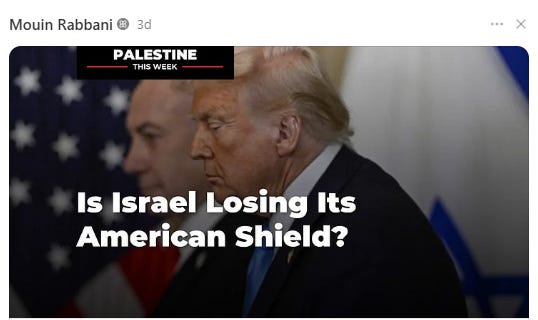
Shit dawg, more “defeat for Trump” bullshit. Do these people get it? The USA a la Is-RAW-Hell are just ramping up for the next stage.
Forwarded this email? Subscribe here for more
What Does Trump’s Defeat mean for the Middle East?
I was interviewed by Mondoweiss about the regional and strategic ramifications of the US-Israeli war against Iran. Text and link below: Mouin Rabbani
This week, President Donald Trump and Iranian President Masoud Pezeshkian signed a memorandum of understanding outlining terms for an end to the U.S./Israeli war on Iran. After months of bombing, the United States has achieved none of its stated war aims.
What does Trump’s defeat mean for the future of U.S. designs in the region? Will the U.S. relationship with Israel change in any way going forward? What does the Iranian victory mean for the country?
I’d start with a few comments. The first is that the United States has suffered an unambiguous defeat.
The second is that any responses to U.S. diplomacy have to be considered tentative, because Washington has repeatedly demonstrated itself to be a thoroughly dishonest, untrustworthy, and unreliable negotiating partner. Most recently, it launched two unprovoked words of aggression, using diplomacy as camouflage, just in the past year. As you just mentioned, this is not a peace treaty, and so we have to keep the very real possibility in mind that the u.s is simply not serious about any commitments it has made under this agreement, but having said so
There are important indications that the U.S. recognizes its defeat and that it will prove extremely costly for the U.S. to try to overturn it. Let’s briefly go through the history. In 2015, the United States and Iran signed the Joint Comprehensive Plan of Action JCPOA. The Iranian nuclear agreement, which ensured that Iran could never develop a nuclear weapon, established the most intrusive monitoring and inspections regime in the history of the nuclear age, and basically fulfilled each of Washington’s explicitly stated objectives with respect to Iran.
What we found is that the United States was very slow to meet its own commitments, and the agreement turned out to be a bad deal for Iran because of the benefits Iran was supposed to get from it, including trade and the lifting of sanctions. So they were quite limited, but that wasn’t enough for the United States. In 2018, the U.S. unilaterally renounced an international agreement and replaced it with a policy of maximum pressure, a policy that made things much more difficult for Iran.
However, the U.S. failed to achieve any of its objectives in terms of either fomenting regime change in Tehran, reducing Iran’s regional footprint, or affecting its ballistic missile program. More importantly, Iran viewed itself as no longer bound by its own commitments under that agreement, which, according to everyone who has looked at it, Iran was scrupulously observing until that agreement.
Then in 2021, Washington renewed negotiations. I’m not talking about Obama and Trump and Biden, because it’s important to understand we’re talking about the policies of a state, of a country, not those of different individuals. That’s why I’m referring to Washington and the United States, rather than the individual leaders involved.
In 2021, recognizing the failures of maximum pressure, Washington reopened negotiations with Iran to rejoin the agreement, but rather than simply admitting its failure or its mistake or whatever, however you want to describe the unilateral renunciation of an international agreement,
The U.S. tried to impose a new agreement on Iran rather than seeking to resolve issues that arose as a result of the renunciation of that agreement and the subsequent Iranian violation of its own commitments. Here I’m referring primarily to Iran’s decision to begin enriching uranium to increasingly high levels. Washington sought to impose a new and entirely different agreement that would have compelled Iran to make commitments that had nothing to do with the original 2015 agreement.
I’m talking about, for example, Iran’s regional policy, its relationships with its partners in the so-called “Axis of Resistance”, and its ballistic missile program. Needless to say, Iran rejected these illegitimate demands, which set the stage for the issues we’re discussing today.
I would like to add a personal note: in late 2020, after U.S. presidential elections, I got a call from a researcher at Chatham House in the UK. They were conducting a study on how the incoming administration should handle the Iranian file.
I made a very simple point. The U.S. has essentially two choices. It can either unconditionally admit its mistake and rejoin the JCPOA, then raise any objections it has to Iran’s conduct under this agreement, or it can take a different path, like trying to impose new conditions on Iran, and that’s not going to work. It’s going to end badly for everyone concerned. If I say so myself, I’ve been proven right by the Biden administration’s refusal to uphold U.S. obligations under the JCPOA. The Biden administration’s insistence on continuing with Trump’s policies towards Iran, without altering them in any way, in other words, maintaining maximum pressure, even adding new sanctions, set the stage for war.
So you can’t just say Trump is horrible and it’s all his fault. We have to look at the consistencies in U.S. policy over the past several decades, and particularly the last one. We had the 12-day war last year. It achieved nothing. Then we had the unprecedented, unprovoked war of aggression launched by the United States and Israel against Iran on February 28 this year. Now the objectives of that war were laid out very clearly, openly, explicitly word for word by the leaders concerned: regime change, a comprehensive end to Iran’s nuclear program. In other words, Iran would no longer have a nuclear program as opposed to having one under proper international supervision with monitoring, you know, every single reactor would be decommissioned, missile material would not be so much be moved out of the country as seized by the United States and taken to the United States. Iran’s ballistic missile program would be comprehensively dismantled. Iran would not be allowed to have any more regional alliances and so on. There was also an unstated Israeli war objective that may or may not have been shared by the United States. And that was essentially a state collapse to make Iran a carbon copy of Iraq during the first decade of the century and Syria during the second decade.
It failed. Not a single one of these objectives was achieved. On April 8, the United States, recognizing its failure and the increasing cost of pursuing success, concluded a ceasefire agreement with Iran, mediated by Pakistan in close coordination with Saudi Arabia and with additional input from Egypt, Turkey, and perhaps others.
The ceasefire agreement ultimately didn’t resolve any of the issues that led the United States to accept it. What I mean is that you had a global economic crisis caused by this war. Energy prices were increasingly high. What was being termed a price shock was threatening to become a supply shock. In other words, the issue wasn’t so much that you had to pay so much for these things, but that they wouldn’t even be available on the market. A whole bunch of secondary impacts were observed in terms of petroleum byproducts, inputs for agricultural fertilizers, and other products that were prominently exported from the Gulf.
None of these issues were resolved because a ceasefire in and of itself was not, for example, sufficient for Lloyd’s of London to begin bringing down maritime insurance rates to a reasonable and acceptable level. In other words, the trade didn’t get back on its feet.
Now, the difference here is that, um, the U.S. was not only dealing with damage to itself but also with damage it had inflicted on the global economy. Whereas for Iran, which the United States had spent nearly half a century seeking to disconnect from the global economy, yes, it was suffering and enduring a very punishing reality, but it was much less affected by these things.
So, to resolve this, the problems that it had created for itself as a result of its decision to launch an unprovoked war of aggression against Iran and in partnership with Israel, the United States essentially had two options, because a ceasefire in and of itself didn’t resolve those challenges. It was left with two options.
The first was to sign a diplomatic agreement with Iran, on the understanding that it would reflect Iran’s strengthened position and Washington’s weakened one. The second option would have been to resume full-scale military hostilities, and that would have required the commitment of substantially larger U.S. military and other resources than had been committed at the beginning of the war. Those are resources that, in key respects, the United States either no longer possessed or was unwilling to commit, and even then, without any guarantee of success.
Faced with these two options, Washington’s initial policy was to seek to create a third option by instituting the blockade of Iran and beginning what was essentially a war of attrition against Iran. The United States hoped to sufficiently weaken Iran and reduce its leverage by forcibly reopening the Strait of Hormuz and compelling Iran to sign a diplomatic agreement that would be much more advantageous to the U.S.
Initially, this approach worked to Washington’s advantage. The problem was that Iran retained the capacity to respond and retaliate, and it began retaliating with increasing force, so that things were rapidly escalating once again, leaving the U.S. facing a fork in the road. It either had to reach a rapid, conclusive diplomatic agreement or, failing that, rapidly escalate once again towards full-scale war.
It chose this diplomatic agreement because it was unprepared, unable, and unwilling to once again commit to full-scale war, bearing in mind, as I said at the outset of this very long-winded response, that the United States has repeatedly proven itself to be a thoroughly dishonest, untrustworthy, and unreliable negotiator. We should by no means conclude on that basis that this is over now.
What we have now is a diplomatic agreement; it’s not a peace treaty. It’s a framework agreement; it sets forth the issues that need to be resolved and those that the United States and Iran have mutually agreed to either implement or negotiate.
If you look at the memorandum, what is as important as the issues that are included in that document are the issues that are excluded. And the issues excluded encompass every single objective proclaimed at the outset of this war regime change. Not only is regime change not on the agenda, but Washington has committed not to interfere in Iran’s internal affairs. Iran’s ballistic missile program, Iran’s regional alliances, these are not even up for discussion. The only issues that are up for discussion are Iran repeating, as it has for decades, that it will not acquire nuclear weapons, and the issues of enriched uranium in Iran, basically, its violations of the 2015 agreement that are on the agenda only because the U.S. unilaterally renounced that agreement. Beyond that, no element of Iran’s nuclear program is even up for discussion.
So, if you look at this agreement, it represents an unambiguous victory uh for Iran, and the reason that I’ve referred to this war as Washington’s Suez Moment, and i’m leaving Israel outside the analysis for the moment, is that just as how in 1956 Britain and France going to war in the Middle East to reassert themselves as global powers in the aftermath of the Second World War and being confronted with the limits of that power, making unambiguously clear that they were in fact declining powers, so in 2026, the United States went to war in the Middle East to reassert its global primacy, and as a result of its failure, has confirmed its decline as a global empire.

This is what Maimi and Tel Aviv should look like. I Followed an Elderly Man Into His Bombed Apartment in Tyre, Southern Lebanon
He had lost his kitchen, his bedroom and much of his home. His concern was that he could not properly welcome me with tea.
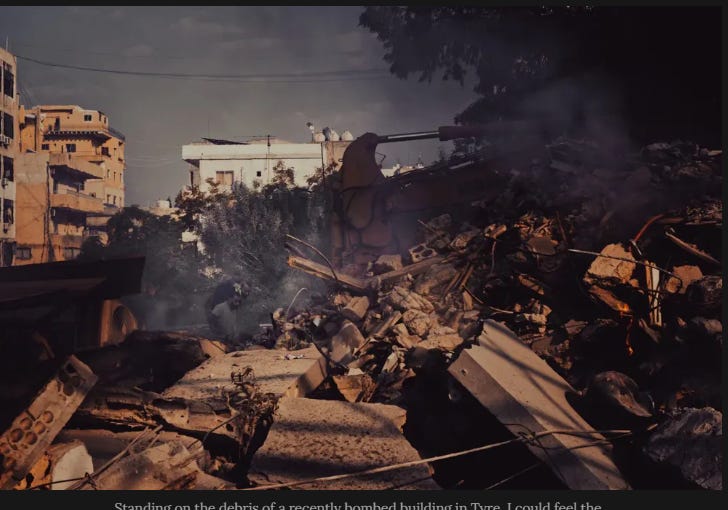
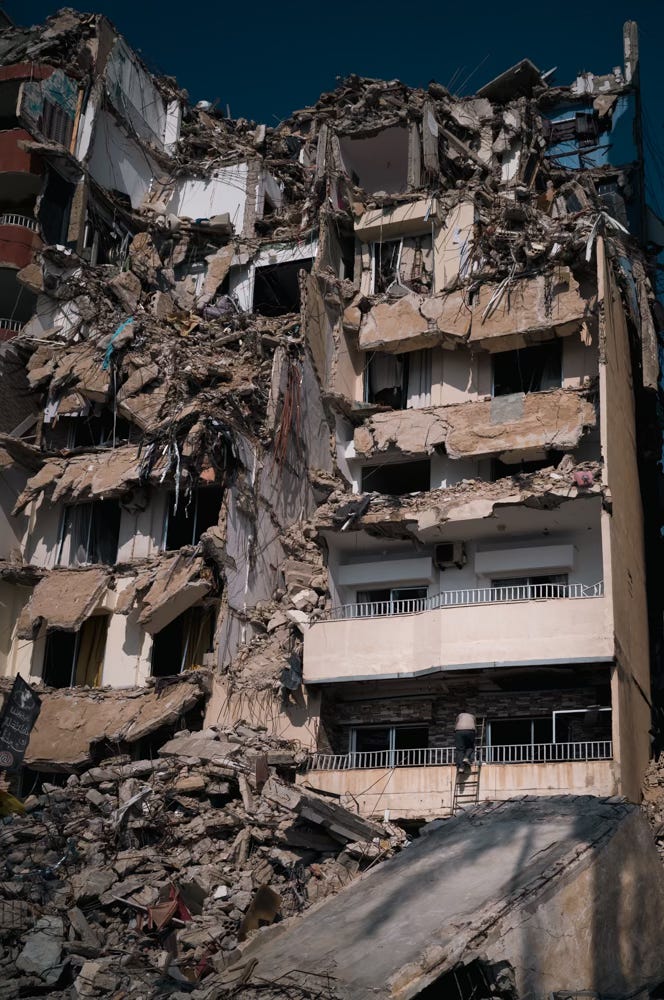
This should be a 24/7 scene in Jew York City, Jew Jersey, Tel Aviv, you name the fucking dirty USA and Israeli city:
Forwarded this email? Subscribe here for more
‘This Week in Palestine’ is a weekly email dedicated to documenting Israel’s ongoing atrocities against Palestinians in occupied Gaza and the West Bank. We hope you find it worth reading every week – but if you’d like to unsubscribe from this newsletter while continuing to receive emails from Zeteo – you can always customize how you get our emails. Here’s how.
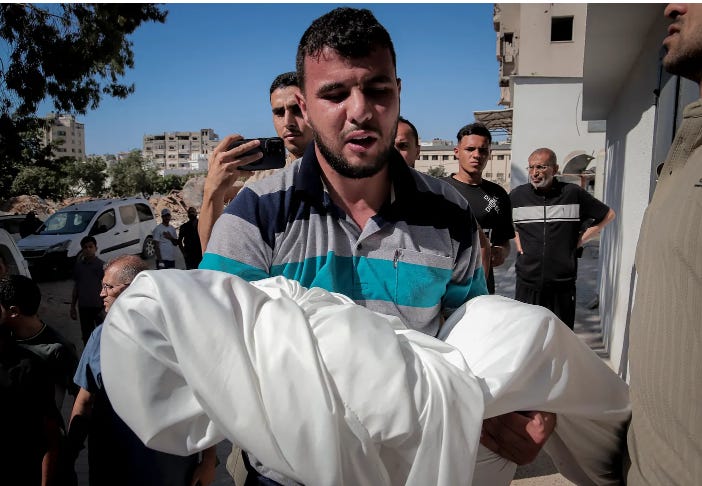
The video is hard to watch. Little Zeina pleading over her father’s body, “Father, father, my beloved father, come to me…. Why did you leave me? Why?”
Zeina, of course, knows her father didn’t leave her. He and her brother were taken from her by Israel. They were killed while collecting water.
Zeina’s father, Mohammad Al-Habeel, and her brother, 5-year-old Mousa, are two of the more than 1,000 Palestinians killed since the so-called “ceasefire” agreement last October. “What ceasefire?” as Zeteo contributor Diana Buttu recently asked.
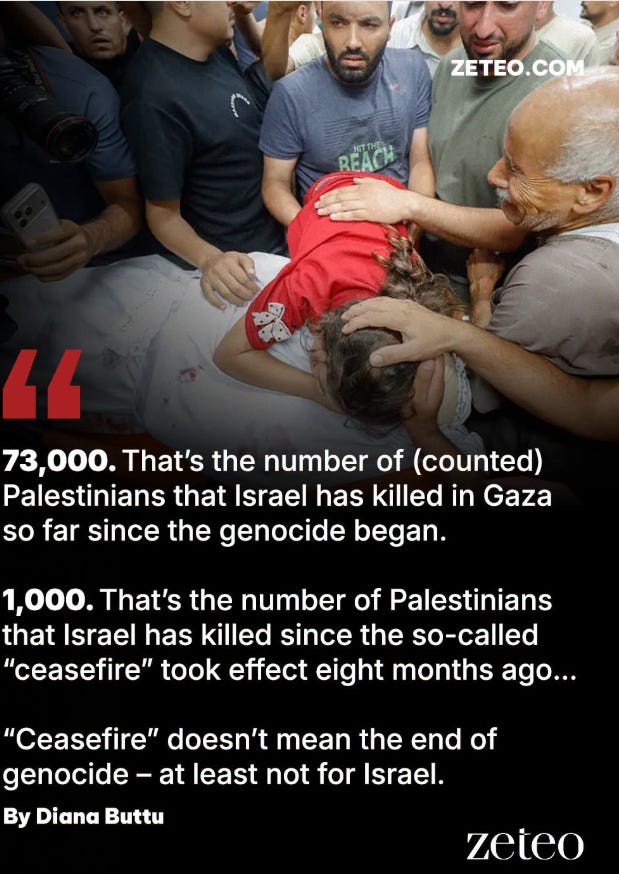
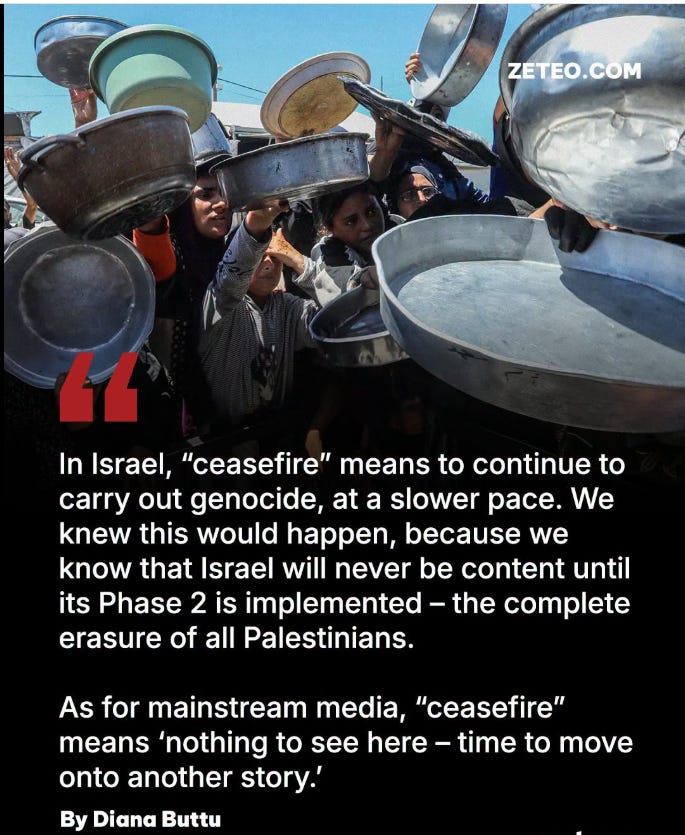
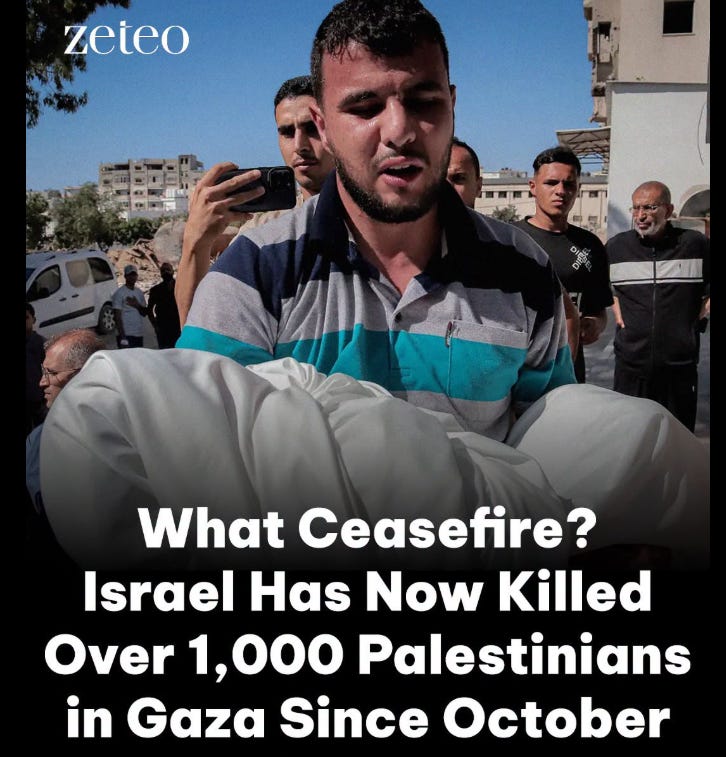
I have always hated the use of the term “ceasefire” when it comes to Palestine. The Cambridge English dictionary defines the term as “an agreement, usually between two armies, to stop fighting in order to allow discussions about peace.” For clarity, Palestinians do not have an army; we are not “fighting” (Israel is committing genocide), and of course, there are no “discussions about peace” (nor prospect of it, given that Israel continues to steal land).
And before anyone misconstrues my words, let me be clear: Palestinians were the happiest to see Israel’s mass killings stop when the so-called “ceasefire” was announced in October 2025. From October 2023 to October 2025 – the height of Israel’s genocide on Gaza – Israel was killing, on average, over 100 Palestinians a day. Israeli forces were gleefully bombing nearly all of Gaza’s 36 hospitals, and more than 200 schools and universities (we saw the TikToks). Israeli soldiers viewed children, journalists, and medical personnel as legitimate targets. Israel and its U.S. backers derived sick pleasure in seeing Palestinians scramble for food, only for Israeli soldier’s to gun them down or bomb them.
So why do I hate the term “ceasefire”? Because “ceasefire” doesn’t mean the end of genocide – at least not for Israel. So let’s examine what it does mean for Israel.
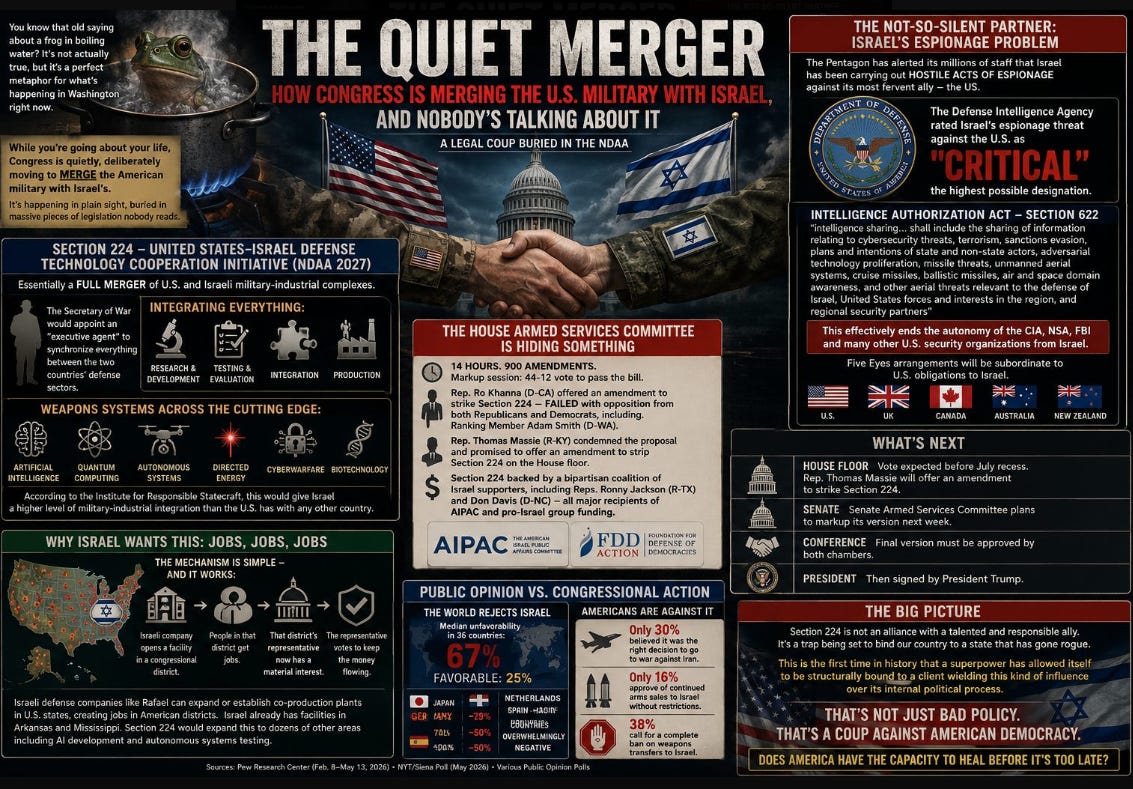
When a foreign government has:
– Direct access to your classified intelligence
– Co-production rights on your weapons systems
– Influence over your defense procurement
– A dedicated executive agent in your Pentagon
– The ability to create jobs to buy political support
– A ‘critical’ espionage rating from your own intelligence agencies
At what point do you stop being a sovereign nation?
The Jews are getting it all, man — USA, Canada, most of EuroTrashLandia, AU, NZ, UK — wherever their murder tools are sold.
Part of the genius of Section 224 is how it’s designed to make opposing it politically impossible. The provision allows Israeli defense companies like Rafael to expand or establish co-production plants in U.S. states, creating jobs in American districts.
The mechanism is simple and it works:
1. An Israeli company opens a facility in, say, Alabama.
2. People in that district get jobs.
3. That district’s representative now has a material interest in protecting the relationship.
4. The representative votes to keep the money flowing.
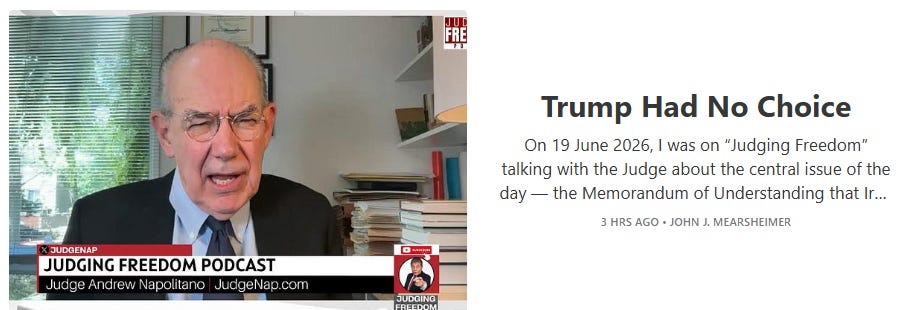
THEY ARE WINNING:
Call your representative at (202) 224-3121 and tell them you see what they’re doing.
References
1. The Intercept. “Congress Is Trying to Permanently Integrate U.S. and Israeli Defense Tech.” June 7, 2026.
2. Consortium News. “Fusing the US Military and the IDF.” June 4, 2026.
3. Pew Research Center. “Most people across 36 countries have negative views of Israel and little confidence in Netanyahu.” June 3, 2026.
4. ThePrint. “Israel ‘spied’ on US negotiators working on Iran deal, Pentagon raises threat perception—NYT report.” June 6, 2026.
5. The Independent. “Trump pushing through law to massively expand US intelligence sharing with Israel.” June 8, 2026.
6. The Jerusalem Post. “Khanna, Massie join to strip US-Israel tech cooperation from defense bill.” June 1, 2026.
7. Newsweek. “NDAA Section 224 alarms progressives and conservatives—Here’s what it says.” June 8, 2026.
8. PressTV. “2027 NDAA Section 224: Inside the deepening integration of American, Israeli military systems.” June 18, 2026.
9. Responsible Statecraft. “Pro-Israel voices win out, kill bill to stop US-Israel military integration.” June 4, 2026.
10. Middle East Eye. “Negative views of Israel soar across 36 countries since Iran war, survey finds.” June 4, 2026.
And, again, more fucking tripe with more fucking ex-Colonels. This is reality, the US Mercenary Diservices: Unfortunately, the War is a Racket and the Middle East/West Asia is Paying the Price, Not USA Ex-Colonel is correct. PROVING gorunds. Stress TESTS.
So Donald Trump’s “little excursion” to Iran—which he assured everyone would be a quick two-week romp—somehow stretched into a 100-day slog of death, destruction, and economic chaos. But don’t worry! They’ve now “settled” the war with “the Red.” (Iran? The Reds? Who knows, who cares—victory lap time!)
Our host Mehdi Hasan sat down with retired Colonel David D. Ro, a man so dedicated to defending the indefensible that he literally had to consult a thesaurus to redefine “imminent,” “massacre,” and “success” into something resembling English.
His conclusion? Operation Epic Fury is a success! Never mind that Iran still has 70% of its missiles, 90% of its underground storage, and enough enriched uranium to make a reactor blush. And sure, they replaced the Supreme Leader with… another Ayatollah.
But David has a four-point checklist, people!
- Air defense? Check!
- Nuclear program? Kind of check!
- Missiles? Well, they’re not firing many *effective* ones, so check!
- Internal security degraded? Maybe? The metrics are flexible!
When confronted with 1,700 dead civilians, 120 children blown up in a school, and dozens of hospitals and universities reduced to rubble, David’s response was truly Olympic-caliber mental gymnastics. Massacre? That implies *intent*! It wasn’t a massacre—it was just… 120 kids getting recklessly deleted. And the school was *near* a military base, so really, it’s the children’s fault for being in the wrong place. Also, the Pentagon’s weapons are apparently so precise they accidentally bomb volleyball teams *and* sports halls simultaneously. But don’t worry—David is *unfamiliar* with that incident. Because his crack research team clearly works from the Pentagon’s PR department.
Barak Cena, an associate fellow at the Henry Jackson Society, joined to explain that 120 dead Iranian children are merely “collateral damage”—and he was *so* careful to say it’s all tragic while simultaneously calling it completely legitimate. The UN War Crimes Tribunal is presumably taking notes.
Meanwhile, Muhammad Ali Shabbani pointed out that Iran’s military budget is 130 times smaller than America’s, yet somehow they’re still fighting. Almost like bombing knowledge, scientists, and universities doesn’t actually work. But who knew?
The highlight reel: David arguing that 1953 Iran wasn’t *really* a democracy because the prime minister was appointed by the king (like the UK’s prime minister!), so therefore the CIA-MI6 coup was fine. And he *still* wouldn’t fully admit the US helped Saddam gas Iranians in the 1980s—just a “little bit” of help targeting Iranian troops with chemical weapons, not *really* endorsing the gassing itself. The distinction was clearly lost on the dead Iranians.
When asked about Israel ethnically cleansing southern Lebanon (a million displaced!), David suddenly couldn’t see the ethnic cleansing. It’s just… temporary Shia relocation? And he insists Israel won’t keep them out permanently—despite the Israeli foreign minister saying exactly that. But David’s “on record” predicting they’ll return. Because his track record of predictions has been so spotless!
The audience poll showing 44% of Arabs see Israel as the biggest threat, 21% the US, and Iran a distant 6%? David’s response: “I’m surprised we only got 21%—we’re a superpower, we get blamed for everything.” And the JCPOA was bad, apparently, because it gave Iran planes that they used to fly militias into Syria—except Iran already had planes and sanctions didn’t actually stop them. But hey, let’s bomb schools instead!
In the end, David’s parting defense: “The burden of being a superpower is we’re blamed for everything we do and everything we don’t do.” A philosophy the families of 1,700 dead Iranians would surely find reassuring. - The Jews have colonized the colonizers:
‘I’ve finally found God without all the extras’: behind the surge in people converting to Progressive Judaism
Despite an increase in antisemitism and anti-Jewish feeling in the UK, adult conversions are on the rise
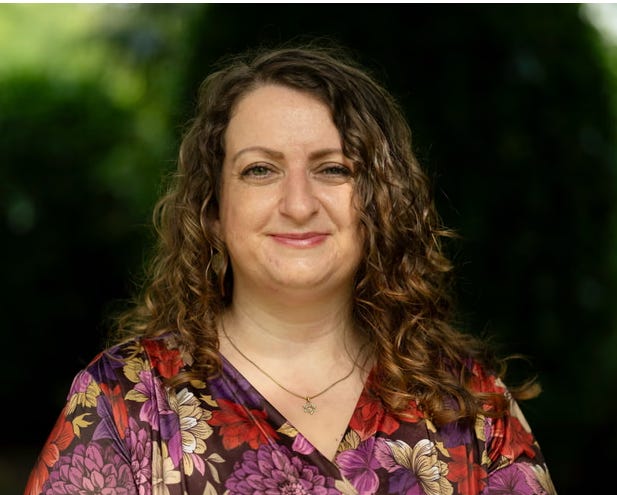
[Elizabeth Arif-Fear was born Christian, then converted to Islam and was Muslim for 14 years and has now converted to Judaism.]

[Rabbi Jonathan Romain is convener of the Reform Beit Din, the rabbinic court for Progressive Judaism.]
“We’ve found several times people have said to me, ‘Somebody gave me a DNA test as a Christmas present and it turned out I was Jewish,’” he says. “For some people, that’s just a matter of information. But other people, it intrigues them, or maybe it even answers something deep inside them.”
Not ONE word about Judaism’s Genocide. NOT ONE.
A mercenary in another man’s land, another child’s land, another aunty’s land, a mother’s land, and this is fucking celebrated?
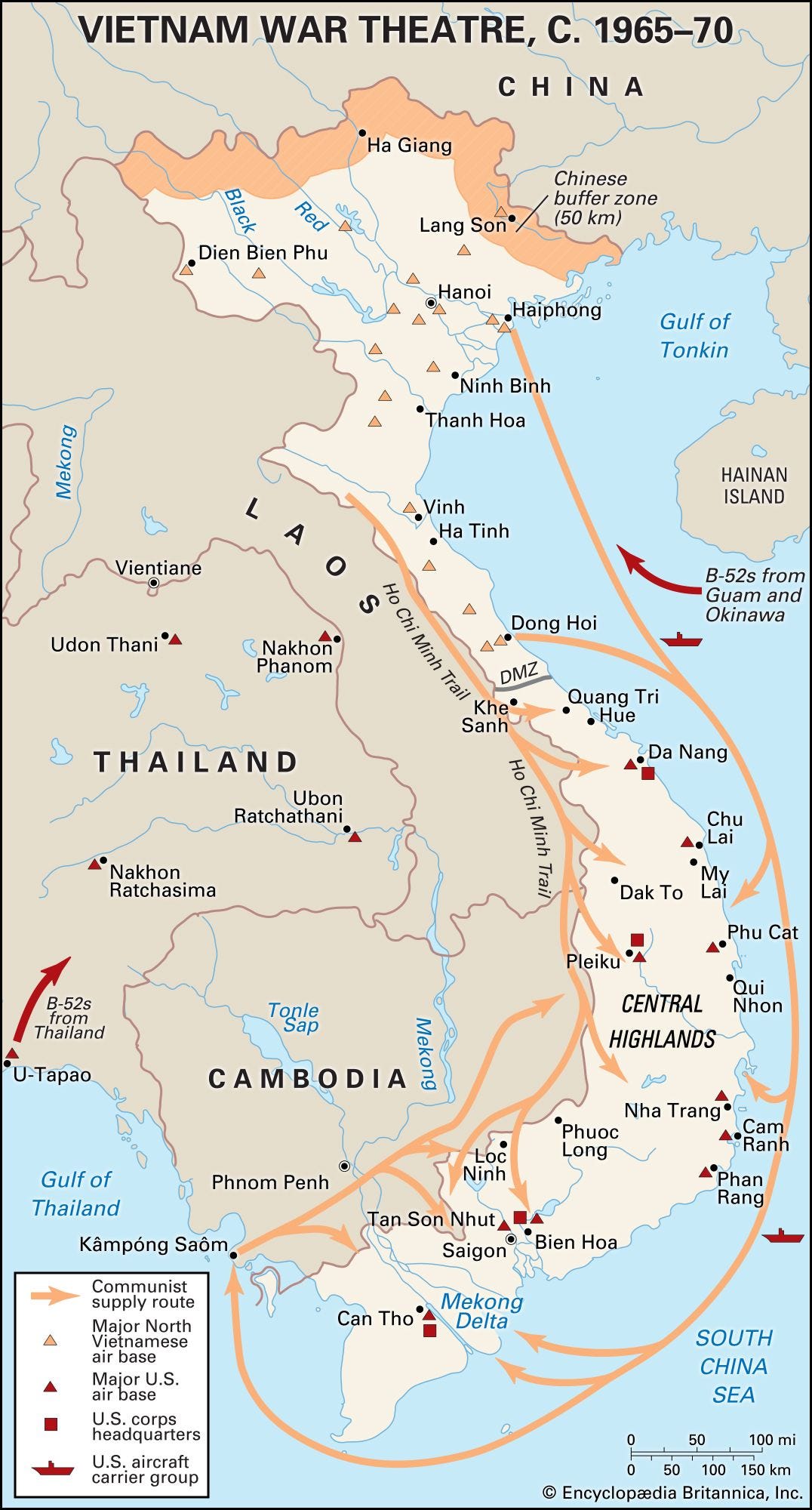
Estimates indicate that several million people—including soldiers and civilians—were killed in Vietnam, Laos, and Cambodia as a result of the Vietnam War and associated U.S. military operations. The total death toll is heavily debated, but the most widely accepted historical estimates place the combined casualties for all sides between 2 million and 3.8 million deaths. [1, 2]
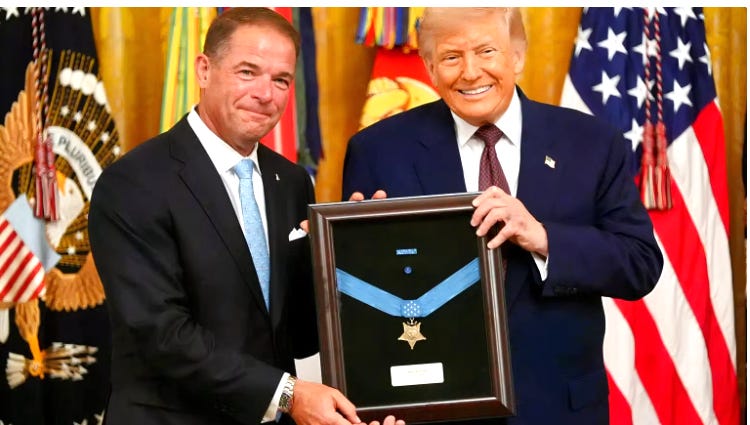
More than 54 years after he crawled beneath the Dong Ha Bridge to stop a North Vietnamese armored invasion, Marine Col. John Ripley entered the Pentagon’s Hall of Heroes on Thursday.
For generations of Marines, the moment represented recognition of one of the most legendary acts of battlefield leadership in the Vietnam War. But for Ripley’s son, Tom, the ceremony was about far more than a medal.
In an exclusive interview with Military.com following the ceremony, Tom Ripley said the Medal of Honor awarded to his father represents the Marines who fought beside him, the military spouse who held their family together through two Vietnam tours, and the generations of service members who carried the story forward for more than half a century.
“This is not my award,” Ripley said. “When people would stand up and clap, I would clap too.”

Fighting for our freedoms to be slipped away… The San Francisco Police Department said an audit of its automated license plate reader camera network shows it was improperly accessed by out-of-state and federal agencies.
Data from the SFPD’s ALPR network, manufactured by Flock Safety, was improperly searched nearly 300 times by over roughly one year, representing about 0.005% of all searches during that period, the department said. The audit found no searches related to immigration enforcement or reproductive rights investigations, according to police.

It’s not greenwashing. It’s green sadomasochism. Green Porn. Green Snuff.
The ocean is home to some of the richest biodiversity on Earth. From coral reefs and mangrove forests to the deep sea, marine ecosystems sustain countless species, support coastal communities, regulate the climate and underpin global food security.
But these systems face growing pressure from overfishing, habitat loss, pollution and climate change.
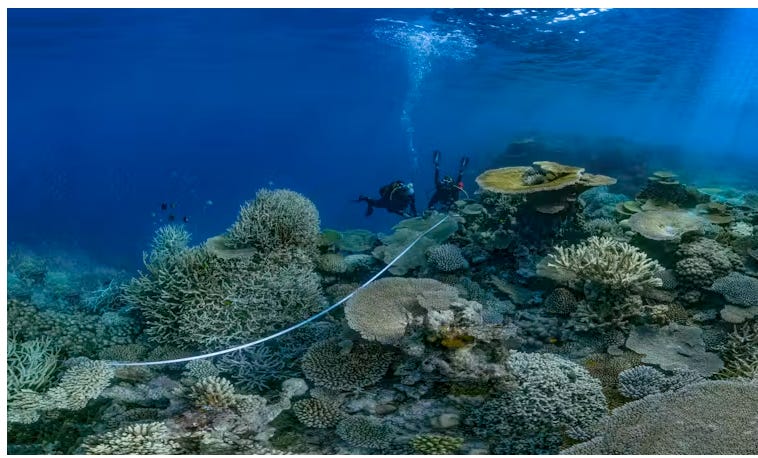
In response, nations have adopted an ambitious global goal to conserve at least 30% of the world’s ocean by 2030 – known as 30×30. This target has expanded marine protection worldwide, particularly through marine protected areas.
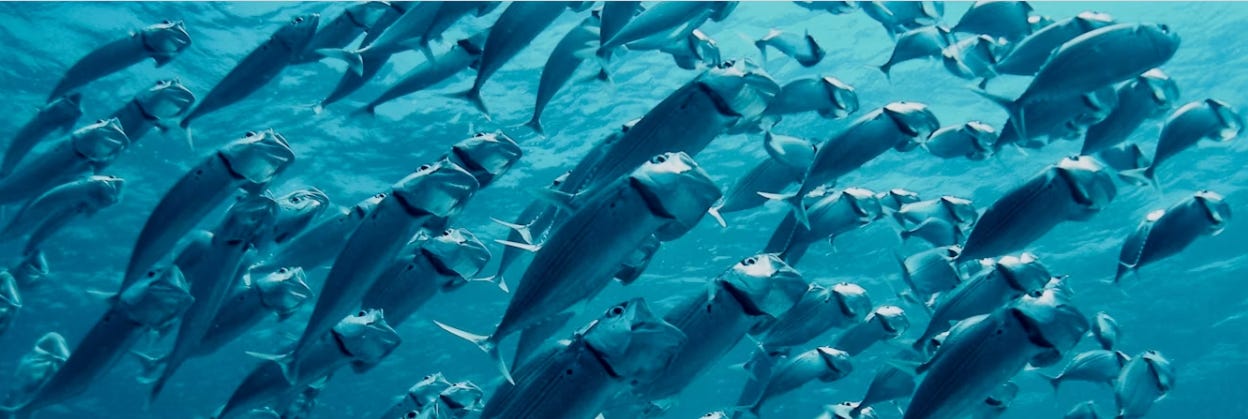
But what happens after protection is announced?
[Marine heat waves can trigger coral bleaching.]

Decades of experience have shown that effective marine protection requires consistent rules, regulations and oversight, along with financing and meaningful collaboration with local governments, industries and communities. Without it, these areas risk becoming paper parks: lines on a map without real-world impact, where marine life may continue to face overfishing and other threats.
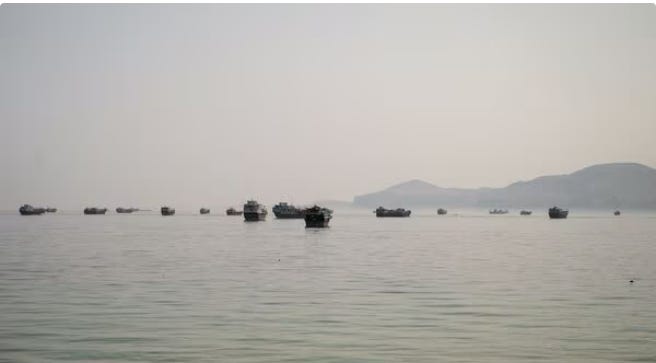
The Strait of Hormuz has reopened to international shipping after Iran and the US signed a memorandum of understanding this week, but a CNN Business analysis warns that the diplomatic breakthrough may have arrived too late to stop global oil reserves running critically short this summer.
Crude has not moved freely out of the Gulf for nearly four months. According to analytics firm Kpler, the war has cost the world some 1.15 billion barrels of oil supply, a shortfall that has pushed the market towards what the outlet describes as a breaking point even as diplomats celebrate the truce.
Even if global production outpaced demand by close to 5 million barrels a day, the surplus the International Energy Agency currently forecasts, it would take roughly a year to recover the 1.15 billion barrels lost during the Iran-US conflict.
Also Read | As US-Iran war ends, Pentagon seeks $80 billion to cover costs tied to conflict
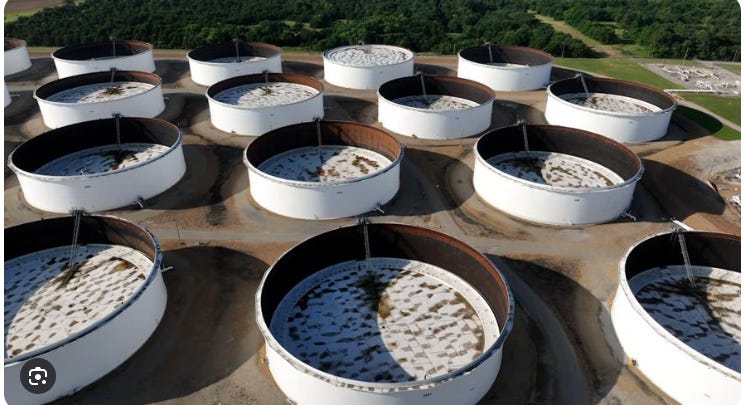
“At some point physical barrels actually matter,” said Dan Pickering. “If you lose those barrels, that matters.”
Finally, everything the Jews Touch turns to Chlamydia Capitalism and War Mongering Deception: I wrote about this several hours ago,
Down to Brass Tacks — Jews Celebrate the Prisoner (kidnapped) rapes, Cheer on the Baby Killers, and let every act of murder wash over themselves like urine-golden showers
·
8:03 AM

Lebanese journalist and analyst Marwa Osman writes:
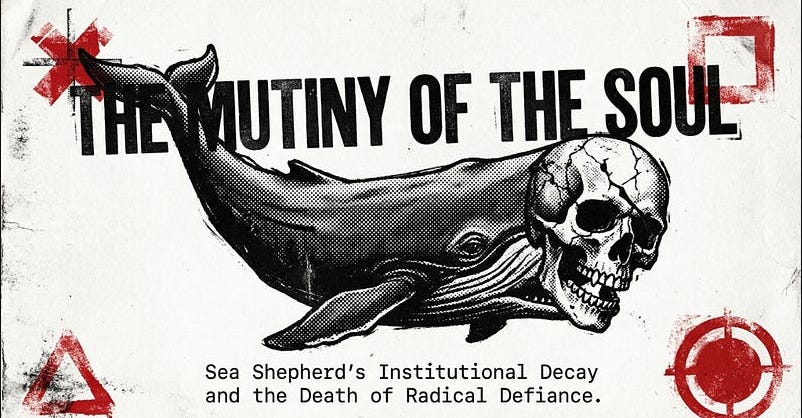
Trumped by the Jews: How Israelis Infiltrated and Destroyed the Largest Sea Conservation Group in the World
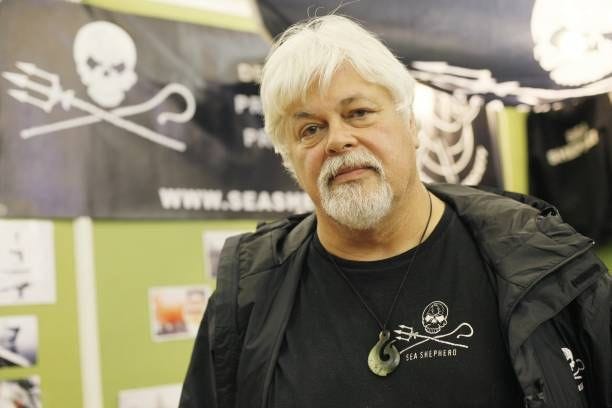
By Watson’s own account, these men were terrified that his uncompromising history would frighten off the governmental partners they were so desperate to court. The tactic of aggressive non-violence that Watson developed in 1977 was rejected as being too controversial, despite having been the very approach that made Sea Shepherd the successful movement it became.
Watson’s account of the split makes clear this was not a disagreement about tactics. It was a disagreement about what the organisation fundamentally was. The new leadership wanted a mainstream conservation NGO. Watson wanted what Sea Shepherd had always been: a direct-action force that answered to no one.
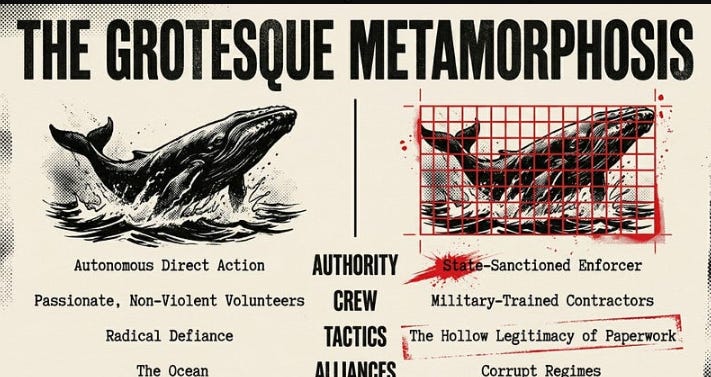
Following the removal of Watson and Essemlali, Sea Shepherd France, Brazil, and the UK remained loyal to the original objectives of the movement. The new Sea Shepherd Global subsequently sued Watson and Sea Shepherd France, charging that they had no legal right to use the name Sea Shepherd — the name Watson himself created — or the logos that he had designed. An organisation suing its founder for using his own name. The symbolism was not subtle.
The Yamasec Problem: Mercenaries at Sea
This is where the story moves from disappointing to genuinely troubling.
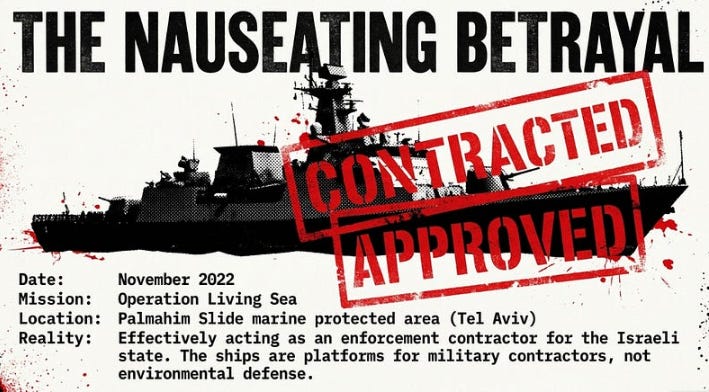
According to reporting by L’Impertinent, the Israeli company Yamasec, based in Uganda, had been hiring security personnel to operate on Sea Shepherd Global boats for approximately seven years. On board Sea Shepherd’s ship the Sam Simon in Gambian waters, two hired Israeli security personnel from Yamasec trained Gambian Navy officers in military boarding procedures: how to carry their weapons while climbing rope ladders, how to check ships for contraband, weapons, or hidden workers, and how to board moving vessels that refused to stop.
Let that sink in. An organisation founded on non-violent direct action, celebrated for its scrappy, civilian-crewed ships standing between whalers and whales, had quietly become a platform for military-trained contractors to run boarding operations with armed naval officers.
Sea Shepherd France’s Lamya Essemlali says she and Watson were entirely unaware of the Yamasec collaboration: “It sounds crazy, but no, we didn’t know. It was never discussed during board meetings, and we never approved any contract.” According to Essemlali, internal documents including the Yamasec contracts were kept hidden from them, which is precisely why Sea Shepherd France filed a lawsuit against Global in Amsterdam — to access the internal documents that had been concealed.
A crew member who spoke to L’Impertinent described the dynamic aboard ship in terms that should alarm anyone who remembers what Sea Shepherd was supposed to be: “They are there to help us in case of pirate attacks and to manage the local soldiers who board with us and give us the legitimacy to dock fishing vessels. One of Yamasec’s bosses has privileged contacts with governments. I was told that without Yamasec, we wouldn’t be able to be there — which surprised me, since they’re the ones working for us, not the other way around. There’s a link I find unhealthy between a private security company and local presidents.”
A former crew member, writing under their own name, corroborated this: “I witnessed an Israeli security team on board — paid obscene amounts — who later returned to participate in operations against Palestinians.” This is a single, unverified account, and it deserves to be treated as such. But it is the kind of account that demands a response from Sea Shepherd Global — one that has not been forthcoming.
The Paul Watson Foundation’s FAQ lays out the founding philosophy with striking clarity: direct action, operational independence, no government partners, complete transparency with the public. These were not aspirational values — they were the operational DNA that made Sea Shepherd effective. Governments do not board illegal fishing vessels at three in the morning in a storm. Radical, non-violent civilians who answer to no flag will.
By choosing legitimacy over autonomy, the new Sea Shepherd Global traded away the only thing that made it powerful. You cannot hold governments accountable while those same governments are signing your contracts and vetting your security personnel. You cannot claim to protect the ocean while your board suppresses internal documents to conceal which military contractors are running your ships. And you cannot pretend to be a grassroots movement while suing your own founder for using his name.
The Captain Paul Watson Foundation carries the original mandate forward, operating independently without government partnerships or security contractors. Whether that is enough — and whether “working within the system” can achieve what defiance could not — is the question the ocean itself may eventually answer.
The rest, as they say, is fancy paperwork for the extinction of the seas.
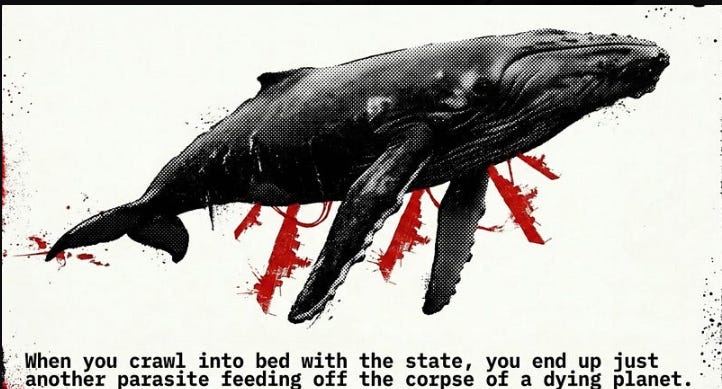
THREE years of spinlessness and complicity:
So, the Jews are losing? Christ. 320 Jew Billionaires and their Cartel of Tech Billionaires and Eichmann millionaires. Jews are not humanity’s or Earth’s friends.
JEWS. Screaming, dirty gutteral fucking yelling;

