
the Jewish State of Hell, Israel, and the Jewish state of mind — swindlers, back stabbers, klannish, cold, natural born killers
Jun 12, 2026


This is a Kapo mixed with an Incel mixed with a White (sic) Supremacist mixed with a Dirty Little Boy mixed with a Jew on a Mission mixed with Racist Deluxe. What do we get? Neurotoxic Glosser . . . Glosser-Miller.
And in the end, dumb goy will continue to get the ex-colonels on their fucking channels who declare “the end of zionism . . . the end of Israel . . . is near!”

THE PETRO-MONARCHIES of the Gulf are celebrated big spenders—not least by the West’s defence industry. Their oil wealth pays for about a fifth of global arms imports, with a shopping list ranging from fighter jets to frigates. In a noisy, volatile neighbourhood, safety comes at a price.
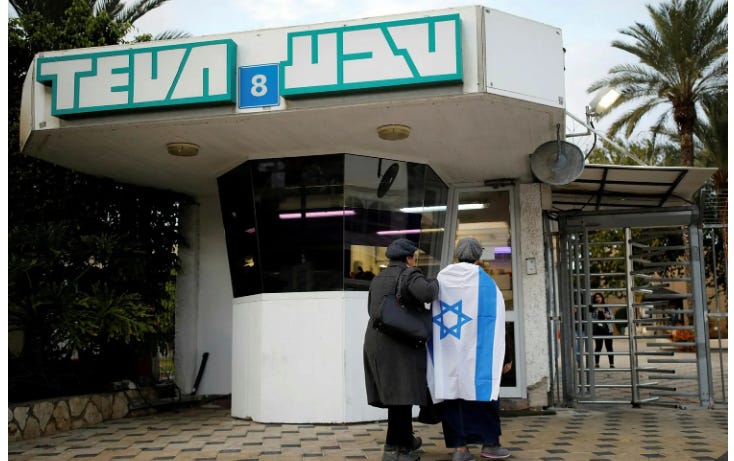
Jewish PUSHERS: Israeli Pharma Giant Teva Lays Off 250 of Its Israel-based Staff
The layoffs are carried out as part of a reorganization of the global division’s operations, which employs 4,000 employees, 650 of whom are in Israel ■ The division was put up for sale in January 2024 at a value of $1.5 billion – efforts to sell it have so far failed
Demand for the division’s products has declined in recent years. This is due both to Teva’s accelerated transition from a company focused primarily on generic drugs to a biopharmaceutical company investing mainly in innovative medicines and biosimilars – produced in living cells that are highly similar to the original product – and to intensifying competition from active ingredient manufacturers in East Asia, particularly in chemical drugs where competition is fierce and profit margins are relatively low.
Related Articles
- Israeli pharma giant Teva to pay Nevada $193 million over role in opioid epidemic Reuters
- Israeli Drugmaker Teva Fueled Opioid Addiction in New York, Jury Finds Reuters
- U.S. Justice Department Charges Teva in Generic Drugs Price-fixing Probe Yoram Gabison

The Trees of DEATH: Jews.
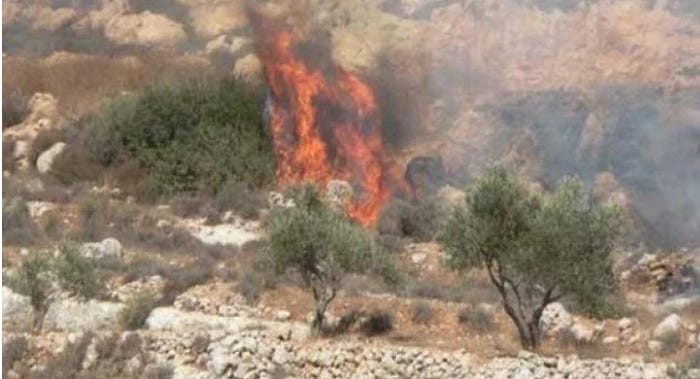
Jews burn down EVERYTHING:
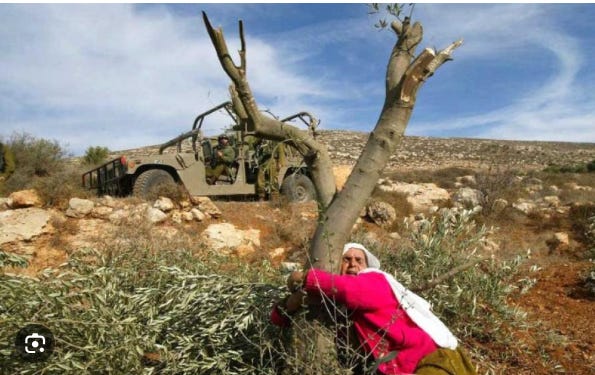
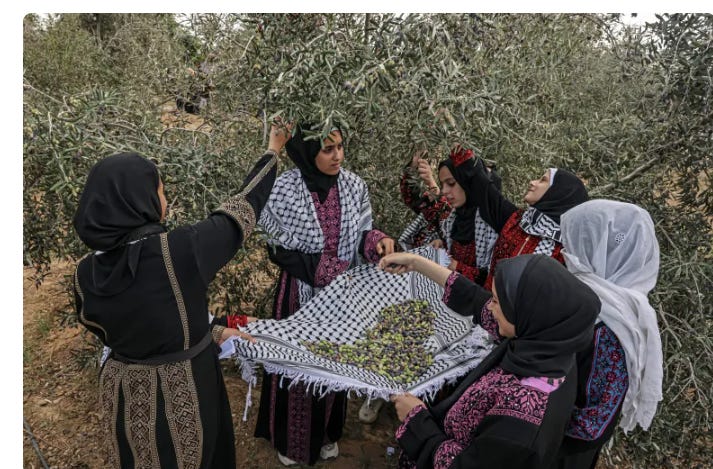
THree years ago: Palestinians pick olives during a ceremony marking the start of the olive harvesting season last year in Deir el-Balah in the central Gaza Strip [
Sure, it’s not the UnUnited Snake$ of Israel, tell me about it. Israel’s Smart Shooter wins $5.8 million contract with US Marine Corps

Earlier this year, Smart Shooter secured a $10.7 million contract with the US Army and, in early June, another valued at $1.8 million with the US Navy.

Some of the dirtiest Jews on Earth: Senate Democrats’ political fortunes have improved. ‘It didn’t happen by accident,’ Schumer says.
The embattled Senate minority leader isn’t popular with the base of his own party. But he says he has laid the groundwork for a Democratic resurgence.
National party operatives fear an unabashedly progressive candidate, Abdul el-Sayed, could emerge from a messy three-way primary and complicate Democrats’ chances at keeping retiring Sen. Gary Peters’ seat in November.
In what many interpreted as an attempt to winnow the field and box out el-Sayed, Schumer voiced this week what had been a not-very-well-kept secret — he’d prefer Rep. Haley Stevens, telling Punchbowl News “she has the best chance to win.”

But the third leading candidate, state Sen. Mallory McMorrow saw an opportunity Thursday — attacking Schumer.
“Michiganders are sick and tired of the party putting their fingers on the scales,” she said in a social media video attacking Stevens and her national backers. “Schumer doesn’t decide — you do.”

And you thought the people hate AI:
Prometheus, the industrial AI startup led by Jeff Bezos and former Google exec Vik Bajaj, today will announce that it’s raised $12 billion in Series B funding at a $41 billion valuation.
Why it matters: It’s a massive bet to rearchitect how physical things are made, from jet engines to medical devices to consumer electronics.
What they’re saying: “The cycle from dream, to manufacturing at rate, to having it out in the world can be very long,” Bezos tells Axios.
- “For example, if you go to a current jet engine manufacturer and say you want the exact same engine but with 10% more thrust, it could be a 10-year program. Not because they’re lazy or bad at their jobs, but because it’s so complex. So what we’re doing is building a set of tools that will empower engineers to compress that cycle time and make that dream-build loop be 10 times faster or even more.”
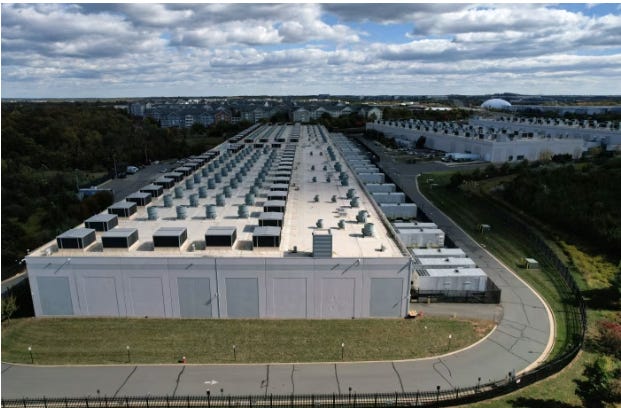
Nothing from their mouths is TRUTH: Amazon Says Its Data Centers Used 2.5 Billion Gallons of Water in 2025
The company said water use at sites it owns and operates directly fell 2% from 2024 levels, even while it expanded its data-center footprint
We’re in the Army NOW: Cunts.
The U.S. Army commissioned its second cohort of senior technology leaders into the Executive Innovation Corps, known as Detachment 201, during a ceremony June 10 at Joint Base Myer-Henderson Hall.
Detachment 201 is a specialized Army Reserve unit designed to bridge the gap between private-sector innovation and military modernization. It reflects the War Department’s broader push to leverage private-sector technical capabilities to address complex national security and defense challenges.
The program selects applicants who are highly skilled civilian technology professionals at the executive or C-suite level to serve as part-time strategic advisers. These officers use their advanced expertise in commercial tech and private industry to offer a different perspective and advise senior Army leaders on solving military problems.
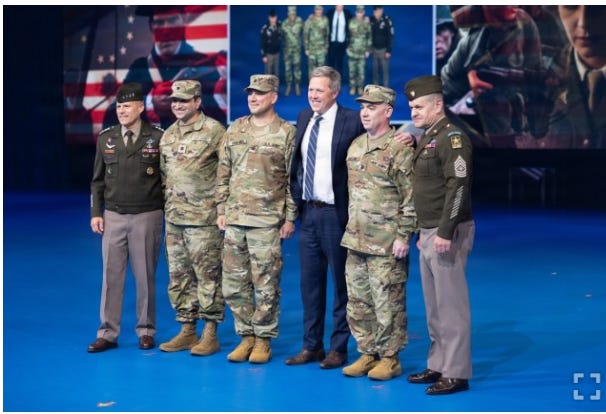
The three newly commissioned officers of Cohort 2 are Dane Knecht, chief technology officer of Cloudflare; Sam Pallura, managing director and chief technology officer of Sutter Hill Ventures; and Serkan Piantino, co-founder of Facebook AI Research and former vice president of products at Reddit.
The officers shared their perspectives on joining the unit:
“I was drawn to Detachment 201 because it’s a unique opportunity to apply private-sector technical expertise to national defense challenges,” Knecht said. “I’m excited to contribute to helping the Army innovate and maintain a strategic advantage.”

I PLEDGE ALLEGIANCE TO WAR SO HELP ME MOSES. THe first Lieutenant Colonels are Shyam Sankar, Chief Technology Officer for Palantir; Andrew Bosworth, Chief Technology Officer of Meta; Kevin Weil, Chief Product Officer of OpenAI; and Bob McGrew, advisor at Thinking Machines Lab and former Chief Research Officer for OpenAI.

Over the past year, the pilot cohort of Detachment 201 has provided strategic counsel on the Army’s critical challenges. Their work has influenced key initiatives, including munitions supply chain data analysis, Organic Industrial Base investments, and foundational strategies for autonomous systems and counter-drone technologies.
The Army’s acquisition pipeline for highly skilled talent is managed through the modernized Direct Commissioning Program, which has been overhauled to compete more effectively with the private sector for technical talent. By streamlining the centralized application process, the military has reduced the onboarding timeline from more than 18 months to approximately six months. This pathway allows senior corporate leaders to serve in uniform part-time without abandoning their civilian careers.
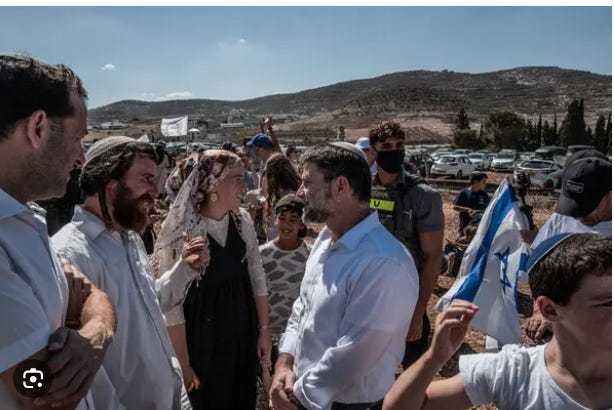
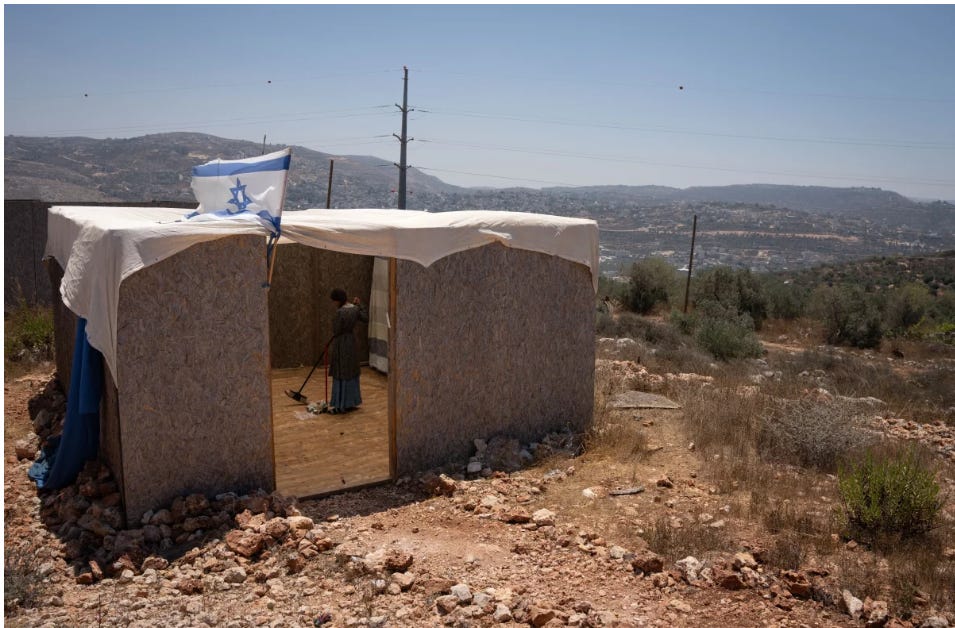
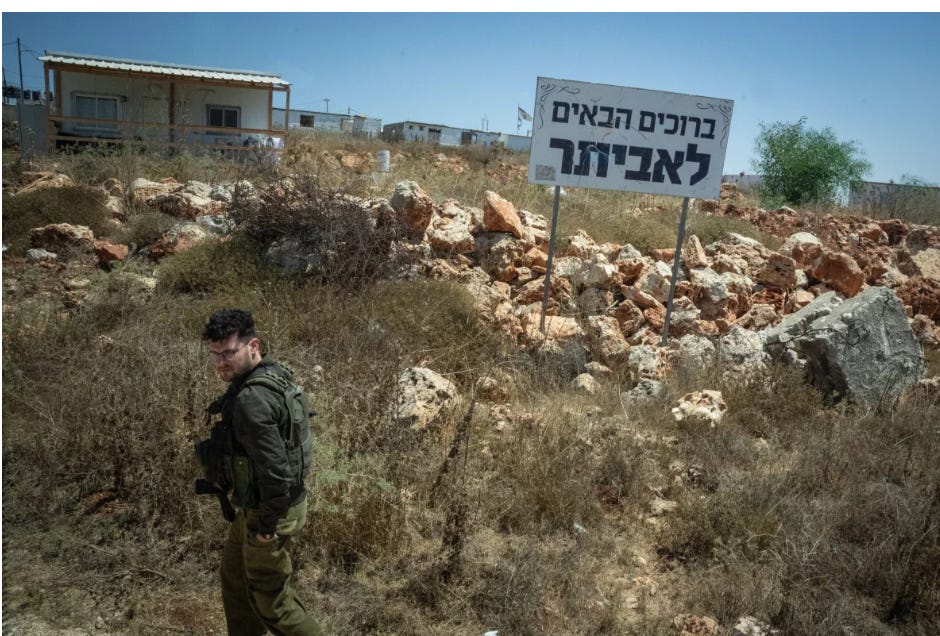
Something about the Jews losing in Occupied Palestine? Israel Set to Rapidly Expand West Bank Settlement.
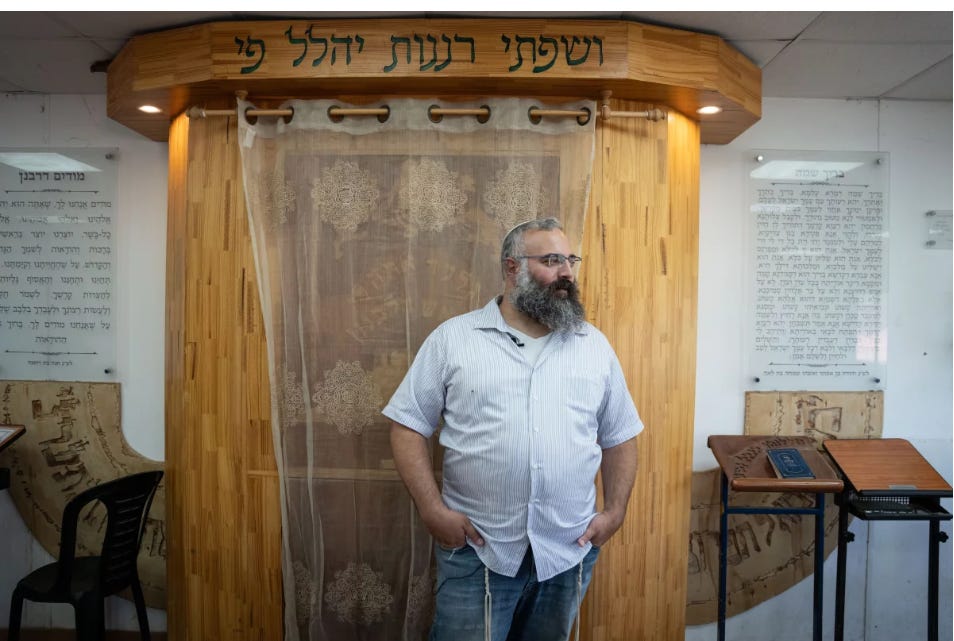
In a major push, the government is rushing to place temporary housing at about 60 empty sites in the Israeli-occupied West Bank before national elections this fall.
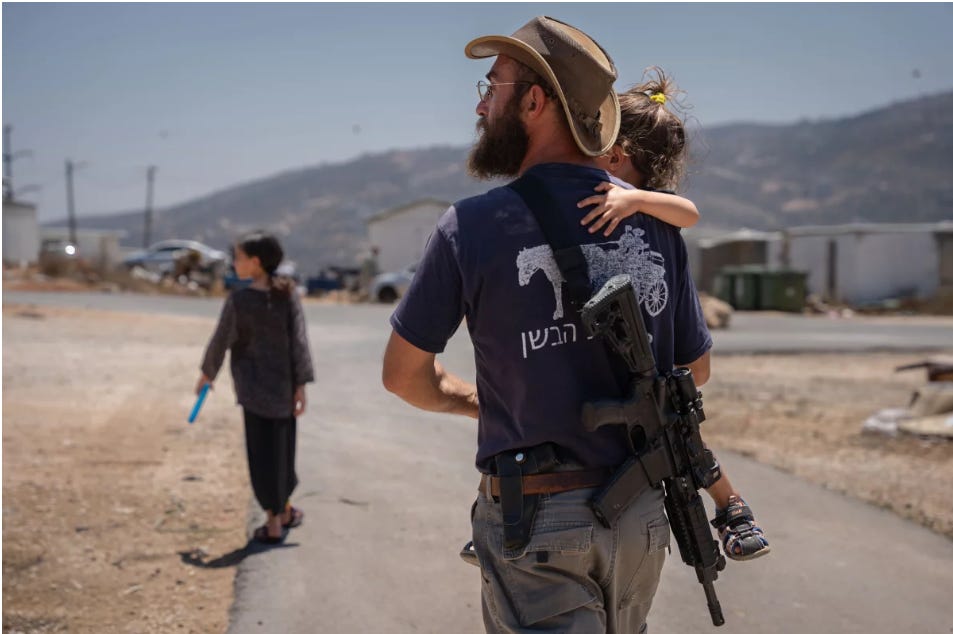
Rats.
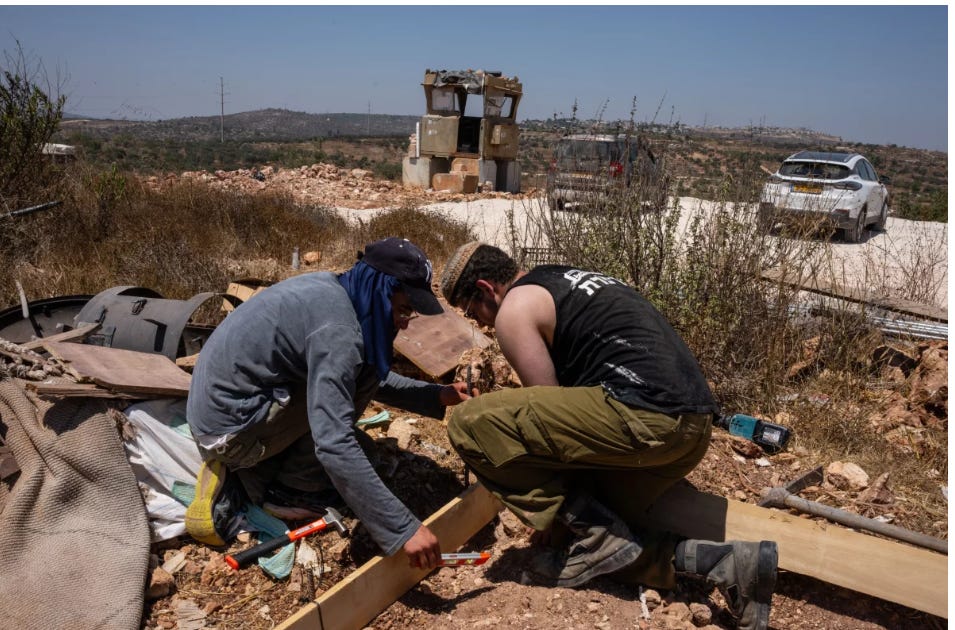
Vermin.
The language of death.
They are EVERYWHERE for a fucking demographic of 18 million globally (I do not believe that number at all, the same numbers game as 6,000,000 Dead in Ohio
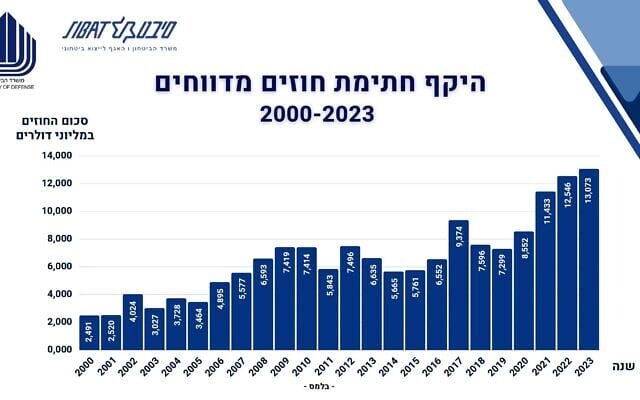
The other side of Israel’s defense export boom — The world condemned Israel. Then it bought $19.2 billion of its weapons
Behind record global sales, smaller manufacturers say orders from the Defense Ministry are drying up.

Alongside an unprecedented accumulated debt of NIS 15.5 billion ($5.2 billion) to Israel’s three largest defense companies, the Ministry of Defense is also slowing the flow of orders to small and medium-sized defense suppliers due to budget constraints.
Most of the revenue generated by Israel Aerospace Industries (IAI), Elbit Systems, and Rafael comes from defense exports. In 2025, the three companies accounted for about 90% of Israel’s record $19.2 billion in defense exports and held a combined order backlog of approximately $90 billion.
Good luck, and Good night, Arabs:

There’s a long Jewish tradition of wrestling with power, land, and law. The canon that gave us lo tirtzach (do not murder) and tzedek tzedek tirdof (justice, justice shall you pursue) also gave us Eretz Yisrael, a sacred geography that has animated prayer for millennia. But turning liturgy into latitude – elevating “Greater Israel” from scripture and slogans into a political program – isn’t faith; it’s maximalist cartography dressed in messianic rhetoric. It collapses ethics into acreage and swaps mamlachtiyut (statecraft) for a theology of permanent exception.
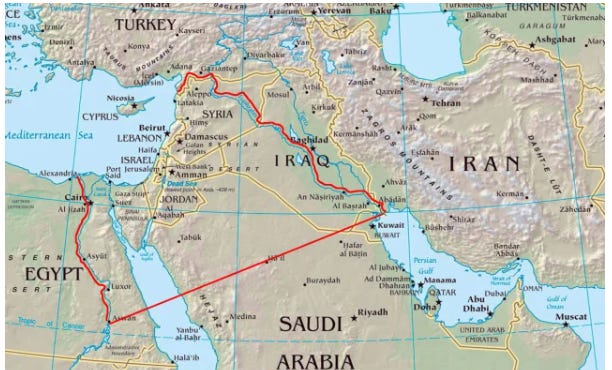
The debate, which has always simmered beneath Israeli politics, roared back into full flame in mid-August 2025. In a highly controversial August 12 interview with i24NEWS, Prime Minister Benjamin Netanyahu was presented with an amulet depicting a map of the “Promised Land.” Asked whether he “feels a connection to the vision” of Greater Israel, he replied simply, “Very much.” It was not a throwaway line; it was delivered with a knowing smile, no walk-back, and, tellingly, in a friendly domestic setting. Within hours, Arab governments from Saudi Arabia to Qatar, Egypt, and Jordan, joined by the Arab League, condemned the remarks as evidence of “a mentality steeped in colonial delusions,” a threat to regional stability, and a confirmation of expansionist intent. Israeli outlets clipped it and ran it; the line reverberated precisely because it was simple and maximalist.
What “Greater Israel” actually means has always been contested. The Hebrew phrase most Israelis use is Eretz Yisrael HaShlema – the “Whole Land of Israel.” In practice it has carried two main meanings: a narrower, post-1967 claim to all the territory “between the Sea and the Jordan,” and a maximal, biblicist claim stretching to the Euphrates and, depending on who is speaking, down to the “brook of Egypt.” The first has been embedded in party platforms; the second is a religious-text reading sometimes weaponized by ideologues and conspiracy theorists. Either way, it is territorial irredentism, not a doctrine of peace.
The textual seed for these visions lies in the Bible itself. Genesis 15:18, Exodus 23:31, Deuteronomy 11:24, and Joshua 1:4 all sketch boundaries far beyond the 1949 Armistice Lines. Yet having verses in scripture does not make them modern border treaties. Ancient sacral maps varied, and none were zoning laws for a 21st-century nation-state. Treating them as such is a category error – theology misapplied as cadastral survey. These are the verses that move the debate from maps to metaphysics and back.
In the Zionist archive, there exists a combustible line in Herzl’s diaries (Vol. II) summarizing a discussion with Zionist leader Bodenheimer: “Area: from the Brook of Egypt to the Euphrates.” Maximalists love to cite it; serious historians note the context – Herzl frames it as Bodenheimer’s ideas in a brainstorming list, not as a binding program. Context matters all the more given that Herzl also pursued the (rejected) Uganda Scheme and repeatedly treated borders as negotiable instruments for securing refuge, not as biblical inevitabilities. A diarist’s brainstorm is not a platform plank. Not all of Herzl’s contemporaries were modest; maverick Davis Trietsch fantasized about a “Greater Palestine” absorbing adjacent territories. In the Revisionist tradition, Jabotinsky’s Betar anthem – “Shtei gadót la-Yardén: zó shelánu, zó gam ken” (“Two banks has the Jordan: this one is ours, that one too”) – turned the East Bank into a youth-movement chant, embedding the claim in Betar’s political liturgy rather than leaving it as mere cartographic wish. These were eddies in the current, not the current itself.
David Ben-Gurion understood the power of ambiguity. In the drafting of Israel’s 14 May 1948 Declaration of Independence, he opposed locking in fixed borders or even explicitly referencing the UN Partition Plan as binding, insisting instead that Israel’s borders would be determined by the realities of war – whether territories like Galilee or areas near Jerusalem could be captured and held. Later, in the early 1950s, he acknowledged that Israel had been founded “in only a portion of the Land of Israel” and that many doubted whether its full historic boundaries would ever be restored – but he never framed this as a “hidden occupation” nor promised inevitable expansion. It was calculated flexibility, not a biblical mandate.
On July 9, 1947, Rabbi Yehuda Leib Fishman (Maimon) told the UN Special Committee on Palestine (UNSCOP) that the “Promised Land was quite a large one, from the river of Egypt, up to the Euphrates” – a theological citation voiced in a diplomatic hearing. The resulting partition plan, of course, bore little resemblance to that sermon. The modern revival of the concept took on political flesh after the 1967 Six-Day War. The Tnu’a Lema’an Eretz Yisrael HaShlema (Movement for Greater Israel) demanded permanent retention and settlement of newly captured territories. Its leaders blended poets, generals, and ideologues; its spiritual charge came from the Kook school’s religious Zionism, with Rabbi Zvi Yehuda Kook sacralizing the land as divinely granted. In parallel, Likud’s 1977 platform canonized the formula: “Between the Sea and the Jordan there will only be Israeli sovereignty.” That sentence has since framed coalition politics for decades.
The maximalist imagination also drew fuel from Oded Yinon’s 1982 essay – later dubbed the “Yinon Plan” – which argued that fragmenting neighboring Arab states would serve Israel’s strategic ends. Scholars have debated its influence; conspiracy theorists have treated it as scripture. It is best read as one ideologue’s blueprint, not state policy, but its logic – rule by engineered balkanization – has haunted the more aggressive strategic visions ever since. Then there is the “10 agorot coin” controversy. In 1990, Yasser Arafat waved a coin before the UN General Assembly, claiming it bore the map of Greater Israel. The Bank of Israel’s own records make clear it features motifs from ancient coins – pomegranates, palms, lyres – not a Nile-to-Euphrates map. Nonetheless, the myth has persisted in polemics.
The Israeli constitutional framework adds another twist. Israel never adopted a single written constitution; instead, it operates via Basic Laws passed by the Knesset – the Knesset’s own explainer is plain about this. The 1948 Declaration of Independence deliberately avoided defining borders after an internal debate; Ben-Gurion argued that the realities of war would dictate them. De jure borders since then have been formalized only through treaties, such as with Egypt in 1979 and Jordan in 1994, not through any constitutional clause. Practically, that constitutional vacuum leaves maximalists to say, with a wink, that borders are “elastic,” while jurists insist – correctly – that it is treaties and statutes that bind.
The so-called “New Middle East” Netanyahu loves to parade is not some visionary project – it’s a recycled slogan. Its most famous early mainstream use came from Shimon Peres, whose 1993/1994 book The New Middle East branded the concept worldwide as a utopian vision of economic integration after Oslo. But after the Iraq War in 2003, US policymakers – most notably Condoleezza Rice in 2006 – revived the phrase with a very different edge: not cooperation, but redrawing borders through regime change and enforced democratization. Born in that crucible of post-Iraq chaos and the Lebanon war, today’s “New Middle East” is once again less about prosperity and more about power. It’s a map of the region carved up to fit Israel’s security obsessions and expansionist appetites, sold under the false banner of “stability” and “peace.” What it really means is an entrenched regional order where Israel dictates terms, Arab fragmentation is permanent, and the Palestinian cause is buried under economic deals and normalization photo-ops.
Today, Israel’s slow-burn application of the “Greater Israel” doctrine is no longer subtle. Piece by piece, it has entrenched irreversible control over the West Bank, normalized its occupation through diplomatic breakthroughs, and tested its reach in Gaza with unprecedented destruction and displacement. The Golan Heights, seized from Syria in 1967 and unilaterally recognized by the United States as Israeli territory in 2019, is another example of how conquest has been laundered into permanence. The map Netanyahu hints at is not hypothetical – settlements, annexation laws, and military dominance have already shifted facts on the ground. This is progress not toward peace, but toward a maximalist reality where Israel extends its influence from the Mediterranean to deep into Arab heartlands, using war, diplomacy, and economics as interchangeable tools. It’s not a “new” Middle East – it’s an old colonial fantasy dressed in modern PR.
Demographics, too, challenge the fantasy. An Arabic Rawabet Center think-tank analysis in 2016 described the global Jewish population – then “not exceeding fourteen million” – as too small to sustain the Greater Israel project. Today, the figure stands at roughly 15.8 million worldwide, about 7.3 million of them in Israel. The increase changes little: it remains less than 0.2% of the global population, underscoring the gap between ambition and human resources.
The rhetoric around Greater Israel has not vanished. Netanyahu himself, in January 2024, declared that Israel must retain “security control over all territory west of the Jordan River” – a functional “river to sea” position couched in security terms. In August 2025, he doubled down with his “Very much” endorsement of the Greater Israel vision, reviving the debate with a single phrase. Finance Minister Bezalel Smotrich has pressed ahead with plans for the E-1 settlement bloc, which critics say would bisect the West Bank and extinguish the possibility of a Palestinian state; in 2023, he even said the Palestinian town of Huwwara “should be erased,” later calling it an “emotional slip.” Smotrich’s “Decisive Plan” outlines permanent Israeli sovereignty, forced choices for Palestinians, and an architecture of annexation by administrative attrition. National Security Minister Itamar Ben-Gvir has been more blunt still: “My right, the right of my wife and my children, to move around Judea and Samaria [West Bank] is more important than freedom of movement for the Arabs [Palestinians]. The right to life comes before freedom of movement.” Former UN ambassador and Likud MK Danny Danon co-authored a Wall Street Journal op-ed proposing the “voluntary resettlement” of Gazans – a genteel phrase for demographic engineering. These are not isolated slips but part of a continuum: statements, plans, and policies that keep the Greater Israel idea alive under different guises – “security control,” “normalization corridors,” “facts on the ground.”
Against this backdrop, dismantling the idea requires confronting it on every front. Biblically, theology isn’t a title deed. Biblically inflected borders shift from Genesis to Joshua to Ezekiel; rabbinic sources themselves dispute their scope and applicability. To elevate one expansive verse while ignoring the prophetic corpus’ insistence on justice over conquest is cherry-picking as statecraft. Ancient maps were fluid, contingent, and often symbolic; prophetic texts tethered the covenant to ethical conduct, not perpetual annexation. Political sovereignty may draw inspiration from tradition, but it cannot outsource the drafting of modern borders to antiquity – turning a covenantal promise into a cadastral survey is to commit a category error, confusing theology with zoning law.
Historically, Herzl sketched big, then sought charters; Ben-Gurion repeatedly prioritized viability over “sanctified borders,” accepting partitions in 1937 and 1947 and later arguing that fetishizing lines was a political mistake. Maximalists like to wear the mantle of founders; the record shows the founders were transactional.
Legally and demographically, permanent annexation without citizenship entrenches an apartheid-like regime; annexation with citizenship dissolves the Jewish majority. International law is not optional: settlement and annexation in occupied territory carry costs, from ICJ opinions to sanctions and isolation.
Strategically, it’s a boomerang. “Security control” over millions of unwilling subjects produces not stability but a permanent mobilization – perpetual reserve duty, perpetual guard duty, perpetual flashpoints. Ask any IDF planner what bitachon costs when your map hard-codes daily friction next to Nablus, Jenin, Hebron, and Gaza. You don’t shrink the threat surface – you pave it. The project has never been a plan with governance, only a mood with bulldozers: hasbará in English, bitachon in Hebrew, then concrete in E-1 – while ministers say the quiet part out loud and then “clarify” when the embassy phones ring. Ask any serious machdav (policy planner): permanent control “west of the Jordan” with no rights architecture for millions of non-citizens is either apartheid or annexation with mass disenfranchisement. There is no third door, just euphemisms.
Internally, organizing politics around sacred soil corrodes the state and breeds messianic governance – coalitions held hostage by the most theocratic partners, budgets bent toward gushim (settlement blocs), and judicial independence attacked to keep the project alive. That isn’t mamlachtiyut; it’s a state in thrall to a sect.
Regionally, the “from river to sea” frame – whether chanted by Palestinians or coded into Israeli platforms – zero-sum-ifies the conflict, ensuring it remains endless. You cannot normalize with neighbors or stabilize alliances while signaling that Palestinian self-determination will never be realized. Even Israel’s friends have said as much when its leaders flaunt the maximalist line. You can’t chant Eretz-Yisrael Hashlema at home and then demand international coalitions abroad; you can’t point to Abraham Accords while hinting that Abraham’s borders are your borders. It detonates legitimacy, hardens boycott politics, and hands your worst critics their exhibit A. If Zionism is a movement to normalize Jewish self-determination, “Greater Israel” is its self-abnormalization – the place where a Jewish democratic state melts into a forever-occupation state and loses the mamlachti soul Ben-Gurion insisted on preserving.
Ethically, the Jewish story is not just sovereignty regained; it is sovereignty restrained – law binding king, prophet rebuking ruler. Jewish sovereignty has always been bound to law and restraint. A “Greater Israel” sustained by permanent domination is not a Kiddush Hashem – a sanctification of the divine name – but a desecration of the very values invoked to justify it. That’s not Torah she-be’al peh; that’s proof-texting to launder power. It is political messianism masquerading as statecraft, a misreading of scripture, a misquotation of history, and a misplacement of power. Zionism’s actual tradition worth defending is not the maximalist chant but the hard, unglamorous tachlis of defensible borders, functioning institutions, and the capacity to live with neighbors in dignity.
Even on its own terms, the project is unserious. It presumes unlimited manpower, infinite resources, and zero diplomatic blowback. The IDF is over-tasked, reserves are exhausted, the economy absorbs political-risk shocks, and the Jewish people – 15-plus million worldwide – remain small in number and bound to higher principles than territorial hunger. The Jewish story doesn’t need an ever-widening border to be secure; it needs a border that is morally defensible and therefore politically sustainable. As the saying could go in Hebrew, ha-gdalat gvulim b’li mishpat hi k’tanut ruach – expanding borders without justice is small-souled. Zionism has endured because it could distinguish emet (truth) from myth and tachlis (practicality) from talk. Greater Israel collapses those distinctions. It turns a living people into an annexation project. It’s time to end the illusions. Savlanut, yes — but no more illusions.
Bottom line. “Greater Israel” is political messianism masquerading as strategy. It misreads scripture, misquotes history, and mistakes force for future. The actual Israeli tradition worth defending is not the maximalist chant but the hard, unglamorous tachlis of borders you can defend, institutions you can trust, and neighbors you can live with. That tradition – the one Ben-Gurion recognized and even Likud once hedged with diplomatic pragmatism – demands that Jews choose a state that is proportionate, law-bound, and livable over a map that is maximal, lawless, and unendingly violent. If the choice is between Eretz Yisrael HaShlema and a Jewish-democratic homeland that can look its own prophets in the eye, Jewish history has already told you which one survives.
About the Author
A Moroccan journalist with a Master’s degree in Media Studies from Qatar. I contribute about the Western Sahara dispute, Morocco-Israeli relations, and Jewish-Muslim coexistence in a country that was once home to around 250,000 Jews—the largest Jewish community in the region. I also run the Instagram account @murakuc.officiel, which now has over 300,000 followers and focuses on old photographs and archives of Morocco, including its deep Jewish roots that the country officially recognizes in its 2011 constitution as the Hebraic component
+—+
But dumb as rocks goyim have bigger issues to deal with. Umbrella BANS!
Sardinian beach bans umbrellas for people aged 10 to 65
Incredulous Italians ask if they should bring grandparents to beach to stay safe, after unpopular move in Villasimìus
Umbrellas have been banned on a beach in Sardinia for anyone between the ages of 10 and 65 in the latest flashpoint in Italy’s long-running beach disputes.
The measure was among several imposed by local authorities at Punta Molentis beach in Villasimìus, on Sardinia’s south-east coast, as part of an initiative to protect its pristine environment.
On top of having to pay €10 to set foot on the public beach, only families with children under 10 are permitted to pitch an umbrella – just one, at that – and those over 65.
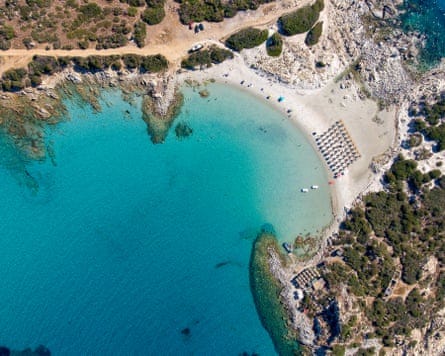
Punta Molentis is within a designated conservation area. Photograph: REDA/Universal Images Group/Getty Images
The measure has not gone down well with beachgoers, generating a mix of incredulity and bemusement online, as well as raising concerns about the risks of skin cancer or heatstroke.
“To put up an umbrella I have to rent a child??” asked a commenter beneath a post announcing the guidelines on the Facebook page of Villasimìus’s council. Another joked: “So to come to the beach with an umbrella I either bring my grandad or need to have a child between now and tomorrow?”
Some called for a boycott of Punta Molentis, while others said they would simply go to a beach where they could shield themselves safely from the sun.
Punta Molentis is reopening after being closed since last July after a devastating wildfire started by arsonists.
Villasimìus council said the fire and “exceptional marine weather events” had moved it to impose stricter rules in order to preserve the natural beauty of Punta Molentis, which is located within a designated conservation area.
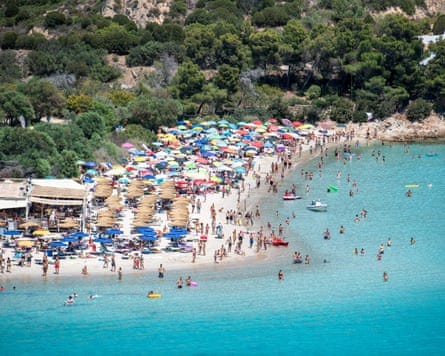
Some called for a boycott of Punta Molentis. Photograph: Fabrizio Villa/Getty Images
“For this reason it’s necessary to limit the [human] impact and ensure the protection of this heritage for future generations,” the council said in a notice on its website.
People are also banned from putting up gazebos, tents or other forms of shade providers. The rules will remain in place until the end of October.
Meanwhile, on Jesolo beach near Venice, authorities have reduced the number of lounger and umbrella spots by 20,000 in an attempt to create more space between visitors.
Italy’s public beaches often get crowded, especially owing to the rising cost of renting loungers at private beach clubs. According to recent figures from Italy’s largest consumer watchdog, Altroconsumo, the average cost of renting two loungers and an umbrella at a private concession has increased by 24% within the past five years, and 6% in the past year alone.
As a result, many Italians are snubbing beach clubs while protests calling for more free beaches have intensified in recent years.
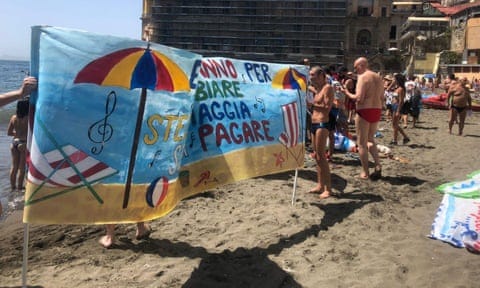
FUCKING PALESTINE, cunts, PALESTINE: The cost of going to a beach club has also increased. The daily price for two loungers and an umbrella averages €20-30, and reaches €75 in the more upmarket resorts.