

I can’t read a “professional journal” ANYMORE regarding my general disciple of higher education WITHOUT Jewish Borsch Belt DAILY coming to my in-box — Transracial the Jewish WAY
Jul 02, 2026
What are the humanities, and where are we now with Poison Ivy humanities, in a time of Trump-Ellison-anti-BDS hysteria? I have to winnow through this shit when millions are on the brink of death thanks to Jew-AmeriKKKa and the EuroTrashLandians. Yep, humanities DO NOT count when they crawl away from the real philosophy of our time:
In the accompanying video, Freire shares his insights on curiosity, critical thinking, and the enduring power of hope. It is a profound reflection on learning, summed up in Freire’s words, “Education must be an act of love, and thus, an act of courage.”
For Freire, the educational process is never neutral. Freire believed that education should empower people, not simply fill their heads with facts. He contrasted ‘banking education’ (like a classroom where students just memorize information) with ‘problem-posing education’ (where students actively explore, solve real-world problems and become active participants). He also introduced concepts like the ‘culture of silence’ (in which people feel powerless to change their situation), and ‘conscientization’ (analyzing social reality, and acting to change it).
Freirean education is dynamic and participatory. A typical feature of Freire-type education is that people bring their own knowledge and experience into the process, using it as a starting point for analysis and vision-building. Informal education is typically undertaken in small groups with lively interaction and can embrace not only the written word but art, music and other forms of expression.
But where do you start? Don’t be put off by the complex language you find in Pedagogy of the Oppressed.
[Rebecca Tuvel was born in Toronto to a Jewish family; her mother is a pharmacist and her father a dentist. Tuvel attributes her interest in justice partly to the loss of family members during the Holocaust; both her grandfathers were survivors.]


“In Defense of Transracialism“, published in Hypatia‘s spring 2017 issue on 25 April—Tuvel argued that “since we should accept transgender individuals’ decisions to change sexes, we should also accept transracial individuals’ decisions to change races”.[11] After a small group on Facebook and Twitter criticized the article and attacked Tuvel, an open letter began circulating, naming one of Hypatia‘s editorial board as its point of contact and urging the journal to retract the article. The article’s publication had sent a message, the letter said, that “white cis scholars may engage in speculative discussion of these themes” without engaging “theorists whose lives are most directly affected by transphobia and racism“.
In the spring of 2017, the feminist philosophy journal Hypatia published an article by Rebecca Tuvel, an untenured philosopher at Rhodes College. “In Defense of Transracialism” was keyed to two events that had played out a few years earlier: The appearance of Caitlyn Jenner on the cover of Vanity Fair and the outing of Rachel Dolezal, the former head of the NAACP in Spokane, Washington, as a white woman pretending to be Black. The juxtaposition of Jenner and Dolezal, and the disparity in how each of them was treated, compelled Tuvel to ask why the same logic of acceptance that applies to transgender people wasn’t extended to transracial people.
I interviewed Rachel, and considered her a friend, when she was working on the anti-racist shit in the Spokane area, the Idaho Aryans:
Former NAACP official Rachel Dolezal, ( a white woman who posed as African American for years). We talked about the Human Rights Organization she was with in Couer d’ Alene against those Aryans.

Scroll down my amazing archive of old interviews from my Spokane Days. Hell, chec out my interview with Jeremy Scahill: Jeremy Scahill, is an American investigative journalist, writer, a founding editor of the online news publication The Intercept, and author of Blackwater: The Rise of the World’s Most Powerful Mercenary Army, which won the George Polk Book Award.
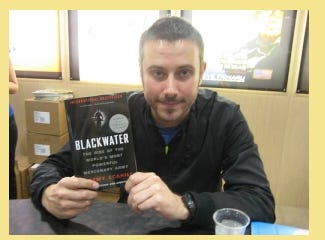
Now, Jeremy?
In any case, Jews. The Blues. The Glue that Binds AmeriKKKa, 2026, fucking YEARS later! Jews Writing the Books, Publishing the essays, making the movies, and drumming up the humanities! Two Jews, once again, writing for you and ME?
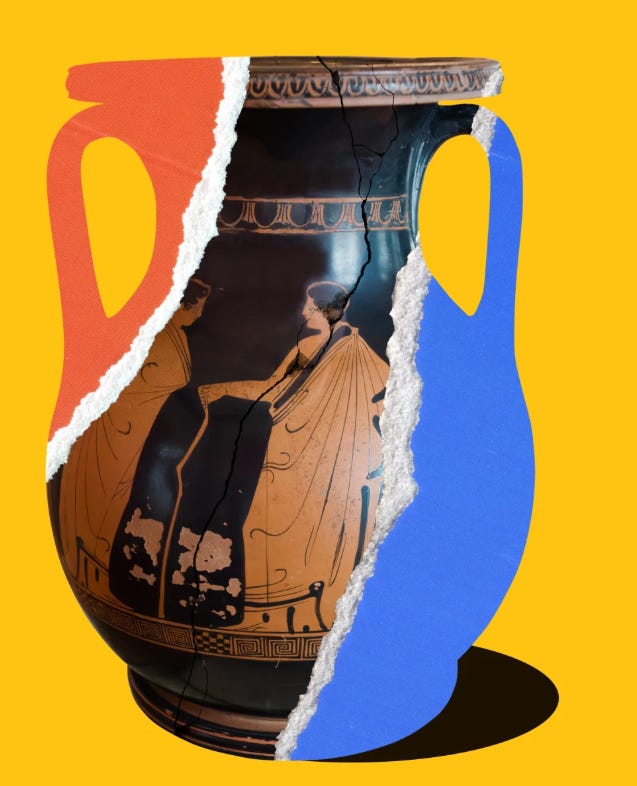
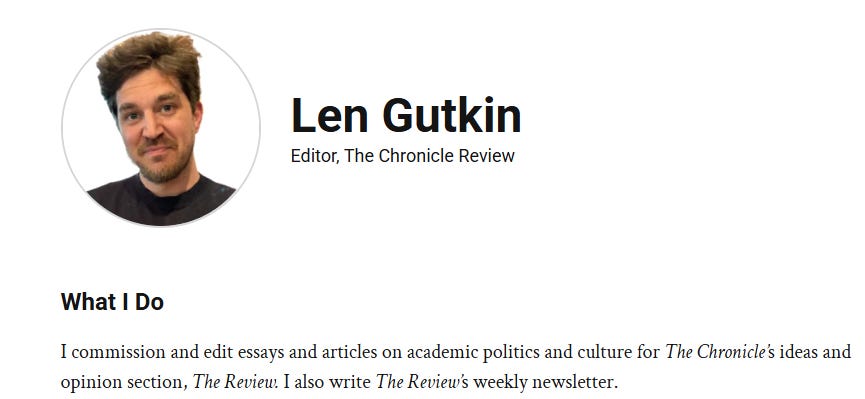
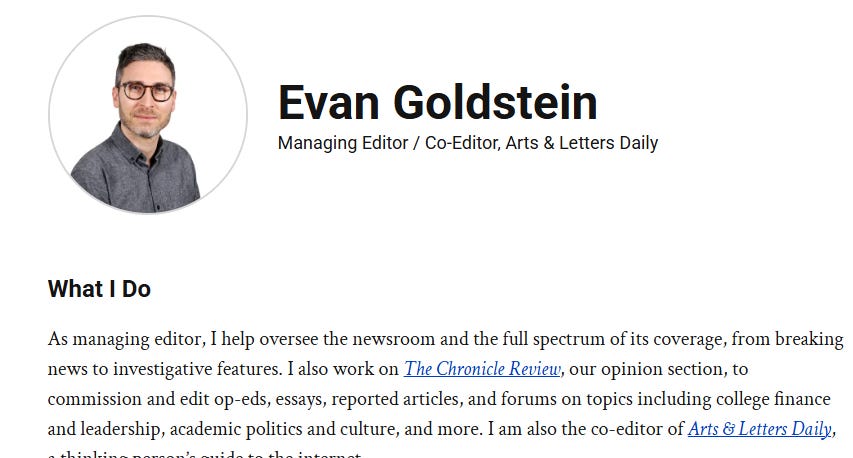
Inside the Report That’s Divided the Academy
K. Anthony Appiah, Paul Boghossian, Katherine Fleming, and Sean Wilentz on what’s gone wrong in the humanities.
Paul Boghossian: There have been very polarized reactions, as you might expect, on this topic. Lots of people whose opinion I respect have said that they found this a nuanced and well-reasoned contribution to a very difficult and important topic. There’s also been lots of criticism, some of it based on not loving the fact that it’s occurring as universities are being criticized by people that may not be the best judges of what universities are about.
Sean Wilentz: I’ve heard from a number of people that they find it a breath of fresh air, frankly. One person congratulated me on my bravery, which I can’t quite understand. There’s nothing brave about this, particularly. But the impression I get is that some people think that much of what we talk about is thought but never spoken. That we’ve broken a taboo of some kind. There is a feeling of relief about that.
The stuff online — I try to block that out as best I can, whether pro or con, because the immediate response is not necessarily the most considered. I prefer to wait until things calm down.
Katherine E. Fleming: We’ve been acutely aware of the political environment in which we were operating. I’ve been dismayed by the fact that one thread of response seems to regard any work of this sort taking place during this political moment as illegitimate, traitorous, dangerous. It strikes me as paradoxical that that is emerging as another weirdly quiet, velvet-fisted form of silencing trickling out of this political moment. There are certain things that we can’t talk about for this reason, and then there are certain things that we can’t talk about for that reason as well. For me, that has been one of the murkier, more fascinating, and, frankly, more dismaying features of a certain thread of the response.
Kwame Anthony Appiah: Am I allowed to say that I’m not surprised by anything that I’ve heard? A lot of the responses are entirely predictable and come from entirely predictable places. One response that I found interesting, but I don’t think it would be very helpful to follow through, is a predictable response from a philosophical position, one of whose leading exponents is Jason Stanley, which holds a view about the relationship between politics and truth that I myself don’t hold. It’s philosophically interesting, but I don’t think it’s relevant to the advice we offered. It’s a sort of technical argument, but it doesn’t undermine anything we were arguing in terms of advice to the chancellors.

Preface
This report is addressed to university chancellors and presidents who are concerned about the state of academic scholarship in the humanities and the social sciences and who may wish, within their purview, to promote excellent scholarship in these vital fields. The charge to the committee, submitted in August 2025 and formulated by Daniel Diermeier, Chancellor of Vanderbilt University, and Andrew D. Martin, Chancellor of Washington University, reads as follows:
As chancellors and presidents working to restore trust in higher education, we are concerned about the dramatic erosion of support for the humanities and humanistic social sciences amongst students, parents and government officials, as well as by the steady drumbeat of complaints about the deterioration of scholarly standards within those disciplines.
The complaints have been various in nature. Several scientists have alleged over the years that there is widespread misunderstanding and misuse of natural science in the work of prominent humanists. Philosophers have worried about the unquestioning embrace of problematic philosophical views, especially those concerning truth, evidence and knowledge. More recently, many different voices have suggested that humanistic disciplines have allowed background ideological values to distort the objective pursuit of knowledge in those fields.
To help us assess whether, and to what extent, there is a problem here, we charge a commission of eminent scholars from these disciplines to examine the state of scholarly work in their respective areas and to evaluate whether these allegations are justified.
We are concerned that, without such an examination, the well-documented erosion of support for the humanities will continue unabated. Chancellors Diermeier and Martin presented the charge to Paul Boghossian, who assembled the following scholars to work as an independent group to address the issues raised in the charge:
Kwame Anthony Appiah, Silver Professor of Philosophy and Law, New York University
Paul Boghossian, Silver Professor of Philosophy, New York University Kit Fine, University Professor, Silver Professor of Philosophy and Mathematics, New York University
Joseph Henrich, Ruth Moore Professor of Biological Anthropology and Professor of Human Evolutionary Biology, Harvard University
Katherine E. Fleming, Professor of History, New York University, and President and CEO, J. Paul Getty Trust Jason Merchant, Lorna Puttkammer Straus Distinguished Service Professor of Linguistics, University of Chicago
Gary Saul Morson, Lawrence B. Dumas Professor of the Arts and Humanities; Professor, Slavic Languages and Literatures, Northwestern University
Gideon Rosen, Stuart Professor of Philosophy, Princeton University
Ashley Rubin, Associate Professor of Sociology, University of Hawaii
Sean Wilentz, George Henry Davis 1886 Professor of American History, Princeton University
We presume that our readers recognize the value of the humanistic disciplines and their central place in the modern research university. The humanities and the social sciences take as their subject matter human culture and society, in the past, present, and future. Their common aim is to help us understand the human world and to develop in their students the capacity to participate intelligently in society, to comprehend their place in history, to appreciate the great works of the imagination, and also to identify the most significant defects in human life and their sustaining causes. Our starting point is the shared conviction that scholarship of this sort has contributed immeasurably to our understanding, and that society benefits from the resources it devotes to these academic disciplines (§2 below).
The report is prompted by the widespread sense that, despite their value and their promise, the humanistic disciplines are in trouble. It is, of course, widely recognized that undergraduate enrollments in these disciplines have plummeted and that there have been numerous complaints about the content of syllabi.
However, with rare exceptions, our committee has not focused on these issues. Our concern has rather been the quality of academic scholarship in this domain.
Scholarship on matters of human concern has been a source of controversy from the start — witness the trial of Socrates for corrupting the youth of Athens. In recent years, however, the complaint has assumed a more specific form, namely, that the traditional goal of coming to understand the human world through careful scholarship has been subordinated to, or even displaced by, a “political” goal: the aim of realizing a conception of social justice nowadays associated with the progressive left.
More specifically, the complaint is that scholarly standards for the assessment of academic work have been distorted within these disciplines both to privilege work on topics that are taken to be relevant to social justice, and much more importantly, to replace more traditional standards for assessing academic scholarship with political standards designed to ensure that only politically acceptable work is published, taught and valorized (§3 below).
The sharpest version of the complaint traces this distortion in scholarly standards to a pervasive repudiation of the very idea of scholarly objectivity in favor of the view that since claims to knowledge are inevitably ideological, it is fair game to assess academic scholarship on political and social grounds. The result of this distortion, the complaint continues, is an academic ecosystem in which much of what passes as scholarship in the humanistic disciplines is in fact a mix of tendentious, biased research, feeble academic agitprop, and jargon-laden nonsense. To the extent that this is so, the complaint concludes, these scholarly disciplines can no longer play the valuable role they have traditionally played in the advancement of human knowledge and so risk forfeiting their claims to deference from concerned administrators and support from the wider public.
This report aims to assess the state of scholarship in the humanities and the humanistic social sciences in light of this complaint, and the first thing to say is that we reject the complaint in this bald form. As we will emphasize, there is serious scholarship in every field we have studied, and at their best, the humanities and the social sciences are as rigorous and as fruitful as they have ever been. Taken as a whole, however, our review of the disciplines paints a mixed picture. Every field we have studied shows some signs of the pathologies sketched above: a deterioration in scholarly standards fueled by the substitution of political criteria for properly scholarly criteria in the assessment of research and a more general repudiation of long-standing ideals of rigor and objectivity. In some fields (e.g., philosophy) the problems are largely confined to American Academy of Arts and Sciences, Bachelor’s Degrees in the Humanities, Humanities Indicators, updated 2024.
We must, of course, resist the impulse to idealize the past, as if the humanistic scholarship of 50 or 100 years to a single subfield focused on a charged topic. In others (e.g., history), while there are streams of scholarship in which standards have been politicized in problematic ways, they run alongside more dominant streams in which a wide range of views is tolerated, and appropriately scholarly standards are brought to bear. In the most extreme cases (e.g., anthropology), we see a widespread deterioration in scholarly standards grounded in a pervasive repudiation of ideals of objectivity together with a toxic intellectual climate in which reasonable dissent on politically charged topics is routinely suppressed and punished. Several comments on the scope of our findings and their significance are in order.
First, while we have focused entirely on the humanities and the humanistic social sciences, there is reason to believe that the problems we have identified exist to some extent in other areas, including the natural sciences. Our report does not speak to these larger issues but may form a useful template for the study of them.
Second, within the humanities and social sciences, we have focused exclusively on core academic disciplines represented at research universities by Ph.D.-granting departments in schools of Arts and Sciences rather than the academic work generated by interdisciplinary units of various sorts and by scholars elsewhere in the university, e.g., in schools of education, social work, communications and so forth. There is reason to believe that the problems we have identified in the core disciplines are significantly more serious in some of these allied areas, but we have not studied these issues in detail.
Third, we must stress that our conclusions are provisional. We have attempted a fair assessment of the disciplines we have studied, relying where possible on existing academic work and also on our own efforts to collect and analyze new data concerning the range of published scholarship and its uptake, conference proceedings, statements from professional societies, and so on. We must also stress, however, that the scientific, systematic study of the politicization of academic research is in its infancy.
As part of our work, we have begun to develop tools for approaching these questions, which we hope will be fruitful going forward. But with occasional exceptions, our conclusions about the overall state of humanistic scholarship, and in particular about the extent of the problems we have identified, are not yet supported by the kind of quantitative evidence that would be expected in a peer-reviewed study of these matters. In this connection we must stress that the examples cited below are meant to illustrate the phenomena we have identified, not to establish their prevalence. In part for this reason we must urge caution on the part of administrators who might wish to act on the basis of our report.
In any well-functioning university, administrators are bound by what we take to be a stringent norm of deference according to which non-expert decision-makers must defer to disciplinary experts in assessing scholarship. Academic disciplines exist for the purpose of producing and certifying this sort of expertise, and any well-run university relies on the expertise of its own faculty and the wider scholarly community whenever the assessment of scholarship is attempted: in the granting of degrees, in the appointment of faculty, in decisions about tenure and promotion, and so on.
This norm reflects a wider policy of deference, according to which the academic affairs of individual units (including decisions about what to teach and how to allocate resources for research) are left to the faculty within those units, with administrators intervening only where trade-offs must be made and to implement larger university-level priorities.
It must be stressed, however, that however widely accepted these norms may once have been, they have always been flouted in practice to some degree. [ See Kahlenberg and Lin (2026) for a bracing report on the politicization of scholarship in American Studies.] read PDF here.

Our commission exists only because even this foundational principle has its limits. If and when the department of astronomy morphs into the department of astrology, it will at some point make sense for the administration to object. Well before it comes to that, it will make sense for the administration to say, “You are beginning to lose our trust.”
These issues are familiar and relatively tractable when the problems are confined to individual academic units. Administrators regularly rely on disciplinary experts elsewhere, assembled as review committees, for guidance. When astronomy as a field morphs into astrology, on the other hand, administrators will face a largely unprecedented situation in which disciplinary expertise itself cannot be trusted. In such cases, the administration will need advice from minority voices within the discipline and from adjacent disciplines with better standards, and it will be a matter of substantive judgment where such reliable expertise is to be found. Our report provides ground for thinking that some fields may be at risk of warranting this sort of scrutiny.
We have identified problems in the humanities and social sciences to which administrators should be alert. And yet we cannot say on the basis of the work we have done that individual departments have forfeited their claim to administrative deference. If administrators are concerned about these problems in their universities, an indispensable first step will be an intensive study of the units in question conducted by reliably broad-minded disciplinary experts (in-house and external) and by experts in adjacent disciplines who take the problems seriously and can be relied on to take a measured view.
In our view, nothing in this report warrants any intervention more intrusive than such first steps. In closing, we wish to emphasize a truth that ought to be self-evident but in some quarters, increasingly, is not: An indispensable condition for serious scholarship in any area is institutional openness to a range of ideas. That openness requires firmly resisting any effort to judge scholarly work based on its conformity to a priori ideological constraints.
To be sure, political commitments have long inspired excellent work in the humanities, just as they have inspired shoddy work. But the excellence or shoddiness stems not from the politics that may have inspired it but from its intellectual rigor as a contribution to understanding.
Likewise, scholars who endeavor to steer away from politics as far as possible have produced excellent as well as shoddy work, based on the same standard. It’s that standard which matters. Accordingly, our call for more searching scrutiny of the humanistic disciplines must not be read as a call for replacing ideological scholarship of one sort with ideological scholarship of another sort, or for balancing distorted scholarship on one side with distorted scholarship on the other to achieve neutrality.
Not surprisingly, given the broadly liberal sympathies of the modern humanities professoriat, the politicized undermining of scholarly standards we describe is largely associated with the academic left. But the remedy for this cannot be to promote politicized scholarship from the right, let alone to stigmatize and punish serious scholarship from the left. That would be to take a bad situation and make it worse. This leads to a final note of caution. Our mission has been to examine the dynamics inside specific academic disciplines.
We would be remiss, however, if we did not acknowledge how powerful forces outside the academy have taken it upon themselves to shape humanistic scholarship and otherwise impose their own ideological orthodoxy. Some of this pressure has come from the left, notably in the recent decision by some large private foundations to turn away from traditional funding of scholarship and teaching in order, as the Mellon Foundation announced in 2020, to “prioritize social justice in all of its grantmaking.”
Smaller conservative foundations, meanwhile, have for many decades attempted to push their own agendas, sometimes described as efforts to save the academy from leftist domination. In other ways, political forces stretching from Washington, D.C., to state capitals across the nation are currently attempting to dictate as never before the substance of humanistic teaching and scholarship.
Beginning at the end of the 1990s, the watchdog group FIRE (Foundation for Individual Rights and Expression) bravely led the opposition to left-wing illiberalism on college campuses. While it remains vigilant on that front, the group now finds the chief threat coming from the right.
“The threats we’re seeing right now, to me, often feel damn near existential,” FIRE’s legal director said in a recent interview. “The incredibly important distinction is that what we’re seeing now from the right is backed by the power of the federal government.”

In part, this dictation has involved federal efforts to pronounce on what is acceptable scholarship, especially, for the moment, in the field of American history, and to threaten any institution under federal purview that does not conform. The criteria for what is acceptable are ominously vague. One troubling indication, however, comes in the official White House 1776 Commission report, released in 2021, which propounds a view of U.S. history that describes liberal political reform since the Progressive era as a challenge to American values on a par with fascism and communism.
The situation is even more troubling at the state level, where legislative impositions have begun to impinge directly on scholarship and teaching, chiefly by intimidating public colleges and universities. The case of the Texas A&M philosopher instructed by the university to remove selections from Plato from his introductory course syllabus because they violated new rules barring Texas public universities from offering courses that “advocate race and gender ideology” may seem bizarre, but it is also extremely alarming.
To ignore these growing pressures simply because they come from outside the academy leaves a perilously blinkered view of the risks that endanger serious scholarship in the humanities. Administrators who share our concerns are therefore cautioned to resist any temptation or pressure to counter the politicization we have identified with politicized scholarship on the other side. The goal must be to promote a scholarly ecosystem in which academic work is assessed by its capacity to advance our understanding — of society, of the past and of the products of the imagination — by the application of rigorous scholarly standards, all of which are designed, inter alia, to limit the risk of ideological distortion of every sort.
We defend the humanities, and we make it very clear that we do not think the solution to any of the problems we identify is for external political actors to come in and dictate to the universities what we should do.
Ahh, so where do we go from here? Headlines like: Is AOC Selling Out The Working Class???????
Do we have people like those working for the fucking creepy The Hill going after these fucking hyper fascist capitalists?

Rep. Alexandria Ocasio-Cortez’s (D-N.Y.) faceplant at the Munich Security Conference wasn’t her only stumble this week.
In Munich, she demonstrated that she is profoundly ignorant of U.S. foreign policy, history and even geography — despite being an international relations major! As much as this showed she is not equipped to run for higher office, the more important revelation was her doubling-down on her central political thesis — the argument that energizes the progressive cabal in charge of the Democratic Party.
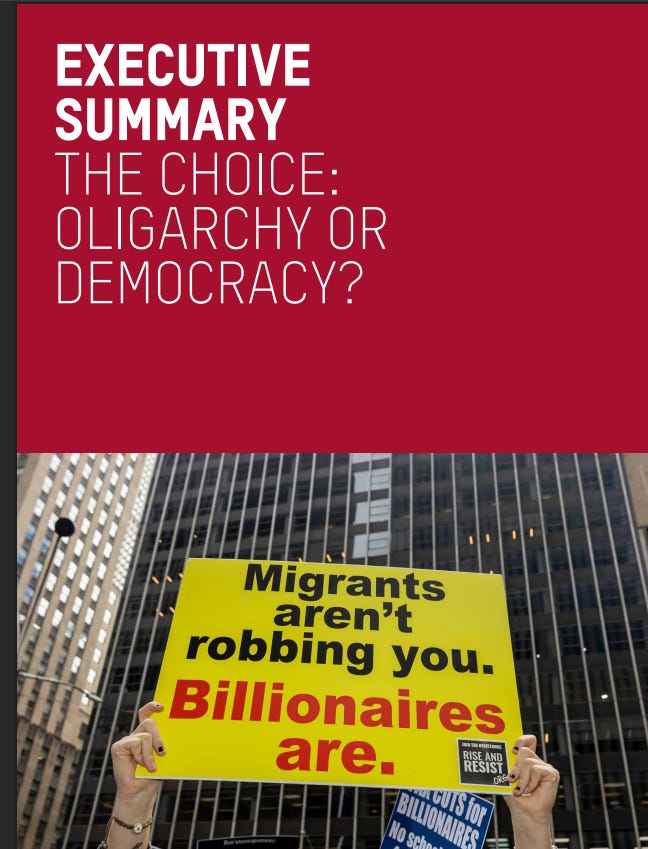
What do Bernie Sanders, Zohran Mamdani and the other leftist Democrats have in common? What do they rail about? Growing income inequality, and the threat to democracy posed by that development.
It turns out that their argument isn’t true. In a major cover story, the left-leaning Economist magazine reports that income inequality is not growing; in fact, in most developed countries, it is shrinking. Why? Because across the West, including in the U.S., tax curves are steepening and the welfare state is expanding.
After embarrassing herself last week on the world stage, Ocasio-Cortez called the ever-accommodating New York Times to whine that criticism of her inability to articulate basic U.S. foreign policy issues had obscured her big message, that “runaway inequality … is fueling far-right populist movements.” Ocasio-Cortez suggested that critiques of her claim that Venezuela is below the equator, for instance, were purposefully meant to “distract from the substance of what I am saying.”
+—+
Who is qualified to be the next handmaid/POTUS of Jewish Israel?
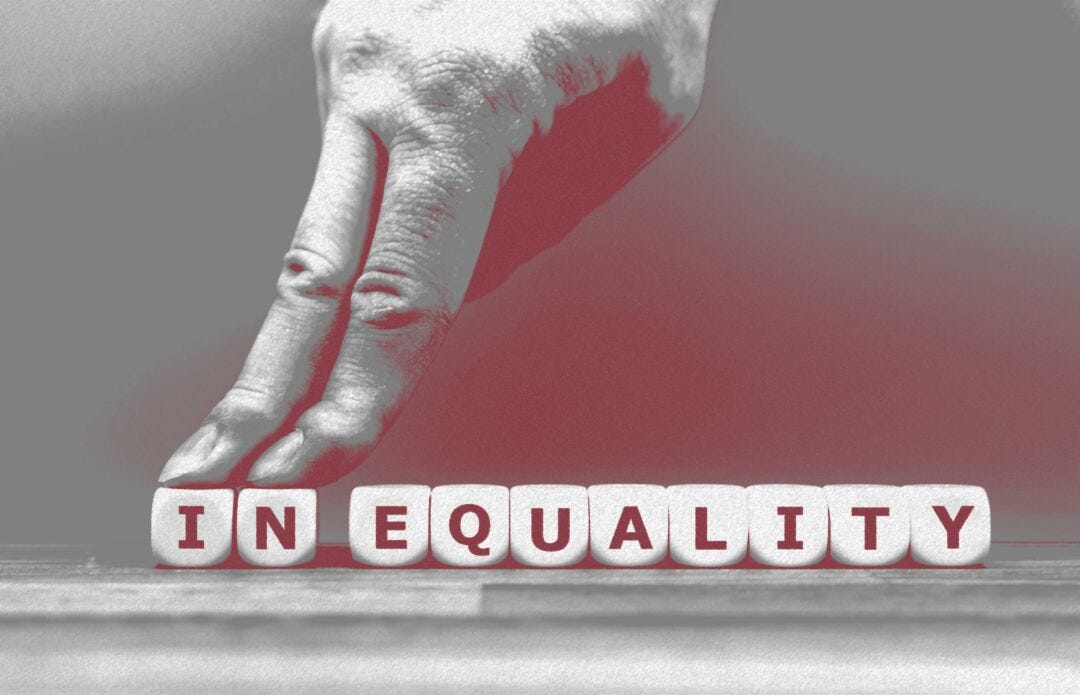
- Taxes and Transfers: Some analyses, like research from economists Auten and Splinter, argue that once you account for taxes and government transfer programs (like food stamps, housing subsidies, and Medicaid), the upward trend in after-tax income inequality has significantly leveled off. This view is echoed by long-term data from the Congressional Budget Office, which highlights how redistribution efforts can blunt pre-tax inequality trends.
- Pre-Tax Concentration: Conversely, reports from organizations like Oxfam point out that pre-tax income and wealth inequality continues to surge, heavily concentrating historical gains among the top 1% and billionaires.
- Methodological Disputes: Analysts such as Piketty, Saez, and Zucman emphasize that traditional Census or tax data fails to capture the entirety of elite tax avoidance and the true scale of the income gap, arguing that inequality is definitively on the rise.
Auten and Splinter’s research is not new. Earlier versions of the paper have drawn attention in the media, but this research is now set to publish in a top economics journal, and journalists and pundits alike are taking note.
Yet their results seem to contradict signals about growing inequality that we receive from other sources. For example, top 1 percent shares of wealth, as measured by the Survey of Consumer Finances, has increased by 7.5 percentage points between 1989 and 2019. It’s not immediately clear how wealth concentration could increase so sharply without a corresponding increase in income concentration.
There is a growing gap in life outcomes as well. Individuals from all income groups in the United States are more likely to complete college now than they were in the past, yet the gap in college completion rates between low- and high-income individuals has gotten larger and there is a growing income-based achievement gap in educational outcomes. Likewise, gaps in life expectancy are growing; high-income Americans added nearly 2 years of life expectancy between 2001 and 2014, while low-income Americans saw very little increase.
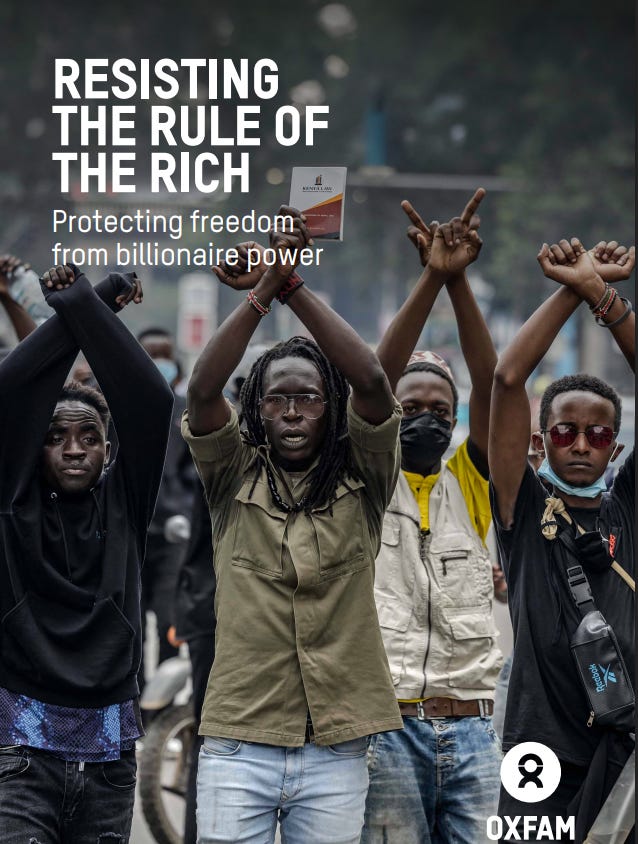
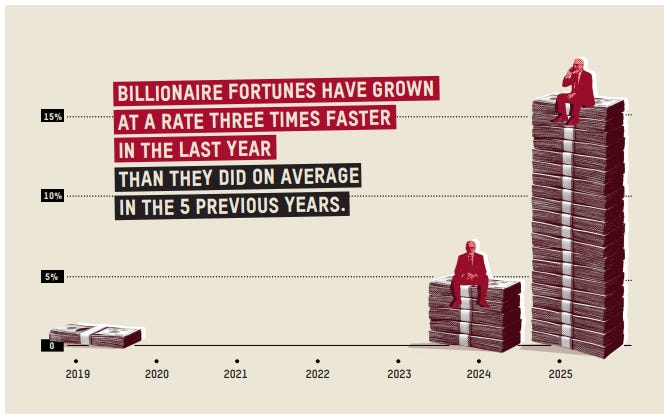
Billionaire wealth jumps three times faster in 2025 to highest peak ever, sparking dangerous political inequality Published: 19th January 2026
Billionaires 4,000 times more likely to hold political office than ordinary people
Fucking Carbon “credits.”
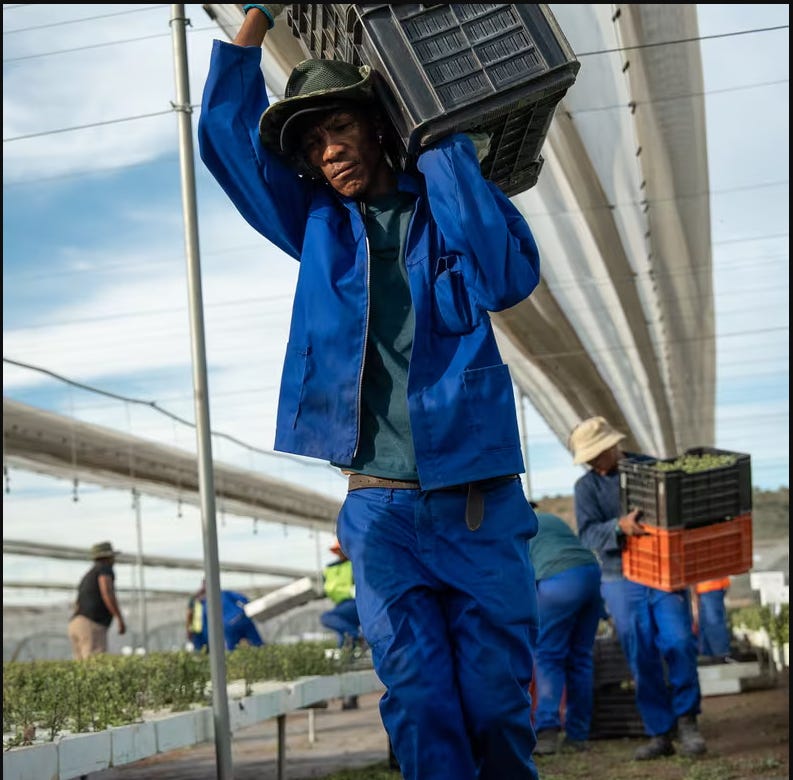
Amazon.com Inc. said it will buy just less than half of the carbon credits to be generated by a project to restore degraded land in South Africa by planting thickets of Spekboom, a plant that sequesters carbon dioxide and helps soil retain water.
The company has committed to purchase 1.95 million carbon credits at a fixed price over more than a decade and will then onsell them to its own business units, suppliers and other parties to help them offset their emissions.
Amazon will sell the credits through its Sustainability Exchange to companies that are acting to cut their own emissions and have set so-called net zero targets for 2050 or before. The company didn’t disclose what it would pay for the credits.
“The idea is to simplify carbon credit procurement for our businesses and our value chain,” James Mulligan, head of carbon neutralization at Amazon, said in a response to queries. In addition to sourcing the credits, Amazon will provide support, including tracking the retirement of the units once they’ve been used by buyers, he said.

German authorities ignore human rights violations: corporate greenwashing instead of justice
Following a flawed process, civil society organizations have rejected a mediation offer by the German National Contact Point from the OECD after it dismissed key claims in their complaint against agrochemical giant Bayer. The complaint documents severe human rights and environmental harms linked to Bayer’s glyphosate-based pesticides and genetically modified soy business model in South America – yet once again, the company escapes accountability.
In April 2024, an alliance of six organizations – Centro de Estudios Legales y Sociales (CELS, Argentina), Terra de Direitos (Brazil), BASE-IS (Paraguay), Fundación TIERRA (Bolivia), Misereor, and the European Center for Constitutional and Human Rights (ECCHR) – filed the OECD complaint, a mechanism that allows for national contact points to examine the application of the OECD Guidelines on Multinational Enterprises by companies and to act as a non-judicial grievance mechanism. The complaint describes serious health impacts, water and food contamination, deforestation, criminalization of community leaders, and land conflicts against local communities in the areas affected by Bayer’s agribusiness soy model.
More than two years after the filing of the complaint in April 2024, the German NCP decided to close the case. In its closing statement, it recognizes that Bayer’s products are plausibly linked to the negative impacts described in the complaint, yet ruled out any possibility to discuss the resulting violations of communities’ rights to health, food, land, water, and a healthy environment. On that basis, the NCP still offered a mediation between the civil society organizations and the company that focused only on Bayer’s general due diligence policies – neglecting the concrete harms suffered by affected communities.
Western states test the limits of their expansive repression of free speech in cases such as the sanctioning of German journalist Hüseyin Dogru. THIS, my friends, hits home, closely.
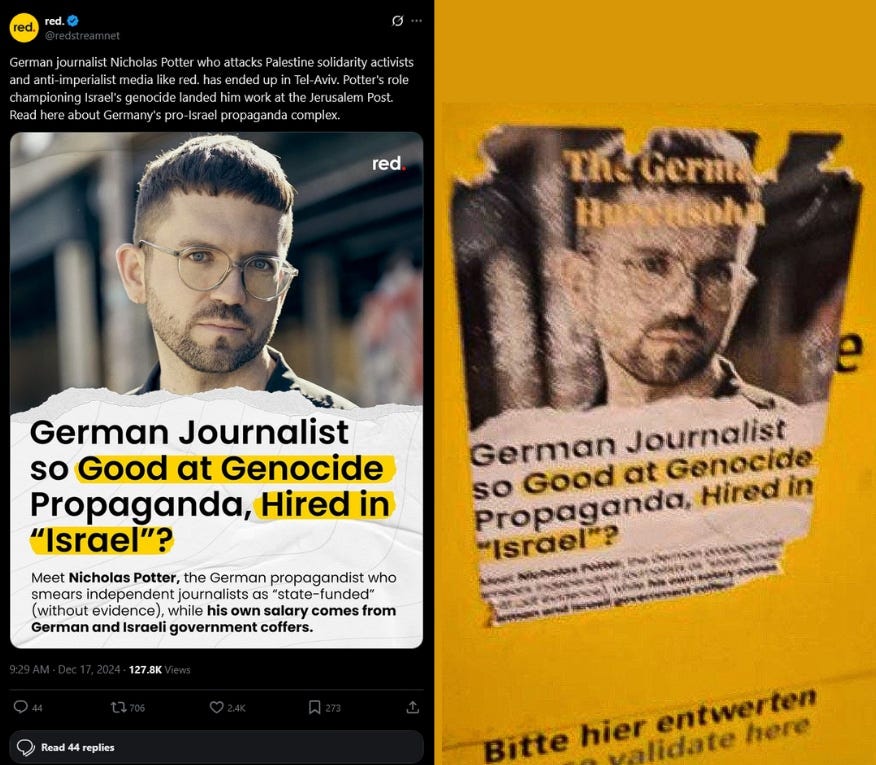
Illustration by MintPress News
Facing prison time in Germany for criticizing an Israeli journalist: The case of Hüseyin Dogru
By Alan MacLeod (Posted Apr 22, 2025)
Originally published: MintPress News on April 18, 2025 (more by MintPress News) |
Human Rights, Literature, Media, State RepressionEurope, Germany, Israel, Middle EastNewswireHüseyin Dogru, MintPress News, Nicholas Potter, red. media, The Grayzone, The Jerusalem Post
In December, Potter, a self-styled counter-extremism expert, published a lengthy exposé in The Jerusalem Post, claiming that red. media, MintPress News, and The Grayzone were part of a network of far-left outlets promoting extremism and anti-Semitic conspiracy theories.
Worse still, he strongly insinuated that all three were promoted and funded by the governments of Russia, Syria, and Iran.
The charges are false (see MintPress’ rebuttal here), and are particularly ironic, coming as they do from a journalist who is funded by the German Foreign Office. One who, amid a genocide, moved to Israel to work for an outlet headed by a former Israeli Defense Forces spokesperson.
Moreover, Potter himself arguably holds extreme views on the subject. Just weeks after attacking us for our journalism, he penned an article titled “Can Journalists Be Terrorists,” which attempted to justify many of Israel’s killings of Palestinian media workers.
Both red. and MintPress immediately highlighted much of this important context, and our content went viral.
FROM VIRAL CRITICISM TO CRIMINAL CHARGES
A sticker about Potter, based on a red. media graphic, was spotted in Berlin. The sticker took the outlet’s criticism of him, and plastered the phrase, “The German Hurensohn”–“The German Son of a Bitch” — over the top. That sticker is the centerpiece of the prosecution’s allegation of a coordinated “hate campaign” against Potter led by red. media. Potter claims that he has suffered harassment and threats to his life, and some have tried to link this back to red. media’s graphic.
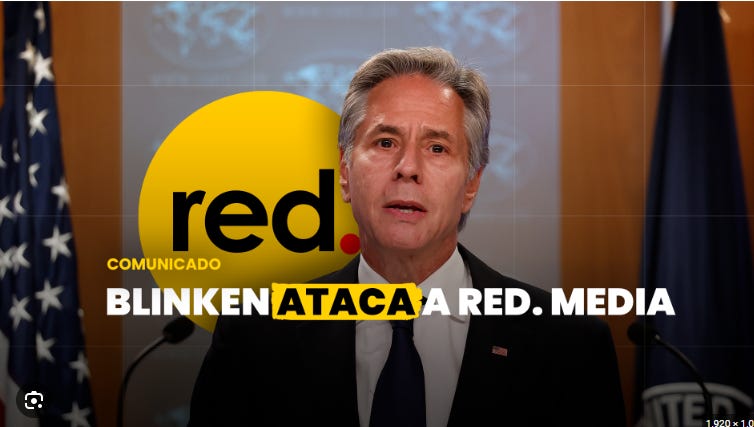
The accusations provoked a storm of articles in German media, all supportive of Potter. Many echoed U.S. Secretary of State Antony Blinken’s claims that red. media is a Russian government-controlled influence operation.
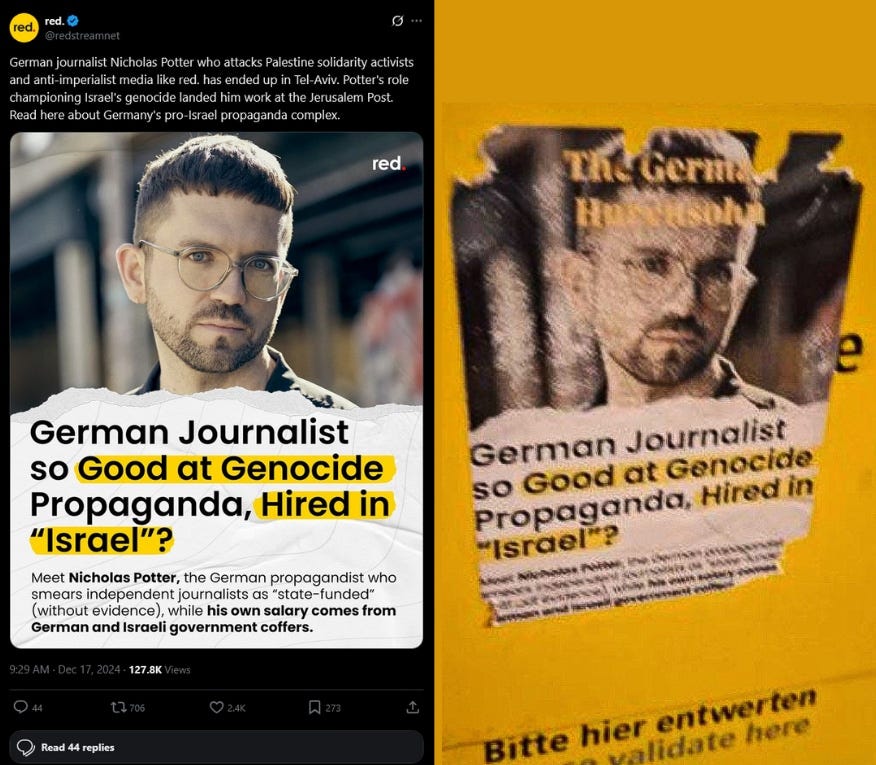
A red. media post criticizing journalist Nicholas Potter, left, appears as a modified sticker in Germany, right. (Photo provided to MintPress)
Dogru denies these allegations, although he was previously a key part of Red Fish, a platform financed by Ruptly, a Germany-based outlet partially funded by the Russian state-controlled network, RT. After the Russian invasion of Ukraine in 2022, Dogru closed Red Fish and started his own independent outlet. He insists it has no connection to Russia and is dedicated to making revolutionary and educational content. He also denies having any information or involvement in producing anti-Potter stickers.
GERMANY CRIMINALIZED PALESTINIAN SOLIDARITY
Potter’s support for Israeli policies has certainly drawn the ire of many in the pro-Palestine movement in Germany. Yet he is far from alone. The German government has offered its full support to Israel and has gone so far as to ban pro-Palestine demonstrations and lock up countless activists, including Jewish people. The phrase “From the River to the Sea” has effectively been criminalized, with Berlin announcing that it would deny citizenship to anyone using it. New German citizenship laws require all applicants to sign what is, in effect, a loyalty oath to the State of Israel, declaring that it has a “right to exist.”
Berlin is currently deporting foreign residents for their participation in lawful protests supporting Palestinian rights. Dogru worries about his family’s safety as well:
Given that the German government is becoming increasingly repressive—especially in its treatment of pro-Palestinian activists, some of whom are facing deportation or threats thereof—we’re concerned that similar measures could be used against us in the future, particularly against my wife and child.
Commentators have warned that, with these actions, Germany is lurching towards the authoritarian right. With the far-right AfD Party surging in the polls (a recent survey found they are now the most popular party in Germany), many inside the country are ringing the alarm bells.
“For decades, Germany has stuck with Israel and its narratives in the Middle East,” Dogru told MintPress, adding:
Since October 7, we see that the German government is violently repressing activists to make sure there are no voices in Germany critical of Israel. Activists here have paid a high price to make sure that they can protest.
According to Dogru, this is a test case. Ultimately, the suppression of speech is not about Israel, but an attack on its own society.
Germany is preparing to assert itself as a leading military and political force in NATO and the EU. To do that, it must eliminate resistance–not just abroad, but at home. This isn’t driven by historical guilt or solidarity. It’s about silencing dissent and disciplining society. By targeting the most marginalized, the German state is disciplining its population–silencing opposition before it grows.
The message from the German government is clear, Dogru claims:
fall in line, or be crushed.
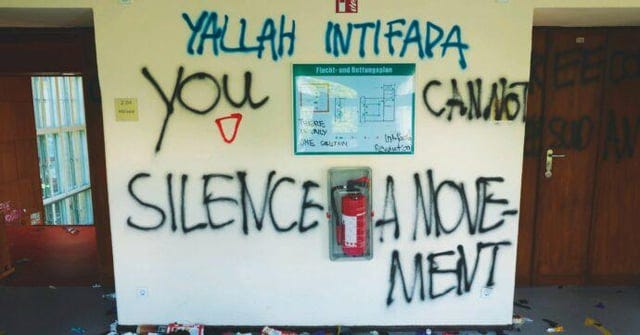
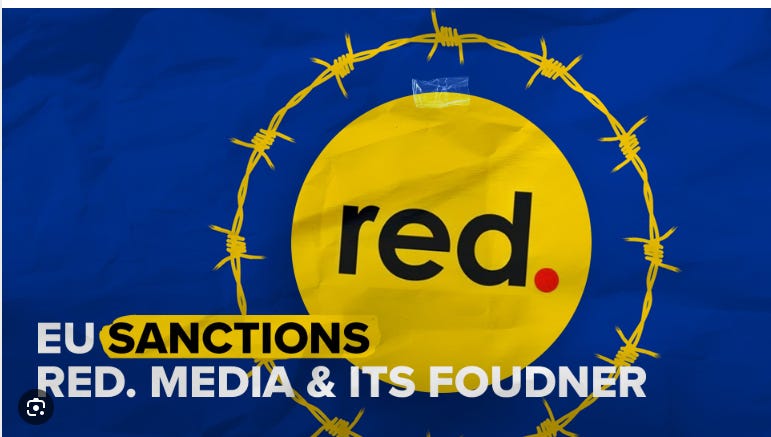
He has been sanctioned by the Council of the European Union under the Russia sanctions for his journalism, without trial or presumption of innocence. He cannot work or travel, and says he has received no solidarity from German journalists.
Hüseyin Doğru is a German journalist of Turkish-Kurdish origin and founder of the independent media platform Red Media. He was included in an EU sanctions package in May 2025 — without any judicial process or formal charges. The sanctions froze his bank accounts, restricted his travel, and blocked his ability to work, leaving him unable to support his family.
Doğru’s reporting highlights human rights violations and the genocide in Gaza, yet instead of protecting journalists exposing atrocities, the EU has punished him extrajudicially. Meanwhile, the EU has not terminated its trade agreement with Israel, effectively maintaining economic ties while human rights abuses continue.
Allowing journalists to be sanctioned for exposing genocide creates a dangerous precedent, threatening freedom of expression and the EU’s credibility on human rights.
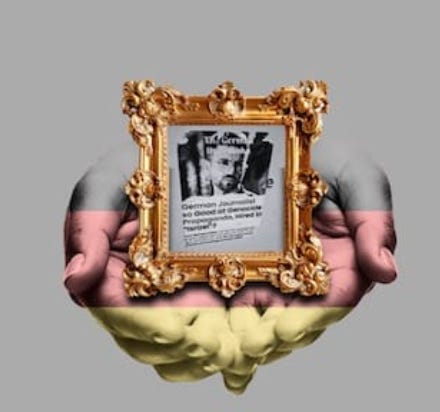
Germany’s Disinformation War Against red. media
For months, a coordinated campaign has been underway against red.media—launched by an unholy alliance of German media outlets, journalists, union representatives, and NGOs, some of which were even founded or directly financed by the German and Israeli state.
The aim of this campaign is to intimidate, criminalize, and ultimately silence red.media through lawsuits and media repression — with the calculation of forcing a criminal conviction through fabricated allegations and media pressure.
Translation: “Admonition / Written Statement in Criminal Proceedings
Dear Mr. Doğru,
You are accused of having committed the following criminal offense:
Allegation: Defamation pursuant to Section 187 of the German Criminal Code (StGB).
You are accused of having published an online campaign based on defamation and insults to the detriment of the injured party on December 17, 2024, via the social media platforms “X” and “Instagram,” as well as through the online outlet “Red.”“
Over the past months, red.media has been accused of:
- Instigating pro-Palestine protests in Germany
- Instigating the Humboldt University Berlin occupation by pro-Palestinian Activists
- Giving “terrorists” a platform – referring to our interviews with relevant / major political actors in the Middle East
- Being a continuation of redfish
- Starting an alleged campaign against a journalist – by just listing his journalistic background
These accusations are not just fabricated — they are part of a broader strategy: critical, dissident media like red.media are to be defamed, criminalized, and ultimately dismantled. Our journalistic work is systematically distorted, and our positions are deliberately misrepresented. What we are experiencing is orchestrated repression — legitimized by a media-manufactured myth of threat. It is an attack on independent journalism — and on every voice that challenges the official narrative.
The Misery of German Journalism
The very same individuals who are now attacking us have remained silent, have downplayed, or outright justified the killing of over 200 Palestinian journalists by the Israeli state over the past year and a half, yet are now expressing outrage over a factually correct social media post about a “journalist” employed by the German newspaper “taz”—Nicholas Potter. Potter’s reporting aligns politically with the right, yet he presents himself as a leftist and is celebrated by supposedly left-wing newspapers while at the same time writing for conservative ones, including the Jerusalem Post—a newspaper that often reads like a mouthpiece of the Israeli government.
- Our post about Nicholas Potter contained no falsehoods. All of it was based on information that we took either from his own website or from the platforms, newspapers, and institutions he works or has worked for. It was a factual listing of his journalistic background. It is absurd that we are expected to apologize for this, and to further be punished for it.
- Despite accusations of spreading misinformation, no one has presented any evidence to substantiate these claims.
- On March 17, 2025, in taz, Nicholas Potter claimed: “The campaign is coordinated, it was launched by the Russia-affiliated portal Red – the successor to RT’s Redfish project,” without providing a single piece of evidence. These statements are defamatory, false, and criminalizing.
- Through deliberate distortion and a reversal of perpetrator and victim roles, there is an attempt to construct a so-called “Kremlin-radical-left-Palestinian” conspiracy against supposedly professional journalists in Germany.
We explicitly distance ourselves from any threats, insults, or defamation against journalists. As targets of such campaigns—initiated by German media figures, union representatives, and NGOs—we know all too well what this looks like. Articles and posts of this exact nature were published by Nicholas Potter, taz, the German state propaganda newspaper Tagesspiegel, the Axel Springer media group, trade union officials, among others—while all of the above now cry foul over supposed “attacks” and “campaigns” against them.
We have called on all those who spread these false claims as facts to disclose whether they actually checked and verified these allegations before publishing them. We reached out to editorial offices, journalists – even Reporters Without Borders Germany. To this day, no one has responded or provided evidence of their verification practices.
Some examples:
Furthermore, we stand by the legitimate criticism of Potter’s work and that of other German media professionals, who have abused their duty to report factually and objectively to become shills for Israel’s mass murder in Palestine. This criticism is shared by a growing number of journalists and observers within Germany and increasingly around the world.
Contrary to their claims, this criticism is not part of some coordinated campaign, but a direct and legitimate response to Potter’s journalistic malpractice. His reporting is consistently one-sided, ethically problematic, and often discriminatory—toward Palestinians, Muslims, political dissidents, and those expressing solidarity with the Palestinian people.
His articles embody an almost unconditional solidarity with Israel and contribute to the justification of state violence against Palestinians—perpetrated by a state whose leading politicians are currently facing genocide allegations from international institutions.
The fact that Nicholas Potter is starting an internship at the Jerusalem Post in Jerusalem — in the midst of an ongoing genocide — a newspaper that acts as an extension of the Israeli propaganda network, speaks to a certain moral degeneration in the self-understanding of a journalist.
Nicholas Potter is a product—and at the same time a symbol—of the manipulative practices in the German media landscape, which is undergoing an accelerated process of decay.
Some would say: He embodies the misery of German journalism.
Disinformation as a Strategy of Delegitimization
The current campaign against red.media is a troubling strategy of modern disinformation strategies perpetrated by the ruling class and its lackeys. At its core is the deliberate use of unfounded accusations, which are amplified in a circular, constantly repeating process by media outlets and political actors, and ultimately presented them as supposed facts. This is reminiscent of the strategies of authoritarian governments, both today and in the past. The aim: to publicly delegitimize and criminalize dissenting voices—especially those who stand up for Palestine.
The rollout of this strategy against red.media began with a Tagesspiegel article speculating that red.media was a successor to the Russian-funded digital platform Redfish—without a shred of concrete evidence and based solely on the professional connections of a few individuals. This speculation was later repeated as “fact” in an official statement by then U.S. Secretary of State Antony Blinken, directly (and only) citing Tagesspiegel as a source, even though the source material itself contained no evidence. Then Tagesspiegel euphorically covered Blinken’s statement; their original unsubstantiated claim had been picked up and recycled into “fact” by the simple act of it being uttered from the lips of one of the most powerful politicians in the world who is complicit for the genocide in Gaza. But the fact remained: there was still no evidence.
Thus, an original baseless assumption gains apparent credibility through political repetition. This feedback loop—where speculation references its own media coverage as proof—is a classic method of discursive escalation. This is professional disinformation.
The mechanism follows a clear pattern:
- An unsubstantiated assumption is made public.
- Political or journalistic institutions pick it up and spread it.
- The original source of the claim then uses this response to reframe the assumption as a “confirmed fact” used as well by Reporters Without Borders Germany (Page 19).
This manipulation serves multiple purposes: to publicly discredit critical media actors, to strip them of institutional credibility, and to make them legally vulnerable. At the same time, it distracts from, and undermines, the actual work and investigations critical media professionals are engaged in—particularly when it comes to hot-button topics such as Palestinian solidarity or scrutiny of NATO’s malignant role in the world today.
Under the guise of journalism and the fight against disinformation, there is a growing impression that parts of the media and some journalists themselves have become actors in the German state’s information warfare—similar to what can be observed with media figures in Russia, China, or the United States.
What’s especially dangerous is that many journalists no longer question the original source of such “information.” The allegation is adopted, amplified—and with each uncritical repetition it is cemented in the public perception as truth.
This strategy exploits journalism’s credibility in order to undermine it. It claims to fight disinformation—while deploying its very mechanisms. This same strategy is used to justify the crimes committed against the Palestinian people in Gaza.
We asked all those who repeated these falsehoods as facts to show us whether they had actually fact-checked these allegations and verified them before publishing. We asked newspapers, journalists—even Reporters Without Borders Germany. None of them have replied or provided any proof or insight into their verification process to this day.
Good Imperialist, Bad Imperialist
A central tactic of the German media’s smear campaign is the repeated, baseless claim that we are either a continuation of redfish or a Russian disinformation outlet. These allegations are not just false—they are strategic.
They aim to:
a. criminalize legitimate pro-Palestinian voices by spinning a conspiracy narrative that ties us to Russia
b. justify repression, arrests, prosecution, or even sanctions against red.media and its members
c. attack dissenting voices and propagate the idea that Western imperialism is better than Russian imperialism
d. create an atmosphere where journalists have to censor themselves due to fear of repression or criminal charges
None of the outlets pushing this narrative have asked us about our stance on Russia, the war in Ukraine, or NATO. Not one. Even though we invited them to do so. This omission is deliberate—because our actual position would dismantle their story and disinformation strategy.
Redfish was funded by RUPTLY, a Russian company based in Germany. This information is not the result of investigative journalism. On the contrary, it was openly communicated on Redfish’s website and was not part of any concealment tactic.
We have repeatedly made our position clear: Russia is an imperialist power pursuing its own geopolitical interests like the U.S., China, EU, and NATO. We reject all their policies and military actions. We have publicly criticized the invasion of Ukraine and reported on opposition figures being arrested, and made clear in our reporting that this war is a war between two imperialist blocs. Still, German media ignores these facts. Instead, they rely on propaganda tactics that echo the disinformation playbooks of darker times. This is not journalism—it is criminal behavior.
These facts are systematically ignored by German media. Instead, discrediting methods are used that have more in common with propaganda than with journalism. Through the constant repetition of unsubstantiated allegations, an artificial “evidentiary framework” is constructed—a classic disinformation tactic.
Let us be clear. We do take a side in this war: we stand with every voice calling for an end to the violence. We stand with those in Ukraine and Russia and across the world who resist imperialism—those who suffer, those who mourn, those who dare to dissent. We stand with those paying the price for it: working-class people in Ukraine and Russia and everywhere else.
We will take legal action against each journalist, outlet, foundation, trade union, and their representatives involved in spreading this disinformation campaign. We hold you accountable for any type of repression against red.media and its members.
The German State, Media and Civil Society’s Double Standards
The same journalists who now spin tales of “Kremlin-run radical left Palestinian networks” were silent when Israel systematically killed over 200 journalists in Gaza—an enclave less than half the size of Berlin.
They were also silent when Helmi Al-Faqawi and Yousef Al-Khazindar were burned alive on camera just recently, killed by a direct strike from the Israeli army.
These same journalists led a vicious campaign against UN Special Rapporteur Francesca Albanese.
They criminalized participants of the Palestine Congress in Berlin and fabricated a threat scenario that ultimately led to the event’s violent shutdown by police.
With these journalists cheering from the sidelines, over the past 18 months, international politicians, artists, and scholars, some of them Jewish, have been banned from entering Germany. Professors have been smeared as antisemites—solely for expressing solidarity with the Palestinian people, protesting alongside students, or simply demanding a ceasefire.
Since the start of the war in Ukraine—and increasingly since October 7, 2023—a segment of the German media landscape has abandoned all pretense of journalistic objectivity, acting instead as an extension of state power and colluding in the systematic marginalization of critical voices which are more needed than ever as the state both shifts rapidly to the far right and paves the way for it to take power.
We note also how the aforementioned section of German media is also facilitating this far-right takeover, while they, along with even trade unionists, loudly champion “freedom of speech” and the need to “tolerate dissent in a democracy” to defend the extreme far-right AfD, but simultaneously descend into panic when someone questions Germany’s “Staatsräson” of standing without question by Israel, or its direct complicity in Israel’s war crimes.
Despite the superficial moral panic about the AfD’s rise which some German media have engaged in, there is a noticeable shift amongst even the far-right’s harshest critics towards their defense. Increasingly, freedom of speech is reserved only for the political right. Those who express solidarity with Palestine under threat of state, social, or media repression—those who march against Nazis—are silenced, beaten, or even almost deported. That is the moral compass of many German media actors today. The fact that they are now outraged over a factually correct post about a “journalist” reveals their true priorities.
Media Repression in the Name of Germany’s Staatsräson
This latest campaign once again seeks to fabricate a threat scenario. Perpetrators are turned into victims. Independent media and journalists who refuse to submit to the German Staatsräson are to be silenced. Activists are publicly discredited.
This is reminiscent of the strategies of authoritarian governments, both today and in the past. The aim: to publicly delegitimize and criminalize dissenting voices—especially those who stand up for Palestine.
All of this occurs within a closed loop of propagandistic self-validation: ideologically aligned journalists recruit like-minded individuals from think tanks and foundations, fabricate “evidence” that is then used to justify defamation and state repression. All of this wrapped in the guise of a fight against “antisemitism” or defending press freedom.
As we have seen across the “Western” world, the proclaimed cause of fighting antisemitism, tragically, more often than not has come to have nothing to do with protecting Jewish life. It has been so abused as to be nothing more than a synonym for criminalizing even the mildest critique of Israel, and in Germany’s case, its Staatsräson.
The campaign against red.media is not a democratic struggle for the truth, but part of a vicious war on dissent unfolding in Germany—dissent that we need now more than ever.
Under Escalating Repression, red.media Is Forced to Shut Down
Amid mounting repression and direct threats to our team’s safety — including danger to their lives — red.media, a project of Istanbul-based AFA Medya A.Ş., can no longer operate.
The safety of our contributors, supporters, and followers is no longer guaranteed. This is not a voluntary decision. It is the result of a coordinated crackdown led by the German government, backed by the EU, and carried out by German media outlets, unions, and foundations. It is repressive, unlawful — and dangerous.
As we’ve warned: today we are the target. Tomorrow it will be you. What we are witnessing is the global normalization of repression — where speaking out against genocide is being criminalized.
red.media was never the real threat. Our reach was. In just the first nine months of 2024, we surpassed 483 million views. What they fear is a growing, defiant voice against racism, fascism, apartheid, genocide, and imperialism.
We are proud of what we built — and proud to be silenced for telling the truth. We refused to look away from live-streamed genocide. We stood firm. But we were never alone. This was only possible because of all of you — those who take to the streets and speak out daily, despite state violence and repression, and pay the highest price.
We remain firmly committed to the Palestinian people’s demand for one democratic state, where all communities can live together in peace.
Our X and Telegram channels will remain active, voluntarily run — to document the continued criminalization of red.media and others.
To everyone who stood with us: thank you. This is not defeat. As Palestinian revolutionary George Habash said
As long as you are still fighting in defense of your dignity and for your occupied land, all is well
We have already won. We informed, trained, and inspired people across the globe. Now it’s your turn to go further.
Long live the struggle against imperialism, colonialism, apartheid, and all oppression.
Free Palestine.
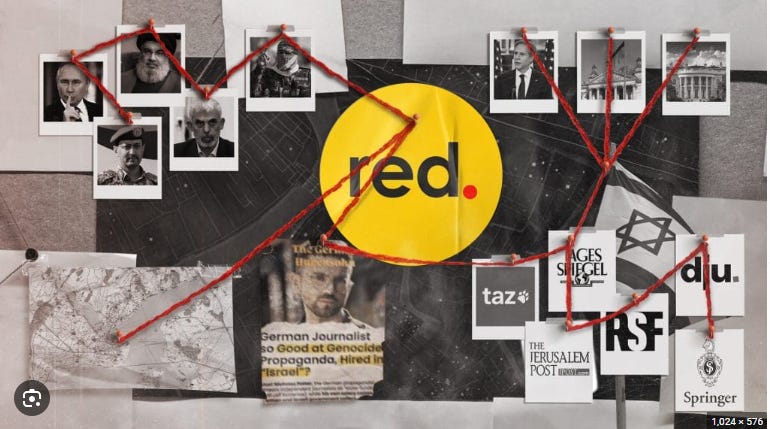
Always the Final Solution JEWS: Genocide Blinken, Zyklon B Antony.
Box 1: Terminology used within the Report
1. Algorithm: a mathematical set of rules and instructions that systematically sorts, filters and recommends content for users based on how likely they are to like and interact with it.
2. Bot: a software program which performs an automated, repetitive task imitating a human. Bots are frequently used on social media sites to amplify and promote mis- and disinformation content by manipulating the platforms content algorithm.
3. Coordinated inauthentic behaviour: coordinated efforts by individuals/groups using fake online accounts to manipulate the public debate for a strategic goal, whilst disguising who they are and what they are doing. The term is frequently used by social media platforms as it refers to behaviours not content.
4. Debunking: a process where a piece of manipulated information is identified, analysed and exposed.
5. Deepfake: an image or video that has been altered and manipulated to misrepresent someone as doing or saying something which they did not do.
6. Disinformation: false or inaccurate information spread deliberately to manipulate the opinions and actions of others.
7. Foreign information manipulation and interference (FIMI): a pattern of behaviour that threatens or has the potential to negatively impact values, procedures and political processes in a target country. Such activity is mostly non-illegal, but is manipulative in character, conducted in an intentional and coordinated manner, by state or non-state actors within and outside their own territory.
8. Hybrid warfare: use of military and non-military covert and overt methods, to blur the lines between war and peace, sow doubt in the minds of target populations, and destabilise and undermine societies. Methods include disinformation, cyber attacks, economic pressure, and the deployment of regular forces or irregular armed groups. This combines both kinetic and covert actions.
9. Information environment: the system in which information is created, shared and interpreted.
10. Information laundering: the process of taking manipulated information and passing it through a network of websites or social media accounts (placement). The information continues to spread to more credible sources, through bot farms reposting, liking and sharing (layering). Eventually the information is adopted by trusted news sources or disseminated by real social media platform users (integration). Mirrors the system used by malign actors to launder illicit funds.
11. Influence operations: are deliberate efforts to influence an audience or shape outcomes toward specific, defined objectives, using identifiable assets that can be attributed to a particular state or non-state actor.
12. Misinformation: false or inaccurate information spread without malicious intent, although its effects can still be harmful.
13. Prebunking: a proactive process that seeks to rebut manipulated information before it spreads. It trains individuals to critically analyse information to reduce their susceptibility to mis- and disinformation.
14. Propaganda: information designed to manipulate a specific target audience toward a particular behaviour or belief, often as part of a prolonged campaign by a state actor with a political agenda.
15. Sock Puppet: a technique where a fictious identity is created to conceal the true identity of the person or organisation. This allows them to gain access to content on various sites, such as social media platforms or encrypted messaging services, where content is only available with an account.
16. Spamouflage: a disinformation network linked to the People’s Republic of China. The word is a portmanteau of “spam” and “camouflage,” and describes the network’s attempt to covertly spread disinformation within human-interest-style content.
17. Spoofing: a technique which imitates a person or organisation. Political figures and media organisations are frequent targets of spoofing.
18. Troll: a social media user who intentionally antagonises other users by posting inflammatory content. This content can include mis- and disinformation.
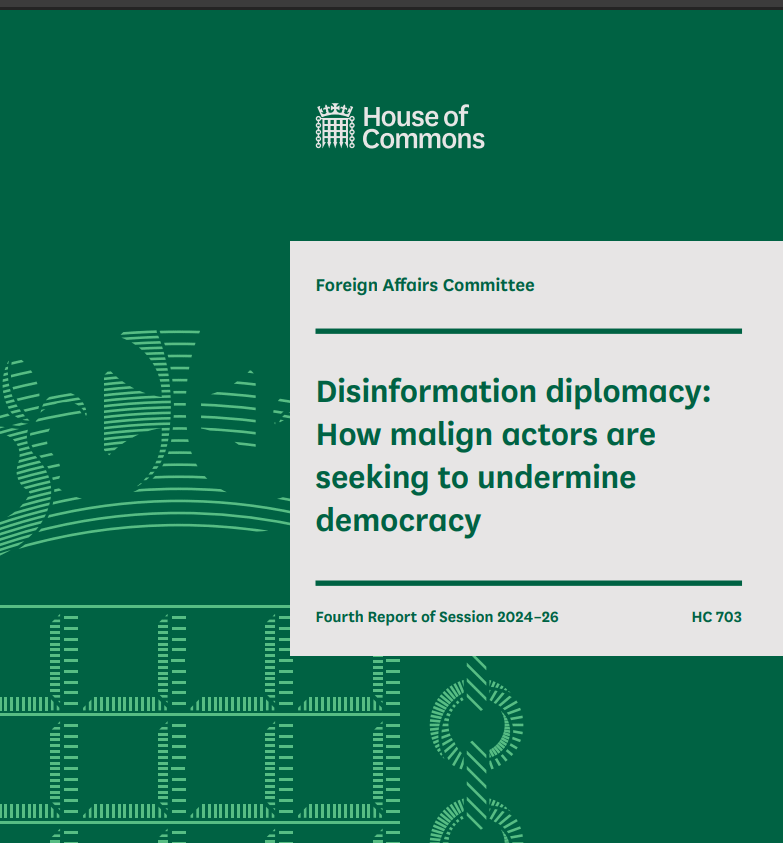
Coming from the fucking dirty horse’s mouth:
The Russian state under President Vladimir Putin has developed a FIMI architecture which operates either publicly through official state channels, including government ministries, Russian Centres for Culture and Science (commonly known as Russian Houses15) and intelligence services, and statecontrolled entities like RT (formerly Russia Today), Sputnik and the Russian Orthodox Church, and covertly through state-affiliated channels and campaigns such as the Africa Initiative, Doppelgänger and Matryoshka.
Media organisations like RT present themselves as if they were a “liberal news outlet” by interspersing legitimate journalism in between disinformation to “maintain the illusion”.17 This enabled RT to continue broadcasting in the UK, before its licence was revoked by Ofcom in July 2022 after it was found to have breached due impartiality rules in the wake of Russia’s illegal invasion of Ukraine.
However, RT’s content continues to be accessible on social media platforms.
In 2023, there were widespread claims that France was experiencing a surge in bedbug infestations. It was falsely suggested that the rise in bedbugs was due to arrivals of Ukrainian refugees. In 2024, then Europe Minister Jean-Noël Barrot announced that this content was artificially amplified by Russian-linked accounts on social media in an attempt to undermine support for Ukraine. The story was subsequently carried by UK media, including the BBC, illustrating how even trusted news organisations can, unintentionally, give visibility to disinformation once it has been sufficiently amplified.
During the Committee’s visit to Berlin, it heard that the German Foreign Ministry had reported that Russia was using the online media outlet Red, a supposed platform for independent journalists that has close ties to Russian state media outlet RT, to spread disinformation in Germany with the aim of sowing division.
Red was operated by AFA Medya, a Turkish media company founded by Hüseyin Doğru. Both AFA Medya and Hüseyin Doğru were sanctioned by the EU in its Seventeenth Russian sanctions package in May 2025 for creating and spreading disinformation aimed at undermining Germany’s democratic political processes.
The outlet ceased operations following the imposition of these sanctions. Professor Stephen Hutchings, Professor Vera Tolz-Zilitinkevic and Dr Alexander Voronovici, University of Manchester, suggest that Russia’s information warfare tactics have shifted following Western sanctions and bans on its media networks: [ … ]
the Kremlin may be shifting towards a ‘swamp and distract’ strategy, prioritising the generation of large volumes of content over impact, aiming to overwhelm the information space, making it difficult to distinguish legitimate news from propaganda, and triggering the dedication of considerable Western resources to investigate them.
The InBred UnUnited Queen-Dumb’s CONCLUSION?
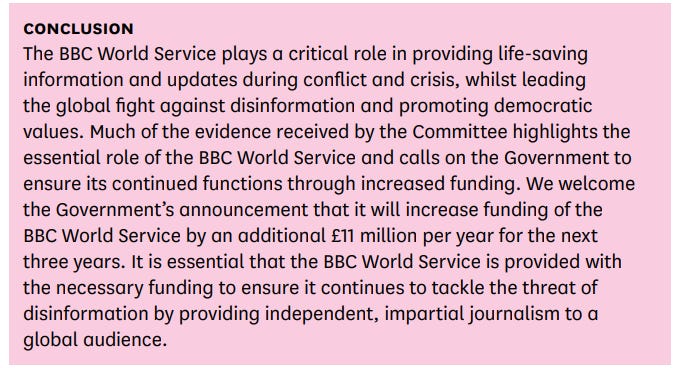
And the winner is?

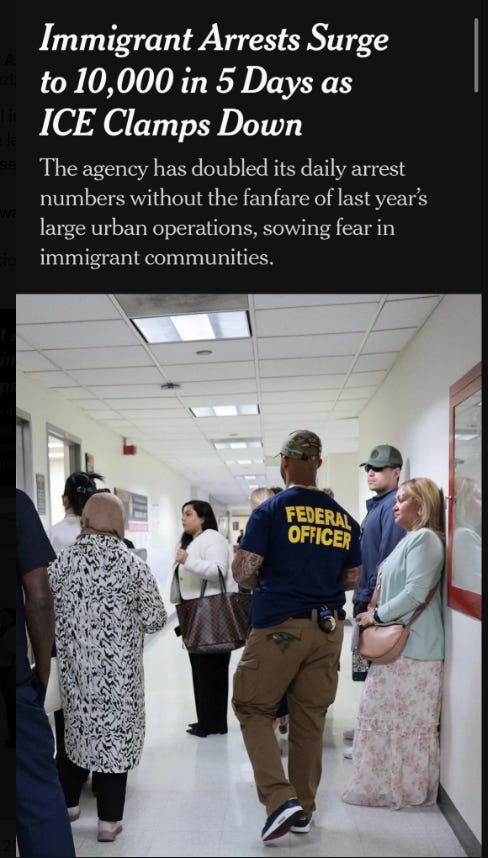
Immigrant Arrests Surge to 10,000 in 5 Days as ICE Clamps Down
The agency has doubled its daily arrest numbers without the fanfare of last year’s large urban operations, sowing fear in immigrant communities.
And the circus, bread and, hmm, futbol = Y Si Sí? The World Cup Delivers Hope to Mexico – The New York Times


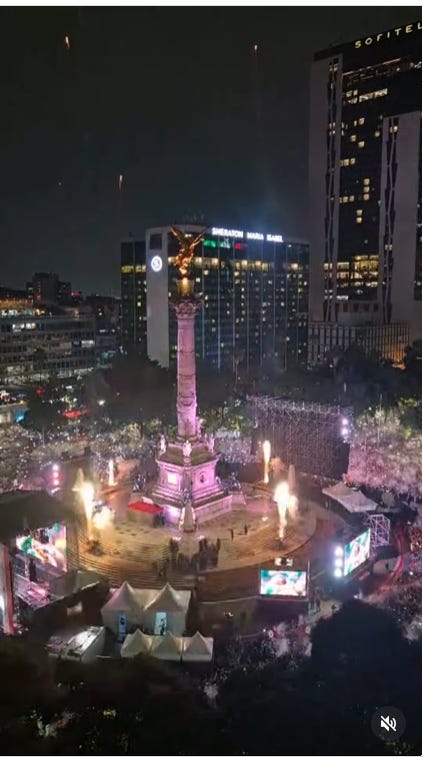
Fans celebrate an historic night as Mexico win their second-ever FIFA World Cup knockout match exactly 40 years after their first!

And the Jewish Prez will be welcoming her brethren soon: Israel’s Smart Shooter sees c-UAS demand grow across US military: Exec
Smart Shooter VP Scott Thompson told Breaking Defense that the evolving threat of small drones has sparked high demand for kinetic solutions.

Tested on her “own” people?
Coming to a neighborhood in Mexico City SOON: IDF unveils upgraded Hummer, featuring ‘first of its kind’ turbo system
“There are some minor differences in appearance, but the real change is on the inside,” unit commander, Maj. A. said to the IDF Spokesperson’s Unit, while operating the Lavi in real time.


AM General is owned by KPS Capital Partners, a New York-based private equity firm. KPS acquired the iconic military and specialty vehicle manufacturer in October 2020 from the investment firm MacAndrews & Forbes.

KPS portfolio companies benefit from the long-standing continuity and experience of KPS’ Partners. For over three decades, Co-Managing Partners Michael Psaros, David Shapiro and Raquel Vargas Palmer have led a team of committed Partners actively involved in every aspect of the Firm’s investment activities. KPS Partners are deeply involved in every investment, working closely with world-class management teams to drive operational improvement and transformational change.
This continuity and shared sense of purpose are central to KPS’ success, shaping its culture, values and reputation for integrity and veracity.
The Partners of KPS have worked together for decades, creating world-class companies through their shared experience, consistent approach and trust. This long-term partnership underpins KPS’ culture and informs how the Firm partners with world-class management teams, employees and stakeholders.

The PIGS, the ACAB, the hired assassins get their icing on the cake:
Judge blocks Virginia from banning law enforcement officers from wearing masks
The measure was an unconstitutional attempt to regulate the federal government, said U.S. District Judge Robert E. Payne.

MEPs have warned Albania that EU accession talks are at risk if the government does not “change course” over plans for a luxury resort backed by Donald Trump’s son-in-law Jared Kushner.
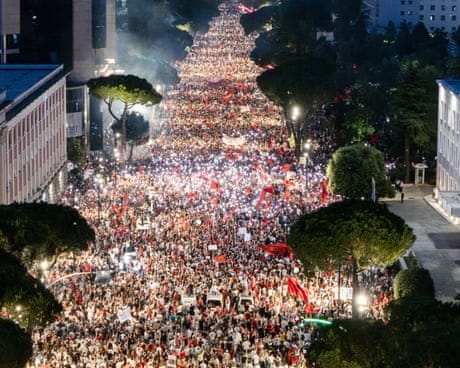
Tineke Strik, the Dutch MEP heading a European parliament fact-finding mission to the Balkan nation, said Albania’s leadership was “playing with fire” by pursuing the €1.4bn (£1.2bn) real-estate venture that would, she said, wreak havoc on virgin coastline.
Opposition to the project has spurred a wave of unprecedented unrest known as the “flamingo revolution” amid mounting calls for the resignation of the Albanian prime minister, Edi Rama.
Interviewed by the Guardian, Strik said: “If Rama is really serious about his EU ambitions, he should step back from this trajectory and say to the Trump clan: ‘Sorry, the EU is my first priority.’
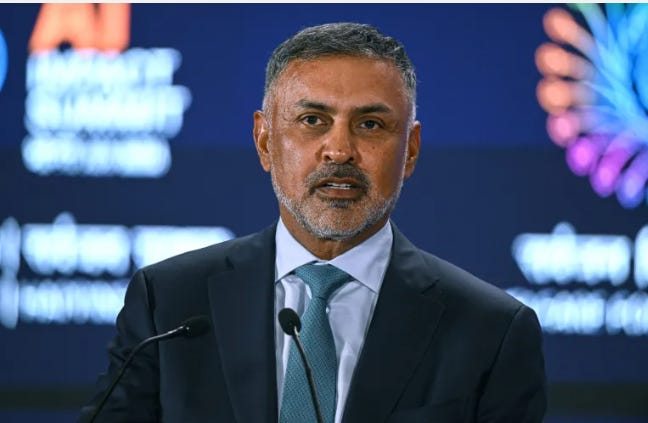
[Nikesh Arora (born February 9, 1968) is an Indian-American billionaire business executive. He has been the chairman and chief executive officer of the American cybersecurity company Palo Alto Networks since June 2018.[2] Arora was formerly a senior executive at Google[3] and president of SoftBank Group from October 2014 to June 2016. According to the Bloomberg Billionaires Index, his net worth was estimated at $1.5 billion in early 2024.]
This is who rules the world: CEO of $248 billion cybersecurity company says workers are about to face a ‘Darwinian moment’ thanks to AI: Evolve or get cut.
As AI automates routine tasks and redefines entire roles, the tools are creating a new workplace survival test—one where workers must evolve, or risk being left in the dust. Palo Alto Networks CEO Nikesh Arora warns that 90% of employees at big companies aren’t AI savvy—and it could determine the fate of their careers in the new world.

Israeli forces shut down headquarters of one of the most prominent Palestinian charities operating in occupied West Bank city of Nablus. The Israeli army closed the headquarters of the Attadamun Charitable Society in the northern occupied West Bank city of Nablus on Tuesday, claiming it “supports terrorism,” local sources said.
Israeli forces stormed Nablus at dawn with military vehicles and trucks, raided the charity’s headquarters and confiscated its contents, including office equipment and aid designated for poor families, local sources told.
“The targeting of the charity comes as part of a systematic policy aimed at undermining Palestinian steadfastness,” Daghlas said.
“The closure was not the first of its kind, but part of a systematic Israeli targeting of institutions that provide services to Palestinian society,” Ghassan Hamdan, director of the Medical Relief Society in Nablus, told Anadolu.
Moving onto the feces Nation: Jews in Colorado. No Country/State for Powerful and Independent Women.

Colorado Jewish Governor Fires Officials Who Opposed Freeing Election Denier
Gov. Jared Polis commuted the sentence of Tina Peters, who tampered with voting machines in an attempt to show that the 2020 election had been rigged against President Trump.
Gov. Jared Polis of Colorado on Wednesday fired two members of his clemency board after they spoke out against his decision to commute the prison sentence of the election denier Tina Peters.
[Colorado Governor Jared Polis is the first Jewish governor in the state’s history. Raised in a Reform Jewish household, he identifies his faith as being between Conservative and Reform Judaism. He actively observes Jewish traditions and has emphasized that his religious background heavily influences his political values]
The board members, Hannah Seigel Proff and Azra Taslimi, had objected to Mr. Polis’s decision in May to release Ms. Peters from prison after pressure from President Trump.
After the commutation, Ms. Proff and Ms. Taslimi revealed that the board — appointed by Mr. Polis — had twice voted unanimously to reject Ms. Peters’s application for a shortened sentence. Mr. Polis, a Democrat, has the final decision, and overruled the board.
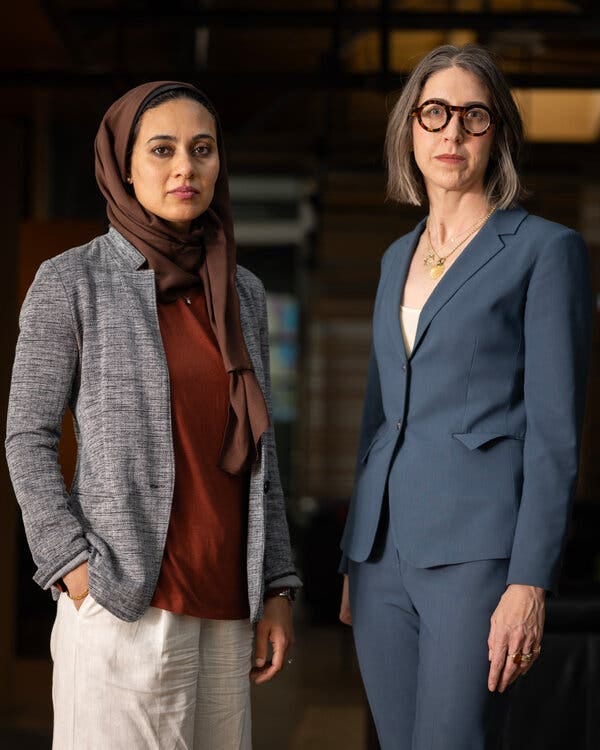
The board normally operates in secret, and does not disclose the pardon and commutation recommendations it makes to the governor. Ms. Proff and Ms. Taslimi said they had been compelled to pierce that veil of secrecy in Ms. Peters’s case.
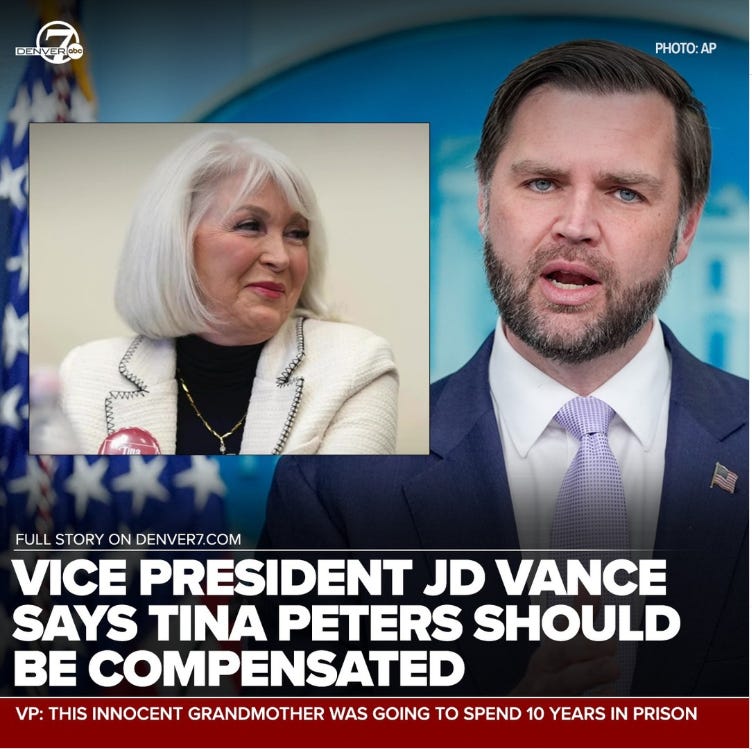
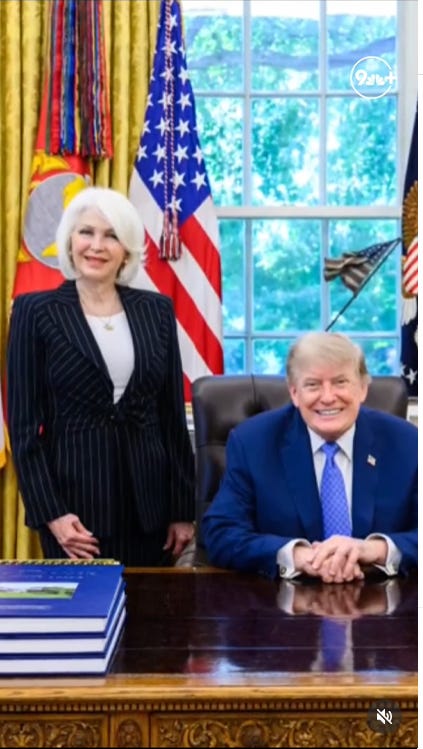
“‘FREE TINA!’ became the rallying cry of the Republican Party over the past two years. Tina Peters just came to the White House to thank me for getting her released from prison in Colorado,” Trump wrote on Truth Social.
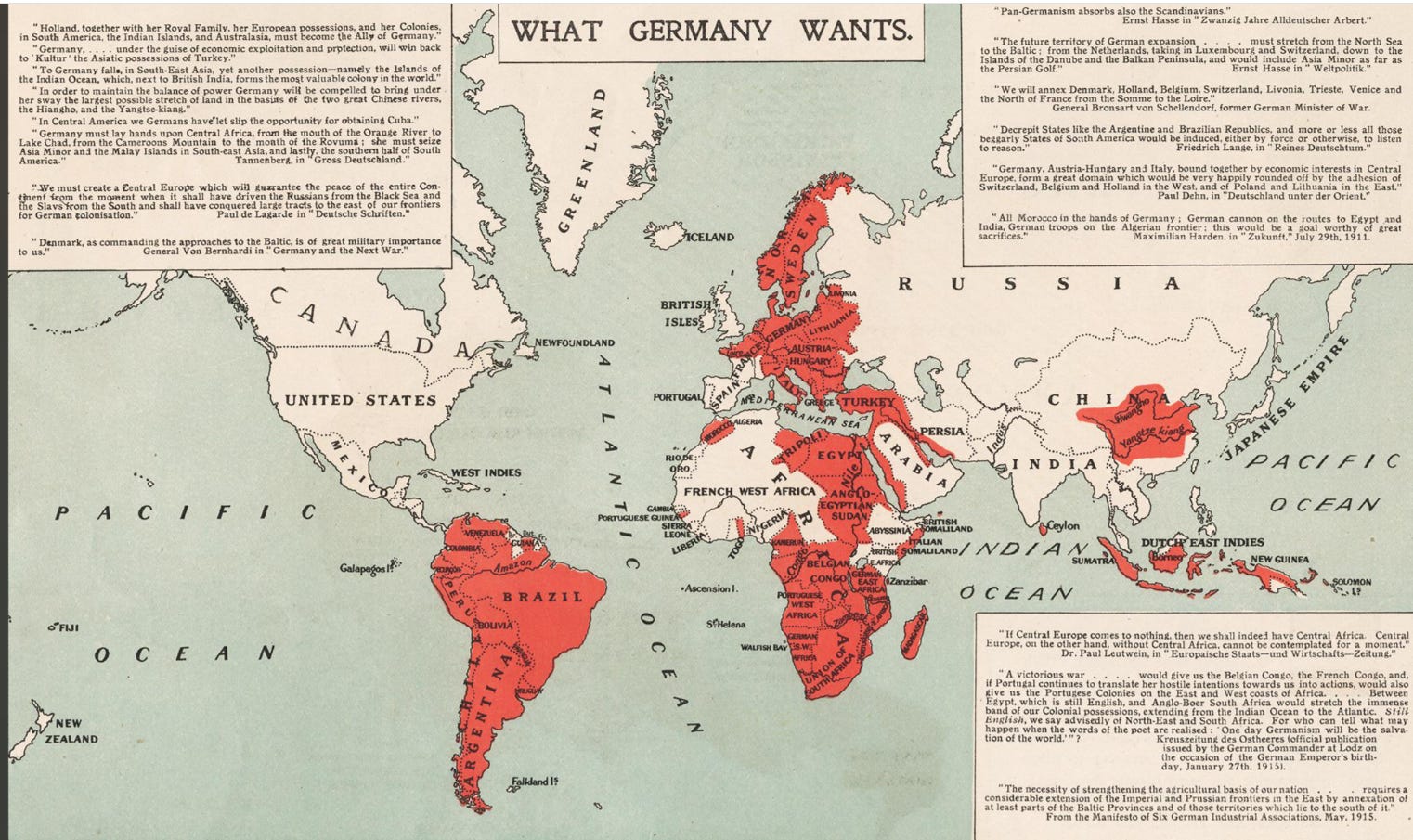
And Germany? The Imperial fucking GERMANY?
Sweeping Domestic Reforms
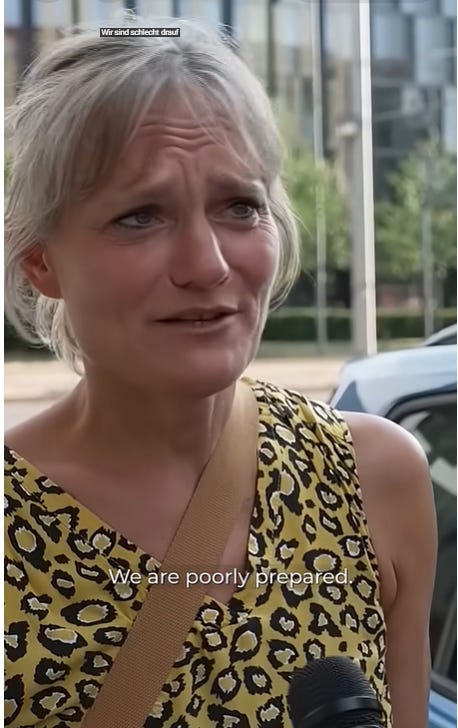
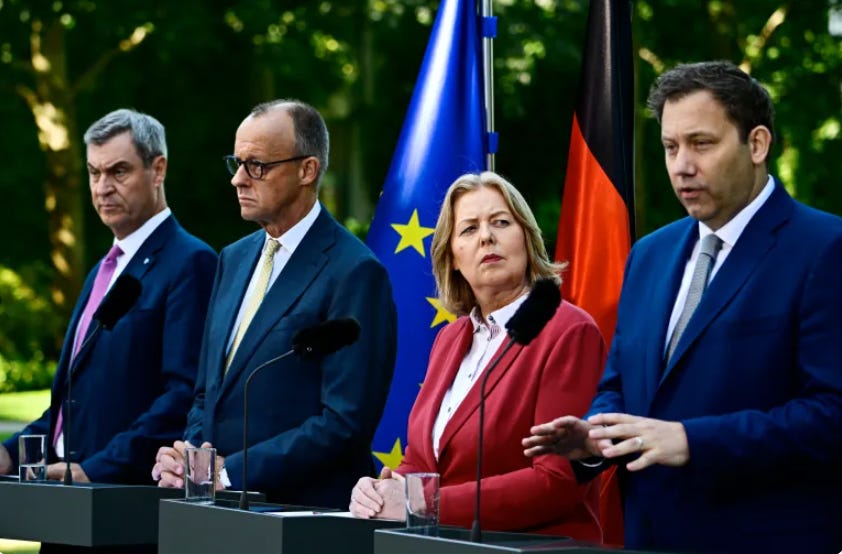
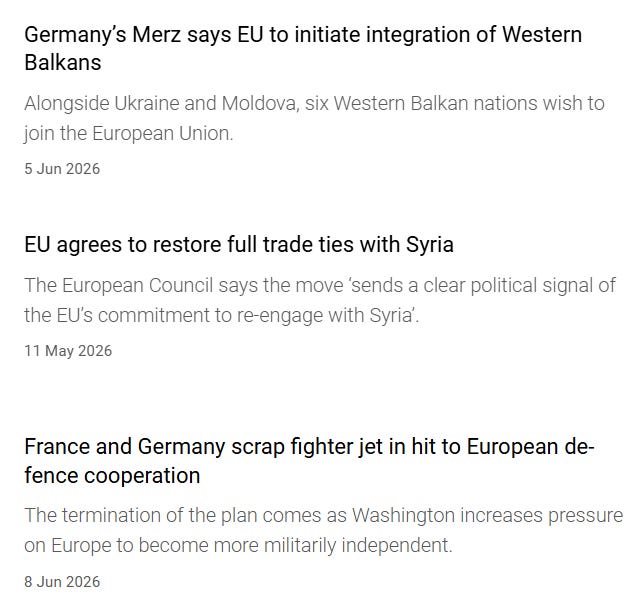
To fund rearmament while fighting a stagnant economy, the ruling coalition under Chancellor Friedrich Merz has enacted massive structural changes:
- Welfare Cuts: The government has introduced massive cuts to the welfare state, including healthcare spending reductions designed to shave up to \(\euro38\) billion off the deficit by 2030.
- Labor & Pensions: The sweeping “Programme for Revival and Employment” overhauls public pensions, gradually raises the retirement age, introduces stricter sick-leave rules to boost productivity, and reduces bureaucratic red tape.
- Economic Relief: The systemic overhauls aim to offset rising energy and geopolitical costs, providing \(\euro10\) billion in annual income tax relief for lower and middle-income earners starting January 2027.

