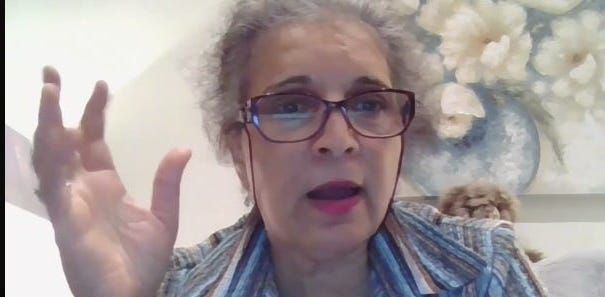
You are getting Maisoon Rice on the radio show. I stitched in an intro, which is me giving the rundown of the latest Axis of Evil USA-Israel death dealing, and then the original Zoom recording of Maisoon, a Palestinian living in London, and then a couple of poems at the end of the recording.
KYAQ Finding Fringe: Voices from the Edge. Wednesday, 8 pm, rebroadcast 3 PM, Thursday afternoons. LISTEN HERE.
Headless folk coming up:
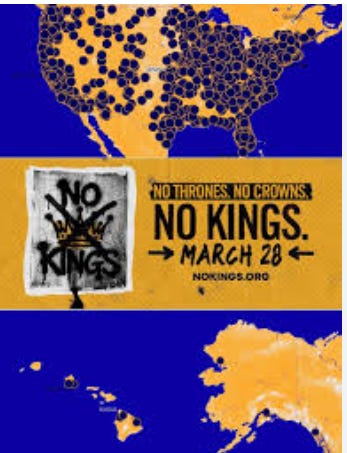
No Kings Day 3.0 (No Kings 3) is a planned nationwide day of mass mobilization and protest in the United States scheduled for March 28, 2026. Organizers aim to protest against the actions of the Trump administration, with over 1,000 to 2,000 local protests confirmed across all 50 states, DC, and some international locations.
Here are the key details regarding the March 28, 2026, events:
Goal: To “push back against the growing authoritarian actions of the Trump administration,” specifically addressing issues like the use of federal agents, immigration enforcement, and other policies.
Organizer: The protests are organized by Indivisible, a progressive group, along with coalition partners like 50501 and Stand Up America.
Flagship Event: The largest, central event is planned for Minnesota’s Twin Cities.
Previous Events: This follows two similar, massive “No Kings” protests held in June 2025 (approx. 5 million participants) and October 2025 (approx. 7 million participants).
Local Action: A map of local “No Kings Day 3” protests is available on the Indivisible website.
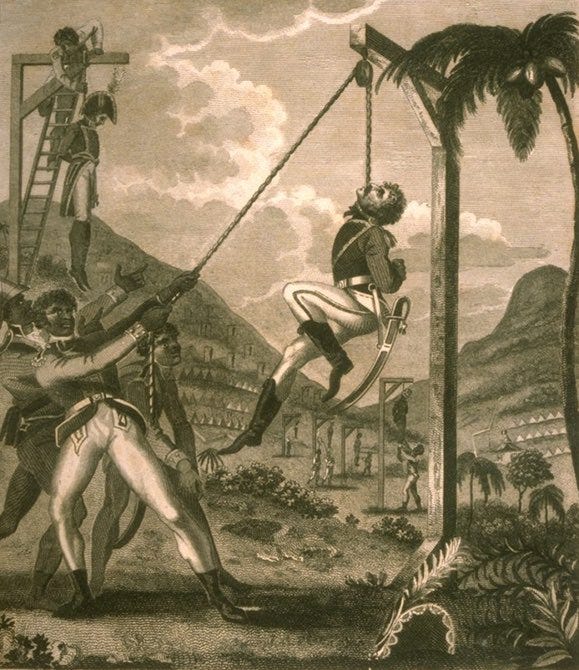
You think they’d let me put this in block letters on a posterboard: Haitians killed their White oppressors. So should WE.
Or this?
I was asked by one of the No Kings organisers to speak?
Will you please consider speaking at No Kings? I hope you will add your progressive voice.
So far, Gomberg will talk about ICE and Brubaker will talk about trusting media.
In Solidarity, M
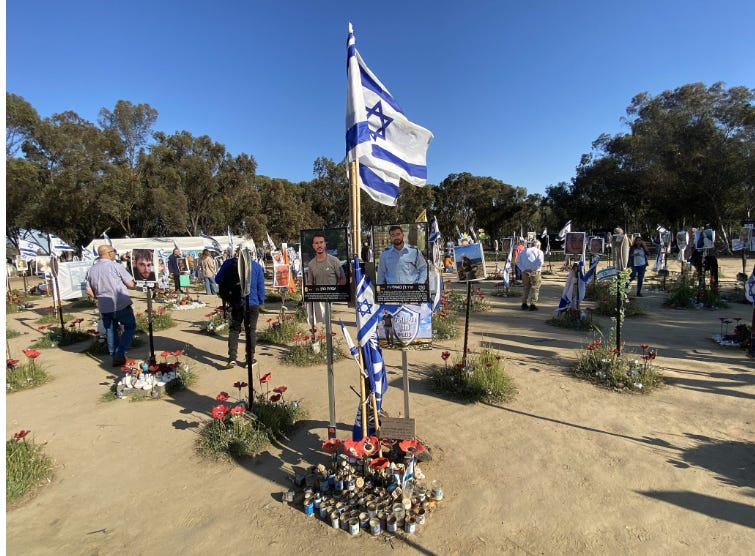
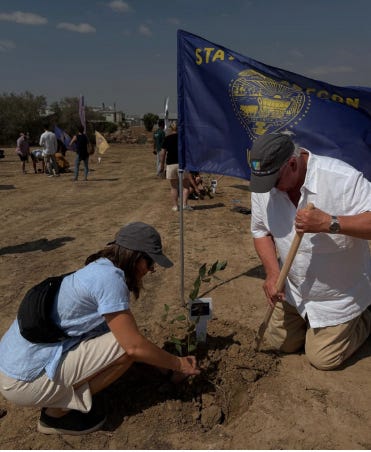
[U.S. state lawmakers this week visited the Nova festival memorial site in Re’im, Israel. The grounds around Re’im Park have been turned into a memorial for the victims and hostages from the Nova music festival which was attacked by Hamas on the morning of Oct. 7, 2023.]
Oh, darn, I had to write back:
Thanks for the endorsement of my ability to speak to this group on many issues, from global heating/warming, to war lust by both parties, education, science, urban planning (yep, I did that graduate work in Spokane), and sustainability. But I am way off the charts in terms of most No Kings Day folk. I’ve talked to some of them in Florence, Bend, Cannon Beach, and Newport: I am a bona fide communist, M, so, not part of the Dems or republicans on national politics, and I voted for Claudia De Las Cruz last time and Jill Stein before that and worked for Nader and Kuchinich. I know education like the back of my hand. And journalism, too. And social work, since I have done case management for years while teaching college from TX to AZ to WA to OR.
It’s a tough one. I am not a progressive, as you understand, unfortunately for your group’s overall collective (I know I am generalizing) ethos and philosophical grounding. I’m way left of left, more than just socialist. Additionally, I recently wrote a piece criticizing Gomberg for his genocide-themed trip to Israel. See page 5. I’ve asked him to be on my radio show, and he might be up for that; however, it might be contentious. We talked briefly at the rambunctious ICE and helicopter city council meeting months ago.
I don’t want to rain on your parade, and while I have lived with boo’s, I am not into those right now. Does this frame things for you a bit better? Look, I was cancelled recently, from a talk I was asked to give at the Performing Arts Center Dec. 4, and I am ghosted by OCCC and can’t teach my memoir writing classes there anymore.
Telling it like it is — Israel doesn’t have any right to exist, and alas, From the River to the Sea, Palestine Will-Should Be Free is considered antisemitic by many on the blue side of the aisle.
Look – I am somewhat impulsive and have a tendency to make simple assumptions like sharing facts will strengthen the resistance.
I had no idea about any of the challenges you have faced. I am not an advocate of boos – they cut off any conversation. That is familiar from being on the street. And, I am familiar with those who confound antisemitism with objecting to Netanyahu’s war on Palestine. The worst part of that, I think, is the way that confusion is used/exploited by the well-oiled MAGA machine.
I get that you are not a progressive. It reminds me of working (years ago) with Women’s Pentagon Action in Northampton and endless discussions about naming a group so that is would draw people into a larger resistance. Now, because I am organizing a variety of people in Lincoln City, I imagine I look more moderate than I am. But, it feels important to do this – even crucial. Indivisible Lincoln City includes folks who have always been out there, working for what is right, and folks who have never stepped out before.
They all need to be out there. The challenge is not to stand on a street corner, but to talk to neighbors and vote MAGA out of school boards, city councils, county boards, state and federal congressional seats.
So, that is me.
I was born and raised in North Portland and went to Jeff, 68 – 72. If you know Albina and those years in our history, you know what HS was like. The first march was anti-Vietnam. Went to a variety of schools and took time to get through undergrad, and ended at UO in psych. Had my son then. Was active, there, too. Went on to grad school in Cognitive Psych, worked as a prof at Quinnipiac in CT for years. Too many. Came home in 20. Finally got to see the real ocean and real mountains again. The last action I organized there was because Trump defunded the arts.
More on me.
This program approach sounds like it doesn’t appeal to you. The plan is to have a bunch of short talks, each focused on an area of damage to our democracy, with the goal of informing and inspiring folks before they move to the rally onto 101. It isn’t substantive, like your writing or your interviews.
Not sure where this leaves us. I still think you could speak. One speaker may talk about what war does to children.
Thanks for reaching back and for telling me about yourself.
+—+
There ain’t no way to do No Kings Day without going back to 1776? Look at this fucking mass killing, mass bombing, Jewish State of Israel!
Endless crocodile tears, don’t you know, Gallee.
Footnote: A really good dad wouldn’t get involved in killing 165 children at school.
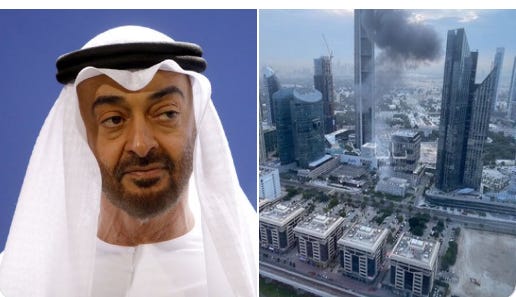
I would love nothing more than to see the destruction of the UAE. It is a slave state. It supports genocide in Sudan. Women and young girls are being raped in Sudan.. UAE LOSSES IN THE WAR ARE STAGGERING.
An estimated $1 million is reportedly lost every minute, totaling nearly $10 billion per week.
Disgusting is the position of the petrodictatorships of the Persian Gulf; Mohamed bin Salman, Crown Prince of Saudi Arabia, dictator and accused of killing and dismembering a journalist, has asked Trump to continue the war against Iran, in addition to selling himself to the Zionist entity of Israel. Traitor, like few others, 800 dead in Lebanon, 2000 in Iran, and a genocide in Gaza.
Trump lives in a world of ballrooms, lobster dinners, gold toilets and yachts. War is nothing more than a pleasant excursion to him. Anyone who dances on stage at rallies while the bodies of our soldiers are being sent home is repulsive and pathetic. A pig is more sensitive.
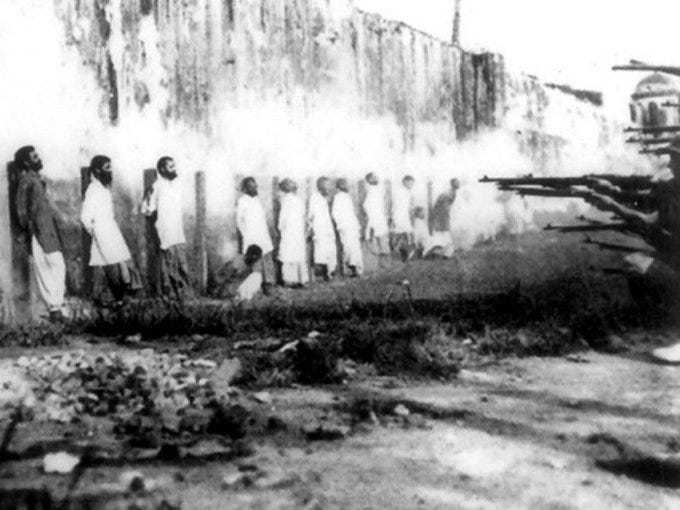
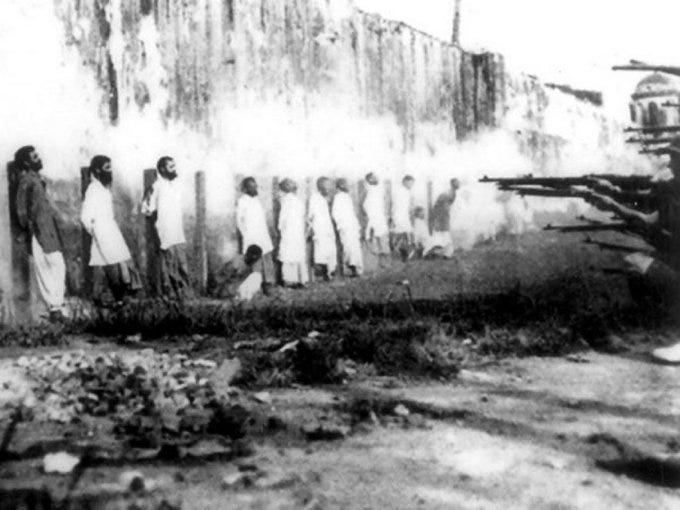
But Trump’s a Kraut and a Brit. Britain executed hundreds of Indian Muslims in Singapore after they refused to fight against the Islamic Caliphate, 1914-1915.
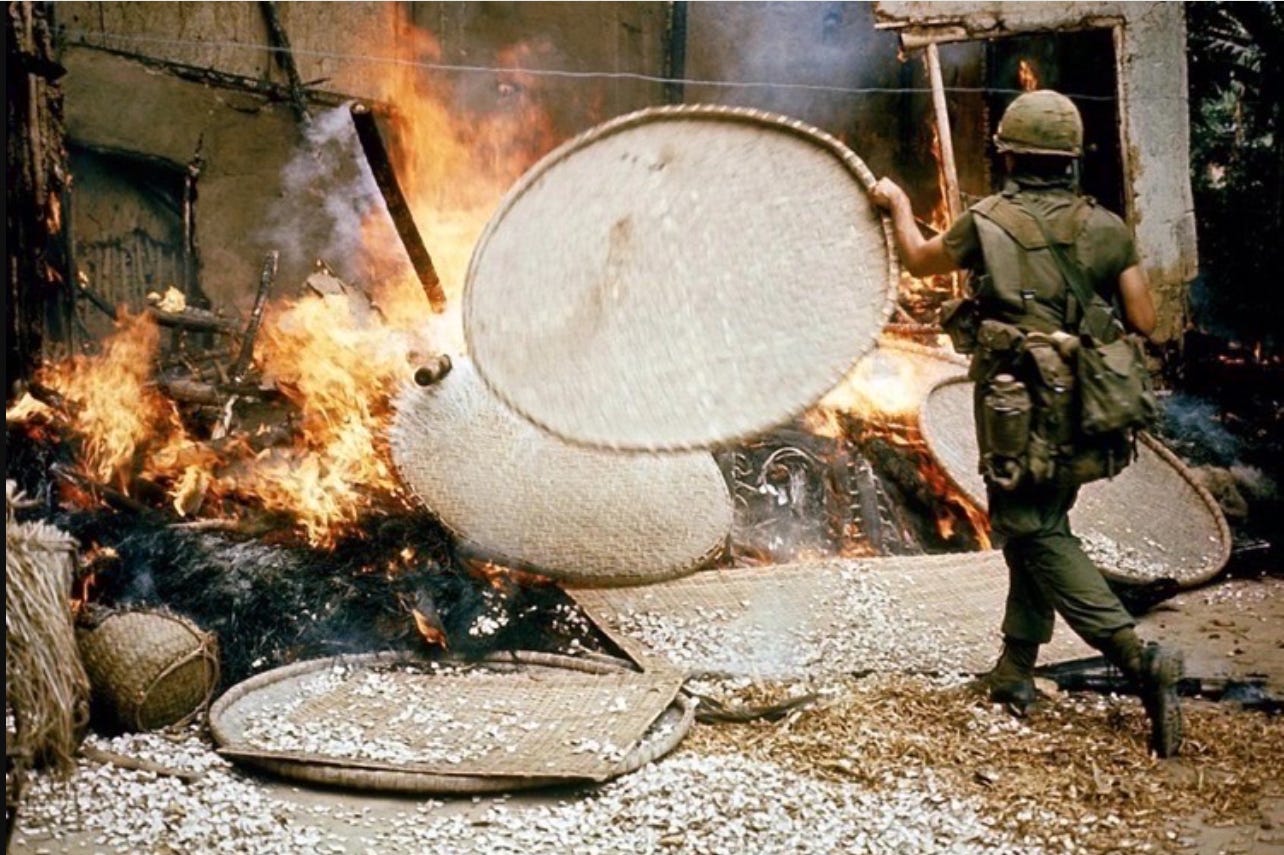
16 March 1968. A platoon of American soldiers murdered approximately 1000 unarmed civilians at My Lai and destroyed a cluster of other small villages located in South Vietnam. The incident was kept secret for nearly 2 years and later became known as the My Lai Massacre.
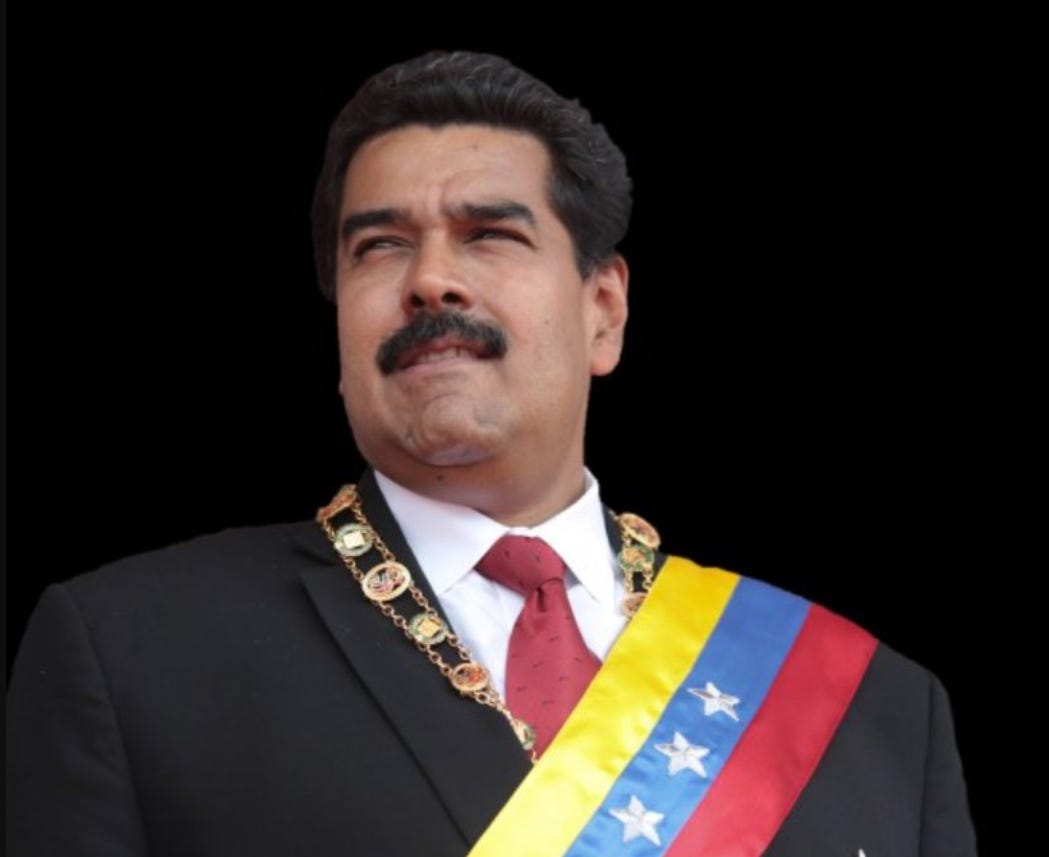
Nicolás Maduro is being kept in solitary confinement, locked in a 6ft by 10ft room for more than 23 hours a day.
All because he wouldn’t let Donald Trump steal Venezuela’s oil.
Every year on May 15, Palestinians around the world, numbering about 12.4 million, mark the Nakba, or “catastrophe”, referring to the ethnic cleansing of Palestine and the near-total destruction of Palestinian society in 1948.
The Palestinian experience of dispossession and loss of a homeland is 69 years old this year.
On that day, the State of Israel came into being. The creation of Israel was a violent process that entailed the forced expulsion of hundreds of thousands of Palestinians from their homeland to establish a Jewish-majority state, as per the aspirations of the Zionist movement.
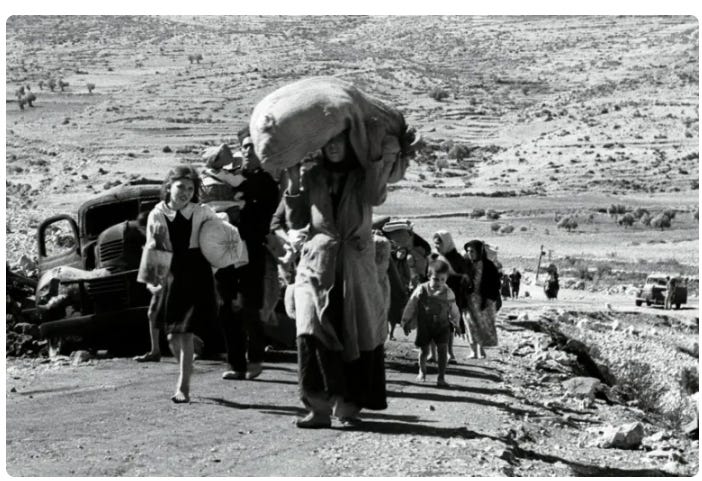
Between 1947 and 1949, at least 750,000 Palestinians from a 1.9 million population were made refugees beyond the borders of the state. Zionist forces had taken more than 78 percent of historic Palestine, ethnically cleansed and destroyed about 530 villages and cities, and killed about 15,000 Palestinians in a series of mass atrocities, including more than 70 massacres.
Palestinians in 1948, five months after the creation of Israel, leaving a village in the Galilee [Reuters]
Though May 15, 1948, became the official day for commemorating the Nakba, armed Zionist groups had launched the process of displacement of Palestinians much earlier. In fact, by May 15, half of the total number of Palestinian refugees had already been forcefully expelled from their country.
Israel continues to oppress and dispossess Palestinians to this day, albeit in a less explicit way than that during the Nakba.
What caused the Nakba?
The roots of the Nakba stem from the emergence of Zionism as a political ideology in late 19th-century Eastern Europe. The ideology is based on the belief that Jews are a nation or a race that deserve their own state.
Advertisement
From 1882 onwards, thousands of Eastern European and Russian Jews began settling in Palestine; pushed by the anti-Semitic persecution and pogroms they were facing in the Russian Empire, and the appeal of Zionism.
In 1896, Viennese journalist Theodor Herzl published a pamphlet that came to be seen as the ideological basis for political Zionism – Der Judenstaat, or “The Jewish State”. Herzl concluded that the remedy to centuries-old anti-Semitic sentiments and attacks in Europe was the creation of a Jewish state.
Though some of the movement’s pioneers initially supported a Jewish state in places such as Uganda and Argentina, they eventually called for for building a state in Palestine based on the biblical concept that the Holy Land was promised to the Jews by God.
In the 1880s, the community of Palestinian Jews, known as the Yishuv, amounted to three percent of the total population. In contrast to the Zionist Jews who would arrive in Palestine later, the original Yishuv did not aspire to build a modern Jewish state in Palestine.
After the dissolution of the Ottoman Empire (1517-1914), the British occupied Palestine as part of the secret Sykes-Picot treaty of 1916 between Britain and France to divvy up the Middle East for imperial interests.
In 1917, before the start of the British Mandate (1920-1947), the British issued the Balfour Declaration, promising to help the “establishment in Palestine of a national home for the Jewish people”, essentially vowing to give away a country that was not theirs to give.
Central to the pledge was Chaim Weizmann, a Britain-based Russian Zionist leader and chemist whose contributions to the British war effort during World War I (1914-1918) made him well-connected to the upper echelons of the British government. Weizmann lobbied hard for more than two years with British former Prime Minister David Lloyd-George and former Foreign Minister Arthur Balfour to publicly commit Britain to building a homeland for the Jews in Palestine.
By giving their support to Zionist goals in Palestine, the British hoped they could shore up support among the significant Jewish populations in the US and Russia for the Allied effort during WWI. They also believed the Balfour Declaration would secure their control over Palestine after the war.
From 1919 onwards, Zionist immigration to Palestine, facilitated by the British, increased dramatically. Weizmann, who later became Israel’s first president, was realising his dream of making Palestine “as Jewish as England is English”.
European Jews arrive from the Nazi holocaust wave into the Palestinian Arab city of Haifa, five weeks before Israel is declared a state [Reuters]
Between 1922 and 1935, the Jewish population rose from nine percent to nearly 27 percent of the total population, displacing tens of thousands of Palestinian tenants from their lands as Zionists bought land from absentee landlords.
Advertisement
Leading Arab and Palestinian intellectuals openly warned against the motifs of the Zionist movement in the press as early as 1908. With the Nazi seizure of power in Germany between 1933 and 1936, 30,000 to 60,000 European Jews arrived on the shores of Palestine.
In 1936, Palestinian Arabs launched a large-scale uprising against the British and their support for Zionist settler-colonialism, known as the Arab Revolt. The British authorities crushed the revolt, which lasted until 1939, violently; they destroyed at least 2,000 Palestinian homes, put 9,000 Palestinians in concentration camps and subjected them to violent interrogation, including torture, and deported 200 Palestinian nationalist leaders.
At least ten percent of the Palestinian male population had been killed, wounded, exiled or imprisoned by the end of the revolt.
The British government, worried about the eruption of violence between the Palestinians and Zionists, tried to curtail at several points immigration of European Jews. Zionist lobbyists in London overturned their efforts.
In 1944, several Zionist armed groups declared war on Britain for trying to put limits on Jewish immigration to Palestine at a time when Jews were fleeing the Holocaust. The Zionist paramilitary organisations launched a number of attacks against the British – the most notable of which was the King David Hotel bombing in 1946 where the British administrative headquarters were housed; 91 people were killed in the attack.
In early 1947, the British government announced it would be handing over the disaster it had created in Palestine to the United Nations and ending its colonial project there. On November 29, 1947, the UN adopted Resolution 181, recommending the partition of Palestine into Jewish and Arab states.
At the time, the Jews in Palestine constituted one third of the population and owned less than six percent of the total land area. Under the UN partition plan, they were allocated 55 percent of the land, encompassing many of the main cities with Palestinian Arab majorities and the important coastline from Haifa to Jaffa. The Arab state would be deprived of key agricultural lands and seaports, which led the Palestinians to reject the proposal.
Shortly following the UN Resolution 181, war broke out between the Palestinian Arabs and Zionist armed groups, who, unlike the Palestinians, had gained extensive training and arms from fighting alongside Britain in World War II.
Zionist paramilitary groups launched a vicious process of ethnic cleansing in the form of large-scale attacks aimed at the mass expulsion of Palestinians from their towns and villages to build the Jewish state, which culminated in the Nakba.
While some Zionist thinkers claim there is no proof of a systematic master plan for the expulsion of Palestinians for the creation of the Jewish state, and that their dispossession was an unintended result of war, the presence of a Palestinian Arab majority in what Zionist leaders envisioned as a future state meant the Nakba was inevitable.
Why do Palestinians commemorate the Nakba on May 15?
The British occupation authorities had announced that they would be ending their mandate in Palestine on the eve of May 15, 1948. Eight hours earlier, David Ben-Gurion, who became Israel’s first prime minister, announced what the Zionist leaders called a declaration of independence in Tel Aviv.
The British Mandate ended at midnight, and on May 15, the Israeli state came into being.
David Ben Gurion, centre, a Polish Jew, reads out what Israel called a declaration of independence on May 14, 1948. A photo of Herzl hangs in the backdrop [Reuters]
Palestinians commemorated their national tragedy of losing a homeland in an unofficial way for decades, but in 1998, the former President of the Palestinian Authority, Yasser Arafat, declared May 15 a national day of remembrance, on the 50th year since the Nakba.
Israel celebrates the day as its day of independence.
When did the process of displacement actually begin?
Though displacement of Palestinians from their lands by the Zionist project was already taking place during the British Mandate, mass displacement started when the UN partition plan was passed.
In less than six months, from December 1947 to mid-May 1948, Zionist armed groups expelled about 440,000 Palestinians from 220 villages.
Before May 15, some of the most infamous massacres had already been committed; the Baldat al-Sheikh massacre on December 31, 1947, killing up to 70 Palestinians; the Sa’sa’ massacre on February 14, 1948, when 16 houses were blown up and 60 people lost their lives; and the Deir Yassin massacre on April 9, 1948, when about 110 Palestinian men, women and children were slaughtered.
As units of the Egyptian, Lebanese, Syrian, Jordanian and Iraqi armies invaded on May 15, the Arab-Israeli war was launched, and stretched until March 1949.
By the first half of 1949, at least 750,000 Palestinians in total were forcibly expelled or fled outside of their homeland. Zionist forces had committed about 223 atrocities by 1949, including massacres, attacks such as bombings of homes, looting, the destruction of property and entire villages.
Some 150,000 Palestinians remained in the areas of Palestine that became part of the Israeli state. Of the 150,000, some 30,000 to 40,000 were internally displaced.
Like the 750,000 who were displaced beyond the borders of the new state, Israel prohibited internally displaced Palestinians from returning to their homes.
Palestinian Arabs leaving the port city of Jaffa as Zionist forces advanced on the city [Associated Press]
In the years that followed the establishment of Israel, the state extended its systematic ethnic cleansing. Though armistice agreements had been signed with Egypt, Jordan, Syria and Lebanon in 1949, the newly founded Israeli army committed a number of additional massacres and campaigns of forced displacement.
For example, in 1950, the remaining 2,500 Palestinian residents of the city of Majdal were forced into the Gaza Strip, about 2,000 inhabitants of Beer el-Sabe were expelled to the West Bank, and some 2,000 residents of two northern villages were driven into Syria.
By the mid-1950s, the Palestinian population inside Israel had become about 195,000. Between 1948 and the mid-1950s, some 30,000, or 15 percent of the population, were expelled outside the borders of the new state, according to the BADIL refugee rights group.
Is the Nakba over?
While the Zionist project fulfilled its dream of creating “a Jewish homeland” in Palestine in 1948, the process of ethnic cleansing and displacement of Palestinians never stopped.
Advertisement
During the 1967 Arab-Israeli War, known as the Naksa, meaning “setback”, Israel occupied the remaining Palestinian territories of East Jerusalem, the West Bank, the Gaza Strip and continues to occupy them until today. While under the UN partition plan Israel was allocated 55 percent, today it controls more than 85 percent of historic Palestine.
The Naksa led to the displacement of some 430,000 Palestinians, half of which originated from the areas occupied in 1948 and were thus twice refugees. As in the Nakba, Israeli forces used military tactics that violated basic international rights law such as attacks on civilians and expulsion. Most refugees fled into neighbouring Jordan, with others going to Egypt and Syria.
Little children play amid lines of laundry drying out at Baqaa Camp in Jordan for Palestinian refugees of the 1967 war – some were refugees from 1948 [The Associated Press]
Palestinians wait to cross the Qalandia military checkpoint in the occupied West Bank as Israeli officers stand guard, in 2016 [Reuters]
The Gaza Strip, where some two million Palestinians live, has been under Israeli siege for more than a decade whereby Israel controls the air space, sea and borders; the Strip has also witnessed three Israeli assaults that have made the area close to uninhabitable.
Within Israel, the 1.8 million Palestinians are an involuntary minority in a state for the Jews. Rights groups have recorded some 50 laws that discriminate against them for not being Jewish, such as ones that criminalise the commemoration of the Nakba.
Since the creation of Israel, no new Palestinian towns or cities were built within its borders, in contrast to the 600 Jewish municipalities that have been developed, according to Adalah, the legal centre for Arab Minority Rights in Israel.
Since 1948, some one million Palestinians have been arrested by Israel, according to the Palestinian Central Bureau of Statistics. Additionally, some 100,000 Palestinian homes have been demolished (not including the Nakba or the Gaza wars), according to BADIL.
There are hundreds of checkpoints, roadblocks and flying checkpoints in the West Bank, and between Israel and the West Bank where Palestinians must show proof of identification and be searched [Reuters]
Today, there are about 7.98 million Palestinian refugees and internally displaced persons who have not been able to return to their original homes and villages.
Some 6.14 million of those are refugees and their descendants beyond the borders of the state; many live in some of the worst conditions in more than 50 refugee camps run by the UN in neighbouring countries.





![Palestinians in 1948, five months after the creation of Israel, leaving a village in the Galilee [Reuters]](https://substackcdn.com/image/fetch/$s_!NXdu!,f_auto,q_auto:good,fl_progressive:steep/https%3A%2F%2Fsubstack-post-media.s3.amazonaws.com%2Fpublic%2Fimages%2F8b5ebd2b-d14f-4ef7-b655-af7849d84cea_999x562.jpeg "Palestinians in 1948, five months after the creation of Israel, leaving a village in the Galilee [Reuters]")
![European Jews arrive from the Nazi holocaust wave into the Palestinian Arab city of Haifa, five weeks before Israel is declared a state [Reuters]](https://substackcdn.com/image/fetch/$s_!Ag68!,f_auto,q_auto:good,fl_progressive:steep/https%3A%2F%2Fsubstack-post-media.s3.amazonaws.com%2Fpublic%2Fimages%2F5db69e37-adf2-4d72-90c9-89a54616766a_999x562.jpeg "European Jews arrive from the Nazi holocaust wave into the Palestinian Arab city of Haifa, five weeks before Israel is declared a state [Reuters]")
![David Ben Gurion, centre, a Polish Jew, reads out what Israel called a declaration of independence on May 14, 1948. A photo of Herzl hangs in the backdrop [Reuters]](https://substackcdn.com/image/fetch/$s_!mrKk!,f_auto,q_auto:good,fl_progressive:steep/https%3A%2F%2Fsubstack-post-media.s3.amazonaws.com%2Fpublic%2Fimages%2F1e2598c0-b79e-4b4d-94e8-1b4d494389fb_999x562.jpeg "David Ben Gurion, centre, a Polish Jew, reads out what Israel called a declaration of independence on May 14, 1948. A photo of Herzl hangs in the backdrop [Reuters]")
![Palestinian Arabs leaving the port city of Jaffa as Zionist forces advanced on the city [Associated Press]](https://substackcdn.com/image/fetch/$s_!Ymem!,f_auto,q_auto:good,fl_progressive:steep/https%3A%2F%2Fsubstack-post-media.s3.amazonaws.com%2Fpublic%2Fimages%2Fb4c9b1af-5b63-4dbf-918c-988eb438aaa0_999x562.jpeg "Palestinian Arabs leaving the port city of Jaffa as Zionist forces advanced on the city [Associated Press]")
![Little children play amid lines of laundry drying out at Baqaa Camp in Jordan for Palestinian refugees of the 1967 war - some were refugees from 1948 [The Associated Press]](https://substackcdn.com/image/fetch/$s_!oXKr!,f_auto,q_auto:good,fl_progressive:steep/https%3A%2F%2Fsubstack-post-media.s3.amazonaws.com%2Fpublic%2Fimages%2F0f51e6ea-6c7e-4a67-b3ce-0a3a6af6abfa_1000x562.jpeg "Little children play amid lines of laundry drying out at Baqaa Camp in Jordan for Palestinian refugees of the 1967 war - some were refugees from 1948 [The Associated Press]")
![Palestinians wait to cross the Qalandia military checkpoint in the occupied West Bank as Israeli officers stand guard, in 2016 [Reuters]](https://substackcdn.com/image/fetch/$s_!IG7L!,f_auto,q_auto:good,fl_progressive:steep/https%3A%2F%2Fsubstack-post-media.s3.amazonaws.com%2Fpublic%2Fimages%2F9350f8e0-ef6b-4393-8751-4e509d6dfe07_1000x561.jpeg "Palestinians wait to cross the Qalandia military checkpoint in the occupied West Bank as Israeli officers stand guard, in 2016 [Reuters]")
![There are hundreds of checkpoints, roadblocks and flying checkpoints in the West Bank, and between Israel and the West Bank where Palestinians must show proof of identification and be searched [Reuters]](https://substackcdn.com/image/fetch/$s_!vBOm!,f_auto,q_auto:good,fl_progressive:steep/https%3A%2F%2Fsubstack-post-media.s3.amazonaws.com%2Fpublic%2Fimages%2Fc3f80d0d-7a21-43d7-a9e8-fe345555eb06_1000x561.jpeg "There are hundreds of checkpoints, roadblocks and flying checkpoints in the West Bank, and between Israel and the West Bank where Palestinians must show proof of identification and be searched [Reuters]")
 Paul Haeder, Author