

sort of flailing today, as the job opportunities are dismal, and the old writer in me is, well, burned out after 50 years writing like a fucking fool . . . . But then Joe Bageant, REMEMBER?
Feb 19, 2026
I need a fucking Jew Agent:
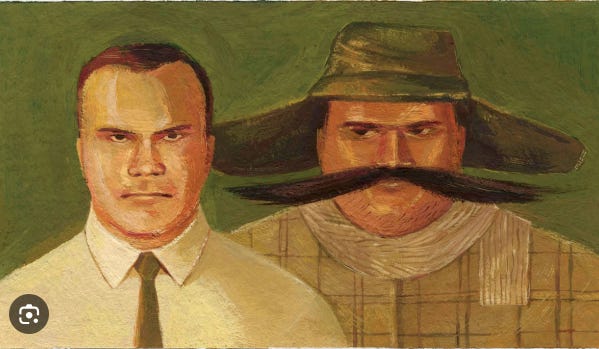
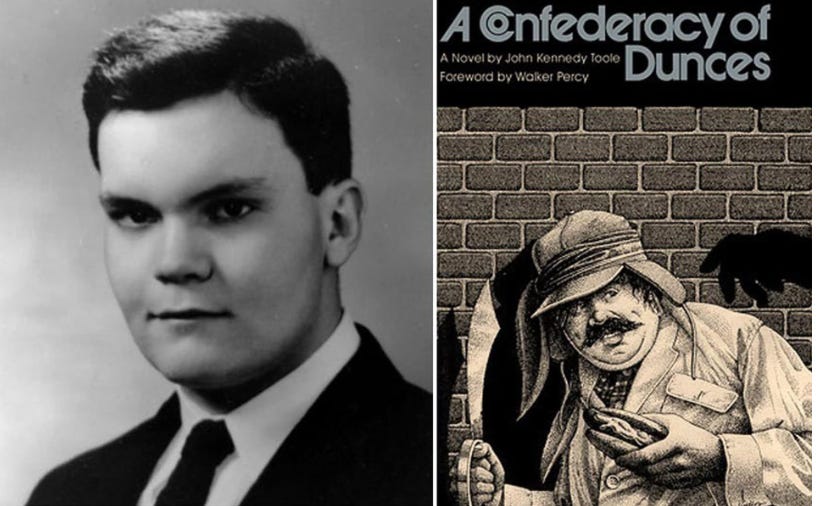
John Kennedy Toole (1937–1969) committed suicide at age 31 on March 26, 1969, in Biloxi, Mississippi,,, by carbon monoxide poisoning in his car. Despondent over severe rejections of his manuscript, A Confederacy of Dunces, and battling mental instability, his mother later championed the book, leading to its 1980 publication and 1981 Pulitzer Prize.
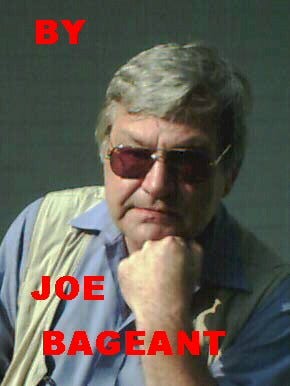
Joe Bageant:

COLUMN 109, SEPTEMBER 1, 2004
COLUMN 109, SEPTEMBER 1, 2004
(Copyright © 2004 The Blacklisted Journalist)
SLEEPWALKING TO FALLUJAH
In the war against terrorism, FBI agents at the Norfolk, Virginia, airport took anal swabs from a mechanical farting dog to make sure it did not contain explosives.”Reported by the British Broadcast Corporation and Harpers Magazine
April 14, 2004? Each workday I commute toward Washington, D.C.. along Route 7, where patriotic war slogans are spray painted on the overpasses, and homemade signs jut from the median in support of our “boys in Iraq.” Mud-splattered construction trucks rip by with frayed flags popping in the wind, loaded with burly bearded men and looking very much like the footage of Afghanistan or Angola, minus the 50 caliber gun mounts. Yesterday I saw my first stretch Hummer, painted in desert tan and carrying half a dozen soccer mom types, which rather sums up the point I am trying to make here. There is a distinct martial ethos, the tang of steel and the smell of gun oil in the air around Washington these days, I swear it.
Only a blind microcephalic could fail to notice this systemic militarization of the American culture, and the media’s hyper-escalation of warrior worship. Reputedly, our national character is supposed to be improved by all this. But I was in the military for a time?a “young warrior” in Fox Network parlance?and I can confidently say I was not improved one bit by the experience. (Although I did learn to cuss properly, if a bit too much.) That was 35 years ago, back when there was little, if any, mythologizing of Vietnam’s warriors, much less patriotic news spasms ejaculated by embedded reporters between the commercials. News was duller then. Certainly not as entertaining as the Jessica Lynch story of a fetching, innocent young blonde wounded while supposedly blazing away at the face of evil itself, only to suffer multiple wounds, then be rescued from some fly-ridden Iraqi hospital (more radio crackling and gunfire, please) by her comrades in arms. After this stirring rescue we were served the titillating dessert of the subsequent doctor’s report: She was sodomized by the sweaty stinking bastards! In the television news business it just does not get any better than that. Pass the corn chips, please.
With television news like that, who needs a rational explanation as to why we are at war? The entertainment value alone is worth it. And therein lies the problem for those of us in that last generation of people who gained most of what they know from reading: We need a tangible explanation why we are spilling so much blood and bullion in that god forsaken desert pisshole. Still no answer. Or no new one at least. Oh, there is the standard line that goes, “We are defending democracy and liberating a people from oppression.” That old saw was getting mighty dull even back in my day, when it was used to explain Vietnam.
I cannot remember a time when the American public ever asked any important questions of its national leadership. In the American scheme of things, that is the media’s job; media frames the question and the public asks it, after having been appropriately bludgeoned over the head with it. That’s our system, by damned! We love it, and it has even been known to work on occasion. Which would be fine, except that Edward R. Murrow has been dead a long time. Since then, the American psyche has been hardwired into a new world communications order— one in which global corporations now pay the freight for national television. Halliburton, Boeing and Sprint ain’t Geritol and this ain’t Ted Mack’s Original Amateur Hour. Content with selling us chewing gum or Chesterfields, early television sponsors were not players in the Pentagon defense contract game and never slept with the government to obtain more bandwidth.
It is tragic that such a promising instrument as television had to grow up at the end of the Age of Enlightenment?just in time to ignite an unholy fission/fusion, a synthesis of mammon and politics amid a culture out of philosophical and spiritual gas. Just when America needed to explain itself to itself, if it were ever to redefine its higher goals and ideas. But television is about emotion, not explanation. It has no patience for ideas (not that we’ve seen a real idea in 30 years). Ideas? Who gives a fuck? Let’s go shopping. The result has been a nation of sleepwalkers, an all-but-expired republic reduced to pure consumption and little else (a fact not unnoticed by the
Instead of ideas, we get data from experts who know the cost of everything and the value of nothing
Muslim world.) Hell, even flatworms consume, and sheer quantity is no substitute for a national soul. It took a couple of generations, but here we are now plugged in at the brainstem, just as McLuhan predicted, to television’s virtual cathedral of commerce where the devoted receive the sacrament in a straight shot to the cortex. Too tired from overwork, or poor, or old, or young, or just plain lazy to feel anything else, the tribal war drumbeat called news and the reality shows that pass for experiencing the world beyond work and consumption, as McCluhan’s electronic hearth casts shadows on the walls of a withdrawn and slowly rotting republic.
We had warning from poets, writers and grim futurists, but who would have guessed it would come to this so soon? That we would become so perfectly attuned to capitalist state television, ever trolling for more business, dragging its nets baited with new cars, Disney character imprinted cell phones, and buckets of fried chicken through a sea of somnambulates. Yet, the sleepwalkers all share but one eye, that of the camera, which, as Lewis Lapham put it, “ . . . doesn’t make distinctions between treason and fellatio . . . between an important senator and an important ape.” So images of the grisly specter in Fallujah and Janet Jackson’s boob draw the same numb respect. Stop and consider that most Americans get their “knowledge” of the outside world from this medium, then consider that most of the Muslim world gets its notion of America from Baywatch. If that does not throw any thinking person into the grip of a Prozac-proof depression, nothing will. And what about these so-called thinking persons? Where is the voice of their dissent? Well, they are naturally unhappy and making the best noise they can?all two dozen of them.
Despite that brief and fabled moment during the 1960s, the U.S. is not a nation comfortable with dissent. We have never spawned a nationally integrated left-wing opposition in the European sense. A well-behaved people when it comes to public debate, when told by the president on TV that we are at war with terrorism, the overwhelming majority of us line up and salute the flag. More importantly, we do not ask questions. So the question of why a hundred million dollar agency dedicates its resources to swabbing the anuses of farting toy dogs never gets asked, just smiled at. And whether we are willing to sustain, say, 25,000 dead American kids in Iraq never comes up, much less debated. It is equally unlikely the public will inquire specifically who is best served by the caskets being unloaded daily at Dover, Delaware. By state decree, we are not even allowed to see them. And let us not even begin to ask that greatest of all American spiritual questions: “Who is getting rich from it?” In a society whose business is business, where whoever raises the most money to buy TV time elects the next president, that question is not likely to get answered either. Not by the Bush administration, nor by the media it sponsors through government license handouts, tax breaks and regulation?or the lack of it.
Hard to believe that not long ago we were asking how we were going to spend the projected $400 billion “peace dividend” that came with the end of the Cold War. That question has now been answered. Thank you and sit down. So who does get rich? As if we didn’t know. Of course there is the Pentagon’s coalition of vested interests, which is just about every material and service provider imaginable from Sprint to SpaghettiOs. But in the end it winds up in vastly disproportionate amounts in the hands of the already-rich. Those uneasy oligarchs who, since the first Neolithic thug stole all the grain in the village, have lived in fear of losing their advantage.
In this country the rich have been uneasy from the beginning, and have long thought that perhaps the democratic experiment has gone just about far enough. Their grumbling, political scheming and sometimes-outright assaults on the common decency of the republic date back to the American Revolution. But now is their hour, thanks to George Bush. George Bush did not invent their fear. He merely rode it into the White House. And as their chosen commander in chief, he has certainly handed them, with some preliminary help from his predecessor Bill Clinton, the promise of ultimate victory in the real war taking place, the ongoing war of which America has ever been in denial’the class war. This time the already-rich are girded for victory, prepared like never before.
As an outer defensive perimeter they have deployed a far-flung and invincible army. Within the nation has been established a pervasive and relentless Homeland Security Department. All accomplished adroitly at public expense. And with Bush’s gift of escape from equitable taxation, they have set about intensifying their real work at hand, protecting themselves with such steep income differences that they will be forever safe’safety to an oligarch being ever rowing the societal boat backward into the past. Thus, if there is any way to return to the uncomplicated world of 1952 Middleburg or Grosse Pointe with enough money to keep their descendants farting through silk for the next 20 generations, these people are going to do it, with the thuggish help of a leering dry drunk and a secretive gang operating from an undisclosed location.
Nobody in their right mind would take them on because American history has taught us one thing, if nothing else: Rich white people with guns will kill everybody in sight if they get spooked. One need only look back at the Ludlow mining massacre, or ask any urban African-American. Better for us to accept the scraps of the roast goat flung to the populi by the government of the feasting rich, and enjoy the meaningless spectacle of the Martha Stewart show trial. Watch the poised and telegenic Condoleezza Rice testify before a stacked 9/11 commission not even allowed to quote the key suspects in its final report; or jeer at the arrogant and thoroughly unlikable Andrew Fastow running laps around Houston before those appointed to administer his very public tar and feathering. Then catch Jay Leno’s monologue for deep analysis of both.
So here we are, sleepwalkers in the intellectual and spiritual desert of America, 2004 at the end of the Enlightenment. We are literally dying for the lack of a new idea to animate our culture, government and the national mind. If the American mind is an ecosystem, we have fed it toxic waste. Instead of news we clamor for bread and circuses, gladiators in the Coliseum of the Middle East. Instead of ideas we get data’the jargon of weapons specialists, political power pundits and stock brokers who know the cost of everything and the value of nothing. Every night I listen numbly to the litany of numbers recited by this priest craft of pundits, all sorts of numbers?jobless numbers, economic indexes, and balance of trade figures . . . And I try to pinpoint the time when the corporate economy, the well-being of faceless monoliths, became our national religion, remembering back to the days when one had to go to the financial pages to find these things out. Now they are inescapable, these somber minute-by-minute reports on the condition and mood of Moloch, whose heart we are told by poets is a cannibal dynamo and whose breath reeks of the stench of war. How many of our jobs did Moloch eat today? How many did Moloch puke back up in Asia? These job numbers, and the number of Americans killed in Iraq, slosh against the beaches of awareness alongside the basketball scores and the number of cockroaches swallowed by a busty blonde on Fear Factor. The American dream of wealth and invincibility has taken on a life of its own, and now dreams us into being. And off on the horizon to the east, the sirens and the wailing never cease, for we have bestowed shock and awe upon Babylon.
Copyright – 2004 Joe Bageant ##
+—+
Black History Month my ASS:
Colleges quietly cut ties with organizations that help people of color
Under pressure from the Trump administration, 31 schools have signed agreements to end links with organizations that “restrict participation based on race.”

Akhil Reed Amar, a law and political science professor at Yale University, described Rosen as one of the best students he ever had at law school and a genuine public intellectual. “When he took over as president and CEO of the National Constitution Center, he brought to it a lustre and level of excellence that it had not had before.
“He was spectacular at preserving the non-partisan nature of the place. That tightrope was not easy to walk in the last decade and yet he did. He was quite the acrobat.”
The dispute leaves the institution facing uncertainty at a sensitive moment, with the eyes of the nation – and the world – expected to turn to Philadelphia in July 2026. The centre is a non-partisan, non-profit institution that is chartered by Congress.
Sean Wilentz, a history professor at Princeton University, said: “It seems as if this is improper. From what I knew as a sort of insider-outsider, Jeff was not about to leave. Jeff had lots more to do, especially in the 250th year. You’re not gonna jump ship just before the ship’s about to take off.
“It didn’t make sense and then the other side – the politicisation part – did make sense. If someone who wanted to impress the administration wanted to try to take over the NCC, it would be a feather in their cap and it would advance that process of not just purging stuff that they think is ‘improper’ or ‘un-American’ but it’s also about power and control.”
Since taking office a year ago, Trump has embarked on an unparalleled bid to capture America’s cultural institutions. He seized control of the John F Kennedy Center for the Performing Arts, which his handpicked board renamed the Trump-Kennedy Center in a legally dubious move, and announced it will close for two years for renovations.
Jesus fucking Christ.
In a meta-experiment on the future of the global economy, Deutsche Bank Research Institute turned to the machine itself for answers. Rather than relying solely on traditional economic modeling, analysts asked their proprietary AI tool, dbLumina, to identify exactly which industries it intends to upend. The resulting report offers a stark vision of a “great rebalancing,” pinpointing exactly where the algorithms expect to displace human labor.

Deutsche Bank asked AI how it was planning to destroy jobs. And the robot answered
Deutsche Bank’s human analysts, Jim Reid and Adrian Cox, noted that the AI’s self-assessment was a “faithful reflection of the current consensus.” However, they cautioned, the machine likely underestimated the physical obstacles to its own takeover, such as the massive energy requirements for data centers and data quality governance.
Ultimately, the AI views its rise as a transformation rather than an apocalypse. While it foresees displacing 92 million jobs by 2030, it also predicts the creation of 170 million new roles, resulting in a net gain for the global workforce. “However, this transition will be disruptive,” Reid and Cox wrote, with estimates suggesting that activities accounting for up to 30% of hours currently worked in the U.S. could be automated by 2030, “necessitating as many as 12 million occupational transitions.”
Jews.
Rep. Jared Moskowitz (D-Fla.) seemed skeptical Wednesday about the potential effectiveness of New York City Mayor Zohran Mamdani’s (D) proposed wealth tax, suggesting it may drive more people to flee south rather than pay.
“I think that if Mamdani’s law were to go forward and he would increase taxes … you’ll see more people move here,” Moskowitz told Fox Business host Maria Bartiromo on “Mornings with Maria.”

Jews!!
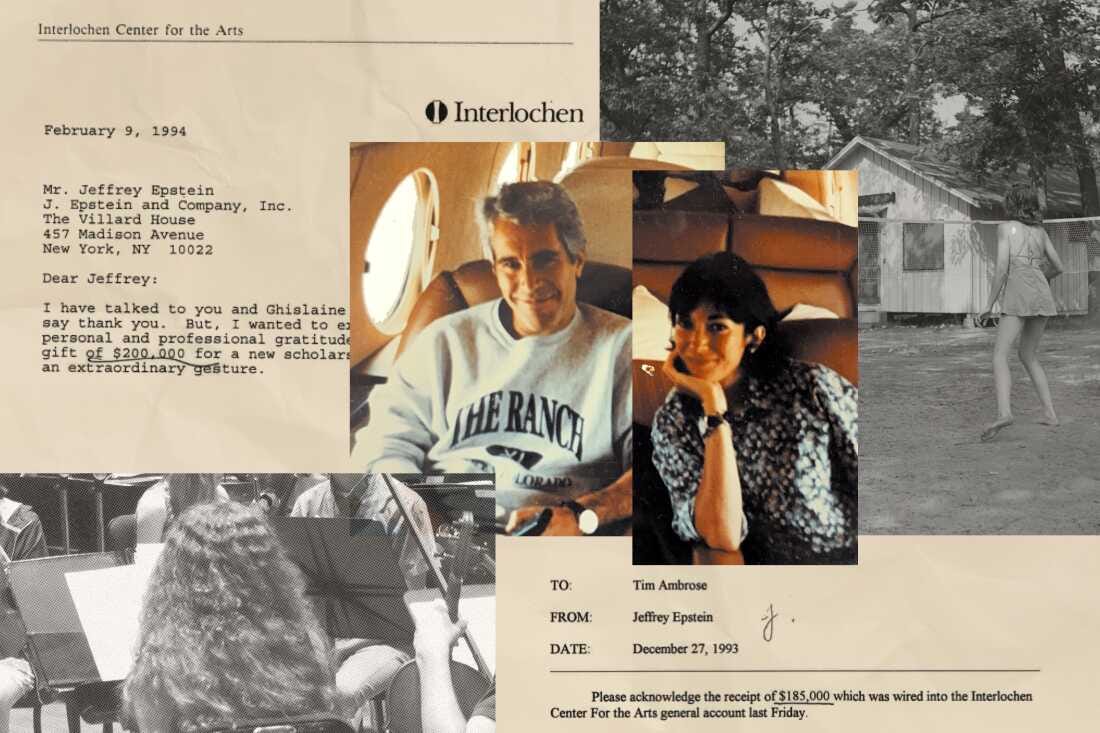
NPR reviewed hundreds of pages of Department of Justice (DOJ) documents on Epstein, interviewed current and former Interlochen officials and spoke with a woman who says that as a teenager at the school, she was targeted by Epstein and Maxwell. What emerges is a portrait of Interlochen as an institution that celebrated openness but that, in accepting Epstein’s financial support, became unwittingly associated with his crimes.
Epstein’s association with Interlochen dates back to 1967, when as a 14-year-old bassoon player, he attended the school’s summer camp. When he renewed his ties to the school in the 1990s, Interlochen viewed him as a loyal alumnus and major benefactor, administrators said. He lavished the school with donations and used his power and influence to gain access to spaces where the administrators felt young kids and artists were safe.
“In hindsight, mistakes may have been made, but it was just out of naivete,” Russ McMahon, a former administrator, said of the ability Epstein had to access the campus. From 1994 to 2003, McMahon was the director of annual giving and later the director of major gifts at Interlochen.
Fucking addicts — child rape, boy rape, S&M, booze, and more:
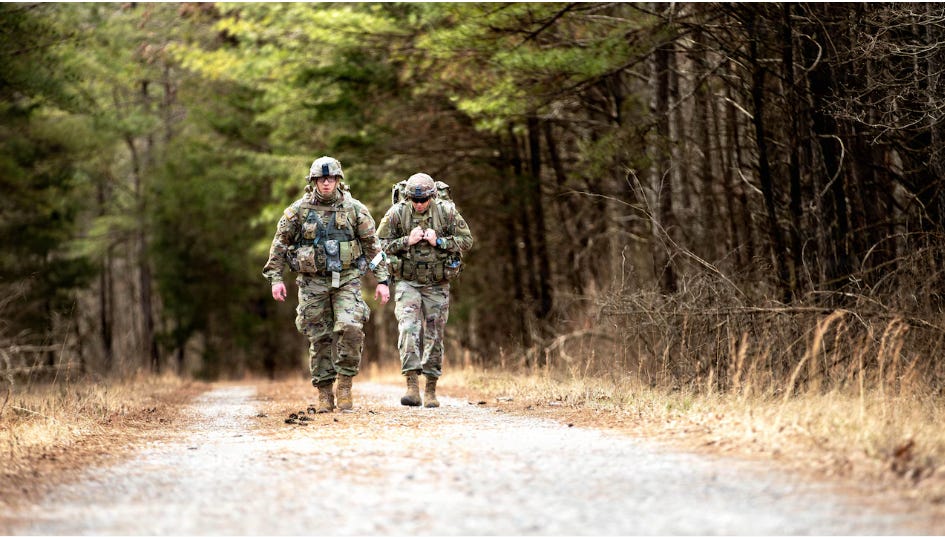
Gambling addiction, which affects many service members and veterans, has been approved for Department of War research funding.
The Fiscal 2026 Consolidated Appropriations Act, signed into law by President Donald Trump on Feb. 3, contains $370 million to fund work on 240 separate research areas.

The Nazi’s:
2-Month-Old Reportedly Suffering from Bronchitis Deported to Mexico After Weeks at Texas Detention Center
Rep. Joaquin Castro claims the child, his sister and parents were deported “with only the money that they had in their commissary—a total of $190”.

The greatest risk of AI in higher education isn’t cheating – it’s the erosion of learning itself
But another answer treats the university as something more than an output machine, acknowledging that the value of higher education lies partly in the ecosystem itself. This model assigns intrinsic value to the pipeline of opportunities through which novices become experts, the mentorship structures through which judgment and responsibility are cultivated, and the educational design that encourages productive struggle rather than optimizing it away. Here, what matters is not only whether knowledge and degrees are produced, but how they are produced and what kinds of people, capacities and communities are formed in the process. In this version, the university is meant to serve as no less than an ecosystem that reliably forms human expertise and judgment.
In a world where knowledge work itself is increasingly automated, we think universities must ask what higher education owes its students, its early-career scholars and the society it serves. The answers will determine not only how AI is adopted, but also what the modern university becomes.

The US has built a portal that will allow Europeans to view blocked content including alleged hate speech and terrorism, according to Reuters.
The portal, “freedom.gov”, will allow worldwide users to circumvent government controls on their content. The site features a graphic of a ghostly horse galloping above the Earth, and the motto: “Information is power. Reclaim your human right to free expression. Get ready.”

Though reports suggest the portal was developed by the state department, the domain appears to be administered by the Cybersecurity and Infrastructure Security Agency (CISA), which is a branch of the Department of Homeland Security (DHS). The DHS also administers Immigration Customs and Enforcement (ICE).
It comes after the Trump administration largely gutted a state department programme called Internet Freedom, which funded grassroots groups worldwide that built technologies to circumvent censorship. Over the past decade, this programme gave more than $500m to digital rights experts – from Myanmar to Iran to Cuba to Venezuela – who built tools used by local populations to access the global internet.
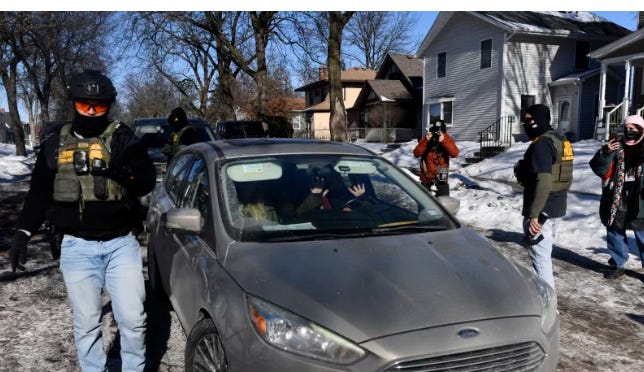
‘Perfectly lawful conduct’
Increasingly, the Trump administration is attempting to criminalize the actions of people tracking and observing its immigration officers, using one particular federal statute: A law that makes it illegal to forcibly impede or interfere with a federal officer.
“While the Trump administration supports everyone’s First Amendment right to freedom of speech and assembly and to petition, it has to be done lawfully and peacefully, because we will not tolerate unlawful actions committed by agitators who are just causing havoc,” White House border czar Tom Homan said in a Feb. 12 press conference announcing plans to end the enforcement surge in Minnesota.

Jews:

What? Miko and Illan and Max and other Jews are saying that Israel is on its last leg?
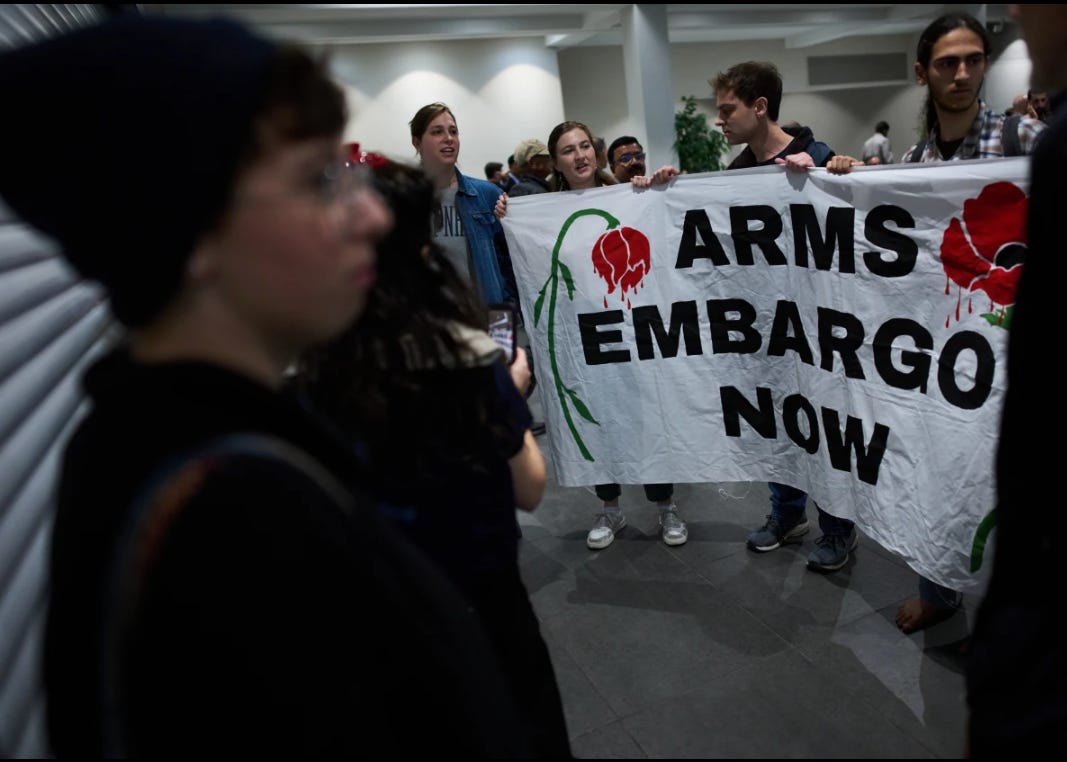
TEL AVIV, Israel (AP) — Rifles are lifted from display racks, drones hover above exhibition stands and large screens loop footage of missile launches inside the halls of Expo Tel Aviv convention center as it hosts the Defense Tech Expo Israel 2026.
The gathering brings together Israeli defense companies, foreign delegations and investors to present technologies ranging from small arms and robotics to air and missile defense systems and cyber tools.
Booths display large models of interceptors and unmanned aircraft, while representatives describe operational capabilities to potential buyers. Business meetings unfold beside screens showing battlefield simulations and promotional footage.
This year’s expo reflected growing international interest in Israel’s defense sector, with manufacturers promoting equipment shaped by recent conflicts


Back to the Pedophile and Rapist Trump-Landia.
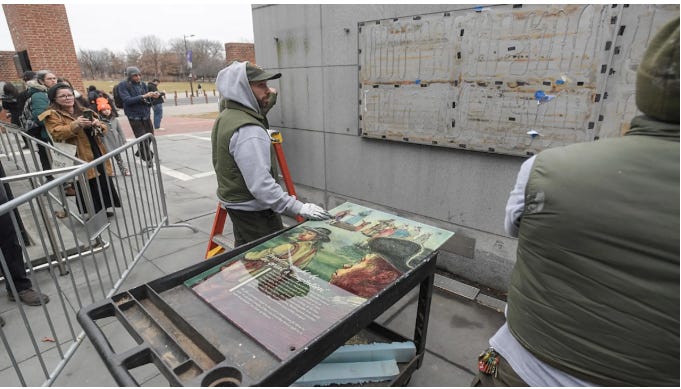
A State-By-State Guide of Known Signs That Have Been Removed or Flagged Across National Parks
In March 2025, President Trump signed an executive order directing federal agencies to review how American history is portrayed at National Park Service sites. Here is the most comprehensive list yet of the signs that have been taken down or flagged for removal since.
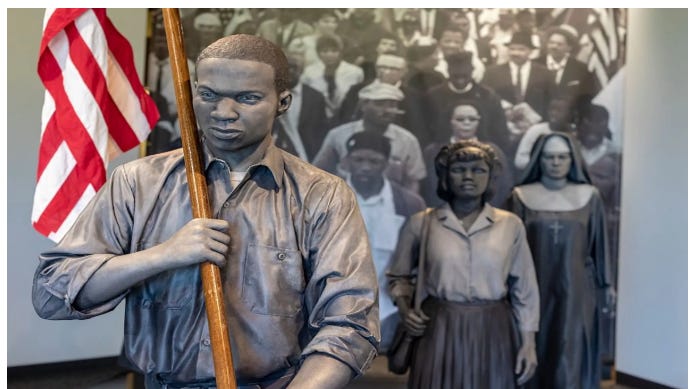

A coalition of nonprofit scientists, historians, and advocates has filed a lawsuit against the Trump administration for removing signs at National Park Service (NPS) sites nationwide. The coalition, represented by the public policy research group Democracy Forward, claims the administration removed signs describing slavery, climate change, and history—among other topics—in an effort “to erase history and censor science in America’s national parks.”
A State-By-State Guide of Known Signs That Have Been Removed or Flagged Across National Parks
We are totally fucked . . . no tires, no Molotovs, no bombs. Trump says he’ll decide whether to bomb Iran in next 10-15 days

Here we go, the Semen Drip and fucking pedophile: U.S. Tells International Energy Agency to Drop Its Focus on Climate Change
The Trump administration is threatening to leave the influential agency unless it stops publishing its annual road map for cutting planet-warming emissions.
Chris Wright, the energy secretary, during a visit to Venezuela this month.Credit…
As Florida prepares to rename the Palm Beach International Airport after President Donald Trump, a recent trademark filing has some state lawmakers wondering if the Trump family is looking to profit.
The bill to rename the south Florida hub after Trump has now passed the Legislature and now awaits Florida Gov. Ron DeSantis’ signature. As the legislation worked its way through both chambers, some Democrats raised concerns about related trademark applications that were filed last week by the private entity that handles licenses and trademarks for the Trump Organization.
Democratic Florida state Sen. Shevrin Jones was initially on board with the name change and supported it in a committee vote, saying he would have done the same for a Democratic president. But he said the trademark application was one of the two things that changed his mind (the other being the racist video recently posted and deleted on Trump’s Truth Social account, which depicted former President Barack Obama and former first lady Michelle Obama as apes).
“No president, Democrat or Republican should be able to benefit” from an airport trademark license, Jones said.

“From a legal perspective, the attorney that drafted these did a really good job. There could be a whole market at the airport, or even off the airport premises. And again, Trump Org would own the trademark and be able to license that name to anybody that was making and selling that merchandise.”
CBS News chief Bari Weiss drops out of UCLA lecture over security concerns

JewLandia: CBS News editor-in-chief Bari Weiss pulled out of a speaking engagement at UCLA due to security concerns.
“We always follow our security team’s guidance. This situation is no different,” a CBS News spokesperson told Fox News Digital.
Weiss was slated to speak at the annual Daniel Pearl Memorial Lecture at the UCLA Burkle Center for International Relations.
The lecture honors the memory of slain Jewish journalist Daniel Pearl, who was kidnapped and beheaded by Pakistani jihadist terrorists in 2002.

God, this woman doesn’t READ!
The CIA & the Frankfurt School’s Anti-Communism

This Jewish American Heritage Month, we recognize the many achievements & contributions of the Jewish community and recommit to battling the rise of antisemitism. As a proud Jewish American, I will always work to lift our community up and call out hate wherever it exists.


Wall Street vulture who survived 9/11 by dropping his kid at kindergarten for the first time ever
> while 658 of his employees got vaporized upstairs
> Rebuilt Cantor Fitzgerald into a personal piggy bank, allegedly pocketing chunks of the 9/11 insurance payout while families fought for scraps
> Next-door neighbor to Epstein on East 71st, bought the adjoining mansion cheap from Wexner-linked trusts, ran joint ventures with the pedo until at least 2014
> Flew the whole family including wife, four kids, nannies to Little St. James for a “family lunch” in 2012, years after Epstein’s conviction
> Sister was a “Founding Citizen” of Ghislaine Maxwell’s scam TerraMar—a real tight-knit crew
> Zero gag reflex, spends every TV hit fellating Trump harder than a Mar-a-Lago waitress chasing tips
> Turned Cantor into Tether’s favorite laundry service, custodies billions in shady stablecoin reserves despite allegations of terrorist financing
> short and bald, just an all-around awful look
> Pumps Bitcoin treasury scams and crypto SPACs with SoftBank, all while playing Commerce Secretary and threatening tariffs that juice his own book
> turned Cantor into a walking conflict of interest, puts his sons with zero real experience in charge
> laughs hysterically any time 9/11 is mentioned, claims it was a “tragedy”

Flags at half mast speak loudly about who a nation chooses to honor.
When Charlie Kirk, a racist agitator who trafficked in division and grievance, died, Trump moved swiftly to lower the American flag, a symbolic gesture of national mourning.
But when Reverend Jesse Jackson, a global civil rights icon, freedom fighter, and lifelong advocate for justice, dignity, and unity passed away, there was no such urgency. No national gesture. No unifying call to honor a man whose life’s work helped expand democracy and human rights for millions.
Instead, the president took to social media to center himself rather than the legacy of a giant who marched with Dr. King, negotiated for the oppressed, and spent decades bringing people together across race, class, and nation.
Let that contrast sink in.
A figure known for stoking division is memorialized with the full weight of presidential symbolism, while a civil rights statesman whose mission was reconciliation, equality, and global justice is met with indifference.
That is not just an oversight.
That is a statement of values.
History will remember who was honored, how they were honored, and who was quietly minimized.
And it raises a sobering question: What does it say about the soul of a nation when a divider is mourned with national symbols, but a unifier is not?

Retardation, man, fucking retardation.
“Man is the most insane species! He worships an invisible God and destroys a Visible Nature—Unaware that this Nature he’s destroying is this God he’s Worshiping!”
~ H. Reeves



Back to JOE:
Toxically Pure
Joe Bageant drops out
John Lingan/ no. 27 March 2015

Shortly before the first election of the second President Bush, Joe Bageant convinced his third wife that they should move from Oregon to Virginia. At the time, Barbara was a bored Merrill Lynch middle manager, while Joe, a self-taught intellectual with stifled literary aspirations, was editing an agribusiness newsletter. They had money and lived well, but when Military History magazine offered him a job in Virginia, Joe saw it as an opportunity to return to his hometown of Winchester. He hadn’t been back in decades, and like many displaced Southern men on the far side of middle age, he felt the pull of home. The people were real there, he told his wife. They took care of each other. Without spending too much, Joe and Barbara could buy a colonial with a porch, right downtown, and say hello to a dozen friends every time they walked to the store.
So they moved. Bought the colonial, downtown as promised, and settled into the nominal capital of the Shenandoah Valley, a 250-year-old, tradition-bound town that had given George Washington his first political victory and Patsy Cline her first stable home. Before long, Joe shook off the cultivated air he’d acquired in his west-coast days. He started dressing in cheap work clothes and guzzling beer alongside the rednecks he’d grown up with. At karaoke nights and in the 7-Eleven parking lot, he listened to his people rail about their menial jobs, their healthcare debt, and their proud anti-liberalism.
Joe was familiar with the shitkicker ethos, but he was unprepared for the tone of panic and resentment that charged his old friends’ conversations. Increasingly despondent, he vented his frustrations in writing, first in chatrooms, and then in the galloping voice that he’d honed as a Hunter S. Thompson–obsessed newspaper columnist in his earlier life. “Something new and . . . ominous is afoot down here,” he wrote in 2004, in the first essay to appear on his website, joebageant.com:
Our girthsome, ill-educated polity hoots, cheers and guffaws at a Fox network made-for-the masses political movie called America, the Baddest Dog on the Block, as the power elite pick every pocket in the audience through regressive taxes, stopping only to loot the local treasury on their way out the back door to that money-insulated estate they bought for a song.
That essay, “Howling in the Belly of the Confederacy,” invoked a hellscape of blue-collar anger. Before long, similar tracts—about guns, real estate, alcohol, Pentecostalism, and other aspects of the Scots-Irish Southern trailer lifestyle—started appearing more frequently than most people exercise, and by the time Bush left the White House, Joe Bageant had detailed Winchester’s spiritual and economic devolution in dozens of elite-indicting online tirades, a book of which, Deer Hunting with Jesus, brought him a six-figure advance from Random House and blurbs from Studs Terkel and Howard Zinn.
His return home, as described in that book, had convinced Joe that American culture “is based on two things: television and petroleum.” We live “in an age of corporate dominion just as we once lived in an age of domination by royal families, kings, and warlords.” He reserved his greatest ferocity for the liberals who let it all happen, with their
thick-headed denial of what is obvious to nearly every thinking white person: A class conflict is being played out between the Scots-Irish culture and what James Webb rightly called America’s “paternalistic Ivy League-centered, media-connected, politically correct power centers.” Whether educated liberals believe this or not, it is true. Tens of millions of Scots Irish and thousands of Scots Irish–influenced communities believe it is true and vote as if it is true, and that makes it true.
Joe’s book prompted speaking invitations in England, Italy, and Australia. His ideas were quoted approvingly by the New York Times, NPR, and the BBC, particularly as the 2008 presidential election neared. His rage became his brand, a fishing vest and beer gut his uniform, and before Barack Obama began campaigning for a second term, Joe Bageant was dead, at age sixty-four. It was cancer, not suicide, but by the end he’d grown so angry about the root cruelty and unfairness of American-style capitalism that the only solace he allowed himself in his columns was a firm belief in the oncoming collapse. “It is seeing everything in material terms, just like our avaricious capitalist overlords, that holds us back,” he wrote just months before learning of the tumor that had clenched around his intestines like a fist. “We are in the sixth great species die-off here.”
Returning as he did to Winchester right as Bush took office, Joe Bageant stepped into a writer’s dream—a perfect confluence of subject, setting, and personal knowledge—and he responded with fury, writing essay after raging essay, a dazzling output that collectively foresaw the housing crisis and recession, Obamacare, and “the 1 percent” as a rhetorical tool. Yet four years after his death, he’s remembered for one book and a corresponding moment of semi-fame as “America’s Most Literate Redneck,” if he’s remembered at all.
His rage became his brand,
a fishing vest and beer gut
his uniform.
From the outside, Joe Bageant’s career and image seemed to materialize spontaneously, but for all his bubba bona fides, Joe’s outlook was equally the product of LSD, Buddhism, American Indian activists, Timothy Leary, and the back-to-the-land movement. In fact, the twenty-first century’s foremost chronicler of red-state dispossession was more than just a literate redneck—he was an avenging angel of the forgotten rural hippie movement. If his work—particularly his vivid second book, Rainbow Pie: A Redneck Memoir, which remains without a U.S. publisher—were more deeply and widely read and his life more fully understood, Joe’s most radical propositions might seem worth considering: he insisted that tree-huggers are the natural allies of trailer trash, and that the political disasters of the last few decades are a result of the mainstream left’s disavowal of them both.
Off the Farm
I first met Barbara, Joe’s widow, in a coffee shop in Winchester’s newly refurbished downtown walking mall. In a scathing 2007 essay about this quaint, yuppified historical district, Joe described this exact place as the town’s “obligatory Starbucks knockoff.” Even Barbara, who grew up in the Midwest and clearly has no moral objection to the yoga center or artisanal jewelry boutiques across the way, laughed at the impeccable leaf design in her latte foam. “Here’s how you can tell D.C. is creeping in,” she said. “We have baristas now.”
It was hard to imagine this quietly thoughtful, middle-aged woman—a genealogy and local history researcher in the town library two blocks away—sharing more than twenty years with a man who eventually lived abroad because he refused “to pay taxes to the empire to kill brown babies.” There was a semi-stunned quality to her voice as she discussed those last years, when Joe’s anger ambushed them both, replacing marital comfort with a nobler, less enjoyable purpose. But I was not the first acolyte to come to town asking for a sense of the man, and her pride, too, was obvious. Barbara pulled a crinkled brown shopping bag out from under her chair and started searching through her husband’s makeshift archive.
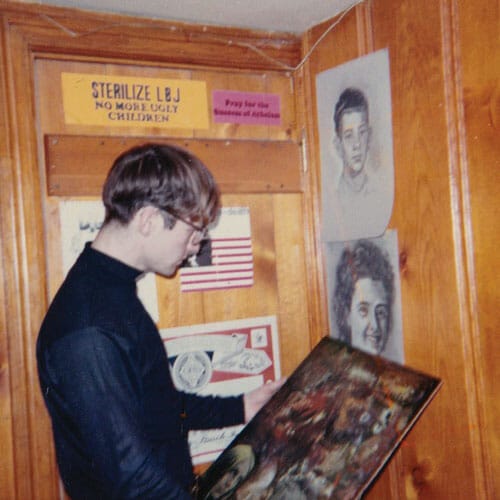
She chose a couple of photo albums from the bundle of manila folders and scribble-filled notebooks. Outside, beyond the window behind her, the walking mall stirred with the usual weekend crowd: Civil War tourists and parents visiting their kids at Shenandoah University on the other side of town. But the pictures on these stiff pages recalled an earlier, gruffer Winchester. Joe had put these albums together haphazardly, so snapshots of his mid-1960s beatnik phase sat next to pictures of his three kids, twenty-five years later. There were a few of his father, but only in old age, and nothing at all from Joe’s earliest years, because that life, the subject of Rainbow Pie, didn’t include cameras.
Joe Bageant was born in 1946 and grew up in the Blue Ridge Mountains north of Winchester, just over the West Virginia line. Joe knew the family farm on Shanghai Road as “Over Home,” a place where generations of Bageants had grown, picked, and preserved their own vegetables and slaughtered their own hogs, all without modern machinery or vehicles. In his memoir, he describes his childhood as “anachronistic even in the 1950s . . . vestigial, charged with folk beliefs, marked by an ignorance of the larger world, and lived unselfconsciously under the arc of Jeffersonian ideals, backed up by an archaic confidence in the efficacies of God’s word and grapeshot.”
The only currency in such a life was work, “calories burned.”
The only currency in such a life was work, “calories burned.” Joe estimated his grandfather never made more than $1,000 a year, but the family lived well enough on only a few acres of vegetables, a small stock of animals, and deeply ingrained wisdom about the management of each. Shanghai Road was dotted with similarly rooted families. They patronized the same general store for staples and relied on each other for the rest of their worldly needs, like a truck to haul the yearly tomato harvest to the nearest cannery. It was “a system where everyone benefited through an economy of labor,” he wrote in Rainbow Pie, “with the small money of small farmers supplying the grease for the common-sense machinery of community sustenance.” And even before Joe was old enough to join hunting trips with his daddy and uncles, it was doomed.
The postwar boom made quick work of hill-country living like this. New highways and subsidies gave large-scale producers an advantage over family farms. It took barely a generation for rural Americans to succumb, and soon they were ensnared by corporations; whether on assembly lines or by “driving truck,” they started working for the same people who had put them out of business.
With a Teamsters salary coming in, Joe Sr. took his wife and children to the city and left Over Home to the grandparents. When the Bageants arrived in Winchester in the late 1950s (or rather, returned, since the family name had been there as early as 1755), it was still largely controlled by a small group of land-owning families. Chief among them were the Byrds, whose patriarch, Harry Flood Byrd, had been Virginia’s governor in the 1920s and its senator since the 1930s. He also owned the town’s only newspaper, the Winchester Star, and a couple other regional weeklies, as well as the largest orchard business in the apple-rich valley outside the city limits. Joe later claimed to have mowed Harry Byrd’s lawn as a teenager, though he had a lifelong fondness for suspiciously unverifiable stories, particularly regarding brushes with celebrity. (By various friends’ accounts, he was either babysat or given a toy or sung to by Patsy Cline, who was still living on South Kent Street when the Bageants came to town.)
Whether or not he actually cut the senator’s grass, Joe was immediately affected by the stark class division that Byrd and his ilk enforced. His father quit trucking and began working in an auto shop, but money remained tight. The Bageants moved whenever they fell behind on rent, which meant they moved constantly. Even as a teenager, Joe sensed that their relocation to the city had cost them much more than a place on their ancestral land. His mother was repeatedly hospitalized for depression, and his father, whose labor had once been enough to fill his three kids’ bellies, now struggled to keep their bedroom heated. Joe so pitied his father that he didn’t even hate the man for taking the shame out on him with a belt.
Bad at school, bad with girls, beaten at home, Joe found refuge at the Handley Regional Library. He would often skip school to follow what he later called a “marvelously undirected pursuit of the mind,” consisting of
Boy’s Life Magazine, the history of the Shenandoah Valley, Pericles’ orations, Jack London, Fur, Fish and Game magazine, countless books on painting and great painters, Civil War diaries, American Heritage magazine, and old hardbound editions of Lord of the Flies, Richard Wright’s Native Son, Dickens, Genet, Sartre, and Rimbaud.
He also painted well enough for a mail-order art school representative to visit one of the Bageants’ many addresses and offer a scholarship covering two-thirds of the course’s tuition. Joe, then thirteen, offered to pick up an extra paper route to cover half of the remainder, but his father still had to decline. That last $50 was too much for the family to bear on a car repairman’s wages.
This was how Joe learned about the shame of poverty. Not material lack—the subsistence life on Shanghai Road had certainly been dollar-poor—but the brutal reality of his dad’s sixty-hour work week for non-negotiable pay that barely covered life’s necessities, let alone his son’s blooming artistic dream. It was the unfair terms of the struggle that stuck with Joe, the fact that wealthier people had pushed his family off the farm, and then kept them in a chokehold when they landed in town.
And then, like a bomb: acid. He first took it in 1965,
thanks to my gay friend George, who was being “treated” for his homosexuality with lysergic acid and enjoying every minute of treatment. . . . After creating a small meditative space with plants, a Tibetan mandala, and classical music on the turntable, we took it. Five years later I was still taking it at least once a week, and to this day I consider LSD the Promethean spark of whatever awakening I have managed to accomplish in th[is] life. . . . For the first time in years, my life in that small town was very enjoyable.
By this point, Joe had dropped out of school and married a curly-haired country girl named Cindy. He was also a veteran, having lied about his age to join the Navy at sixteen. He had served noncombat time aboard the USS America, but his military career was only just long enough to secure VA benefits, and when he returned home, he had found a
small psychedelic scene, one among thousands in heartland America at the time . . . an assortment of perhaps fifty artists, gays, hillbilly hipsters, academics from a nearby college of music, passing beatniks, and psychedelic enthusiasts . . . hanging out at a marvelous old “dinner and juke joint” in the poor section. . . . Finally, the good fundamentalist Christians and Republican business community just couldn’t take it any more.
Joe was the inaugural victim of the crackdown. He claimed for years to be Winchester’s first marijuana arrest, and also claimed to have lived while awaiting trial in Resurrection City, an encampment in Washington, D.C., set up by Martin Luther King Jr.’s Poor People’s Campaign. This dates the ordeal to the summer of 1968, meaning he was already a father; Cindy gave birth to Timothy, named for Leary, in 1967. Joe was acquitted, but the experience shook him enough that he knew he couldn’t keep his young family and newly expanded consciousness locked in Byrd country anymore. In 1969, he and Cindy escaped in a school bus, hayseed flower children set free.
A Fleeting Paradise
At the time, Boulder, Colorado, was referred to as the Buckle of the Granola Belt, and indeed, there might as well have been a dog whistle blaring on Pearl Street, beckoning the nation’s dropouts and longhairs. The clean air and relative seclusion attracted everyone from the Weathermen to the Nitty Gritty Dirt Band to Allen Ginsberg. The nearby Pygmy Farm, one of the many rural communes sprouting up at the time, hosted visitors like Chögyam Trungpa, a Buddhist scholar who loved the area so much he stayed, founding Naropa University and the Shambhala Meditation Center in the early 1970s.
Joe and Cindy pulled in after nearly a year of travel in their school bus. They were heading for San Francisco, that better-known hippie mecca, but the Rockies felt like kismet. Joe liked to say that they pulled into Boulder on the inaugural Earth Day: April 22, 1970. The atmosphere of Buddhism, banjos, and Beat poetry made San Francisco seem unnecessary.
Jerry Roberts, now an assessor for Boulder County, was a recent college graduate when he first met his neighbors Joe and Cindy in 1973. Jerry came from West Virginia, but his other connection to Joe was musical; they spent most of their early friendship playing guitar together. Joe had an encyclopedic knowledge of Appalachian and country music from Over Home. Jerry, a few years younger, was plainly in awe. “He was an incredibly creative person—it just oozed out of his pores,” he told me.
The mood in Boulder was high-minded in every sense, but Joe was the son of a laborer with a son of his own, and he wasn’t afraid to take on manual work. At one point, moving boxes at a grocery store, his back gave out. Laid up in the hospital, Joe began to write in earnest. He shared a poem when Jerry came to visit, a “Howl”-indebted portrait of Boulder’s nightlife scene. With a couple of friends, Jerry made copies of it and posted the poem around the city. His name was left off, but when he was discharged from the hospital, Joe was happy to see his work out in public for the first time.
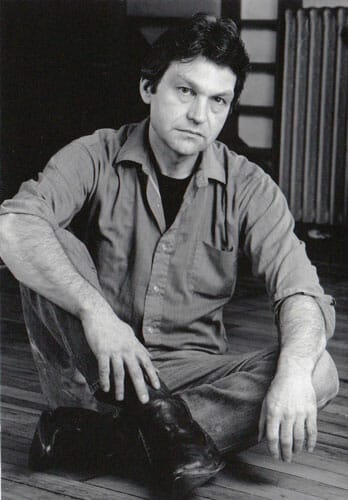
He started picking up freelance bylines, writing features about local characters and touring musicians. His steadiest work came with a Boulder-based ersatz Rolling Stone called The Rocky Mountain Musical Express. Joe was its main editor by 1977, and also its most frequent contributor; he filled pages with his own writing under multiple pseudonyms. His freelance staff included Mark Bliesener, a studio musician who arrived in Boulder in 1976 while playing in a late incarnation of Question Mark and the Mysterians. Bliesener, who had never written seriously before the Musical Express, recalls visiting the Bageant trailer home to deliver a draft for the upcoming issue: “He gave me a copy of The Elements of Style, sold me a bag of speed, and said, ‘If you want to write, here’s what you need.’”
Joe started taking road trips with the Express’s distributor, Ward Churchill, who is now a prominent American Indian advocate (and a former college professor—he lost his job in 2007 after referring to World Trade Center workers as “little Eichmanns”). Churchill took Joe on numerous trips to reservations, and introduced him to activists like Russell Means and Vine Deloria Jr. Joe was still a voracious reader, and would almost certainly have read Deloria’s epochal Custer Died for Your Sins: An Indian Manifesto (1969), a wry and bitter essay collection about the historical exploitation of a rural minority—and a book that Joe may well have had in mind while writing Deer Hunting with Jesus.
It was an era of agitation for Indian rights. In the summer of 1979, a federal court awarded the Sioux tribe more than $100 million in damages for their forced removal from the state’s Black Hills region. The Sioux refused to take the money and began a prolonged, violent standoff in the Black Hills. Joe patrolled the occupation’s border with Ward Churchill and a group of John Birch Society members—imperfect but willing partners who had come on board out of shared contempt for the U.S. government.
But for all his broadening horizons and writing momentum, Joe hadn’t yet made a proper home for Tim and Cindy, so after a decade out west, they decided to move back to Winchester. There were few goodbyes, and this would prove to be a pattern. Joe could make friends with anybody, anywhere, but always had an eye on the exit. “I don’t know anyone in my life who was smarter than Joe,” recalls Jerry Roberts, “but that doesn’t give you self-esteem. He was always wanting to go somewhere else.” Later, Joe would look back on his time in Boulder as one of the happiest periods of his life: “All these years later I am beginning to understand the effect [that] living for a decade or so in a genuinely free time and place had on my life. . . . A weird electricity arched over everything, as blown-away rap sessions drove into the starry night while sanity cowered in the back seat. Yup, this was paradise all right.”
Back to the Land
Joe had left Winchester as a high school dropout, teen father, and purported drug casualty, but he returned as a seasoned journalist, and ended up working for the Byrd family once again, this time on the staff of the Star. Remnants of the Granola Belt still clung to him: he claimed a battered, thrown-away desk for his office, and lined up almost twenty containers of vitamins on its edge to advertise a strict regimen that he’d heard would give him total recall.
But Joe had few other outlets. He and Cindy separated in 1979, and Joe was devastated. He’d found his way into the Winchester middle class but didn’t get much comfort from it. The divorce, as he surely recognized, would disrupt Tim’s life right at the age when Joe’s had been shaken by the loss of Over Home. He retreated back to Boulder, a radical with no outlet and a romantic with a broken heart.
By then, Boulder’s conversion from hippie outpost to commoditized yuppie playground was well underway. The “People’s Republic” vibe was losing out to higher costs of living and real estate development. The Musical Express was no more, though Joe managed freelance features with other local and national magazines. He met a bright and idealistic woman named Nancy, who was writing a newsletter for the well-known Boulder Free School.
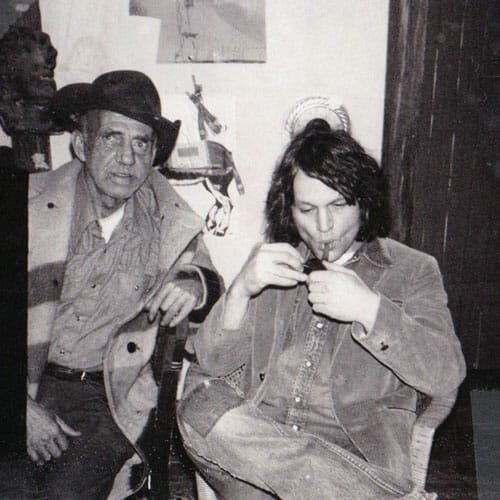
United in their disappointment over paradise lost, Joe and Nancy dropped out. Joe knew that Indian land was cheap, so they got married and set out for the Coeur d’Alene Reservation in the Idaho panhandle. Plenty of their peers had attempted a similar feat, but the heyday of Mother Earth News and The Modern Utopian had passed. And most of those middle-class homesteaders in the ’60s and ’70s had tried some kind of communal arrangement, whether sharing a house between several families or joining a collective. Joe and Nancy, by comparison, found a desolate, forest-adjacent plot about ten miles from the nearest town, St. Maries.
They bought the shack in 1982, with no electricity, running water, or address. It was on a dirt road about halfway up a mountain, which must have recalled Shanghai Road. Joe worked tirelessly, clearing forest and planting a garden behind the house. He built a barn for horses and livestock. Their first child, Patrick, was born in November 1982, and their second, Elizabeth, arrived in May 1984.
To the extent that any couple can remove themselves from the politics and culture of a country while still living there, Joe and Nancy managed it, living more or less self-sufficiently apart from rare trips to the St. Maries food co-op. But as a quest for personal happiness, it wasn’t as successful. The kids reached school age by 1988, and by that point the pressures of self-sufficiency were too much. Like his father before him, Joe took his kids from the country to the city, in this case Moscow, Idaho, on the border with Washington state. He and Nancy divorced soon after.
The old anger returned, as did the memory of watching his father tremble when the rent money ran out.
Joe was now forty-two years old, with three children, two failed marriages, and no definite home. He took up writing again, this time for a local paper, The Idahonian. From his easy but musical style you wouldn’t guess that he’d been chopping wood and tending to horses for the previous six years. He interviewed Woodstock attendees for the festival’s twentieth anniversary, and touched on politics by talking to locals like “Big Leroy” about everything from gas prices to Vietnam veterans.
Around this time he met Barbara, who was living in Pullman, Washington, right across the border. Both are small college towns, “so if you were over thirty, you just wanted to meet anybody,” Barbara told me. “Anything besides watching how drunk the twenty-year-olds could get on the weekends.” But it turned out that she and Joe had more in common than simply being stranded. The decade before, Barbara had been an antiwar protester and vocal feminist in Madison, Wisconsin, raising her son in a reflexively liberal community steeped in Gloria Steinem and Free to Be You and Me. From the first, she recognized a fellow traveler. “A lot of women my age were raised to accommodate men,” she says, “but that wasn’t a big thing with Joe.” Instead, they could talk about books and music. He cooked for her and reminisced about his own radical days.
On January 23, 1990, Joe wrote an Idahonian column about Mississippi, particularly its blues traditions and poverty: “Sometimes it seems to me like the Mississippi River washes all the unconscious repressions of the rest of America down to the Delta, where they lie in a volatile, dormant state until some new change comes along to touch them off.” After an evocative litany of southern scenery—kudzu, field hands, “bobbing white cotton”—he ended the essay on a personal, not political, note: “I miss it. I really do.”
Nevertheless, he went west next, not south. Eugene, Oregon, was a more liberal town than Moscow, but the move inaugurated the straightest, most middle-class period of Joe’s life. He first worked for a nonprofit that served foster children, writing their PR materials and mentoring kids. On one field trip, he took a group of young boys to see then-candidate Bill Clinton on the 1992 campaign trail. But soon he left that job for Crop Production Magazine, a glossy trade publication that had one patron: the gigantic food processor ConAgra, which sent issues to all its customers.
The arrangement was beyond lucrative, and as editor, Joe was obliged to live the same lavish lifestyle as his publisher: dinners out on the corporate card, sometimes in San Francisco, and expenses-paid trips to Las Vegas with the wives, where a $500 shopping allowance awaited them at check-in. Joe was suddenly a man for whom Scotch preceded dinner, and dinner preceded brandy. Which is to say, he had finally caught up to the business class that ran his hometown, and to the kind of company, ConAgra, that had driven his people into the cities.
And it made him miserable. The work was vapid and superficial. It was as bad as Joe had always assumed the world of the Byrds was, even while envious of its money. Now he had money of his own, more than he’d ever expected to have, and he came to the realization that it didn’t quiet his mind or offer any sense of meaning. And so he asked Barbara, what about Winchester?
A Colonial Home
Their house was on the west side of town, far from the train tracks and close to the unofficial royal mile, Washington Street, where the properties are more like castles. Nearby was Stonewall Jackson’s former headquarters, now a museum. Joe and Barbara’s place, with its pillars and porch, fit right in, even if they had to clean a little mold off the walls.

Winchester had become unrecognizable. For one, an influx of outside companies had brought a huge new labor force, many of whom were immigrants. More than 50 percent of Winchester residences were rentals, a fact Joe gleaned from conversations at working-class bars like the Royal Lunch and Coalie Harry’s. He further learned that the biggest property owners served on the local government, and had efficiently suppressed any regulations on rental properties. The old anger returned, as did the memory of watching his father tremble when the rent money ran out, and soon Joe founded the Winchester Tenant’s Board.
He interviewed renters and gave away his own money when they asked him. He wrote regular scathing letters to the Star detailing the exploitation. He killed rats in the unregulated apartments and brought them to city council meetings in a box—anything to call attention to the abuse. Soon Coalie Harry’s could no longer contain his exasperation, and he began writing in chat rooms under the screen name “ScreamingMan.” Then came “Howling in the Belly of the Confederacy,” and the deluge began.
As a private citizen, Joe despised Winchester’s cretinous Republican class, but once his writing grew more ambitious, he tapped into a deeper, more personal resentment of his self-satisfied liberal peers who could somehow never understand his feelings about working people. “Fifty years ago, men and women of goodwill agreed that every citizen had the right to health care and to a free and credible education,” he wrote in Deer Hunting.
It was to liberal Americans and their party that these humanist ideals were entrusted. . . . Nobody kidded themselves that Republicans—the party of business—would look out for the education of the working class, or for the health of working-class children and oldsters. . . . That’s what Democrats and liberalism stood for: working people and collective progress. Between 1932 and 1980, Democrats held comfortable majorities in both houses of Congress in all but four years (1947–1949 and 1953–1955). You’d think that sometime during those forty-eight years the party of Roosevelt would have done the right thing about health care and education for everyone. Especially during the fat nineties. But the stock market was booming, and middle-class professional and semiprofessional liberals had their diplomas in hand and their student loans paid off. They had jobs and those newly established 401(k)s that begged to be fattened, and airfare to France was cheap and . . . well . . . you know how it is. I cannot point fingers here. I was certainly among them at the time.
This vein of anger, guilt, and sadness proved surprisingly relatable. By January 2005 Joe was receiving so many fan emails that Ken Smith, a fan himself who had offered to create and manage joebageant.com, started running them on the site. The emails came from all over: Fair Oaks, CA, and Auburn, WA; DuQuoin, IL, and Davenport, IA; Chatsworth Island, Australia; Leeds, Vancouver, Beijing. The writers tended to be Joe’s age, with a similar perspective on America’s despoliation. “My roots are in the Texas dirt, but I made a journey through the student radical acid communal left,” said one. “Your articles remind me so much of my family. They are the same pissed off, ignorant white trash that fought their way from Virginia, through the Appalachians, to East Texas,” said another.
He signed his book deal in May 2005; the working title was DRINK, PRAY, FIGHT, FUCK: Dispatches from America’s Class Wars, though late in the editorial process it was changed, in part because of commercial considerations, but also because its metrical thunder had been stolen by Eat, Pray, Love.
Joe used his advance to move to Belize, a country he hadn’t seen in thirty years, and then only as a tourist. As he told it, he arrived there and soon met a young family from the town of Hopkins Village, a coastal outpost founded by the survivors of a slave ship crash. He agreed to pay for and help build a guest house that the family could rent for extra income. As payment, he could stay in it for free whenever he came to Hopkins. Three thousand miles from Shanghai Road, Joe felt he’d found one last bastion of the communal, sustainable life that American consumerism had long since made impossible. “What I get out of it is a feeling of direct accomplishment that a man can never have in this country,” he wrote on his site.
Being a working man in America means that, no matter how much you earn or how hard you work, it is never enough and the job is never done. Never do you feel the immediate satisfaction, much less security, from your labors as a citizen of the empire. Pay and work and grind and pay some more as everything drags on forever extracting ever-increasing sums of money just to hang onto what you’ve already paid for. And always there is the specter of retirement and all the geet that is supposed to require. . . . I have no doubt that I could easily live in Hopkins for about $400 a month . . . and manage to have some left over for rum, guitar strings and a little ganja.
It wasn’t the romanticized toil of rural labor that Joe missed, nor the uneducated culture of mountain people. Rather, it was a sense of wide-eyed exploration and a genuine affection for the soil. This is what the Colorado Buddhists espoused, what the Nitty Gritty Dirt Band and the other “newgrass” acts of the era conveyed. That attitude was short-lived in America, though Joe lived through its zenith, and Deer Hunting with Jesus, which only glances at this aspect of his life, is shot through with its influence. In one chapter, Joe describes his “sideways kin” Tom, another country transplant. They’d met back in 1957 in Winchester, and bonded over Dylan and drugs. “Given this shared background,” he wrote,
you can imagine my slack-jawed incomprehension when all these years later we meet again and I see that he has become a conservative hard-liner and, at least for a while, a born-again Christian. . . . Tom is intensely antiunion, which amazes me since I can remember when he had a Che Guevara poster on his apartment wall. You’d think after twenty years in a southern factory a guy would be begging union organizers to sweep through this town like Grant took Richmond. But Tom and most other plant workers here have bought the rightist mantra that goes: “Maybe unions were once valuable, but they have priced American labor completely out of the market.” . . . Tom, like me, has heard this line from birth.
Joe blamed Tom’s transformation in part on liberals, who, in their noble rush to disown the racist southern elements of their party during the civil rights era, pulled away from the region entirely, leaving an information vacuum that Fox News and GOP operatives would later exploit. “There is no good reason,” Joe continued,
why for the past thirty years the uncertainty and dissatisfaction of people like Tom . . . was automatically snubbed as unenlightened by so many on the left. If the left had identified and dealt with this dissatisfaction early on, if they had counteracted the fallacies the Republicans used to explain that dissatisfaction, if they had listened instead of stereotyping blue-collar angst as “Archie Bunkerism” . . . we might have witnessed something better than the Republican syndicate’s lying and looting of the past six years.
There was a time, Joe contended, when “Americans were concerned with actualizing individual potential,” and that time was the 1960s. He cited the desegregation of schools and colleges, the commitment to social change, and of course the cultural-pharmaceutical innovations.
There was such vigorous electricity in the air, so many possibilities in ourselves and in America, that this working-class boy grabbed his wife one day and said: “Let’s grab the baby and head west, and grow our brains and hearts, read Rilke and Chief Joseph and Rimbaud and Lao-Tzu and burn meat on open fires with cowboys! Maybe even meet Allen Ginsberg!” And we did it too.
Joe Bageant was hardly the only one to view the sixties this way. The sons and daughters of mainstreamed baby boomers have heard it all our lives. But Joe recognized that the era’s passing meant more than just a dropoff in the quality of pop radio. It signaled victory for the money-grubbers. The most prominent liberals of Joe’s generation, people like the Clintons and John Kerry, were corporate types just like their purported foes: “They ‘support the troops.’ . . . They play the imperial game, maintain their credit ratings, and plan to keep the beach house and the retirement investments” no matter how dismal life may grow for the rural residents of West Virginia, New Mexico, or Mississippi. Joe argued that Americans’ turn away from the earth—and with it, our marginalization of people who live for it, red or blue—constituted a denial of “the one truth held in common by every enlightened civilization: we are our brother’s keepers.” This new, profits-first society driven by fear, debt, TV, and petroleum is a Republican-designed dream, so they always win, even when they lose. And Democrats were willing to forsake their old base of Southerners and environmentalists just to enjoy their own small version of that victorious feeling.
Expatriots
Joe lived much of his final years in Ajijic, an expat-filled town near Guadalajara, Mexico, at the invitation of his webmaster Ken Smith. Joe needed the international airport in order to honor his frequent speaking invitations abroad, and though he still lived half the year with Barbara in Winchester, he wanted to avoid paying American taxes. Barbara says he used to joke that his months away were his gift to her; he knew that he’d grown intolerably bleak, and he was so terrified of a third divorce that it seemed better to just stay away and avoid fights. Joe’s ethical view had grown toxically pure, with no room for the normal compromises most people must make in order to buy affordable clothes or occasionally enjoy themselves in the First World. “He had the moral high ground in every argument we had,” Barbara claims. She didn’t discuss her own life because she didn’t feel like getting a lecture or being made to feel petty. Compared to the Belizean poor, she had nothing to complain about, after all.
A few days before Christmas 2010, less than a week after Joe had gone into the Mexican mountains on horseback to drop acid with a group of gauchos, Ken took him to a doctor to have his stomach pains checked out. An X-ray revealed a gastrointestinal stromal tumor, bigger in mass than his liver. “I don’t want to die in the America I see emerging,” he had written four years earlier, justifying his move to Belize. He would not get his wish. After three months in and out of VA hospitals and in a prescription painkiller haze, Joe died with his three kids, Barbara, and Cindy by his side. In lieu of a funeral, they drove up to Shanghai Road and scattered his ashes in private.
The outpouring of grief came on his website, where Ken rounded up tributes by bloggers and writers from around the globe. It is the final irony of Joe’s life that he found his largest audience by writing about the dissolution of his community. Raised on the eastern frontier, reborn in the acid-drenched West, and lost all over again in the corporate hinterlands, Joe Bageant returned to Winchester to bury the shame of childhood poverty at last. Instead, he found a battlefield on which he could finally use the full force of his drop-out beliefs on behalf of the people who had taught him to love the land in the first place. These people, of course, didn’t read his book; they barely read anything.
Where was home for this terminally displaced, community-obsessed man? He gave a hint in one of his essays that appeared online after Deer Hunting. “Often at my speaking engagements or readings, I see one or more of them in the audience,” he wrote, “long gray hair, loose-fitting, sensible, well-worn clothing, soft eyes, and perhaps an herbal amulet around the neck or in the hair. . . . Immediately after the reading or talk or whatever, I seek them out if at all possible (press agents sometimes screw this up). Always there is the big smile and the hug.
“And we are again brothers and sisters, as we used to sincerely address each other on the street. And again I have been granted the gift, that brief spark of unquestioned mutual love and goodwill in a darkening time.”

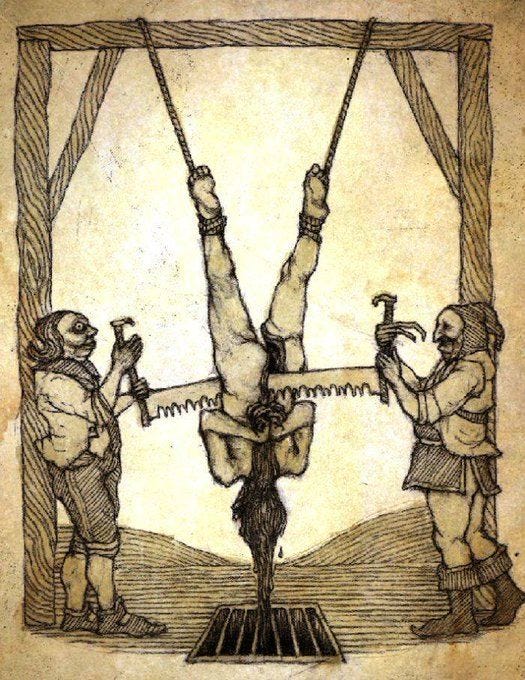
“These are the people who later on set out to civilize the world.” -Eusi Kwayana
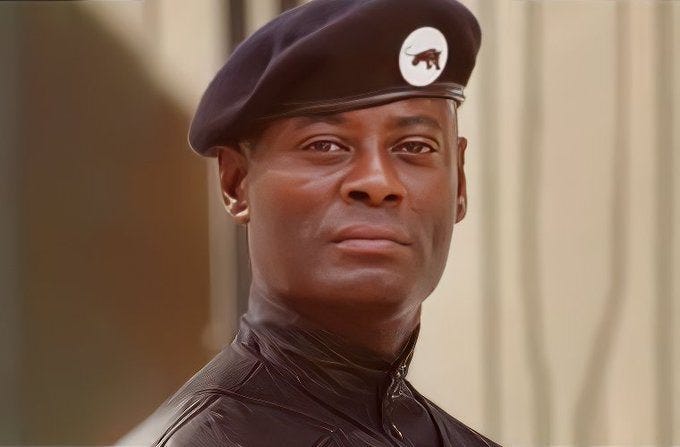
“ I was born to give the white man hell, and I will give him hell from the cradle to the grave.”
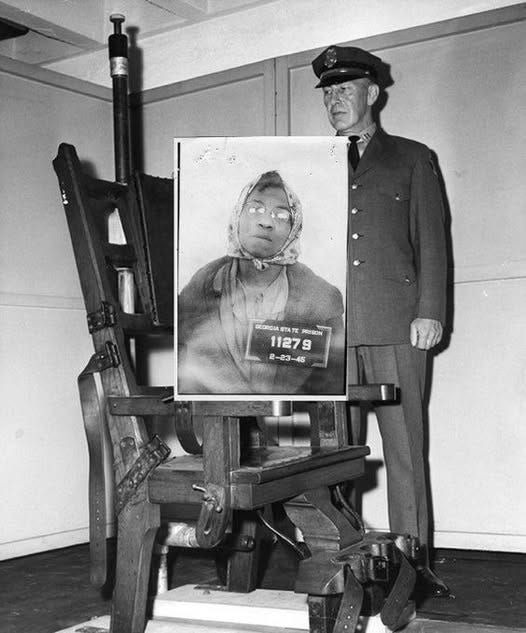
On March 5th, 1945, Lena Baker, a maid, mother of three and former cotton-picker, was the first woman to be executed in the state of Georgia. She was wrongly convicted for killing her white employer, Ernest Knight, after he held her captive for days and threatened to kill her if she went back home to her family. Knight promised to kill Lena Baker with an iron bar. She took his gun in self-defense and shot Knight. She immediately reported the incident to the authorities and told them exactly what happened and how she shot him in self-defense. She was charged with Capital Murder at trial by an all-white male jury. Baker was the only woman executed by electrocution in Georgia. 60 years later in 2005, Baker was granted an unconditional pardon by the state of Georgia.
Don’t forget Lena Baker!! She’s just like all of the innocent black lives lost today and desired to be forgotten and thrown away.
 Paul Haeder, Author