

“To men like us, the rules need not apply.” — Oppenheimer
Jul 29, 2025
The climate agenda is clearly being used to transform the world we live in. A world in 2030 according to WEF Young Global Leader and Danish MP Ida Auken, where you will own nothing and have no privacy. Her article (“Welcome To 2030: I Own Nothing, Have No Privacy And Life Has Never Been Better”) was published in Forbes, and by the World Economic Forum in November 2016. I leave it to your discretion as to whether her and the WEF’s vision is wonderful and desirable, or a dystopian hellscape. Does this article give us a unique insight into the dystopian, centrally planned future institutions like the WEF are planning for everyday people (e.g., a world with no privacy, no private property ownership, with compulsory digital IDs, digital currencies, and social credit scores)? I have always interpreted UN SDGs and Agenda 2030 to mean a heavily technocratic future, where the true intention is to monitor, control, and direct all life on the planet. I agree with Alison McDowell’s view that powerful interests are using the SDGs “to mask their plans to remake the world as a digital panopticon.”

Corsight —
Hip company, no?

Corsight AI is dedicated to creating industry-leading face intelligence technology with unrivaled speed, reliability and privacy. The technology is powered by Autonomous AI®, the most advanced artificial intelligence system developed by top AI researchers and backed by more than 250 patents.
Our mission is to radically enhance the world of face intelligence technologies while holding ourselves to the highest ethical standards in personal privacy protection.We provide facial intelligence solutions built for the most challenging environments, helping make communities safer while respecting individual privacy. Corsight AI works with enterprise clients and government agencies in a variety of industries including aviation, law enforcement, retail, entertainment and more.
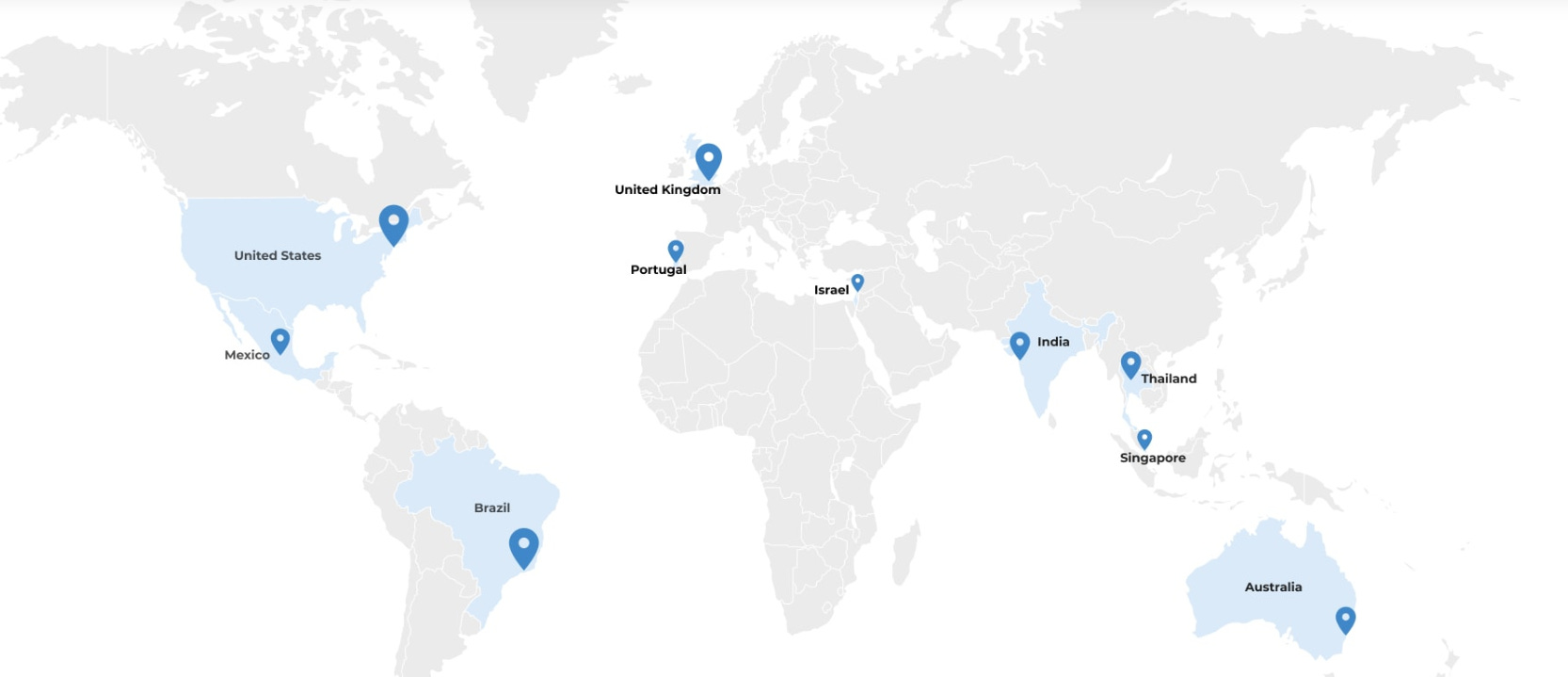
Corsight AI is headquartered in Israel, with local representatives and operations around the world.

What a hip company!

“Israel Deploys Expansive Facial Recognition Program in Gaza“, 27 March 2024
Within minutes of walking through an Israeli military checkpoint along Gaza’s central highway on Nov. 19, the Palestinian poet Mosab Abu Toha was asked to step out of the crowd. He put down his 3-year-old son, whom he was carrying, and sat in front of a military jeep.
Half an hour later, Mr. Abu Toha heard his name called. Then he was blindfolded and led away for interrogation.
It turned out Mr. Abu Toha had walked into the range of cameras embedded with facial recognition technology, according to three Israeli intelligence officials who spoke on the condition of anonymity. After his face was scanned and he was identified, an artificial intelligence program found that the poet was on an Israeli list of wanted persons, they said.
Mr. Abu Toha is one of hundreds of Palestinians who have been picked out by a previously undisclosed Israeli facial recognition program that was started in Gaza late last year. The expansive and experimental effort is being used to conduct mass surveillance there, collecting and cataloging the faces of Palestinians without their knowledge or consent, according to Israeli intelligence officers, military officials and soldiers.
The technology was initially used in Gaza to search for Israelis who were taken hostage by Hamas during the Oct. 7 cross-border raids, the intelligence officials said. After Israel embarked on a ground offensive in Gaza, it increasingly turned to the program to root out anyone with ties to Hamas or other militant groups. At times, the technology wrongly flagged civilians as wanted Hamas militants, one officer said.
The facial recognition program, which is run by Israel’s military intelligence unit, including the cyber-intelligence division Unit 8200, relies on technology from Corsight, a private Israeli company, four intelligence officers said. It also uses Google Photos, they said. Combined, the technologies enable Israel to pick faces out of crowds and grainy drone footage.
Three of the people with knowledge of the program said they were speaking out because of concerns that it was a misuse of time and resources by Israel.
Matt Mahmoudi, a researcher with Amnesty International, said Israel’s use of facial recognition was a concern because it could lead to “a complete dehumanization of Palestinians” where they were not seen as individuals. He added that Israeli soldiers were unlikely to question the technology when it identified a person as being part of a militant group, even though the technology makes mistakes.
Israel previously used facial recognition in the West Bank and East Jerusalem, according to an Amnesty report last year, but the effort in Gaza goes further.
In Gaza, which Israel withdrew from in 2005, no facial recognition technology was present. Surveillance of Hamas in Gaza was instead conducted by tapping phone lines, interrogating Palestinian prisoners, harvesting drone footage, getting access to private social media accounts and hacking into telecommunications systems, Israeli intelligence officers said.
After Oct. 7, Israeli intelligence officers in Unit 8200 turned to that surveillance for information on the Hamas gunmen who breached Israel’s borders. The unit also combed through footage of the attacks from security cameras, as well as videos uploaded by Hamas on social media, one officer said. He said the unit had been told to create a “hit list” of Hamas members who participated in the attack.
Corsight was then brought in to create a facial recognition program in Gaza, three Israeli intelligence officers said.
Corsight declined to comment.
Unit 8200 personnel soon found that Corsight’s technology struggled if footage was grainy and faces were obscured, one officer said. When the military tried identifying the bodies of Israelis killed on Oct. 7, the technology could not always work for people whose faces had been injured. There were also false positives, or cases when a person was mistakenly identified as being connected to Hamas, the officer said.
To supplement Corsight’s technology, Israeli officers used Google Photos, the free photo sharing and storage service from Google, three intelligence officers said. By uploading a database of known persons to Google Photos, Israeli officers could use the service’s photo search function to identify people.
Google’s ability to match faces and identify people even with only a small portion of their face visible was superior to other technology, one officer said. The military continued to use Corsight because it was customizable, the officers said.
A Google spokesman said Google Photos was a free consumer product that “does not provide identities for unknown people in photographs.”
The facial recognition program in Gaza grew as Israel expanded its military offensive there. Israeli soldiers entering Gaza were given cameras equipped with the technology. Soldiers also set up checkpoints along major roads that Palestinians were using to flee areas of heavy fighting, with cameras that scanned faces.
The program’s goals were to search for Israeli hostages, as well as Hamas fighters who could be detained for questioning, the Israeli intelligence officers said.
The guidelines of whom to stop were intentionally broad, one said. Palestinian prisoners were asked to name people from their communities who they believed were part of Hamas. Israel would then search for those people, hoping they would yield more intelligence.

What a fucking Cool Mossad IDF/IOF Company — Google:
And so the Talmudists and Torah Torah Torah freaks are with you and we me 24/7, 365 days a year — in our driving, sleeping, puking, shitting, breathing, beating off, hospital visiting, schooling, workplace action, purchasing, traveling, recreating, dreaming.

Oh, those sneaky little Oppen-Monster-Heimers. What busy busy busy bees.

And so the Gazafication of the World has Already Been Christened:
The AI tool — which is being built under the auspices of Unit 8200, an elite cyber warfare squad within Israel’s Military Intelligence Directorate — is what’s known as a Large Language Model (LLM): a machine-learning program capable of analyzing information and generating, translating, predicting, and summarizing text. Whereas LLMs available to the public, like the engine behind ChatGPT, are trained on information scraped from the internet, the new model under development by the Israeli army is being fed vast amounts of intelligence collected on the everyday lives of Palestinians living under occupation.
The existence of Unit 8200’s LLM was confirmed to +972, Local Call, and the Guardian by three Israeli security sources with knowledge of its development. The model was still being trained in the second half of last year, and it is unclear whether it has been deployed yet or how exactly the army will use it. However, sources explained that a key benefit for the army will be the tool’s ability to rapidly process large quantities of surveillance material in order to “answer questions” about specific individuals. Judging by how the army already uses smaller language models, it seems likely that the LLM could further expand Israel’s incrimination and arrest of Palestinians.
Oh, the cameras are only used to find lost dogs and children!

The phallic of the Jewish Race?

This race of rapists sees all others as cattle:

The little little men of Jewish Israel.

Ahh, the pathogen spreads spreads spreads:

Our sacred football, the Jews are Picking Apart.
Never, ever good intentions:
Yeah, that fucking Semen Drip Zionist Musk:
Tesla Announced Human-Assisted Robotaxi Launch in San Francisco — But State Regulators Say Otherwise
The electric carmaker appears to be both-sides-ing its impending launch, telling regulators it will have human drivers on board while touting the project as ‘robotaxis’ to investors.

Ya think that facial recognition tool won’t be on? DNA scanners, man, from the fingerprints on the window, or just the breath of passengers collected, collated, scanned, and there you go — DNA capture of the world.

[Karp was the first leader of a major Western company to meet with President Volodymyr Zelensky after Russia invaded Ukraine.]
USAID’s DC rollout of the dystopian Diia “state in a smartphone” app introduced by the government of Ukraine’s Volodymyr Zelensky.
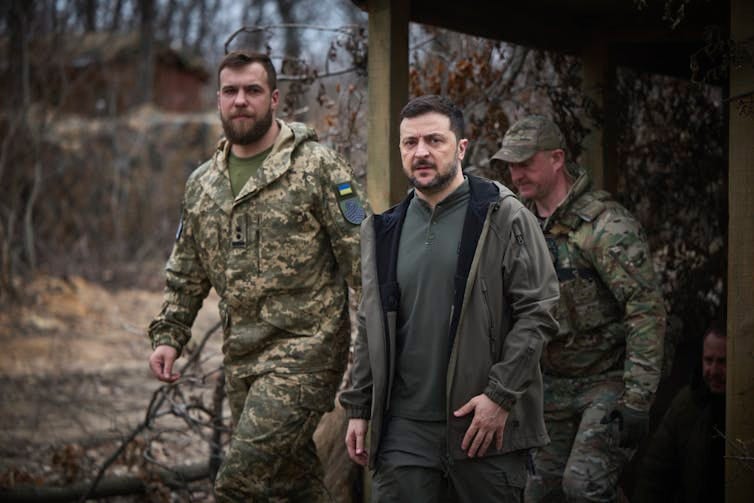
Karp has described Palantir’s work as “the finding of hidden things”. The New York Times described its work as sifting “through mountains of data to perceive patterns, including patterns of suspicious or aberrant behavior”.
Palantir has worked closely with United States armed forces and intelligence agencies across Democratic and Republican governments for 14 years. It has been criticised for enabling heightened government surveillance and loss of privacy among US citizens.
Karp describes himself as progressive – and “a Jewish, racially ambiguous dyslexic”. Unusually for Silicon Valley, he has a PhD in neoclassical social theory from the Goethe University in Frankfurt, Germany. His inspirations include Goethe’s Faust and J.R.R. Tolkien (the latter much loved in the tech world). He is willing to ask big questions about what constitutes “the good life”.
He founded Palantir with (among others) controversial libertarian figure Peter Thiel, who funded Donald Trump’s presidential campaign in 2016 and JD Vance’s Senate campaign in 2022. (Thiel is reportedly financing Republicans again in 2025.)
Karp acknowledges Thiel’s influence on creating a company infused with a sense of national purpose (though, oddly, Thiel’s own worldview seems to be the very antithesis of any collective project).

“Anything approaching a worldview is now seen as a liability”, write Karp and Zamiska, leading to an “atrophying of the mind” and “self-editing”, which are “corrosive to real thought”.
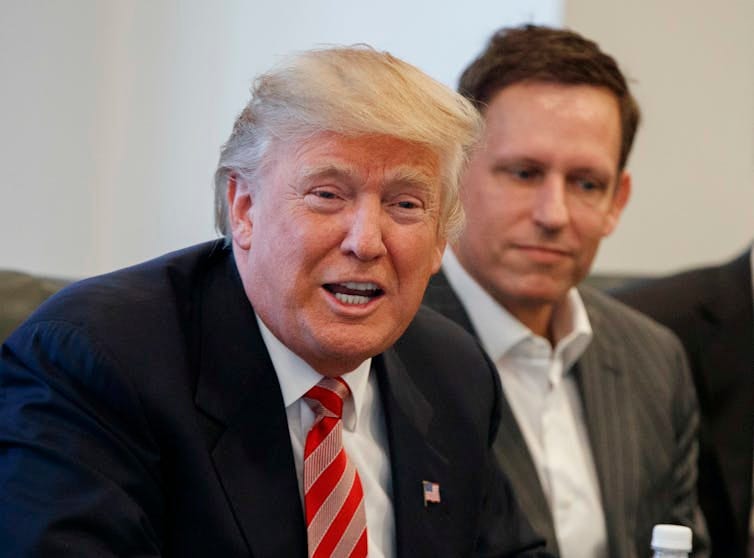
Karp, Zuckerberg and others have learned to fear making strong claims about the national interest in a rancorous public square. Musk was the exception, with his foray into federal politics following Trump’s election. Last week, his company Tesla reported a 12% drop in revenue, its biggest quarterly sales decline in more than a decade.
Silicon Valley’s masters of the universe tolerate anything, believe in nothing (except their own companies’ products) and largely run a mile from politics, Karp and Zamiska suggest. Of course, several tech billionaires were in the front row of Trump’s second presidential inauguration. But this seems less about being actively political than flexibly adapting to changes in power.
According to the New York Times, despite funding the presidential campaigns of both Joe Biden and Kamala Harris, Karp “welcomed” Trump’s 2024 win – and called Musk (whose DOGE would go on to hire Palantir) the most “qualified person in the world” to remake the US government.
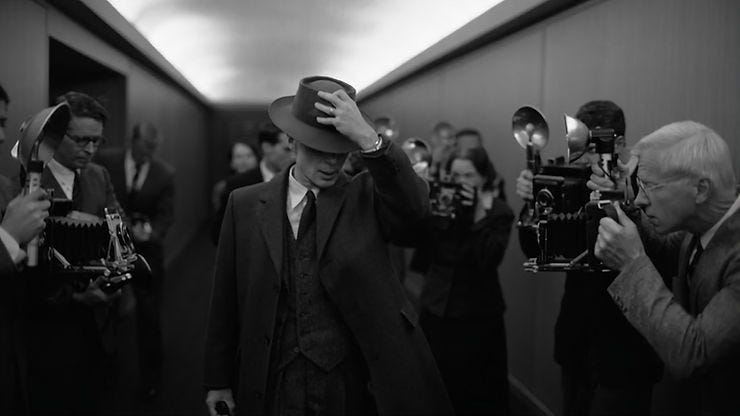
GHOSTS OF THE FUTURE: WHY I THINK OPPENHEIMER IS A BRILLIANT HORROR FILM
At the twilight of her teenage years, Mary Shelley wrote what is widely considered to be the first, true science fiction story. This novel, Frankenstein, is both about the grand scale of academic ambition and scientific invention, and the horror of it. Victor Frankenstein, the novel’s titular hero, creates a monstrous creature in his attempts to invent a lab-generated being. This creature, once freed from the lab, starts a bloody rampage.
This is not a digression from Oppenheimer. This is its premise. Well, almost its premise. Unlike Victor Frankenstein, Oppenheimer didn’t create a sentient being capable of making its own decisions. During the culmination of the Second World War, in a project that was apparently meant to effectively end the war, J. Robert Oppenheimer created something that was used by a nation for a devastation far greater than what Frankenstein’s monster could ever imagine. Frankenstein’s monster, despite being a living, breathing creature, was never named. Oppenheimer’s monsters were named as though they were living creatures – Little Boy and Fat Man.
And like living creatures that return from the dead, they haunt their creator. From the very opening frames of the film muted hues, raindrops, a constant sense of foreboding – Oppenheimer looks like he is staring into the eye of the monster that he is about to create, hypnotised. There is a lot to be said about Cillian Murphy’s hold upon his character.
It is not enough to state that he becomes Oppenheimer. Murphy becomes both the subject and the narrator of this story. Perhaps this is what happens when the actor is also a storyteller, in expressions not in words. He withholds Oppenheimer’s thoughts where need be. In other frames, he unlashes himself, exploding.The film is structured like an unrelenting spiral into the depths of Oppenheimer’s mind. And in signature Nolan style, moments from different timelines blend and melt into each other. Ludwig Göransson’s soundscape Oppenheimer’s ferries fear, guilt and follies across the sequences of the film.
You hear a certain score in a sequence echoing through corridors of Oppenheimer’s mind. Sometime later, Nolan shows you the scene that score has originated in. This is about as much clarity that you can expect from a Nolan film in the first watch – he is telling you, again and again, the subject of his film is a haunted man. There are two characters in the film who are perhaps as aware of Oppenheimer’s haunted-ness as the audience. Kitty, his wife, played by the fierce, strikingly intense Emily Blunt, understands what the guilt is doing to him to some extent.
He sees through the future. She sees through him. She is a conflicted person herself – struggling with her own anger at her husband’s choices, coping with motherhood and a nascent alcoholism at once. She might not understand Frankenstein’s monster. But she understands Frankenstein, and speaks to him with such clarity that she makes it easier for you to understand him.
The second character who understands his guilt – Albert Einstein, played by Tom Conti. He understands. He does not forgive. In many ways, I suppose, the film’s central message is layered beneath the scenes he shares with Einstein and Kitty that despite our knowledge of Oppenheimer’s own repentance, his complicity in the devastation of the atomic bomb can neither be ignored nor forgiven.
It is difficult to fully explain this without giving out spoilers, so it is better to circle back – like the film does – to the visions of its protagonist. At various moments in the film, Oppenheimer sees flashes of the bomb’s impact upon the world. The sharp sparkles of blazing light, the macabre dance of fire spreading across his mind remind you of the visions of a ghost in horror films. No, not a jump scare. I am talking about the everlasting, morbid fear that pulsates through a ghost story. Like ghosts return to haunt the sinner out of an otherworldly spite, the bomb returns to Oppenheimer constantly reminding him of what he did. In ghost stories, the haunting is an inevitable event.

An opening for martyrdom? Not a chance.
Fairly early on in the film, there’s a scene where Oppenheimer asks American writer Haakon Chevalier to look after his child for a while, because he and his wife can’t cope. It’s not the sort of thing that one normally does, but everything goes on account of Robert’s genius.
“We’re selfish, awful people.”
Oppenheimer tells Chevalier, and I believe the entire weight of the film lies in that one scene. The choosing of death over life, because ultimately, Oppenheimer’s research will take him to a destruction and terror of such magnitude he will not be capable of coming back.
 Paul Haeder, Author