

and in that Jewish Racist and Supremacist schema, I am dead in the water, once again, looking for ‘work’
Fucking gets me down EVERY time, man, hundreds of job rejections in 40 years?
April 30, 2025
Thank you for submitting your application and resume to the City of Newport for consideration.
We are fortunate to have many qualified candidates apply for the 60+ Supervisor position. We have reviewed the qualifications of each candidate and after careful consideration, we have determined that the credentials of other candidates may better fit our needs at this time. We invite you to revisit our career site at https://www.governmentjobs.com/careers/cityofnewport to view other current openings.
Thank you for your interest in the City of Newport and please accept our best wishes in your job search.
City of Newport
Human Resources
I was asked by some of the senior center folk to apply since the last and the last process produced not so great candidates, and these people already know me, but alas, this is the screening of the Kafkaesque Human Resouces departments.
More depressing news here on the Oregon Coast, and alas, I get it I get it. These fucking HR pricks and cunts used Google and a deeper tool to screen the internet for my name: and then they attach my name with words like “politics” and “activism” and “anti-American” and of course “antisemitism.”
Here’s the cunt AI response:
Employers often utilize applicant tracking systems (ATS), background checks, and social media monitoring to screen candidates for potential issues, including negative comments about the company.
Here’s a more detailed look:
- Applicant Tracking Systems (ATS):.Opens in new tabMany companies use ATS to manage the hiring process. These systems can be programmed to search for keywords in resumes and online profiles, potentially identifying candidates who have written negative comments or expressed dissatisfaction with the company.
- Background Checks:.Opens in new tabBackground checks can include searches for information on social media, where candidates may have shared their opinions about previous employers or companies.
- Social Media Monitoring:.Opens in new tabSome employers actively monitor a candidate’s social media presence to assess their character and potentially identify any negative comments or opinions about the company.
Important Considerations:
- While employers may look for negative comments, it’s important to remember that social media and online content can be interpreted differently. A candidate’s comments might be a reflection of a personal experience, not necessarily a widespread issue with the company.
- Employers must also be mindful of the Fair Credit Reporting Act (FCRA) and other relevant laws when using background checks and accessing information from social media.

Types of adverse media to screen
So what is adverse media? Unfortunately, “media” itself is a very broad term that can refer to many different types of information sources. Here are some common adverse media examples.
- News outlets: This includes physical and digital newspapers; TV and online news videos; and audio news shows. Investigative journalism can uncover evidence of illegal or unethical behavior by a business (or someone associated with it).
- Social networks & forums: Users of social networks and forums often provide feedback and opinions regarding businesses and their customer experiences. A buildup of grievances, criticisms, and unfavorable reviews can create reputation problems for a business. This could cause risks for you, if you’re affiliated with that business.
- Blogs: Similar to with social networks, a business could post long-form content on blogs that readers respond negatively to (if they’re able), reducing the business’s credibility. Other blog writers could also post reviews, commentaries, and even exposés on businesses that could cause reputational risks — and even other types of risks if the information turns out to be valid.
- Video sharing websites: Users may post things like reviews, commentaries, and even raw footage on video sharing websites that could damage a business’s image if they portray the business in a negative light. Additionally, if the business posts content itself, its reputation could suffer if users consistently give the content negative feedback or comments.
- Regulatory databases: Public sanctions lists and watchlists from regulatory agencies, such as the Financial Action Task Force (FATF), can also count as adverse media. They can indicate a business or associated person is involved in unethical or even criminal behavior, or at least with a country that’s at high risk for this sort of activity. Or they could indicate activities from the business that aren’t necessarily illegal, but can still signal risks (such as bankruptcy filings, court judgments, and liens).
Ahh, so many tools, to find out if I have ever criticized the city of Newport, the social services arena, etc. etc. Know Your Business. KYB.
So, instead of drowning my sorrows with tequila, I went for Richard Medhurst’s most recent interview on Chris Hedges. Talk about depressing. Sure, no chance to interview for an $81k a year job. Downer. Bummer. Worse than that. But Medhurst?
Richard Medhurst’s persecution by both British and Austrian authorities signifies a major escalation in Israel’s and its allies’ full throated attack against the press in the West.
“I was just trying to tell the truth as best as I could with the facts that we had at that time and that’s it. And I think they’re trying to make an example out of me, definitely,” Medhurst tells Hedges.
Medhurst points to Schedule 7 of the Terrorism Act 2000 in the UK as one of the broad laws being used to silence people like him. “If they really want to, they can charge you for just saying a simple fact just because the fact is uncomfortable to the government or perhaps they can twist it into saying you’re glorifying a group but it’s not true,” he explains.
For Medhurst, the UK pinned Schedule 12(1A) on him, which he explains “has never been used before, and escalated it straight to an arrest.” They then took his “fingerprints, [his] DNA, [and] they put [him] in jail for 24 hours.”
Despite his accurate reporting, Medhurst says that the validity of what one says does not matter when it conflicts with the establishment line. “You’re not glorifying anyone. You’re just stating a fact, but they can still charge you. That’s what’s so dangerous about this law,” he said.
Austrian security service agents still possess most of Medhurst’s journalistic tools. There is still no clear time table as to when he will get his tools back.
As Medhurst explained:
“It wasn’t just my phone and my laptop, which I also use for work, which are my work tools, but …you know, hard drive adapters, things that don’t even have data on them, analog microphones. Why would you do that to someone unless you’re trying to make a point that you don’t want them to continue their work?”
Again, we can and shall criticize Judaism or Jews or what have you. AIPAC? Is it ZAIPAC — zionist American Israeli Public (Putrid Propaganda) Affairs (Deceit) Committee (Minyan).

I wholeheartedly agree with this:
“This fetishisation of ‘Jewish anti-Zionism’ is based on racism.
The underlying logic is that resistance to Jewish supremacism is only legitimate if endorsed by Jews. Most individuals on this graphic do not even support the Resistance, or the complete liberation of the Levant from the racist cult of Jewish supremacism. This is due in part to the residual Zionism that clings to Jewish identity, which afflicts the overwhelming majority of Jews.
Depending on which figures you uses somewhere above 60% and up to above 90% of British Jews either say they are Zionist or that Israel has a special place in their lives. Its true that the young are more critical but even there recent figures suggest around 57% are attached to Zionism.
But in the end, why should anyone care what Jewish people think of resistance to Jewish supremacism? Did we poll Germans on whether we should attempt to eliminate the Nazi threat? Did we beg for German ‘allies’ in this cause?
Jewish ‘communities’ and institutions (like the JNF, CST, BoD, JLC) are the backbone of Zionist militarism. They provide the money, the manpower and the tactics to steal Arab land across the Levant; to terrorise Muslims globally; and to penetrate and subvert political systems the world over.
The Western Left’s reification of Jews and fetishisation of Jewishness comes with the price of: complete irrelevance from the liberation struggles of West Asia; a startling ignorance of Islamophobia and a deliberate obfuscation of how it works, so as not to offend Jewish Zionist sensibilities; and the embedding of Islamophobia in left-wing thought.
Quite simply, a Jewish life, a Jewish voice and Jewish concerns are elevated in importance — certainly to a higher level than any Palestinian or Lebanese — by most Western Leftists, whether they know it or not.
Until this endemic and frankly inane form of racism — practiced throughout the Corbyn years by Corbyn himself and his team; organisations like JVL and their ilk; the ‘Palestine Solidarity Campaign’ and other ‘Jewish’ or ‘left’ groups — is defeated, the Western Left will remain a tool of the Zionists, as it has been especially since 1948.”=-Professor David Miller
+—+
The unending propaganda NEVER ends.
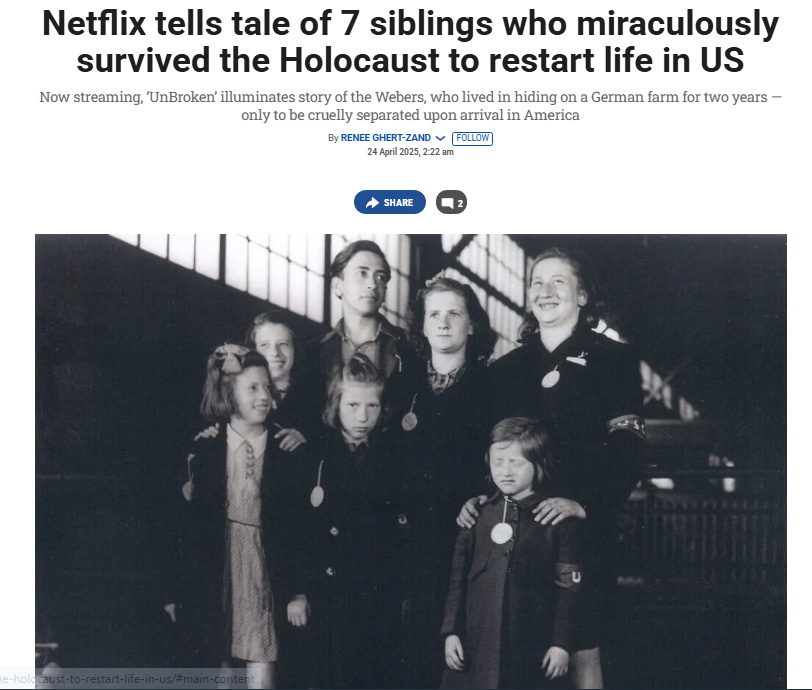
Stone the fucking Jew:
Yes, roots, spawn, sperm, family do say A LOT about people: Early life
[edit]
WIlliam Oliver Stone was born on September 15, 1946 at Doctors Hospital in New York City, the only child of Jacqueline (née Goddet)[11] and Louis Stone (born Abraham Louis Silverstein), a stockbroker.[12] His parents met in his mother’s hometown of Paris during World War II where his father, a U.S. Army colonel, served as a financial officer on General Eisenhower‘s staff.[13][14] Stone’s paternal great-grandparents were Ashkenazi Jewish immigrants from Poland. His grandfather, Joshua Silverstein, owned and operated successful skirt-making companies in New York City and New Jersey.[15] His aunt was author and editor Babette Rosmond and his cousins are writer Gene Stone and former chairman of the United States Commodity Futures Trading Commission James Stone.[16] The family changed its surname from Silverstein to Stone in the 1920’s due to rampant antisemitism in the United States. Stone himself grew up in Manhattan and Stamford, Connecticut. While his American father was Jewish, his French mother was Roman Catholic, though both were non-practicing.[17] Stone was raised in the Episcopal Church[18][19] and now practices Buddhism.[20]
+—+
Jews:
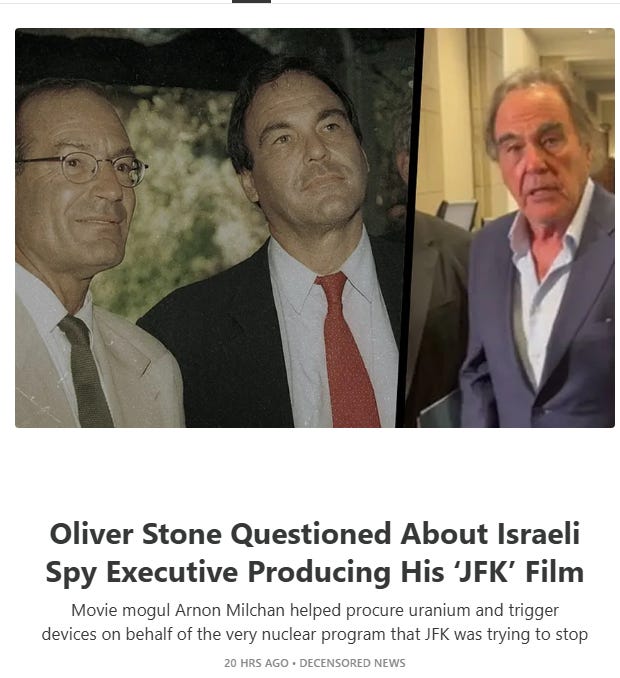
Executive Producing ‘JFK’
The question of how Milchan came to be the executive producer of JFK was addressed in some detail in the 1995 book, Stone: The Controversies, Excesses, and Exploits of a Radical Filmmaker.
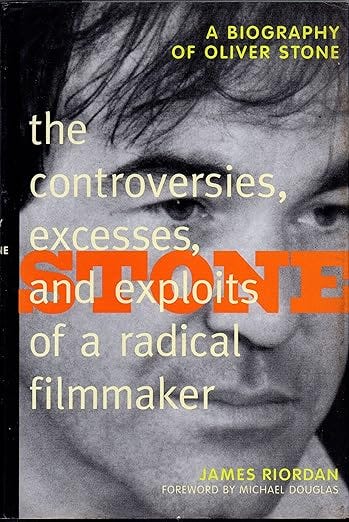
“In this first full biography, author James Riordan has interviewed Stone, the actors who’ve starred in his films, and his family and friends, to assemble a complete portrait of Stone’s professional achievements and personal demons,” reads a note on the front flap of the book.
According to Riordan, Stone had met Milchan “years before” writing and directing JFK, and he was the “ace” that Stone had up his sleeve—and ultimately played— when he realized he’d need a lot more money for the film than the $20 million that Warner Brothers had initially committed to.
After explaining the origins of the project, the research that went into Stone’s writing of the screenplay, Stone’s deal with Warner Brothers, and his early attempts to court actor Kevin Costner to play Jim Garrison, Riordan writes on p. 364:
Costner held out, refusing to commit to the role. Meanwhile, there were budgetary concerns. The new budget came in at over $40 million and Stone felt that Warner Brothers was getting a little nervous. And there was increasing concern about the script. Stone knew that a studio talking about doing a controversial movie and actually reading the script were two different things. So far, everything was fine, but he knew the real heat was yet to come. Like any astute tactician, Stone was always careful to protect his backside. He’d been holding an ace for some time and now he decided to play it.
Arnon Milchan is one of the true power players in Hollywood. He’s so friendly and unassuming it’s hard to believe he’s amassed a huge fortune and an even huger power base from foreign arms deals. The owner of Milchan Bros., an Israeli company with interests in half a dozen industries, Milchan has been in the international headlines for making deals to benefit Israel’s nuclear arms program, but he claims defense of his homeland, not profit, has been his motive. His Regency International Pictures is a major force in world entertainment, partnering with German conglomerate Scriba & Deyhle and French pay-TV company Le Studio Canal.
Remember, Stone told Sam Husseini that he “knew [Milchan] was an Israeli, uh– let’s say a big shot in Israel, and he probably had some intelligence ties,” but “didn’t know specifically what he had done.” Here’s Riordan (pp. 364-365):
Milchan’s past and slickness didn’t bother him. Stone likes power players from the fringe because they have an independence and a gutsiness that establishment Hollywood lacks . . . When asked about his relationship with Milchan, Stone made references to The Mask of Dimitrios, a classic film noir starring Peter Lorre as a mystery writer who becomes ensnared by a web of intrigue while tracking an international businessman with shady methods across Europe.
Milchan, however, apparently told Riordan that he was the one who “pushed himself right down” the “throat” of a “hesitant” and “highly suspicious” Stone (pp. 365-366, bold added):
For his part, Arnon Milchan had been eager to work with Stone for some time. “I had met Oliver years before and was impressed with his work because he is a fighter,” Milchan says. “An artist and a fighter. Then I saw him a couple of times at Terry Semel’s house. And this was when JFK started to cook. Now, a few other things were cooking at the same time. I was getting more muscles in the business and Warner Brothers was getting more and more nervous about JFK. I liked Oliver and we met for dinner one night, had a couple of beers, at Spago’s. We were both drunk at the end, but I remember my last words before I collapsed were, ‘Whether you like it or not, I’m going to be your partner.’ And he had this manipulative little grin. I call it manipulative because it does magic on you. He could give you a smile and even if you were just about to kill him, you’d change your mind. Oliver can get away with anything.”
Stone had let it drop that Warner Brothers might be open to a partner on the film, and that was all Milchan needed. “I’m good at feeling when people are hesitant,” Milchan says. “I realized there was discomfort around the project. First of all, Kevin Costner was not committed yet. Warners was a little hesitant. Actually, I practically ignored Oliver and made the deal with Warner Brothers. I said, I’ll put up all the money, let’s go. My agenda was—I wanted the project. I wanted to start the new company, Regency Films, off with a big bang, whatever happened. And I wanted to nail down the beginning of a relationship with Oliver.” . . .
Stone, though he had sown the seeds for the arrangement, reacted customarily. “He was highly suspicious,” Milchan recalls. “Nobody like Oliver Stone wants a partner without being asked. I pushed myself right down his throat, y’know? And I sensed that all he wanted really was a relationship with my French partners, Canal. He thought my being so emotional was some kind of Hollywood game. But Oliver is a great whore, in a good sense. He will do what it takes to make the kinds of movies he wants to make.
Sicarios and war lords and gun runners and murderers, Barbara!
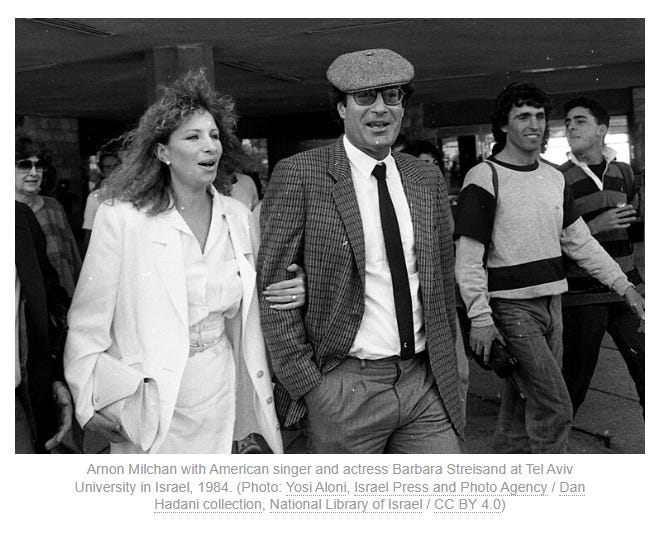
Jews, peepsqueek Danny!
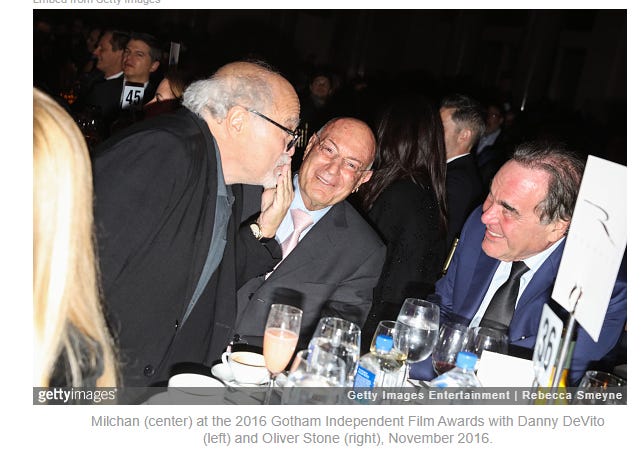
Israel and the JFK assassination
Going back to the “mini-presser” at the Capitol this month: In addition to asking about Milchan, Sam Husseini—along with a couple others who were present, including Karl Golovin—were able to ask Stone, James DiEugenio, and Jefferson Morley several other questions.
Among the topics discussed:
- Kennedy’s attempt to stop Israel’s nuclear weapons program
- CIA counterintelligence chief James Angleton’s use of Israeli agents
- LBJ reversing course on Kennedy’s Middle East policy
- JFK and RFK’s attempts to order the Israeli lobby to register as a foreign agent
- “Cui Bono”—the Cuban exiles or Israel?
- Why they think Kennedy was killed
For more background, see Sam’s 2023 article: “Israel and the Kennedy Assassinations.”
Here’s a compilation of clips, starting with what Stone said right after answering Sam’s question about Milchan (seen in the video at the beginning of this article):
Trump on Biden Steroids — how many Larry Finks and Schwarzmans and Zelenskys does it take to make a Jewish Minyan?
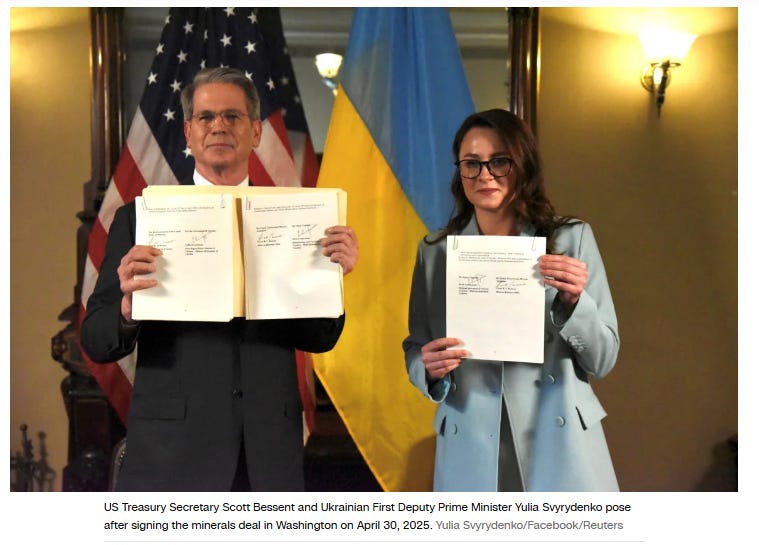
Ahh, Trump and his Jews are Keeping the Jew Penis Piano Man in the Buggering Seat:
So, after teh HR monster(s) sent the letter saying that they won’t even entertain my candidancy, Hedges, Medhurst and Viet (unfortunately on Jewish Democracy Now)
Vietnam, uh? El Salvador and Guatemala, and Jewish Arms.
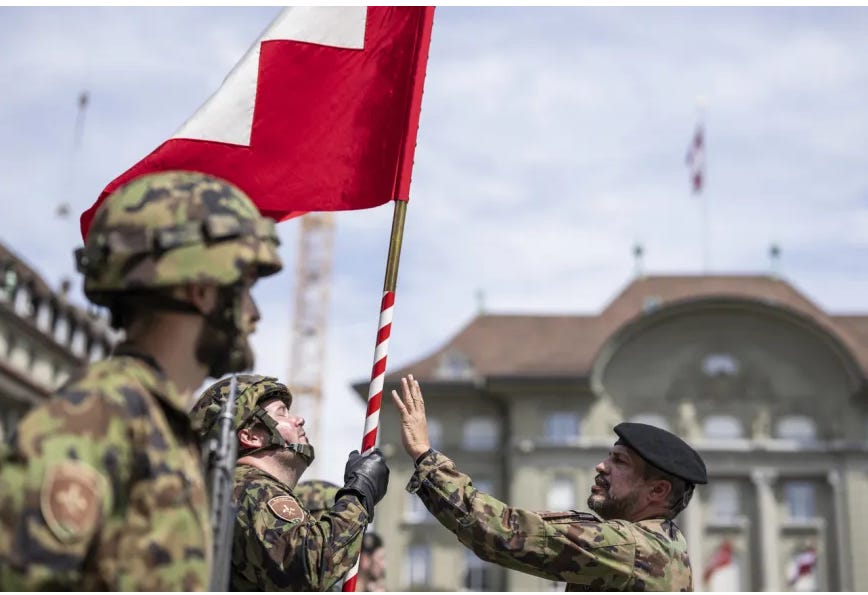
They are all leeches and rabid monsters, the fucking Swiss? Swiss entrepreneur Peter Huber is shifting most of his defense contracting business to Portugal, as the neutrality of his home nation threatens its arms industry.

Oregon education leaders say they’re already following federal student privacy laws in response to an ultimatum from the U.S. Department of Education over federal funding that implied schools are withholding information from parents related to students’ gender identity.
In March, federal officials wrote to state education agencies demanding proof that schools and states’ departments of education are following two federal student privacy laws.
The Dear Colleague Letter, sent March 28 by Education Secretary Linda McMahon and Frank Miller, acting director of the federal education department’s Student Privacy Policy Office, gave states until April 30 to respond. In the letter, McMahon and Miller imply “many” schools and districts are violating the Family Educational Rights and Privacy Act of 1974, or FERPA, and the Protection of Pupil Rights Amendment, or PPRA by allowing schools to use workarounds that keep parents and guardians from receiving requested records from schools about their students.
Among the examples listed were schools creating “gender plans” that are left out of an “official student record,” and stories McMahon said she’s heard from young people who formerly identified as trans “about the lengths schools would go to in order to hide this information from parents.” McMahon and Miller did not provide evidence of such hiding from any schools or districts but implied the problem was widespread.
Charlene Williams, director of Oregon’s Department of Education, wrote back Wednesday to remind McMahon and Miller that Oregon codified the rights inferred by FERPA in state law in the 1990s.
Your complete guide to Trump’s Jewish advisers and pro-Israel cabinet
Trump’s new cabinet will include Mike Huckabee, Marco Rubio, and other loyalists with strong pro-Israel stances
- Copy to clipboard
- Share on Facebook
- Share on X
- Share on Bluesky
- Share on Reddit
- Share on Email
- Print Article
- Republish Article
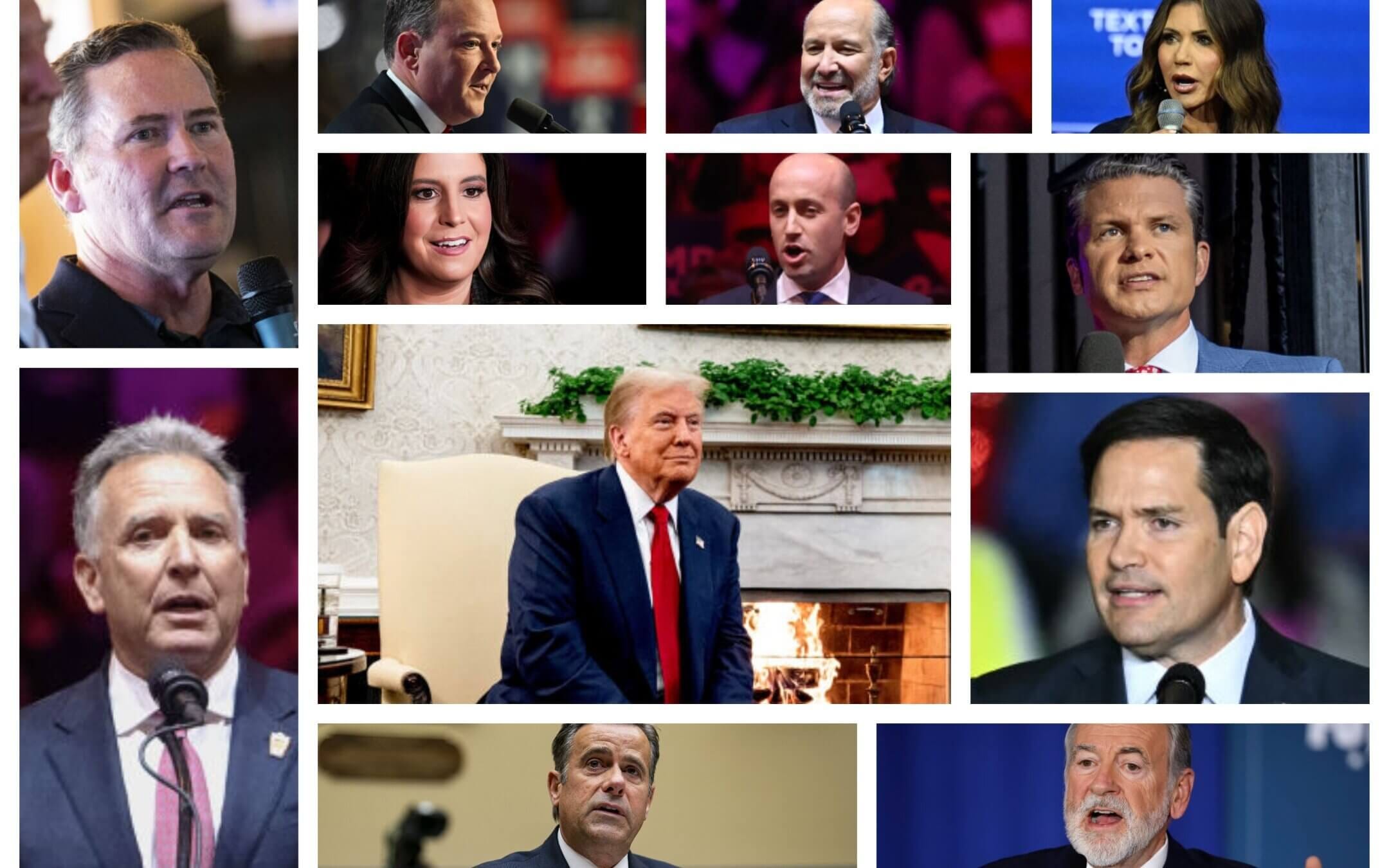
President-elect Donald Trump (center) on Nov. 13, 2024 and his recently announced appointees. Photo by collage photo via Getty Images
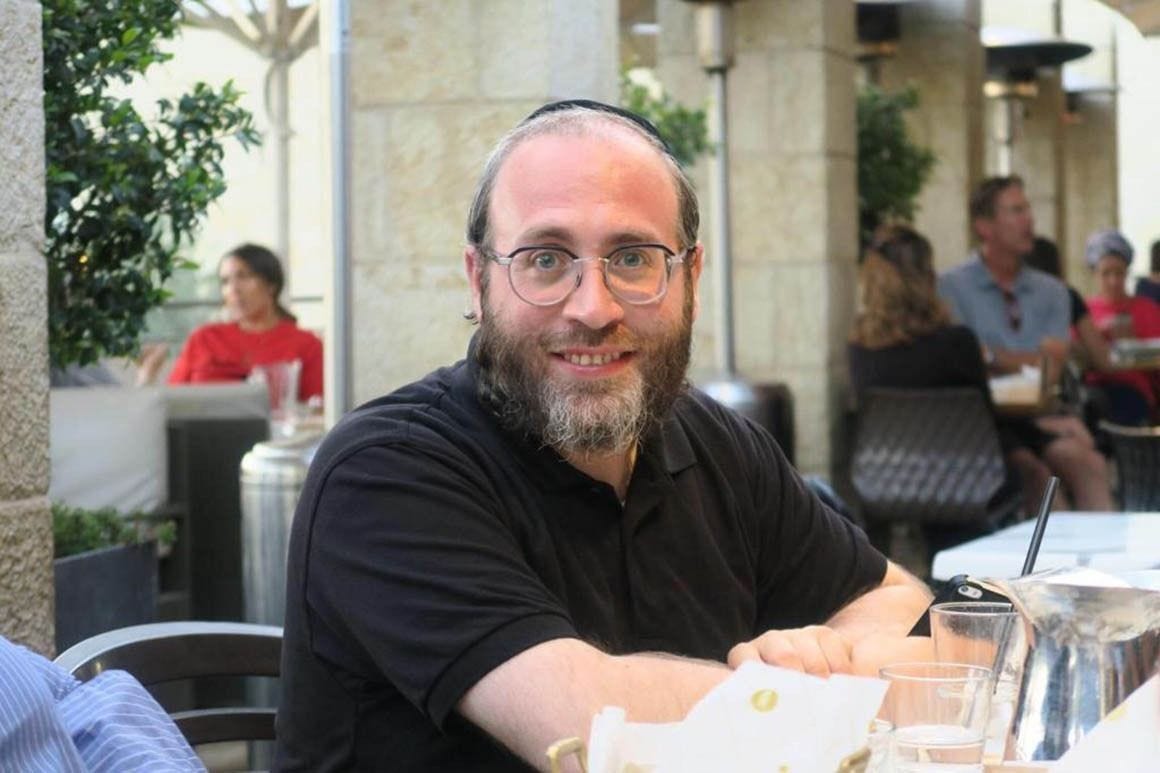
By Jacob KornbluhNovember 13, 2024
President-elect Donald Trump has filled much of his cabinet, rolling out nominations that feature people deeply connected to the Jewish and pro-Israel communities, including Mike Huckabee, Steve Witkoff, and Marco Rubio.
His first national security picks are die-hard Israel supporters, some of whom have denied the existence of the Palestinian people and back the annexation of the occupied West Bank. These loyalists are set to advance his “America First” and hardline populist agenda in a second term. They could signal some shifts in longstanding U.S. policy, especially regarding a possible conflict with Iran and resolving conflicts in the Middle East.
Related
- Opinion:Trump’s first picks are die-hard Israel supporters, mocking the pro-Palestinian protest vote

Forwarding the News
Thoughtful, balanced reporting from the Forward and around the web, bringing you updated news and analysis each day.
Terms(Required)
I agree to the Forward’s Terms of Service and Privacy Policy
Email(Required)
Marco Rubio, secretary of state
Why Trump picked Rubio: Rubio, vice chair of the Senate Intelligence Committee and a member of the Senate Foreign Relations Committee, has vast national security experience and strong connections to secure a swift Senate confirmation.
What he’s said on Israel: Rubio, 53, has echoed Trump’s “peace through strength” doctrine and call to allow Israel to do what’s needed to defeat Hamas. In a viral video earlier this year, Rubio said he expected Israel “to destroy every element of Hamas.” Rubio likened the Israeli ground operation in Rafah, which was opposed by the Biden administration, to the Allies’ pursuit of Adolf Hitler during the Holocaust.
What he’s said on Iran: Rubio has advocated for reinstating tough economic sanctions on Iran to weaken its terror networks and prevent it from acquiring nuclear weapons.
Relationship with Jews: Norman Braman, an auto dealership magnate and past president of the Greater Miami Jewish Federation, was Rubio’s political patron. Rubio surprised pro-Israel backers with his April vote against emergency funding to Israel because it lacked border enforcement measures. Rubio excused Trump after he repeatedly accused American Jews of disloyalty to Israel and suggested they must hate their religion if they vote for Democrats. And he also angered Orthodox leaders in 2022 for introducing a bill that would make daylight saving time permanent across the nation, which they said would have made it more difficult for people to attend morning prayers and get to work on time.
Pete Hegseth, secretary of defense
What he’s said on Israel: Hegseth, 44, a Fox News host, provided favorable coverage of Israel on the network and said that his time in the U.S. Army turned him into a supporter of the Jewish state. He interviewed Israeli Prime Minister Benjamin Netanyahu in March and said, “Israel needs our support.” He also ran a three-part series on Fox Nation, “Battle in the Holy Land: Israel at War,” that focused on the war in Gaza and the ongoing Israeli-Palestinian conflict. “There’s no doubt this is a fight that Israel needs to finish,” Hegseth said, echoing Trump’s call for Israel to finish the job and eliminate Hamas.
A hardliner on Iran: Hegseth called for U.S. military action against Iran back in 2020. “I don’t want boots on the ground, I don’t want occupation, I don’t want endless war,” he said on Fox News. “But Iran has been in endless war with us for 40 years. Either we put up and shut up now and stop it, or we kind of wait, go back to the table, and let them dither while they attempt to continue to develop the capabilities to do precisely what they said they want to do.”
Mike Waltz, national security adviser
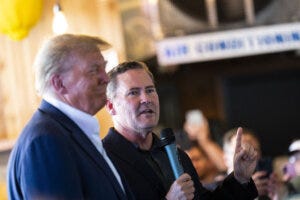
Why it matters: The selection of Rep. Mike Waltz of Florida, a former Green Beret with a staunchly pro-Israel record, to lead the National Security Council signals Trump’s intent to maintain his strong support for Israel in a second term and take a tougher approach toward Iran.
What he’s said on Israel: Waltz, 53, consistently criticized the Biden administration’s foreign policy, describing it as one of “concession and chaos.” He strongly supports Israel’s war in Gaza and praised Israel’s targeting of Hezbollah operatives and elimination of the terror group’s commanding leadership. Even before the war in Gaza, Waltz said the U.S. should allow Israel to strike Iran’s nuclear program. Last month, Waltz recommended that Israel strike Kharg Island, a crucial hub for Iran’s oil exports, and its nuclear facilities at Natanz.
One of his key tasks: Waltz, a staunch advocate for expanding the Abraham Accords, will be playing a central role in talks with Saudi Arabia to advance Trump’s goal of achieving regional peace and resolving the Israeli-Palestinian conflict.
Elise Stefanik, US ambassador to the UN
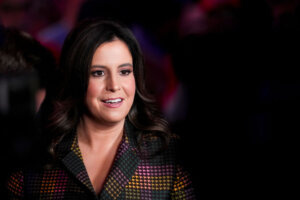
What it means for Israel: Stefanik, 40, brings her national security experience and a combative, unapologetic style to the United Nations at a critical juncture for Israel and the Middle East. With tensions expected to rise around Iran’s nuclear ambitions and increasing global pressure on resolving the Israeli-Palestinian conflict, Stefanik could position herself as a formidable ally to Israel.
Stefanik recently called to cut off aid for the United Nations Relief and Works Agency for Palestine, the main supplier of humanitarian assistance to Palestinians in Gaza.
Her popularity among conservative Jews: Stefanik gained popularity in the Jewish and pro-Israel community after challenging the presidents of Harvard, MIT, and the University of Pennsylvania on whether calls for the genocide of Jews violate their campus codes of conduct.
Mike Huckabee, US ambassador to Israel
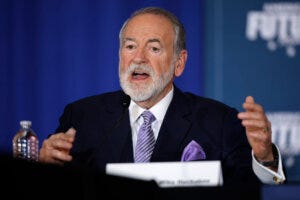
Why he got the job: Huckabee, 69, enjoys the trust of both Trump and Israeli Prime Minister Benjamin Netanyahu. Huckabee, a Baptist minister, has been traveling to Israel since 1973 and says he’s taken more than 100 trips there. A MAGA loyalist, Huckabee is a seasoned advocate for Israeli interests. His influence could bolster Netanyahu’s outreach to U.S. evangelicals, a community Netanyahu has increasingly prioritized over American Jews in recent years.
What he’s said on Israel: Last year, he led a mission of evangelical leaders to Israel following the Oct. 7 attacks. “I came here to say loud and clear that evangelicals stand with Israel,” Huckabee said. In 2008, Huckabee said, “There’s really no such thing as a Palestinian.” During the 2016 Republican presidential primary, Huckabee said he saw the occupied West Bank as an “integral part” of Israel. In 2017, he said, “There is no such thing as a West Bank. It’s Judea and Samaria. There’s no such thing as a settlement.”
A supporter of annexation: In a radio interview following the announcement of his new role, Huckabee said there’s a chance that Israel will be given the green light to annex the occupied West Bank in a second Trump term.
Unconventional pick: The position, traditionally a political appointment, is usually given to Jewish donors, trusted Jewish officials or career diplomats. Huckabee would be the first non-Jewish ambassador since 2011 and the first non-Jewish appointee without diplomatic experience in more than four decades.
Steven Witkoff, special envoy to the Middle East

Why he was picked: Witkoff, 67, has no diplomatic experience. However, he has a longstanding trusted relationship with Trump, and with his son-in-law, Jared Kushner, who was instrumental during the first Trump administration in crafting the Trump peace plan and brokering the Abraham Accords.
Like Kushner, Witkoff brings a real estate negotiating approach that Trump values. Witkoff has served as the Trump campaign’s backchannel to the Jewish business community, particularly after President Joe Biden halted the shipment of 2,000-pound weapons to Israel.
Relationship with Israel: Witkoff attended Israeli Prime Minister Benjamin Netanyahu’s address to Congress in July, and found it moving, especially when Netanyahu talked about the hostages in Gaza — some of whom were at the Capitol that day. “It felt spiritual,” Witkoff said on the Fox Business channel the next day, “and yet, that’s not the reaction you sense that you were getting from many of those Democrats.”
Morgan Ortagus, deputy to special envoy to the Middle East
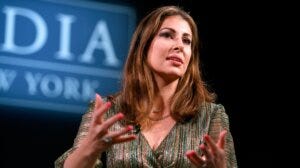
Ortagus, a former evangelical Christian, converted to Judaism in 2007 while working in Iraq for the U.S. Agency for International Development under President George W. Bush. She brings extensive foreign policy expertise to her role as deputy to Steve Witkoff, a real estate investor and Trump’s longtime friend and golfing partner, who does not have a background in diplomacy.
During Trump’s first term, Ortagus was part of the team working on the Abraham Accords, which normalized relations between Israel and four Arab nations. After leaving the State Department in 2021, Ortagus founded Polaris National Security, a nonprofit supporting defense-focused political candidates, and launched an unsuccessful 2022 run for Congress in Tennessee, a campaign Trump endorsed before ballot access issues derailed her candidacy.
Adam Boehler, special presidential envoy for hostage affairs
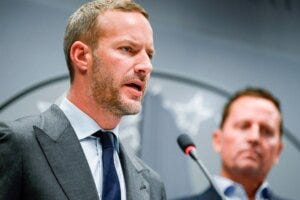
Who he is: Boehler, 45, who is Jewish, was CEO of the U.S. International Development Finance Corporation during the first Trump administration. He served with Jared Kushner, Trump’s son-in-law, on the negotiating team for the Abraham Accords and was the lead negotiator in normalization talks between Israel and Morocco. Bohler and Kushner were summer colleague roommates and worked together on a national coronavirus testing plan.
What it means for Israel: Boehler’s nomination to the role, with the rank of ambassador and requiring Senate confirmation, is a positive sign for the families of Israeli hostages, including the American hostages held by Hamas in Gaza. In past writings and interviews, Boehler said U.S. negotiations to secure the release of American citizens wrongfully detained abroad should be backed by the threat of military action. Earlier this year, he said that the Abraham Accords happened because Trump took a hard stance on Iran. “That is how real peace is achieved in the Middle East, through strength. Now is the time to get tough on Iran and their proxies, especially Hamas.”
Howard Lutnick, secretary of commerce
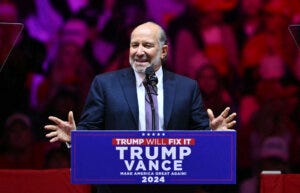
Why he was picked: Lutnick co-leads Trump’s transition team and had been considered for treasury secretary before Trump nominated him to lead the Commerce Department. Lutnick has served as Trump’s most enthusiastic liaison to the business world, promoting the president-elect’s plan to increase tariffs, which many in the business world worry will dampen the economy. Over the course of the election, Lutnick raised $75 million for Trump’s campaign, not including the $10 million he personally donated.
Lutnick gained fame in the days after 9/11, leading Cantor Fitzgerald, the financial services firm that suffered more fatalities than any other business in the terror attack.
Jewish ties: Lutnick has long supported Jewish organizations. Among them: Park Avenue Synagogue and the Synagogue of the Hamptons, where he is an honorary trustee. Lutnick and his wife chaired United Hatzalah’s annual gala in New York this year, the first since Oct. 7, organizers noted, connecting Lutnick’s loss of his brother, friends and employees in the 9/11 terror attack to Hamas’ terror attack on Israel. Last month, he accompanied Trump to the Ohel, where Rabbi Menachem Schneerson, the Lubavitcher Rebbe, is buried; it’s a frequent stop for candidates trying to show respect to the Orthodox Jewish community.
Lee Zeldin, EPA administrator
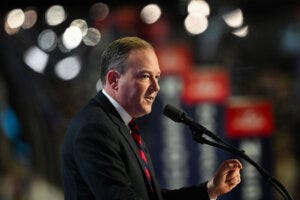
A Jewish MAGA loyalist: Zeldin, 44, has earned Trump’s trust since voting as a congressman against certifying the 2020 election results. During the campaign, Zeldin was a vocal Trump surrogate and critic of anti-Israel sentiment in the Democratic Party. He excused Trump’s remarks saying Jews would be to blame if the former president lost the election, and he accused Pennsylvania Gov. Josh Shapiro of “trying to un-Jewish himself” to become Kamala Harris’ vice presidential pick.
His Jewish background: Zeldin, who is married to a Mormon, leaned into his Jewish background to rally Orthodox voters during his 2022 New York gubernatorial campaign. His great-grandfather Moshe Efraim “Morris” Zeldin, whom Zeldin is named after, was an Orthodox rabbi in Brooklyn and a pioneer in the Zionist movement.
Growing up in Suffolk County on Long Island, Zeldin spent considerable time with his grandfather Bernard Zeldin, who founded the Farmingdale Jewish Center. His mother, Merrill Schwartz, was a fourth grade teacher at a yeshiva in Brooklyn.
Scott Bessent, treasury secretary
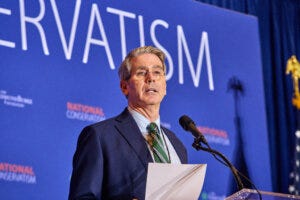
His background: Bessent, 62 is described as a protege of Jewish billionaire George Soros, serving for two decades as management investing chief at the Soros Fund Management. (Trump invoked the Soros-as-puppeteer antisemitic conspiracy in his fundraising emails last year.)
What he said about Iran: The treasury department oversees economic and trade sanctions on Iran and other bad actors.
In a recent interview, Bessent echoed Trump’s “maximum pressure” campaign on Tehran. “I say, let’s make America great again, and let’s make Iran broke again,” he said.
John Ratcliffe, CIA director
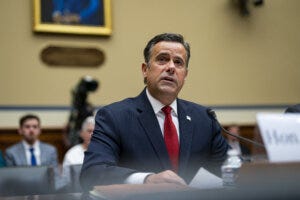
What it means for Israel: Ratcliffe, 59, previously a member of Congress from Texas and former director of national intelligence, accused the Biden administration of diverting critical U.S. intelligence assets from monitoring terrorist groups like Hamas.
During the presidential campaign, he criticized Vice President Kamala Harris for promoting “a false narrative” that portrayed Israel as targeting innocent Palestinians in Gaza. Ratcliffe also supported the 2017 travel ban that restricted immigration from seven predominantly Muslim countries.
What he’s said on Iran: In an interview with Fox News this year, Ratcliffe praised Israeli strikes on Iran, describing them as an example of the “Trump doctrine” of maximum pressure. He suggested that the U.S. should assist Israel in such military actions.
Stephen Miller, deputy chief of staff and homeland security adviser
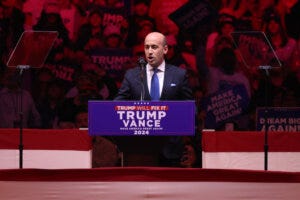
Jewish with strong nationalist views: Miller, 39, declared last month at Trump’s Madison Square Garden rally, “America is for Americans and Americans only.” He was influential in crafting tough immigration policies during Trump’s first term and was the architect behind the policy of separating young children from their undocumented parents. Miller led the implementation of the so-called Muslim travel ban in 2017 and reportedly also hoped to eliminate all refugee admissions to the U.S., dismantling a policy put in place in the wake of the Holocaust.
Condemned by family and classmates: Miller, now tapped for a powerful role within the administration, has been condemned by his Jewish family, descendants of immigrants who fled pogroms, and by his past classmates. His uncle, Dr. David Glosser, a retired neuropsychologist, called him an “immigration hypocrite.” His former rabbi said Trump and Miller’s statements are “echoes of ominous promises that Jews have heard throughout history.”
Pam Bondi, attorney general
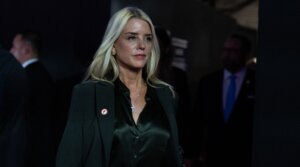
Her background: Bondi, 59, was Florida’s attorney general. In 2019, she joined Ballard Partners, a top Republican lobbying firm. According to news reports, among her clients was the government of Qatar, the Gulf state that has long been a refuge for the leaders of Hamas and was involved in brokering a ceasefire agreement between Hamas and Israel. In 2010, in her race for Florida attorney general, her Jewish opponent, Dan Gelber, accused Bondi of a smear campaign aimed at undermining him among Jewish voters. Bondi repeatedly denied that she was behind the mailer.
What it means for Jews: The Justice Department oversees the prosecution of violent extremism and hate crimes. Bondi called antisemitism “rampant” in the U.S. and said it’s “heartbreaking to see what’s happening to all of our Jewish friends in this country.” In 2017, after a meeting between Trump and state attorney generals regarding a rash of antisemitic incidents and bomb threats on Jewish institutions, Bondi, said, “I know firsthand President Trump cares deeply about our Jewish community and is extremely upset by these attacks.” If confirmed by the Senate, Bondi would succeed Attorney General Merrick Garland, a Jewish former federal judge.
Her views on Israel: Bondi said she had been to Israel “multiple times.” She criticized President Joe Biden for not building on the Abraham Accords. Shortly after Oct. 7, Bondi suggested federal officials get tougher with pro-Palestinian protesters on college campuses and revoke the visas of those who are not U.S. citizens.
Kristi Noem, homeland security
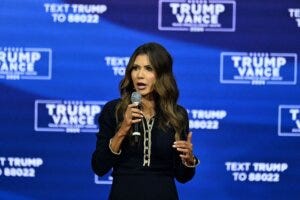
What it means for Jews: The department of homeland security provides resources and guidance to houses of worship to protect themselves under the Nonprofit Security Grant Program. Close collaboration between the agency and Jewish community leaders will be vital to address growing threats and security concerns.
Earlier this year, Noem, 52, serving as governor of South Dakota, signed into law a bill that mandates the use of the controversial International Holocaust Remembrance Alliance definition of antisemitism when investigating allegations of discrimination.
Best known for: Noem gained national attention earlier this year after a revelation in her memoir sparked backlash that derailed her bid to be chosen as Trump’s vice presidential pick. She disclosed that she had shot her hunting dog, an action that stirred controversy, as societal views against cruelty to animals stretch back to the time of the Talmud.
Robert F. Kennedy Jr., department of health and human services

What it means for Jews: The political scion, 70, a vaccine skeptic who referenced Anne Frank at an anti-vaccine rally, has made some bizarre and troubling comments in recent years. He compared vaccine and mask mandates to the Holocaust. He met with Nation of Islam’s Louis Farrakhan in 2015 about measles vaccines. During his 2024 presidential run, RFK Jr. was condemned by major Jewish groups for promoting antisemitic conspiracy theories about COVID-19. He defended his remarks that the pandemic was an “ethnically targeted” bioweapon that spared Ashkenazi Jews, and claimed he has “literally never said an antisemitic word in my life.”
In 2020, Kennedy spoke at a rally organized and attended by antisemitic and neo-Nazi groups. And last year, after critcism, he retracted his praise of former Pink Floyd frontman Roger Waters, who faced backlash for using Holocaust imagery in his concerts.
What he’s said: Kennedy claimed he has “literally never said an antisemitic word in my life” and boasted about spending “a lifetime studying the Holocaust and having “many friends who are Holocaust survivors.”
Jared Isaacman, NASA administrator

Who he is: Isaacman, 41, a Jewish tech entrepreneur and philanthropist, made history in September as the first astronaut to perform a commercial spacewalk. Born in New Jersey, he set the world speed record in 2009 by flying a jet around the world in less than 62 hours. In 2021, he led the first private human spaceflight, operated by SpaceX.
He told CNN that he would not observe Yom Kippur, the holiest day in the Jewish calendar, that year as it coincided with the launch date. “To be very honest, I’m actually not a religious person,” he said. Accepting his nomination, Isaacman said in a statement that he is “passionate about America leading the most incredible adventure in human history.”
Jewish philanthropy: In 2010, Isaacman used one of his jets to raise funds for Chabad of Hunterdon County, N.J., which was hosting an auction to benefit the organization’s scholarship fund. offered to fly the winner in his high-performance jet, capable of speeds exceeding 8Gs or 80% of the speed of sound — the fastest permissible outside of the military. “The ability to combine having fun and supporting a good cause is a growing trend in fundraising efforts and their success,” Rabbi Eli Kornfeld, executive director of the Chabad of Hunterdon County, said at the time. “People want to enjoy giving back to the community.” This year, he and his father Don, who is on Shift4’s board, were among dozens of people on a gala committee for the local Chabad house.
Daniel Driscoll, army secretary
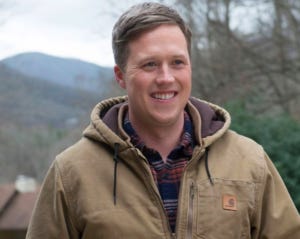
Why it matters: Driscoll, 37, is a close friend and adviser of Vice President-elect JD Vance and they were classmates at Yale Law School. In contrast to the views of some of Trump’s national security team. Vance is an isolationist and made headlines during the presidential election with his skepticism about American military involvement overseas, including regarding Iran. In the announcement, Trump said Driscoll brings a combination of experiences “to serve as a disruptor and change agent.”
His views on Israel and Iran: Driscoll, who served a 10-month tour in Iraq in 2009, where he led a platoon of Cavalry Scouts, told me during his run for Congress in 2020 that he favored maintaining a U.S. military presence in the Middle East and supports the “maximum pressure” campaign against Iran. “Sometimes you have to punch a bully in the nose,” he said. Driscoll called Trump’s Mideast peace plan at the time a “helpful” basis for negotiations leading to a two-state solution.
Sebastian Gorka, director of counterterrorism at the NSC
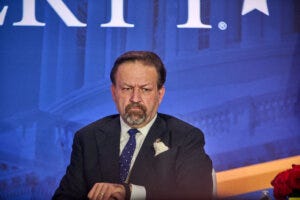
Gorka is a White House adviser in Trump’s first term who once swore his allegiance to a Hungarian neo-Nazi group. In 2022, Gorka called the FBI raid of Trump’s Mar-a-Lago resort in the classified documents case “Gestapo Stasi tactics.”
Earlier this month, Gorka suggested in an interview that there was “no such thing as Palestine.” He also said that Trump’s success in brokering peace is by ignoring the Palestinian Authority, “who are teaching their children that every Jew has to die.”
Gorka declined an interview with the Forward.
Other appointments
► Will Scharf, a former prosecutor and Trump attorney, was appointed White House staff secretary. Scharf, who is Jewish, lost a tense Republican primary race for Missouri attorney general in August.
► Vivek Ramaswamy, 39, a biotech entrepreneur who has never served in public office, was appointed to an outside government entity, called the Department of Government Efficiency, along with Tesla CEO Elon Musk. Ramaswamy has publicly questioned the necessity of continuing U.S. military aid to Israel.
► Katie Miller, the Jewish wife of White House senior advisor Stephen Miller, was named by Trump as a member of DOGE, the informal advisory body. During Trump’s first term, Miller served as press secretary for former Vice President Mike Pence.
► Tulsi Gabbard, an anti-war former Democratic congresswoman who switched to the Republican Party, was nominated for director of national intelligence, raising concerns within the pro-Israel community.
► Charles Kushner, the father-in-law of Ivanka Trump, was nominated as U.S. ambassador to France. Kushner, a convicted felon who received a pardon from Trump at the end of his first term, is likely to play a pivotal role in engaging with the French government. France is a key partner in enforcing the ceasefire in Lebanon and a vital ally in countering Iran’s nuclear ambitions.
► Massad Boulos, the Lebanese American father-in-law of Tiffany Trump who led outreach to Arab-American communities during the election, was appointed as senior adviser on Arab and Middle Eastern affairs.
► David Sacks, a tech entrepreneur who bundled millions for Trump, was tapped as the White House AI & Crypto Czar. Sacks is a longtime friend of Musk.
► Chris Landau, whose father was Jewish and escaped Nazi persecution in 1938, has been nominated as deputy secretary of state. Raised Catholic, Landau shared the story of his father’s flight from Vienna during a 2020 interview. His father later served as an ambassador to several Latin American countries. Landau himself was the U.S. ambassador to Mexico during Trump’s first term and was on the shortlist Supreme Court justice in 2020. “The nomination is a tribute to them,” Landau wrote following Trump’s announcement.
► Stephen Feinberg, a Jewish billionaire investor, was nominated deputy defense secretary. Feinberg is the founder of Cerberus Capital Management, a private investment firm that invested in hypersonic missiles. The number 2 role at the Pentagon requires Senate confirmation.
► Stephen Miran, who was senior adviser for economic policy at the Treasury Department in Trump’s first term, was appointed as chair of the Council of Economic Advisers.
► Boris Epshteyn, a Jewish senior adviser to Trump since 2016, may receive a position. He served as counsel during the hush money trial in New York, and remains in Trump’s inner circle. Epshteyn has reportedly expressed interest in becoming the special envoy for the Russia-Ukraine conflict. Epshteyn, a Russian immigrant, told Trump he had family members on both sides of the ongoing conflict.
► Rick Grenell, former ambassador to Germany who also served as acting director of national intelligence toward the end of Trump’s first term, will serve as Trump’s envoy for special missions. In his announcement, Trump mentioned countries like Venezuela and North Korea, not Iran or Russia. Grenell was on the shortlist for secretary of state. He was a key figure in advancing sanctions against Iran and the normalization of relations between Israel and the United Arab Emirates. Grenell was instrumental in Trump’s outreach to Arab American and Muslim voters in Michigan during the presidential campaign.
► Kevin Warsh, an economic policy adviser during the George W. Bush administration and a former Federal Reserve Board member, was a treasury secretary finalist. The Wall Street Journal reported that Trump is also considering Warsh for the powerful chair of the Federal Reserve in 2026. Warsh is the son-in-law of Ronald Lauder, the cosmetics heir and president of the World Jewish Congress, who was a whisperer to Trump during his first term.
► Marc Rowan, CEO of Apollo Global Management, is a candidate for a top economic role.
Outside Jewish advisers and people with access
► Jared Kushner, Trump’s son-in-law and former Middle East adviser, who said earlier this year he would not return to the White House, is involved behind the scenes and could be a key player in a potential normalization deal between Saudi Arabia and Israel.
► David Friedman, Trump’s first ambassador to Israel, is interested in returning to a national security position to influence Middle East policy and advance a pro-settlement agenda.
Related
► John Paulson, a financier and supporter of Trump, removed himself from consideration for treasury due to financial obligations.
► Steve Schwarzman, Blackstone CEO, will be an influential voice on antitrust rules and trade policy. He is offering recommendations for administration roles.
► Wayne Berman, head of global government affairs for Blackstone and a Republican Jewish Coalition board member, has been suggested by some for deputy secretary of treasury.
► Miriam Adelson is the widow of casino magnate and GOP megadonor Sheldon Adelson, who spent more than $100 million for Trump and made several joint appearances with him.
► Matt Brooks, CEO of the Republican Jewish Coalition, who spent $15 million in Jewish voter outreach and increased Jewish support for Trump and the GOP.
► Elan Carr, CEO of the Israeli American Council, served as the antisemitism envoy in Trump’s first term.
► Jeff Miller of Miller Strategies was one of Trump’s top fundraisers.
► Arthur Schwartz, described as a behind-the-scenes operator and longtime political adviser to Donald Trump Jr., is also close to Vice President-elect JD Vance.
Related
► Bill Ackman, a hedge fund billionaire, has been highly critical of the pro-Palestinian protest movement at Harvard and the university leadership’s response to antisemitism. He has also been outspoken against diversity, equity and inclusion initiatives.
► Ike Perlmutter, a former Marvel mogul, is a Mar-a-Lago member who influenced policy at the department of veterans affairs in Trump’s first term.
► Steve Wynn, a Vegas casino mogul, is a longtime Trump friend who warned him about being off message during the campaign.
► Paul Packer, who chaired the commission of the preservation of America’s heritage abroad in Trump’s first term, was co-chair of the Trump campaign’s Jewish Leadership Coalition, a fundraising group.
► Bruce Blakeman, Nassau County’s first Jewish executive and a close Trump ally, is in consideration for an administration job.
► Sid Rosenberg, a conservative New York-based radio host, was one of Trump’s most aggressive Jewish surrogates.
► Yehuda Kaploun worked with the Trump campaign on outreach to Orthodox leaders.
► Laura Loomer, the conspiracy theorist and provocateur who flew with Trump and appeared with him in September, uses her Jewishness to attack opponents.
+—+
Jew-Landia, while Milwaukee burns: Milwaukee’s air quality remains among worst in the nation, a new report says

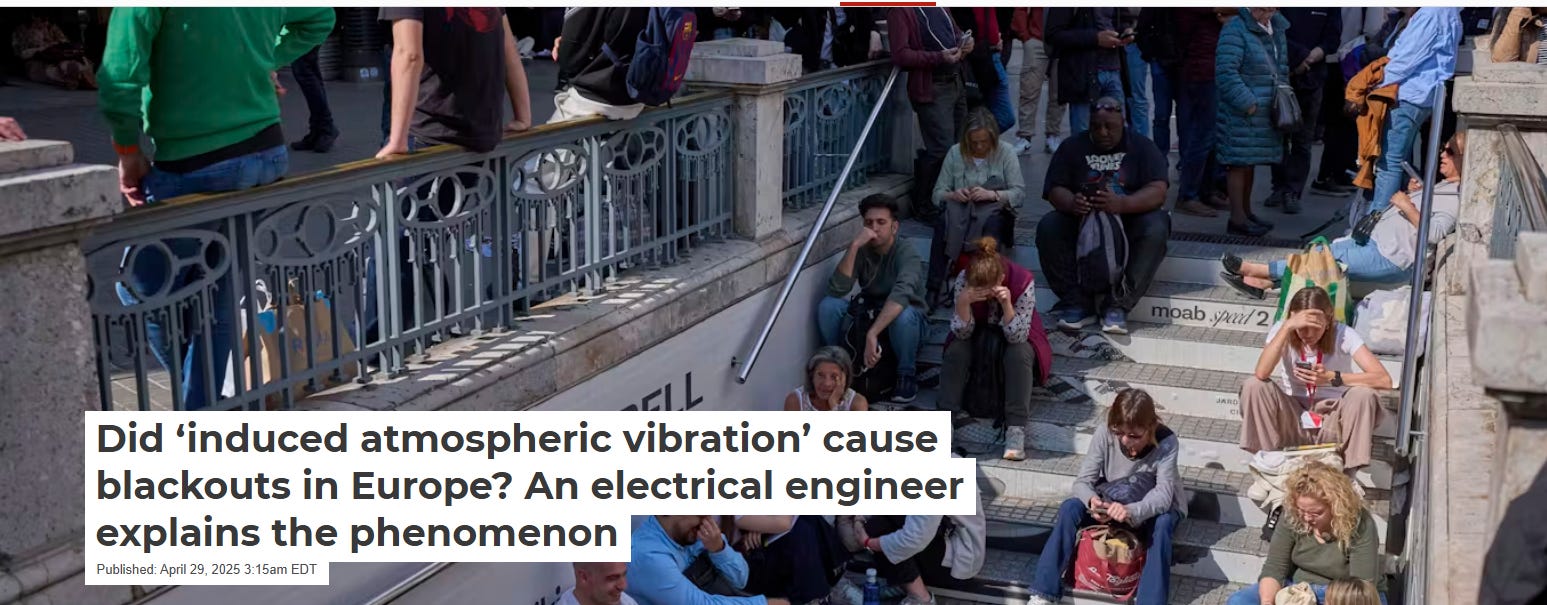
Vibrations in power lines can also be caused by extreme changes in temperature or air pressure. And this is one hypothesis about what caused the recent widespread blackout across the Iberian peninsula.
As The Guardian initially reported Portugal’s REN as saying:
Due to extreme temperature variations in the interior of Spain, there were anomalous oscillations in the very high voltage lines (400 kV), a phenomenon known as “induced atmospheric vibration”. These oscillations caused synchronisation failures between the electrical systems, leading to successive disturbances across the interconnected European network.
In fact, “induced atmospheric vibration” is not a commonly used term, but it seems likely the explanation was intended to refer to physical processes climate scientists have known about for quite some time.
In simple terms, it seems to refer to wavelike movements or oscillations in the atmosphere, caused by sudden changes in temperature or pressure. These can be triggered by extreme heating, large-scale energy releases (such as explosions or bushfires), or intense weather events.
When a part of Earth’s surface heats up very quickly – due to a heatwave, for example – the air above it warms, expands and becomes lighter. That rising warm air creates a pressure imbalance with the surrounding cooler, denser air. The atmosphere responds to this imbalance by generating waves, not unlike ripples spreading across a pond.
Oh, so all that military hardware and all those billionaires in the EuroTrashLandia, helping the people, we the people.
Jews:
Jews Don’t Need No Stinkin’ Head Start!

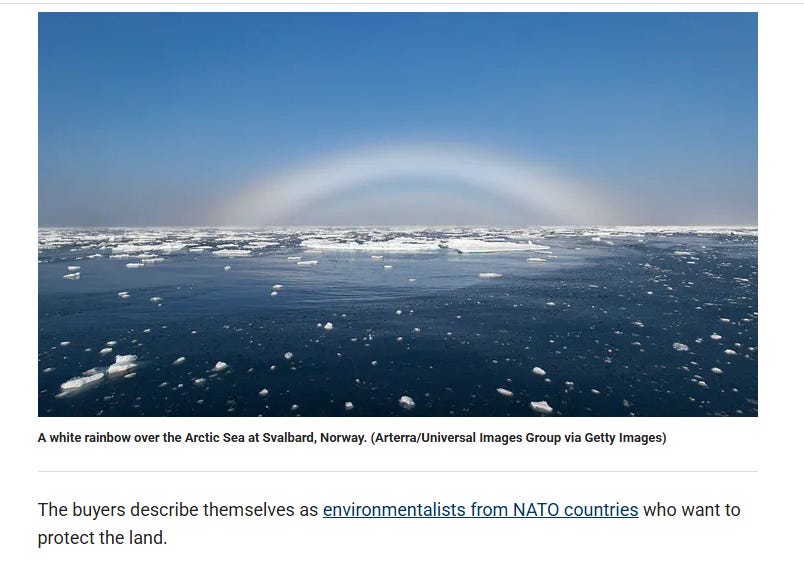
Still, Norwegian officials are cautious. In 2024, they blocked a similar attempt by Chinese investors. Trade Minister Cecilie Myrseth warned at the time that such actions could harm regional stability and threaten national interests.
Svalbard is governed by a 1920 treaty that gives over 40 countries, including Russia, China and the U.S., equal rights to live and do business there.
Russia, which operates a settlement on the islands, has accused Norway of breaking the treaty by increasing its military presence, something Norway denies.
 Paul Haeder, Author