

Yanqui Go Home? Nah, Yanqui die die die.
Everything is interconnected. Vandana Shiva, watch her below!
The China Question?
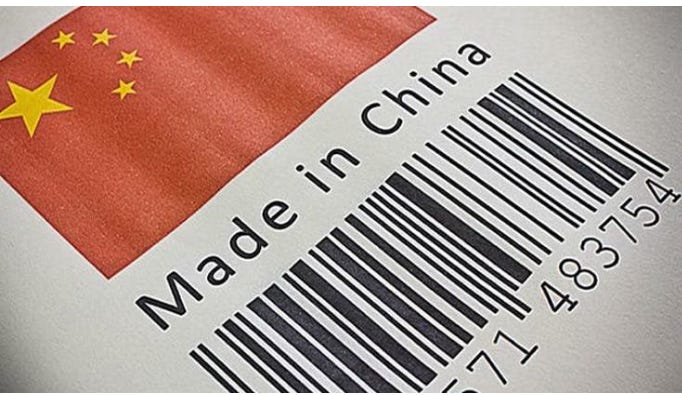
Production does not take place in the USA. The producers have given up production. The US trade deficit with China is instrumental in fuelling the profit-driven consumer economy which relies on Made in China consumer goods.
A dozen designer shirts produced in China will sell at a factory price FOB at $36 a dozen ($3 dollars a shirt). Once they reach the shopping malls, each shirt will be sold at $30 or more, approximately ten times its factory price. Vast revenues accrue to wholesale and retail distributors. The US based “non-producers” reap the benefits of China’s low cost commodity production. (Michel Chossudovsky, The Globalization of Poverty and the New World Order, Global Research, 2003)
Oh, globalization and the Chinese Sweat. Blood. Tears
Levels of income inequality are higher than in the U.S. according to a 2014 University of Michigan study. Social inequality in China is among the highest in the world.
Income inequality has been rising rapidly in China and now surpasses that of the U.S. by a large margin, say University of Michigan researchers.
That is the key finding of their study based on newly available survey data collected by several Chinese universities.
“Income inequality in today’s China is among the highest in the world, especially in comparison to countries with comparable or higher standards of living,” said University of Michigan sociologist Yu Xie. University of Michigan study.
While China plays an important and positive balancing role on the geopolitical chessboard, it does not constitute a viable “socialist” alternative to Western capitalism. In contrast to the US, however, China has no imperial ambitions.
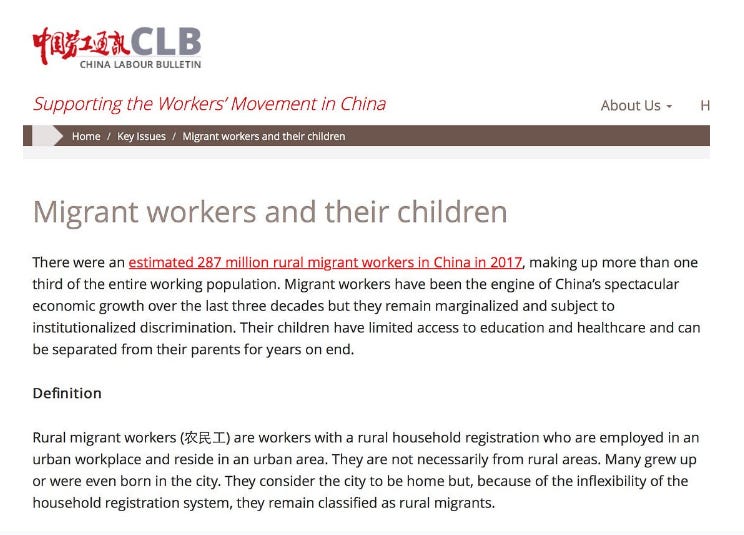
Unlimited Reserves of Cheap Labor: 287 Million Internal Migrant Workers
China has currently, according to official figures [275 million (2015)], 287 million in 2017 internal migrant workers employed in the cheap labor export economy, construction and infrastructure projects as well as in the urban service economy.
A formidable labor force almost the size of the population of the US (325 million in 2017).
China’s 287 million migrant workers also constitute the driving force behind the development of infrastructure, roads and transport corridors not to mention the PRC’s “Belt and Road” Eurasian trade and investment initiative.
These workers largely from rural areas and townships constitute more than a third of the labor force. They do not have the right of abode in urban areas.
[China and the Restoration of Capitalism. The Largest Cheap Labor Factory in the World by Michel Chossudovsky]
Oh, China — the USA wants to weaken you, man:
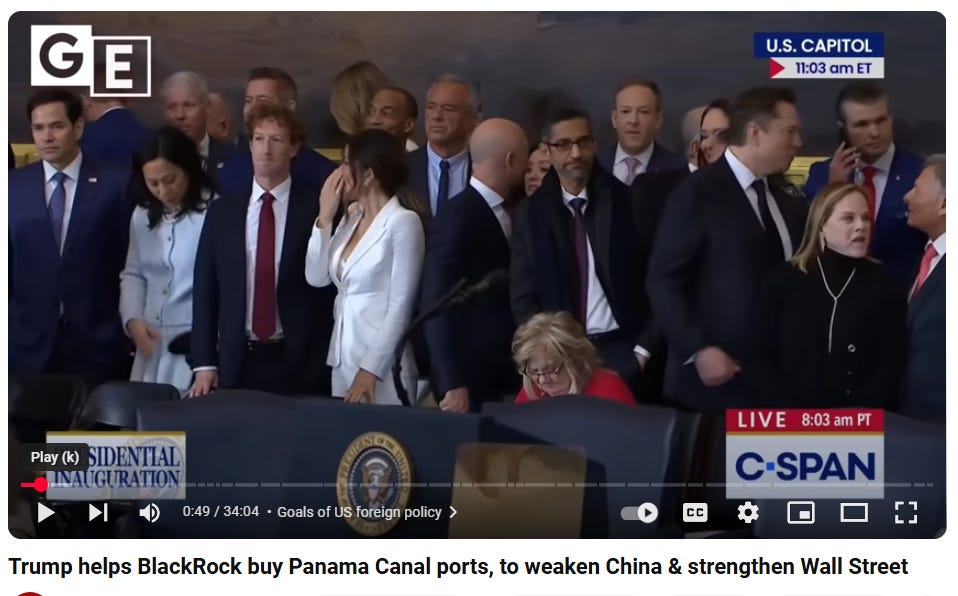
BlackRock, the world’s largest asset manager, is buying the ports on both sides of the Panama Canal, after Donald Trump threatened the Latin American country and forced it to pressure a Hong Kong company to sell its stake. Ben Norton discusses how the US government is trying to weaken China — and strengthen Wall Street oligarchs.
But but . . . Fuck AmeriKKKa, from dirty sea to oil slick sea:
Rollover: Briahna Joy Gray, host of Bad Faith podcast, joins the show to analyze Trump’s speech to Congress on Tuesday, where he lied repeatedly, attacked immigrants and transgender people, while omitting his unpopular agenda to gut social security, Medicaid, and Medicare. Meanwhile, the Democrats responded with boycotts, pink outfits, and bingo paddles– symbolic gestures as Trump dismantles the last modicum of a social safety net left in the US. Why are the Democrats “rolling over and playing dead?” Gray asks.
“At the end of the day they’re funded by a different version of the same people who fund the Republicans.”
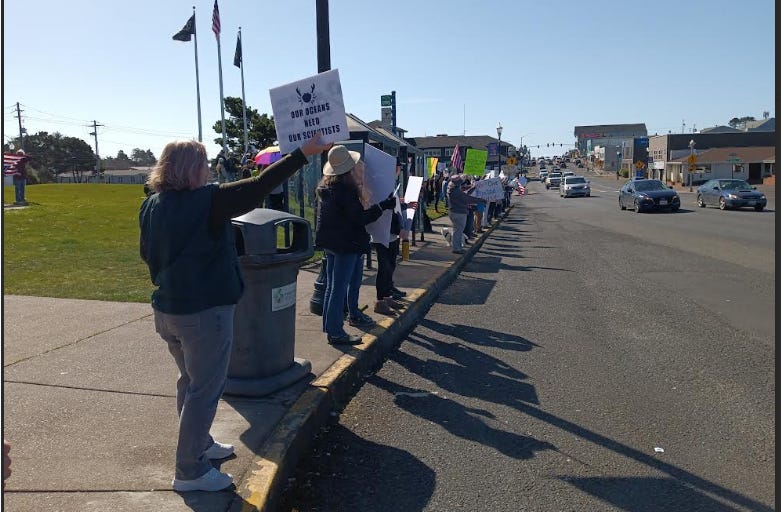
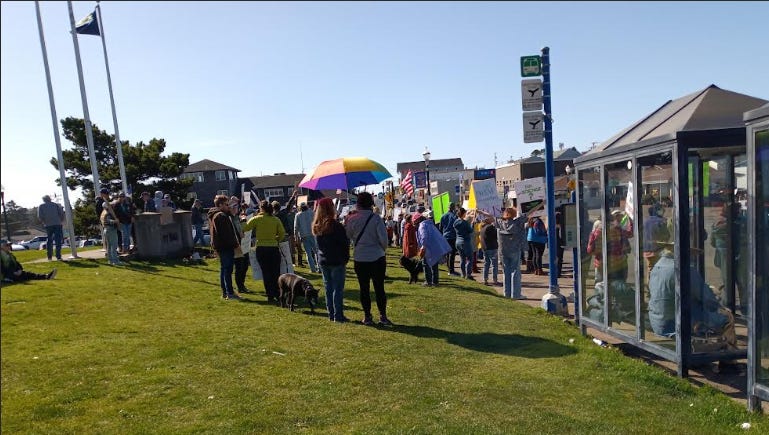
Such such such wimpy “Democrats.” Here in Newport, fighting for science.
Ten Democrats voted to censure Al Green. Cunts. Look at this fucking albino, this souther inbred piece of shit.
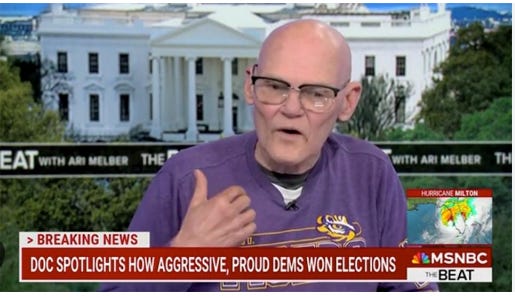
“Democratic strategist James Carville wrote this: ‘Roll over and play dead, allow the Republicans to crumble beneath their own weight and make the American people miss us,’” Welker said. “Senator, what say you? Do you think that’s a good idea?”
“No, I don’t,” Bernie Sanders replied. “In fact, the problem is the Democrats have been playing dead for too many years.”
He highlighted the wealth inequality across the country, a topic he’s been passionate about for decades. By disagreeing with Carville, Sanders is exposing the differing views on how top Democrats think they should respond to the influx of Trump administration action.
“I don’t think you play dead. I think you stand up for the working class of this country and make the point that right now, the Trump administration is clearly an administration designed to represent the interests of the [Elon] Musks of the world,” Sanders said.
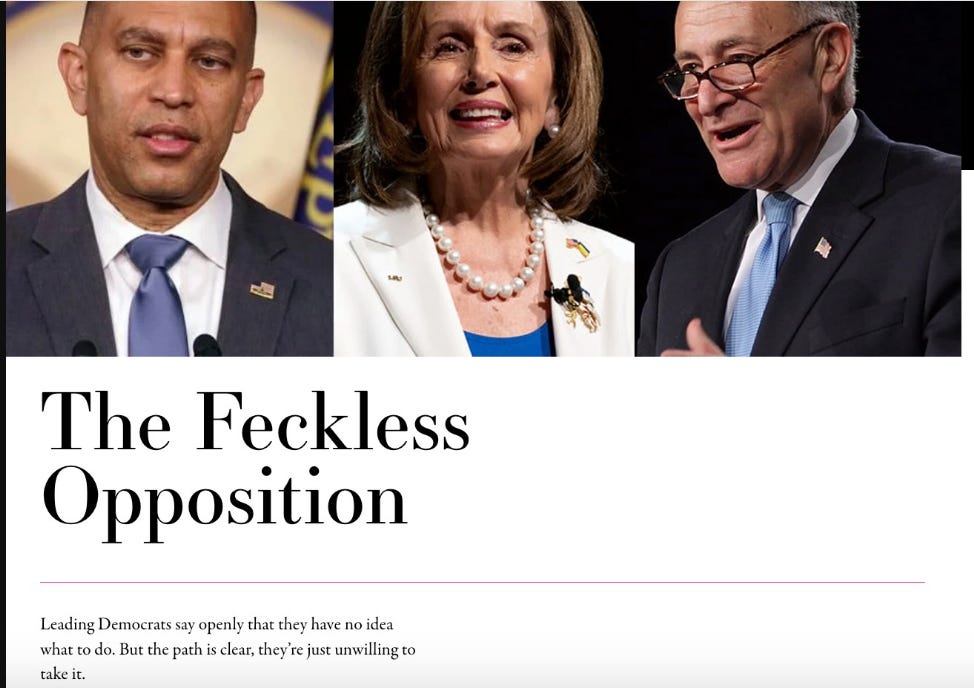
Leading Democrats say openly that they have no idea what to do. But the path is clear, they’re just unwilling to take it.
+—+
Dirt.
Watch: My old fucking school, U of Arizona. A Native student was nearly silenced for calling out the University of Arizona for quietly altering its statement honoring Indigenous land stewards. Caving to Trump’s attacks, the university erased any mention of DEI.
Watch: https://youtube.com/shorts/VihAbs3aC2M?si=Nhlo_O2G3q1Yd9O4
A post shared by @uarizonanilsa
For those students, the sudden ending of those programs is a front-and-center concern. One of those changes sparked concern among Indigenous students at the University of Arizona when they noticed that the university quietly changed language in its official land acknowledgment — without consulting tribes and students.
Indigenous law student Jacquelyn Francisco pointed out the change to Arizona tribal leaders on Feb. 19 during the 4th Annual Tribal Leaders Summit & Student Engagement event.
Francisco stood in front of a room full of tribal leaders and fellow Native students and sharply criticized the university’s administration for unilaterally changing the land acknowledgment language, which had been drafted in conjunction with tribal leaders. She was met with resistance from university officials hosting the event.
Before she spoke, Franciso was denied access to the microphone at the podium by Tessa Dysart, the assistant vice provost for Native American Initiatives, and Kari McCormick, the executive director for Native American Advancement and Tribal Engagement.
Stepping away from the podium and speaking directly to the crowd, Francisco said that University of Arizona President Suresh Garimella discussed the university’s commitment to tribal nations in an earlier speech, but she questioned this commitment after the university “erased” the words “committed to diversity and inclusion” from its official land acknowledgment.
“If he and the university were really committed, they would not delete these words,” Francisco said in a video posted on social media by the University of Arizona Native and Indigenous Law Students Association (NILSA). The Arizona Mirror contacted Francisco for comment, but she declined an interview.
Francisco is a second-year law student at the University of Arizona’s James E. Rogers College of Law and serves as president of the NILSA. She is Diné and Jicarilla Apache.
NILSA is an organization of law students, faculty and staff at UA dedicated to raising awareness about Indigenous peoples within the law school and the broader community, as well as educating on the legal issues that affect them
“Deleting those five words triggers the erasure of our tribes,” Francisco said in the video. “It’s coming.”
The University of Arizona announced its land acknowledgment statement in 2021, highlighting how it was crafted in consultation with Arizona tribal leaders. Its purpose is to recognize the peoples whose homelands the campus occupies.
The university said at the time that it would provide a foundation for partnerships that more meaningfully serve tribal students and Indigenous communities around the state.
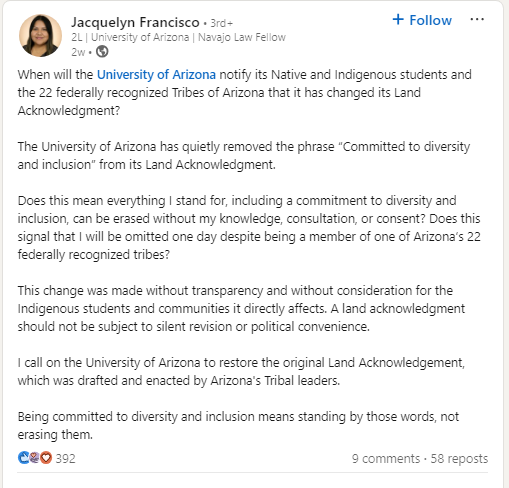
The original land acknowledgment was: “We respectfully acknowledge the University of Arizona is on the land and territories of Indigenous peoples. Today, Arizona is home to 22 federally recognized tribes, with Tucson being home to the O’odham and the Yaqui. Committed to diversity and inclusion, the University strives to build sustainable relationships with sovereign Native Nations and Indigenous communities through education offerings, partnerships, and community service.”
The land acknowledgement on the university’s website now does not include the phrase “committed to diversity and inclusion” in the third sentence. University spokesperson Mitch Zak could not say when the language was changed but said it occurred within the last week.
An internet archive shows that the original language was still present on Feb. 7, and that it had been removed by Feb. 13.
Francisco said in a post on her LinkedIn that the university’s actions were made “without transparency and without considerations for the Indigenous students and communities it directly affects.”
“A land acknowledgment should not be subject to silent revision or political convenience,” she added. “I call on the University of Arizona to restore the original Land Acknowledgement, which was drafted and enacted by Arizona’s Tribal leaders.”
Winona Little Owl-Ignacio was sitting at a table in the audience when Francisco went up to the podium to speak and watched as the university officials denied her access to the mic. But it wasn’t until she overheard them threaten to call campus security to remove Francisco that she walked up and stood beside her.
Little Owl-Ignacio said she recognized that Francisco needed the support because she did not want the situation downplayed as simply a Brown woman getting angry.
“Anger is never a good thing, but especially for people of color,” she said in an interview. “I didn’t want them to paint that picture of her, because she’s a student (and) she doesn’t deserve to be treated like that.”
Little Owl-Ignacio said she stood up because it was unfair for university officials to try to physically prevent Francisco from speaking. In the video, Dysart is seen pulling and keeping the microphone away from Francisco while McCormick stands on the other side of her.
That denial, coupled with comments about calling campus security, raised concerns among the Indigenous students present, Little Owl-Ignacio said, adding that several students approached her afterward, expressing their fears.
“Nobody deserves to have that fear when they go to school,” she added, especially when it comes from university officials who are “supposed to be helping Native Americans.”
Little Owl-Ignacio, 22, is a James E. Rogers College of Law student in the Indigenous People’s Law and Policy Program. She is Lakȟóta and Tohono O’odham.
In the video, she stands next to Francisco and addresses the crowd, calling on tribal officials’ support and asking them “to stand with us, especially when President Trump is handing down these DEI initiatives and saying that we don’t need that.”
+—+
International Women’s Day: Feminism and Revolution: A Conversation with Alejandra Laprea
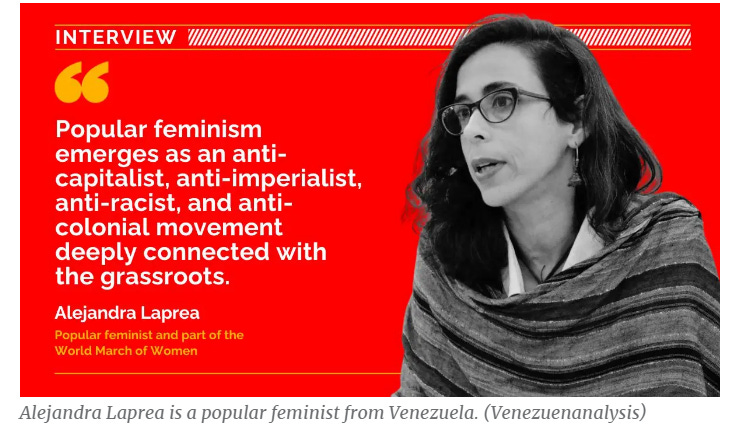
What is the situation of the feminist movement at the continental and national level?
One of the key lessons we have learned through our participation in the March is that we are part of something larger – feminism manifests in diverse ways across the continent and the world, but our movements share many things, including the effects of crises on working women.
We lived through extraordinary years when the “Marea Verde” [Green Tide, a pro-abortion movement] swept Latin America, with different expressions such as the Me Too movement, the March 8 feminist strikes, and “El violador eres tú” [the wave of anti-patriarchal street performances that used the slogan “You Are the Rapist”].
We witnessed a powerful global feminist surge. However, the enemy was not defeated and reacted with force. Today, we are facing a backlash from patriarchal, capitalist, racist, and colonialist forces working in concert. In the Women’s March, we refer to this as a system of multiple oppressions – they operate simultaneously and reinforce one another.
There are different manifestations of this reaction. For example, Javier Milei in Argentina is aggressively dismantling hard-won rights. On a different scale, we see the emergence of fascist forces in Venezuela, while the negotiations and concessions forced by the blockade-induced crisis are putting some of our rights at risk.
There has been a rise of fundamentalist evangelical Christianity in Venezuela and beyond. How does it affect women?
We are witnessing the global rise of religious fundamentalism. In Africa and the Arab world, this manifests as fundamentalist Islam, while in Latin America, there is a growing influence of Christian fundamentalist tendencies. Venezuela is no exception. Christian fundamentalism is on the rise here, and its primary target is women. These forces invoke the so-called traditional, heteronormative monogamous family – an idealized construct that never really existed – and blame societal problems on its supposed breakdown. These tendencies are gaining ground in every sphere of our society, and they are deeply troubling.
+—+
Women Rock:
Zoe Alexandra, Editor of Peoples Dispatch, joins the show to unpack Trump’s recent announcement pausing (again) 25% tariffs on Mexican imports following discussions with Mexico’s President Claudia Sheinbaum. Alexandra discusses how Sheinbaum is navigating aggressive US attacks—from trade wars to threats of military intervention—while working to rebuild Mexico’s sovereignty, improve living standards for its people, and push back against entrenched US corporate interests.
+—+
Panama:
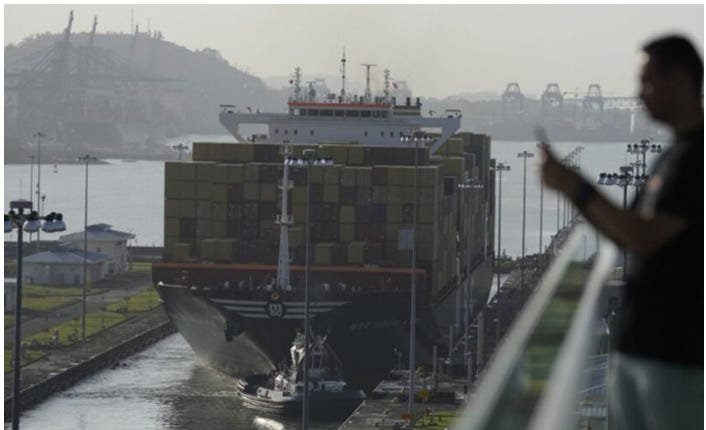
In this eyewitness account, Tan Wah Piow reports on the mood in Panama, along with the background to the issue, following US President Donald Trump’s brazen threats to “take back” the canal that connects the Atlantic and Pacific oceans.
Referring to Trump’s “audacity”, Wah Piow notes that: “This is a thriving sovereign nation, a regional financial powerhouse, and, as of January 2025, a newly elected [non-permanent] member of the UN Security Council.”
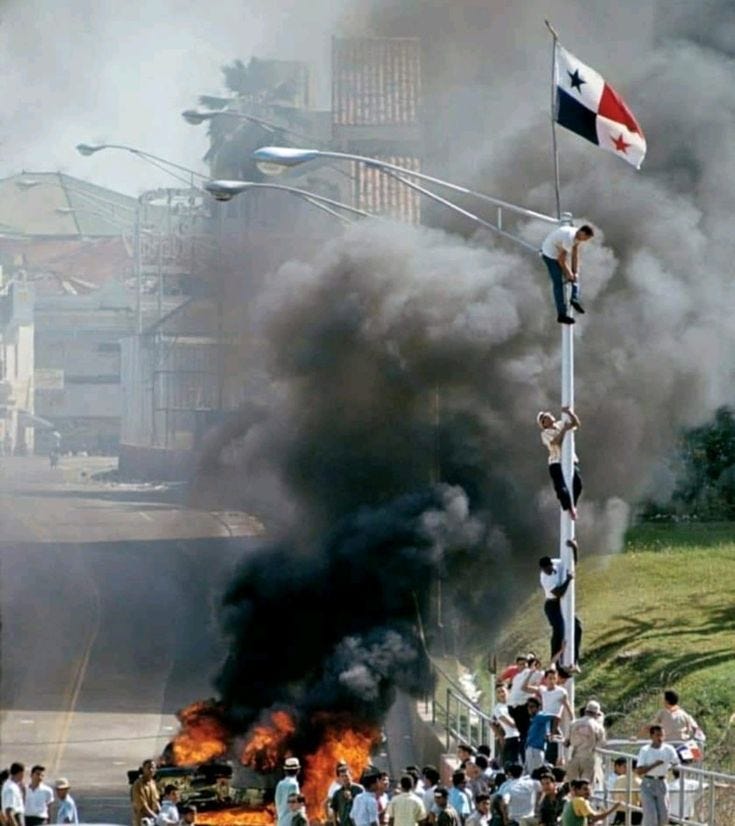
Citing a vast field of Panamanian flags he saw from his taxi, he notes: “His [the taxi driver’s] words brought back memories of the Museo Canal exhibit on the 1964 Martyrs Day incident when US troops killed 21 Panamanian students for asserting their right to raise the national flag in the US-controlled Canal Zone. The 1964 incident remains deeply ingrained in Panamanian consciousness, symbolising the people’s struggle for independence and control of the Canal.
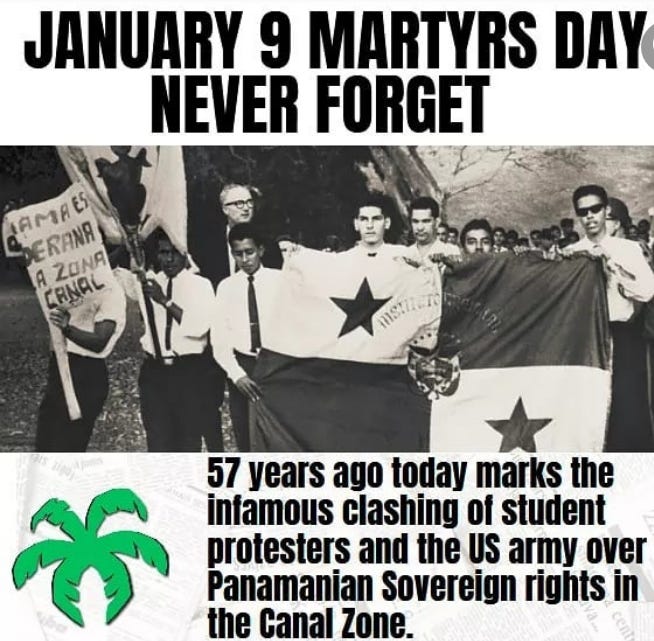
“That incident was a rallying cry for international solidarity against US imperialism in Latin America. Even Chairman Mao of China issued a statement on January 12, 1964, published in Hong Qi, the Chinese Communist Party’s official organ, supporting the ‘great patriotic struggle’ of the Panamanian people. Back then, China had no diplomatic ties in the region beyond Cuba, and there was no Chinese shipping through the Canal.
“The 1964 Martyrs Day protests ultimately led to the 1977 Torrijos-Carter Treaties, which ceded sovereignty of the Canal to Panama. Under these agreements, Panama gained full control of the Canal in perpetuity.”
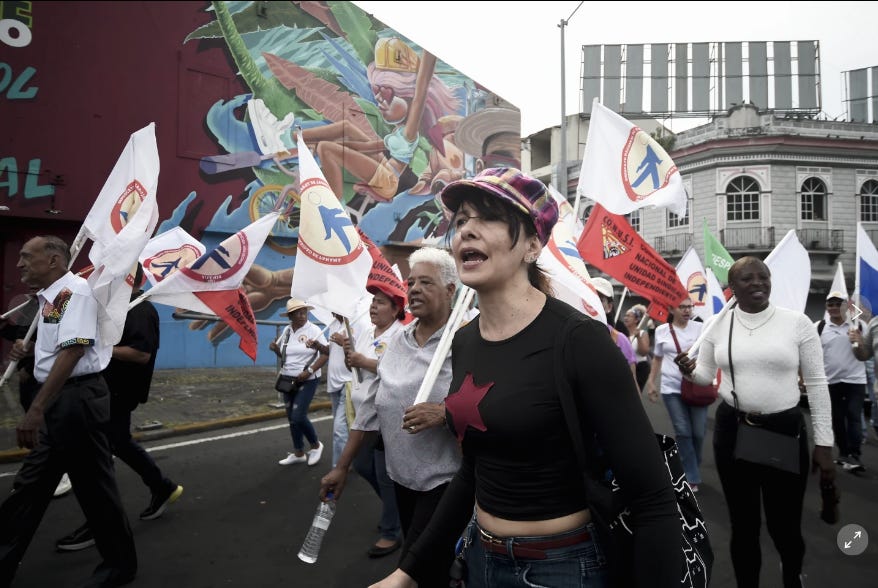
Trump’s remarks, he explains, were not merely a one-off provocation or a bargaining tactic, followed as they were by a threatening visit by Secretary of State Marco Rubio.
“Today,” Wah Piow notes, “the Panama Canal sees 14,000 vessels annually, handling 5 per cent of global shipping. China-US trade accounts for about 20 per cent of its traffic, while China-Latin American trade represents another 15-20 per cent. Studies suggest this volume is set to rise, with China already having surpassed the US as the primary trading partner of countries such as Brazil, Chile, and Peru. Trump’s renewed interest in the Canal appears driven by the fear that China is outpacing the US in Latin America.”
He calls on the international community to defend Panamanian sovereignty, “otherwise, a US power play to uphold its imperialist interests could threaten not just Panama but the economic stability of an entire region long hindered by dependence on Washington.”
Tan Wah Piow, a retired London lawyer, has been in exile from Singapore since 1976. He was imprisoned as a student leader for his activism and is Singapore’s most well-known exile. He is also a member of the Friends of Socialist China Advisory Group. He visited Panama in February 2025. This article was originally published in the Morning Star.
Women Rock:
Vandana ROCKS:
 Paul Haeder, Author