

Refaat Alareer Was a Brilliant Poet and Intellectual
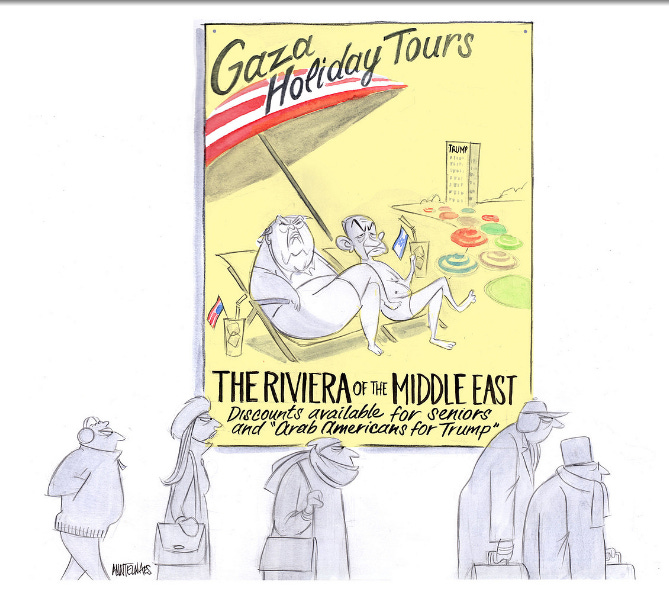
This is supposed to be fucking FUNNY?
ANd, alas, just another Jew, Amy Goodman, talking to another entitled Jew:
DNA of fucking JEWS?
AMY GOODMAN: You write in your book, Peter, Being Jewish After the Destruction of Gaza, about the anguish of Palestinians. You say, “This book is about the story Jews tell ourselves to block out the screams.” So, go back in history and talk to us about what Jews understand, Israelis understand, and what the standard education is and how you reeducated yourself. For example, right now what’s being talked about is this forcing out of the Palestinian population. It’s not the first time. It’s not even the second time. Talks about the exoduses.
PETER BEINART: Right. This is in Israel’s political DNA. Israel was created with an act of mass expulsion of Palestinians. That’s why those people are in Gaza in the first place. There was another act of mass expulsion in 1967, and there have been smaller expulsions since then ongoing, right? And so, this is something that is inherent in the notion — if the notion of your state is that the state has to have a large Jewish majority, that Jews have to rule, then Palestinians constitute a demographic problem, right? And so it’s not really surprising at all that people on the Israeli right want to solve that demographic problem by getting rid of Palestinians. That’s how Israel was created in the first place.
Here’s the fucking Cunt Kicker from the Minyan Bar Mitzvahed South African Beinart:
So, what happened on October 7th was horrifying. It was really, for me, one of the worst days of my life. And I fundamentally oppose any targeting of civilians, no matter what the circumstances are.
So, the murder of Palestinians, that’s not the worst day of his life. Cast Lead? Fuck these entitled millionaire Jews with their fucking books and rapid fire yak yak.
Explain what happened then in 1948. Explain what happened to the Palestinian villages.
PETER BEINART: They were completely demolished. What happened was that David Ben-Gurion, Israel’s first prime minister, said this cannot be a truly Jewish state unless it has a roughly 80% Jewish majority, which was actually — the state that Israel would have been given under the U.N. was far, far less than that. So you had to carry out mass ethnic cleansing. In Jewish communities, people tend to say this only began when the Arab countries invaded in May 1948. It’s not true. Haifa and Jaffa, for instance, the largest Palestinian populations, were ethnically cleansed before May 1948, because it was impossible to create a Jewish state. There were simply too many Palestinians there, so you had to clear them off in order to create a large Jewish majority where Jews controlled the land. That’s how Israel was created. And it’s the refusal in Israel and in organized American Jewish communities and in Washington to honestly discuss that history that brings us to this point where we have an American president who wants to replay that history.
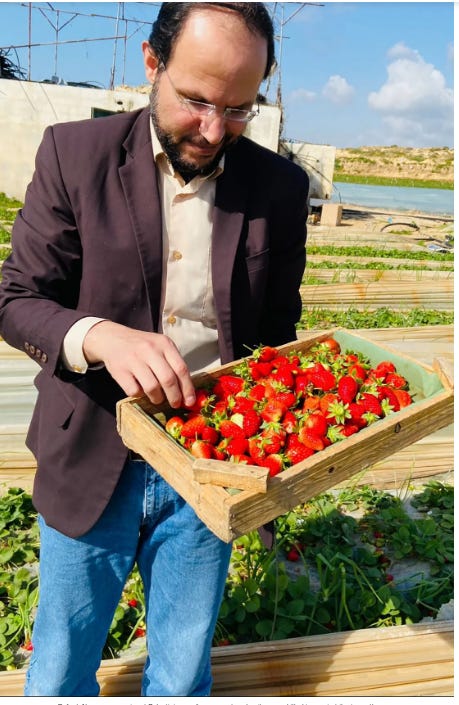
Read his book:
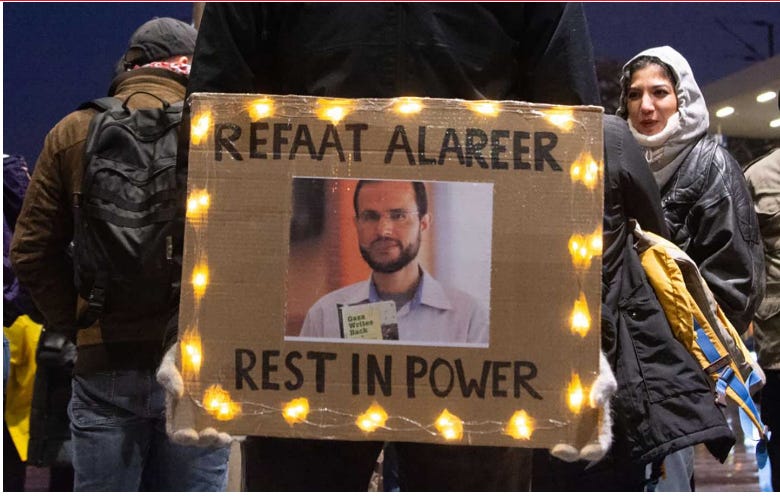
In October, Refaat Alareer was deliberating whether to stay at his home in the heart of Gaza City, or flee further south with his wife and six children.
As Israeli warplanes bombarded northern Gaza, the Israel Defense Forces (IDF) told civilians to evacuate their homes immediately and go south.
Civilians like Alareer were confronted with an impossible predicament. Stay home and risk being killed, or try to flee without protection. At the time, the 44-year-old writer and academic told CNN he and his family had no choice but to remain in the north, because they “have nowhere else to go.”
“It’s an archetypal Palestinian image of a discussion, a debate on should we stay in one room, so if we die, we die together, or should we stay in separate rooms, so at least somebody can live?” he said.
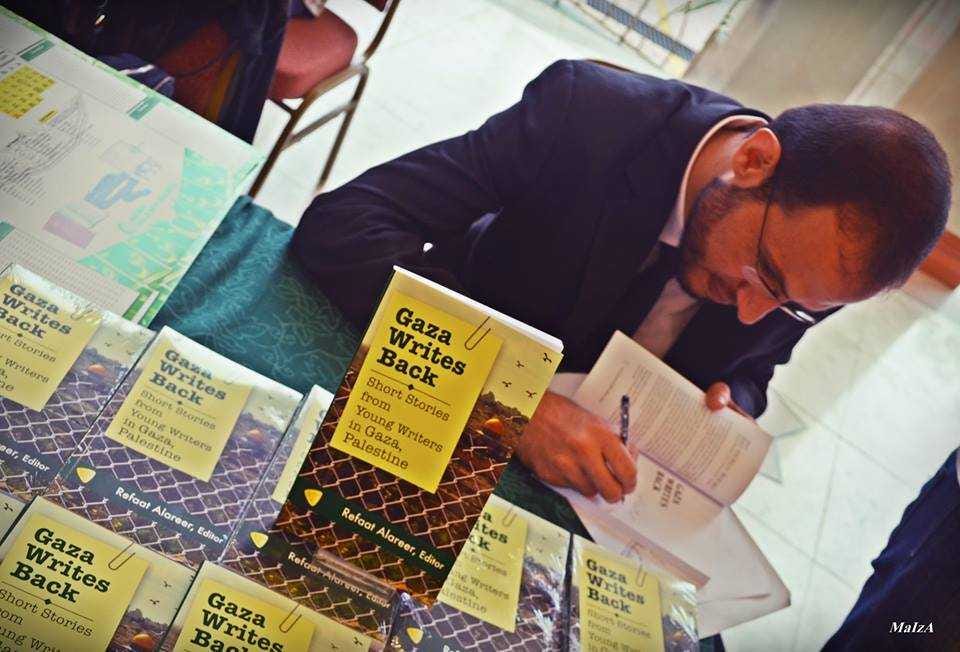
A professor of comparative literature at the Islamic University of Gaza, Alareer was famed for his role in chronicling Gazan experiences. He was instrumental in nurturing young Palestinian writers and helped them tell their stories in English, according to friends and colleagues.
Alareer spoke to CNN from Gaza City, on October 12 and October 13. He gave consent in written messages to share the recording in the event of his death.
Weeks later, on December 7, Alareer was killed by a strike in Shajaiya, in northern Gaza, his friend and colleague, Jehad Abusalim, confirmed to CNN. He was staying with his brother, his sister, and her four children, who were also killed, according to Abusalim, a writer, 35, based in Washington, DC.
He left behind his wife, and children aged 7 to 21. CNN has been unable to reach members of Alareer’s family.
If I must die
by Refaat Alareer (1979 – 2023)
If I must die,
you must live
to tell my story
to sell my things
to buy a piece of cloth
and some strings,
(make it white with a long tail)
so that a child, somewhere in Gaza
while looking heaven in the eye
awaiting his dad who left in a blaze–
and bid no one farewell
not even to his flesh
not even to himself–
sees the kite, my kite you made, flying up above
and thinks for a moment an angel is there
bringing back love
If I must die
let it bring hope
let it be a tale
ArabLit: How did the idea for this collection come about? How did you put out the call for submissions? Did you tell the writers it was to commemorate Cast Lead?
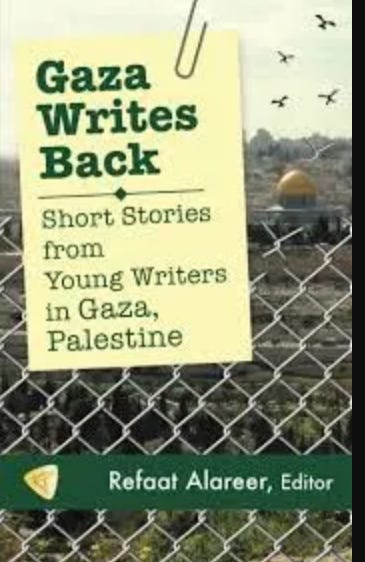
Refaat Alareer: I’ve been teaching World Literature and Creative Writing at the Islamic University-Gaza (IUG), and at other Gaza training centres, ever since I finished my MA in Comparative Literature from UCL, UK in 2007. And I always had the idea of collecting the best pieces written by my students in a book. Going global became a necessity after the hateful Israeli Offensive of 2008-09. I met Helena Cobban in Gaza and threw the idea of a book of young talents into her lap, and later, thanks to Annie Robbins of Mondoweiss.net, Helena saw the potential in the project. In October 2012, Helena and I discussed a number of possible book projects and later decided a book of short fiction is the best place to start.
Since many of the writers are my own students (and friends), I contacted them and informed them of the idea of a book to mark the fifth anniversary of Cast Lead. We had a couple of fruitful workshops, and I took many of their suggestions into consideration. Later, I announced the project through Facebook, Twitter, local universities in Gaza, and personal contacts.
You should know that maybe only four stories were written in order to be submitted to the book. Many had already been written a year, two, or even three before I asked for submissions. But all pieces were written after the Cast Lead Operation.
I received tens of submissions (around 70!), and with the help of Sarah Ali, Sameeha Elwan, and Diana Ghazzawi, we managed, with difficulty, to narrow them down to 23 stories by 15 writers. Choosing the 23 stories was one of the toughest things I have ever done, because there were many more stories with strong potential.
AL: You say, in the introduction, that you wanted this collection to be “without the mediation or influences of translation or of non-Palestinian voices.” Why without translation? Are there particular effects of translation (on literature) that you’ve seen that you were trying to avoid?
RA: As much as I believe in the importance of translation, when it comes to literature I strongly believe many things get lost in translation, no matter how accurate. Therefore, our efforts were directed at improving the English creative writing skills. So that the writers think in English and express themselves in English. Also, the book comes to encourage and give a nudge to those who write in English, as that will enable them to write more and be in touch and in dialogue with the whole world. Maybe in the future we can work on a book of stories originally written in Arabic.
AL: Why young writers?
RA: Because they have a lot to say. Because they are doing most of the work these days. Because they are leading all the campaigns to make the world aware of the ills and pains Israeli occupation is bringing on Palestinians. Because young people have their worldviews and visions that are worthy of being heard. Because there are many more young Palestinians who write in English that old ones. And because the young have largely been marginalised from mainstream discussions.
AL: It’s interesting that so many of the young writers are women. Do you think this is particular to those who write in English?
RA: This is particular to those who write in English and in Arabic as well. In Palestine, we have more women joining universities than men, more women journalists than men, more women activists than men. Women are in many ways taking the lead, in writing, in activism, and in struggle.
AL: You quoted Sameeha Elwan, in the introduction, in saying that the Internet has changed the storytelling process among Palestinians (who have been fragmented since ’48). Will this collection somehow make use of the Internet? Will any of the stories appear online?
The encouragement the writers received from people in Palestine and all over the world was a catalyst for more writing. That means without the internet, many of the pieces could have been forgotten or not written in the first place.
RA: Much of the support for the young writers came through the internet. They first started by posting their creative pieces in forums, and personal blogs, and Facebook, and then Mondoweiss, the Electronic Intifada, the Palestine Chronicle and other websites. The encouragement the writers received from people in Palestine and all over the world was a catalyst for more writing. That means without the internet, many of the pieces could have been forgotten or not written in the first place. Social media platforms have been the major battlefields in the recent years. Facebook pages, YouTube Videos, and Twitterstorms have brought awareness about the Israeli occupation and human rights violation and about the suffering of Palestinians in Jerusalem, Gaza, areas occupied in 1948 and the West Bank. Currently, we are very much depending on social media to promote the book and raise awareness about Palestine.
I think with permission from the publisher, certain extracts from the stories can appear online (some already did).
But other than that, we hope that some of the pieces can be made into films or short videos.
AL: One of the PalFest authors, who has taught workshops in both Gaza (by video link) and the West Bank, has said that — because of life, and life-and-death issues — it’s generally been difficult for talented young authors to follow through on writing projects. Do you find that’s true of young authors in Gaza?
RA: To some extent, when it comes to online courses or tutoring, it’s true. Imagine yourself not having electricity for most of the day! However, in the many courses I held in Gaza, there were a lot who joined and benefited from the creative writing sessions such as short story writing, poetry writing, and general creative-writing skills.
Israel is making it very difficult for Palestinians to live a decent life. Israel has caused every possible hindrance to prevent Palestinians from being. Still, that very same thing was the very cause that led many to write back. For many of us, writing is an act of resistance, but it is also an act of life, meaning writing happens no matter who we are and where we are. We write, therefore we exist.
AL: Most of the selections are very short. Some of them are powerful snapshots — the pain and embarrassment in Sameeha Elwan’s “Toothache in Gaza” and Muhammad Suliman’s “Bundles” — but they’re more like “flash fiction” than short stories. Did you ask for very-short pieces, or is this how the writers turned in their work?
The micro-stories, in my opinion, suit the atmosphere they came to life in and reflect many aspects of Palestinian life.
RA: When the book was announced, I asked for “short stories/short fiction stories.” No word limit was imposed. The micro-stories, in my opinion, suit the atmosphere they came to life in and reflect many aspects of Palestinian life. The stories, by zooming so closely into a very precise moment, show how brief life, hope, and dreams under occupation can be. Even the abruptness that characterises some of the pieces tells of a promising story suddenly coming to an end because the main character is killed. Because of Israel. Because there is occupation. It is true many of the stories begin in medias res, but at the end no resolution is made, as the suffering, the pain, and the deprivation continue to linger, haunting readers for a long time after reading the story. In other words, the story still ends in medias res.
Writing longer pieces is something I started working on with a couple of the writers. Although this might require a lot of time, effort, and training, some told me that the idea of writing longer stories, even novels, is lurking in their minds. Hopefully, the attention of this anthology will receive will encourage them to write more and write longer pieces.
AL: What comes after Gaza Writes Back?
RA: I am hoping the stories will get the attention of film producers. I know at least a couple of the stories can be made into great movies, or at least short movies.
+—+
OPERATION CAST LEAD: WHO CREATED THE JEWS? More than fi ve years ago, during Israel’s 2008–09 twenty-three-day largescale offensive war on Gaza, Operation Cast Lead, my little daughter, Shymaa, who was only fi ve years old, asked me and my wife a question that still puzzles me, as on several occasions it has become my own. Amidst the sounds of explosions and the smell of gunpowder, her question, in her soft, shaky voice, came as a shock to both of us.
“Who created the Jews?” she asked, looking me in the eyes and then turning to her mother in anticipation of an answer. For a while, neither of us was able to talk, let alone answer her question. Bemused, I offered to tell her a story, and several other stories followed.
If I could not answer her question, one thing I did know was why Shymaa, in the space of a few weeks, had grown up enough to ask such a profound question. She must have thought that the merciful and loving God she learns about in her kindergarten, Who usually saves the good guys in her mother’s stories, could not be the same God who created those killing machines that for long days and nights brought us nothing but death, chaos, destruction, tears, pain, and fear, causing her and her little brothers to wake up at night and sob hysterically. Her version of God could not be the creator of the same people who caused our windows to shatter and who, two days earlier, shot at her father when I was filling water tanks on the roof of our house during the two-hour ceasefire.
Israel’s Operation Cast Lead murdered more than 1,400 Palestinians and injured thousands, most of whom were children, women, and elderly people. Many of the injured are now disabled for life, and many of the martyrs left children and wives orphaned and widowed for life. Five years ago, Israel destroyed more than 6,000 housing units. More than 20,000 Palestinians were made homeless, some forcibly displaced for the fourth or fi fth time in their lives. The war came after a long siege that Israel is still imposing on Gaza, a siege that has left almost all aspects of life paralyzed. Israel targeted infrastructure, schools, universities, factories, houses, and fi elds. Everyone was a possible target. Every house could be turned into wreckage in a split second. There was no right time or right place in Gaza. The whole of Gaza was the bull’s-eye for Israel’s most sophisticated military arsenal. It was clear as crystal to Gazans then that Israel was deliberately and systematically targeting life and hope, and that Israel wanted to make sure that after the offensive we had nothing of either to cling to, and that we are silenced forever.
TELLING STORIES
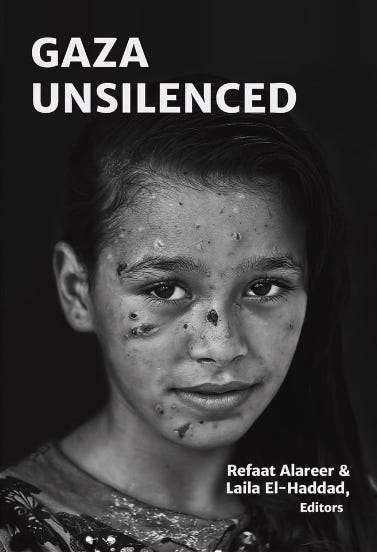
The five years that followed Operation Cast Lead were the most productive years of my life. As a young academic with an MA degree from University College London, teaching world literature and creative writing at the Islamic University-Gaza, I had great opportunities to be part of the struggle for Palestinian national rights. My job gave me the chance to work with some of the most brilliant students in Palestine, many of whom contributed to Gaza Writes Back, the anthology of short stories I was to spend over a year editing, to showcase Palestinian creative resistance to injustice and to Israeli racism and brutality. But how I got there requires a story about coming to understand the signifi cance of stories.
I remember vividly how I spent the twenty-three days preparing for the second semester, because I believed there would be life after the offensive. I was rereading Daniel Defoe’s Robinson Crusoe. And for the fi rst time, it dawned on me how Friday’s story was mediated by a self-appointed, colonial, supremacist master assuming ownership of a land that was not his. Crusoe’s imperialist discourse had never before annoyed me like it did then—“My island was now peopled, and I thought myself very rich in subjects . . . my people were perfectly subjected. I was absolute lord and lawgiver, they all owed their lives to me, and were ready to lay down their lives.” I thought there had to be a different story that Friday could have told, had he not been silenced, and that we Palestinians should never be the Man Friday of anyone—that we have to own our own narrative, and that no one but us can better reveal the sheer pain and suffering we are made to experience. If Israel’s apartheid has to be fought, Israel’s narratives have to be challenged, and exposed.
It was then that I realized much of my mother’s wisdom. For years, she told me and my siblings many stories. And many a time, I gave my mother a grumpy how-many-more-times-are-you-going-to-tell-this-same-story face as she retold the same story, again and again. In response, my Mother, who gave birth to fourteen of us—eight boys and six girls, me being the second eldest— started experimenting with the stories, not only by adding new interesting details, but also by zooming in and out as she saw fi t, to serve her purposes. The stories became more engaging. My Mom, through this rare act of compromise, must have realized that the purposes of telling us stories are a lot more important than simply keeping us quiet or even correcting our bad behaviors, like making us eat vegetables because the boy in the story who did not eat was easily carried away by a giant fl y (I cannot help but remember Mom’s story about the lazy boy whose mother asked him to go out and see if it was raining. The boy replied, “Ok, when the cat comes in, I will feel its hair and see if it is wet!”).
My usually multi-tasking mother dedicated her everything to the story when she was telling one. The story appeared on her facial expressions, in her tone of voice, and through her gestures, and added solemnity to her already radiant face. My mother believed in her stories. And my mother’s stories became and still are part of our lives. It was only later in life that I realized my mother’s strong belief in the power of stories, and understood that there are several ways to tell the very same thing. Sometimes my mother asked us to tell our own stories or even to repeat one of hers. The stories gave my mother more authority and power; single voices, my mother must have believed, are blindly dangerous. As children living in the fi rst Intifada, for us the stories of my mother and those of my grandparents were our solace, our escort in a blind world controlled by soldiers and guns and death. In part, they are responsible for the person I am today, although very few might have predicted that the reckless stone-thrower of the fi rst Intifada would grow up to be an academic at university. Despite the attacks, or rather more accurately because of them, I found myself telling my three kids, Shymaa, Omar, and Ahmed, either the same stories Mom told me, or different stories with similar themes, featuring my children as the heroes and saviors every now and then.
Nothing broke the concentration except the intermittent “Boom! Boom!” sounds. That was how I spent most of the time, trying to make sure I was in the room least likely to take a hit from Israeli stray(!) missiles. The stories I told my kids and my brother’s kids, who crowded the place and helped make the cold room warmer with their breath, were not mere pastime pleasures, nor were they prepared in a scholarly way. They just came out. Stories in Palestine just come out. You decide to tell stories and the stories just appear. The characters start to gather and then everything, to the amazement of the storyteller, unfolds.
If charity begins at home, so too do stories. As a Palestinian, I have been brought up on stories and storytelling. It’s both selfi sh and treacherous to keep a story to yourself—stories are meant to be told and retold. If I allowed a story to stop, I would be betraying my legacy, my mother, my grandmother, and my homeland. To me, storytelling is one of the ingredients of Palestinian sumud— Alareer, Gaza Writes Back 527 steadfastness. Stories teach life even if the hero suffers or dies at the end. For Palestinians, stories whet the much-needed talent for life. My stories were both an end and a means. As I told stories to my children to distract, soothe, and educate them, for the fi rst time I felt very close to my Mother, to what happened to her, and to my grandparents. The stories were my window to my mother’s past, to my past, as I started living every minute she had to spend in the panic room her grandfather had prepared before Israel fi rst invaded Gaza decades ago.
My hair stands on end when she tells me of the many near-death experiences she or her family had to endure. The mere idea of my mother coming this close to death, just for being there, still transfi xes me. One day, Mom told us, she was going to school when a shell exploded a few meters away from her. The following day she woke up and went to school like nothing had happened the day before, like she was rejecting the rule of the shells. (In retrospect, I believe that’s why I almost never skipped a class in my life.) But my mother has outlived Israel’s brutal invasion, and so have her stories. During the attack, the more bombs Israel detonated, the more stories I told, and the more I read. Telling stories was my way of resisting. It was all I could do. And it was then that I decided that if I lived I would dedicate much of my life to telling the stories of Palestine and empowering Palestinian narratives and nurturing young voices.
GAZA WRITES BACK
In the immediate aftermath of the Israeli Operation, when we dusted ourselves off from the most immediate pain and agony that came with Cast Lead, Gaza went back to normal, only this time there were piles of bodies, houses, orphans, ruins, and stories to tell. I went back to my classrooms and to my students at the English Department of the Islamic University-Gaza, which had its newest, highly equipped laboratory building bombarded by Israel. Scars were everywhere. Every single person in Gaza had to mourn a loved one. I started inviting my friends and students to write about what they had endured and to bear witness to the anguish the operation had caused. “Writing is a testimony,” I told them, “a memory that outlives any human experience, and an obligation to communicate with ourselves and the world. We lived for a reason, to tell the tales of loss, of survival, and of hope.”
The plan was to start writing personal experience, nonfi ction creative pieces, and then transform our writing to fi ction. Writing creative pieces was new to many of my students, let alone writing short fi ction. Some initially resisted, and it was only when they started believing in themselves and their unique position in history, and came to understand that storytelling is a creative act of resistance to oppression, that they started writing. For they eventually can become voices of their generation. Stories and articles started pouring out. If storytelling is signifi cant to us as Palestinians, then writing these stories is of paramount importance. It was high time to break the intellectual embargo Israel has been enforcing for decades, and similarly, it was high time to break with psychological shackles and talk to non-Arabs in the language and discourse they understand.
Three years after Operation Cast Lead, I collected tens of creative pieces written by my students and friends. I started using some of them in my creative writing and literature classes as samples to show the students that they too can write. The more stories I collected, the more I believed they had to be published in a book. When I was approached, then, by Just World Books to curate a book out of the pieces on my personal blog, I suggested a short story collection instead. When I called for submissions at university campuses in Gaza and on Facebook and Twitter, I received dozens more stories. They struck me with their diversity and maturity. What I wanted, however, was twenty-three stories in order to counterattack the twenty-three days of terror in Operation Cast Lead. I wanted stories to represent life in the face of death, hope in the face of despair, and selflessness in the face of horrible selfishness.
The twenty-three short stories chosen for Gaza Writes Back testify against one of the most brutal occupations the world has known. I saw in the stories the potential for bringing together a range of Palestinian voices into one book. The stories endeavor to educate both Palestinians and a wider audience, because these young writers strongly believe there is still a lot to share and because we believe it is our moral obligation to educate the world about our plight and travails as Palestinians living under Israeli occupation.
Gaza Writes Back does not give voice to Palestinians. Palestinians have their own voices. Rather, Gaza Writes Back showcases some of these Palestinian voices. These stories are acts of resistance and defi ance, proclaiming the endurance of Palestinians and the continuing resilience and creativity of our culture in the face of ongoing obstacles and attempts to silence us. Every time I read any of the submissions, whether tackling the tragedy that surrounds missile strikes and home raids, or the everyday indignities encountered by Palestinian refugees, or a love story that cannot be because of social customs, the story brings to life the real issues that the people of Gaza face.
A sense of longing pervades the book, as the characters in the stories reveal desires ranging from the mundane to the profound—including, in several of the stories, a strong yearning to return to long-cherished family homes and properties after many decades in exile from them. Social differences and class divisions within Gaza are also sensitively explored. A few stories are especially diffi cult—but critical—to digest, for the vividness and rawness with which they depict the experiences of victims of Israeli military strikes and confront the legacy of violence and occupation, particularly the impact on young people. There are also self-critical stories that delve into issues such as internal divisions or discrimination, and aging leadership. Five years after Cast Lead, these stories remind us that the pain lingers on and the people of Gaza will be forever scarred by the attack. Yet, the call for justice remains forcefully persistent, and these young writers refuse to let the world forget about them—their land, their people, and their story.
HANAN HABASHI
Hanan Habashi is one of my most signifi cant success stories. Hanan, the quiet girl who rarely spoke in the classroom, had never previously written anything in English let alone fi ction, yet she came up with a story as powerful as “L for Life.” Hanan’s story is my favorite and I chose to start the book with it not only because it is a profoundly mature one, but also because Hanan is but one of many talented youth who just require some encouragement and training. Writing her story helped Hanan grow more confi dent and mature.
Her story tells of a girl very much connected to her father as well as impacted by the fact that he was ruthlessly snatched by heavily armed Israeli soldiers when he was about to fi nish telling her most favorite story. And thus, she has to endure life with “the agony of being fatherless, with an uncompleted story.” But she does not let this defeat her. Endurance, or sumud, has long translated into taking action and seeking an ending to plights rather than just patiently enduring what the occupation imposes. Much as the protagonist seeks closure, Hanan herself seems to be seeking a place for herself as a young female writer.
The story thus becomes a journey of initiation, self-discovery, and growth, both for the writer and the protagonist. When I fi rst read Hanan’s story, I felt very angry. Just as I was pulled into the story and felt personal identifi cation with the main character and her struggle, the story came to an abrupt, violent ending. I felt betrayed by the writer; I wanted her to write more and venture more. Only later, during our four-week book tour in the United States, did it dawn on me how deep Hanan is. The way the story prematurely ends mirrors the experience the protagonist has to endure when the Israeli soldiers break into her house and break off the bedtime story, whose ending was very much anticipated by the characters as well as the readers.
The reader suffers by reliving through fiction what a fictional character and the people of Palestine endure on a daily basis: an untimely and forced parting of company with their dreams and beloved ones. The fictional pain becomes our pain, and the frustration that of the readers. And as readers, we want to help, to be part of the journey to end the pain and fi nd the endings to stories the occupation forces have disrupted.
Other than using classrooms to encourage students to write, I knew I had to seek others with the potential to write creatively. One of those brilliant voices is Yousef Aljamal (whose work appears in this Biography issue). Yousef, who writes articles for several well-respected websites such as the Electronic Intifada and Mondoweiss, had never before tried to write fi ction. But I saw a potential short story in one of his very personal articles, “Why I have Two Brothers Called Omar,” which he wrote about his brother Omar who was murdered ten years earlier, when Israeli soldiers invaded al-Nusairat Refugee Camp in the middle area of the Gaza Strip. He then tells of how his parents named their youngest son, born two years later, after the son they lost. I approached Yousef and we discussed ways to create a short story based on his bereaved family’s experience, because “going fiction is going global.”
After Omar’s death, his family discovered from his mobile phone call log that he had tried to contact them just before he was slain. Yousef’s task was to retrace and imagine the moments leading up to his brother’s death and what might have gone through his mind as Israel was stealing life out of his fragile body and preventing him from the fi nal farewell he needed to bid to his family. The outcome is a compelling read—reliving the last moments of a martyr’s life flashing in front of him as the bullets whizzed through his body.
To Yousef, writing fiction meant immortalizing his brother, taking him into the hearts and homes of people around the globe. On a tour with Yousef for Gaza Writes Back, I heard Yousef read the story of his brother to American audiences, and I saw how the story moved many to tears. As Omar lies dying, his life fl ashes in front of him. For every bullet that slams into his body, Omar remembers an episode of his life. The reader follows Omar’s earliest days as he is born and named, and we even follow his very fi rst defi ant encounter with the Israeli soldiers—when Omar is only an infant! How did Omar know of this event? Through stories told and retold to him by his parents.
A Palestinian’s life is usually structured by and around stories. We grow up to relive the stories. “Omar X” is a story about how stories make us who we are. It’s also a story about the importance of telling stories even when one is dying. So not merely did Yousef preserve the memory of his brother, he also managed to salvage his brother’s stories, which Israel wanted to assassinate along with Omar himself.
WRITING BEYOND THE ARAB READERSHIP
The twenty-three stories in Gaza Writes Back were written in English. There are many young and old Palestinians writing fi ction and poetry in Arabic; in comparison, very few people write in English. Too often, the Palestinian narrative in English has come from non-Palestinians. We Palestinians urgently need to take the initiative to voice our dreams, views, pains, and concerns in English. We have seen the unacceptable consequences of leaving our narratives to the western media that regularly misrepresents us, usually adopting Israeli narratives and discourse. And we have seen, too, how some Pro-Palestinians fail to grasp the depth and core of our calamity, reducing the Palestinian cause to a humanitarian crisis, rather than a crisis of people colonized by Israel, deprived of their basic human rights, and constantly exposed to racism and humiliation.
Therefore, in Gaza Writes Back, writing directly to a large audience, taking the book outside an Arab readership, and utilizing English as the medium were the priorities. Because literature in translation, although signifi cant, inevitably loses some of its meaning through the process of translation, we directed our efforts at improving the writers’ English creative writing skills. Also, we conceived the book to give a nudge to those who write in English, with the hope that it would enable them to write more and establish more international dialogue. I am certain that the media buzz generated by Gaza Writes Back and the US book tour will encourage many Palestinians to write in English, for Palestine.
Only four months after we published the book, there is a plan to translate Gaza Writes Back into Arabic (it has already been translated into Malay). I hope an increasing number of projects that translate emerging Palestinian literature into English and other languages will follow.
WHY FICTION
This book presents Palestine in fi ction. The stories provide samples of major trends among young writers; they provide windows into how young writers translate, and transcend, statistics, facts, and fi gures. While news articles convey the stories of the day, they tend to fade into history. Literature has the ability to reform us, to make us grow; literature connects people across time and place. At the same time, these works of short fi ction are deeply rooted in reality, and the reality that civilians in a time of war experience can be more horrifying and unreal than fi ction. Stories enable us to make sense of our past and relate it to our present; stories can be the main thread attaching us to our past; and they can take the form of a dream yet to be fulfi lled. Palestinians in particular have grown to cherish, and to seek, stories. Indeed, storytelling is itself a major theme of some of the stories in Gaza Writes Back, because the writers know quite well that stories outlive individual experience. Writing back is also an act of life, of hope, and of resistance; it fulfi lls an obligation to humanity as it raises awareness among people throughout the world who are blinded by multi-million-dollar Israeli campaigns of misinformation, or hasbara.
PALESTINE IS A STORY AWAY!
In Palestine, no family gathering lacks stories of those good old days when Palestine was the Palestine that current generations have not experienced directly. Because of this storytelling, there is a Palestine that dwells inside all of us, a Palestine that needs to be revived: a free Palestine where all people regardless of color, religion, or race coexist; a Palestine where the meaning of the word “occupation” no longer connotes the death, destruction, pain, suffering, deprivation, isolation, and restrictions that Israel has injected into this word. These horrendous Israeli practices, and many others, are ones young Palestinian writers capture in literary forms in search of their Palestine.
While sometimes portrayed metaphorically, Palestine can be a beautiful reality. Palestine is a martyr away, a tear away, a missile away, or a whimper away. Palestine is a story away. While Gaza Writes Back contests negative narratives propagated by Israel about Palestine, that is not the only reason for its existence. Writing is an act not only of preserving history and human experience, but also of resistance to intruders and colonizers. Although we do not write only because there is occupation and injustice, we write the kind of literature we do because there is occupation. Like any other people who have lived under ruthless occupation, as Palestinians we believe in Chinua Achebe’s powerful statement:
Then I grew older and began to read about adventures in which I didn’t know that I was supposed to be on the side of those savages who were encountered by the good white man. I instinctively took sides with the white people. They were fi ne! They were excellent. They were intelligent. The others were not . . . they were stupid and ugly. That was the way I was introduced to the danger of not having your own stories. There is that great proverb—that until the lions have their own historians, the history of the hunt will always glorify the hunter. That did not come to me until much later. Once I realized that, I had to be a writer. I had to be that historian. It’s not one man’s job. It’s not one person’s job. But it is something we have to do, so that the story of the hunt will also refl ect the agony, the travail—the bravery, even, of the lions.
We know we belong here in Palestine. We write not to beg for our rights and for a better life, but to fulfi ll our obligations to ourselves, to others, and to the generations to come. And in so many ways, the struggle in Palestine for land and rights has been fought metaphorically and verbally. Even the colonization of Palestine came in the form of a poem and a story long before it became a reality. Hence, let a free Palestine materialize fi rst in the form of a story or a poem. Gaza Writes Back is a weapon to shatter the Israeli narratives of a land without a people, of a people without roots, a people who never existed and never will—through this writing, we not only assert our existence, but also envision our future.
VIRTUAL PALESTINE
In Gaza Writes Back the stories range from simple, punchy pieces, to long and complex ones, from allegory to child-like bedtime stories. This collection goes beyond the purely literary and seeks to bring together the whole of Palestine in one narrative: while Gaza has to endure Israel’s siege and successive military assaults, the West Bank and Jerusalem have to experience Israel’s Wall and checkpoints; Palestinians of 1948 have to suffer Israel’s apartheid, including Israel’s fi fty laws discriminating against non-Jewish nationals; and those in the Diaspora have to endure not being able to simply book a ticket and come back home. Even, or especially within, the Occupied Territories (which still include Gaza), mobility is severely restricted: most if not all the Gaza writers in this book have never been to other parts of Palestine. The internet is the place where writers—with the help of social media websites and pro-Palestine websites like the Electronic Intifada and Mondoweiss and many others—have managed to meet and interact with Palestinians from the Diaspora, the West Bank, Jerusalem, and territories occupied in 1948.
Together Palestinian writers and activists piece together the territorial fragments of Palestine to construct a powerful entity that Israel, backed by western powers, continues to try to further fragment and erase. Contributors, refusing the common understanding that Gaza is a separate entity, write about things they never have experienced directly, like the Wall, the checkpoints, and the settlements. Gaza Writes Back is about place-making, and forging bonds with Palestinians we cannot meet under conditions of apartheid and colonization.
For Palestinians, to tell a story is to remember, and to help others remember. Many if not all the stories in Gaza Writes Back zoom in on minute details in an attempt to engrave in the writers’ own memories and those of others the atrocities or rare moments of hope that the stories capture. Because memories shape much of our world, telling these memories in the form of stories is an act of resistance to an occupation that works hard to obliterate and destroy links between Palestine and Palestinians. The stories here promote remembering and condemn forgetting. Even when a character is dying, his/her ultimate wish is for others to “to tell [the] story,” as Hamlet put it.
And telling the story itself becomes an act of life. Further, some of the stories (like “Canary” and “A Wish for Insomnia”) even chase the Israeli soldiers into their own memories or conscience, declaring that there will be no rest for the occupiers—that we will spoil the occupiers’ most intimate moments, too. In “House,” the narrator penetrates the mind of the Palestinian character Abu Salem to tell us that he “erected the tent soon after he moved to the house, lest he should forget the days his family spent in a tent in the Qalandia refugee camp. Forgetting, he believed, was a scandal, like surrendering to the enemy while you had plenty of ammunition.”
THE WRITERS
The writers of Gaza Writes Back are all young—some were only seventeen when they wrote their pieces. Currently, young Palestinians are leading the campaigns locally and internationally to create awareness of the ills and sufferings Israeli occupation brings upon Palestinians. The youth are the stone throwers; they hold the sledgehammers to break parts of the Wall; they are the administrators of countless Palestine Facebook pages, Twitter accounts, and blogs; they are the freedom fi ghters; they are the photographers; and they are leading the Boycott, Divestment, and Sanctions (BDS) campaigns. But not only that, the young people have views and visions worthy of being heard. Sadly, the young have largely been marginalized from mainstream discussions by the Palestinian leadership.
This book comes to give them the prominent place they deserve in the struggle for a free Palestine and a better society. Twelve out of the fi fteen writers are women. The young women are not included at the expense of young men but because the fact is that on the ground more young women writers in Gaza use social media and write, particularly in English, than do their male counterparts. This shows how important young Palestinian women have become in recent years, as they have managed to use all the available tools to take the initiative in preserving Palestinian identity, resisting the occupation, and building a more open Palestinian society in which women and men are equal. The roles Palestinian women have played in the battle for a free Palestine are undeniable. And this young wave of women short story writers continues the struggle while at the same time revolutionizing it.
The women portrayed in the stories are powerful, independent, intellectual, and proactive—in stories such as “L for Life” by Hanan Habashi, “Toothache in Gaza” by Sameeha Elwan, and “Lost at Once” by Elham Hilles, their role is no longer restricted to giving birth to freedom fi ghters. They are the freedom fi ghters. Gaza Writes Back 535 Gaza Writes Back not only nurtures the blossoming talents of young writers, but, as with the powerful BDS movement, this book spreads awareness and promotes and protects the rights of Palestinians. According to Abu Salem in “House,” “They [Israelis] have to feel that we are breathing down their necks. I want the Israelis to start asking questions.”
Much as BDS empowers Palestinians and puts pressure on Israel for its human rights violations, publishing a book of short stories by young Palestinians empowers them and takes their voices all over the world. Our book shows yet another example of how Israel limits and prevents the movement of students, writers, and books. Israel prevented Sarah Ali, a contributor to Gaza Writes Back, from joining the US book tour although she has a US visa. And just a couple of weeks ago, Israeli authorities at Ben Gurion Airport confi scated and destroyed twenty copies of Gaza Writes Back that were intended to go to Gaza with an American convoy.
FIVE YEARS LATER . . .
Gaza Writes Back proves that sometimes a homeland becomes a story. We love the story because it is about our homeland and we love our homeland even more because of the story. And now, fi ve years later, Israel continues its inhuman policies against Palestinians. And every time Israel escalates its violence—every time the Israeli government violates a truce, or murders someone, or jams the TV signal through its drones, or sends in F16s for casual sonic booms—I see the very same question in the eyes of my daughter, Shymaa. Five years have passed since Cast Lead, and Israel has not given me the slightest chance to explain that we all have the same God, or to see an end to all this crazy, man-made violence and evil in our midst that will stop when Israel ends its occupation and brutality against non-Jews.
Five years later, Gaza Writes Back took me and several Palestinian contributors to the US, where I met Palestinian and pro-Palestinian activists, some of whom were Jews. The tour, jointly sponsored by the book’s publisher, Just World Books, and by the American Friends Service Committee, lasted from March 27 to April 24, 2014, and was aimed at promoting young Palestinian voices and empowering the Palestinian narrative. Although Sara Ali was denied permission by the Israeli government to join us from Gaza, I toured with Yousef Aljamal and Rawan Yaghi, who like me are currently seeking education outside Gaza. During our tour, we spoke in more than ten US cities in seven states, and met Palestinians living in the Diaspora, many of them born and raised in America.
We also met hundreds of pro-Palestinian American activists; and most importantly, anti-Zionist Jewish activists working for justice in Palestine. We met with very promising young people from an African American organization in Chicago, who told us about US police brutality against Americans of color and the often invisible wall of racism they still have to deal with. Hundreds of people from all walks of life came to listen to the young voices from Palestine, in churches, synagogues, bookstores, and houses. And we spoke about politics, literature, life, food, water, resistance, the future, racism, feminism, and justice.
The tour was proof that fi ction is universal, and that literature breaks barriers and returns us all to our humanity, which is, in Edward Said’s words,
“the only and I would go so far as saying the fi nal resistance we have against the inhuman practices and injustices that disfi gure human history”
Because of our travels, I now am able to tell my daughter Shymaa that not only have we been exposed to occupation and oppression, but we also have been subjected to isolation and segregation. I will tell her that we were made to believe the fi ght is between Jews and Palestinian Christians and Muslims. And I will tell her Israel builds walls and checkpoints to maintain this fi ction and to keep us isolated. I will tell her that in my tour I learned that Jews, too, can and have been victims, and that Judaism has been hijacked by Zionism.
I will tell Shymaa that we Palestinians still need to grow and keep gaining additional perspectives because the fi ght for Palestine is universal, and needs to be fought globally as well as nationally. In The Battle for Justice in Palestine, Ali Abunimah summarizes this understanding:
“the struggle for Palestinian human rights must be closely linked to the struggle for human rights in the United States and around the world”
Now when I tell my daughter stories, I usually have in mind the generous Jewish hosts in Atlanta, whose fi ve-year-old sweet daughter, Viola, kept asking me about optical illusions. I never gave Viola an answer to her question, because every time she asked it, my mind went to Shymaa, wishing she and the hundreds of thousands of Palestinian children had not been deprived by Israel of their right to live a decent life. Sometimes I think we may one day fi nd it in our hearts to forgive Israeli leaders (when, among other things, occupation ends, apartheid is abolished, justice prevails, equal rights are guaranteed to all, refugees return, and reparations are made), but I do not think we will ever forgive them for not allowing our children to live a normal life, to ask about optical illusions rather than who was killed and why and whether that noise was an Israeli bomb or a resistance rocket. I want my children to plan, rather than worry about, their future and to draw beaches or fi elds of blue skies and a sun in the corner, not warships, pillars of smoke, warplanes, and guns. Hopefully, the stories of Gaza Writes Back will help bring my daughter Shymaa and Viola together and give them consolation and solace to continue the struggle until Palestine is free. Until then, I will continue telling her stories.
 Paul Haeder, Author