

“Everything he has said and done is to inflame violence… We need moral leadership, and he’s done everything to divide us.” –on Trump by Bishop Budde
Easy Targets NOW? This is fucking the way this fucking country was set up. New targets under the New Rapist in Chief?

Trump posted on his social media website about the service, calling it “very boring and uninspiring.” He also called Budde “a Radical Left hard line Trump hater” who “brought her church into the World of politics in a very ungracious way.”
The new president’s first hours in office have come with dire consequences for the most vulnerable.
Since when were pigs in uniforms, with guns, with copters, with heat seeking tools, with planes, satellites, and such, NOT be the fucking storm troopers of Capitalism?
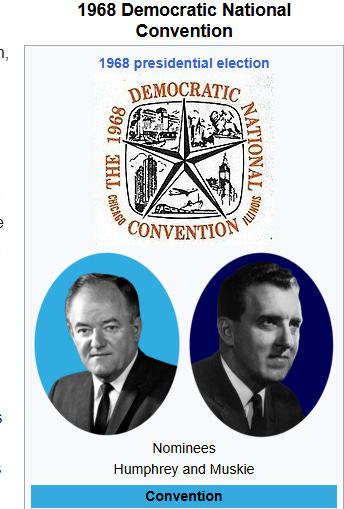
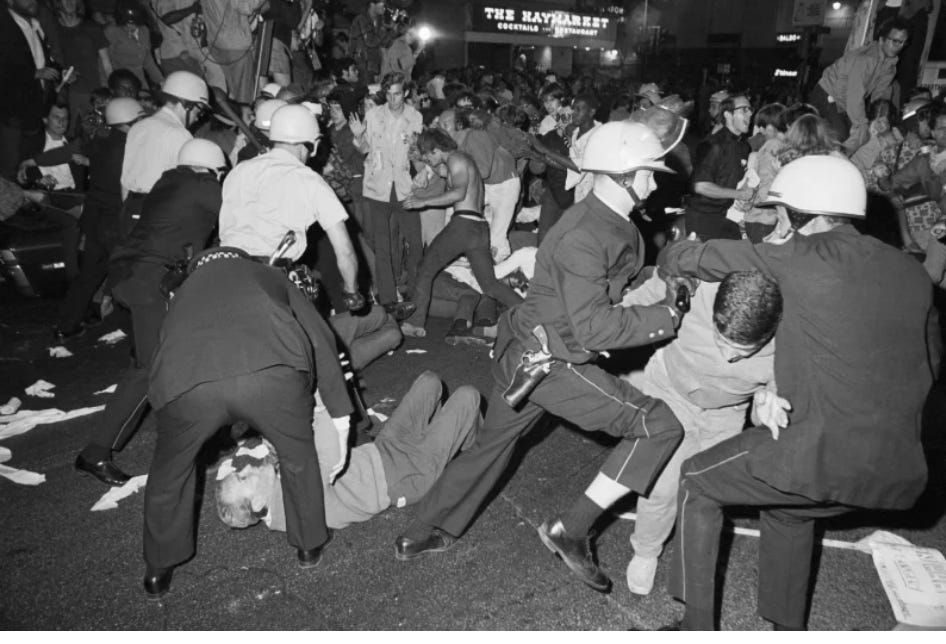
Oh, those stormtroopers:
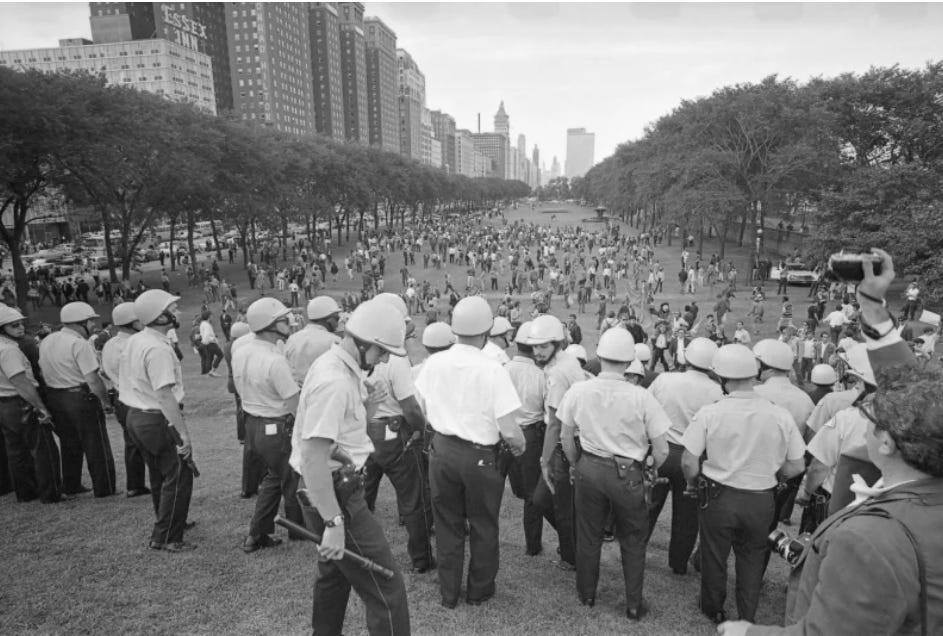
For some Americans, just saying “Chicago 68” is enough to bring it all back. Add the words, “Democratic National Convention” and millions more can visualize brawling delegates, billowing clouds of tear gas and police batons flailing at long-haired protestors.
The chant went up from witnesses of the street battle at the time: “The whole world is watching! The whole world is watching!”
Much of it was. And the memory has been a kind of curse on the Democratic Party and on the Windy City itself. Prior to 1968, Chicago had easily hosted the most presidential nominating conventions of any city. There had been nine Democratic conventions in the centrally located and convention-friendly city and — 14 Republican ones.

Whore House, USA, and the Bishop?
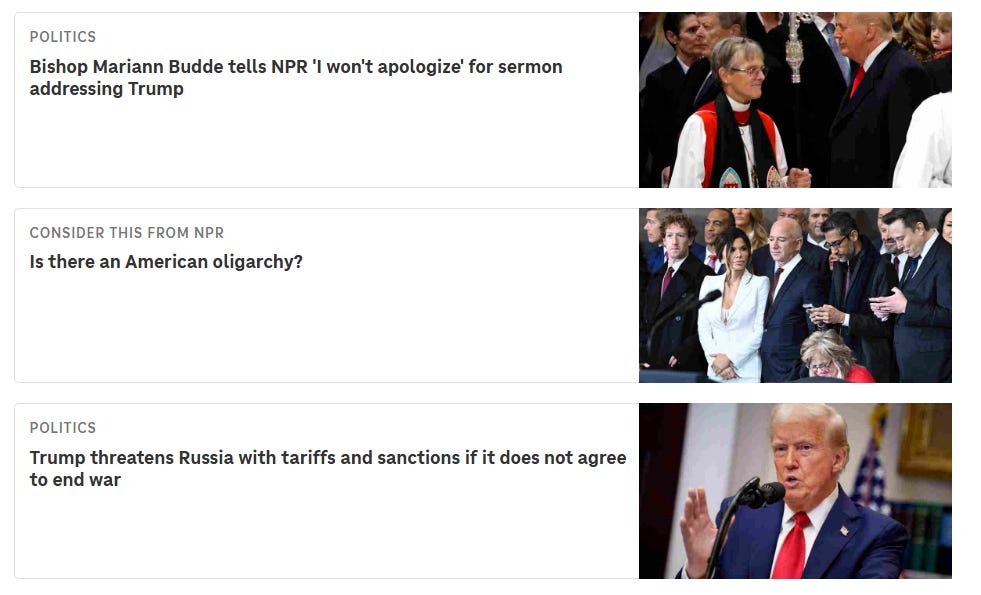
“Let me make one final plea, Mr. President,” Bishop Mariann Budde said in her 15-minute sermon. “Millions have put their trust in you. And as you told the nation yesterday, you have felt the providential hand of a loving God. In the name of our God, I ask you to have mercy upon the people in our country who are scared now,” said Budde, as she appeared to look towards the president.
“There are gay, lesbian and transgender children in Democratic, Republican, and independent families, some who fear for their lives.”
This came just one day after Trump issued a slate of executive orders, including one which has a section dedicated to “recognizing that women are biologically distinct from men,” one that declared a national emergency at the country’s southern border and issued several others related to immigration, including one attempting to do away with birthright citizenship.
Budde challenged these orders and much of the rhetoric that has surrounded them.
“The people who pick our crops and clean our office buildings; who labor in poultry farms and meat packing plants; who wash the dishes after we eat in restaurants and work the night shifts in hospitals, they – they may not be citizens or have the proper documentation. But the vast majority of immigrants are not criminals. They pay taxes and are good neighbors,” said Budde.
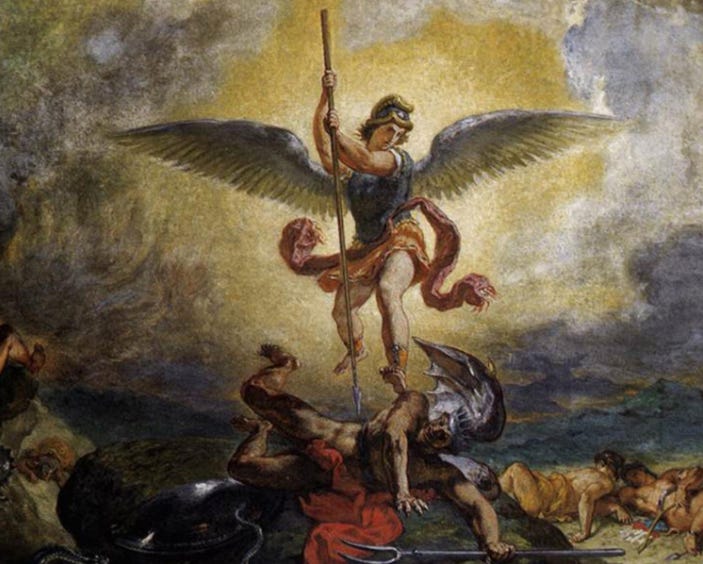
Buddle, please, these people, all of them, from Bernie Sanders voting for Marco Rubio, to the entire fucking rich and semi-rich and really-rich “class,” all human stain, ordained by your loser archangel Miguel versus Satan, man, to rule the Earth.
Oh, those prisons:
Randall Sullivan is no stranger to the Catholic mystical. A previous book, The Miracle Detective (2004) is reported to have profoundly changed him. His current book cited above, opens with a question: “Does the Devil exist, or is he a figment of our imagination?” The second question follows: “If he is real, who or what are we describing when we refer to ‘the Devil’”? Sullivan concludes his book with a statement of personal conviction: “There is a Devil, a force of evil that human beings can best comprehend by personifying it. To acknowledge this, he says, is to throw open the door “the Devil hides behind.”
That certainly got my attention. I was stunned to read this in the WSJ on the same day as my haunting dream. Replaying the dream in my mind, one of my first thoughts was to wonder whether the location of the Evil entity — a “far left” corner — was actually a metaphor for a present trend in our culture. It is a trend I wrote about in my recent post (published just a week before my dream) “Cultural Meltdown: Prophetic Wisdom for a Troubled Age.” There is a lot there that I imagine the Devil would prefer you and I did not ponder.
Today many people no longer believe in the Devil — Randall Sullivan gives it an uppercase “D” throughout — and many of those also no longer believe in God. This is a cultural phenomenon that the Devil finds most promising. It’s the theme of a psychological masterpiece by C.S. Lewis, The Screwtape Letters. I wrote of it in Holy Week this year in a post that I am certain the Devil would also prefer that you did not see. In his book, C.S. Lewis laid out the long, subtle descent upon which humans travail a slippery slope away from God:
“It does not matter how small sins are provided that their cumulative effect is to edge a man away from the Light and out into the Nothing… . Indeed the safest road to Hell is the gradual one — the gentle slope, soft underfoot, without sudden turnings, without milestones, without signposts.”
— The Screwtape Letters, p. 60-61
Saint Michael the Archangel Contends with Satan Still
Then, all these people wondering what Kushner-Stephen Miller-Kushner-Netanyahu LLC will do next?

Trump? You are not serious? He’s another rapist in chief and a mutant of the highest criminal and narcissistic order. And so we normalize the fucking abnormal. His picks? Abnormal and misanthropy on steroids. But we’ll just shift the baseline and treat him and his fucked up crew as human? Normal? He’s the old German Nazi ledby the nose by the newest Jewish versions .
Gaza is currently experiencing the largest slaughter of men, women and children in decades and a destruction rate that has produced over 40 million tonnes of rubble that will take over a decade to clear. The near 100,000 tonnes of bombs dropped on the Gaza Strip since1 October 2023 surpasses(external link) the World War II bombings of London, Dresden, and Hamburg combined. Gaza is the site of one of the largest engineered mass starvations(external link) this century. For over a year, a day has not passed by in which a child has not been dismembered by the US-backed Israeli army.
Gaza has seen its hospitals, universities, markets, and essential services blown to pieces, and its waterways, air, and soils polluted to highly toxic levels by chemical residues from carpet-bombing. The destructive force with which the Gaza Strip has been bombarded is equivalent to several times that of the nuclear bomb that the United States dropped on Hiroshima(external link). And yet, the tens of thousands of Palestinian children dying due to mutilation and incineration, and from infection resulting from amputation, count for absolutely nothing in the eyes of the West, in stark contrast to how it reacts when an Israeli is held hostage, or an ultra-wealthy American is trapped in an undersea submersible on a pleasure trip to view the Titanic.
It is breathtakingly clear that Palestinian lives do not matter to Imperial powers and their interests. The complete dismissal of entire populations as sub-human, or not equivalent to European or Euro-American bodies, is a stark reminder that the horrors of the transatlantic slave trade and colonial genocide of indigenous populations by Western empires have never left us. It is also a frightening reflection of the priorities of the world’s rulers as we watch the planet’s life-support systems erode due to ecological collapse.
The ruling class’s desire to preserve a liberal democratic society that is free from ecological breakdown extends only to a future reserved for themselves – an ever-decreasing minority of multi-millionaires and billionaires. Meanwhile, what we are witnessing in Gaza is a sign of what is to come in an era of growing ecological breakdown brought on by a capitalist world order that is no longer fit for purpose – if it ever was.
As Colombian president Gustavo Petro declared at the COP28 climate conference in Dubai last year: “Gaza is the mirror of our immediate future”.
+—+
Trump reply Bishop wey tell am to ‘have mercy’ on LGBT pipo and migrants – who be di Bishop?


Wetin we call dis foto,President Trump don dismiss di passionate appeal wey Bishop Mariann Edgar Budde make
Article information
- Author,Lebo Diseko
- Role,BBC World Service global religion correspondent
- 8 hours wey don pass
For many progressive Christians, Bishop Mariann Edgar Budde appeal say make President Donald Trump show mercy to LGBTQ+ pipo and migrants during one service wey hold on Tuesday, 21 January for Washington DC na example of Christian leadership at its best.
But to some conservative Christians, her words for di inaugural prayer service for Washington National Cathedral no hold water, as one pastor call am “inappropriate and embarrassing”.
President Trump for im reaction on Truth Social, call her “radical left hard-line Trump hater” and e demand for public apology.
For inside her 15-minute sermon, di Episcopal bishop of Washington tok about undocumented and LGBTQ+ pipo wey dey fear wetin di future go hold for dem.

Wetin we call dis foto,Trump look no show say e dey moved as e listen to Bishop Mariann Edgar Budde. E later tell di press say im no “think say di service good”
Since e assume office, di president don issue a number of executive orders wey include one wey recognise only two genders – male and female.
E also announce new measures wey aim to drastically reduce illegal migration and asylum claims for di US border.
65-yer-old Right Rev Budde, na di spiritual leader for 86 Episcopal congregations for di District of Columbia wey include di city of Washington DC and four counties for Maryland, di state wey surround di city.
She be di first woman to dey dat role, she dey also oversee di ministries of di Washington National Cathedral.
One 2011 Washington Post interview she do shortly after she dey installed as di ninth Bishop of di Episcopal Diocese of Washington bin describe her as “unapologetically liberal”.
She bin tok of her support for gay marriage, she call am “a no-brainer”. For di predominantly Democratic region, many pipo welcome her progressive views.

Wetin we call dis foto,Bishop Mariann Edgar Budde ask Trump to show mercy to LGBT pipo and migrants
Di Episcopal church na arguably one of di most liberal of di churches wey make up di global Anglican Communion (one of di world largest global Christian denominations).
On dia website, dem describe themselves as “aspiring to tell and exemplify God love for every human being”, wit pipo of “all genders and sexual orientations” wey dey serve as bishops, priests and deacons.
Bishop Budde post on her church website say she be “advocate and organiser in support of justice concerns, wey include racial equity, gun violence prevention, immigration reform, [and] di full inclusion of LGBTQ+ persons”.
Dis dey very different from di views of many more conservative Christians, in particular di evangelical believers wey form core part of Donald Trump base.
For dem, di increase in LGBTQ+ rights dey in opposition to teachings of di Bible, one perspective wey be like say don already dey shape government policy.
These believers also dey worry say immigration dey put America at risk, dem accuse former President Joe Biden say im policies encourage human trafficking.

Wetin we call dis foto,Trump don dclare border emergency to control di flow of migrants from Mexico
Dis no be di first time wey Bishop Budde and Donald Trump go dey jam.
During im last presidency, she bin para for am sake of one foto wey show as e how hold Bible outside St John Episcopal Church for Washington DC for di middle of George Floyd protests for June 2020.
For one interview at di time, she tok say “everything e say and don do na to cause violence… We need moral leadership, and e don do everything to divide us”.
Wetin dey happun for America dey show clash between two competing visions of wetin e mean to be Christian.
Progressives argue say living like Jesus na about being accepting of odas and fighting for social justice.
Many conservatives dey of di view say dia kontri dey di state of moral decline becos dem stop to dey follow God word.
Na conflict wey play out for dis election, as heavyweight evangelical leaders like Franklin Graham call Trump victory “a big win for Christians, for evangelicals”.
Perhaps, pipo fit see am clearly for di two statements dem issue on Tuesday. Inside one, di Episcopal church reiterate dia support for migrants, dem tok say “as Christians, our faith dey shaped by di biblical story of pipo wey God led go foreign kontris to escape oppression”.
For anoda statement on X, Republican lawmaker Mike Collins say Bishop Budde “di pesin wey give dis sermon suppose dey added to di deportation list”.
[A pidgin is a simplified language that allows people who don’t share a common language to communicate. Pidgins are often developed in situations like trade, colonization, and enslavement.]

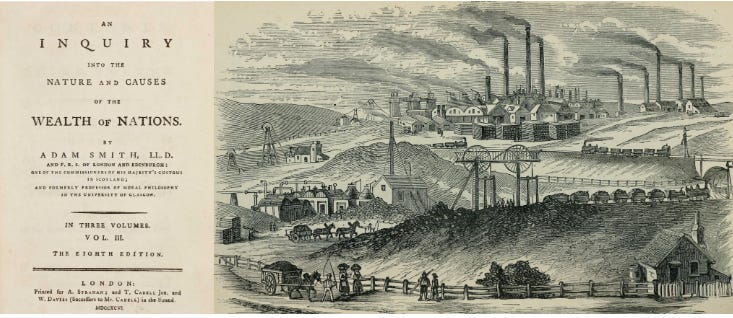
[The Wealth of Nations. Smith’s economic and social theories are crucial for understanding Marx’s critique of political economy. Smith deals with such issues as the so-called labor-theory of value, the equalization of the rate of profit, and the determination of commodity prices in important ways that anticipate Marx or require the corrections Marx provides.]
+—+
The Pverty of a Nation of scoundrels and sycophants and spineless democrats:
The first act of the 119th Congress of the United States was to pass a bill that would require federal immigration enforcement to detain and potentially deport any unauthorized immigrant accused of minor crimes including petty theft or shoplifting.
The bill, which is to be passed on 20 January, is a meaningful departure from current policy, which requires not one but two or more convictions – not accusations – of crimes of moral turpitude to trigger deportation proceedings. Immigration and Customs Enforcement (Ice) estimates that it would cost $29.6bn to implement, requiring an additional 110,000 detention beds and 10,000 detention and removal personnel.

This bill is widely recognized as a step toward Donald Trump’s promise of mass deportations under the leadership of border czar Tom Homan, one disparaged by the Democratic party as being inhumane.
Yet, even as Democratic party leadership has decried this mass deportation plan and even as the bill maligns Democrats as victimizing Americans through its policy of “open borders,” 48 Democratic members of Congress voted for this GOP-backed bill . The bill is on the verge of passing in the Senate, as 10 Democrats joined Republicans in clearing the way for its final approval.
As a scholar of borders and immigration, I am not at all surprised by the Democrats’ willingness to participate in the prizing of notions of “security” over human rights. After 9/11, the Homeland Security Act was signed, establishing Ice and Customs and Border Protection (CBP), framing immigration as a security issue, to be solved with security solutions. Since then, $409bn has been spent on enforcement, in the form of removal personnel, detention facilities and all forms of dystopian border technology – increasing steadily regardless of which party is in power, and reaching unprecedented levels this year.
But even as people are deported, even as the south-west border has become the deadliest land route in the world , even as more money has been spent on the southern border than ever before, people continue to arrive in unprecedented numbers. The number of unauthorized people has shifted over time but stayed between 10 and 12 million people for at least the last decade. Continuing to adopt more violent solutions do little more than turn us into an autocracy that imprisons people on accusations, one that is willing to eject them at whatever cost.
Today, an unprecedented one in every 69 people in the world is displaced. For them, crossing into the US is the end of a horrifically long journey – the last steps of an ultramarathon. They are fleeing horrors of a world ravaged by climate disaster, civil war and persecution, much of which the world’s wealthiest nations have had a hand in, through their militaries, industries or colonial pasts and presents.
Yet, looking at these numbers, policy makers have called for more security. The former president Barack Obama built walls that Trump expanded, from which hundreds of people, disproportionately pregnant and older women, have fallen to be maimed and even killed. In his first administration Trump separated children from their families, an idea innovated by Homan, who won an award for his service as head of Ice under the Obama administration. During Joe Biden’s tenure, CBP officers on horseback were filmed violently corralling Haitian immigrants, in imagery that evoked slave patrols.
A security focus is a self-fulfilling prophecy in that if security is not working, you need more security, if it is working you need more security. It creates a nail for which there can only be one hammer. Benchmarks for security have been exceeded and raised again and again, each time with deadlier force, with less attention to human rights or human life.
After 9/11, the Patriot Act vastly expanded the government’s right to conduct mass surveillance. As a result, multiple minority groups’ rights were violated – including Muslim Americans who were subject to registration and unfair deportation, and whose mosques were infiltrated by informants. Later, Black Lives Matter activists movements and social media were monitored through the same policies.
This deportation bill, named after Laken Riley, a nursing student who was killed by an asylum seeker who was accused of shoplifting, is the latest move on the slippery slope towards autocracy promised by this security-focused approach.
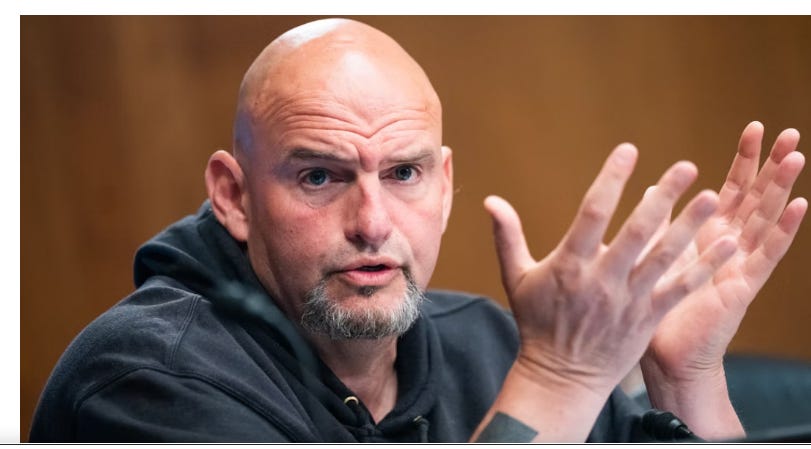
Its logic is laid bare by John Fetterman , a Democratic senator who co-sponsored the bill and said it “will ensure detention and deportations of criminal aliens before they can commit heinous crimes like what happened to Laken Riley”. His statement shows the willingness to trample the foundational tenets of human rights – the presumption of innocence, the promise of due process in the name of “security”.
While Fetterman’s words may seem particularly callous or absurd, it is less so when we recognize that our system is designed to repel, deny or kill rather than accept or process people’s legal claims. It is a system that imagines all people coming to our borders as guilty until proven innocent. It is one that has long denied due process.
Our legal pathways have shrunk, with funding on the adjudication of immigrant claims steadily declining in favor of higher and higher expenditure on smart walls that are designed to meet people with violence. The US spends triple the amount on immigrant detention than it does on adjudicating removal and asylum claims. The Biden administration recently enacted a policy that rights groups claim amounts to an “asylum ban ” – far from the “open borders” critics allege.
As Trump put it in reference to authorized and unauthorized immigrants he wants to eject, “getting them out will be a bloody story ”. If you believe in the sanctity of human life, this alone should be disturbing.
But even if the moral costs do not concern you, then be concerned with the financial costs; the billions we are all paying to fight windmills. There is copious data on the benefits of immigrants , including unauthorized immigrants, to this nation’s economy; copious data on how law abiding they are as compared to citizens.
Detaining and deporting everyone accused of shoplifting is an expensive, stupid idea. The case of one heinous attack does not change that.
It is time to divest from this path to nowhere and invest instead in the long-neglected systems of adjudication of immigrant claims. Given the exorbitant costs of deportation and detention , this approach promises to be not only more humane but also, ultimately less expensive, and safer.
As we enter this second Trump presidency, people are gearing up to fight against policies that dehumanize, to safeguard the rights that do exist. That fight begins with the Democratic party, many of whose members have veered towards autocracy themselves. It is time to call in those who claim to represent us, and demand that they fight for the US to live up to its mantra as a nation of immigrants.
Heba Gowayed is an associate professor of sociology at CUNY Hunter College and Graduate Center and author of the book Refuge: How the State Shapes Human Potential
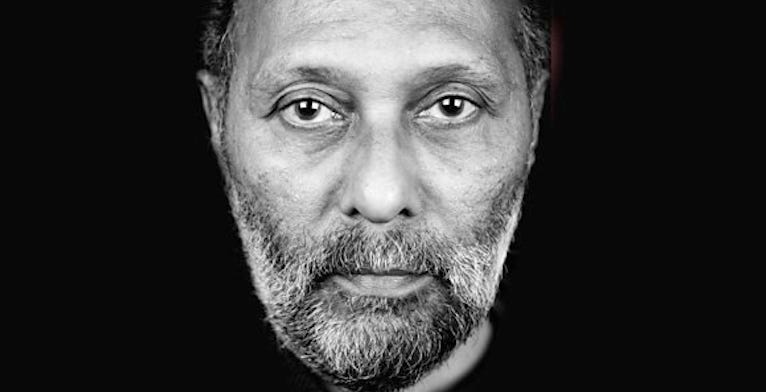
Stuart Hall would probably caution us from turning to the past to understand the present. The late, great Jamaican-British Marxist would most likely suggest that we approach historical precedent warily, that we not find an easy predictive pattern in prior events, that we not get caught in the trap of seeing history as repetition, as an inevitable cycle with inevitable outcomes. This is not to say that we should not ask questions of the past to understand the present. But those questions should not be answered in advance to confirm what we think we already know. They should work to reveal the specific conjunctures of power and the political-economic formations that characterize the here and now.
And yet it is almost impossible to read Hall’s 1979 Marxism Today essay “The Great Moving Right Show” – on the historical rise of Margaret Thatcher in the late 1970s – without seeing parallels with the contemporary phenomenon of Donald Trump. Hall’s cogent analysis of the shifting perceptions and functions of the state; of changes to approaches to the management of the economy, of control of education by the right; of racism, immigration, and law and order; of the question of fascism and what he calls “authoritarian populism;” and of the confusion and oftentimes complicity of progressive forces when it comes to the right wing resurgence — all seem to speak powerfully to the present. But Thatcherism is not Trumpism and Musk is not Mussolini, and in the US, the “great moving right show” began long before Trump’s second ascension to the presidency.
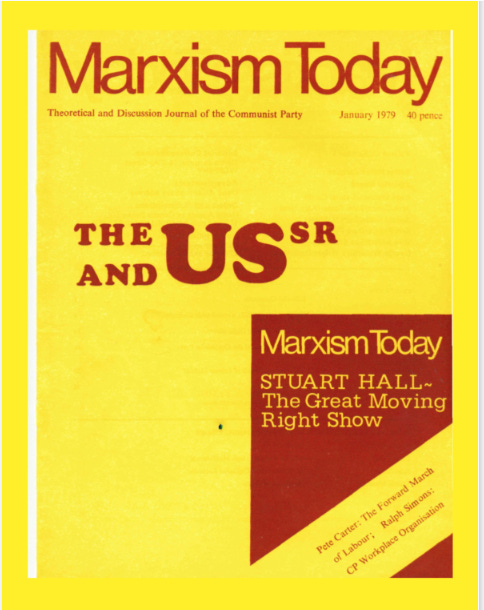
The Great Moving Right Show
Stuart Hall
No one seriously concerned with political strategies in the current situation can now afford to ignore the “swing to the Right”. We may not yet understand its extent and its limits, its specific character, its causes and effects. We have so far—with one or two notable exceptions—failed to find strategies capable of mobilizing social forces strong enough in depth to turn its flank. But the tendency is hard to deny. It no longer looks like a temporary swing in the political fortunes, a short-term shift in the balance of forces. It has been well installed—a going concern—since the latter part of the 1960s. And, though it has developed through a series of different stages, its dynamic and momentum appears to be sustained. We need to discuss its parameters more fully and openly on the Left without inhibi- tion or built-in guarantees.
Certain aspects have won attention from the Left: the present Government’s tough industrial and economic strategy in face of the recession and crisis in capital accumulation; the emergence of “Thatcherism” and the anti-Left campaigns; the rise of the National Front as an open political force. But the full dimensions of the precipitation to the Right continues to evade a proper analysis. This may be because the crisis continues to be “read” by the Left from within certain well-entrenched and respectable “common sense” positions. Many of these no longer provide an adequate analytic or theoretical framework: the politics which flow from them thus continue to fall far short of their aim.
Thus there are some who would still argue that “worse means better”—i.e. a sharpening of the contradictions. Such a position is often based on a belief in the inevitable rising tempo of class struggle and the guaranteed victory of “progressive forces everywhere”. Those who hold it have short political memories. They forget how frequently in recent history a sharpening of the contradictions has led to “settlements” and solutions which favoured capital and the Right, rather than the reverse. The commonest response on the Left is probably to interpret the “swing to the Right” as a simple expression of the economic crisis. Thus “Thatcherism” is—give or take one or two elements—the corresponding political bedfellow of a period of capitalist recession: the significant differences between this and other variants of Tory “philosophy” being conceived as without any specific pertinent political or ideological effects. And the National Front is the long-anticipated irrational face of capitalism—the class enemy in familiar Fascist disguise.
Specific Features
This position neglects everything particular and specific to this historical conjuncture. It views history as a series of repeats. It is predicated on a notion of a social formation as a simple structure in which economic factors will be immediately and trans- parently translated to the political and ideological levels. It falls under the sign of all “economisms” in supposing that, if you operate on the “determining level”—the economic front—all the other pieces of the puzzle will fall neatly into place.
It thus prevents itself, theoretically and politically, from working on those related but distinct contradictions, moving according to very different tempos, whose condensation, in any particular historical moment, is what defines a conjuncture. It neglects Lenin’s reminder of “an extremely unique historical situation” in which “absolutely dissimilar currents, absolutely heterogeneous class interests, absolutely contrary political and social strivings have merged . . . in a strikingly ‘harmonious’ manner . . .” (Letters From Afar (No. 1)). It takes for granted what needs to be explained: how a capitalist economic recession is presided over by a social democratic party in power (politically) with mass working class support and organized depth in the trade unions; and “lived” for increasing numbers of people through the themes and representations (ideologically) of a virulent, emergent “petty-bourgeois” ideology. These features of the current situation are not so much expressions of the economic crisis (its political and ideological reflection) as they are factors which have effects—including effects on the economic crisis itself and its possible solutions.
One also encounters in this discussion variants of “revolutionary optimism” and “revolutionary pessimism”. The pessimists argue that we mustn’t rock the boat, or demoralize the already dispersed forces of the Left. To them one can only reply with Gramsci’s injunction: to address ourselves “violently” towards the present as it is, if we are serious about transforming it. The optimists cast doubt on the doubters: look for the points of resistance—the class struggle continues. Of course, in one sense, they are right. We must look behind the surface phenomena, we must find the points of intervention, we mustn’t underestimate the capacity for resistance and struggle. But, if we are correct about the depth of the rightward turn, then our interventions need to be pertinent, decisive and effective. Whistling in the dark is an occupational hazard not altogether unknown to the British Left. “Pessimism of the intelligence: optimism of the will”.
Fascism
Finally, there is “”fascism”. There is a sense in which the appearance of organized Fascism on the political stage seems to solve everything for the Left. It confirms our best-worst suspicions, awakening familiar ghosts and spectres. Fascism and economic recession together seem to render transparent those connections which most of the time are opaque, hidden and displaced. Away with all those time-wasting theoretical speculations! The Marxist guarantees are all in place after all, standing to attention. Let us take to the streets. This is not an argument against taking to the streets. Indeed, the direct interventions against the rising fortunes of the National Front—local campaigns, anti-fascist work in the unions, trades councils, women’s groups, the mobilization behind the Anti-Nazi League, the counter-demonstrations, above all Rock Against Racism (one of the timeliest and best constructed of cultural interventions, repaying serious and extended analysis)—constitute one of the few success stories of the conjuncture. But it is an argument against the satisfactions which sometimes flow from applying simplifying analytic schemes to complex events. What we have to explain is a move toward “authoritarian populism”—an exceptional form of the capitalist state—which, unlike classical fascism, has retained most (though not all) of the formal representative institution in place, and which at the same time has been able to construct around itself an active popular consent. This undoubtedly represents a decisive shift in the balance of hegemony, and the National Front has played a “walk- on” part in this drama. It has entailed a striking weakening of democratic forms and initiatives, but not their suspension. We may miss precisely what is specific to this exceptional form of the crisis of the capitalist state by mere name-calling.
The swing to the Right is part of what Gramsci called an “organic” phenomenon:
“A crisis occurs, sometimes lasting for decades. This exceptional duration means that uncurable structural contradictions have revealed themselves . . . and that, despite this, the political forces which are struggling to conserve and defend the existing structure itself are making efforts to cure them within certain limits, and to overcome them. These incessant and persistent efforts . . . form the terrain of the conjunctural and it is upon this terrain that the forces of opposition organize”. (Gramsci, Prison Notebooks, p. 179)
Gramsci insisted that we get the “organic” and “conjunctural” aspects of the crisis into a proper relationship. What defines the “conjunctural”—the immediate terrains of struggle—is not simply the given economic conditions, but precisely the “incessant and persistent” efforts which are being made to defend and conserve the position. If the crisis is deep—”organic”—these efforts cannot be merely defensive. They will be formative: a new balance of forces, the emergence of new elements, the attempt to put together a new “historical bloc”, new political configurations and “philosophies”, a profound restructuring of the state and the ideological discourses which construct the crisis and represent it as it is “lived” as a practical reality; new programmes and policies, pointing to a new result, a new sort of “settlement”—”within certain limits”. These do not “emerge”: they have to be constructed. Political and ideological work is required to disarticulate old formations, and to rework their elements into new configurations. The “swing to the Right” is not a reflection of the crisis: it is itself a response to the crisis. I want to examine certain features of this response, concentrating on some neglected political-ideological aspects.
Economic Crisis
We must examine first the precipitating conditions. This is a matter of a set of discontinuous but related histories, rather than neat, corresponding movements. In economic terms, Britain’s structural industrial and economic weakness emerges in the immediate aftermath of the postwar boom. The 1960s are marked by the oscillations between recession and recovery, with a steady underlying deterioration. These effectively destroy the last remnants of the “radical programme” on the basis of which [British Prime Minister Harold] Wilson won power in 1964, and to which he tried to harness a new social bloc. By the end of the 1960s, the economy has dipped into full scale recession— slumpflation—which sustains the exceptional “Health course” of 1971-4 [after Conservative Prime Minister Edward Heath], with its head-on collisions with organized labour. By the mid-1970s, the economic parameters are dictated by a synchronization between capitalist recession on a global scale, and the crisis of capital accumulation specific to Britain—the weak link in the chain. Domestic politics has thus been dominated by crisis-management and containment strategies: dove-tailed through an increasingly interventionist state, intervening both to secure the conditions of capitalist production and reproduction. The strategy has a distinctively corporatist character -incorporating sections of the working class and unions into the bargain between state, capital and labour, the three “interests”. Crisis management has drawn successively on the different variants of the same basic repertoire: incomes policy, first by consent, then by imposition; wage restraint: social contracting. The “natural” governor of this crisis has been the party of social democracy in power. This last factor has had profound effects in disorganizing and fragmenting working class responses to the crisis itself.
At the ideological level, however, things have moved at a rather different tempo, and in certain respects pre-date the economic aspects. Many of the key themes of the radical Right–law and order, the need for social discipline and authority in the face of a conspiracy by the enemies of the state, the onset of social anarchy, the “enemy within”, the dilution of British stock by alien black elements —are well articulated before the full dimensions of the recession are revealed. They emerge in relation to the radical movements and political polarizations of the 1960s, for which “1968” must stand as a convenient, though inadequate notation. Some of these themes get progressively translated to other fronts as the confrontation within organized labour, and the militant resistance it meets develops during the Heath interregnum. For the constitution of the principal thematics of the radical Right, this must be seen as a formative moment. (We have attempted a fuller analysis of this moment elsewhere: the chapters on the “Exhaustion Of Consent” and “Towards the Exceptional State” in Policing The Crisis , Hall, Clarke, Critcher, Jefferson and Roberts. Macmillan, 1978).
The Radical Right
The radical Right does not appear out of thin air. It has to be understood in direct reaction to alternative political formations attempting to occupy and command the same space. It is engaged in a struggle for hegemony, within the dominant bloc, against both social democracy and the moderate wing of its own party. Not only is it operating in the same space: it is working directly on the contradictions within these competing positions. The strength of its intervention lies partly in the radicalism of its commitment to break the mould, not simply to rework the elements of the prevailing “philosophies.” In doing so, it nevertheless takes the elements which are already constructed into place, dismantles them, reconstitutes them into a new logic, and articulates the space in a new way, polarizing it to the Right.
This can be seen with respect to both positions. The Heath position was destroyed in the confrontation with organized labour. But it was also undermined by its internal contradictions. It failed to win the showdown with labour; it could not enlist popular support for this decisive encounter; in defeat, it returned to its “natural” position in the political spectrum, engaging in its own version of bargaining. “Thatcherism” succeeds in this space by directly engaging the “creeping socialism” and apologetic “state collectivism” of the Heath wing. It thus centres on the very nerve of consensus politics, which dominated and stabilized the political scene for over a decade. To sustain its possible credibility as a party of government in a crisis of capital, “Thatcherisni” retains some lingering and ambivalent connections to this centre territory: Mr. Prior [Conservative Party politician Jim Prior] is its voice— but soto voce. On other grounds, it has won considerable space by the active destruction of consensus politics from the Right. Of course, it aims for a construction of a national consensus of its own. What it destroys is that form of consensus in which social democracy was the principal tendency. This evacuation of centrist territory has unleashed political forces on the Right kept in reign for most of the postwar period.
The Contradiction within Social Democracy
But the contradiction within social democracy is the principal key to the whole rightward shift of the political spectrum. For if the destruction of the Heath “party” secures hegemony for “Thatcherism” over the Right, it is the contradictory form of social democracy which has effectively disorganized the Left and the working class response to the crisis.
This contradiction can be put in stark and simple terms; considerable strategic conclusions flow from it. As follows: To win electoral power social democracy must maximize its claims as the political representative of the interests of the working class and organized labour. It is the party capable of (a) mastering the crisis, while (b) defending—within the constraints imposed by recession—working class interests. It is important here to remember that social democracy is not a homogenous political entity but a complex political formation. It is not the expression of the working class “in government,” but the principal measure of representation of the class. Representation here has to be understood as an active and formative relationship. It organizes the class, constituting it as a political force—a social democratic political force—in the same moment as it is constituted. Everything depends on the ways, the apparatus and the “philosophies”—the means—by which the often dispersed and contradictory interests of a class are welded together into a coherent position which can be articulated and represented in the political and ideological theatre of struggle.
The expression of this representative relationship of class-to-party, it the present period, has depended decisively on the extensive set of bargains negotiated between Labour and the trade union representatives of the class. This “indissoluble link” is the practical basis for the claim to be the natural governing party of the crisis. This is the contract it delivers. But. once in government, social democracy is committed to finding solutions to the crisis which are capable of winning support from key sections of capital, since its solutions are framed within those limits. But this requires that the indissoluble link be used, not to advance but to discipline the class and organizations it represents. This is only possible if the link—class-to-party—is dismantled and if there can be substituted for it an alternative articulation: government-to-people. The rhetorics of “national interest”, which is the principal ideological form in which a succession of defeats have been imposed on the working class by social democracy in power, are exactly the sites where this contradiction shows through—and is being constantly reworked. But government-to-people dissects the field of struggle differently from class-to-party. It sets Labour, at key moments of struggle—from the strikes of 1966 right through to the present 5 percent norm—by definition “on the side of the nation” against “sectional interests”, “irresponsible trade union power”, etc.
This is the terrain on which Mr. Heath played such destructive games in the lead-through to the Industrial Relations Act and its aftermath with his invocation of “the great trade union of the nation” and the spectre of “holding the nation up to ransom”. “Thatcherism”, deploying the discourses of “nation” and “people” against “class” and “unions” with far greater vigour and popular appeal, has homed in on the same objective contradiction. Within this space is being constructed an assault, not on this or that piece of “irresponsible bargaining” by a particular union, but on the very foundation and raison d’etre of organized labour. Considerable numbers of people —including many trade unionists—find themselves reflected and set in place through this interpellation of “nation” and “people” at the centre of this mounting attack on the defensive organizations of the working class.
Anti-Collectivism
A closely related strand in the new philosophy of the radical right is the themes of anti-collectivism and anti-statism. “Thatcherism” has given this traditional arena of conservative “philosophy” expansive play. At the level of organized theoretical ideologies, anti-statism has been refurbished by the advance of Monetarism as the most fashionable economic credo. Keynesianism was the lynch-pin of the theoretical ideologies of state intervention throughout the postwar period, assuming almost the status of a sacred orthodoxy or doxa. To have replaced it in some of the most powerful and influential apparatuses of government, research and the universities and restored in its place [Milton] Friedman and [Friedrich August] von Hayek is, in itself, a remarkable reversal. Neither Keynesianism nor Monetarism win votes in the electoral marketplace. But in the doctrines and discourses of “social market values”—the restoration of competition and personal responsibility for effort and reward, the image of the over-taxed individual, enervated by welfare coddling, his initiative sapped by handouts by the state—”Thatcherism” has found a powerful means of popularizing the principles of a Monetarist philosophy: and in the image of the welfare “scavenger” a well designed folk-devil. The elaboration of this populist doctrine—to which Sir Keith Joseph and Mr. Boyson, leader writers in the Telegraph, the Economist and the Spectator, opinion leaders in the Mail and Express and many others have given their undivided attention—represents the critical ideological work of constructing for “That- cherism” a populist common sense. It is a particularly rich mix because of the resonant traditional themes —nation, family, duty, authority, standards, self-reliance—which have been effectively condensed into it. Here elements from many traditional ideologies— some already secured at earlier times to the grand themes of popular Conservatism, many others with a wider popular connotation—have been inserted into and woven together to make a set of discourses which are then harnessed to the practices of the radical Right and the class forces they now aspire to represent.
Aspects of the Repertoire
Two aspects of this rich repertoire of anti-collectivism only should be remarked on here. The first is the way these discourses operate directly on popular elements in the traditional philosophies and practical ideologies of the dominated classes. These elements—as [Ernesto] Laclau among others has recently argued—always express a contradiction between popular interests and the power bloc. But, since they have no intrinsic, necessary and historically fixed class meaning but can be effectively composed as elements within very different discourses, themselves articulated to and by different class positions and practices, it marks the neutralization of that contradiction to have successfully colonized them, for the Right.
The second point is a related one. For what is represented here (again, in an active sense) is indeed the materiality of the contradiction between “the people,” popular needs, feelings and aspirations—on the one hand—and the imposed structures of an interventionist capitalist state—that state of the monopoly phase of capitalist development — on the other. In the absence of any fuller mobilization of democratic initiatives, the state is increasingly encountered and experienced by ordinary working people as, indeed, not a beneficiary but a powerful, bureaucratic imposition. And this “experience” is not misguided since, in its effective operations with respect to the popular classes, the state is less and less present as a welfare institution and more and more present as the state of “state monopoly capital”. Social democracy cannot, of course, exploit any of this terrain to its advantage. First, it holds to a neutral and benevolent interpretation of the role of the state as incarnator of the national interest above the class struggle. Second in the representations of social democracy (and not only there, on the Left) the expansion of the state is understood as, in itself, and without reference to the mobilization of effective democratic power at the popular level, virtually synonymous with “socialism”. Third, the enlarged interventionist state is the principal instrument through which the party of social democracy attempts to manage the capitalist crisis on behalf of capital. Fourth, in this phase, the state is inscribed through every feature and aspect of social life. Social democracy has no alternative viable strategy, especially for “big” capital (and “big” capital has no viable alternative strategy for itself) which does not involve massive state support. Thus in any polarization along this fissure, Labour is undividedly “with” the state and the power bloc—and Mrs. Thatcher is, undividedly, out there “with the people”. It can now be seen that the anti-statist elements in the discourses of the radical Right are key supporters for the new populism. It is no rhetorical flourish. To add that it then does some service in making respectable the radical Right assault on the whole structure of welfare and social benefits is only to say that the work of ideological excavation, if well done, delivers considerable political and economic effects.
Education
We might turn to another area of successful colonization by the radical Right: the sphere of education. Until very recently, the social democratic goals of “equality of opportunity” and “remedying educational advantage” were dominant throughout the world of secondary education. The struggle over comprehensivization was its political signature. Contestation in this area has only gradually deve- loped, through a series of strategic interventions. The “Black Paper ” group—at first no more than a rump—has moved from very modest beginnings to the point where it could justly be claimed (and was) that their preoccupations set the agenda for the “Great Debate” which the Labour Government initiated last year. In the 1960s “progressive” and “community” education made considerable advances within state schools. Today, “progressivism” is thoroughly discredited: the bodies of a whole series of well-publicized schools—William Tyndale and after, so to speak—lie strewn in its path. The panic over falling standards and working class illiteracy, the fears concerning politically-motivated teachers in the classroom, the scare stories about the “violent” urban school, about the adulteration of standards through the immigrant intake, and so on have successfully turned the tide in the education sphere towards themes and goals being established for it by the forces of the Right. The press—especially those three popular ventriloquist voices of the radical Right, the Mail, the Sun and the Express— have played here a quite pivotal role. They have publicized the “examples” in a highly sensational form—and they have drawn the connections.
These connections and couplings are the key mechanisms of the process by which education as a field of struggle has been articulated to the Right. There are long, deep-seated resistances within the philosophy of state education to any attempt to measure schooling directly in terms of the needs and requirements of industry. That these were resistances often shot through with ambiguity is not so important for our purposes. However it arose, this reluctance to cash the school in terms of its immediate value to capital was one on which campaigns could be based with some hope of professional and administrative support. These defences have now been dismantled. Clear evidence is supposed to exist that standards are falling: the principal witnesses to this alarming trend are employers who complain about the quality of job applicants: this, in turn, must be having an effect on the efficiency and productivity of the nation—at a time when recession puts a premium on improving both. Once the often ill-founded elements can be stitched together into this chain of “logic”, policies can begin to be changed by leading educationists of the political Right, indirectly, even before they take charge. And why?
First, because the terrain on which the debate is being conducted has been so thoroughly reconstructed around this new “logic” that the groundswell for change is proving hard to resist. Second, because Labour itself has always been caught between competing goals in schooling: to improve the chances of working class children and the worse-off in education, and to harness education to the economic and efficiency needs of the productive system. We can see now that this contradiction, even within the social democratic educational programme, is a reworking of what earlier we called the principal contradiction of social democracy in this period. The educational experts and spokesmen, the educational press, sections of the profession, the media, many educational interest groups and organizations have been operating exactly on the site of this dilemma and—in conditions of recession—have convinced the Government. It in turn has now taken up the lead in promoting debates and policies designed to make this equation—success in education = requirements of industry—come true.
The “Great Debate”
Thus the agenda for the “Great Debate” was indeed set for social democracy by the social forces of the Right—and the Government, which initiated it, is almost certainly convinced that this is a largely “non political debate—like debates about education ought to be”. Yet, in order to bring this about, a major restructuring of the state apparatuses themselves has had to be executed. The DES has been set aside, and new state apparatuses, capable of realizing the equation in more immediate and practical forms, have moved into a central position in the field— the Manpower Services Commission, the new TSA re-training programmes in further and technical education, and its ancillary supports etc. Here, training and retraining programmes directly geared in to the demands and movements of industry and the silent deskilling and reskilling of the unemployed can proceed.
Again, this is no merely imposed or rhetorical strategy. The recomposition of the educational state apparatuses and the redirection of resources and programmes is the site of a very real and profound construction of a field of the state, from above. But many aspects of the strategy also seem to win consent and support from parents. Perhaps because, in a period of scarce jobs, working class parents are glad to see their children undergoing the process of being skilled—even if it is for particular places in routine manual labour or, in many instances, for places which are unlikely to exist at all when and if industrial production revives. Perhaps it is because, if comprehensivization, in the form in which it was implemented, and other radical education pro- grammes are not going after all to deliver the goods for working class children, then they may have to be content to be “skilled” and “classed” in a way that seems appropriate.
The shift in educational strategy thus says, in effect, to such parents: you are in the educational subordinate class; the way out is by moving up, through increased educational competition; what counts in this competition is a standard training, acceptable social skills, respect for authority and traditional values and discipline. In the face of the massive failures of social democratic policies on schooling to turn the tide of educational disadvant- age, the positive aspirations of working people for the education of their children can be redirected towards the support for a traditional education, programmes of discipline and “relevance to indus- trial experience”. In the 1960s, parental involvement belonged to “de-schooling” and Ivan lllyich: in the 1970s, it is one of the strongest cards in the educational pack being shuffled by Mr. St. John-Stevas , Shadow spokesman for Education.
Law and Order
If education is an area where the Right has won territory without having to win power, two other areas in the repertoire of the radical Right—race and law and order—are ones where the Right has traditionally assumed a leading role. We can be brief about them since they have gained considerable attention on the Left in recent months. They are chosen as examples here only to make a general point. On law and order, the theme—more policing, tougher sentencing, better family discipline, the rising crime rate as an index of social disintegration, the threat to “ordinary people going about their private business” from thieves, muggers, etc., the wave of lawlessness and the loss of law-abidingness—are perennials of Conservative Party Conferences, and the sources of many a popular campaign by moral entrepreneur groups and quoting editors. But if the work of the Right in some areas has won support over into its camp, the law and order issues have scared people over. In some versions of the discourse of the radical Right, moral interpellations play an important role. But the language of law and order is sustained by moralisms. It is where the great syntax of “good” versus “evil”, of civilized and uncivilized standards, of the choice between anarchy and order constantly divides the world up and classifies into its appointed stations. The play on “values” and on moral issues in this area is what gives the law and order crusade much of its grasp on popular morality and common sense con- science. Yet despite this, it touches concretely the experiences of crime and theft, of loss of scarce property and fears of unexpected attack in working class areas and neighbourhoods; and, since it promulgates no other remedies for their underlying causes, it welds people to that “need for authority” which has been so significant for the Right in the construction of consent to its authoritarian programme.
Race constitutes another variant, since in recent months questions of race, racism and relations between the races, as well as immigration, have been dominated by the dialectic between the radical-respectable and the radical-rough forces of the Right. It was said about the 1960s and early 70s that, after all, Mr. Powell lost. This is true only if the shape of a whole conjuncture is to be measured by the career of a single individual. In another sense, there is an argument that “Powellism” won: not only because his official eclipse was followed by legislating into effect much of what he proposed, but because of the magical connections and short-circuits which Powellism was able to establish between the themes of race and immigration control and the images of the nation, the British people and the destruction of “our culture, our way of life”. I would be happier about the temporary decline in the fortunes of the Front if so many of their themes had not been so swiftly reworked into a more respectable discourse on race by Conservative politicians in the first months of this year.
I have looked exclusively at some political-ideological dimensions of the emergence of the radical Right, not to evoke wonder at its extent, but to try to identify some things which are specific to it, which mark its difference from other variants which have flourished since the War. The first is the complex but interlocked relationship of the Right to the fortunes and fate of social democracy when the latter takes power in a period of economic recession, and tries to provide a solution “within certain limits”. It is always the case that the Right is what it is partly because of what the Left is: here we are dealing with the effects of a lengthy period of social democratic leadership. The second is its popular success in neutralizing the contradiction between people and the state/power bloc and winning popular interpellations so decisively for the Right. In short, the nature of its populism. But now it must be added that this is no rhetorical device or trick, for this populism is operating on genuine contradictions, and it has a rational and material core. Its success and effectivity does not lie in its capacity to dupe unsuspecting folk but in the way it addresses real problems, real and lived experiences, real contradictions—and yet is able to represent them within a logic of discourse which pulls them systematically into line with policies and class strategies of the Right.
Finally—and this is not limited to this analysis, though it seems especially relevant—there is the evidence of just how ideological transformations and political restructuring of this order is actually accomplished. It works on the ground of already constituted social practices and lived ideologies. It wins space there by constantly drawing on these elements which have secured over time a traditional resonance and left their traces in popular inventories. At the same time, it changes the field of struggle by changing the place, the position, the relative weight of the condensations within any one discourse and constructing them according to an alternative logic. What shifts them is not “thoughts” but a particular practice of class struggle: ideological and political class struggle. What makes these representations popular is that they have a purchase on practice, they shape it, they are written into its materiality. What constitutes them as a danger is that they change the nature of the terrain itself on which struggles of different kinds are taking place; and they have pertinent effects on these struggles. Currently, they are gaining ground in defining the “conjunctural”. That is exactly the terrain on which the forces of opposition must organize, if we are to transform it.
Stuart Hall, “The Great Moving Right Show,” Marxism Today (January 1979), 14-2
+—+
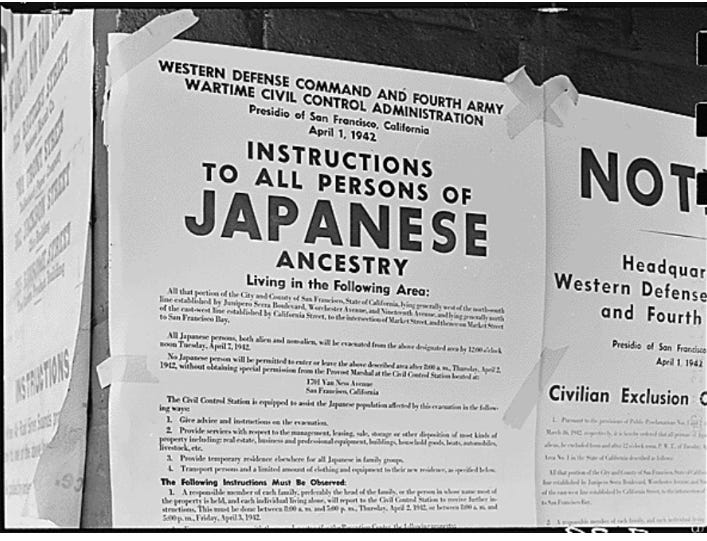
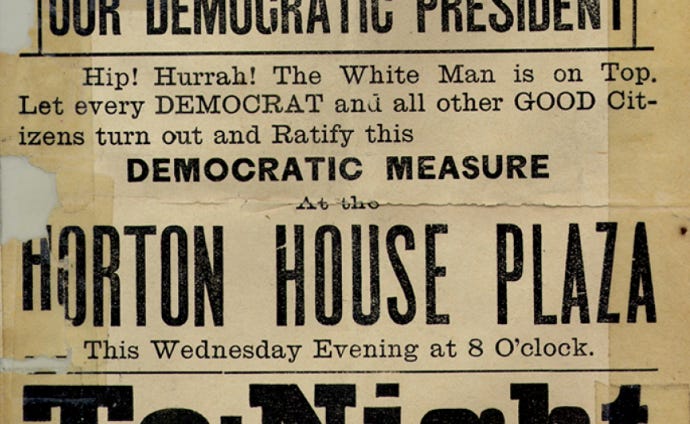


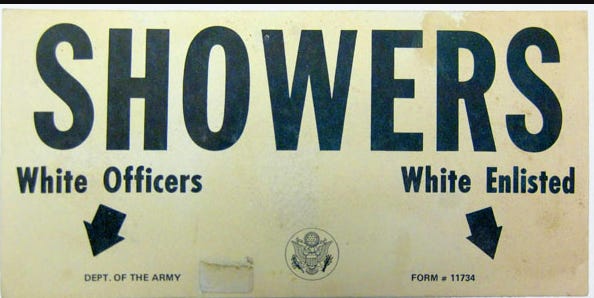


It’s a fucking sick country:
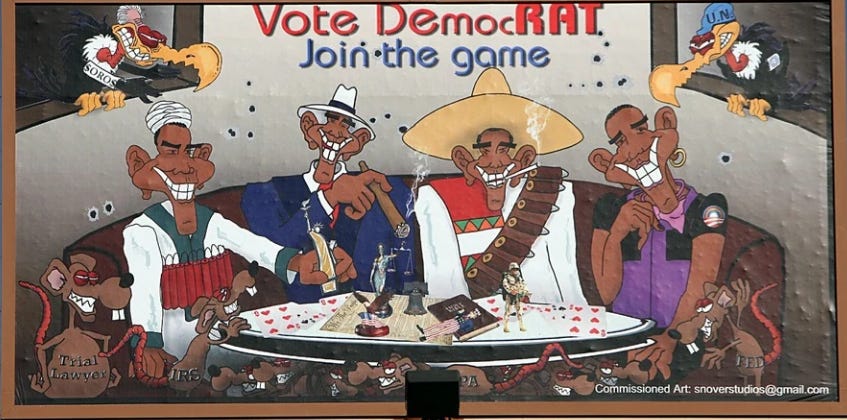
Freedom is GONE!
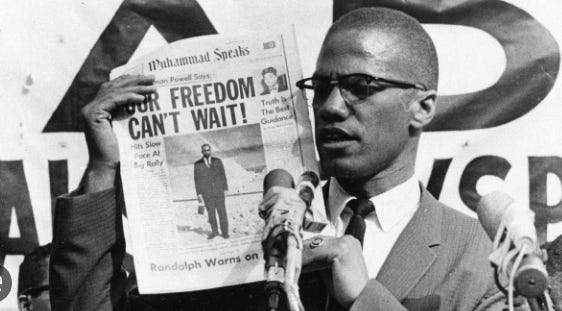
“If one really wishes to know how justice is administered in a country, one does not question the policemen, the lawyers, the judges, or the protected members of the middle class. One goes to the unprotected — those, precisely, who need the law’s protection most! — and listens to their testimony.” — Baldwin, No Name on the Street

The origins of policing in the USA can be traced back to a period when there was a need to control Native Americans and slaves.
New England settlers appointed various constables to police Native Americans as they were deemed a threat.
Slave patrols were created to control the slave population. Their brutality and cruelty brought fear to every black person who came in contact with them.
Fast forward 2020, the previous adjectives can be applied to describe the modern US police. The murder of George Floyd is a testament to this appalling behaviour.
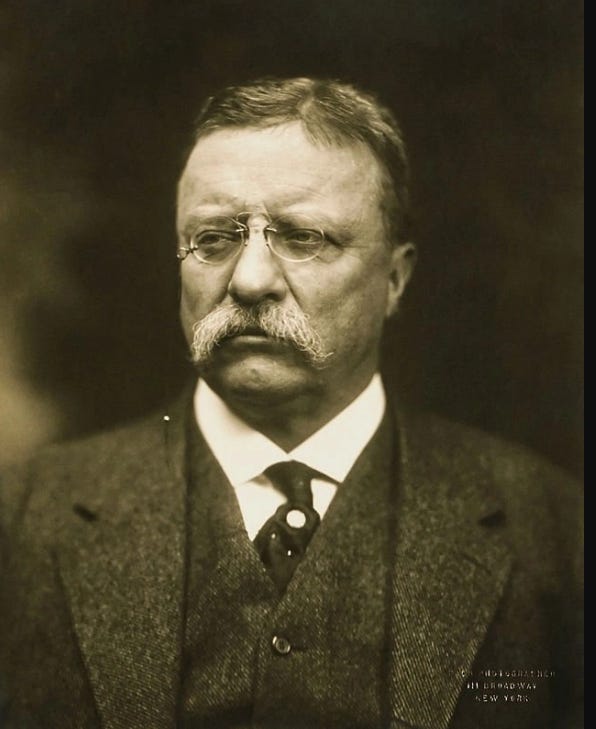
“This continent had to be won. We need not waste our time in dealing with any sentimentalist who believes that, on account of any abstract principle, it would have been right to leave this continent to the domain, the hunting ground of squalid savages. It had to be taken by the white race.”
Seventeen years earlier, Roosevelt, then a young widower, left New York in favor of the Dakotas, where he built a ranch, rode horses and wrote about life on the frontier. When he returned to the east, he famously asserted that “the most vicious cowboy has more moral principle than the average Indian.”
“I don’t go so far as to think that the only good Indians are the dead Indians, but I believe nine out of every 10 are,” Roosevelt said during a January 1886 speech in New York. “And I shouldn’t like to inquire too closely into the case of the tenth.”

Counting the dead: How the ceasefire will reveal the true scale of Gaza’s death toll
Who is liberated Palestinian leader Khalida Jarrar?
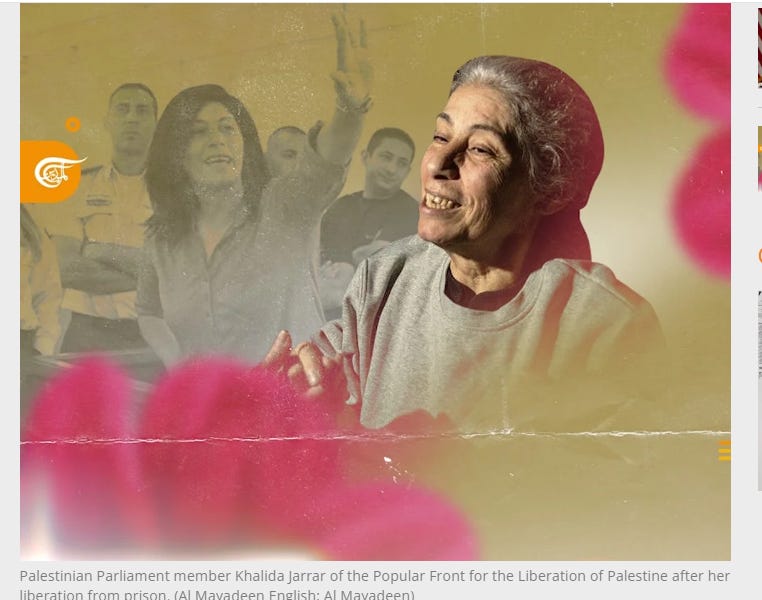
After enduring years of struggle and detention in Israeli prisons, Khalida Jarrar, hailed as “Political Prisoner No. 1” by Israeli journalist Gideon Levy, is finally liberated. Her liberation came as part of the first prisoner exchange between the Israeli occupation and the Palestinian Resistance following Operation Al-Aqsa Flood, which symbolized a historic triumph against the atrocities in Gaza.
Palestinian leader Khalida Jarrar was born on February 9, 1963, in the city of Nablus. She is married to Ghassan Jarrar, a businessman who has endured years of administrative detention, investigation, and deportation.
Jarrar has two daughters, Yafa and Suha. Tragically, Suha passed away in July 2021 while her mother was still in detention, and the occupation prevented her from saying a final farewell to her daughter.
SharePrevious
 Paul Haeder, Author