

…as we starve and rape Gazans and Palestinians, the Yanquis and Klanadians Toast their Nothingness (Amnesiac) Roots . . . .
Paulo Kirk poem for my wife’s birthday, today, and alas, it is the day, two years, when her hyounger brother died. AND, my spouse’s 25 year old daughter has self-estranged herself going on four years. What lovely mother’s and birth days for her.
But she resists the gloom temptation. Ofrenda’s in Portland!
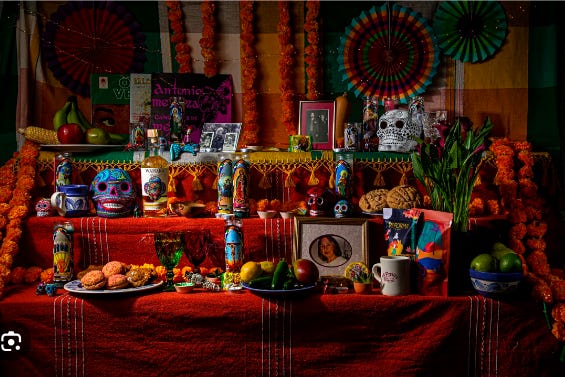
Days of Glory Captured in Ofrendas
you breathe life into those boxes
offerings for the living, dead
back to still-life
journeys in the process
hands over hands
fingers from metate work
quern in your other language
your DNA is deep into
poblanos, chile de arbol
+-+
you would have been
Maria under palapa
Tulum your shade of enlightenment
instead now you purchase
bagged masa, hold earth-like
corn mash between fingers
smooth into husks, and alas
you venture back
+-+
Maria in Taxco de Alarcon
piecing together ofrendas
or pounding tin-shapes into
hojalatas, you prefer retablos
singed with dia de los muertos
but family shies away
instead covering the blood
of suffering Christ
++
I see you in Taxco or Puebla
eyes focused on your Maria
shapes, your Lisa vanishing
while a Cabazos or Gonzales
rises like corn stalk
reaching a sun not in
Ireland, or France
+-+
yet your birthday
tied to Saint Patrick’s Day
but I see the charge of Mexicans
Irish fighting for their adopted
country, Mexico, valiant
old world meshed with
Marias and Marios, working
earth, plying fingers, hands
+-+
into the craftwork of el sol
happy birthday, Lisa Marie
Feliz cumplianos, one soon
to be celebrated in a town
of 300 churches, or where other
volcanoes steam in tribute
to mi esposa incredible
+-+
for Lisa Marie McCrabb, from ‘that’ esposo!
______________________________________________________
Ahh, but Saint Patrick’s Day? This is a piece that has made the rounds “out there.”
Mexico’s Saint Patrick’s Day & Britain’s Genocide
By Paulo
The history of Irish-American defenders of Mexico and the Catholic faith unfolded elegantly for me when I was living and working in El Paso and later in Mexico.
I have Irish roots, with family who ended up in Scotland and then Canada. That’s my Kirk side. While Ireland never held an allure for me, when I was there, including in Belfast, I dove into my history and realized how dirt poor and superstitious many of my brethren were.
But this? Every March 17 is celebrated with bagpipes and parades in Mexico! The irony of ironies is I even partied hearty in Chihuahua and Juarez on many a St. Patrick’s Day.
“Every St Patrick’s Day, the first toast that I make is in honor of the San Patricios,” says Martin Paredes, a Mexican writer based in the US. “A group of Irishmen came to the defense of Mexico, and many of them died in defense of Mexico. That has to be lauded as one of the greatest honors ever, because they were fighting for an adopted nation — and they died for an adopted nation.”
It is a complex story that goes back into the history of the Mexican-American war, for which most of my K12 and college students have no knowledge.
Paredes has written extensively on the San Patricio Battalion; Smithsonian Magazine has featured this history. The San Patricio Battalion was a military unit composed mainly of Irish soldiers that were serving in the US Army when the US was invading Mexico.
“These were US soldiers that left US lines and joined Mexican lines and fought for Mexico against the United States.” It was in a time when Texans were going after Mexicans and wanting that “independent state” to be annexed by the USA. War drums precipitated pressing men into the military to go fight against Mexico. Irish were considered non-people, and anti-Catholicism was rampant in the US.
Genocide: The touchstone for Irish folk is Ireland’s Great “Potato” Famine, which generated a huge wave of immigrants arriving to the US’s soil. During the peak of Irish emigration — 1845-1852 — nearly two million people – about a quarter of the population – emigrated to the United States.
Even this story is broken: According to economist Cormac O’ Grada, more than 26 million bushels of grain were exported from Ireland to England in 1845, a “famine” year. Even greater exports are documented. In the 1997 issue of History Ireland by Christine Kinealy of the University of Liverpool, her research shows that nearly 4,000 vessels carrying food left Ireland for ports in England during “Black ’47” while 400,000 Irish men, women and children died of starvation.
The food was shipped from ports in some of the worst famine-stricken areas of Ireland, and British regiments guarded the ports and granaries to guarantee British merchants and absentee landlords their “free-market” profits.
During the famine, the British government “deliberately and systematically adopted reckless and wanton policies of official neglect that exacerbated the famine’s savagery and substantially increased its cruel death count.”
Viva Mexico: Irish deserters from the US Army formed the core of the “Battalion of Foreigners,” which was renamed “Batallón de San Patricio.” Roman Catholic deserters from Germany and other European nations also joined, as did some foreign residents of Mexico City. There were also several African Americans who had escaped from slavery.
John Riley, a Galway-born soldier who was serving in the 5th US Infantry Regiment, led this battalion. Under Riley, this elite artillery-unit-turned-infantry battalion fought with distinction in most of the major battles of the war until the Battle of Churubusco (Mexico City) on August 20, 1847.
The unit was overrun, dozens of the San Patricios were captured, and many were hanged on the spot.
My El Paso friend Tom Connolly showed me his San Patricio banner of green silk. On one side is a harp, surrounded by the Mexican coat of arms, with a scroll on which is painted, ‘‘Libertad por la Republica de Mexicana.” Under the harp, is the motto “Erin go Bragh.”
On the other side is a painting St. Patrick. In his left hand is a key and in his right a crook of staff resting upon a serpent. Underneath is the name: San Patricio.
While in Mexico City years ago, I sought out the plaque bearing names of those San Patricios who died in battle, with an inscription of gratitude. They are considered martyrs who gave their lives during an unjust invasion. In Plaza San Jacinto stands a bust of Riley.
This Saint Pat’s Day read the novel, “A Ballad of Love and Glory” by award-winning writer and memoirist, Reyna Grande. It weaves a love story into the true tale of the San Patricios. Toast, drink a whiskey and listen to legendary Irish group The Chieftains and Ry Cooder on their album titled, “San Patricio.”
++++++++++++++++_______________________________+++++++++++++++++
FYI:
Estrangement between parents and their adult children appears to be on the rise. Over 25 percent of Americans are currently estranged from a family member, and over 43 percent have experienced family estrangement at some point.
In fact, those statistics are probably low since they are based on pre-COVID data — before the stresses of the pandemic and the political climate deepened existing fault lines in many families. Some experts believe that increased political and cultural polarization coupled with growing mental health awareness and recognition of the effects of toxic or abusive family relationships on well-being have contributed to the upward trend in numbers.
Learning to Cope with Estrangement
Work on Parent Child Estrangement
Why Adults are Cutting off their Parents
Basics about Family Estrangement
Related Links
USU Family Communication and Relationships Lab
“Debunking Myths About Estrangements,” New York Times
“Study Identified 8 Components of Family Estrangement,”
+—+
Irish guts!
 Paul Haeder, Author