

…ICJ is just yet another document, kubuki theater, strange antics in 2024 . . . sure to be repeated over and over and over in the Lunar Year of the Dragon!
Oh, that little bit of starvation with a rainbow of herbicides: VIETNAM!

President Johnson had ruled out combat forces in Laos, the US military campaign to stop the Trail was primarily carried out from the air, resulting in the largest aerial interdiction effort in human history. The US relied on “geographical intelligence,” including the work of soil scientists who created tractionability maps for southern Laos to understand the seasons and places where vehicles could move. Starting in 1965, US air strikes aimed at slowing supply movement by bombing bridges and way stations.
Other approaches included Operation Ranch Hand to extensively spray herbicides to expose jungle cover. By mid-1966 it was estimated that 1,500 km of roads had been doused with 200,000 gallons of herbicides, and many key routes and passes were heavily defoliated. Another scheme, codenamed Project Commando Lava, aimed to destabilize soils on the Trail; paper sacks filled with secret chemical concoctions were thrown from aircraft for several months, to little avail. A further scheme of weather modification known as Operation Popeye from 1967–1972 laced high clouds with silver iodide to create rain to slow down the traffic on the Trail.
A Spray by any Other Name: Agent Orange or Clear-cut Agent?/Haeder
As crude a weapon as the cave man’s club, the chemical barrage has been hurled against the fabric of life. — Rachel Carson

FURTHER READINGS:
- Biggs, David. Footprints of War: Militarized Landscapes in Vietnam. Seattle: University of Washington Press, 2018.
- Nguyen, Trien T. “Environmental Consequences of Dioxin From the War in Vietnam: What Has Been Done and What Else Could Be Done?” International Journal of Environmental Studies 66, no. 1 (2009): 9–26.
- Hupy, Joseph. “The Environmental Footprint of War.” Environment and History 14 (2008): 405–21.
- Martini, Edwin. Agent Orange: History, Science, and the Politics of Uncertainty. Amherst: University of Massachusetts Press, 2012
- McElwee, Pamela. Forests are Gold: Trees, People, and Environmental Rule in Vietnam. Seattle: University of Washington Press, 2016.
- Westing, Arthur H. Environmental Consequences of the Second Indochina War. Stockholm: Almqvist and Wiksell, 1976.
- Zierler, David. The Invention of Ecocide: Agent Orange, Vietnam, and the Scientists Who Changed the Way We Think About the Environment. Athens: University of Georgia Press, 2011.
RELATED LINKS:
- “Agent Orange During the Vietnam War: The Lingering Issue of Its Civilian and Military Health Impact”
- “Down in the Weeds: Ranch Hand” (National Museum of the United States Air Force)
- The Vietnam War’s Environmental Legacy (video)
- “In War-Scarred Landscape, Vietnam Replants Its Forests” (Yale Environment 360)
- War Legacies Project
- The Agent Orange in Vietnam Program (The Aspen Institute)
- Vietnam Reporting Project
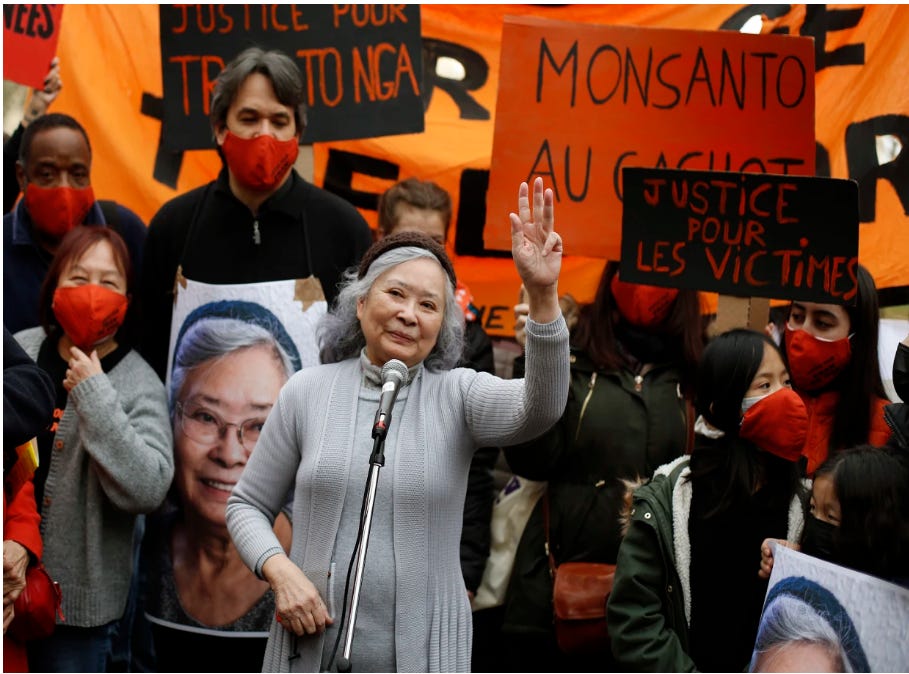
PARIS — A French court on Monday threw out a lawsuit brought by a French-Vietnamese woman against more than a dozen multinationals that produced and sold toxic herbicide Agent Orange, used by American troops during the war in Vietnam.
The landmark case, filed in 2014, has pitched Tran To Nga, a 79-year-old who says she was a victim of Agent Orange, against 14 firms, including U.S. multinational companies Dow Chemical and Monsanto, now owned by German giant Bayer.
This is the murderous gift that keeps on giving, and leave it to the French, a French court, to throw out this righteous case. Oh the French in Haiti, in Viet Nam. The irony of it is Tran’s children and grandchildren have been diseased because of the exposure to Agent Orange. One child died because of the dioxin disease(s). How many millions of Vietnamese were exposed to this sprayed on poison? Deaths? Disabilities? Chronic illnesses?
The other irony is that US veterans have successfully sued those chemical monsters and have gotten service connected disabilities from this massive poisoning, again, it is we the taxpayer, paying for those “injuries.” The chemical Eichmanns are equal to the military Eichmanns. Bomb them back to the Stone age, uh?
+—+
Oh, that fucking criminal and his Gazas times 10,000,000!
The destruction of the South Vietnamese rice (Oryza sativa L) crop using an arsenic-based herbicide known as Agent Blue during the American Vietnam War (1965-1972) was not a secret; however, it received little media attention in the United States. Republic of Vietnam and United States (U.S.) militaries began destroying food crops (rice) in November of 1962 primarily via aerial applications in the Mekong Delta and Central Highlands of South Vietnam.

Spraying of Agent Blue on 100,000 ha of mangrove forests and about 300,000 ha of rice paddies just before rice harvest time resulted in the destruction of the standing crop and rendered the land contaminated with arsenic (As).
Six Rainbow herbicides, commonly called Agent Orange, Agent Green, Agent Pink, Agent Purple, Agent White, and Agent Blue, were sprayed on wetlands, rice paddies, forests, mangroves, bamboo and military base perimeter fences to defoliate jungle vegetation, reveal guerilla hiding places and destroy the food supply of enemy troops. South Vietnamese farmers, U.S. and Republic of Vietnam military personnel, and communist insurgents were exposed to these herbicides with immediate and longer term impacts on personal health, civilian household food security and population-wide famine.

Agent Blue (cacodylic acid, C2H2AsO2,) was the most effective of all the Rainbow herbicides in killing rice and grasses. Manufacturing of cacodylic acid began in the late 1950s in the U.S. at the Ansul Company chemical plant in Marinette, Wisconsin and Menominee, Michigan. During the Vietnam War, ocean going ships were loaded with 208-liter Agent Blue barrels and shipped via the St. Lawrence Seaway to the coast of South Vietnam. Arsenic (As) is a naturally occurring element that is found throughout SE Asia deltas including the Mekong Delta.
Today arsenic contaminated rice and groundwater are growing concerns as neither naturally occurring arsenic nor anthropic arsenic have a half-life and cannot be destroyed.
Anthropic arsenic has remained in the Mekong Delta environment for the last 60 years and added to persistent As contamination in water supplies, sediments and soils. Water soluble arsenic primarily leaches into the soil root zone and the groundwater or is carried by floodwater into adjacent waterways or volatilized under anaerobic rice paddy conditions as gaseous arsine.
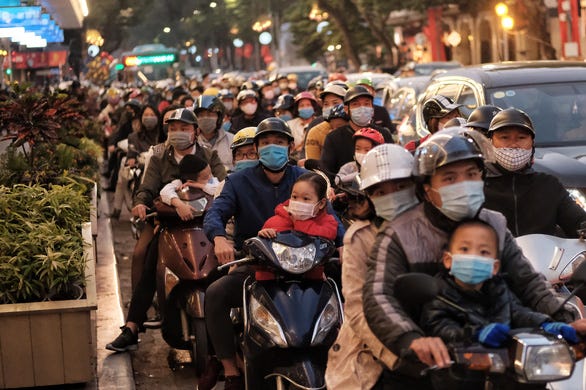
The health of 15 million Vietnamese people living in the Mekong Delta is at risk from the combination of manufactured and natural As in drinking water and food supply. The As in the contaminated rice paddy soil, sediment and water is up taken by fish, shrimp or by crop vegetation and trace amounts can end up in the food supply (rice grain) or be bioaccumulated by the fish, shrimp and birds which when eaten were bioaccumulated in the Vietnamese people.
It is urgent that elevated As concentrations in water supplies and agricultural products be identified and mitigated through better run-off control and groundwater management; improved rice genetics and alternate crop selections; shifts in crop management associated with tillage, fertilization and phosphorus use; and systematic monitoring of food and drinking water.
Related Articles
- Agent Blue Spraying in the Mekong Delta during the Vietnam War: Fate of the Arsenic Based Herbicide Weapon Used to Destroy Rice Crop and Mangrove Forests
- Agent Blue: A Secret Military and Environmental Chemical Weapon Used for Food Denial in South Vietnam during the Vietnam Civil War (1962-1965)
- Use of Agent Purple, Agent Orange and Agent Blue on Royal Thai Air Force Base Perimeters in Thailand during the Vietnam War
- Long-Term Fate of Agent Orange and Dioxin TCDD Contaminated Soils and Sediments in Vietnam Hotspots
- How Did Vinh Moc Village, Located near Vietnam DMZ, Protect Their Villagers from United States Air Force Bombardment during the Vietnam War?
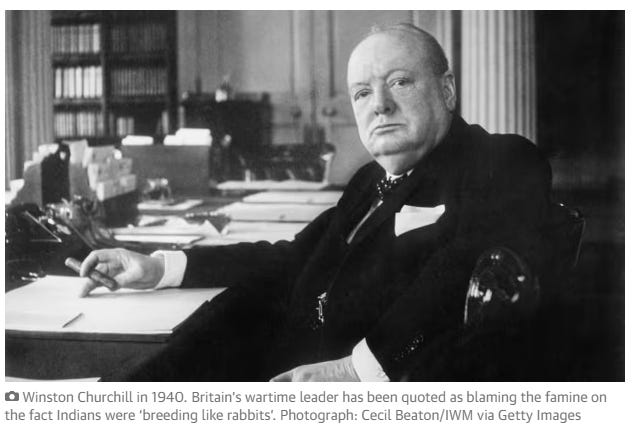
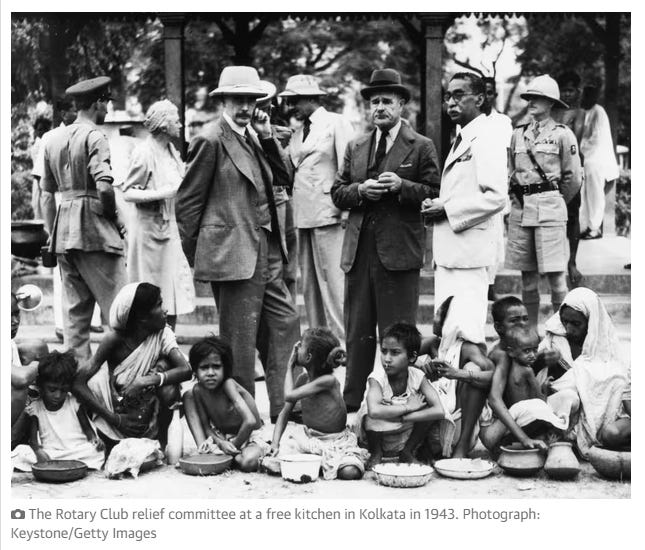


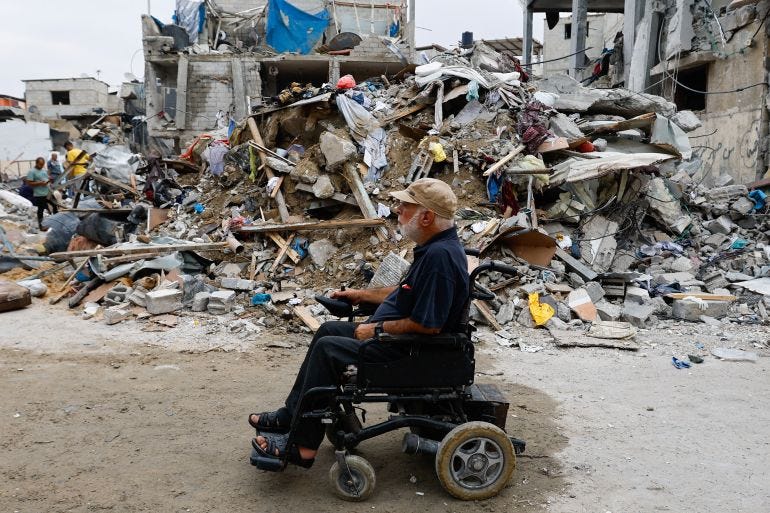
Shit, from U of Chicago: Siege Starvation: A War Crime of Societal Torture

Well well: The Rome Statute of the International Criminal Court provides that intentionally starving civilians by “depriving them of objects indispensable to their survival, including willfully impeding relief supplies” is a war crime.
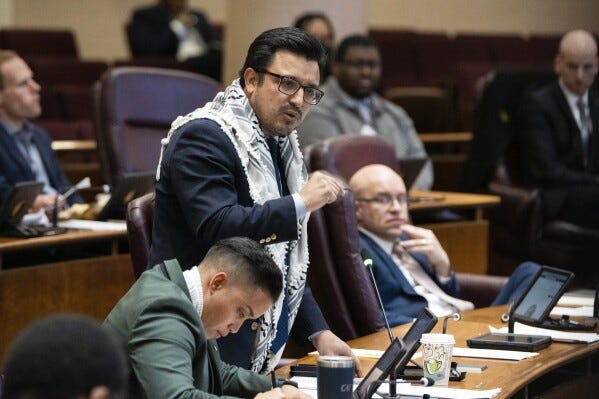
Chicago becomes latest US city to call for cease-fire in Israel-Hamas war
Fucking UNBELIEVABLE. This is 2024, and these fucking people are celebrating words!
The symbolic declaration in the nation’s third-largest city follows weeks of rowdy public meetings with disruptions from demonstrators, including on Wednesday when things became so boisterous the first-term mayor had to temporarily clear the council chambers. The resolution, approved 24-23, includes a call for humanitarian aid and the the release of all hostages. Supporters in the chambers included the Rev. Jesse Jackson.
Chicago is latest U.S. city to approve such a non-binding resolution, following Atlanta, Detroit and San Francisco in recent months.
Fucking Monty Python Inbred Brits!
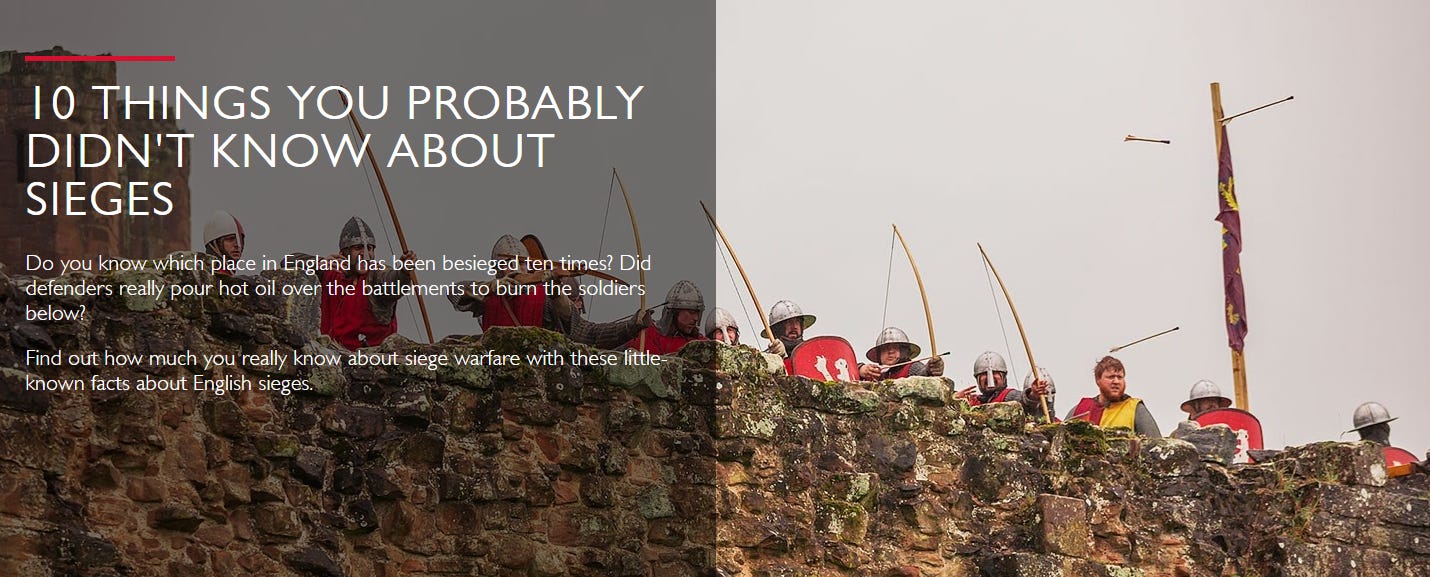
3. HUNGER WAS USED AS A WEAPON…
If a castle had good defences, attackers often decided to wait and try to starve the defenders out. It was not uncommon for those inside the castle to resort to eating their horses, or even their dogs and cats, as supplies ran low. The starving defenders were sometimes forced out of the castle, abandoning it to the besiegers.
Hunger was a key factor in the surrender of garrisons at castles across England, including sites such as Kenilworth Castle, Goodrich Castle, and Pendennis Castle.
4. …BUT ATTACKING ARMIES ALSO FORCED PROBLEMS
Maintaining an army large enough to lay siege to a major castle – and keeping them fed and armed – was a hugely expensive challenge.
Royal armies often gave farmers no choice but to sell their goods to the army at low prices. During the siege of Kenilworth Castle in 1266 at least 20 counties had to supply food to King Henry’s army. The Sheriff of London even sent a whale to help feed the army.

Millions of civilians across multiple conflicts have suffered severe deprivation, often in ways that are attributable directly to the strategies of the belligerent parties. Isolated by a Saudi- and Emirati-led blockade on one side and subject to the confiscation of food and medicine by the Houthis on the other, the people of Yemen have endured years of what remains one of the world’s gravest humanitarian crises. In Myanmar, the destruction, pillage, and denial of food and other essentials have been key components of the military’s counterinsurgency strategy, contributing to the ethnic cleansing and alleged genocide of the Rohingya population.

In 2020, almost half of the population of South Sudan was in “crisis” or worse due to food deprivation arising in significant part from the actions of the warring parties. The Independent International Commission of Inquiry on Syria has described “modern day sieges in which perpetrators deliberately starved the population along medieval scripts,” imposing “indefensible and shameful restrictions on humanitarian aid.” Most recently, Ethiopian and Eritrean belligerents have used a range of starvation tactics in Tigray in what has quickly become one of the world’s most severe humanitarian catastrophes.
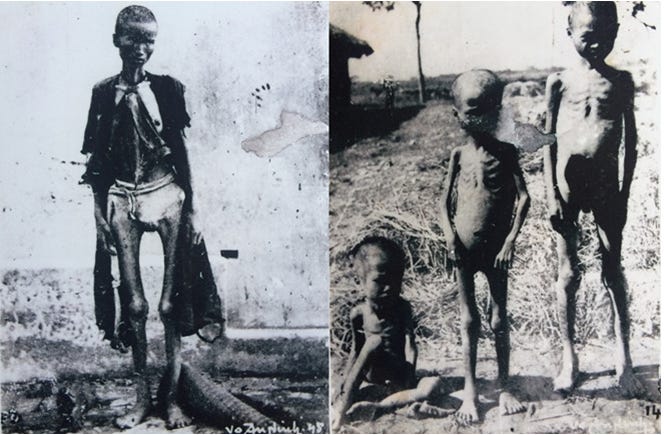
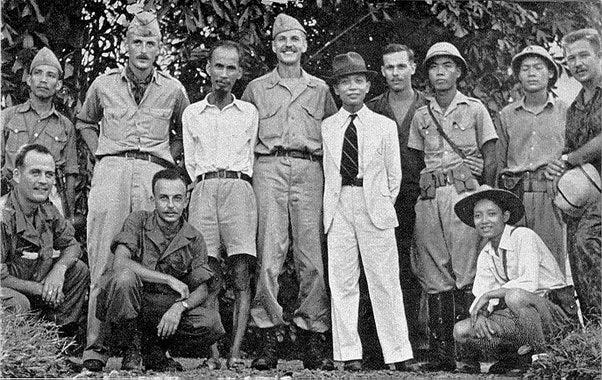
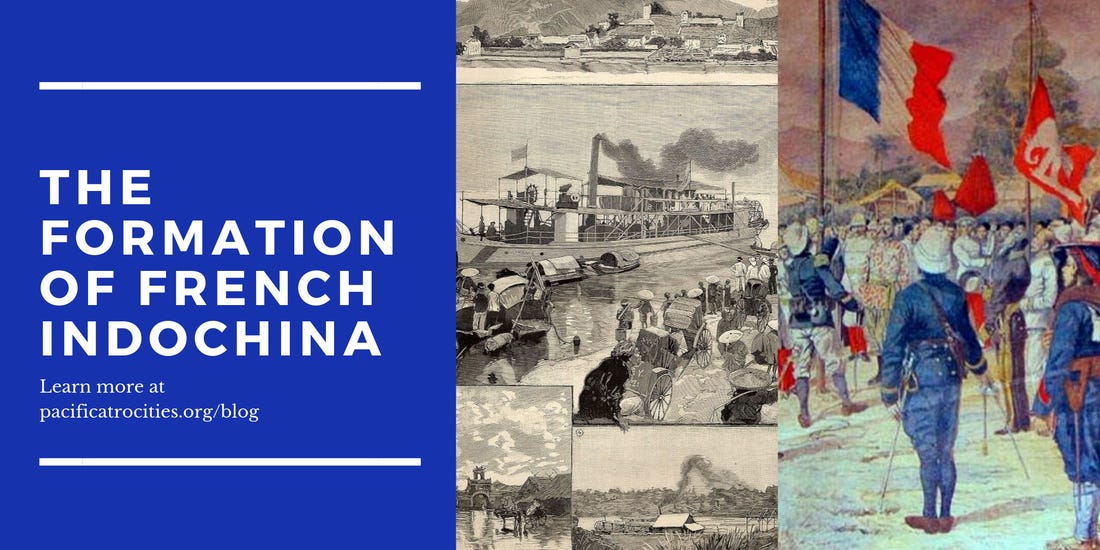
“Our people were subjected to the double yoke of the French and the Japanese. Their sufferings and miseries increased. The result was that from the end of last year to the beginning of this year from Quang Tri province to the north of Vietnam, more than two million of our fellow citizens died from starvation.”
Oh, the dirty dirty history of the Anglo Saxon and her/his millions upon millions of murders.
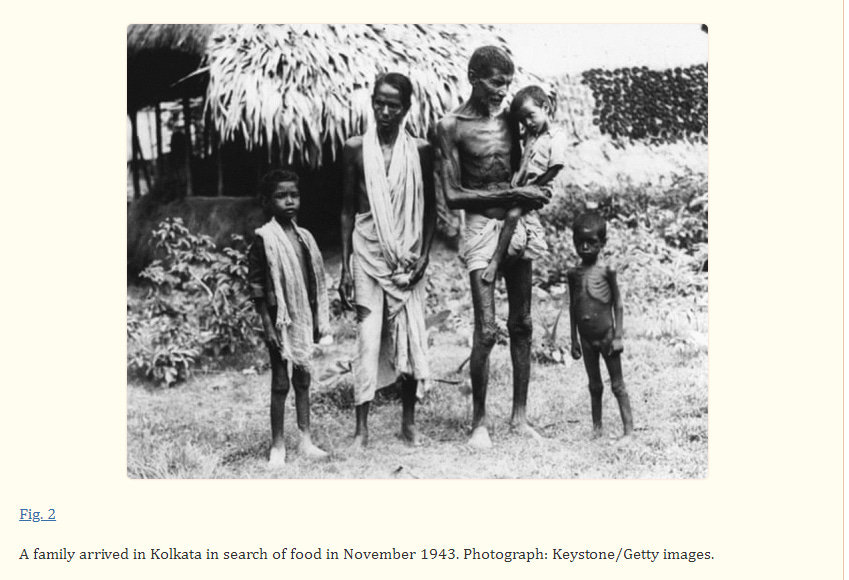
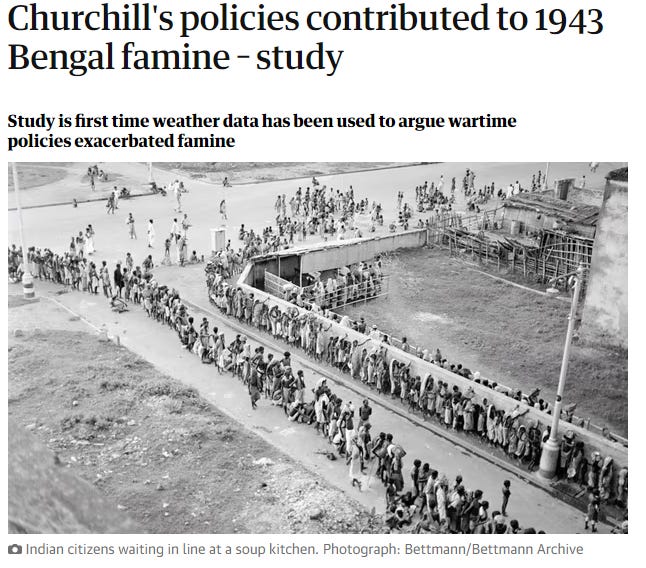
[Colonial Biopolitics and the Great Bengal Famine of 1943]
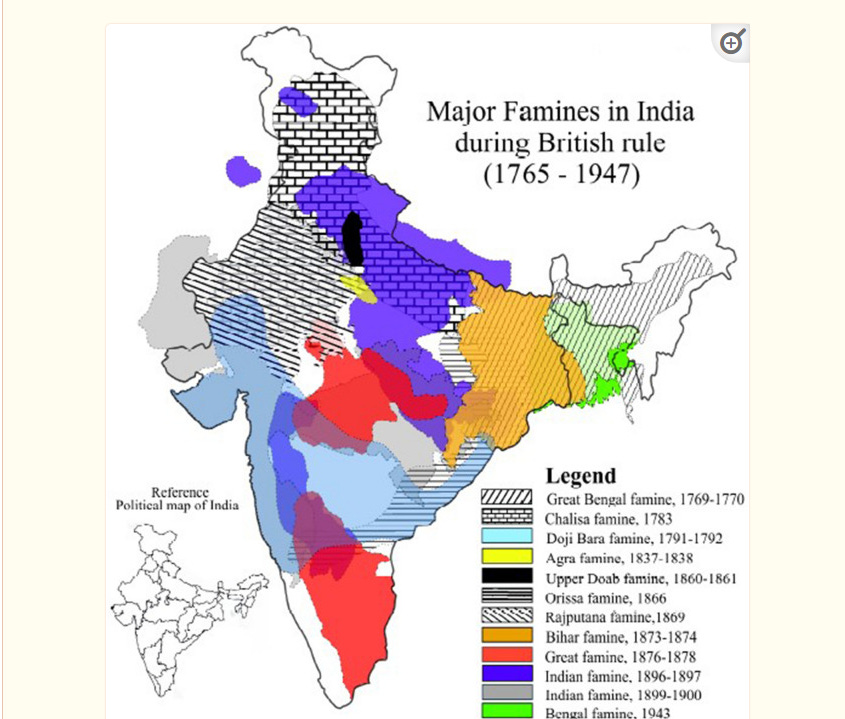
Among the countless famines that India suffered, Bengal was affected most severely. The first and worst of these was in 1770, which is estimated to have taken the lives of 10 million people The Great Bengal Famine of 1770 was the first of the horrendous famines and it opened the door to future famines in South Asia during colonial rule. The list of major famines during the British rule as pointed out by Tharoor (2016) are: The Great Bengal Famine (1770), Madras (1782–1783), Chalisa Famine (1783–1784) in Delhi and surrounding areas, Doji bara Famine (1791–1792) around Hyderabad, Agra Famine (1837–1838), Orissa Famine (1866), Bihar Famine (1873–1874), Southern India Famine (1876–1877), Bombay Famine (1905–1906) and the Bengal Famine (1943–1944). Purkait (2020) illustrated the 12 major famines during the British Rule (1765-1947), which were unevenly distributed throughout the colony (Fig. (Fig.1).1). The famine in 1876–1878 initiated the foundation of the first Indian Famine Commission of 1880 that consequently laid the commencement of India’s subsequent relief system, namely the Famine Codes (Maharatna, 1992).
+—+
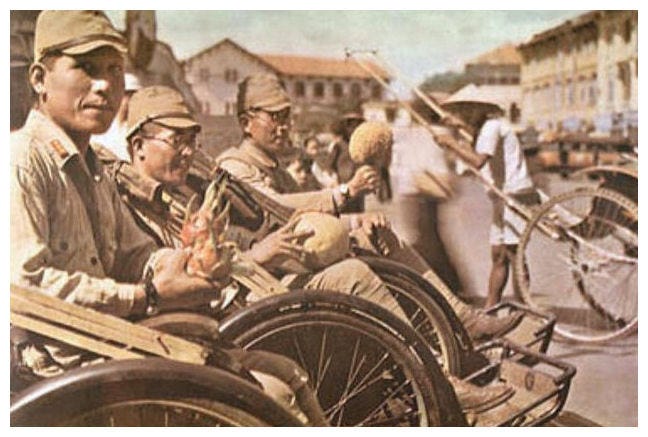
‘Finally, I am in agreement with Bui Ming Dung who argues that “the Japanese occupation of Vietnam was the direct cause, in the final analysis, of several other factors, in turn affecting the famine, but their military efforts together with their economic policy for the Greater East Asia Co-Prosperity Sphere per se seem to have systematically played a role considerably greater than any other factors in the Vietnamese starvation.”’ [Mass Violence and Resistance – Research Network]
It’s not a coincidence that the attacks on UNRWA took place after the ICJ ruling. Israel is trying to discredit the International Court of Justice, and one way of doing that is by rubbishing UNWRA. But UNWRA has fulfilled the heroic role of providing health, education and all other services to the Palestinian refugees since 1948. And it’s really heartbreaking that Israeli propaganda is now demonizing UNWRA and leading some countries to cut off aid. So, my sympathy and support is entirely on the side of UNWRA, and I hope it can long continue to play the vital role it has always played in supporting the Palestinian victims of Israeli aggression. Avi Shlaim, Israeli historian, You Tube
UNRWA provides food and flour distribution for the entire 2.2 million population of Gaza. Defunding UNRWA will lead to mass starvation and death.
+—+

This essay, however, utilizing new research in genocide theory and a correspondingly complicated definition of genocide, argues that the relief efforts undertaken in Ireland by the Russell Administration from the winter of 1846 to 1849 did constitute genocide against the Irish people.
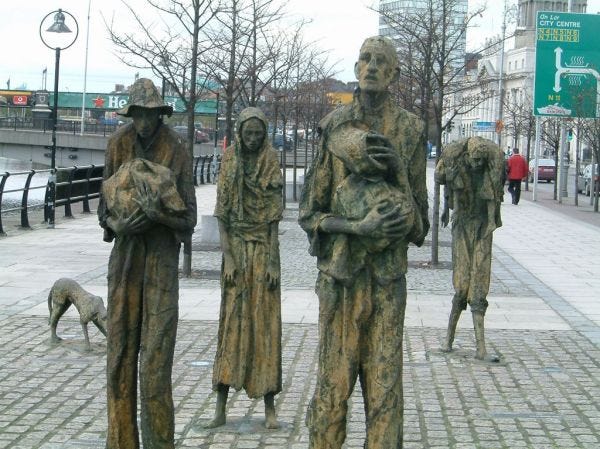
To date, historians have paid little attention to the objectives, both stated and implicit, of British Famine relief efforts. Much of the analysis contends that Famine relief was a compromise between the Whig Party’s adherence to laissez faire governance and Lord Russell’s basic human empathy. However, if British relief is viewed in the context of Britain’s concern with the “Irish Question,” it becomes clear that relief efforts were not designed to relieve Irish suffering as much as to permanently reform the Irish economy.
As a result, Irish Famine mortality gradually became the avenue through which the British pursued and attained this objective. By 1849, the forcible displacement of poor Irish cottiers, under the guise of relief legislation, became the major channel through which the Irish economy was remade. Thus, the British Government deliberately facilitated Irish deaths during the Great Famine, and therefore committed genocide against the Irish people. [ Rethinking and Recognizing Genocide: The British and the Case of the Great Irish Potato Famine; In: Re-Imaging Death and Dying — Author: Neysa King]
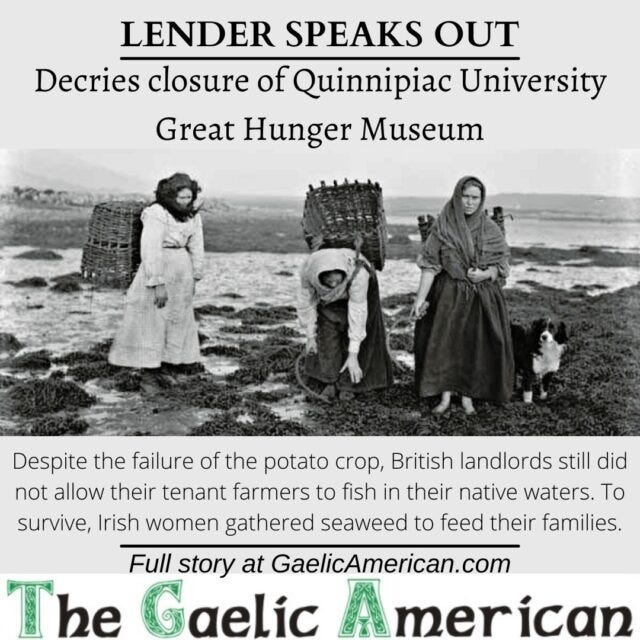
THE IRISH FAMINE: COMPLICITY IN MURDER
In his Sept. 17 op-ed Washington Post piece, “Ireland’s Famine Wasn’t Genocide,” Yale economics professor Timothy W. Guinnane says, “With the potato crop ruined, Ireland simply did not have enough food to feed her people.”
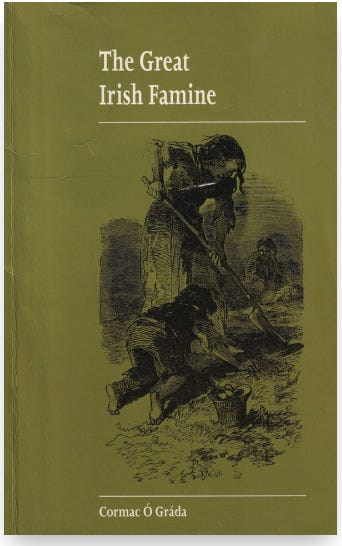
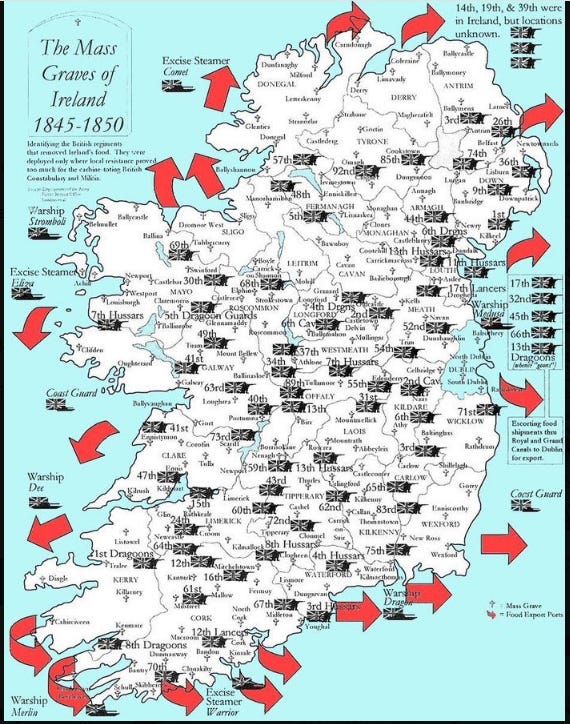
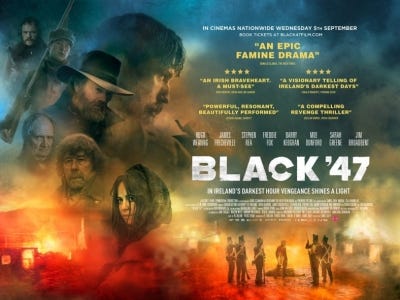
According to economist Cormac O’ Grada, more than 26 million bushels of grain were exported from Ireland to England in 1845, a “famine” year. Even greater exports are documented in the Spring 1997 issue of History Ireland by Christine Kinealy of the University of Liverpool. Her research shows that nearly 4,000 vessels carrying food left Ireland for ports in England during “Black ’47” while 400,000 Irish men, women and children died of starvation.
Shipping records indicate that 9,992 Irish calves were exported to England during 1847, a 33 percent increase from the previous year. At the same time, more than 4,000 horses and ponies were exported. In fact, the export of all livestock from Ireland to England increased during the famine except for pigs. However, the export of ham and bacon did increase. Other exports from Ireland during the “famine” included peas, beans, onions, rabbits, salmon, oysters, herring, lard, honey and even potatoes.
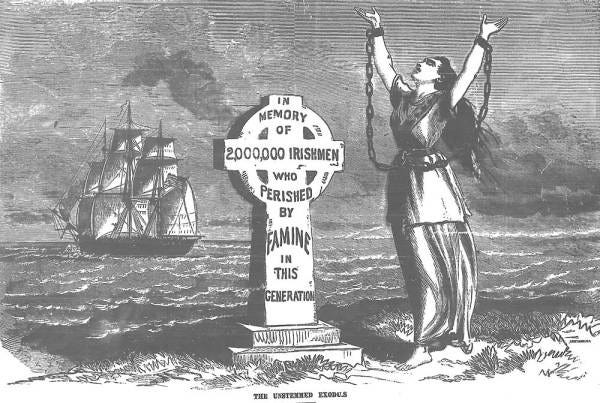
Dr. Kinealy’s research also shows that 1,336,220 gallons of grain-derived alcohol were exported from Ireland to England during the first nine months of 1847. In addition, a phenomenal 822,681 gallons of butter left starving Ireland for tables in England during the same period. If the figures for the other three months were comparable, more than 1 million gallons of butter were exported during the worst year of mass starvation in Ireland.
The food was shipped from ports in some of the worst famine-stricken areas of Ireland, and British regiments guarded the ports and graineries to guarantee British merchants and absentee landlords their “free-market” profits.
Mr. Guinnane says that “the contrast with the Holocaust is instructive” and points out that the British did not act like Nazis who “devoted considerable resources to hunting down and murdering the Jews.” Instead, he says that “the British government’s indifference to the famine helped cause thousands of needless deaths.”
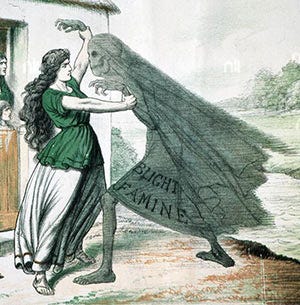
Richard L. Rubenstein, in his book,
“The Age of Triage: Fear and Hope in an Overcrowded World,” says, “a government is as responsible for a genocidal policy when its officials accept mass death as the necessary cost of implementing their policies as when they pursue genocide as an end in itself.” [ James Mullin, President Irish Famine Curriculum Committee and Education Fund, Inc. Moorestown, N.J.
Timothy Guinnane’s question, “But does the {British} government’s inadequate response to the famine constitute genocide?” is answered in the affirmative by the following undisputed facts:
In 1846 Prime Minister Robert Peel succeeded in repealing the Corn Laws, eliminating protective tariffs on grain imports to the United Kingdom, thereby reducing the cost of grain and bread. The compelling reason for the repeal was the crop failure in Ireland. Peel also established the Relief Commission to coordinate relief measures in Ireland.
Lord John Russell replaced Peel as prime minister in mid-1846. Russell immediately abolished Peel’s Relief Commission. Under Russell’s administration, all food depots except on the western seaboard were closed, public works were suspended, and local relief committees were forbidden to sell or distribute food at less than prevailing prices — which were inflated because of scarcity and speculation.
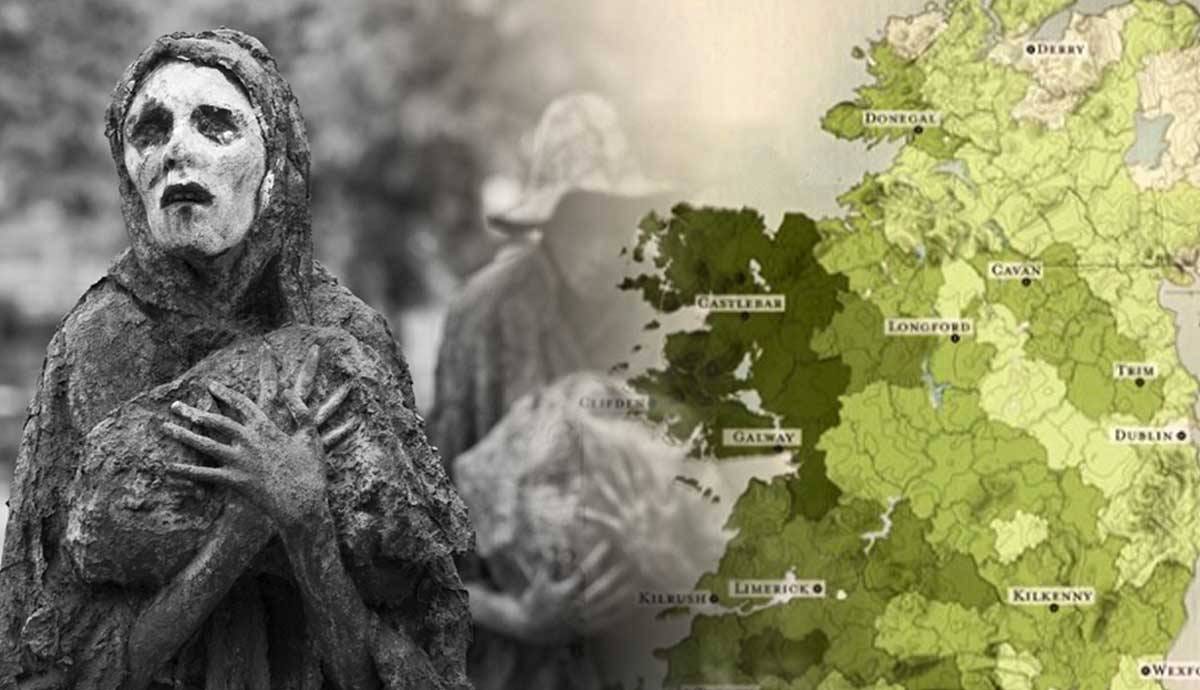
The chief architect of these policies was Charles Trevelyan, assistant secretary of the treasury and director of government relief, who was knighted in 1848 “for his services to Ireland.” The motivation for these policies was attested to by none other than Trevelyan, who stated: “The great evil with which we have to contend is not the physical evil of the famine, but the moral evil of the selfish, perverse and turbulent character of the {Irish} people.”
In mid-1847, Parliament amended the Poor Law with the “Gregory Clause.” The effect of this clause was to forbid public relief to any household head who held more than a quarter-acre of land and refused to relinquish possession of the land to the landlord. The choice was either become landless or starve, and many Irish chose the latter. Those who chose eviction were at the tender mercies of the Russell administration, whose policies are described above.
During the famine period, the wheat and other grain crops were unaffected and were reported to be “bountiful.” However, the Irish could not take advantage of those crops. The agricultural structure of the times required landlords to pay “rates” to Britain, which were due and payable even if the tenant farmer could not pay rent. Russell and Trevelyan never permitted an abatement on “rates,” with the result that wheat and other grains were exported to pay “rates” while millions of Irish starved. (The estimated deaths from the famine are between 1.1 and 1.5 million.)
Finally, Mr. Guinnane’s disingenuous observation that “by 1847 Ireland was a large net importer of food” misleads the reader. He fails to point out that throughout the famine period, Ireland exported 100,000 pounds sterling of food monthly, and almost throughout the period Ireland remained a net exporter of food.
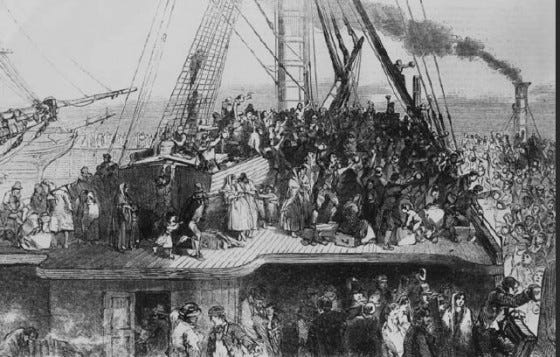
Russell and Trevelyan’s laissez-faire economics cannot forgive or excuse the results of their policies in Ireland any more than Pol Pot’s political ideology can protect him from the ravages he visited on his people, which — as I recall — are being referred to as genocide. Similarly, the forced deportation of the Armenians by the Turks during World War I, resulting in untold deaths and suffering, is known as genocide — and I would not quarrel with that.
Timothy Guinnane’s statements are surprisingly misleading. The disastrous potato famine of 150 years ago should and could have been avoided. During that famine, wealthy Irish Catholic landowners of the South continued to sell their abundant crops, their beef and their lamb to French, German and Low-Country markets rather than feed their own impoverished and starving tenant farmers. Aggravating the farmers’ reliance on the blighted potato was the number of young in each Catholic family. In the following four years, potatoes continued to be planted and new babies born, while in the Protestant North — with its same reliance on the staple potato — crisis was eased by the region’s industry and a landowner population caring for its poor.
Certainly the predominantly English Parliament also was at fault. Unfortunately, they were not made aware of the Irish famine until it had reached disastrous proportions and then behaved with far too typical indifference to a problem so non-English in much the same way they had behaved with our own American colonies some 70 years earlier.
The Oxford English Dictionary defines genocide as the {attempted} deliberate and systematic extermination of an ethnic or national group. The Catholic Irish were an ethnic or national group.
During the famine, the British government deliberately and systematically adopted reckless and wanton policies of official neglect that exacerbated the famine’s savagery and substantially increased its cruel death count. Can inactivity be criminal to the point of homicide? I submit that it can and was in the circumstances of the Great Famine.
As force majeure masters of Ireland, the British had an affirmative duty grounded in justice to provide relief. They had the means and the ability to deliver such relief. They intentionally failed to do their duty because of their hostility to Irish Catholics — who then starved to death by the hundreds of thousands as their rich and well-fed British rulers complacently waited and watched. British inertia in such circumstances was callous, contemptible — and maliciously criminal to the point of second-degree murder. — D. J. REARDON Leavenworth, Kan.
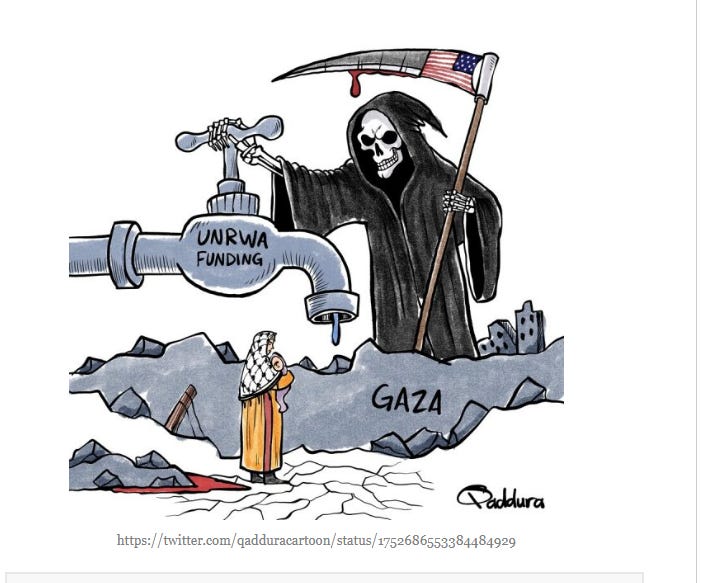
[Israel’s Starvation Strategy]
Here’s your Zionist quiz for the day: Why did Israel launch a full-blown media blitz on a United Nations relief agency (UNRWA) on the same day that the International Criminal Court of Justice (ICJ) released its historic genocide ruling?
- —To divert attention from the fact that Israel is committing genocide in Gaza
- —To inform the public that new intelligence had serviced revealing Hamas involvement in the United Nations Relief and Works Agency
- —To assure people everywhere that Israel’s main concern is fighting terrorism
- —To activate the final phase of their ethnic cleansing operation
If you answered “4” then pat yourself on the back because that is the right answer. Of course, it’s also true that Israel wanted to divert attention from the ICJ’s announcement, but that pales in comparison to the launching of the final phase of its ethnic cleansing operation. This is the real coup de grâce, the final death blow to the two-state solution and a practical remedy to Israel’s nagging demographic problem. This is also the critical puzzle piece that makes sense of the last 100-plus days of relentless bombardment, airstrikes and other forms of state terror. It’s as if Israel is boldly laying down its cards so the entire world can see the strategy it plans to employ to eradicate the native population and fulfill the Zionist dream of a Jewish state from the river to the sea.
And what might that strategy be?
To disperse 2 million Palestinians to the four corners of the earth via mass immigration.
But, how will they do that, after all, haven’t a number of countries already refused to take the Palestinians?
Indeed, they have, but that is before the (soon to-be-published) photos of starving women and children flooded social media sites around the world generating an unprecedented outpouring of sympathy for the beleaguered population. And as public sympathy leads to widespread outrage, more and more people will demand that their governments take action to relieve the suffering through mass immigration. This is how Israel intends to rid itself of its native population and create Zionist Valhalla, a Jewish majority into perpetuity.
 Paul Haeder, Author