

… the power of the portfolio, millionaire or billionaire, always includes the virus of military industrial complex in one form or another . . . as it does even for the teachers’ pension fund!!!
How can we process this photo:

[For some workers, it doesn’t matter how grim the economy is, how dismal the job market, or how thankless their current job. If they were laid off—especially during the pandemic—many workers would never dream of returning to the place that dropped them. — Fortune (fascist) Magazine: “The laid-off masses have a message for Mark Zuckerberg and Marc Benioff: We’ll never come back”
versus this one?

Jesus!
A Letter to my Gazan Palestinian Son.
Dear Malik,
I am sitting here in bed with you in my arms. It is 11:59 PM, and you are fast asleep. Did you know you sleep talk? Yes at 21 months, you sleep talk. Sometimes you just chuckle and then roll to the other side, and other times you manage to touch my face and say “mama” while your eyes are closed.
I am looking up at the ceiling fan and it’s lying perfectly still. Our vases are on the shelves- we’re not afraid of them falling. The windows are closed when we sleep. It gets chilly at night.
Then you wake up to the sound of birds chirping at our window on our clean white sheets. We don’t hear anything except the birds here.
You open your eyes and I am the first thing you see. If I am not there, you don’t panic, you just come to the living room and give me a hug.
I couldn’t fall asleep like you, however. I was too busy holding you, and thinking of those who look like you, breathe like you, related to you.
You are from a place where 21 month olds never sleep with messy hair. Your cousin told me he likes to comb it in case he never wakes up. “I want to die while looking nice” he said.
You are from a place where 21 month olds do not sleep talk. They wake up multiple times at night afraid that the ceiling fan falls on them.
You are from a place where no house has vases and the windows at night are always open. Leaving them closed will guarantee shattered glass.
You are from a place where 21 month olds do not sleep on clean white sheets. Instead, they are buried in them.
You are from a place where if 21 month olds wake up and do not find their mothers next to them- it is most likely they will never see her again.
I do not know why I felt the need to tell you this. You won’t read this letter for a decade or two. But I wanted to remind you that the place you are from, despite the proximity of death, is a place worth remembering, worth loving, worth being proud of.
To be from Gaza means that you are a child of extreme creativity. Did you know your older cousins can power a generator using just cooking oil? And your cousin Shahd knows how to crotchet the most beautiful dolls for you. A few weeks ago she made you a rabbit with overalls. You loved it.
To be from Gaza means you know how to live life, often times because it is not guaranteed. It means you feel the beauty of our waters, and don’t mind sleeping on the fine hot sand. Children from Gaza don’t put on sunscreen- they don’t mind feeling the sun’s touch.
To be from Gaza means seeing those who look like you perish in an instant. It means hearing the country where you live tell you that they deserve it. It means seeing the number of thousands of Palestinian children dead- and growing numb to it since we don’t hear their stories, know their names or see their photo collages on our screens.
Instead, we just see them wrapped in bloody white sheets if they are lucky enough to even be whole when they die.
But, my love, being from Gaza means you can understand deep love and deep hatred better than others. You understand that the talking heads’ hatred of you is not a reflection of you. Your humanity is in tact and your faith even stronger. Their’s is the one that is so deeply lost.
Being from Gaza means you understand that the success of the Palestinian people, of your people, means the success of the down-trotted everywhere. From Ferguson, to Mexico, to Palestine- being from Gaza means you know that justice is the most important human pursuit a person can have. Even if they dehumanize you like they do to all other Black and brown folks, being from Gaza means you know that all walls and empires fall. Eventually.
Our resilience is stronger than their hatred.
Remember Gaza, for being from such a marvellous, beautiful, creative place means you understand that it is worth fighting for. Such a place can never die.
I love you.
Sincerely,
Your mother





These American stories make a grown caring adult vomit. We are in crisis after crisis, and this Team Israel First Blinken-Garland-Powell-Yellen-Nuland-Kagan under Joe “I Finally Have a Jewish Doctor in the Family” Biden, it is the most destructive force on earth.
[According to a colleague, Krein is “a proud Jew.” And, speaking of pride: Joe kvelled about his Jewish son-in-law at a political event in Ohio in 2016, saying:
“I’m the only Irish Catholic you know who had his dream met because his daughter married a Jewish surgeon.”]

Here you go, the dirty dealings of some of these dirty Israel-First Billionaires, and the fallout with their mostly Goyim Workers (read, well, enslaved ones): “Tech companies have laid off nearly 245,000 workers this year alone, per tracker Layoffs.fyi, and Silicon Valley heavyweights like Meta and Salesforce have led the pack, each culling thousands of jobs apiece.
But workers weren’t losers for long. Now, as the job market shifts once again, companies are scrambling for talent, and some are angling for the very kinds of workers they just cut. The real question is what will happen when those workers decide they don’t want them back?
Over half (58%) of 6,000 professionals who responded to a recent Glassdoor poll said they’d never return to a company who laid them off. In the tech sector specifically, just 46% of workers said they’d boomerang. Men were slightly more likely to consider boomeranging than women, and older workers were more open-minded than younger ones.”
“As the labor market has softened over the past year….some regrets are inevitable,” Aaron Terrazas, chief economist at Glassdoor, tells Fortune. A few sectors have begun “cautiously” ramping up their hiring as their fears of a recession recede, but “corporate reputation casts a long shadow.”
The legacy of layoffs—and how they were carried out—could “come back to haunt companies when the pendulum of the labor market inevitably swings back,” Terrazas adds. “Former employees can be a company’s most loyal advocates, or they can be the most piercing critics.” The result depends on the nature of the company.
Salesforce laid off about 10% of its workforce earlier this year, but now CEO Marc Benioff is encouraging those people to apply to fill its 3,000-plus open roles.
“Our job is to grow the company and to continue to achieve great margins,” Benioff said in September. “We know we have to hire thousands of people.” He’s hoping a good portion of those people will be boomerangs. Benioff admitted to attempting to lure workers back in with an “alumni event for people who are employed in other companies to say—it’s okay, come back.”
As for Meta, after laying off about a quarter of its workforce, jobs are open again, and the company has even constructed a specialty “alumni portal” for boomerangs looking to cut the line.
Tech jobs?
For new college grads, the tech industry is out, and the defense industry is in. Well, sort of.
Companies like Raytheon and Lockheed Martin saw some of the biggest jumps in search interest by this year’s grads on the popular college career site Handshake. Meanwhile, not a single tech company made the top 10. When it came to applying for work, there was huge growth in the number of applications to jobs in government, law, and politics (84 percent); energy (53 percent); and pretty much every industry that isn’t tech, although that grew too (8 percent). This likely reflects the overall 24 percent growth in full-time applications this year, as students struggle with a rougher job market than last year.
If you don’t spend a lot of time with Gen Z, it might be confusing that such an idealistic and tech-savvy generation would want to work for defense contractors or the government. But talking with new grads, it starts making sense. They don’t have the same associations as millennials like me who witnessed — and protested — the forever wars in Iraq and Afghanistan. But they have been exposed to lots of other chaos in their young lives and now crave stability. Some see that in defense jobs as well as more tried-and-true industries. Chevron, Boeing, Bank of America, and NASA also topped the list as far as growth in interest.
Recognize the enemies of the world. Can you name these felons?

The military and surveillence and prison and digital gulag and economic and “everything in education pushing everything about USA exceptionalism” COMPLEX touches almost everything in the USA. Don’t look at those nerds in the AI-VR-MR-AR realm without seeing THE DEVIL’s workshop workers.
Every dime or million or billion in the billionaires’ portfolio goes to killing Palestinian babies or babies in Yemen or future babies in China or Ukraine or North Korea.
And how many, truly, people will die or get sick because of USA bombing Nordstream? How many desperate people? In the cold? Or with huge energy bills? With social services cut? Lives and dreams turned to existences and nightmares?
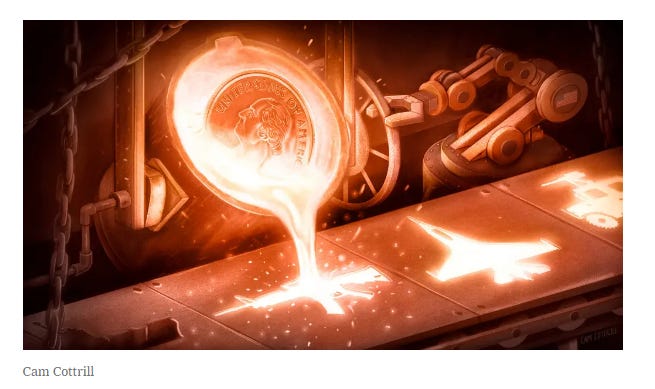
Fucking Fascist Fortune Magazine: Falling stocks, wounded unicorns and rising interest rates translated into a down year for the world’s wealthiest people. Globally, we counted 2,640 ten-figure fortunes, down from 2,668 last year. Altogether, the planet’s billionaires are now worth $12.2 trillion, a drop of $500 billion from $12.7 trillion in March 2022. Nearly half the list is poorer than a year ago, including Elon Musk, who falls from No. 1 to No. 2 after his pricey acquisition of Twitter helped sink Tesla shares. Bernard Arnault, head of luxury goods giant LVMH, takes his place as the world’s richest person, marking the first time a citizen of France leads the ranking. The United States still boasts the most billionaires, with 735 list members worth a collective $4.5 trillion. China (including Hong Kong and Macau) remains second, with 562 billionaires worth $2 trillion, followed by India, with 169 billionaires worth $675 billion. To calculate net worths, we used stock prices and exchange rates from March 10, 2023. See below for the full list of the world’s billionaires and our methodology. For daily updated net worths of all 2,640 billionaires, check out our real-time billionaires rankings.
Know thy enemy:

“If you know the enemy and know yourself, you need not fear the result of a hundred battles. If you know yourself but not the enemy, for every victory gained you will also suffer a defeat. If you know neither the enemy nor yourself, you will succumb in every battle.”
―Sun Tzu, The Art of War

President Dwight Eisenhower famously warned of in 1961, when he described the growing “military-industrial complex,” the huge military establishment that would have “grave . . . economic, political, even spiritual . . . implications” that would be felt “in every city, every Statehouse, every office of the Federal government.”
Miriam Pemberton focuses on the military budget, which is now nearing $1 trillion per year: how it became so big, what it funds, its impacts on communities around the country, and how the linked forces of members of Congress, the military, and defense contractors work together to push its constant growth. The military’s workforce, which includes active-duty soldiers, reserves, and civilians, exceeds three million people. In addition to thousands of bases within the United States, the military maintains 750 bases in at least 85 countries. No other country owns more than a handful of bases abroad. The U.S. defense budget is larger than the rest of the discretionary federal budget combined, and private contractors now account for more than half of it. According to Pemberton, a well-funded force of congressional lobbyists and a revolving door that guides retired generals and admirals into senior roles at arms manufacturers keep the money flowing into private hands even in the absence of clear threats. At first glance, communities should be expected to benefit from military projects funded with huge sums of federal money. Yet a majority of the states that have received the most military contracts over many decades have poverty rates above the national average.
At the time, even the most defense-dependent big prime contractors were convinced, at least publicly, that they needed to venture into civilian manufacturing. In 1993, at the height of the post-Cold War downturn, Lockheed Martin, the entrenched world leader in military contracting (now 96% defense dependent) publicly predicted that “the growth in Lockheed’s forecast will come from our nondefense sector,” and that in five years just 55% of its revenue would come from DoD.
Lockheed encouraged its engineering teams to brainstorm about what they might be able to do in the civilian realm. One team was working on fighter jets at a manufacturing facility in Binghamton, New York. The engineering team leader at the time, Bob Devine, explains that standard new product development practice involves positioning your existing product lines on a grid and looking for the “one box move.”
You try to find these market adjacencies [between the military and civilian markets] which are also business adjacencies … A one-box move might be new technology into the same market. Or new market, same technology. But trying to jump to commercial in a new market with new technology or a different approach to the business altogether is kind of a move on both those axes … So it’s a stretch for the business to be able to adapt.
They chose to focus on technology adjacencies. As Devine put it, the team did not try to switch gears from fighter jets to toasters. They focused on a move to a product that shared the characteristics of high maneuverability, complex engineering and heavy-duty manufacturing with what they were building for the military. They had been working on replacing the mechanical hydraulic flight controls on the F-15 fighter jet with lighter and more reliable electronic versions. At the same time, they were building an electronic fuel injection control system for a new freight locomotive.
And we said, this is really interesting—if you have a set of batteries you have a hybrid. And you’ll be able to capture regeneration—taking the heat energy that would normally be lost in braking and putting that back in the batteries. And thus was born the idea of a hybrid. Locomotives had been doing that for years, but we applied it to rubber tire vehicles—buses and trucks.
Toyota was figuring out regenerative braking for its Priuses around the same time, but, he claims, his shop at Lockheed got there first. They like to bring this up with Toyota from time to time, Devine said with a chuckle.
The engineers at the site could bring a variety of specialized skills to the task, as well as the “systems integration” experience from building complex weapons systems. They took the light, compact, highly reliable power controls from the jets and applied them to the diesel electric power train of the locomotives, creating a hybrid drive train system for what they called a “HybriDrive” transit bus.
As cities around the world looked for mass transit solutions that cut fuel consumption and carbon emissions, as well as maintenance costs and noise, HybriDrive buses began appearing on streets from New York City to London to Tokyo to Toronto. In February of 2022, Houston and Philadelphia were added to the list.
In 1999, just months after announcing a delivery of 125 buses to New York City, Lockheed announced it would be selling the facility, including its HybriDrive line, to BAE Systems, another major military prime contractor. Its CEO explained the decision this way: “This proposed transaction is consistent with Lockheed Martin’s strategic initiative to focus on business and technical competencies that will strengthen our position … in core aerospace and defense markets.”19 Since by then—just seven years after it began efforts to convert away from defense—the “crisis” of post-Cold War military budget cuts seemed to be well over, diversifying beyond their “core competencies” seemed, to Lockheed, no longer necessary.
Under BAE the bus-building project continued mostly as before, with the same players, and its production ramped up to meet the demand of proliferating markets domestically and overseas. By 2013, the team calculated that their buses had travelled more than 600 million miles and saved more than 520,000 tons of CO2 emissions.
KNOW THY ENEMY = From a Militarized to a Decarbonized Economy: A Case for Conversion by Miriam Pemberton
In this episode, we’ll take a deep dive into the Pentagon budget. During the first half of the program, Carley Towne interviews Miriam Pemberton, author of Six Stops on the National Security Tour: Warfare Economies & Other Ambitions about how we can demilitarize the economy. Then, CODEPINK organizer Cody Urban talks with James Ehlers, an activist in Vermont about our ongoing campaign to Divest Vermont from the War Machine and the F-35 program there.

Ever since World War II, the US economy has become increasingly reliant on the war industry to provide jobs. It was, in fact, World War II that converted our existing economy into one dependent on government spending from the Pentagon and its associated agencies and industries. But it is possible to convert the economy back the other way, from one centered on the war industry to one that generates good jobs while addressing the existential threats of the climate emergency, pandemics, and ecological devastation.
In this panel discussion recorded on March 10, 2021, and organized by the War Industries Resisters Network (WIRN), panelists discuss the existential need to transition away from the war economy and the practical steps that would make it possible. (WIRN is a coalition of local groups and organizations across the US and around the world that are opposing their local war industries and collaborating to confront corporate control of US foreign policy.) With permission from the event organizers, we are sharing this recording with TRNN audiences.
Panelists Include: Miriam Pemberton, founder of the Peace Economy Transitions Project at the Institute for Policy Studies in Washington, DC, and author of the upcoming book Six Stops on the National Security Tour: Rethinking Warfare Economies; David Story, a third-generation union member born and raised in Alabama, President of the Machinists & Aerospace Workers Union Local 44 in Decatur, Alabama, and a founding member of the Huntsville IWW; Taylor Barnes, an award-winning, multilingual investigative journalist based in Atlanta who covers military affairs and the defense industry, and whose work has been published in local and national media outlets, including Southerly Magazine, Facing South, Responsible Statecraft, and The Intercept. This panel is hosted by Ken Jones of Reject Raytheon Asheville, a local movement of activists and peacemakers who have come together to ensure that the economic development of Buncombe County relies not on incentives given to war profiteering multinational corporations, but rather on investments in a sustainable local economic model.
But again, cold talkers, for sure. Here, a better look at what the nerds and the CPAs and lobbyists and lawyers and service industrialists and academics and the entire USA culture is doing to kill Palestinians.
These contractual and transactional Americans really do not know the full excent of the price war, war making, war planning, war teaching, all the bombs and sanctions, all of that, the price of future generations’ mental and material well being, all of the crime and the pollution, physical and spiritual, all of these wars and war making and war standing and war thinking does to the world.
Yeah, blithe headlines: “Rare Earth Elements Aren’t That Rare, but They’re Vital to National Security” by the millions. That’s the COMPLEX!
Wash your hands and enjoy that AmeriKKKan lifestyle: For one-third of the price of one F-35 Lightning II, the Pentagon made a key investment to ensure its supply of rare earth elements.
The Department of Defense earlier this month announced that Lynas USA LLC was awarded a $30.4 million technology investment agreement under Title III of the Defense Production Act.
With that award, Lynas will construct and begin operating a light rare earth elements processing facility in Hondo, Texas.
The recent announcement from the Pentagon serves as an important milestone and reminder of the ground gained—and left to be won—in the effort to secure a reliable rare earths supply chain for the U.S. defense industry.
Few Americans could name even one of the 17 arcane rare earth elements. According to the American Geosciences Institute, those substances are components to more than 200 products, such as cellphones, flat-screen monitors, lasers, and sonar systems.
With wide-ranging applications, materials like cerium, lanthanum, and samarium may be found in everyday commercial products.
Fucking smiling face and faceless one here: Cetner for National Defense (OFFENSE) and Heritage Foundation.
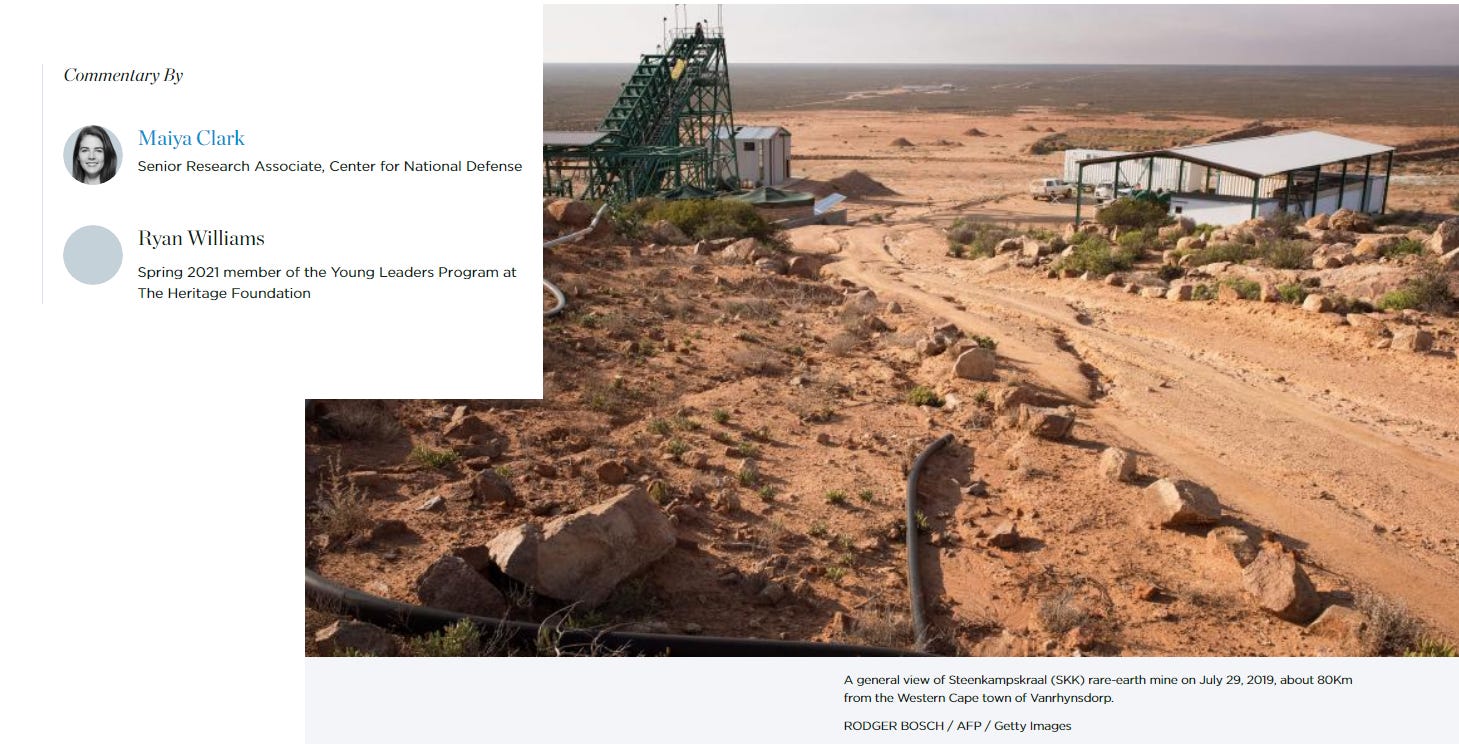
Oppen-monster-Heimers:
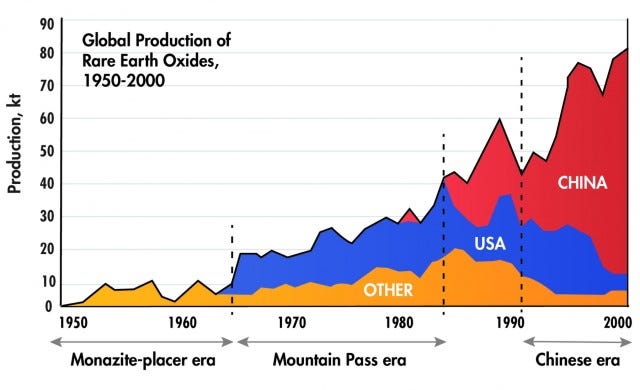
An elemental issue by Russell Parman, U.S. Army Aviation and Missile Command
The rare-earth supply problem will have no easy solutions. According to the U.S. Government Accountability Office, it would take 15 years to overhaul the defense supply chain, meaning that any changes to it need considerable lead time. The American Mineral Security Act, passed in 2015, is meant to determine which minerals are critical and diversify the supply chain, according to the NATO Association of Canada. Currently, switching from present suppliers (e.g., China) would cause major disruptions to supply chains.
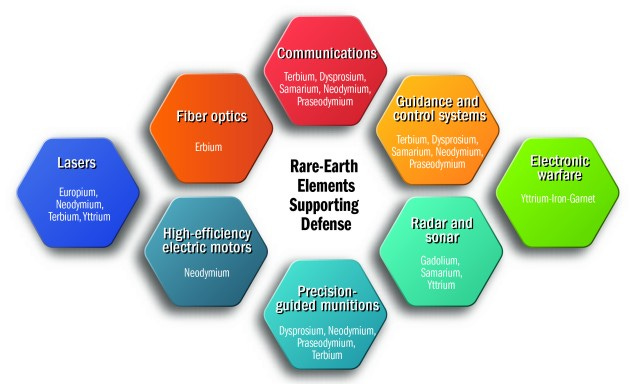
Rare earths are a critical part of laser- and precision-guided missile technology. Lockheed Martin Corp. is working on a small, high-power laser weapon, heavily reliant on the rare earths erbium and neodymium, that the U.S. Air Force Research Laboratory wants to test in a tactical fighter aircraft by 2021.
Rare-earth elements are widely used in strong, permanent magnets that are impervious to temperature extremes. The permanent magnets are used in fin actuators (which control flight patterns in missiles) in missile guidance and control systems; disk drive motors installed in aircraft and tanks; satellite communications; and radar and sonar systems. Samarium-cobalt magnets are more resistant to demagnetization than those made from any other material. This quality-called high coercivity-means that they do not lose magnetic strength when exposed to high temperatures. That makes them the best choice for many military applications, according to Air Force Lt. Col. Justin C. Davey, in a 2011 Air War College report. Neodymium-iron-boron magnets are very strong, light and relatively low-cost. By weight, they are almost 10 times more powerful than traditional ferrite magnets. That makes them ideal for use in the tiny electronic components such as disk drives that have helped make possible decades of computer-driven innovation.
While the Jews commit genocide, and while the Blinken-Yellen-Nuland-Garland-Powell-Kagan White Phosphorus House feeds the monster of Zionist Racists.

LINK.
 Paul Haeder, Author