

… the job if you should decide to take it will drive your empathy, if you started with any, into the ground, into HELL
Until the 1980s, U.S. incarceration rates were comparable to Europe’s. Then came the war on drugs and a new tough-on-crime ethos. State after state enacted longer sentences, particularly for drug offenses and other nonviolent crimes. Today, the United States keeps a higher percentage of its citizens behind bars than any other nation — outpacing France, Germany and Great Britain by 10 times or more.
“We have to really start taking a deep, deep look at how we are treating human beings,” said Rep. Terry Landry, D-New Iberia, former head of the Louisiana State Police. “Somewhere in a book it says, ‘By the grace of God go I.’ Some of us, the difference between us and the people who got incarcerated is that they got caught and we didn’t.”
Can it be there are worse states than Wisconsin:
In Texas, no bastion of liberalism, a two-time car burglar would be guilty of a misdemeanor and sentenced to a maximum of six months. California’s famous three-strikes law does not kick in unless at least one of the crimes was a rape, murder, carjacking, residential burglary or other major felony. There, Martin would have received no more than a year behind bars.
In Louisiana, about 160 habitual offenders whose most recent crime involved nothing more harmful than marijuana are serving 20 years or more. More than 300 people serving life without parole in Louisiana have never been convicted of a violent crime.
It’s not just low-level criminals who fare worse here. Louisiana is the only state that automatically sentences murderers to life without parole.
Jackson, 50, is serving life without parole for stealing a jacket from a department store. In 1996, using two car-burglary convictions and a two-decades-old robbery conviction, Orleans Parish prosecutors put him behind bars for the rest of his life.
The 4th Circuit Court of Appeal initially downgraded Jackson’s sentence, calling it “excessive, and a prime example of an unjust result.” Then the Louisiana Supreme Court ruled that judges may not second-guess the habitual-offender law except in rare instances. The 4th Circuit reluctantly reversed itself.
Under current law, the jacket theft would no longer count as a fourth offense, but the change is not retroactive. Jackson, a Mid-City native who worked as a cook at Brennan’s and other local restaurants, is out of luck.
“I’m going to be honest. I’m locked up like I killed someone. They’ve got people who killed people got less time than I did,” Jackson said. “A $159 jacket. If somebody had told me I could get life for that, I wouldn’t believe them.”
This came into my email box. Of course, I am not certified as a social worker, and thus, not qualified. Social work programs? People coming out of them? Who would want to work in a prison? What sort of out of box fuckers like me would be hired to do REAL work?
It is disgusting.
The Wisconsin Department of Corrections is focused on public safety through the custody and supervision of those in our care. Corrections employees have the opportunity to positively impact the lives of others through careers in a variety of fields. Using cutting-edge research and evidence-based approaches, employees implement lasting change with a positive impact for the people of Wisconsin.
The Department of Corrections is currently accepting applications for Social Worker positions in locations throughout the state.
DOC is a great place to work! In addition to meaningful and rewarding work, we offer a competitive benefits package featuring:
- Substantial leave time including (for full time employees) a minimum of 3.5 weeks of vacation/year, 4.5 days of personal holiday, 9 paid legal holidays, and up to 16.25 days of accrued sick time that can roll over from year to year.
- Excellent and affordable health, vision, and dental benefits.
- An exceptional pension plan with employer match and lifetime retirement payment, plus access to an optional tax-advantaged 457 retirement savings plan.
- DOC is a qualifying employer for the Public Service Loan Forgiveness program.
- The Well Wisconsin Program administered by WebMD, provides tools and resources to help participants set health and well-being goals, track progress, stay motivated, and earn incentives.
- EAP: A free and confidential employee assistance program offering employees and their immediate family/dependents a variety of tools, resources, and professional consultation services to support their health, goals, and overall well-being.
Please click here for a quick downloadable summary of State of Wisconsin employment benefits or click here to explore State of Wisconsin employment benefits on the website.
Part-time employees will receive some of the benefits listed above on a prorated basis. Candidates hired into positions that are less than 60% of a full-time position may not be eligible for all benefits.
Position Summary
This position assesses problems and capabilities of assigned persons in our care; formulates case plans; monitors progress; provides counseling; and develops and refers them to appropriate institution and community resources upon transfer or release. Some of the tasks are governed by Administrative Rules, Department of Corrections and/or Institution mandates. In addition, treatment efforts are coordinated with other institution and unit staff, parole agents, family members and/or community resources.
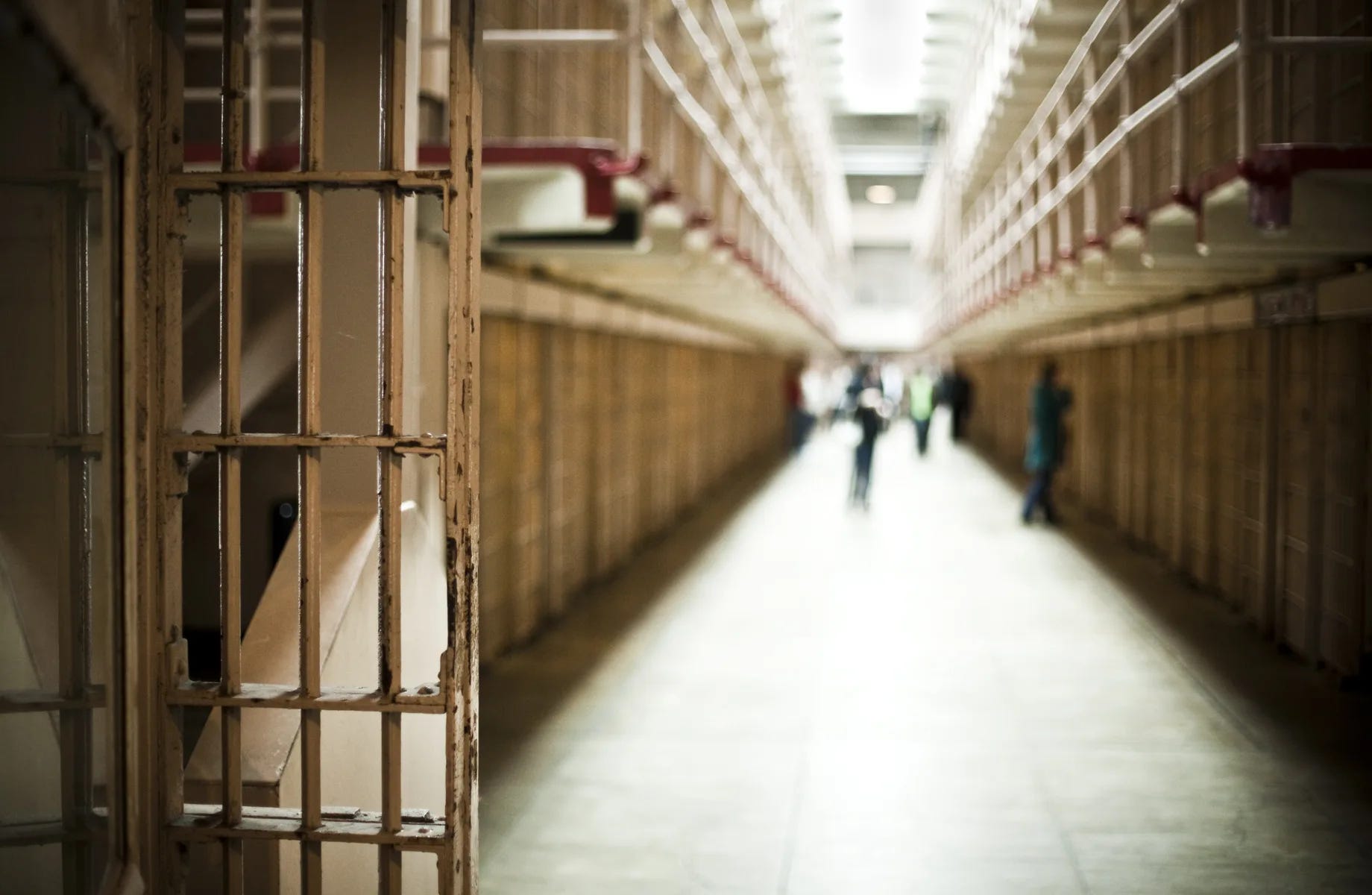
Recruiting Locations:
Black River Correctional Center (Black River Falls, Jackson County)
Chippewa Valley Correctional Treatment Facility (Chippewa Falls, Chippewa County)
Columbia Correctional Institution (Portage, Columbia County)
Dodge Correctional Institution (Waupun, Dodge County)
Felmers O. Chaney Correctional Center (Milwaukee, Milwaukee County)
Fox Lake Correctional Institution (Fox Lake, Dodge County)
Gordon Correctional Center (Gordon, Douglas County)
Green Bay Correctional Institution (Green Bay, Brown County)
Jackson Correctional Institution (Black River Falls, Jackson County)
John C. Burke Correctional Center (Waupun, Dodge County)
Kenosha Correctional Center (Kenosha, Kenosha County)
Kettle Moraine Correctional Institution (Plymouth, Sheboygan County)
Lincoln Hills & Copper Lakes Schools (Irma, Lincoln County)
Marshall E. Sherrer Correctional Center (Milwaukee, Milwaukee County)
McNaughton Correctional Center (Lake Tomahawk, Oneida County)
Milwaukee Secure Detention Facility (Milwaukee, Milwaukee County)
Milwaukee Women’s Correctional Center (Milwaukee, Milwaukee County)
New Lisbon Correctional Institution (New Lisbon, Juneau County)
Oakhill Correctional Institution (Oregon, Dane County)
Oregon Correctional Center (Oregon, Dane County)
Oshkosh Correctional Institution (Oshkosh, Winnebago County)
Prairie du Chien Correctional Institution (Prairie du Chien, Crawford County)
Racine Correctional Institution (Sturtevant, Racine County)
Racine Youthful Offender Correctional Facility (Racine, Racine County)
Redgranite Correctional Institution (Redgranite, Waushara County)
Robert E. Ellsworth Correctional Center (Union Grove, Racine County)
Sanger B. Powers Correctional Center (Oneida, Outagamie County)
Stanley Correctional Institution (Stanley, Chippewa County)
Taycheedah Correctional Institution (Fond du Lac, Fond du Lac County)
Thompson Correctional Center (Deerfield, Dane County)
Waupun Correctional Institution (Waupun, Dodge County)
Winnebago Correctional Center (Winnebago, Winnebago County)
Wisconsin Secure Program Facility (Boscobel, Grant County)
Check out my friend: Lawyering up: Big Fish, Big Pond, But not For the 80 Percenters
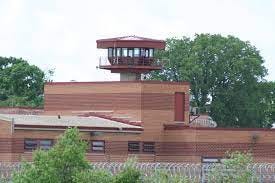
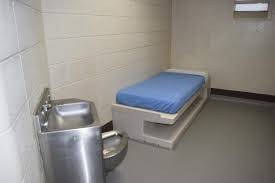
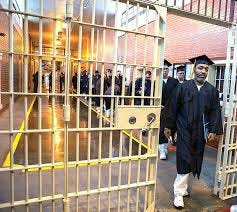

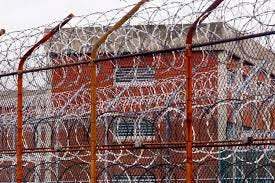

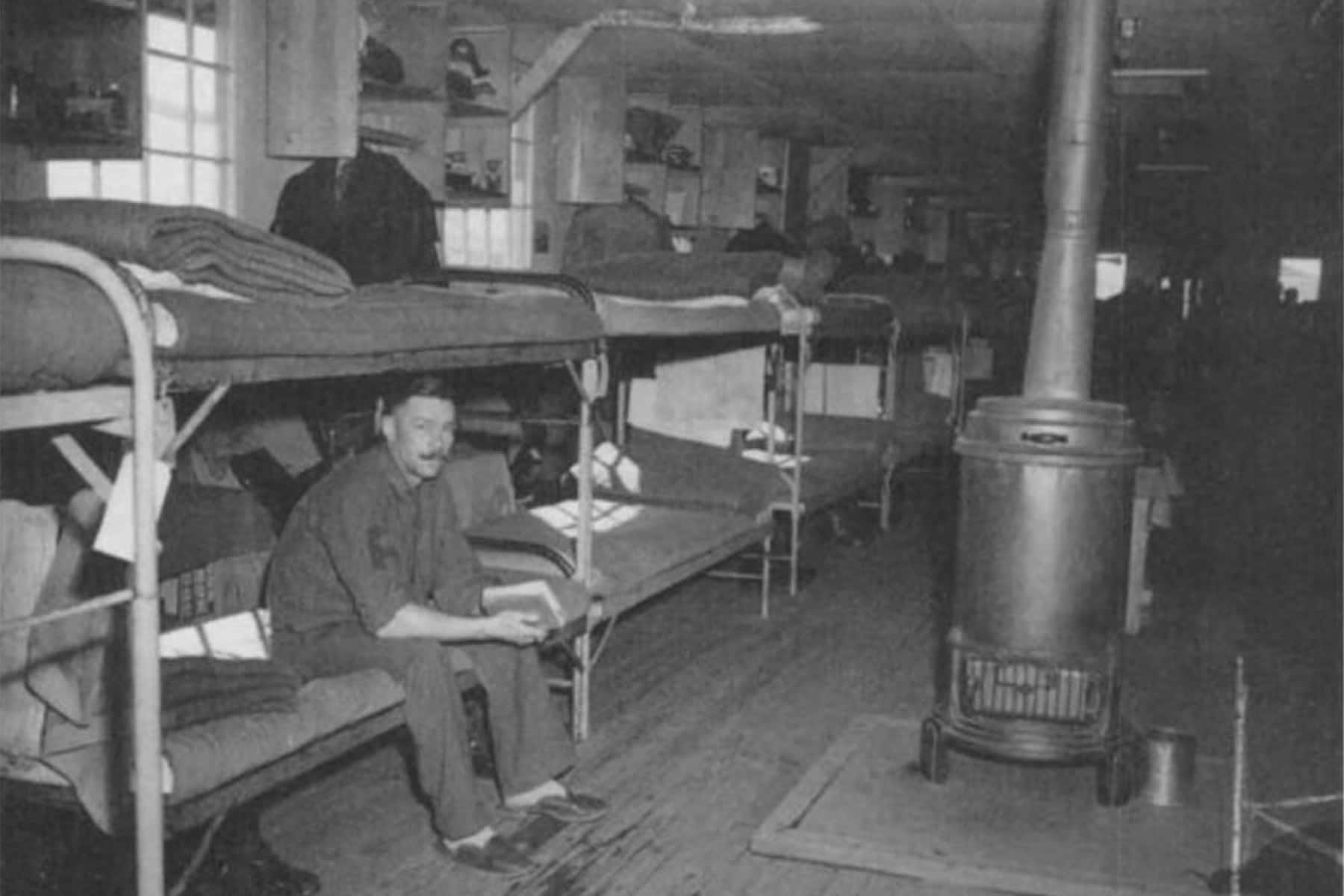
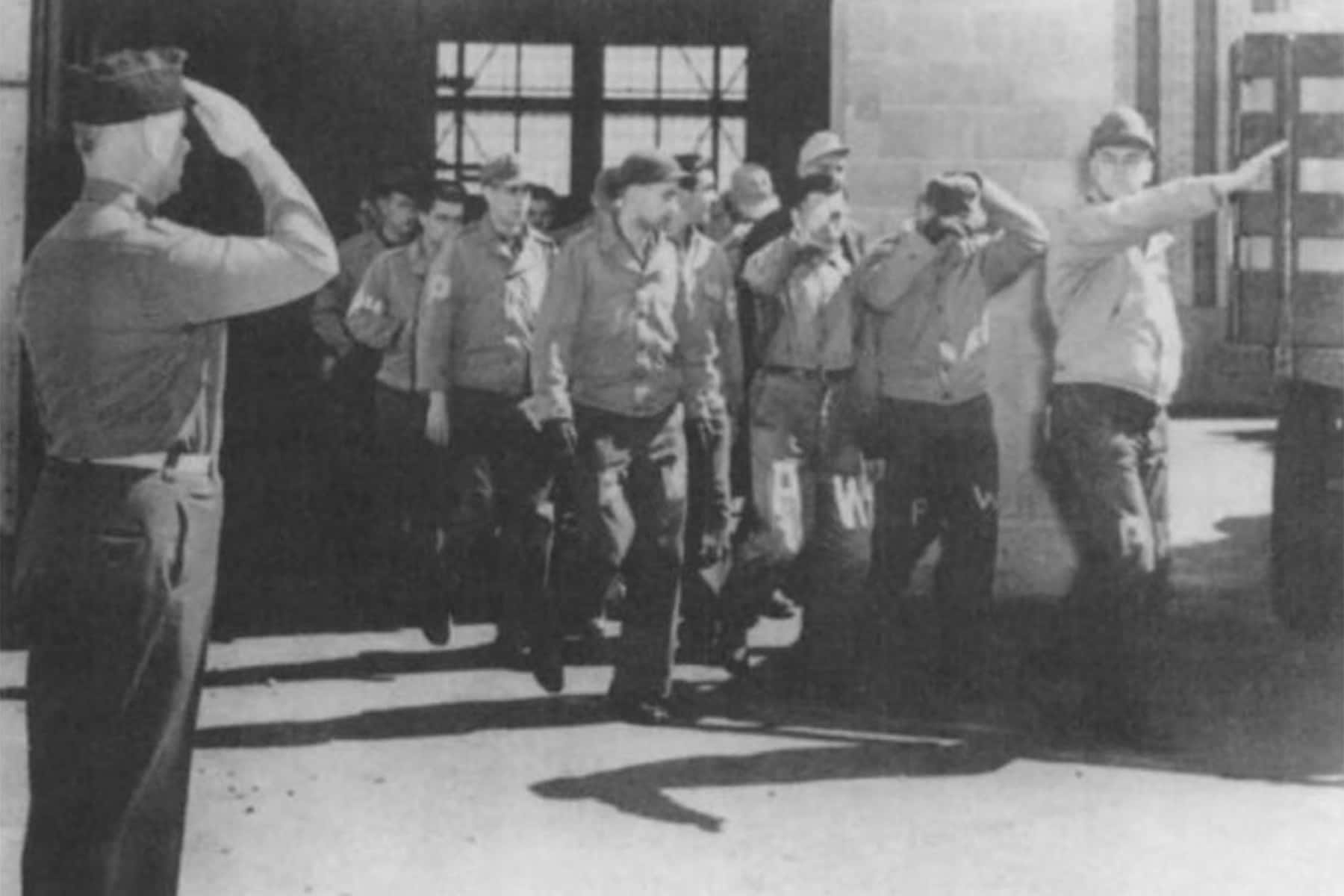
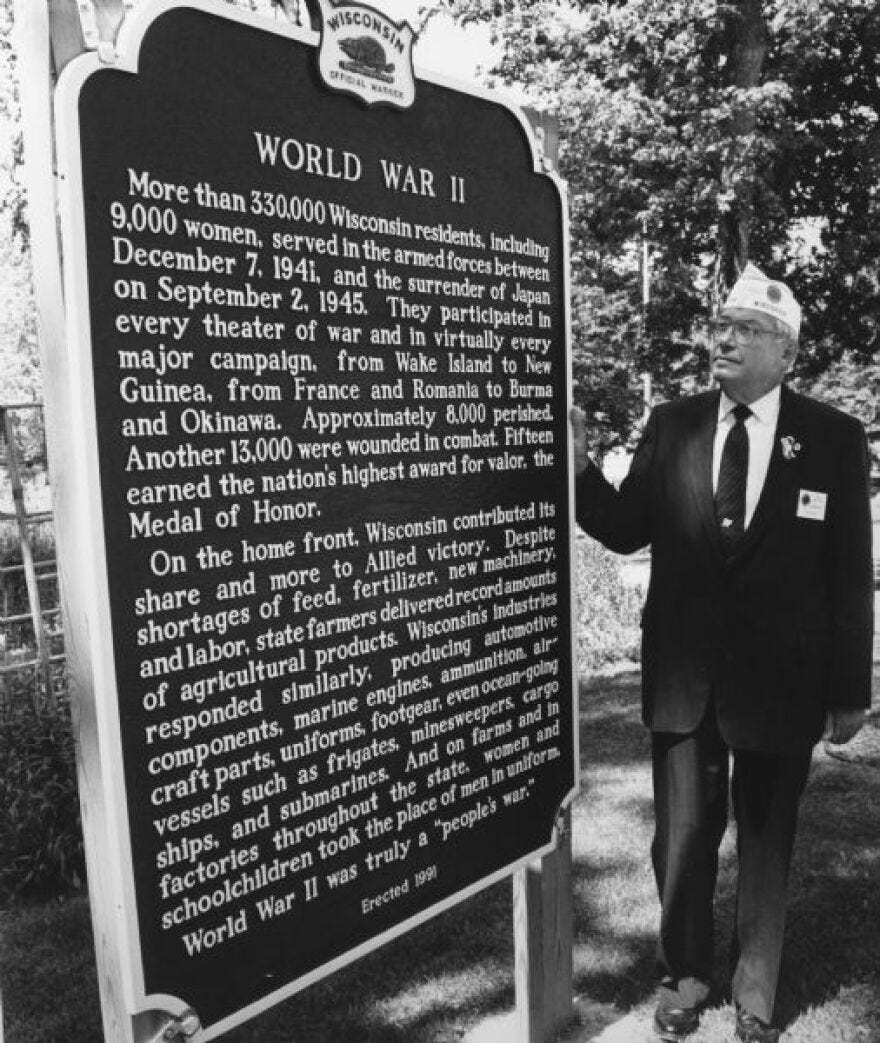

[Ian Krance, a Riverview Middle School student and the son of Ann and John Krance, Barron, displays the three-dimensional model of the German POW camp in Barron during WWII, which he built while he was in 4th grade. The history display was on exhibit during summer 2014 at Pioneer Village (the Barron County Historical Museum), between Barron & Cameron.]
Smiles, this human stain, who has an entire country under lock: Outgoing Ukraine Defense Minister Aleksey Reznikov!

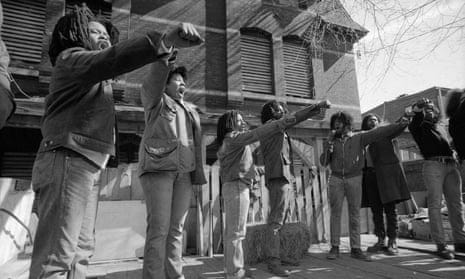
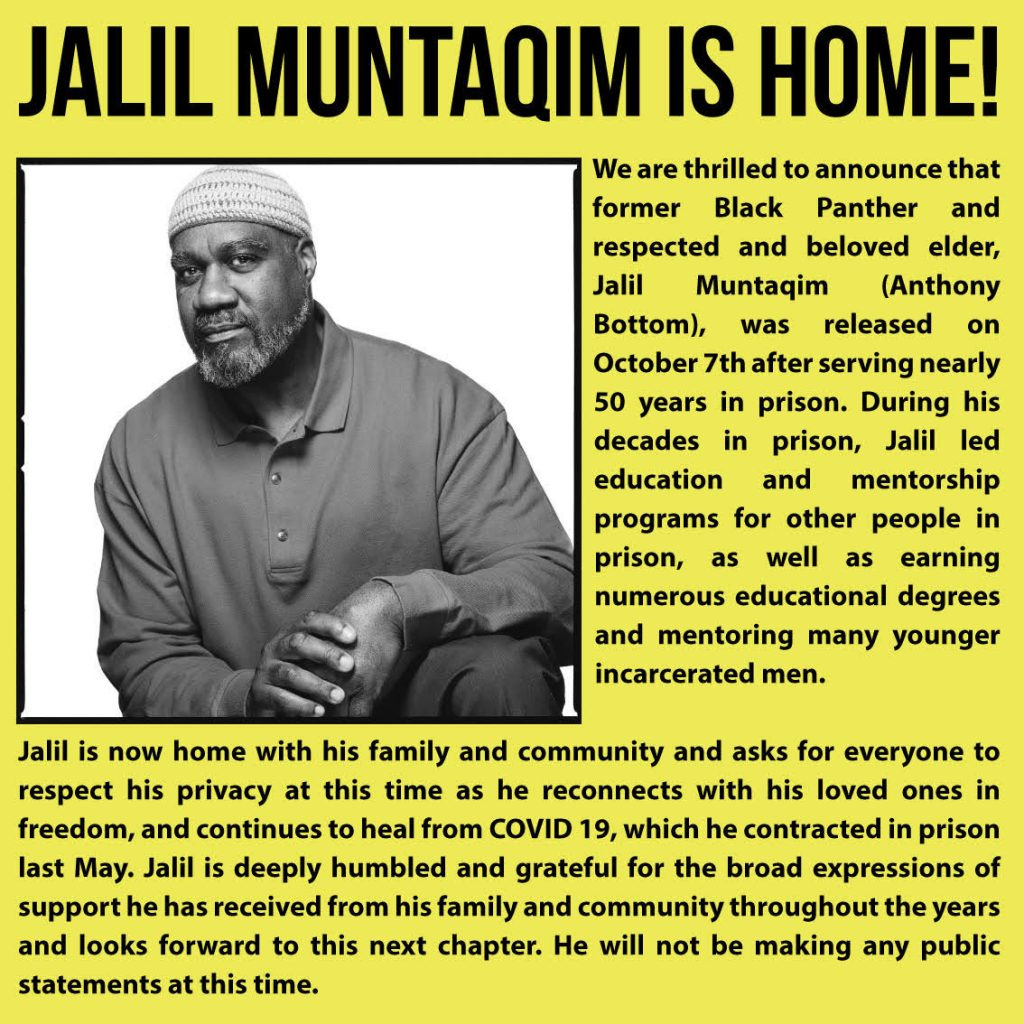
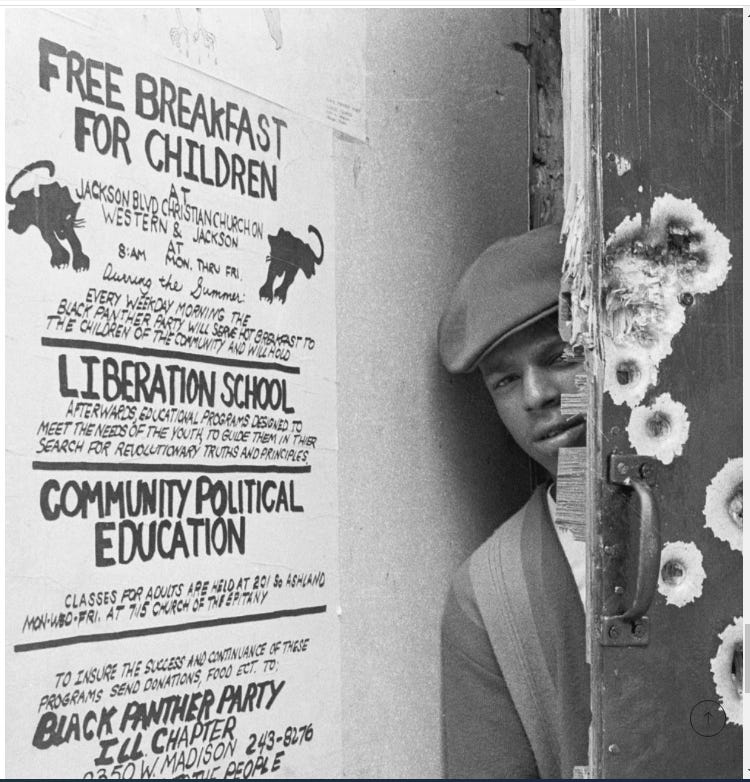
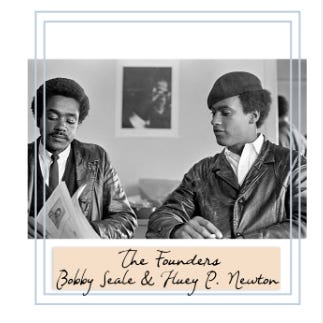
The 19 black radicals who are still in prison after four decades
Some African American rebels, including Mumia Abu-Jamal and members of Move, are still incarcerated for their actions during the 1970s black liberation struggle.



The U.S. has a staggering 1.9 million people behind bars, but even this number doesn’t capture the true reach of the criminal legal system. It’s more accurate to look at the 5.5 million people under all of the nation’s mass punishment systems, which include not only incarceration but also probation and parole.
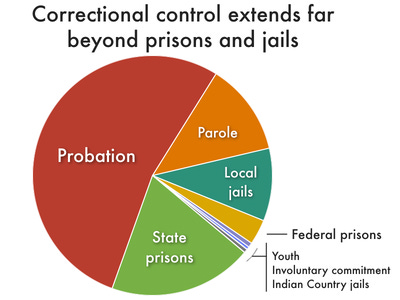
Altogether, an estimated 3.7 million adults are under community supervision (sometimes called community corrections) — nearly twice the number of people who are incarcerated in jails and prisons combined. The vast majority of people under supervision are on probation (2.9 million people), and over 800,000 people are on parole. Yet despite the massive number of people under supervision, parole and probation do not receive nearly as much attention as incarceration. Policymakers and the public must understand how deeply linked these systems are to mass incarceration to ensure that these “alternatives” to incarceration aren’t simply expanding it.(SOURCE)
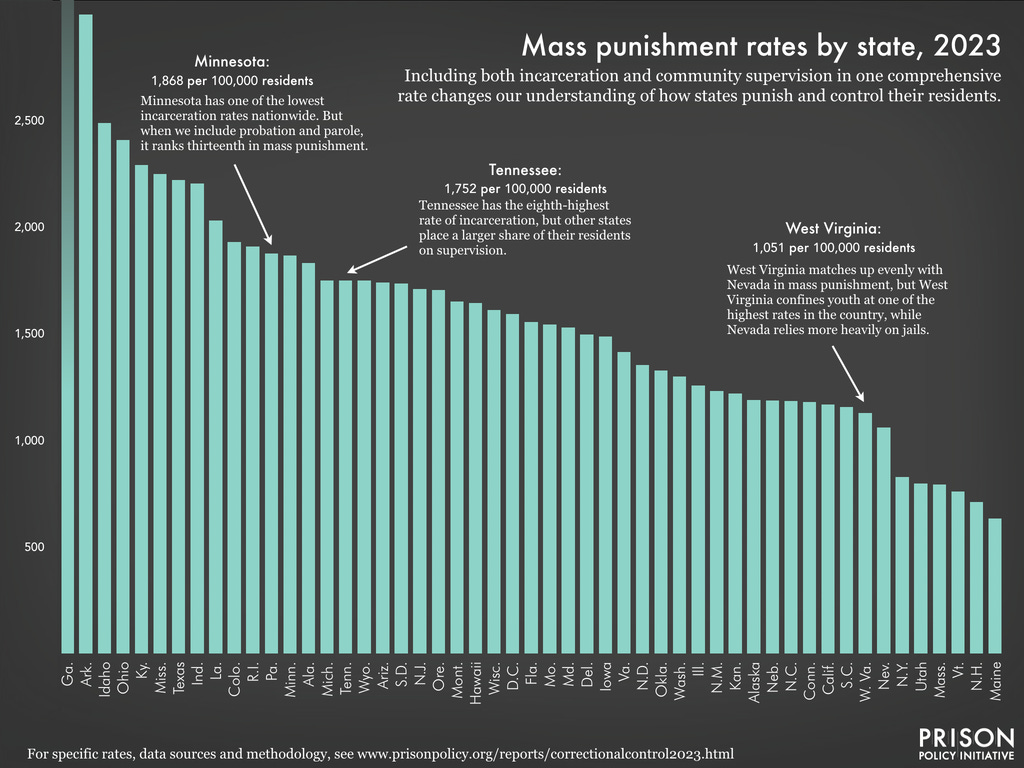
Considering each state’s total mass punishment system leads to other insights:
- Massachusetts and Utah have nearly identical rates of overall correctional control, but 69% of people in Massachusetts’ punishment systems are on probation, and only 28% are incarcerated in state, federal, and local jails. In Utah, on the other hand, only 39% are on probation, and a much larger share (46%) are incarcerated.
- Georgia is unfortunately well-rounded in its practice of mass punishment, with the fourth-highest incarceration rate nationwide (between Arkansas and Oklahoma) but a probation rate that eclipses all other states.
- Residents of New Jersey (1,712 per 100,000 under correctional control) are more than twice as likely to be caught up in their state’s mass punishment system compared to New York residents (830 per 100,000).
- Minnesota has a larger share of its population under correctional control than Alabama does, even though a resident of Minnesota is far less likely to be incarcerated than a resident of Alabama.
- Because of its large probation system, Rhode Island’s total correctional control rate rivals that of Louisiana, one of the most notoriously punitive states in the country (with the nation’s highest incarceration rate).
 Paul Haeder, Author