
all of it, run through a thespian’s tool box of lies, deception, tone, rhetoric, fancy dancing with purple prose and method acting, all of it, now in the employ of the masters of Oligarchy!
Whew, we have to see those two monsters, a la thespians? L to R: Tom Conti is Albert Einstein and Cillian Murphy is J. Robert Oppenheimer in ‘Oppenheimer’. Two Catholics messing with stupdity, but it’s on the big screen, so it must be so so important.

Ya getting enough of the fucking lies of Oppenheimer and the fall over themselves rich sons of bitches telling us oh how good it is? That turncoat, Stone, man, shut the fuck up. It’s just a thespian cesspool, a movie, money, man, money for nothing:
JFK filmmaker Oliver Stone posted a series of tweets Tuesday praising Christopher Nolan’s latest film Oppenheimer during which he revealed he once turned down a project based around J. Robert Oppenheimer’s life because he couldn’t crack the narrative.
“Saturday, I sat through 3 hours of Oppenheimer, gripped by Chris Nolan’s narrative. His screenplay is layered & fascinating. Familiar with the book by Kai Bird & Martin J. Sherwin, I once turned the project down because I couldn’t find my way to its essence. Nolan has found it,” Stone tweeted.
That fucking Stone, who goes on and on about how JFK woulda, coulda, must’ve pulled US out of its many killing fields in Indochina. BULL shit!
In a press conference on July 17, 1963, JFK said:
“for us to withdraw from that effort would mean a collapse not only of South Viet-Nam, but Southeast Asia. So we are going to stay there.” (source)
Oliver Stone in JFK had excerpts of Kennedy’s September 2 TV interview with Walter Cronkite. But the film did not include this:
“But these people who say we ought to withdraw from Vietnam are wholly wrong because if we withdrew from Vietnam the Communists would control Vietnam, pretty soon Thailand, Cambodia, Laos, Malaya, all of Southeast Asia… So I think we should stay… I don’t agree with those who say we should withdraw. That would be a great mistake. That would be a great mistake.… We are in a desperate struggle against the Communist system…. It doesn’t do us any good to say, ‘Well, why don’t we all just go home and leave the world to those who are our enemies’… We are going to meet our responsibility.”
In his September 9, 1963 Huntley-Brinkley interview:
“What I am concerned about is that Americans will get impatient with the government in Saigon, that we should withdraw. That only makes it easy for the Communists. I think we should stay…we should not withdraw.”
It just never ends, even over at Dissident Voice:
The Movie and the Moment — An Oppenheimer Review Through the Lens of an Anti-War Activist
Shite!
Fucking sell sell sell, the Mad Men and Mad Women in the fucking game: ‘Oppenheimer’ Sold $5 Million in Tickets This Weekend Because ‘Barbie’ Was Sold Out
While millions die, thousands are bombed, and the war war of depleted uranium, cluster bombs, and just big ass TNT human imploders, and these movies do what?
“Barbenheimer” double features were only the beginning. Disappointed by sold-out shows, hundreds of thousands of Barbie fans turned to Robert Oppenheimer for comfort. The result: an extra $5 million at the “Oppenheimer” box office.
According to film-data research company The Quorum, 6 percent of the people who saw “Oppenheimer” in the U.S. this past weekend did so because tickets to “Barbie” were sold out. “Oppenheimer” drew $83 million domestically, so $4.98 million is attributed to “Barbie” leftovers. (“Oppenheimer” made $93.7 million at the foreign box office.)

Fuck Einstein, too:
An Oppenheimer fact-check reveals that German-born theoretical physicist Albert Einstein signed a letter dubbed the Einstein-Szilard letter on August 2, 1939. Authored by physicist Leo Szilard, the letter was sent to President Franklin D. Roosevelt, recommending that he provide funding for research into the potential for using nuclear fission as a weapon. The letter warned that Nazi Germany may be carrying out similar research into the development of nuclear weapons.
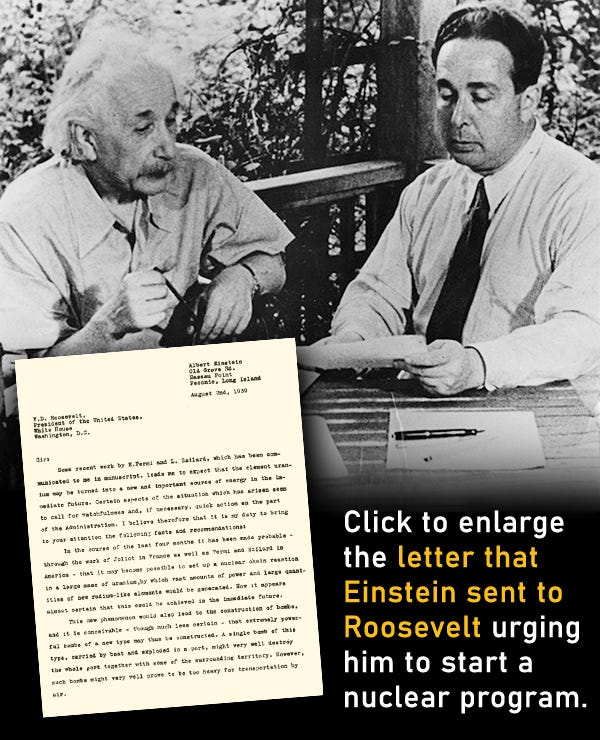
Here, read the fucking thing! Link.
If these people were never born, man, never ever born. Millions of these mad scientists and military merchants of death, never born, Aborted.

Trinity?
John Donne and Trinity
Seventeenth-century poet John Donne was one of Oppenheimer’s favorite writers and an inspiration during his work with the Manhattan Project.
In 1962, Manhattan Project leader Gen. Leslie Groves wrote to Oppenheimer to ask about the origins of the name Trinity. According to a copy of the letter that is a part of the collections of the Lab’s National Security Research Center, Oppenheimer said, “Why I chose the name is not clear, but I know what thoughts were in my mind. There is a poem of John Donne, written just before his death, which I know and love.” Oppenheimer then quoted the sonnet “Hymn to God, My God, in My Sickness” about a man unafraid to die because he believed in resurrection.
Oppenheimer continued, “That still does not make a Trinity, but in another, better known devotional poem Donne opens, ‘Batter my heart, three person’d God.’ Beyond this, I have no clues whatever.”
“Batter my heart” expresses the paradox that by being chained to God, the narrator can be set free. A great force could enthrall the narrator to do greater good. Richard Rhodes, who wrote the book “The Making of the Atomic Bomb,” proposed that “the bomb for [physicist Niels] Bohr and Oppenheimer was a weapon of death that might also end war and redeem mankind.”
Hymn to God, My God, in My Sickness
BY JOHN DONNE
Since I am coming to that holy room,
Where, with thy choir of saints for evermore,
I shall be made thy music; as I come
I tune the instrument here at the door,
And what I must do then, think here before.
Whilst my physicians by their love are grown
Cosmographers, and I their map, who lie
Flat on this bed, that by them may be shown
That this is my south-west discovery,
Per fretum febris, by these straits to die,
I joy, that in these straits I see my west;
For, though their currents yield return to none,
What shall my west hurt me? As west and east
In all flat maps (and I am one) are one,
So death doth touch the resurrection.
Is the Pacific Sea my home? Or are
The eastern riches? Is Jerusalem?
Anyan, and Magellan, and Gibraltar,
All straits, and none but straits, are ways to them,
Whether where Japhet dwelt, or Cham, or Shem.
We think that Paradise and Calvary,
Christ’s cross, and Adam’s tree, stood in one place;
Look, Lord, and find both Adams met in me;
As the first Adam’s sweat surrounds my face,
May the last Adam’s blood my soul embrace.
So, in his purple wrapp’d, receive me, Lord;
By these his thorns, give me his other crown;
And as to others’ souls I preach’d thy word,
Be this my text, my sermon to mine own:
“Therefore that he may raise, the Lord throws down.”
Holy Sonnets: Batter my heart, three-person’d God
BY JOHN DONNE
Batter my heart, three-person’d God, for you
As yet but knock, breathe, shine, and seek to mend;
That I may rise and stand, o’erthrow me, and bend
Your force to break, blow, burn, and make me new.
I, like an usurp’d town to another due,
Labor to admit you, but oh, to no end;
Reason, your viceroy in me, me should defend,
But is captiv’d, and proves weak or untrue.
Yet dearly I love you, and would be lov’d fain,
But am betroth’d unto your enemy;
Divorce me, untie or break that knot again,
Take me to you, imprison me, for I,
Except you enthrall me, never shall be free,
Nor ever chaste, except you ravish me.
Mad men, killers, and they did it, didn’t they?
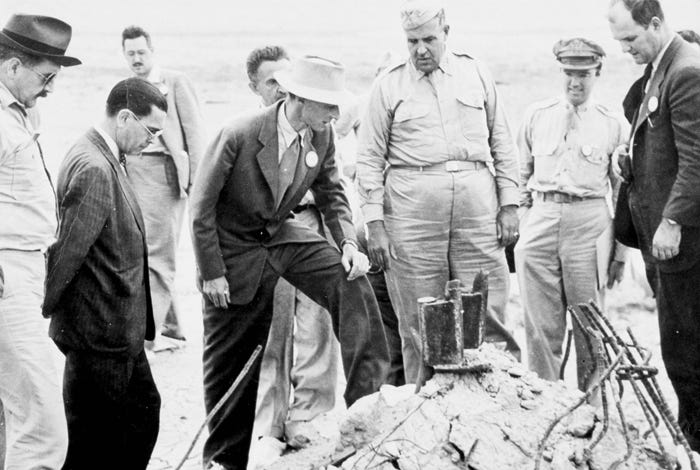
It’s just stupid junk TV:
Experts say that the issue of representation is more nuanced. They emphasized that while no one film has the responsibility to illustrate Japanese victims’ perspective, “Oppenheimer” does little to challenge the long history of glorifying the work of white men, and risks perpetuating the persistent, often reductive, portrayals of Japanese victims in Hiroshima and Nagasaki.
“I don’t think we should depend on Hollywood to tell our stories with the nuance and the depth and the care that they really deserve,” Nina Wallace, media and outreach manager at Densho, a nonprofit group dedicated to preserving the stories of those of Japanese descent. “But it is true that these institutions that are in positions of power, positions of influence, put more value on stories of men like Oppenheimer, like Truman, than it does on the Asian and indigenous communities that suffered because of decisions that those men made.”
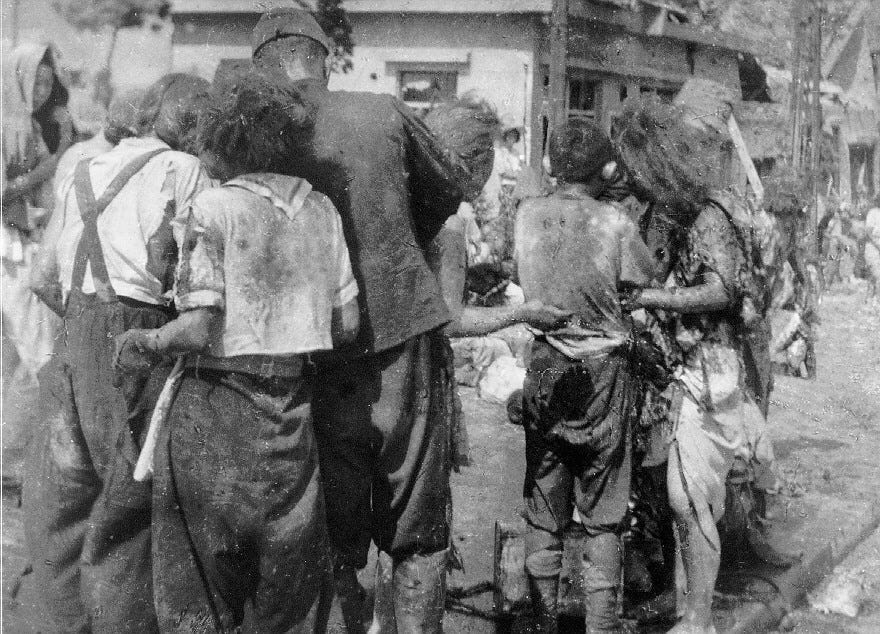
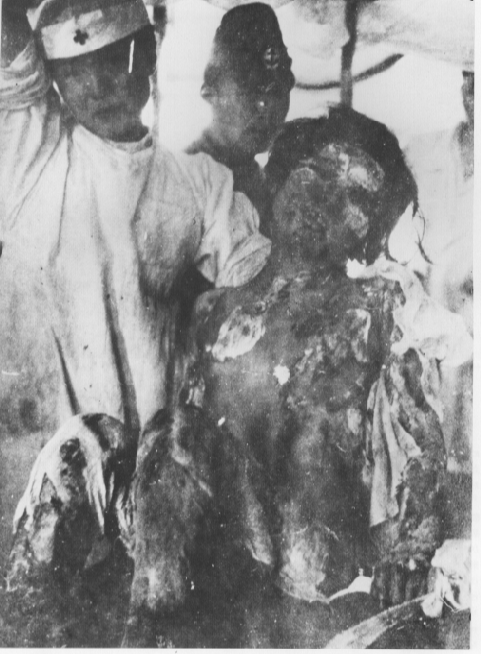
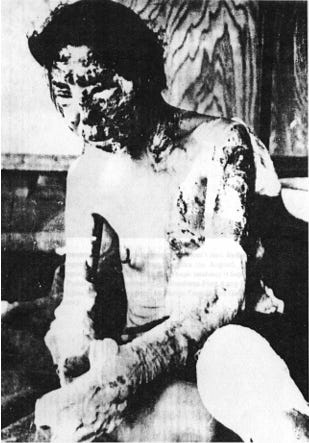
Oppenheimer’s work led to the deaths of more than 200,000 people by some estimates, as well as a generation of “hibakusha,” or survivors of the blast — many of whom continue to contend with the impacts of the bomb to this day. And the movie has largely been billed as a contemplation over the moral dilemmas facing the scientists.
However, Nolan doesn’t show the bombings of Hiroshima and Nagasaki, or the devastating aftermath in the cities. While there’s a scene that depicts American leaders discussing where to drop the bomb — with then-Secretary of State Henry Stimson depicted as arguing against Kyoto because of his honeymoon there — victims of the blasts never appear on screen. In another scene, Oppenheimer gives a speech and, while looking into the crowd, visualizes some of the predominantly white audience as the victims of his bomb. (NBC, some source)
Lies lies from the director of fucking Batman.
Greg Mitchell, a journalist and author who has written extensively on the bombings of Hiroshima and Nagasaki, notes, Oppenheimer leaves out key historical facts that raise questions about the necessity of deploying the atomic bomb to end the war—and the necessity of dropping the second one on Nagasaki. “Many historians today believe that if Truman had waited just three days after Hiroshima for the Soviets to enter the war as the US insisted,” he points out, “the Japanese would likely have surrendered in about the same time frame.” Mitchell also observes that there is no mention in the film that 85 percent of the dead at Hiroshima and Nagasaki were civilians.
The bloody Soviet Union defeated the Japanese:
To the Soviet military, it is known as the Manchurian Strategic Offensive Operation. Although it had no official name to the Japanese, it has become known in the West as Operation August Storm. It was the greatest defeat in Japanese military history, yet few outside the circles of Japanese and Soviet history are even aware that it occurred. It ensured the end of World War II as much as the dropping of the atomic bombs on Hiroshima and Nagasaki did, yet it is often ignored in Western studies of the war.
More than one million Japanese soldiers and hundreds of thousands of Japanese civilians were killed or captured in a month’s bitter fighting in a far-off land that even today remains somewhat mysterious.
The seeds of the annihilation of four Japanese armies, each equal to an American field army, were planted in 1931. Japanese militarists saw the civil war in China between Chiang Kai-shek’s Nationalists and Mao Tse-tung’s Communists as an opportunity for a place at the imperialist table and a slice of the Chinese pie, and thus decided to invade China, Manchuria, and Korea.
The Soviets’ Manchurian Campaign, August Storm, destroyed the last vestige of Japanese military power outside Japan, and put the final nail in the coffin of those Japanese militarists who, even after suffering two atomic attacks, intended to continue the war to the death.
Only the most fanatical Japanese still wanted to continue what had become a war of annihilation. These few were either killed by the rational Japanese leaders or conveniently committed suicide. The Soviet invasion of Manchuria—which led to Japan’s greatest defeat—had helped to end the Pacific War. (source)
These overpaid freaks will be putting the finishing touches on the NaziLandia of UkroNaziLandia, and the great swaths of untruths papering over the Penis Piano Man, ZioAzovLensky.
Holly-Dirt has already thrown in with that Nazi, man, that Nazi, man.
Soviet Union, and the bomb was dropped, or both were dropped on civilian Japan, to scare the Soviets. This is the sickness of Einstein and Oppenheimer and that DIaspora and the other White Lords of Science and Military Madness.
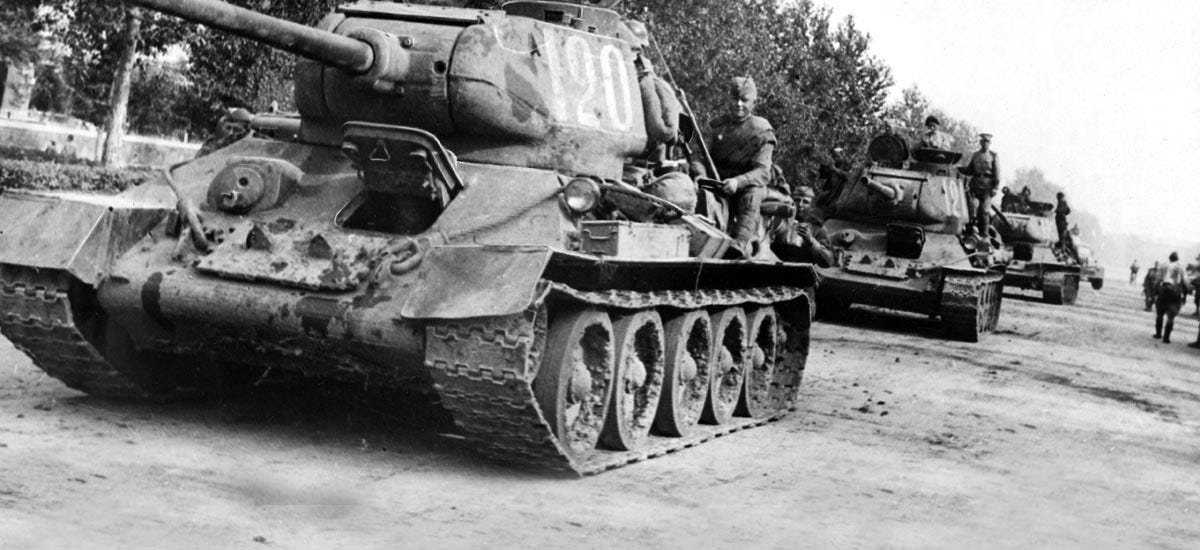

In an attempt to halt the Soviet invasion of Manchuria, Japanese infantrymen board a train bound for the front. Most would not return home alive.

Riding in U.S. Lend-Lease amphibious DUWKs, Red Army troops advance to the U.S.S.R.- Manchuria border during Operation August Storm.

Japanese soldiers man a machine-gun outpost along the shores of the Amur River in Manchuria, August 9, 1945, the day the Soviet invasion began.
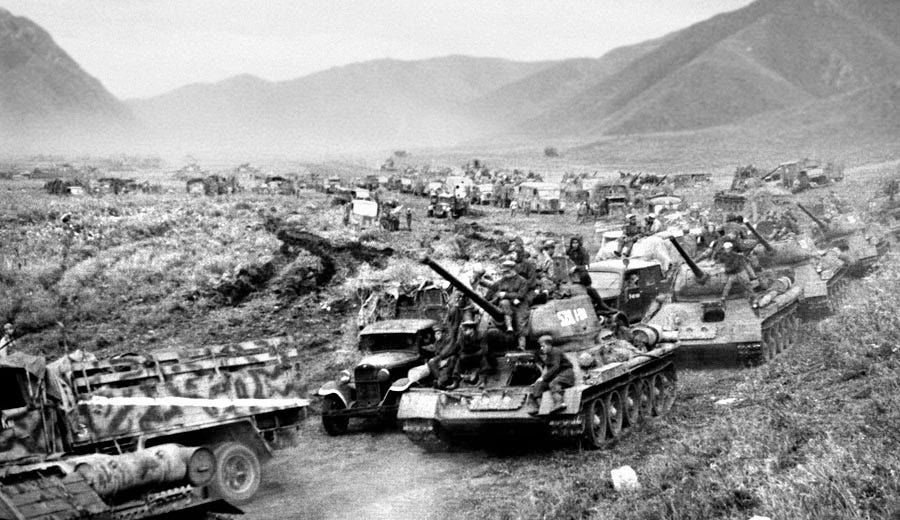
A huge motorized Soviet convoy advances across the Grand Khingan Mountain Range in south central Manchuria.
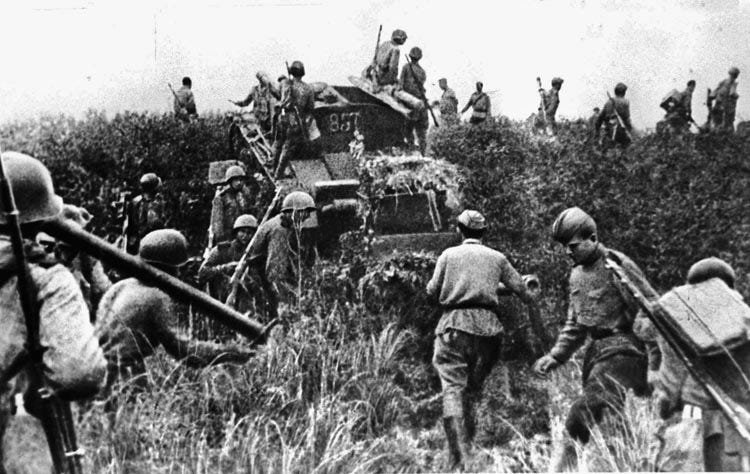
Red Army troops follow in the wake of an armored vehicle towing an artillery piece up a steep incline.

A Japanese horse-mounted unit on maneuvers along the banks of the Amur River shortly before the Soviets declared war on Japan, August 8, 1945.
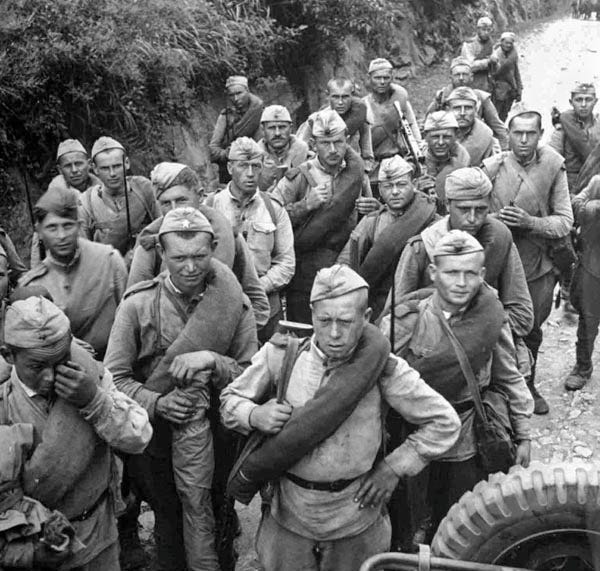
After the Soviets launched an amphibious invasion of Japanese-occupied Korea on August 14, the Red Army stopped at the 38th Parallel at the proposal of the United States, thus establishing the later border between North and South Korea.
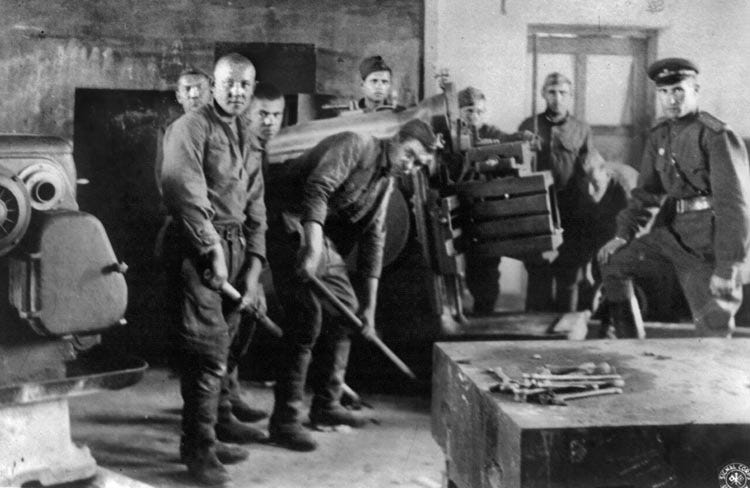
The spoils of war: Soviet troops remove industrial equipment from a Manchurian factory.
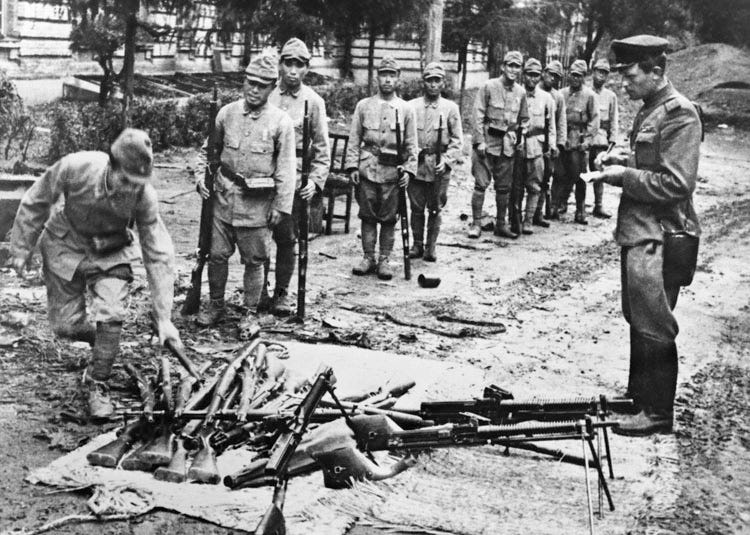
Japanese troops lay down their arms after surrendering to the Red Army in Harbin, Manchuria, August 20, 1945.
Reference: Spring 2018. by Nathan N. Prefer
From Ed Curtain’s site: Trinity’s Shadow
Was I born in a normal time? Is war time our normal time? It is. I was.
But to be born at a time and place when your country’s leaders were denouncing their German and Japanese enemies as savage war criminals while execrably emulating them and then outdoing them is something else again. With Operation Paperclip following World War II, the United States government secretly brought 1,600 or more Nazi war criminals into the U.S. to run our government’s military, intelligence, space, chemical, and biological warfare programs. We became Nazis. Lewis Mumford put it this way in The Pentagon of Power:
By the curious dialectic of history, Hitler’s enlargement and the refurbishment of the Nazi megamachine gave rise to the conditions for creating those counter-instruments that would conquer it and temporarily wreck it. In short, in the very act of dying the Nazis transmitted their disease to their American opponents; not only the methods of compulsive organization or physical destruction, but the moral corruption that made it feasible to employ those methods without stirring opposition.
There are always excuses for such moral corruption. When during WW II the U.S. firebombed almost all Japanese cities, Dresden and Cologne in Germany, and then dropped atomic bombs on Hiroshima and Nagasaki killing hundreds of thousands of innocent civilians in gratuitously savage attacks, these were justified and even celebrated as necessary to defeat evil enemies. Just as Nazi war criminals were welcomed into the U.S. government under the aegis of Allen Dulles who became the longest running CIA director and the key to JFK’s assassination and coverup, the diabolic war crimes of the U.S. were swept away as acts of a moral nation fighting a good war. What has followed are decades of U.S. war crimes from Korea through Vietnam and Iraq, etc. A very long list.
The English dramatist Harold Pinter, in his Nobel Address, put it bluntly:
It never happened. Nothing ever happened. Even while it was happening it wasn’t happening. It didn’t matter. It was of no interest. The crimes of the United States have been systematic, constant, vicious, remorseless, but very few people have actually talked about them. You have to hand it to America. It has exercised a quite clinical manipulation of power worldwide while masquerading as a force for universal good. It’s a brilliant, even witty, highly successful act of hypnosis.
JUNK: Piece of junk
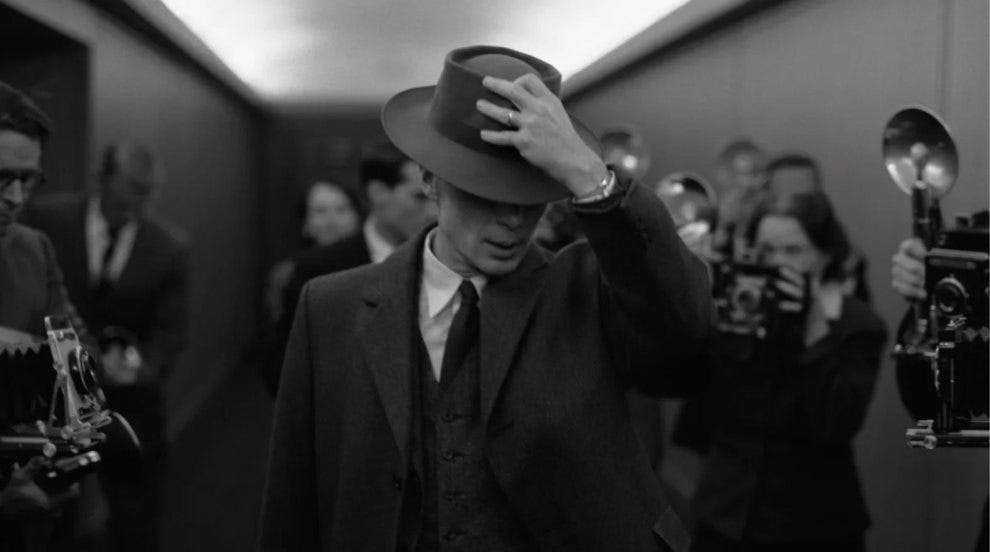
Truth: THE TRUTH.
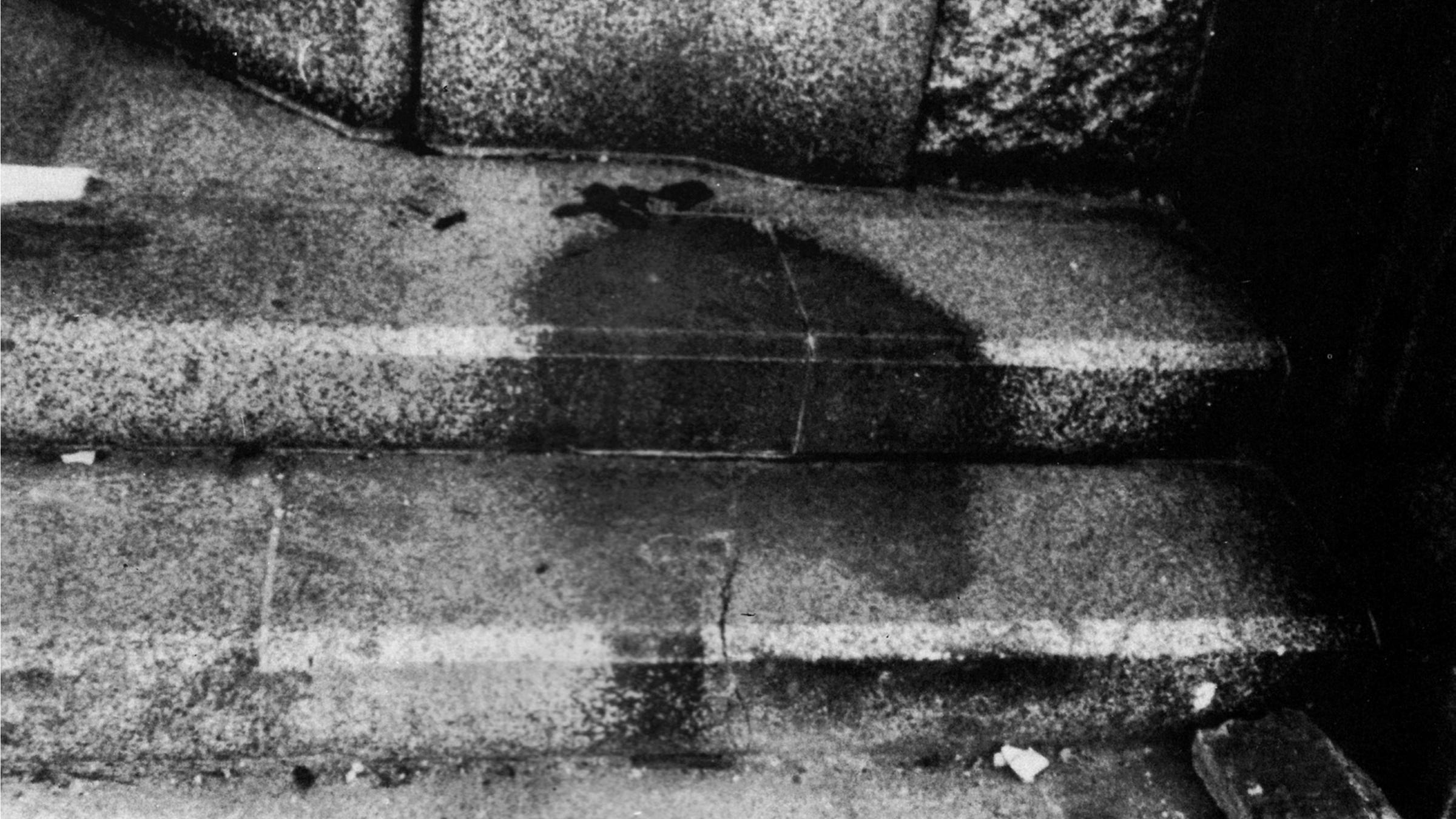
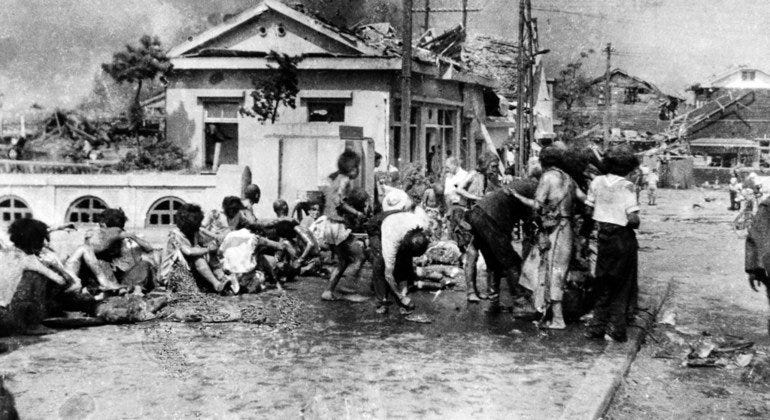

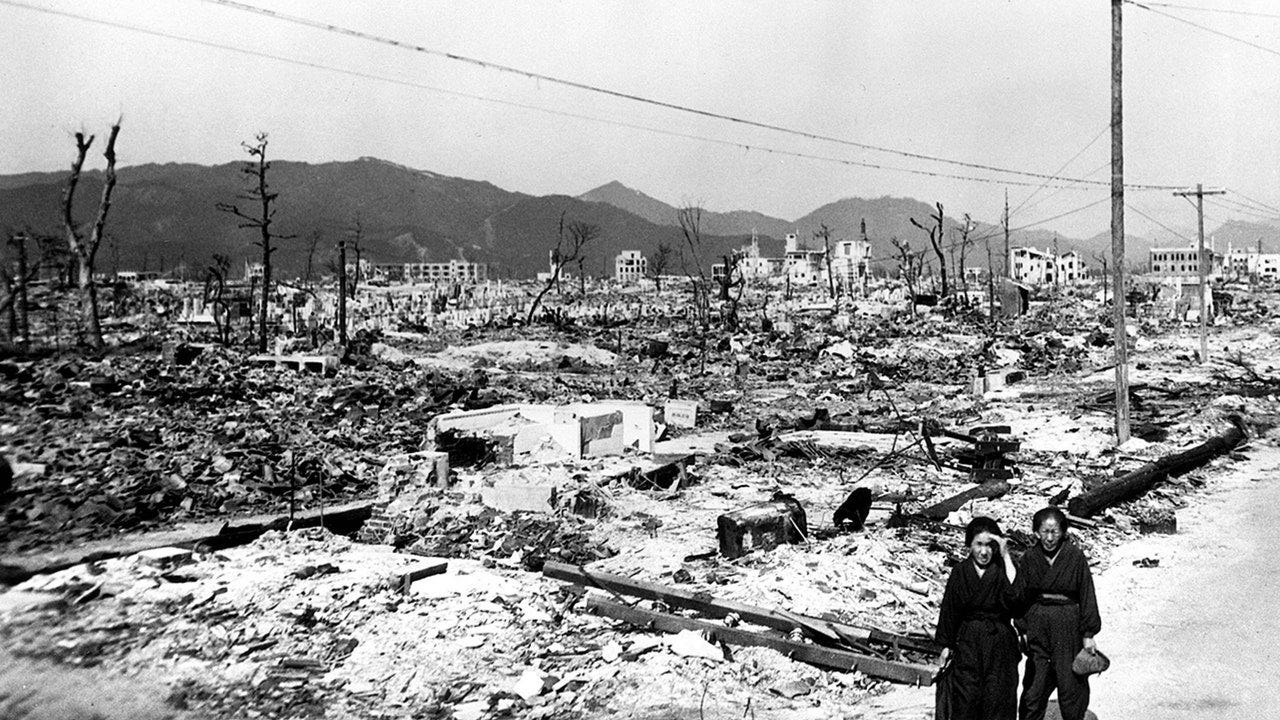

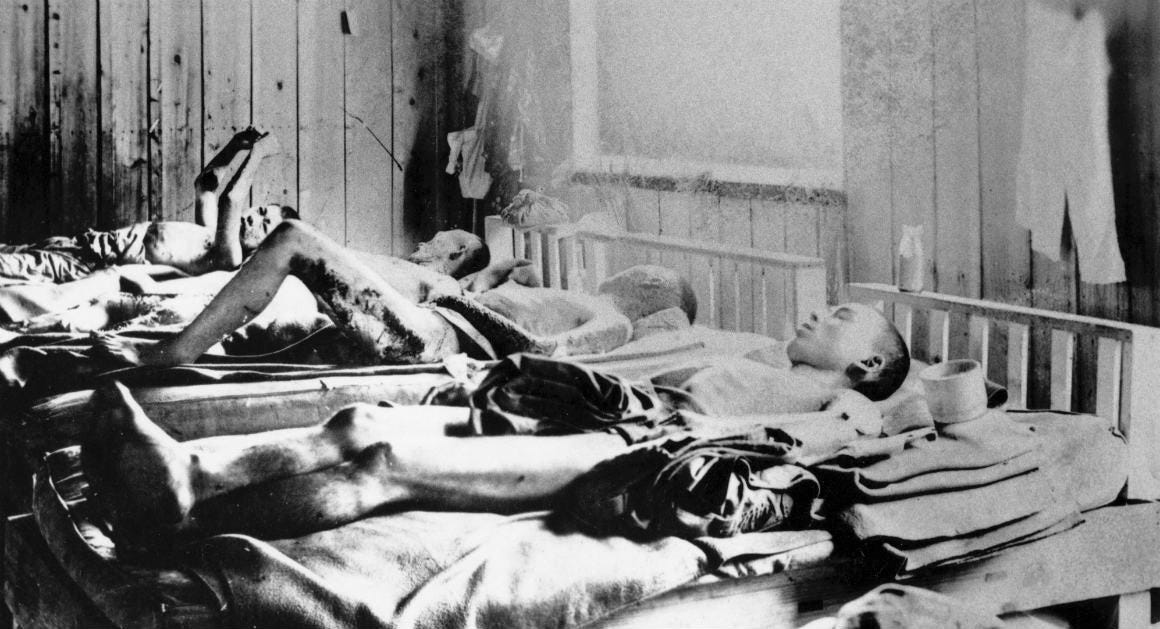
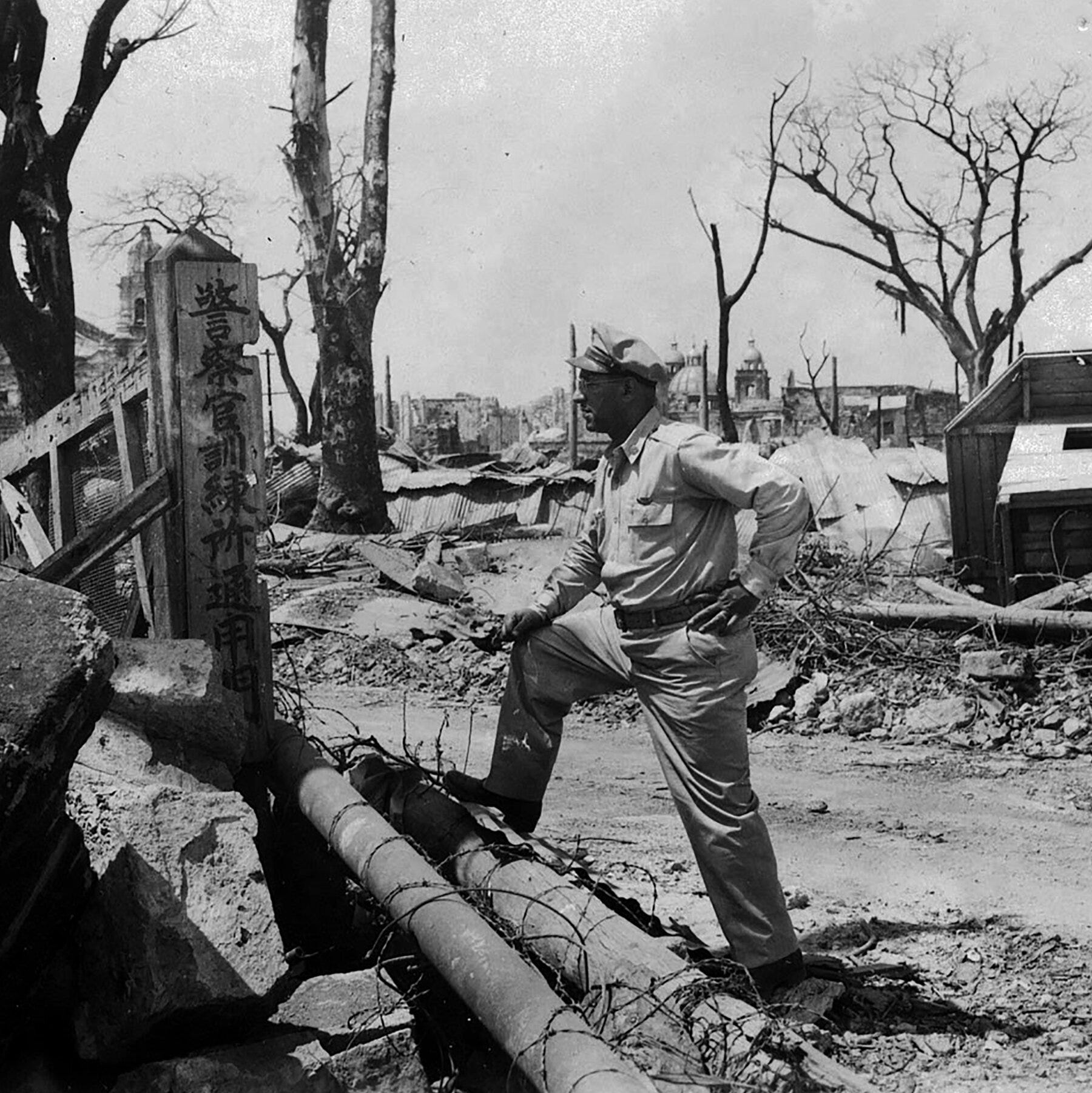
Charles Loeb: The Black Reporter Who Exposed an Atomic Bomb Lie – The New York Times


Fuck Holly-Dirt and EVERYTHING it stands for.
In late 6th century Athens (BCE), it was all the rage.
Introduced by Thespis, “play-acting” quickly attained widespread popularity among Athenians who, like most people, were looking for diverting forms of entertainment to fill the evening hours.
On one such evening the aged patriarch Solon, celebrated lawmaker and civic founder, was persuaded to attend a performance.
His reaction?: indignation and an angry rebuke to Thespis, who blithely responded that such “play” was harmless, merely a novel pastime.
“No!” Solon retorted angrily (here paraphrasing Plutarch’s account), “It is dangerous. Such a tolerance for pretense and deception will end up infecting all our commerce and civic life.”
But Thespis merely shrugged — and, some 2500 years later, we now find ourselves enmeshed in a media-sphere of garrulous, deceitful “actors,” all clamoring for our attention as they exhibit their base arts of “persuasion.”
Aristotle, in his book on Rhetoric, had warned presciently that the “base” variety of rhetoric seeks to undermine our self-directed judgment in order to manipulate and control our decisions.
Much later, in the mid-18th century, Jean-Jacques Rousseau followed Plutarch’s account of Solon by writing an angry polemic against the establishment of a theater in his beloved Geneva.
Consulting the Dictionary of Occupational Titles, I find that there are some 70,000 “professional actors” in the U.S. (compared to, for instance, 3000 sociologists). Quite obviously, the requisite job skills require playing different roles, displaying (false) emotions, and “sincerely” persuading us to buy sundry products, “lifestyles” — and candidates. With their omnipresence in all performing media, actors have by now become absurdly over-valued as role-models in everyday life. Writing back in the 1940s, psychoanalyst Erich Fromm had already critiqued the rise of a new American character-type: the “marketing personality” — whose looks, smiles and jokes would be “selling points,” not only in politics, but infiltrating all aspects of social engagement. In short, not the real person and his values (if any), but a simulacrum or image fashioned to display pleasing, if insincere, demeanor, attitudes and opinions. (A Nation of Thespians)
Although Boyer argues for a more complex and nuanced view of the censor’s role and intellect, he offers a harsh viewpoint that encapsulates a number of discussions on censor:
“Censorship is a crude business: punitive, petty, anti-humanitarian, and far beneath the work of the truly gifted and intelligent”.
Read a doctoral dissertation: ROUSSEAU AND THE PROBLEM OF CENSORSHIP: FREEDOM, VIRTUE, AND THE EDUCATION OF THE CITIZEN; Elliot Thomas Montagano
 Paul Haeder, Author