“If you chart the West to 1492, when Columbus sailed the ocean blue, that is kind of the main springboard through which everything else comes from. What is the first act of Europe, in the Americas? It is the largest genocide that has ever existed on the planet, killing up to – the midpoint estimate of people who died in the Americas is 17 million people. […] I actually don’t understand the science of this, but apparently there were so many people killed, the temperature of the earth actually rose.”
“The British Empire was far worse than the Nazis. It lasted far longer; it killed far many more people; and in fact, in many ways, as you mentioned, the Nazis were copying large elements of the British Empire. And that’s just fact. But you state something like that it’s like heresy, right? Because we’re not having a rational conversation; we’re not having a conversation about actual history.”
“He was an unashamed imperialist, like many of his generation, and staunchly committed to maintaining India’s unity within the British Empire. He had a strongly held conviction that too sudden and rapid a move to democracy and independence would tear the subcontinent apart on sectarian lines, a fear that events would justify.”3
It’s in the DNA:
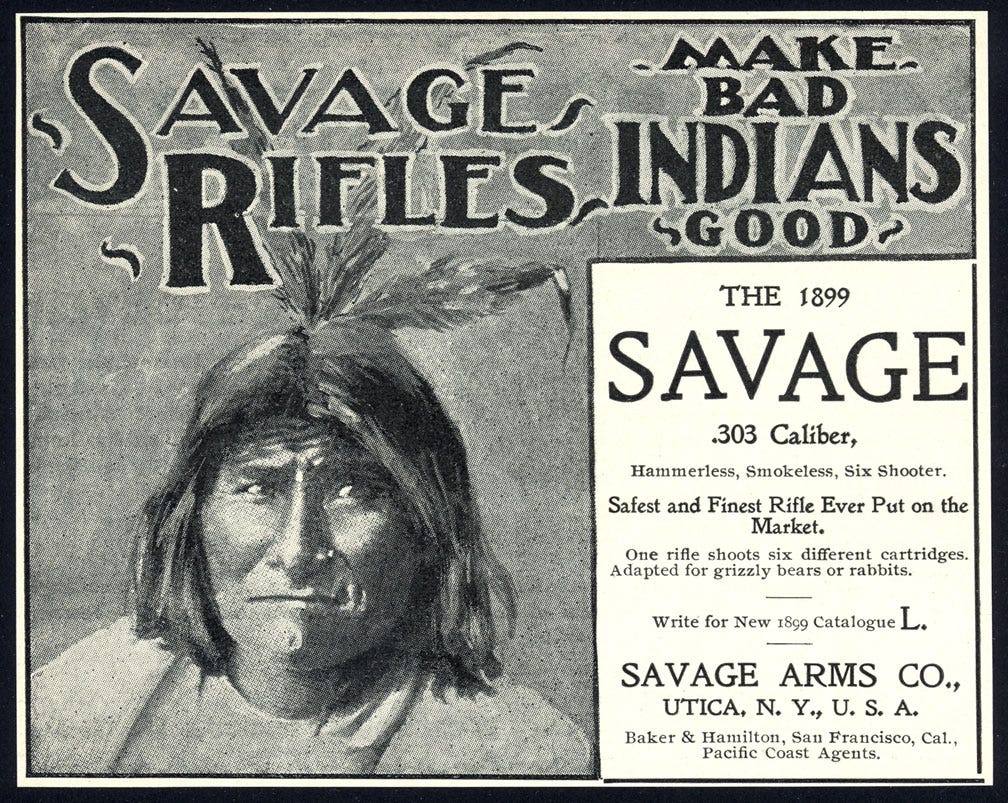
Comanche Chief Tosahwi reputedly tells Sheridan in 1869, “Tosahwi, good Indian,” to which General Sheridan supposedly replies, “The only good Indians I ever saw were dead” (Brown, 1970).
+–+
Not atypical of U$A: Other “Indians.”
Asked about Nixon’s remarks, Natwar Singh said Nixon’s language reflected “his vulgarity and racism”.
“Richard Nixon was a third-rate human being and his entire record shows that and also the manner in which he was dismissed,” Singh told , referring to the Watergate scandal that led to Nixon’s resignation.
Nixon had a genuine preference for Pakistan vis-a-vis India and he knew about the genocide that was going on in Bangladesh but turned his eyes the other way. In this, his accomplice was Kissinger, Singh said.
“Kissinger, 20 years later at least had the decency to apologise, but Nixon went to his grave and never apologised,” said Singh, who has been a decorated diplomat and India’s envoy to several countries.
Singh also hailed then prime minister Indira Gandhi for “completely out-maneuvering” the Americans.
Aiyar, a former Union minister and IFS officer who has handled sensitive assignments, also slammed Nixon, describing him as “very vulgar” and “completely uncivilised”.
“Kissinger, 20 years later at least had the decency to apologise, but Nixon went to his grave and never apologised,” said Singh, who has been a decorated diplomat and India’s envoy to several countries.
Singh also hailed then prime minister Indira Gandhi for “completely out-maneuvering” the Americans.
Aiyar, a former Union minister and IFS officer who has handled sensitive assignments, also slammed Nixon, describing him as “very vulgar” and “completely uncivilised”.
“The Nixon tapes have long ago revealed that Nixon was a very vulgar, completely uncivilised and perhaps typical white American male of his generation. The revelations made by Gary Bass only confirm that,” Aiyar told .
“What good man would prefer a country covered with forests and ranged by a few thousand savages to our extensive Republic‚ studded with cities‚ towns‚ and prosperous farms embellished with all the improvements which art can devise or industry execute‚ occupied by more than 12‚000‚000 happy people‚ and filled with all the blessings of liberty‚ civilization and religion?
The present policy of the Government is but a continuation of the same progressive change by a milder process. The tribes which occupied the countries now constituting the Eastern States were annihilated or have melted away to make room for the whites. The waves of population and civilization are rolling to the westward‚ and we now propose to acquire the countries occupied by the red men of the South and West by a fair exchange‚ and‚ at the expense of the United States‚ to send them to land where their existence may be prolonged and perhaps made perpetual.”
In 1830, Jackson shared his plans for “Indian Removal” in his annual message to congress. The language of removal is itself a euphemism for the attempted ethnic cleansing of tens of thousands of Native people from their ancestral homelands.
Dead Presidents:
“Indians and wolves are both beasts of prey, tho’ they differ in shape.”
George Washington
“If ever we are constrained to lift the hatchet against any tribe, we will never lay it down till that tribe is exterminated, or driven beyond the Mississippi… in war, they will kill some of us; we shall destroy them all.”
Thomas Jefferson
“My original convictions upon this subject have been confirmed by the course of events for several years, and experience is every day adding to their strength. That those tribes cannot exist surrounded by our settlements and in continual contact with our citizens is certain. They have neither the intelligence, the industry, the moral habits, nor the desire of improvement which are essential to any favorable change in their condition. Established in the midst of another and a superior race, and without appreciating the causes of their inferiority or seeking to control them, they must necessarily yield to the force of circumstances and ere long disappear.”
Andrew Jackson
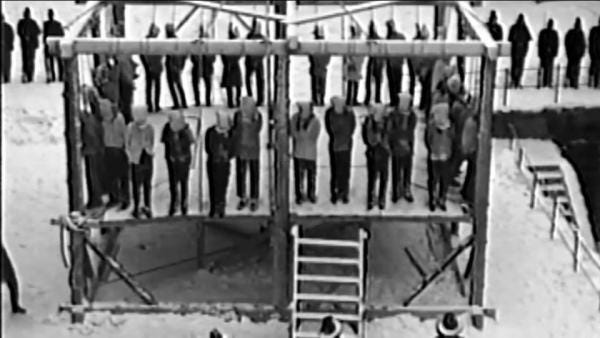
“Ordered that of the Indians and Half-breeds sentenced to be hanged by the military commission, composed of Colonel Crooks, Lt. Colonel Marshall, Captain Grant, Captain Bailey, and Lieutenant Olin, and lately sitting in Minnesota, you cause to be executed on Friday the nineteenth day of December, instant, the following names, to wit… ” – Text from order made by President Lincoln to General Sibley ordering the execution of American Indians in Minnesota.
[President Abraham Lincoln (March 1861-April 1865). Lincoln oversaw the breaking of treaties and the robbing of the Dakotas and other Native peoples of their land, livelihood, and often their lives. And he sent troops to crush their resistance. Lincoln made clear his white supremacist views. Speaking in February 1860, he asked “[W]hy did Yankees almost instantly discover gold in California, which had been trodden upon and overlooked by Indians and Mexican greasers for centuries?” He also argued that phonetic writing was what separated whites from “savages,” and that this ability had given rise to the fruits of civilization—government, culture, etc. In 1863, Lincoln said: “Although we are now engaged in a great war between one another, we are not, as a race, so much disposed to fight and kill one another as our red brethren.”]
[Photo: Lynching of 38 Dakota (Santee Sioux) men, December 26, 1862.]
“I don’t go so far as to think that the only good Indians are dead Indians, but I believe nine out of ten are, and I shouldn’t like to inquire too closely into the case of the tenth.”
Theodore Roosevelt
“All of our people all over the country – except the pure blooded Indians – are immigrants or descendants of immigrants, including even those who came over here on the Mayflower.”
Franklin Roosevelt
“The United States, which would live on Christian principles with all of the peoples of the world, cannot omit a fair deal for its own Indian citizens.”
Harry Truman
“There has been a vigorous acceleration of health, resource and education programs designed to advance the role of the American Indian in our society. Last Fall, for example, 91 percent of the Indian children between the ages of 6 and 18 on reservations were enrolled in school. This is a rise of 12 percent since 1953.”
Dwight Eisenhower
“For a subject worked and reworked so often in novels, motion pictures, and television, American Indians remain probably the least understood and most misunderstood Americans of us all.”
John Kennedy
“The American Indian, once proud and free, is torn now between White and tribal values; between the politics and language of the White man and his own historic culture. His problems, sharpened by years of defeat and exploitation, neglect and inadequate effort, will take many years to overcome.”
Lyndon Johnson
“What we have done with the American Indian is in its way as bad as what we imposed on the Negroes. We took a proud and independent race and virtually destroyed them. We have to find ways to bring them back into decent lives in this country.”
Richard Nixon
“I am committed to furthering the self-determination of Indian communities but without terminating the special relationship between the Federal Government and the Indian people. I am strongly opposed to termination. Self-determination means that you can decide the nature of your tribe’s relationship with the Federal Government within the framework of the Self-Determination Act, which I signed in January of 1975.”
Gerald Ford
“It is the fundamental right of every American, as guaranteed by the first amendment of the Constitution, to worship as he or she pleases … This legislation sets forth the policy of the United States to protect and preserve the inherent right of American Indian, Eskimo, Aleut, and Native Hawaiian people to believe, express, and exercise their traditional religions.” [as he signed into law the American Indian Religious Freedom Act.]
Jimmy Carter
“Let me tell you just a little something about the American Indian in our land. We have provided millions of acres of land for what are called preservations – or reservations, I should say. They, from the beginning, announced that they wanted to maintain their way of life, as they had always lived there in the desert and the plains and so forth. And we set up these reservations so they could, and have a Bureau of Indian Affairs to help take care of them. At the same time, we provide education for them – schools on the reservations. And they’re free also to leave the reservations and be American citizens among the rest of us, and many do. Some still prefer, however, that way – that early way of life. And we’ve done everything we can to meet their demands as to how they want to live. Maybe we made a mistake. Maybe we should not have humored them in that wanting to stay in that kind of primitive lifestyle. Maybe we should have said, no, come join us; be citizens along with the rest of us.”
Ronald Reagan
“This government-to-government relationship is the result of sovereign and independent tribal governments being incorporated into the fabric of our Nation, of Indian tribes becoming what our courts have come to refer to as quasi-sovereign domestic dependent nations. Over the years the relationship has flourished, grown, and evolved into a vibrant partnership in which over 500 tribal governments stand shoulder to shoulder with the other governmental units that form our Republic.”
George Herbert Walker Bush
“Let us rededicate ourselves to the principle that all Americans have the tools to make the most of their God-given potential. For Indian tribes and tribal members, this means that the authority of tribal governments must be accorded the respect and support to which they are entitled under the law. It means that American Indian children and youth must be provided a solid education and the opportunity to go on to college. It means that more must be done to stimulate tribal economies, create jobs, and increase economic opportunities.”
Bill Clinton
“Tribal sovereignty means that. It’s sovereign. You’re a… you’re a… you’ve been given sovereignty and you’re viewed as a sovereign entity.”
George W. Bush
“We also recommit to supporting tribal self-determination, security, and prosperity for all Native Americans. While we cannot erase the scourges or broken promises of our past, we will move ahead together in writing a new, brighter chapter in our joint history.”
Barack Obama
“You were here long before any of us were here. Although we have a representative in Congress who they say was here a long time ago. They call her ‘Pocahontas.’
Donald Trump
“The federal government has long broken promises to Native American tribes who have been on this land since time immemorial. With her appointment, Congresswoman Haaland will help me strengthen the nation-to-nation relationship.”
Last week, we asked Native News Online social media followers how they celebrate the Fourth of July as Native Americans.
Read on to see how Indian Country is celebrating the Fourth of July, and be sure to follow us on Facebook, Twitter, Instagram and LinkedIn.
The following answers have been published as written.
June 2, 1924 is when Native peoples were granted US citizenship. To me the 4th of July is like Cinco de Mayo — a way for humans to make money.
— Melanie Tallmadge Sainz
This native Veteran enjoys duel citizenship, I will respect both defend both until the day I die, ask my dad, Ira Hayes, our beloved, Navajo code talkers, how they feel… learn from out tragic history don’t repeat it and look forward with open heart and mind. Former chairman of my beloved Suquamish People.
—Lyle Emerson George
I don’t get patriotic, given our history with America. I enjoy fireworks so I make it out to see them but that’s about it.
— Monica Lazur
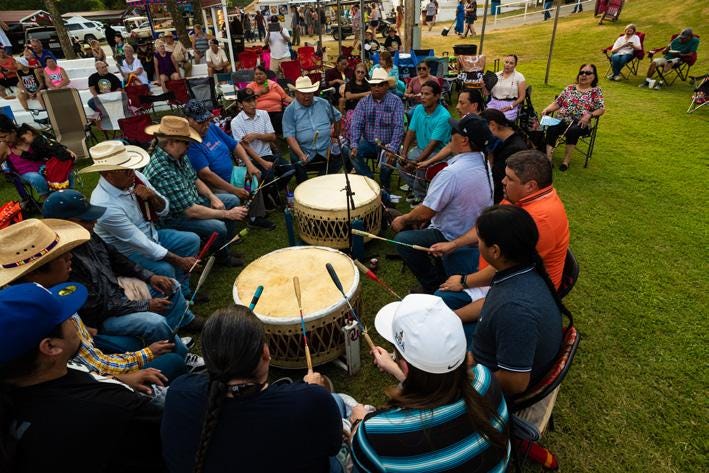
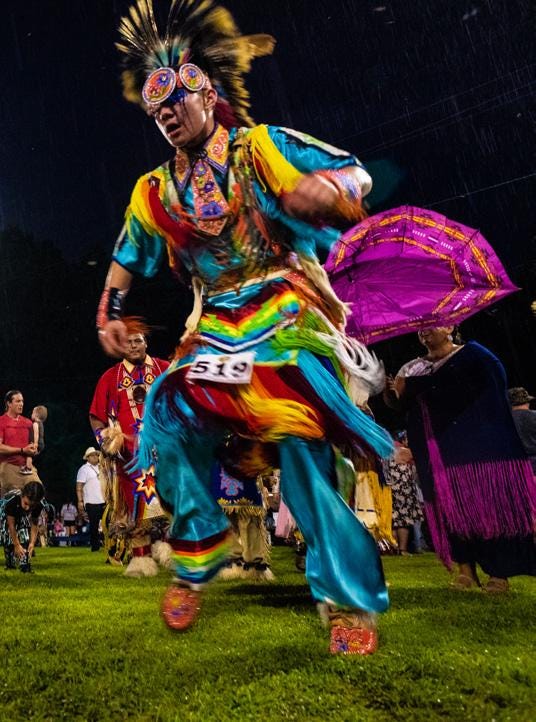
We have a big powwow at Ft. Duschene that weekend every year!
— Erin Cahill
July 6 1889 Miskwaagamiiwi-zaaga’igan signed for Sovereignty. Their celebration is one of the Best I’ve ever seen.
— Monika Brunner
I just treat it like any other day off from work. Go boating with family, motorcycling, roping and a day to get away. And eat! Steaks! Crawfish!
— Austin Mix
I respect those that do celebrate it but I’m not “patriotic “ per say. Usually we go to a powwow.
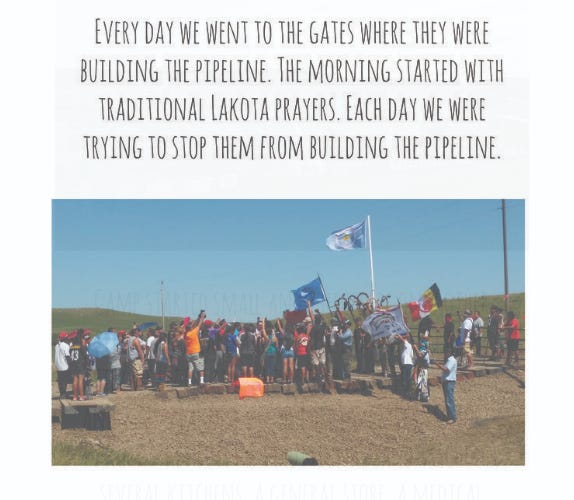
I plan on finding a peaceful demonstration in a larger community to be a part of. Afterward you can celebrate the hard work and survival of you and your ancestors with your own fireworks.
— Nicoli Poitra
151st Quapaw Nation Powwow.
— Mary Wheeler-McCarty
I don’t. Only Earth Day, Indigenous People’s Day, summer and winter solstice, and Juneteeth.
— Apak T Hill
We don’t celebrate the creation of the country illegally occupying our land.
I only celebrate June 2. Day of Indian Citizenship Act. I’ll think about celebrating a different day when they honor the Fort Laramie Treaty.
— Bunny Vardanega
I don’t. So called independence day didn’t apply to us, and still doesn’t. This does not mean that I don’t support military personnel. They have my utmost respect and I honor them year round for their service to people.
— Sibyl Enciso Esquivel
Not a special day to me (at over seven decades of age), we celebrate our warriors on Vets Days too but this day seems to be in honor of the whole notion of it’s birthday and independence from their mother country of europe. We (Native/Indigenous People) don’t have any connections to that “independence” at all. It does remind us that their arrival that destroyed us almost completely.
— Berni SantaMaria
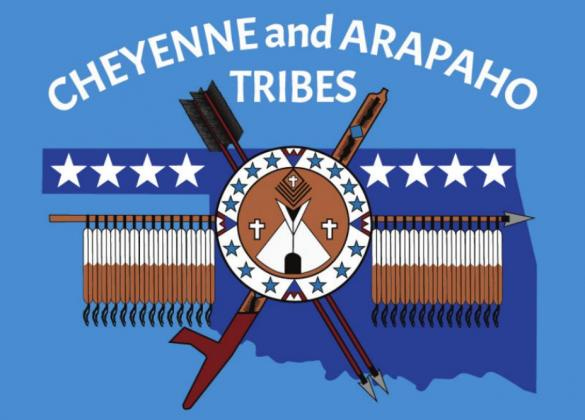
Southern Cheyenne and Arapaho celebrate the new year at this time after ceremony.
— Abigail Wilson
Why celebrate a colonizer’s holiday? The government and the millions of its non-indigenous peoples that live in our lands don’t respect us. Our treaties have yet to be fulfilled. I personally don’t celebrate anymore. Just another day.
— Tÿłēr Brïdgę
Cree singer-songwriter Buffy Sainte-Marie singing, “Now that the Buffalo’s Gone.”
Lyrics:
Can you remember the times That you have held your head high? And told all your friends of your Indian claim Proud good lady and proud good man Your great-great-grandfather from Indian blood sprang And you feel in your heart for these ones Oh it’s written in books and in songs That we’ve been mistreated and wronged Well over and over I hear those same words
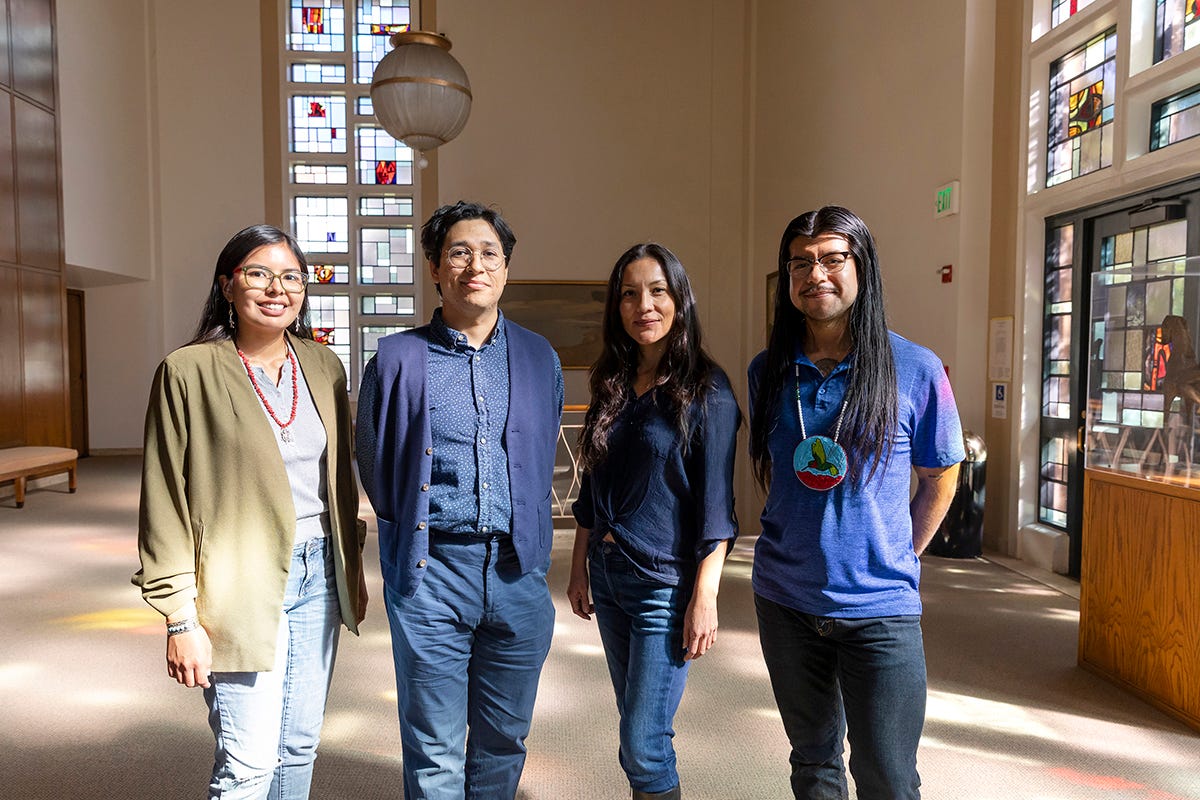
[Photo: From left: Graduate students Sierra Edd, Everardo Reyes, Lissett Bastidas and Valentin Sierra are in the Indigenous Sound Studies working group on campus. Reyes and Edd started the group in 2020 to make a space for Indigenous scholars to talk about the intersection of sound, law, performance, gender, sexuality and other areas of study. (Photo by Brittany Hosea-Small)]






 Paul Haeder, Author