all pretentions aside, yep, I was just there, on the edge, an almost almost-made-it-going-concern, and here I am, age 26 to 66, like some weedy and trash strewn lot ready for, paving over
“The changes I’ve seen in my lifetime should normally take a couple generations. Where I used to go out hunting with my .22 now is endless miles of subdivision.”
— Charles Bowden
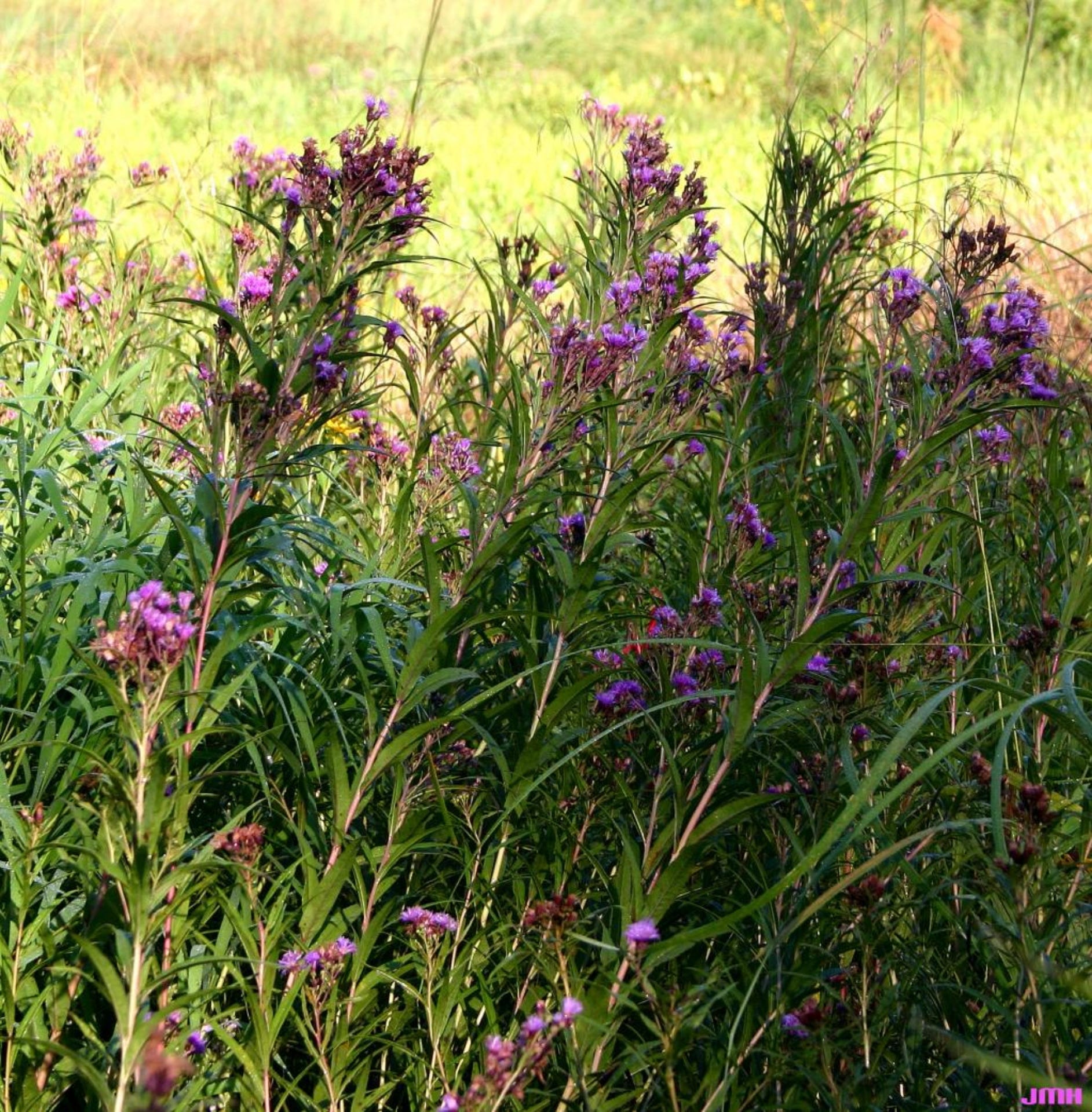
Me, ironweed:
Okay, okay, a bit dramatic, but, still, these are some fucked up times, sisters and brothers, man-oh.
I was just hitting the beach here in Waldport, talking to the sky and seals, and then Toothless in Wisconsin on the mobile phone. He promises me a wrap up of his rare time out from his current shut-in experience he is travailing under, missing a deceased wife, nursing a cut-off finger, talking to the walls, the mice and the Weiner dog, Elldee, as well as still waiting for a probabtion officer, and still on paper after three years of good times and good behavior. That was last night, so stay tuned.
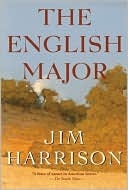
On the walk, I stopped by our Little Free Library, and picked up two books, including Jim Harrison’s The English Major. Then the juices started flowing. Volcanic, because before Toothless in Wisconsin, I had a talk with my Canadian friend fighting for a divorse and prosecution of her battering husband. Her eyes have finally opened, so the world is now back on track — she knows she has to fight for EVERYTHING, and that includes her self-determination and friendships that might be not worth the grief.
Here, a look at the book: on The English Major, a novel by Jim Harrison reviewed by Ron Slate
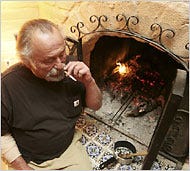
In a New York Times interview last year, Jim Harrison told Charles McGrath that he wrote The English Major at top speed – even though he rationed himself to one page per day. “My mind can’t stop running fictively,” he said, a comment not just about his continuous productivity. Prizing authenticity and the instinctive life, Harrison seems to have slammed all the distracting doors in the corridor between his psyche and his writing. His sentences are spoken, their pauses not governed by commas as much as by the using-up of breath. Since Harrison, now 70, is still a loyal American Spirit smoker, those breaths measure out a pared-down, unwasteful speech in which the materials of the novelist’s life – aging, affinity for the animal and the land, food and sex, living with loss – can’t stop running towards their renewed appearance in language and story.
The narrator of The English Major, Harrison’s fifteenth book of fiction, is a 60-year old Michigan cherry farmer named Cliff who has been abandoned by his wife Vivian at a high school reunion. Cliff had taught English and history at that school before taking over his father-in-law’s farm (“This man was a big strong asshole and had gone to glory from a heart attack trying to carry a hundred pounds of perch fillets and ice from a cabin to the pickup”). Vivian went into real estate – and with their separation, arranged to have the farm auctioned off. Cliff’s pending homelessness doesn’t seem to bother him until the death of his dog: “I took to drink which had never been a big item in my life … quitting two weeks ago after I thought I ran over our dog Lola.” But 14-year old Lola has died anyway “with a half-chewed gopher in her mouth.”
It’s as if this story is being told to Lola’s abiding ghost, riding shotgun in his 13-year old Ford Taurus since Cliff has decided to tour the USA with his meager payout from the farm sale. He’ll not only travel, but execute a project: renaming the states and the state birds. Lola has been the most companionable and reliable female presence in his life, and memories of her flare up throughout the novel. This makes the reader (the listener) an equivalent of the dog — slow to criticize, empathetic, familiar with basic instincts, and unfussy about language. Cliff is comfortable with us — and that makes for flattery. We’re taken in. The English Major is a road novel, and each chapter (titled by the state visited) is told perhaps at some moment of rest at the end of the day or while Cliff is driving the backroads or highways from upper Michigan, through the upper Midwest to Montana, Idaho, Oregon, California, the southwest, and ultimately back to Michigan.
Cliff’s speech is occasioned by the sudden dismantling of his way of life. In Wisconsin he takes pictures of cows and remarks on the pastureland. But in Minnesota he meets up with Marybelle, a 43-year old former student with bipolar streakiness. The first sentence of “South Dakota” reads, “As we crossed the state line of south Dakota below Fort Yates Marybelle joked that I sounded like I had been in long-term parking for twenty-five years” – meaning he sounded worn, his mind slowed. But what the reader hears from Cliff is something closer to Marybelle’s own talkativeness – aimed at Cliff and her cell phone:
“These empty western areas are bad for cell phone reception so I said I’d try to park on a hill, and if that didn’t work when we reached a good-sized town I’d park and go into a diner for coffee and a piece of pie and she could chatter to her heart’s delight. ‘I don’t chatter,’ she said. ‘I exchange survival information with friends.” ‘‘What are you surviving?’ I stupidly asked. ‘‘Life itself. Marriage. Children. My stunted growth as a human.’ ‘You seem real lively to me,’ I offered. ‘You’re seeing the best side. You draw out my best side. You were my favorite teacher. You mentored me.’”
Much like Harrison, Cliff moves easily from the raunchy to the literary. “Marybelle had also made the slightest apology for her concern about our age differences and said, ‘There are miracle drugs that can keep a man active until he’s a hundred.’ While looking at the Pacific I laughed imagining myself a wizened flying squirrel hurling myself on unsuspecting women while aiming my boner before I leapt.” Three pages later, he’s talking about Dostoevsky and Jack London.
Harrison said that Cliff represents “all those preposterous people who major in English in college.” Cliff’s state-bird-naming project may be preposterous in one sense, but in another it stands for an idiosyncratic truth in the man. Cliff isn’t drawn as preposterous, just at a loss (but not for words). About his marriage he reflects, “Maybe we were just another couple who faded late in the game. I didn’t offer her a lot in my back-to-nature binge after I quit teaching. We English majors of a serious bent are susceptible to high ideals we paste on our lives like decals.” Nevertheless, the narration is salted with oddball references (thus sounding astute) to Joyce, Emerson, Nabakov, Thoreau, Wolfe and Woolf, Dickens, Shakespeare, de Toqueville, Byron, Whitman, Eiseley, Spenser, Hemingway, Genet, Ionesco, Dickinson, Henry Miller, Millay, Frost, Sandburg, Benet, EA Robinson, Hart Crane and Wordsworth. In a Salon interview, Harrison said, “Fiction writers tend to err either making people more than they are or less than they are.” In this novel, he seems to have hit on a workable mix.
Cliff knows that desire dies quickly and routine takes its place. His road trip becomes a routine of desire. Marybelle is a sexual windfall – but the flux of her emotions and conversation soon has Cliff yearning for solitude. His gay son Robert, a site scout for Hollywood films, lives in San Francisco, the halfway mark of the novel. Here the Marybelle episode subsides and is replaced by adventures at a snake farm in the southwest (where Harrison spends his winters). There Cliff meets up with his friend AD (alcoholic doctor) who tells him, “You’re trying to start a new life at age sixty, which is also impossible. You can only try variations on your common theme.” In the end, the trip is an abbreviated circle – but Harrison spares us from a too-comfortable resolution (perhaps just barely).
Lust, fishing, diners, waitresses, animals, memory of youth and marriage, birds, rivers, backroads, burgers, drinking – these are Cliff’s materials. Harrison’s timing is perfect, the plot often very comical, and the pace constant. Cliff’s doubts are poignant and round him out (while suggesting a thought that perhaps has flickered across Harrison’s mind from time to time). Cliff has a habit of wandering out into the landscape and encountering harsh weather or circumstances. Harrison juggles a sincere appreciation for Emersonian self-reliance and nature with opposing worries. Cliff says, “I couldn’t get rid of the idea that nature had had too much effect on my abilities to pan out in the world. I was an old baloney bull who favored the far corner of the pasture where it merged into the forty-acre woodlot. A baloney bull is one that has out-aged its effectiveness. You cart it into the slaughterhouse where it’s turned into low-rent cold cuts.
Harrison told Charles McGrath, “One’s work is a building and everything else in the literary life is just scaffolding. The building either stands or not. The literary world, whether New York or Paris or London, is chock full of esteemed nullities.” It’s not the nullity (of which there’s a lot in his novels) but the pretension of esteem that turns off Harrison. The English Major only confirms my esteem for his novels – and the leveling experience, the sensation of cutting through thought-clutter that comes from hearing Harrison’s language and guides the reader to an appreciation that Harrison would seem to consider more proper.
[Published by Grove Press on October 7, 2008, 272 pages., $24.00 hardcover]
So, Harrison was in Arizona and Montana, and then my Toothless in Wisconsin’s love of Chuck Bowden just pops out. Harrison and Bowden, pals. Yep, Arizona, Patagonia, Tucson, all of it, I know it, like the liver spots on the back of my hand: me in my vibrant reckless (controlled, really, so don’t tell anyone) youth in those hills, running with my two German shepherds while the mountain lions were lurking about. Javelina and plethora of deer and so many other animals, man, this little bit of paradise, 1970-ish. Rattlesnakes and shards from Indian pottery and skies, man, and floods and endless sun.
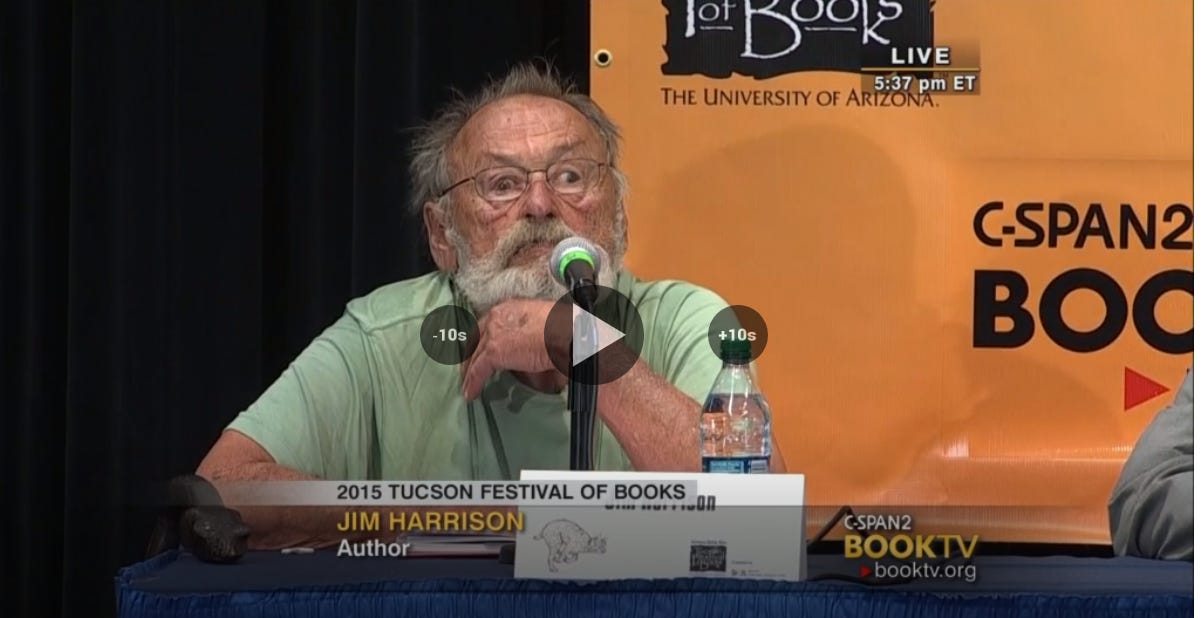
Hit hour 4:30:00 for old man Jim Harrison talking about Charles: C-Span!
Here, that interview of Harrison, on the talk above:
Authors Chuck Bowden and Jim Harrison were a lot more than close friends. They walked, drank, smoked, hiked, and endlessly talked politics, writing and nature together. Beyond that, Bowden spent the last six summers of his life resting, writing, birdwatching and cogitating on Harrison’s spread along Sonoita Creek outside the town of Patagonia while Harrison and his wife fled to Montana to escape the heat.
Harrison, now 77, is scheduled to talk about Bowden’s literary legacy at a March 15 panel discussion at the Tucson Festival of Books. Like Bowden, Harrison is intensely prolific, having written more than 30 books, mostly poetry collections and novels, including his just-released “The Big Seven.” Both men’s work have been compared to Hemingway’s. Both have, or in Bowden’s case had, a taste for wine, cigarettes and the outdoors. Both possess an innate tendency to speak their minds with no compromise.
An Outside Magazine writer described Harrison back in 2011 as “seeming less like a man to me than a force of nature with a Pancho Villa mustache.” Here, the forceful Harrison remembers a friend of 20 years.
Q. How did you meet him?
A. I met him at Doug Peacock’s house (Peacock, the real-life role model for George Hayduke’s character in Edward Abbey’s “The Monkey Wrench Gang,” is an author and naturalist). It was well before we moved to Patagonia from Michigan. Peacock lived on the west side of town, off Ina Road. I was friends for years with Peacock, who showed up at my house in Michigan once and we just hit it off. When I got out here we started doing a lot of camping together. (Peacock now lives only four months of the year in the Tucson area and the rest of the time in Montana.)
Abbey was there, and he and Chuck argued at each other all the time, usually about matters most people don’t care about. My first impression of Chuck was that he was very, sort of abrasive, but I found that to not really be true. That was just his manner, as you know.
Q. What do you mean?
A. All of us disagree with everyone, which I enjoy. So much of our culture, when people don’t ever disagree, sometimes we’re so boring. Chuck would really let go.
Later, after I moved out here, I’d go over to his house where he and Mary Martha (Mary Martha Miles, Bowden’s partner for more than a decade in the 1990s and 2000s) lived. We would have a drink, eat lunch and walk with the dog. We became good friends pretty, pretty fast. We had so many of the same interests — literature to the desert to having a drink now and then.
Q. What was it you liked about him?
A. His way above-board curiosity, his intense curiosity, his willingness to talk about what everybody apparently thinks is too raw or difficult to talk much about. I mean the border and so on. I don’t see anything wrong with an open border myself. In general, Mexicans have been a tremendous boon for America.
Q. How would you rank him in the pantheon of writers, Southwestern and otherwise?
A. He ranks way up there. I was disappointed that in his death, he got all this talk that really should have come to him when he was alive. Quite often that happens — sometimes the only way to make an extra buck is to die. There’s a sad, abrupt popularity in dying.
Q. Your view of his writing.
A. I thought he wrote beautifully and vividly. You were always sort of spellbound when you read anything of Chuck’s. At least I was and I’m spoiled. He had a curious interest in poetry. I’m a poet, too, and for some reason he started reading poetry and he was pretty interested in the subject — suddenly one day he started asking me why I bother writing poetry …
He certainly had this all abiding interest in everything, which you don’t find to be true of people or writers in general. They are often bored at everything but themselves.
Q. Do you have a favorite book of his?
A. Not specifically. I just concentrate on all the border stuff. I don’t know that he was very optimistic along those ways (about the border). How can people comprehend 5,000 murders in one year in a not very big city (Juarez, the subject of much of Bowden’s early Mexico reportage)? We lost so many people. The cartels were offering jobs with benefits, which is ironic.
Q. So he was pessimistic about the border.
A. I think he was pessimistic about everything. I would say that the healthiest people I know are hopeless about everything. He was certainly full of subdued rancor about everything. We used to have a talk about the point of how do you spend billions on Afghanistan, and not a lot on Mexico?
Q. How did he come to spend summers at your place?
A. He liked it down here. We were gone in the summer and we don’t rent it. He would come here and go to Nogales and buy 10,000 tripe and feed the ravens. Then he put a dozen hummingbird feeders out here and had 1,000 hummingbirds.
It’s sort of a unique property — a number of acres on the creek, which flows the year around and draws a lot of wildlife, including mountain lions. They killed a big deer in front of us last year. There are grasslands, woods, the creek and a lot of willows and cottonwoods. A riparian thicket.
Q. He always had a thing for birds and there are a lot of birds down there.
A. This area is such a good flyway for every species. There’s an awful lot of warblers — he saw six in one willow bush once. My mother was such a good birdwatcher. She was here and saw 119 species in one weekend from the patio.
Q. Did you two talk much about the environment (Bowden’s most-reported-on topic until he started on the border and Mexico)?
A. We talked constantly about the environment. We were both habitual walkers. The dog required me to take a habitual walk every morning. Interesting, Chuck was sort of a modern Thoreau. He’d say, ‘Please, don’t bullshit me’ right from the start. You would wonder if anyone could have a lower view of politics than Chuck.
When he and I were down here at the same time, we’d walk on my property. My property — I’m encircled by the Circle Z Ranch property. I have a deeded right to walk all the Circle Z land. That whole stretch of woods from there down to the conservancy property (the Nature Conservancy’s Patagonia-Sonoita Creek Preserve) is luscious. We would walk an hour or so, then go have a drink. Something about walking frees your mind.
Q. What do you hope that people who come to your panel will take away from it?
A. I don’t know if I’d expect people to get anything, except a curiosity about Chuck and his work.
It is a discordance I bring up Chuck and Jim, because I was just hitting the beach to clear the mind from the mindlessness, and to fragment a new blog based on some conversations I’ve had lately.
What is the meaning, then, of all these great pretenders pretending to be the social workers and non-profit gurus to end all gurus? I have a friend whose friend is in a Muslim country, and her job is got something to do or some such thing about housing. The French are there, and the country is in religious holiday spirit, so the office is closed, but the French and the diplomats get carte blanche diplomatic immunity, and with that come cases of the finest wine and booze. Partying all night long, into the morning. Booze, cigarettes, blue jeans and revealing blouses for women, behind those walls.
These non-profit expoiters are just that — lost, exploitation experts, post-post colonial brainwashed fools.
Simone de Beauvoir once said: “It is in the knowledge of the genuine conditions of our lives that we must draw our strength to live and our reasons for acting.”
Prospero, you are the master of illusion. Lying is your trademark. And you have lied so much to me (Lied about the world, lied about me) That you have ended by imposing on me An image of myself. Underdeveloped, you brand me, inferior, That s the way you have forced me to see myself I detest that image! What’s more, it’s a lie! But now I know you, you old cancer, And I know myself as well. ~ Caliban, in Aime Cesaire’s A Tempest
One way the heads of these foundations maintain this control is by choosing which political and economic projects they put their money toward. Foundation staff determine the criteria for which organizations receive their funding, allowing them to pick the causes that become better resourced. However, for the most part, foundations are not representative of the communities most impacted by inequity. A 2014 study found that white people comprise 91% of foundation executive directors, 83% of foundation executive staff, and 68% of program officers. This lack of diversity shows in how foundations give their money — the same study found that only 7% of foundation grant giving went toward nonprofits that explicitly serve people of color.
Again, from beach to busted friend on the phone, Toothless in Wisconsin, and here we are, in the same dead end cancel-deplatforming-censoring-evil place, 2023, where the attention spans are the dirty tricks of the sociologists, marketers, entertainment complex, education complex, psychologists and the overlords of capital infecting all over out lives.
It just comes down to so many different languages and frames, man. The obvious is why would Pakistan need or want a white woman with six languages on her forked tongue and a Canadian background to swoop in and “solve” anything?
Incite, a network of radical anti-state violence activists, convened a conference to detail this relationship in 2004, titled, “The Revolution Will Not Be Funded: Beyond the Non-Profit Industrial Complex.” Incite had been grant-funded by the Ford Foundation— funding Incite lost because of its support for Palestine.
As outlined at the conference, nonprofits that depend on corporate and foundation funding do so often to the detriment of their missions. Time and energy is spent laundering the reputation of corporate funders, for example, rather than on their stated purpose. Or, rather than building mass movements, talented organizers get funneled into staff and admin jobs just to keep the charity running. In other words, as was said at the conference, the nonprofit-industrial complex model encourages “social movements to model themselves after capitalist structures rather than to challenge them.”
James Petras makes the same arguments against this new colonialism in his 1994 essay “NGOs: In the Service of lmperialism.” Petras notes that despite claiming to be nongovernmental organizations, they actually support government interests. NGOs, he writes,
“receive funds from overseas governments, work as private sub-contractors of local governments and/or are subsidized by corporate funded private foundations with close working relations with the state …. Their programs are not accountable to local people, but to overseas donors who “review” and “oversee” the performance of the NGOs according to their criteria and interests. The NGO officials are self-appointed and one of their key tasks is designing proposals that will secure funding. In many cases this requires that NGO leaders find out the issues the Western funding elites fund, and shape proposals accordingly.”
“Progressive NGOs use peasants and the poor for their research projects, they benefit from the publication-nothing comes back to the movements not even copies of the studies done in their names! Moreover, peasant leaders ask why the NGOs never risk their neck after their educational seminars? Why do they not study the rich and powerful-why us? … The NGOs should stop being NGOs and convert themselves into members of socio-political movements …. The fundamental question is whether a new generation of organic intellectuals can emerge from the burgeoning radical social movements which can avoid the NGO temptation and become integral members of the next revolutionary wave.”
So, my friend’s friend is a lost child, and being Western, Canadian, and surely quasi-feminist, she seems incapable of working with labor, and she’s at a loss for words about Pakistan and the issue of hiring on female staff.
Jesus Fucking Christ, get to work, woman. Listen and learn, and reach out: “Professor one of the 100 most influential Pakistani Women.”
Warwick University law professor Shaheen Ali has been named one of the 100 most influential Pakistani women in a list titled ‘Women Power 100’.
The list is intended to recognise the achievements of Pakistani women that, over the course of the last 60 years, “broke records, broke ground, blazed trails… in a male-dominated world”.
Other notable figures included in the list are Fatima Bhutto, the famous writer, poet and activist, and Baroness Warsi, who sits in the House of Lords.
Prof. Ali has been recognised for her work in the field of human rights.
Get to work and stay away from the booze, girl:
TUSCALOOSA, Ala. (WBRC) – A group of educators from Pakistan came to Tuscaloosa for a cultural exchange. They’re here to learn how women are succeeding in the field of higher education. The University of Alabama and University of Utah partnered with more than a dozen universities in Pakistan. Part of the partnership involves developing women leaders.
WBRC caught up with the group when it visited Stillman College. It’s made up of 25 women from Pakistan who are faculty, department chairs or deans at the colleges they represent. While here, they learned about Historically Black Colleges and Universities. Women who are leading at Stillman and Alabama offered suggestions that could help their Pakistani counterparts better address disparities in higher education that have held women back and make schools more inclusive.
Stillman’s President, Dr. Cynthia Warrick, is the first female president in that school’s history.
“They also wanted to learn about my leadership path as a female leader in higher education. Understanding what kind of barriers or challenges did I have to overcome to get where I am today,” explained Dr. Cynthia Warrick.
The group learned the importance of mentorship and setting up systems able to support women as they advance in higher education in Pakistan.
“The encouragement from the faculty members, especially the female faculty members from the very beginning, to involve them in the leadership positions so that they are prepared for the higher leadership positions in academia.” Professor Asma Hyer said.
Susan Carvalho, UA’s Dean of Graduate School, said they’re happy to exchange ideas and history of how women have overcome challenges, especially in areas that have been majority male over the years. They’ll take what they learned during this visit back home to Pakistan later today.
Goddamn, get to work: Shit, there’s even an email, man!
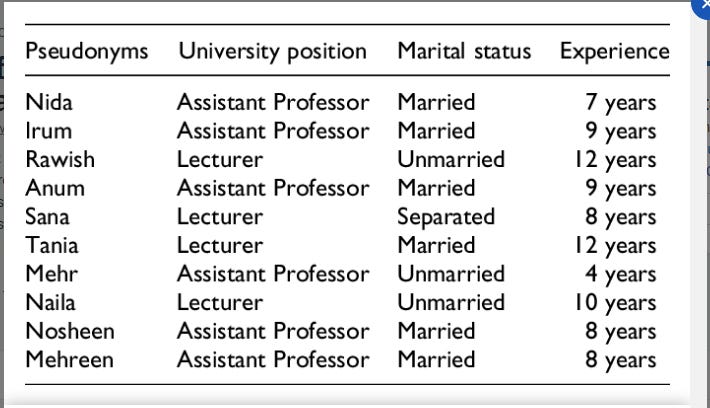
Work–life balance in the context of this paper means keeping a balance between home and workplace responsibilities and roles. In more traditional societies, such as in Pakistan, working women often find it difficult to keep a balance between their responsibilities in the workplace and their home responsibilities. This paper is based on findings from a qualitative research study that explored the perceptions of working women regarding their home–work responsibilities and how these impact their lives. Data were collected from 10 female academics working in a university in the north of Pakistan, using semi-structured interviews. Thematic analysis was used to analyse the data. Findings reveal that most women academics find it challenging to keep a balance between their home and workplace responsibilities. Participants faced a range of problems both at home and in the workplace that impacted their life in both places. These problems included lack of support and facilities at home and in the workplace. These problems, however, did not seem to deter them from carrying on with their work–home responsibilities. Some of the strategies the participants adopted to keep this balance included separating and scheduling home–work time, securing support of the family and utilising time in the workplace more productively. The downside of this, however, seemed to be that these women academics found little time for themselves as leisure time or time entirely devoted to their own mental and physical wellbeing. The research has important implications for working women, their employers, families and policy makers in Pakistan and other societies with similar contexts.
In any case, all of this is just a minor bump in my road, wherein I know I have lost all my callings, lost all my agency to be of service to people, including highfalutin women like the one in question.
Work hard, man, and realize this is it, the one life in balance, and nothing else, and if booze and beauty and big time networking are the goals in Pakistan, then you are the enemy, the problem, no solution or even a needle nudge in the right social justice direction. The opposite, that is.
Get to fucking work, you non profit industrial complex Eichmman.
Feb 12, 2018: On Sunday, in Lahore, Pakistan, the world-renowned Pakistani human rights lawyer and activist Asma Jahangir died suddenly at the age of 66. For decades, Jahangir has been a leading advocate for women, minorities and democracy in Pakistan. In 1983, she was imprisoned for her work with the Movement to Restore Democracy during the military rule of General Zia ul-Haq. Later, in 2007, she was put under house arrest for helping lead a lawyers’ protest movement that helped oust military leader Pervez Musharraf. As one of Pakistan’s most powerful lawyers, she founded the country’s first legal aid center in 1986, served as the first female president of the Supreme Court Bar Association of Pakistan and was the U.N. special rapporteur for human rights, extrajudicial killings and religious freedoms. Democracy Now! interviewed Asma Jahangir in 2007 and 2016. Click here to watch Asma Jahangir’s full speech when she accepted the Right Livelihood Award in 2014. For more on her extraordinary life, we speak with her close personal friend, Tufts University professor Ayesha Jalal.
Oh well, back to Harrison and Chuck. Just another tangent, man, on a Saturday, on the Central Coast of Oregon, sunny, hard winds, cool and warm at the same time, and cleanest air in the world right now!
“It’s impossible to live in this town without a sense of guilt, without a sense that you’re failing; that you’re going to have to answer to someone someday. That nobody will ever accept your explanation of why you let this obliteration of such a beautiful place occur. You’re like a beaten person half the time and an enraged warrior the rest of the time. My glass is always half full; I may not like to drink but at least it’s half full.”







 Paul Haeder, Author