
forty hard years of lobotomizing, dumbdowning, infantilizing, and PSYOPS direct and covert operations by the Edward Bernays of the World have gotten us here:
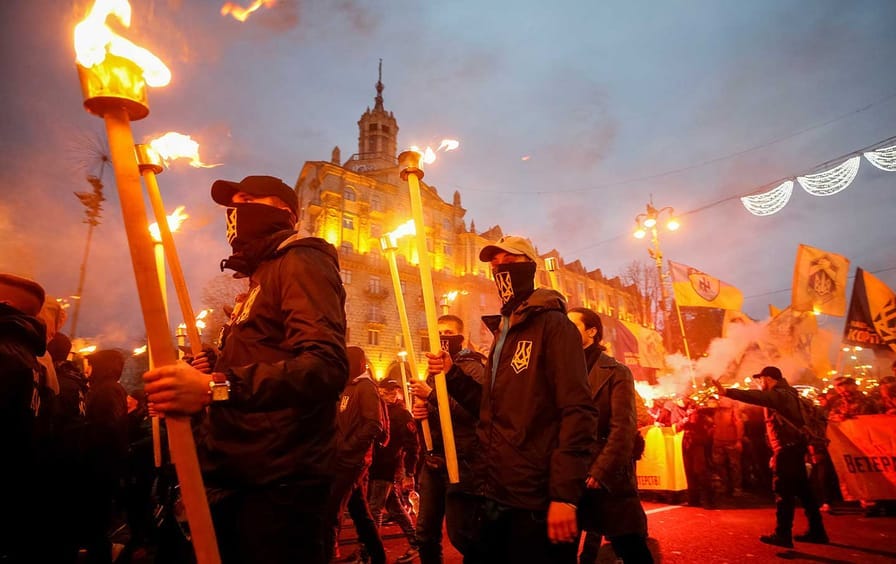
Trillions for Ukraine. Christ, this is 2019, from The Nation, not exactly radical: “Neo-Nazis and the Far Right Are On the March in Ukraine/ Five years after the Maidan uprising, anti-Semitism and fascist-inflected ultranationalism are rampant.” By Lev Golinkin
Versus, Covert Action Magazine’s piece titled:
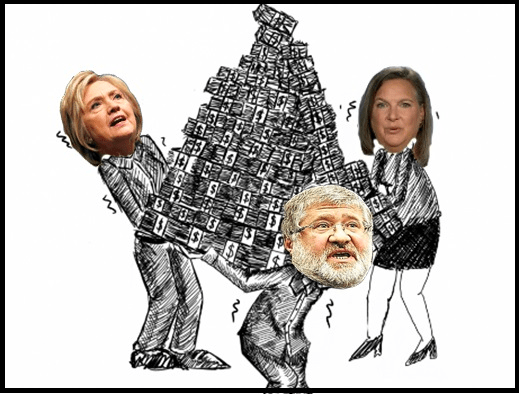
Before the Russian invasion, CIA reports linked him to an oligarch so dirty and so mired in “significant corruption” that the State Department banned him from entering the U.S.
But now CIA propaganda portrays Zelensky as nobler than Winston Churchill and saintlier than Mother Theresa.
Will the Real Volodymyr Zelensky Please Stand Up
Sorry, but it does matter who controls the levers of power, the narrative, the engines of Press-Propaganda-Entertainment. As well as, politics, marketing, education?
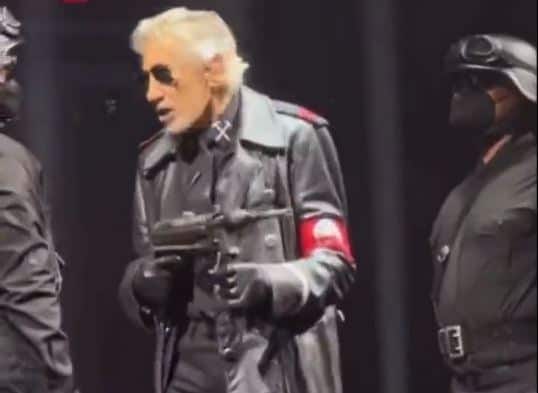
Jews will attack Roger Waters, of Pink Floyd, and they will get countless thousands of lies published in countless broken media outfits immediately. Just Google-Gulag search: Roger Waters and Berlin Fascism. Hate, pure lies, and the hasbara and powerful Jewish hatred of thinking.
Israel’s foreign ministry later criticized Waters on social media, tweeting on May 24: “Good morning to everyone but Roger Waters who spent the evening in Berlin (Yes Berlin) desecrating the memory of Anne Frank and the 6 million Jews murdered in the Holocaust.”
I am sorry to say that the Jewish folk I have been reading about, listening to, and researching throughout my decades, even from day one of college onward are indeed a clear and present danger. They hate Russia, Russians, and anyone who might dare question the UkroNazi Proxy War with Russia, started, oh, hell, way before 2014.
Self-proclaimed Jewish criminal, Kolomoyskyi is the dirty banker and the dirty funder of Zelensky:
But, read this Jewish rag in Isra-Hell, Haaretz | World News/ “Ukraine Enlists Jewish Leaders to Lobby Israel for Arms”
Ukraine recently requested air defense systems and training from Israel, saying that Iran would use the deployment of its weapons systems in Europe to refine their capabilities. Still, Israel maintains that it would not send military assistance to Ukraine
A senior Ukrainian official close to President Volodymyr Zelenskyy called on world Jewry to push Jerusalem to arm his country with defensive weapons on Wednesday, only two days after Moscow warned Israel that supplying military equipment to Ukraine would “destroy the political relations between the two countries.”
Of course, I am disgusted by any racist group calling on “all Jews worldwide to continue the murder of Russians and Ukrainians in Donbass, and now, throughout Ukraine and into Russia.
This is merchant of death war mongering, and it has to stop, stop first by calling a Jewish Fascist a Jewish Fascist when you come in contact with him or her or them: Here, more lies, blatant valorizing of a corrupt and criminal man, Zelensky!
1. The most important Jewish leader in the world (source)
The past week has turned us all into experts on Ukraine, now at the center of every conversation. Did you know how big it is? (When you lay it over the U.S. map, it stretches from New York to Chicago.) Who knew that we were actually using the Russian city names and not the Ukrainian ones (it’s Kyiv, not Kiev; Lviv, not Lvov; and Kharkiv, not Kharkov). And their president—did you know that he is Jewish?
Volodymyr Zelensky is probably the most admired Jewish leader the world has to offer right now. Before entering politics in 2018, Zelensky was a popular comedian (and you can’t get any more Jewish than that); he does not often speak about his Jewish identity, but he has never tried to hide it. In a country like Ukraine, which is still struggling with a painful legacy of antisemitism, Zelensky’s Jewishness has always been present.
For Jews across the world, Zelensky is now a source of pride: a young, inexperienced leader who is putting his life at risk for his people by leading a nation of 40 million people in opposing a ruthless Russian aggressor.
In his inauguration speech, Zelensky famously told lawmakers not to hang his portrait on their walls. “I do not want my picture in your offices: The president is not an icon, an idol or a portrait. Hang your kids’ photos instead, and look at them each time you are making a decision.”
True to form, Zelensky maintained his unassuming, direct style when crisis hit. His video messages, posted several times a day, have been helping reassure the Ukrainian people. He spoke from his office and from the streets of Kyiv, even as Russian troops closed in on the capital, and when the fighting intensified, Zelensky candidly shared with all Ukrainians the fact that he has been marked by the Russians as “target number one” and that his family is “target number two.” But when the U.S. offered to evacuate him from Kyiv to somewhere safer, he responded: “The fight is here; I need ammunition, not a ride.”
I’m writing this column on Sunday, as Russian forces, bogged down and weakened by courageous Ukrainians armed with AK-47s, Molotov cocktails, or sometimes just a large pole they picked up on the side of the street, still threaten the capital. Zelensky is leading the effort to save his nation, though most foreign intelligence services still think he’s fighting a losing battle.
So, this piece of shit Ukraine and Zelensky and the US and UK, with their Kill List, all brains have been thrown out the window, or the voice of reason is where?
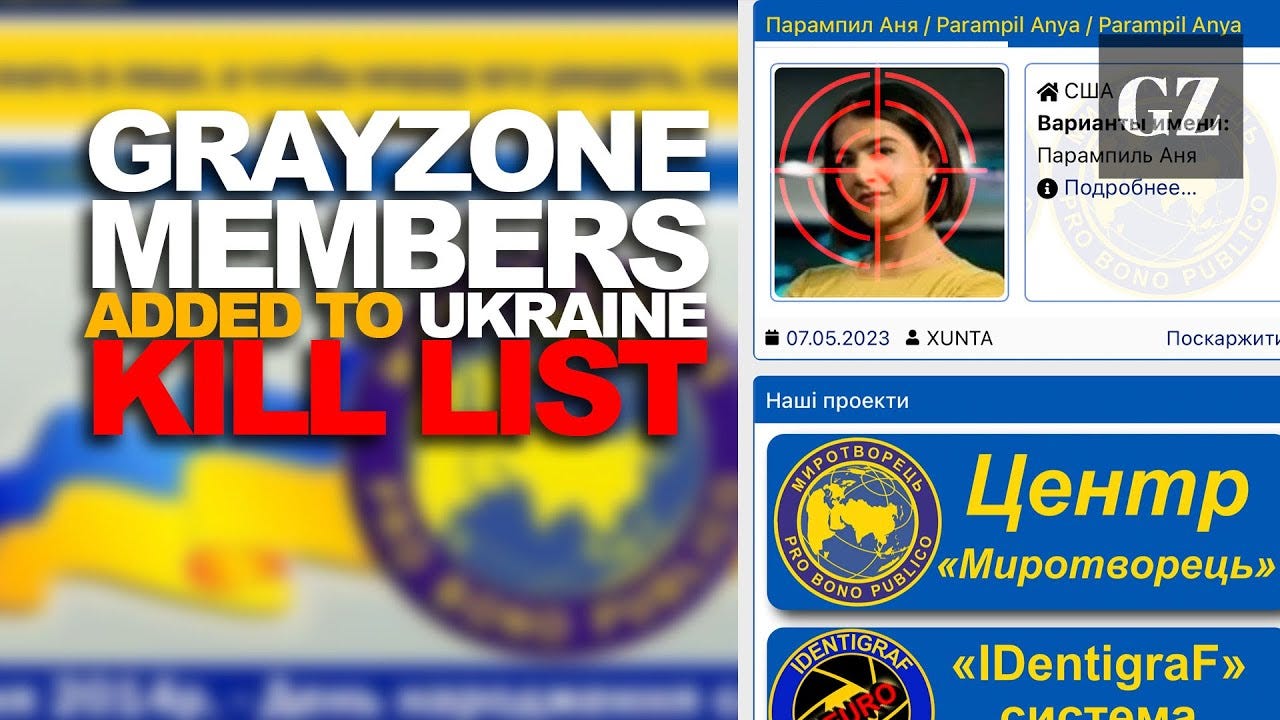
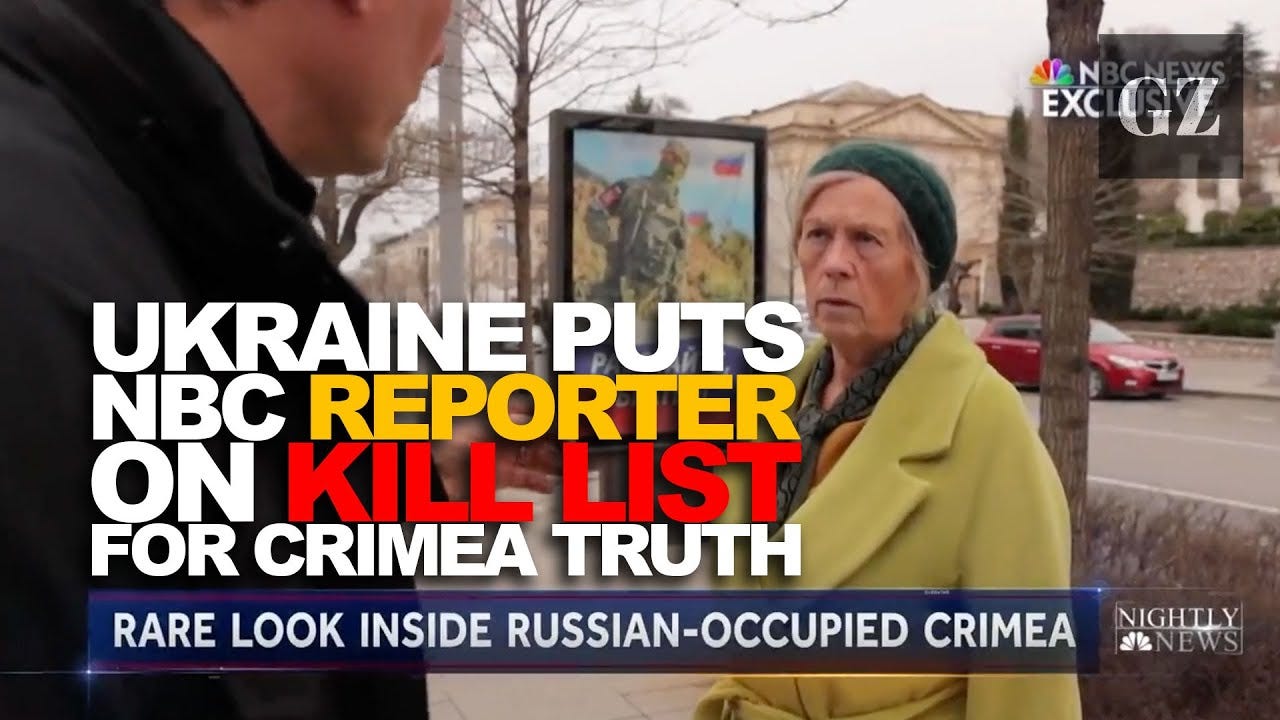
This is how ZioAzovLensky rolls, and even the corrupt CIA-controlled Wikipedia has some facts here on the murderous Jews, Zelenksy’s mother ship, historical grounding, who called themselves Zionists, but I know very few Jews who are not ZIONISTS:
A successful paramilitary campaign was carried out by Zionist underground groups against British rule in Mandatory Palestine from 1944 to 1948. The tensions between the Zionist underground and the British mandatory authorities rose from 1938 and intensified with the publication of the White Paper of 1939. The Paper outlined new government policies to place further restrictions on Jewish immigration and land purchases, and declared the intention of giving independence to Palestine, with an Arab majority, within ten years. Though World War II brought relative calm, tensions again escalated into an armed struggle towards the end of the war, when it became clear that the Axis powers were close to defeat.
The Haganah, the largest of the Jewish underground militias, which was under the control of the officially recognised Jewish leadership of Palestine, remained cooperative with the British. But in 1944 the Irgun, an offshoot of the Haganah, launched a rebellion against British rule, thus joining Lehi, which had been active against the authorities throughout the war. Both were small, dissident militias of the right-wing Revisionist movement. They attacked police and government targets in response to British immigration restrictions. They intentionally avoided military targets, to ensure that they would not hamper the British war effort against their common enemy, Nazi Germany.
The armed conflict escalated during the final phase of World War II, when the Irgun declared a revolt in February 1944, ending the hiatus in operations it had begun in 1940. Starting from the assassination of Baron Moyne by Lehi in 1944, the Haganah actively opposed the Irgun and Lehi, in a period of inter-Jewish fighting known as the Hunting Season, effectively halting the insurrection. However, in autumn 1945, following the end of World War II in both Europe (April–May 1945) and Asia (September, 1945), when it became clear that the British would not permit significant Jewish immigration and had no intention of immediately establishing a Jewish state, the Haganah began a period of co-operation with the other two underground organisations. They jointly formed the Jewish Resistance Movement.
The Haganah refrained from direct confrontation with British forces, and concentrated its efforts on attacking British immigration control, while Irgun and Lehi attacked military and police targets.[6] The Resistance Movement dissolved amidst recriminations in July 1946, following the King David Hotel bombing. The Irgun and Lehi started acting independently, while the main underground militia, Haganah, continued acting mainly in supporting Jewish immigration. The Haganah again briefly worked to suppress Irgun and Lehi operations, due to the presence of a United Nations investigative committee in Palestine. After the UN Partition Plan resolution was passed on 29 November 1947, the civil war between Palestinian Jews and Arabs eclipsed the previous tensions of both with the British. However, British and Zionist forces continued to clash throughout the period of the civil war up to the termination of the British Mandate for Palestine and the Israeli Declaration of Independence on 14 May 1948.
Within the United Kingdom there were deep divisions over Palestine policy. Dozens of British soldiers, Jewish militants, and civilians died during the campaigns of insurgency. The conflict led to heightened antisemitism in the United Kingdom. In August 1947, after the hanging of two abducted British sergeants, there was widespread anti-Jewish rioting across the United Kingdom. The conflict caused tensions in the United Kingdom–United States relations.
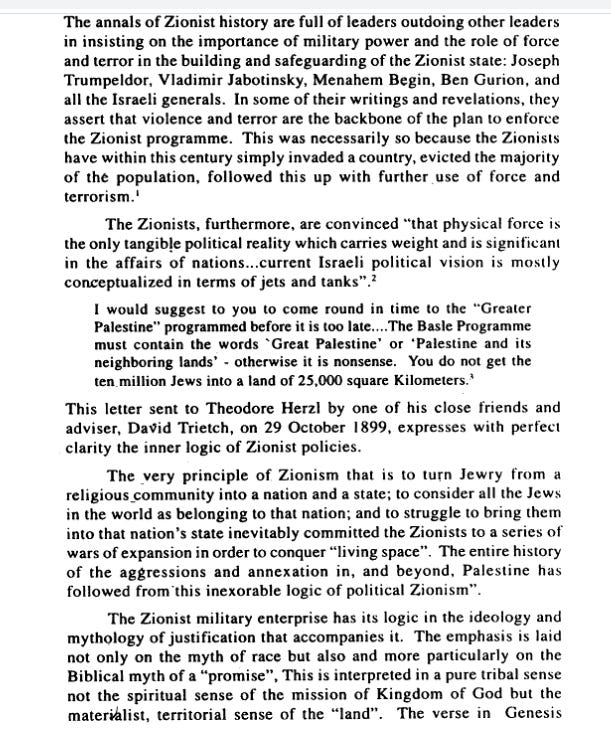
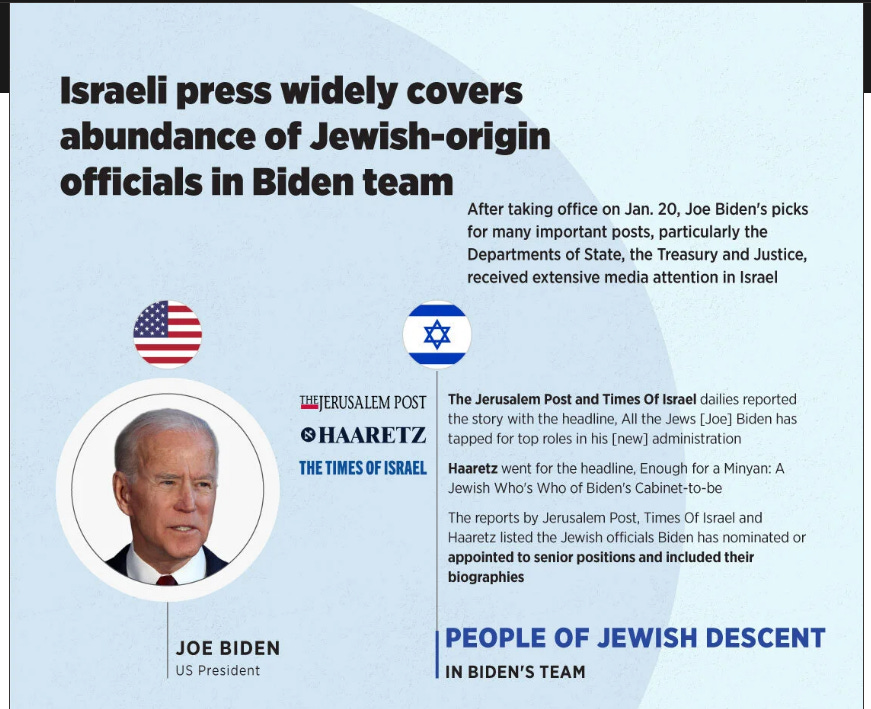
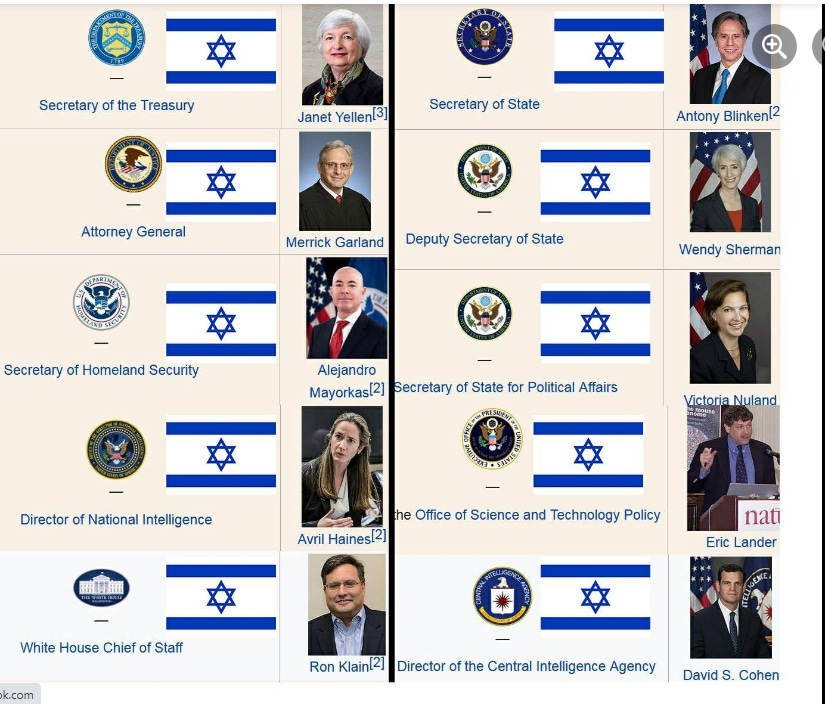
Putin and Russians and those of us who actually want Russia to have a safe border, peace, and zero NATO interference, see Zelensky and his Jewish Lords — Kagans, Nuland, Blinken, Yellen, Sherman, Garland, and hundreds of others in the Biden White House and thousands of others in the Military Industrial Expanded Complex and millions more in the world of turning a dollar on death — as the ENEMY. Murderous, conniving, hateful, slick enemies numero uno. Violence and terror, that is right up Zelensky’s alley, and this war that UK and USA and Five Eyes and EU have unleashed will not end soon. Expect those weapons that USA taxpayer footed the bill for to bring down some commercial airlines in a neighborhood near-by soon.
We are a soiled Western Culture, and we have seeded the rest of the world with our feces — high tech, low tech, money, land theft, pollution, exploitation, consumerism, throw-away mentality, sanctions, blood lust, coups, supporting depots, money laundering and gold theft and assets removal. Loans from Hell, and alas, here we are, in a putrid world, two days before the big Monday Holiday, Memorial Day, and we straddle syphilitic monsters running the world and our own populous generally marked for death, marked as marks, by the billionaires, the fleecers and those Zionists and Israel-Firsters who have sold us down the Ukrainian toilet.
But leave it to the Paranoid Former Nazis and the disgusting ADL and AIPAC and Mossad loving Israelis to attack us all attacking them:
Pink Floyd’s Roger Waters says Berlin gig controversy a ‘smear’
“The depiction of an unhinged fascist demagogue has been a feature of my shows since Pink Floyd’s ‘The Wall’ in 1980,” Roger Waters said.
“I have spent my entire life speaking out against authoritarianism and oppression where I set it… My parents fought the Nazis in World War II, with my father paying the ultimate price,” he said.
“Regardless of the consequences of the attacks against me, I will continue to condemn injustice and all those who perpetrate it.”
Waters is a well-known pro-Palestinian activist who has been accused of holding anti-Jewish views. He has floated an inflatable pig emblazoned with the Star of David at his concerts. The singer denies the anti-Semitism accusations, saying he was protesting against Israeli policies, not Jewish people.
Ah, those old days, which now would be both considered hate speech and also ground down by the ugly media and the uglier mainstream fools in college, in towns, every where.
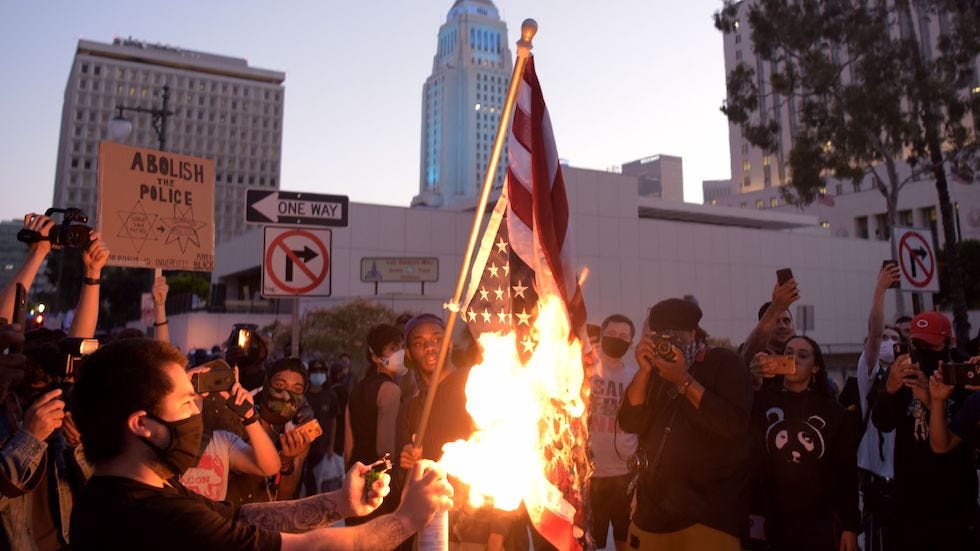
Yep, it is a piece of shit piece of cloth representing so so much death, murder, hate, and racism:
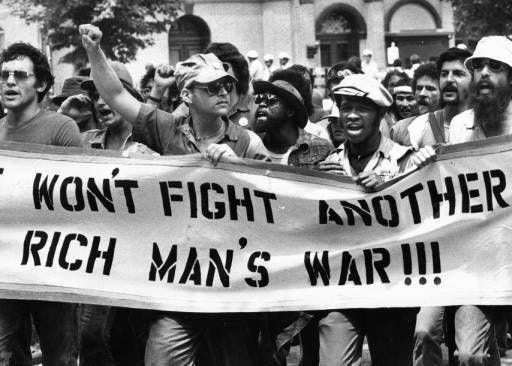
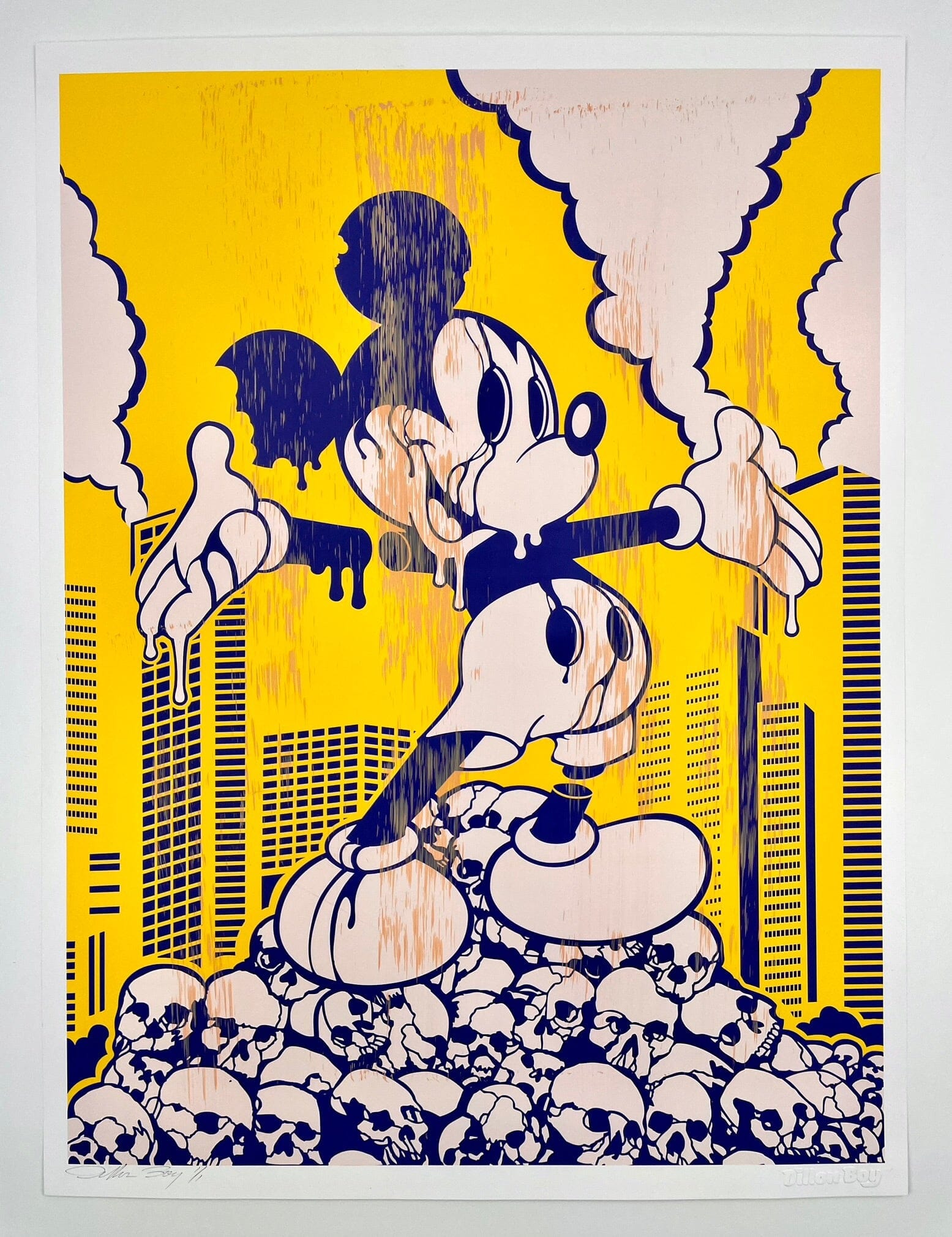
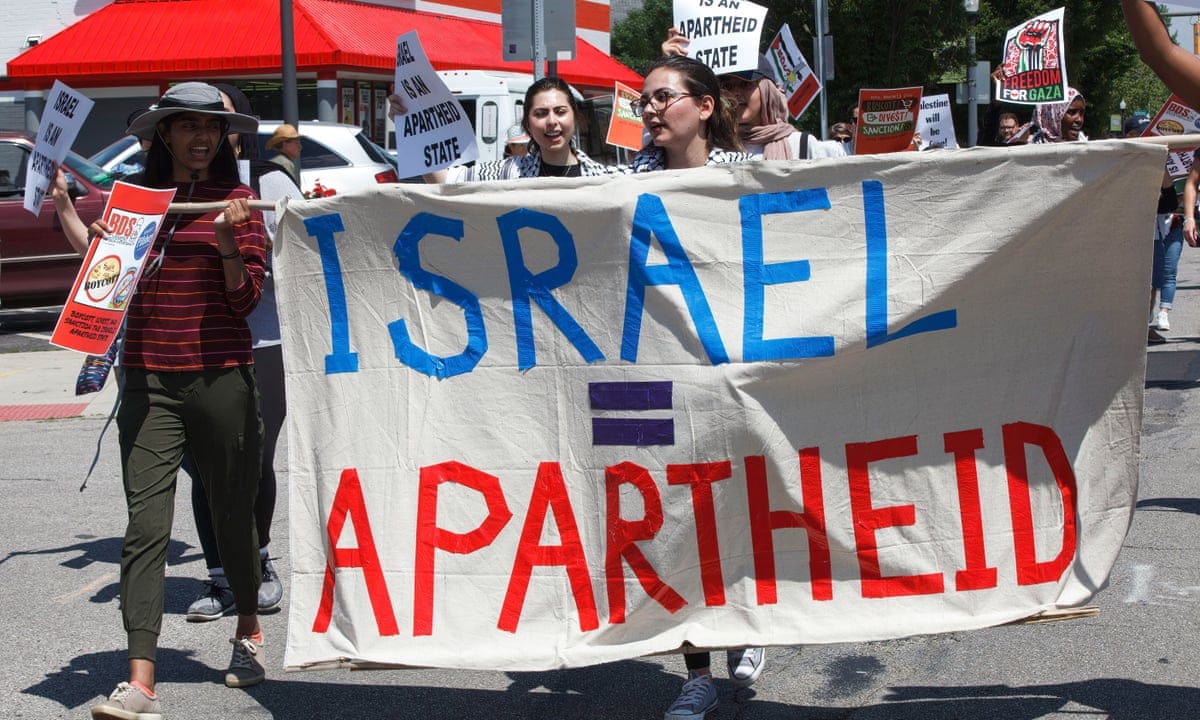
And, well, and, who writes the narrative of Ukraine, of Zelensky, of the Jewish Apartheid State supporting the Nazis under Zelensky?
Will one vapid bought and brainwashed media person get on with knowledge:
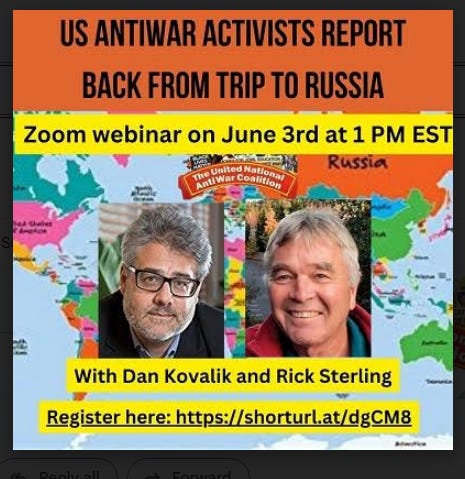
Here, over at Dissident Voice:
Journey to St. Petersburg, Moscow, and Crimea
by Dan Kovalik and Rick Sterling / May 25th, 2023
At the end of April of this year, the two of us ventured together to Russia. We went with the purpose of fact-finding and also to make a point that we do not believe that Russia should be isolated from the world through sanctions and travel bans.
At this moment, Russia is more isolated from the West than it has ever been, quite possibly in history. As just one example, while V.I. Lenin was able to famously travel from Finland via train to St. Petersburg, even during the height of WWI, the train from Finland to Russia ceased operating after February 24 of 2022. And indeed, it was through Finland that we decided to travel to Russia, simply because there are now very limited ways to travel there. Thus, while for years, even during the Cold War, one could easily fly directly from the US to Russia on Aeroflot and other airlines, that is no longer possible due to sanctions. Now, one can only fly there through Serbia, Turkey or the UAE, but those flights are quite expensive.
And so, we ended up choosing to fly to Helsinki, Finland and have a Russian friend who has a non-Russian passport (Russians with only Russian passports cannot travel to Finland) drive from St. Petersburg to pick us up. This turned out to be more easily said than done as our friend’s car broke down at the Finnish/Russian border. And so, we took a very expensive, three-hour cab ride to the border, met up with our friend and crammed ourselves into the cab of a tow truck to drive the remaining three hours to St. Petersburg – a quite inauspicious beginning to our journey.
[Saint Petersburg streets are busy from early morning til late at night. This photo taken at 11:30pm]
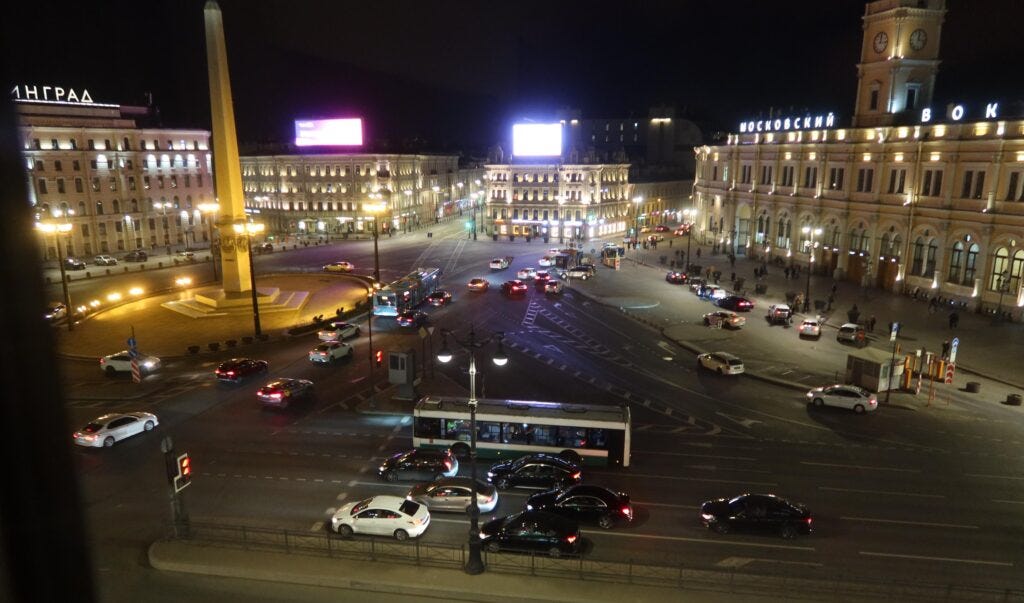
St. Petersburg (Leningrad)
Our first several days were spent in St. Petersburg, formerly “Leningrad.” We stayed strategically at the Best Western in Uprising Square – so named by the new Bolshevik government in 1918 to commemorate the Great October Revolution of 1917. In the Square is located the Moscow train station which we used to great effect during our journey, as well as the Leningrad Hero-City Obelisk. The Obelisk commemorates Leningrad’s designation as one of 13 “hero cities” in the Soviet Union which distinguished themselves for their exceptional sacrifices in resisting the Nazis during WWII. Two other cities we visited on our trip (Moscow and Sevastopol, Crimea) are also honored with this designation, as is Kiev, Ukraine and of course Volgograd (formerly “Stalingrad”).
During our stay, the city of St. Petersburg sure seemed more like Leningrad, for it was beginning to be decked out in red flags with hammers and sickles and stars to commemorate both May Day and Victory Day over the Nazis on May 9. We were told by long-time residents that the ubiquitous display of such symbols of the USSR was something new (at least since the collapse of the Soviet Union in 1991), and was spurred on by Russia’s Special Military Operations beginning in February of 2022. It appears that the Russian people, and the Russian government as well, are looking to the legacy of the Soviet Union as a source of strength, pride and unity during this time of war – a war that they view, we believe quite rightly, was forced on them.
The newly released Russian Federation “concept” on foreign policy states quite explicitly that Russia’s current foreign policy is informed by the two main objectives and successes of the USSR – the defeat of Nazism and global decolonization. Certainly, on paper at least, this belies the claim of some Western leftists that Russia is motivated in its relations with other nations by imperialist concerns.
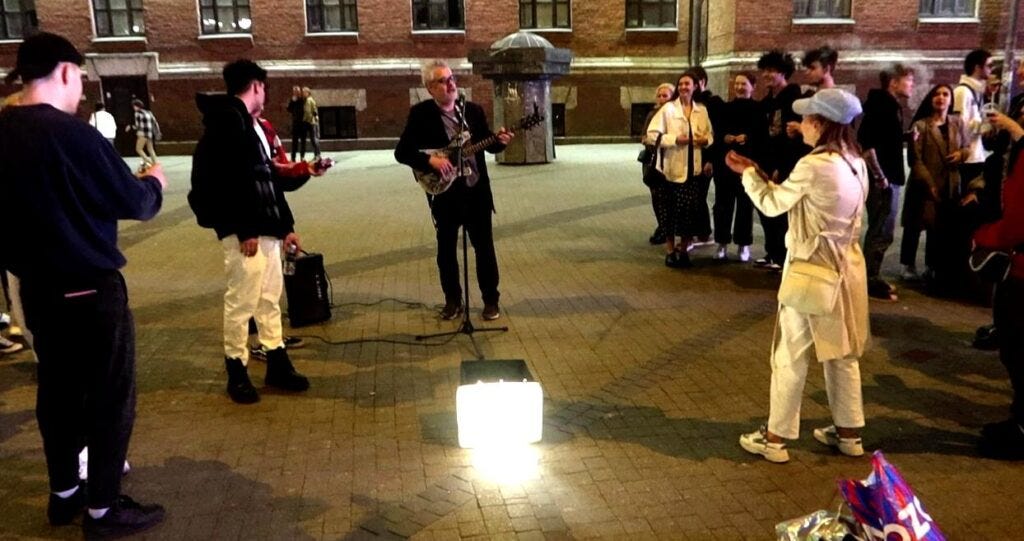
[Dan takes his turn playing guitar on St Petersburg street at 11 pm]
While in St. Petersburg, we visited the site of the terrorist attack which claimed the life of Russian journalist Vladlen Tatarsky and wounded over 30 others, at least 10 gravely. The attack involved the bombing of a cafe in the picturesque University district of St. Petersburg along the Neva – a soft target if there ever was one. The cafe remains closed, and three sets of memorials for Tatarsky are set up around it, consisting of flowers and photos. Of course, the Western press has tried to do everything it can to justify this vicious attack upon civilians, writing off Tatarsky as “pro-Kremlin” and “pro-war” (as if the Western press can’t be fairly characterized as “pro-war” and “pro-Pentagon”) and simply glossing over the numerous other civilians wounded in the assault as collateral damage.
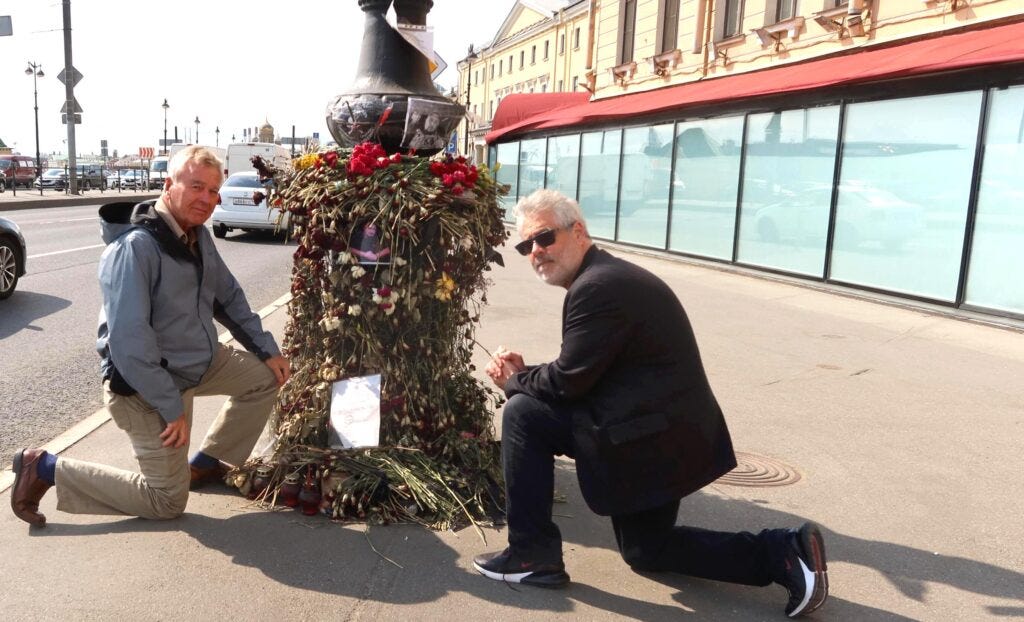
[Rick and Dan at the site where Russian journalist was killed]
Moscow
As planned, we left St. Petersburg by train to Moscow after several days. We took the faster “Sapsan” (Falcon) train to Leningrad Station in Moscow (it is still called that). The train ride, reaching 120 mph, was smooth and comfortable. We sat across from two Russian women, one of whom was quite friendly. She told us of her son who lives in Boston and who, quite sadly for her, she hasn’t seen in years. She kept sliding over hard candy to share with us. And, when she saw Dan nervously biting his nails, she kindly handed him her nail filer for him to use. This type of sharing on the train is quite common in Russia as we would continue to discover on our journey.
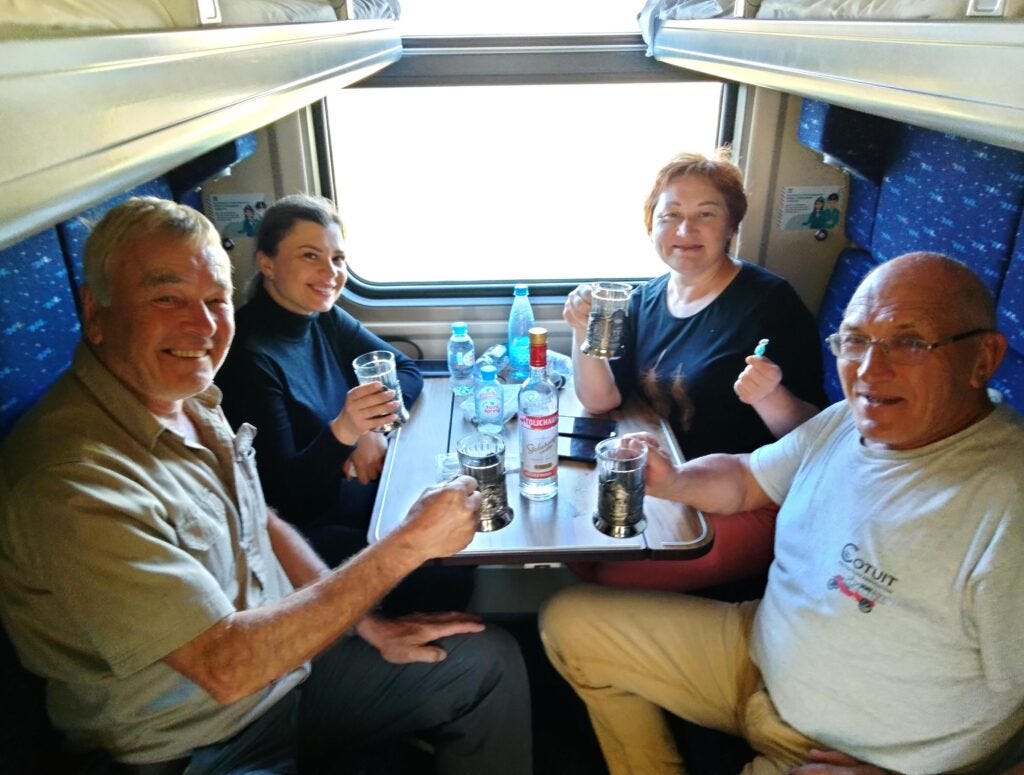
[Rick with train compartment companions.]
Moscow too was being decorated for the May 9 Victory Day celebration. Red Square was sealed off from the public to prepare for the event, and the city was on high alert for possible terrorist attacks, one of which would come while we were in Russia with the drone attack upon the Kremlin itself. Despite the fears of attack, Muscovites were out on the streets day and night. Both Moscow and St. Petersburg were incredibly vibrant – much more so than our cities back home which are still feeling the effects of the lockdowns during the pandemic. Gorky Park was particularly lively with throngs of families with children enjoying the spring weather, swings and slides. Colorful tulips were in full bloom.
From appearances, Russia largely did not appear to be a country at war. However, everyone we talked to confided in us about their concerns for the war – for the loss of life on both sides, the fact that it was lasting much longer than people had expected, and the danger that the war could expand into a greater conflagration. Some Russians expressed their fear that nuclear weapons would end up being used before this was all over, though they believed that the US would be the first to launch them. At the same time, the Russians showed their usual stoicism in the face of such dangers, with one family with whom Dan had dinner stating almost matter-of-factly that “Russia has always had difficult times, and it will have them again.”
After several days in Moscow, and our hopes for visiting the Donbass falling through, we took the long, 27-hour train ride to Crimea – a region now fully in the crosshairs of the proxy war.
Arriving in Crimea
Ukrainian President Zelensky says he will “take back” Crimea. US leaders Victoria Nuland and Jake Sullivan say they support him. Indeed, Sullivan recently suggested Ukraine is free to use the F-16 fighter jets in attempting to “recapture” Crimea.” We traveled to Crimea to see the situation and learn details of how and why Crimea seceded from Ukraine in 2014.
A highlight of the train ride was passing over the new 12-mile long Kerch Strait bridge which connects mainland Russia to the Crimean peninsula. As our train approached the bridge, we could see that saboteurs had been active. There was a fuel tank on fire in the near distance. A couple passengers did not want us to photograph this, probably thinking it gives publicity to the enemy.
As we departed the train in Crimea at the beautiful station in the Capitol city, Simferopol, the loudspeakers on the platform greeted us with traditional Russian songs.
We then drove the roughly two hours to Yalta where we stayed while in Crimea. Along our drive, we saw the giant mosque which the Russian government is building along the highway in an area where Tatars, who generally practice the Islamic faith, protested to have land to live and worship. The Tatars had been persecuted during WWII as suspected collaborators and forcibly removed from Crimea to other Soviet Republics.
A number of Tatars have moved back to Crimea over the years and now make up about 12 percent of the population of Crimea. Meanwhile, about 65 percent of the Crimean population is ethnic Russian and about 15 percent is Ukrainian, though about 82 percent of the population overall speaks Russian on a daily basis.
As we were told while in Crimea, one of the first things President Putin did after Crimea returned to Russia in 2014 was to try to make good relations with the Tatar community by “rehabilitating” them from the claims of collaboration made by Stalin government, giving them the land they protested for, providing them with modest monetary reparations and building them the new Mosque.
Historical Background
All in all, we spent five days seeing the sights and meeting people in the capital Simferopol, Sevastopopol and Yalta. We were guided by translator and native Crimean Tanya. In the past, Tanya worked for US Aid for International Development (USAID), teaching Russian to US Peace Corps volunteers.
Crimea has a rich agricultural sector. It was severely hampered after Ukraine dammed the canal bringing fresh water from the Dnieper River. After Russian forces intervened, they removed the dam and agriculture is once again thriving. Crimean cities are busy with the streets and sidewalks full. In the parks, there are teens skate boarding and seniors playing chess.
The situation in Crimea is emblematic of the Ukraine crisis overall. In both Crimea and the Donbass (eastern Ukraine), the majority of people are ethnically Russian, their native language is Russian and they voted overwhelmingly for the elected but overthrown President Yanukovich.
From the 15th century Crimea was part of the Ottoman Empire. It became part of the Russian Empire in 1783 after the army of Catherine the Great defeated the Turks.
In 1921, Crimea became the Crimean Autonomous Soviet Socialist Republic as part of the Russian Soviet Socialist Republic.
In 1954, Soviet Premier Khrushchev designated Crimea to be part of the Ukraine republic. This was done without consulting the Crimean people but it was not a major change since they were all part of one country, the Soviet Union. As we were told in Crimea, “Nobody could imagine the Soviet Union breaking up.”
As the Soviet Union was breaking up, Crimeans held a referendum in January of 1991. They voted overwhelmingly (94% in favor) to become the “Autonomous Republic of Crimea” and to separate from Ukraine. There was contention with Kiev and ultimately it was agreed that Crimea would be autonomous but within Ukraine. There was desire but not the urgency to secede from Ukraine at this point.
The desire to separate from Ukraine became more urgent in late 2013 and early 2014 as Crimeans watched with alarm as Russophobic ultra-nationalist and neo-nazi groups increasingly dominated violent protests in Kiev’s Maidan plaza. The book To Go One’s Own Way documents how the Crimean parliament and presidency issued statements, pleas and warnings about the threat to Ukrainian unity beginning in November 2013.
As we discuss in an upcoming article, the government of Ukraine reacted to the Crimean referendum to reunite with Russia quite punitively, and it continues to punish the Crimeans for their decision. At the same time, Russia has actively invested in the peninsula and made major improvements in the overall infrastructure there. In light of the foregoing, it is safe to say there are relatively few Crimeans who ever wish to return to Ukraine.
The End — Source!
 Paul Haeder, Author